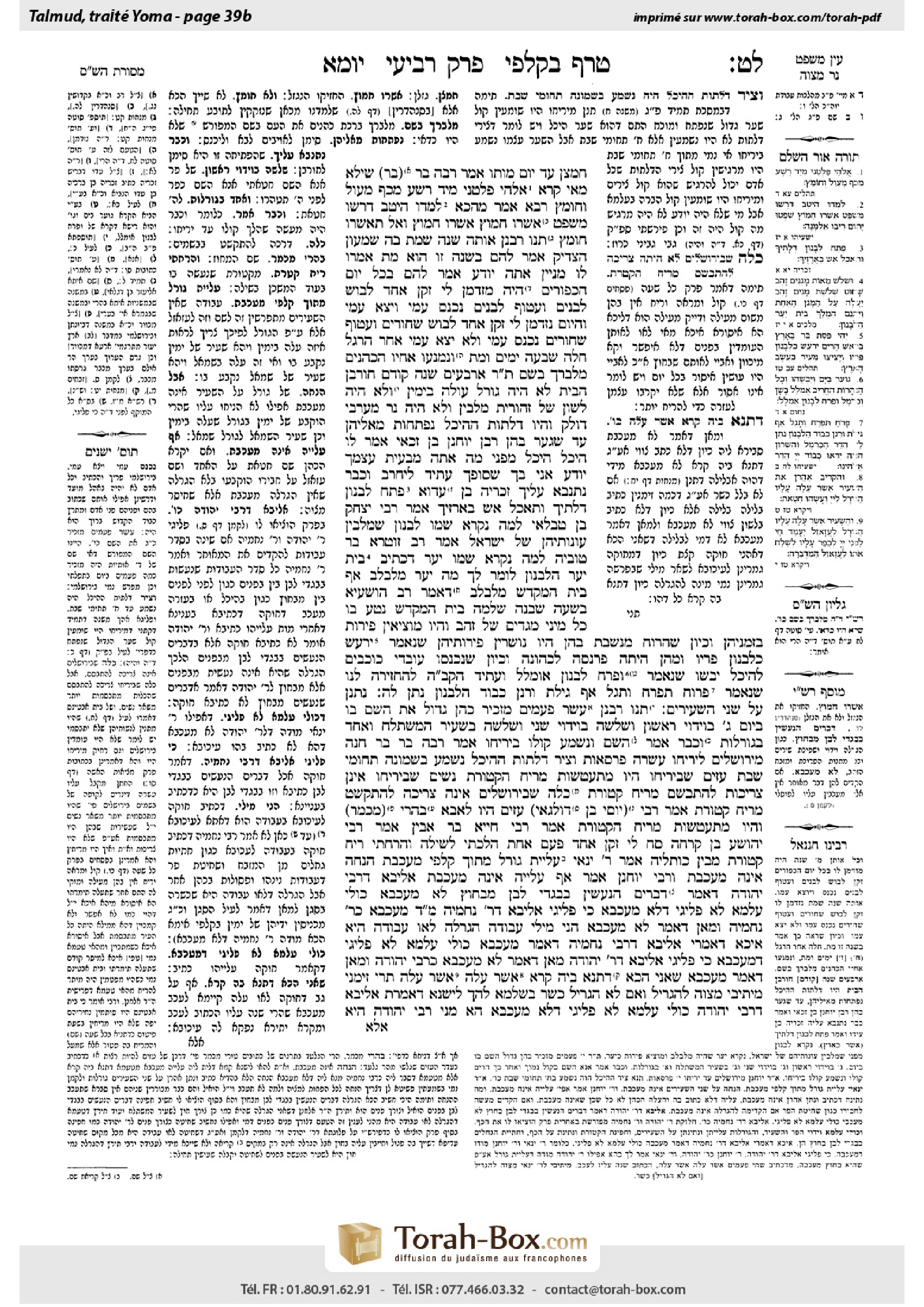
Yoma 39b: Talmud study for Daf Yomi
Daf Yomi is the daily study of one Talmud folio. Explore 37 tractates with scans, Hebrew text, Sefaria English and AI-generated French translations where annotated.
Passage selection and English or AI-generated French translation are available where the scan has annotations. Daf Study is independent of Torah-Box and Sefaria.
Browse Yoma · יומא · All tractatesYoma 39b text and translations
This page of Yoma includes the Aramaic text, an English translation and an AI-generated French translation, alongside the scan above.
יומא ל״ט ב · Aramaic and Hebrew text
חַמְצָן״ עַד יוֹם מוֹתוֹ.
אָמַר רַבָּה בַּר (בַּר) שֵׁילָא, מַאי קְרָא: ״אֱלֹהַי פַּלְּטֵנִי מִיַּד רָשָׁע מִכַּף מְעַוֵּל וְחוֹמֵץ״. רָבָא אָמַר, מֵהָכָא: ״לִמְדוּ הֵיטֵב דִּרְשׁוּ מִשְׁפָּט אַשְּׁרוּ חָמוֹץ״. אׇשְׁרוֹ חָמוֹץ — וְאַל תַּאַשְׁרוּ חוֹמֵץ.
תָּנוּ רַבָּנַן: אוֹתָהּ שָׁנָה שֶׁמֵּת בָּהּ שִׁמְעוֹן הַצַּדִּיק, אָמַר לָהֶם: בְּשָׁנָה זוֹ הוּא מֵת. אָמְרוּ לוֹ: מִנַּיִין אַתָּה יוֹדֵעַ? אָמַר לָהֶם: בְּכׇל יוֹם הַכִּפּוּרִים הָיָה מִזְדַּמֵּן לִי זָקֵן אֶחָד לָבוּשׁ לְבָנִים וְעָטוּף לְבָנִים, נִכְנַס עִמִּי וְיָצָא עִמִּי, וְהַיּוֹם נִזְדַּמֵּן לִי זָקֵן אֶחָד לָבוּשׁ שְׁחוֹרִים וְעָטוּף שְׁחוֹרִים, נִכְנַס עִמִּי וְלֹא יָצָא עִמִּי. אַחַר הָרֶגֶל חָלָה שִׁבְעָה יָמִים וָמֵת.
וְנִמְנְעוּ אֶחָיו הַכֹּהֲנִים מִלְּבָרֵךְ בַּשֵּׁם.
תָּנוּ רַבָּנַן: אַרְבָּעִים שָׁנָה קוֹדֶם חוּרְבַּן הַבַּיִת לֹא הָיָה גּוֹרָל עוֹלֶה בְּיָמִין, וְלֹא הָיָה לָשׁוֹן שֶׁל זְהוֹרִית מַלְבִּין, וְלֹא הָיָה נֵר מַעֲרָבִי דּוֹלֵק.
וְהָיוּ דַּלְתוֹת הַהֵיכָל נִפְתְּחוֹת מֵאֲלֵיהֶן, עַד שֶׁגָּעַר בָּהֶן רַבָּן יוֹחָנָן בֶּן זַכַּאי. אָמַר לוֹ: הֵיכָל הֵיכָל! מִפְּנֵי מָה אַתָּה מַבְעִית עַצְמְךָ? יוֹדֵעַ אֲנִי בְּךָ שֶׁסּוֹפְךָ עָתִיד לֵיחָרֵב, וּכְבָר נִתְנַבֵּא עָלֶיךָ זְכַרְיָה בֶּן עִדּוֹא: ״פְּתַח לְבָנוֹן דְּלָתֶיךָ וְתֹאכַל אֵשׁ בַּאֲרָזֶיךָ״,
אָמַר רַבִּי יִצְחָק בֶּן טַבְלַאי: לָמָּה נִקְרָא שְׁמוֹ לְבָנוֹן — שֶׁמַּלְבִּין עֲוֹנוֹתֵיהֶן שֶׁל יִשְׂרָאֵל.
אָמַר רַב זוּטְרָא בַּר טוֹבִיָּה: לָמָּה נִקְרָא שְׁמוֹ יַעַר, דִּכְתִיב: ״בֵּית יַעַר הַלְּבָנוֹן״, לוֹמַר לָךְ: מָה יַעַר מְלַבְלֵב — אַף בֵּית הַמִּקְדָּשׁ מְלַבְלֵב. דְּאָמַר רַב הוֹשַׁעְיָא: בְּשָׁעָה שֶׁבָּנָה שְׁלֹמֹה בֵּית הַמִּקְדָּשׁ, נָטַע בּוֹ כׇּל מִינֵי מְגָדִים שֶׁל זָהָב, וְהָיוּ מוֹצִיאִין פֵּירוֹת בִּזְמַנֵּיהֶן. וְכֵיוָן שֶׁהָרוּחַ מְנַשֶּׁבֶת בָּהֶן הָיוּ נוֹשְׁרִין פֵּירוֹתֵיהֶן, שֶׁנֶּאֱמַר: ״יִרְעַשׁ כַּלְּבָנוֹן פִּרְיוֹ״, וּמֵהֶן הָיְתָה פַּרְנָסָה לַכְּהוּנָּה.
וְכֵיוָן שֶׁנִּכְנְסוּ גּוֹיִם לַהֵיכָל יָבְשׁוּ, שֶׁנֶּאֱמַר: ״וּפֶרַח לְבָנוֹן אוּמְלָל״. וְעָתִיד הַקָּדוֹשׁ בָּרוּךְ הוּא לְהַחְזִירָהּ לָנוּ, שֶׁנֶּאֱמַר: ״פָּרוֹחַ תִּפְרַח וְתָגֵל אַף גִּילַת וְרַנֵּן כְּבוֹד הַלְּבָנוֹן נִתַּן לָהּ״.
נְתָנָן עַל שְׁנֵי הַשְּׂעִירִים. תָּנוּ רַבָּנַן: עֶשֶׂר פְּעָמִים מַזְכִּיר כֹּהֵן גָּדוֹל אֶת הַשֵּׁם בּוֹ בַּיּוֹם: שְׁלֹשָׁה בְּוִידּוּי רִאשׁוֹן, וּשְׁלֹשָׁה בְּוִידּוּי שֵׁנִי, וּשְׁלֹשָׁה בְּשָׂעִיר הַמִּשְׁתַּלֵּחַ, וְאֶחָד בַּגּוֹרָלוֹת.
וּכְבָר אָמַר ״הַשֵּׁם״, וְנִשְׁמַע קוֹלוֹ בִּירִיחוֹ. אָמַר רַבָּה בַּר בַּר חָנָה: מִירוּשָׁלַיִם לִירִיחוֹ עֲשָׂרָה פַּרְסָאוֹת.
וָצִיר דַּלְתוֹת הַהֵיכָל נִשְׁמַע בִּשְׁמוֹנָה תְּחוּמֵי שַׁבָּת. עִזִּים שֶׁבִּירִיחוֹ הָיוּ מִתְעַטְּשׁוֹת מֵרֵיחַ הַקְּטוֹרֶת. נָשִׁים שֶׁבִּירִיחוֹ אֵינָן צְרִיכוֹת לְהִתְבַּשֵּׂם מֵרֵיחַ קְטוֹרֶת. כַּלָּה שֶׁבִּירוּשָׁלַיִם אֵינָהּ צְרִיכָה לְהִתְקַשֵּׁט מֵרֵיחַ קְטוֹרֶת.
אָמַר רַבִּי (יוֹסֵי בֶּן) דּוּלְגַאי: עִזִּים הָיוּ לְאַבָּא בְּהָרֵי (מִכְמָר), וְהָיוּ מִתְעַטְּשׁוֹת מֵרֵיחַ הַקְּטוֹרֶת. אָמַר רַבִּי חִיָּיא בַּר אָבִין אָמַר רַבִּי יְהוֹשֻׁעַ בֶּן קׇרְחָה: סָח לִי זָקֵן אֶחָד, פַּעַם אַחַת הָלַכְתִּי לְשִׁילֹה, וְהֵרַחְתִּי רֵיחַ קְטוֹרֶת מִבֵּין כְּותָלֶיהָ.
אָמַר רַבִּי יַנַּאי: עֲלִיַּית גּוֹרָל מִתּוֹךְ קַלְפִּי — מְעַכֶּבֶת, הַנָּחָה — אֵינָהּ מְעַכֶּבֶת. וְרַבִּי יוֹחָנָן אָמַר: אַף עֲלִיָּיה אֵינָהּ מְעַכֶּבֶת.
אַלִּיבָּא דְּרַבִּי יְהוּדָה, דְּאָמַר: דְּבָרִים הַנַּעֲשִׂין בְּבִגְדֵי לָבָן מִבַּחוּץ לָא מְעַכְּבָא — כּוּלֵּי עָלְמָא לָא פְּלִיגִי דְּלָא מְעַכְּבָא. כִּי פְּלִיגִי אַלִּיבָּא דְּרַבִּי נְחֶמְיָה, מַאן דְּאָמַר מְעַכְּבָא — כְּרַבִּי נְחֶמְיָה. וּמַאן דְּאָמַר לָא מְעַכְּבָא — הָנֵי מִילֵּי עֲבוֹדָה, הַגְרָלָה לָאו עֲבוֹדָה הִיא.
אִיכָּא דְּאָמְרִי,
אַלִּיבָּא דְּרַבִּי נְחֶמְיָה דְּאָמַר מְעַכְּבָא — כּוּלֵּי עָלְמָא לָא פְּלִיגִי דִּמְעַכְּבָא,
כִּי פְּלִיגִי אַלִּיבָּא דְּרַבִּי יְהוּדָה. מַאן דְּאָמַר לָא מְעַכְּבָא — כְּרַבִּי יְהוּדָה, וּמַאן דְּאָמַר מְעַכְּבָא — שָׁאנֵי הָכָא דִּתְנָא בֵּיהּ קְרָא: ״אֲשֶׁר עָלָה״, ״אֲשֶׁר עָלָה״, תְּרֵי זִימְנֵי.
מֵיתִיבִי: מִצְוָה לְהַגְרִיל, וְאִם לֹא הִגְרִיל כָּשֵׁר.
בִּשְׁלָמָא לְהָךְ לִישָּׁנָא דְּאָמְרַתְּ אַלִּיבָּא דְּרַבִּי יְהוּדָה כּוּלֵּי עָלְמָא לָא פְּלִיגִי דְּלָא מְעַכְּבָא, הָא מַנִּי — רַבִּי יְהוּדָה הִיא.
Yoma 39b · English translation
a robber [ḥamtzan] until the day of his death.
Rabba bar bar Sheila said: What is the verse that indicates that a ḥamtzan is a robber? The verse states: “O, my God, rescue me out of the hand of wicked, out of the hand of the unrighteous and robbing man [ḥometz]” (Psalms 71:4). Rava said: From here: “Learn to do well, seek justice, strengthen the robbed [ḥamotz]” (Isaiah 1:17), which teaches that one should strengthen the robbed, but not strengthen the robber.
§ The Sages taught: During the year in which Shimon HaTzaddik died, he said to them, his associates: In this year, he will die, euphemistically referring to himself. They said to him: How do you know? He said to them: In previous years, on every Yom Kippur, upon entering the Holy of Holies, I was met, in a prophetic vision, by an old man who was dressed in white, and his head was wrapped up in white, and he would enter the Holy of Holies with me, and he would leave with me. But today, I was met by an old man who was dressed in black, and his head was wrapped up in black, and he entered the Holy of Holies with me, but he did not leave with me. He understood this to be a sign that his death was impending. Indeed, after the festival of Sukkot, he was ill for seven days and died.
Without the presence of Shimon HaTzaddik among them, the Jewish people were no longer worthy of the many miracles that had occurred during his lifetime. For this reason, following his death, his brethren, the priests, refrained from blessing the Jewish people with the explicit name of God in the priestly blessing.
The Sages taught: During the tenure of Shimon HaTzaddik, the lot for God always arose in the High Priest’s right hand; after his death, it occurred only occasionally; but during the forty years prior to the destruction of the Second Temple, the lot for God did not arise in the High Priest’s right hand at all. So too, the strip of crimson wool that was tied to the head of the goat that was sent to Azazel did not turn white, and the westernmost lamp of the candelabrum did not burn continually.
And the doors of the Sanctuary opened by themselves as a sign that they would soon be opened by enemies, until Rabban Yoḥanan ben Zakkai scolded them. He said to the Sanctuary: Sanctuary, Sanctuary, why do you frighten yourself with these signs? I know about you that you will ultimately be destroyed, and Zechariah, son of Ido, has already prophesied concerning you: “Open your doors, O Lebanon, that the fire may devour your cedars” (Zechariah 11:1), Lebanon being an appellation for the Temple.
Rabbi Yitzḥak ben Tavlai said: Why is the Temple called Lebanon [Levanon]? Because it whitens [malbin] the Jewish people’s sins, alluded to by the root lavan, meaning white.
Rav Zutra bar Toviya said: Why is the Temple called: Forest, as it is written: “The house of the forest of Lebanon” (I Kings 10:17)? To tell you: Just as a forest blooms, so too the Temple blooms. As Rav Hoshaya said: When Solomon built the Temple, he planted in it all kinds of sweet fruit trees made of gold, and miraculously these brought forth fruit in their season. And when the wind blew upon them, their fruit would fall off, as it is stated: “May his fruits rustle like Lebanon” (Psalms 72:16). And through selling these golden fruits to the public, there was a source of income for the priesthood.
But once the gentile nations entered the Sanctuary the golden trees withered, as it states “And the blossoms of Lebanon wither” (Nahum 1:4). And in the future hour of redemption, the Holy One, Blessed be He, will restore them to us as it is stated: “It shall blossom abundantly, it shall also rejoice and shout, the glory of Lebanon will be given to it” (Isaiah 35:2).
§ The mishna states that after selecting the two lots, the High Priest places them upon the two goats. Upon placing the lot for God upon the appropriate goat, he says: For God, as a sin-offering. This is just one of the occasions on which he mentions God’s name, as the Sages taught in the Tosefta (Yoma 2:2): The High Priest mentions the name of God ten times on that day: Three times during the first confession; and three times during the second confession, over the bull; and three times when he confesses over the scapegoat to Azazel; and one time with the lots, when placing the lot for God upon the goat.
And there already was an incident when the High Priest said the name of God and his voice was so strong that it was heard even in Jericho. Rabba bar bar Ḥana said: The distance from Jerusalem to Jericho is ten parasangs. Despite the great distance, his voice was miraculously heard there.
The Gemara describes similar miracles in which events in the Temple were sensed a great distance away. And the sound of the doors of the Sanctuary opening was heard from a distance of eight Shabbat limits, which is eight mil. Furthermore, goats that were in Jericho would sneeze from smelling the fragrance of the incense that burned in the Temple; the women that were in Jericho did not need to perfume themselves, since they were perfumed by the fragrance of the incense, which reached there; a bride that was in Jerusalem did not need to adorn herself with perfumes, since she was perfumed by the fragrance of the incense, which filled the air of Jerusalem.
Rabbi Yosei ben Dolgai said: Father had goats in the hills of Mikhmar, a district some distance from Jerusalem, and they would sneeze from smelling the fragrance of the incense. Similarly, Rabbi Ḥiyya bar Avin said that Rabbi Yehoshua ben Korḥa said: An old man reported to me: One time I went to the ruins of the Tabernacle in Shiloh, and I smelled the smell of the incense from between its walls. The Tabernacle stood there during the period of the Judges, and more than a thousand years had passed since its destruction.
§ Rabbi Yannai said: The drawing of the lot from inside the receptacle is an indispensable part of the service, as it determines which goat will be for God and which for Azazel. However, the actual placing of the lots upon the goats is not indispensable. And Rabbi Yoḥanan said: Even the drawing of the lots from inside the receptacle is not indispensable, since the High Priest may designate the goats himself, without employing the lottery.
The Gemara explains the dispute: In accordance with the opinion of Rabbi Yehuda, who said that matters that are performed in the white garments outside of the Holy of Holies are not indispensable, everyone agrees that the drawing of the lots is not indispensable, since it is held outside the Holy of Holies. When they disagree, it is in accordance with the opinion of Rabbi Neḥemya. He holds that all matters performed in the white garments, even those performed outside the Holy of Holies, are indispensable. The one who said the drawing of the lots is indispensable holds in accordance with the straightforward application of the principle of Rabbi Neḥemya. And the one who said the drawing of the lots is not indispensable claims that this principle applies only with regard to matters that are classified as a Temple service. The drawing of the lots is not a Temple service, therefore it is indispensable, even according to Rabbi Neḥemya’s principle.
Some say a different version of the dispute:
In accordance with the opinion of Rabbi Neḥemya, who said that all matters performed in the white garments, even those performed outside the Holy of Holies, are indispensable, everyone agrees that the drawing of the lots is indispensable.
When they disagree, it is in accordance with the opinion of Rabbi Yehuda, who holds that matters that are performed in the white garments outside of the Holy of Holies are not indispensable. The one who said that the drawing of the lots is not indispensable holds in accordance with the straightforward application of the principle of Rabbi Yehuda. And the one who said that the drawing of the lots is indispensable claims that although Rabbi Yehuda’s principle is generally true, it is different here, in the case of the lottery, because the verse repeated the phrase “which came up” (Leviticus 16:9) “which came up” (Leviticus 16:10) two times. In the laws of sacrifices, a repeated phrase indicates the matter is indispensable.
The Gemara raises an objection from that which was taught in a baraita: It is a mitzva to draw the lots, and if the High Priest did not draw the lots but instead designated the goats without using the lots, the designation is valid.
The Gemara considers the opinion presented in the baraita: Granted, according to that first version of the dispute, in which you said: In accordance with the opinion of Rabbi Yehuda everyone, i.e., Rabbi Yannai and Rabbi Yoḥanan, agrees that the drawing of the lots is not indispensable, in accordance with whose opinion is this baraita taught? It is in accordance with the opinion of Rabbi Yehuda, according to all opinions.
Yoma 39b · Traduction française (IA)
un voleur [ḥamtzan] jusqu’au jour de sa mort.
Rabba bar bar Sheila dit : Quel verset indique qu’un ḥamtzan est un voleur ? Le verset dit : « Ô mon Dieu, délivre-moi de la main du méchant, de la main de l’injuste et de l’homme qui dépouille [ḥometz] » (Psaumes 71:4). Rava dit : Voici un autre verset : « Apprenez à faire le bien, recherchez la justice, redressez celui qui est dépouillé [ḥamotz] » (Isaïe 1:17). Cela enseigne qu’il faut défendre celui qui a été dépouillé, mais non le voleur.
§ Les Sages ont enseigné : Durant l’année où Chimon HaTsadik mourut, il dit à ses compagnons : « Cette année, il mourra », parlant de lui-même par euphémisme. Ils lui demandèrent : « Comment le sais-tu ? » Il leur répondit : « Les années précédentes, chaque Yom Kippour, lorsque j’entrais dans le Saint des saints, un vieillard vêtu de blanc, la tête enveloppée de blanc, venait à ma rencontre dans une vision prophétique. Il entrait avec moi dans le Saint des saints et en ressortait avec moi. Mais aujourd’hui, un vieillard vêtu de noir, la tête enveloppée de noir, est venu à ma rencontre. Il est entré avec moi dans le Saint des saints, mais il n’en est pas ressorti avec moi. » Il comprit que c’était le signe de sa mort imminente. En effet, après la fête de Soukkot, il fut malade pendant sept jours et mourut.
En l’absence de Chimon HaTsadik parmi eux, le peuple juif ne fut plus digne des nombreux miracles qui s’étaient produits de son vivant. C’est pourquoi, après sa mort, ses frères, les prêtres, s’abstinrent de bénir le peuple juif en prononçant le Nom explicite de Dieu dans la bénédiction sacerdotale.
Les Sages ont enseigné : Du vivant de Chimon HaTsadik, le sort pour Dieu tombait toujours dans la main droite du grand prêtre. Après sa mort, cela ne se produisit plus qu’occasionnellement ; mais durant les quarante années qui précédèrent la destruction du Second Temple, le sort pour Dieu ne tomba jamais dans la main droite du grand prêtre. De même, la bande de laine écarlate attachée à la tête du bouc envoyé à Azazel ne blanchissait pas, et la lampe la plus occidentale du candélabre ne brûlait pas continuellement.
Les portes du Sanctuaire s’ouvraient d’elles-mêmes, signe qu’elles seraient bientôt ouvertes par des ennemis, jusqu’à ce que Rabban Yoḥanan ben Zakkaï les réprimande. Il dit au Sanctuaire : « Sanctuaire, Sanctuaire, pourquoi t’effraies-tu de ces signes ? Je sais que tu seras finalement détruit, et Zacharie, fils d’Iddo, a déjà prophétisé à ton sujet : “Ouvre tes portes, ô Liban, afin que le feu dévore tes cèdres” (Zacharie 11:1) », le Liban étant une appellation du Temple.
Rabbi Yitzḥak ben Tavlai dit : Pourquoi appelle-t-on le Temple « Liban » [Levanon] ? Parce qu’il blanchit [malbin] les péchés du peuple juif, comme le suggère la racine lavan, qui signifie « blanc ».
Rav Zutra bar Toviya dit : Pourquoi appelle-t-on le Temple « forêt », comme il est écrit : « La maison de la forêt du Liban » (I Rois 10:17) ? Pour t’enseigner que, de même qu’une forêt fleurit, le Temple aussi fleurit. En effet, Rav Hoshaya a dit : Lorsque Salomon construisit le Temple, il y planta toutes sortes d’arbres fruitiers odorants en or, qui, par miracle, produisaient des fruits en leur saison. Quand le vent soufflait sur eux, leurs fruits tombaient, comme il est dit : « Que ses fruits bruissent comme le Liban » (Psaumes 72:16). La vente de ces fruits d’or au public constituait une source de revenus pour les prêtres.
Mais lorsque les nations non juives entrèrent dans le Sanctuaire, les arbres d’or se desséchèrent, comme il est dit : « Et les fleurs du Liban se fanent » (Nahum 1:4). Au temps futur de la rédemption, le Saint, béni soit-Il, nous les rendra, comme il est dit : « Il fleurira abondamment, il se réjouira et poussera des cris de joie ; la gloire du Liban lui sera donnée » (Isaïe 35:2).
§ La Michna enseigne qu’après avoir choisi les deux sorts, le grand prêtre les pose sur les deux boucs. Lorsqu’il pose le sort pour Dieu sur le bouc qui lui correspond, il dit : « Pour Dieu, en sacrifice expiatoire. » C’est l’une des occasions où il prononce le Nom de Dieu, comme les Sages l’ont enseigné dans la Tosefta (Yoma 2:2) : Le grand prêtre prononce le Nom de Dieu dix fois ce jour-là : trois fois lors de la première confession, trois fois lors de la deuxième confession, au-dessus du taureau, trois fois lorsqu’il se confesse au-dessus du bouc envoyé à Azazel, et une fois lors du tirage au sort, lorsqu’il pose sur le bouc le sort pour Dieu.
Il y eut déjà un épisode où le grand prêtre prononça le Nom de Dieu d’une voix si puissante qu’on l’entendit même à Jéricho. Rabba bar bar Ḥana dit : La distance entre Jérusalem et Jéricho est de dix parasanges. Malgré cette grande distance, sa voix y fut entendue par miracle.
La Guemara décrit des miracles semblables, grâce auxquels des événements survenant dans le Temple étaient perçus à grande distance. Le bruit des portes du Sanctuaire qui s’ouvraient s’entendait à une distance de huit limites de Chabbat, soit huit mil. De plus, les boucs qui se trouvaient à Jéricho éternuaient en sentant le parfum de l’encens brûlé dans le Temple ; les femmes de Jéricho n’avaient pas besoin de se parfumer, car elles l’étaient par le parfum de l’encens qui leur parvenait ; une jeune mariée de Jérusalem n’avait pas besoin de s’orner de parfums, car elle était parfumée par l’encens dont l’odeur emplissait l’air de Jérusalem.
Rabbi Yosei ben Dolgai dit : Mon père avait des boucs dans les collines de Mikhmar, une région située à une certaine distance de Jérusalem, et ils éternuaient en sentant le parfum de l’encens. De même, Rabbi Ḥiyya bar Avin rapporte au nom de Rabbi Yehoshua ben Korḥa : « Un vieillard m’a raconté qu’un jour, il s’était rendu aux ruines du Tabernacle de Silo et avait senti l’odeur de l’encens entre ses murs. » Le Tabernacle se trouvait là à l’époque des Juges, et plus de mille ans s’étaient écoulés depuis sa destruction.
§ Rabbi Yannai dit : Le prélèvement du sort à l’intérieur du récipient est un élément indispensable du service, car il détermine quel bouc sera pour Dieu et lequel sera pour Azazel. En revanche, poser les sorts sur les boucs n’est pas indispensable. Rabbi Yoḥanan dit : Même le prélèvement des sorts à l’intérieur du récipient n’est pas indispensable, car le grand prêtre peut désigner lui-même les boucs sans recourir au tirage au sort.
La Guemara explique le désaccord : Selon l’opinion de Rabbi Yehuda, qui affirme que les actes accomplis avec les vêtements blancs à l’extérieur du Saint des saints ne sont pas indispensables, tous reconnaissent que le tirage au sort n’est pas indispensable, puisqu’il a lieu à l’extérieur du Saint des saints. Leur désaccord porte sur l’opinion de Rabbi Neḥemya. Selon lui, tous les actes accomplis avec les vêtements blancs, même ceux qui ont lieu à l’extérieur du Saint des saints, sont indispensables. Celui qui affirme que le tirage au sort est indispensable suit l’application directe du principe de Rabbi Neḥemya. Celui qui affirme qu’il ne l’est pas soutient que ce principe ne s’applique qu’aux actes considérés comme un service du Temple. Le tirage au sort n’étant pas un service du Temple, il n’est donc pas indispensable, même selon le principe de Rabbi Neḥemya.
Certains transmettent une autre version du désaccord :
Selon l’opinion de Rabbi Neḥemya, qui affirme que tous les actes accomplis avec les vêtements blancs, même ceux qui ont lieu à l’extérieur du Saint des saints, sont indispensables, tous reconnaissent que le tirage au sort est indispensable.
Leur désaccord porte sur l’opinion de Rabbi Yehuda, qui estime que les actes accomplis avec les vêtements blancs à l’extérieur du Saint des saints ne sont pas indispensables. Celui qui affirme que le tirage au sort ne l’est pas suit l’application directe du principe de Rabbi Yehuda. Celui qui affirme qu’il est indispensable soutient que, bien que le principe de Rabbi Yehuda soit généralement vrai, le cas du tirage au sort fait exception, car le verset répète deux fois l’expression « qui est sorti » : « qui est sorti » (Lévitique 16:9), « qui est sorti » (Lévitique 16:10). Dans les lois relatives aux sacrifices, la répétition d’une expression indique que l’acte est indispensable.
La Guemara soulève une objection à partir de ce qui a été enseigné dans une baraïta : Il est une mitsva de tirer au sort ; si le grand prêtre ne tire pas au sort, mais désigne les boucs sans utiliser les sorts, sa désignation est valide.
La Guemara examine l’opinion présentée dans la baraïta : Certes, selon cette première version du désaccord, où il a été dit que, selon l’opinion de Rabbi Yehuda, tous — c’est-à-dire Rabbi Yannai et Rabbi Yoḥanan — reconnaissent que le tirage au sort n’est pas indispensable, selon l’opinion de qui cette baraïta a-t-elle été enseignée ? Selon l’opinion de Rabbi Yehuda, d’après tous les avis.
Traduction française générée par IA à partir de l’édition anglaise de Sefaria. Vérifie toujours un passage avec le texte source.
Text from Sefaria: William Davidson Edition - Vocalized Aramaic (CC BY NC); William Davidson Edition - English (CC BY NC).