Yoma 40a: Talmud study for Daf Yomi
Daf Yomi is the daily study of one Talmud folio. Explore 37 tractates with scans, Hebrew text, Sefaria English and AI-generated French translations where annotated.
Passage selection and English or AI-generated French translation are available where the scan has annotations. Daf Study is independent of Torah-Box and Sefaria.
Browse Yoma · יומא · All tractatesYoma 40a text and translations
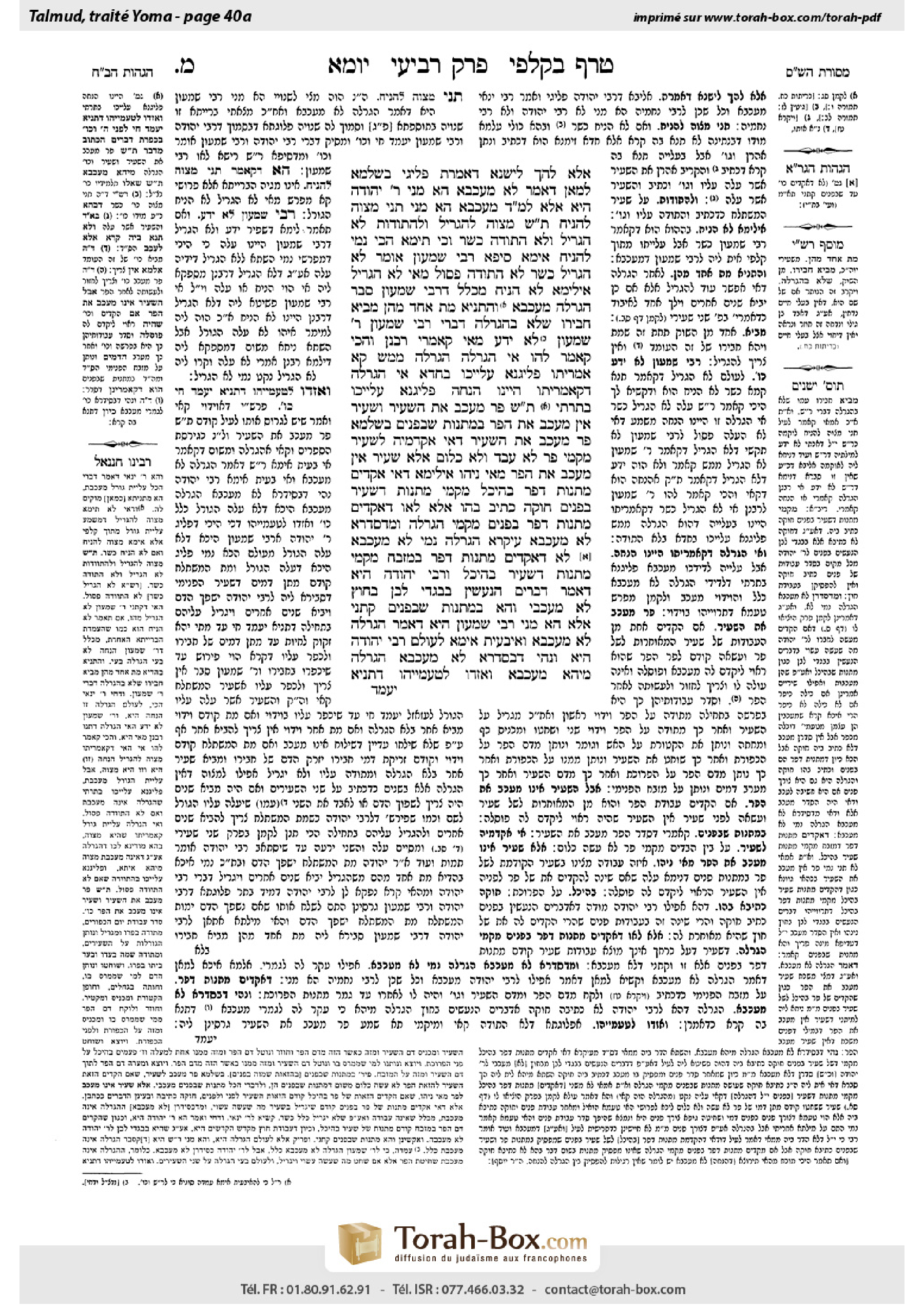
This page of Yoma includes the Aramaic text, an English translation and an AI-generated French translation, alongside the scan above.
יומא מ׳ א · Aramaic and Hebrew text
אֶלָּא לְהָךְ לִישָּׁנָא דְּאָמְרַתְּ פְּלִיגִי, בִּשְׁלָמָא לְמַאן דְּאָמַר לָא מְעַכְּבָא, הָא מַנִּי — רַבִּי יְהוּדָה הִיא,
אֶלָּא לְמַאן דְּאָמַר מְעַכְּבָא, הָא מַנִּי? תְּנִי: מִצְוָה לְהַנִּיחַ.
תָּא שְׁמַע: מִצְוָה לְהַגְרִיל וּלְהִתְוַדּוֹת. לֹא הִגְרִיל וְלֹא הִתְוַדָּה — כָּשֵׁר. וְכִי תֵּימָא הָכִי נָמֵי לְהַנִּיחַ, אֵימָא סֵיפָא, רַבִּי שִׁמְעוֹן אוֹמֵר: לֹא הִגְרִיל — כָּשֵׁר, לֹא הִתְוַדָּה — פָּסוּל.
מַאי ״לֹא הִגְרִיל״? אִילֵּימָא לֹא הִנִּיחַ, מִכְּלָל דְּרַבִּי שִׁמְעוֹן סָבַר הַגְרָלָה מְעַכְּבָא, וְהָתַנְיָא: מֵת אֶחָד מֵהֶן, מֵבִיא חֲבֵירוֹ שֶׁלֹּא בַּהַגְרָלָה, דִּבְרֵי רַבִּי שִׁמְעוֹן.
רַבִּי שִׁמְעוֹן לָא יָדַע מַאי קָאָמְרִי רַבָּנַן, וְהָכִי קָאָמַר לְהוּ: אִי הַגְרָלָה — הַגְרָלָה מַמָּשׁ קָא אָמְרִיתוּ, פְּלִיגְנָא עֲלַיְיכוּ בַּחֲדָא. אִי הַגְרָלָה דְּקָאָמְרִיתוּ הַיְינוּ הַנָּחָה — פְּלִיגְנָא עֲלַיְיכוּ בְּתַרְתֵּי.
תָּא שְׁמַע: פַּר מְעַכֵּב אֶת הַשָּׂעִיר,
וְשָׂעִיר אֵין מְעַכֵּב אֶת הַפָּר בְּמַתָּנוֹת שֶׁבִּפְנִים.
בִּשְׁלָמָא פַּר מְעַכֵּב אֶת הַשָּׂעִיר: דְּאִי אַקְדְּמֵיהּ לְשָׂעִיר מִקַּמֵּי פַּר — לָא עֲבַד וְלֹא כְּלוּם. אֶלָּא שָׂעִיר אֵין מְעַכֵּב אֶת הַפָּר — מַאי נִיהוּ?
אִילֵּימָא דְּאִי אַקְדֵּים מַתָּנוֹת דְּפַר בַּהֵיכָל מִקַּמֵּי מַתָּנוֹת דְּשָׂעִיר בִּפְנִים — ״חוּקָּה״ כְּתִיב בְּהוּ.
אֶלָּא לָאו, דְּאַקְדֵּים מַתָּנוֹת דְּפַר בִּפְנִים מִקַּמֵּי הַגְרָלָה. וּמִדְּסִדְרָא לָא מְעַכְּבָא — (עִיקְרָא) הַגְרָלָה נָמֵי לָא מְעַכְּבָא!
לָא, דְּאַקְדֵּים מַתָּנוֹת דְּפַר בְּמִזְבֵּחַ מִקַּמֵּי מַתָּנוֹת דְּשָׂעִיר בַּהֵיכָל, וְרַבִּי יְהוּדָה הִיא, דְּאָמַר: דְּבָרִים הַנַּעֲשִׂין בְּבִגְדֵי לָבָן בַּחוּץ — לָא מְעַכְּבִי.
וְהָא בְּמַתָּנוֹת שֶׁבִּפְנִים קָתָנֵי!
אֶלָּא: הָא מַנִּי — רַבִּי שִׁמְעוֹן הִיא, דְּאָמַר: הַגְרָלָה לָא מְעַכְּבָא.
וְאִיבָּעֵית אֵימָא: לְעוֹלָם רַבִּי יְהוּדָה הִיא, וּנְהִי דִּכְסִדְרָא לָא מְעַכְּבָא — הַגְרָלָה מִיהָא מְעַכְּבָא.
וְאָזְדוּ לְטַעְמַיְיהוּ, דְּתַנְיָא:
Yoma 40a · English translation
But according to that second version of the dispute, in which you said that Rabbi Yannai and Rabbi Yoḥanan disagree whether the drawing of the lots is indispensable according to Rabbi Yehuda, but according to Rabbi Neḥemya it certainly is indispensable, then granted, according to the one, i.e., Rabbi Yoḥanan, who said that the drawing of the lots is not indispensable, in accordance with whose opinion is this baraita taught? It is in accordance with the opinion of Rabbi Yehuda.
However, according to the one, i.e., Rabbi Yannai, who said that both according to Rabbi Yehuda and Rabbi Neḥemya the drawing of the lots is indispensable, then in accordance with whose opinion could this baraita be taught? It would appear that, according to Rabbi Yannai, the baraita does not reflect anyone’s opinion. Perforce, the baraita cannot be referring to drawing the lots, and one must emend and teach the baraita as saying that it is a mitzva to place the lots on the goats.
Come and hear another challenge to Rabbi Yannai’s opinion, as presented in the second version of the dispute, which maintains that both Rabbi Yehuda and Rabbi Neḥemya hold that drawing of the lots is indispensable. A baraita teaches: It is a mitzva for the High Priest to draw the lots and to confess upon the goat to be sent to Azazel. If he did not draw the lots or did not confess, the service is still valid. This baraita also appears to say that the drawing of the lots is not indispensable, in contradiction to Rabbi Yannai’s opinion. And if you say: So too, the baraita should be emended to say it is a mitzva to place the lots on the goats, this is problematic. How will you then say, i.e., explain, the latter clause of that baraita, which teaches: Rabbi Shimon says: If he does not draw the lots, it is valid. If he does not confess, it is invalid?
The Gemara clarifies the challenge from the latter clause: In this baraita, what is the meaning of: He did not draw the lots? If we say it means he did not place the lots on the goats, then by inference Rabbi Shimon holds that while the placing is not indispensable, the drawing of the lots is indispensable. But this is incorrect, since wasn’t it taught in a baraita: If, following the designation of the goats, one of them died, a new goat is brought to be the counterpart of the surviving goat and is designated without drawing lots; this is the statement of Rabbi Shimon. It would therefore appear that the baraita should not be understood as referring to the mitzva to place the lots, but as referring to the drawing of the lots themselves. Therefore, the challenge to Rabbi Yannai’s opinion remains.
The Gemara responds: Rabbi Yannai’s opinion can still be defended by claiming that Rabbi Shimon did not know precisely what the Sages were saying, i.e., whether they were referring to the drawing or the placing of the lots. Therefore, in his response to them, this is what he is saying: If when you say: Drawing of the lots, you are saying that the actual drawing of the lots is not indispensable, as I also hold, then I disagree with you only with regard to one halakha, namely with regard to the indispensability of the confession. But if, when you say: Drawing of the lots, you are saying only that the placing of the lots is not indispensable, but you assume that the drawing of the lots is indispensable, then I disagree with you with regard to two halakhot, i.e., with regard to the indispensability of both the drawing of the lots and of the confession.
Come and hear another challenge to Rabbi Yannai’s opinion that all agree that the drawing of the lots is indispensable, from a baraita: Various services are performed with the bull and the goat and their blood. These services must be performed in a specific sequence, often alternating between the bull and the goat. If one service is neglected and a later service is advanced to be before it, the halakha is as follows: Failure to perform a service of the bull that was to precede a service of the goat disqualifies the service of the goat, if it was performed without that service of the bull preceding it.
However, failure to perform a service of the goat that was to precede a service of the bull does not disqualify the service of the bull; rather, it is valid after the fact. This last rule applies to the applications of blood performed inside the Holy of Holies.
The Gemara explains the challenge from the baraita: Granted, failure to perform the service of the bull disqualifies the service of the goat that is advanced ahead of it. This can be understood to mean that if he advanced the service of the goat ahead of the service of the bull, it is considered as though he has not performed anything at all. Once the service of the bull has been performed, the service of the goat must be repeated. However, the rule in the baraita that failure to perform a service of the goat does not disqualify the service of the bull that was advanced ahead of it. To what case is it referring?
If we say that that the baraita means that if one advanced the applications of the blood of the bull in the Sanctuary made toward the curtain ahead of the applications of the blood of the goat inside the Holy of Holies, then the baraita should not rule that it is valid. The term “statute” (Leviticus 16:29) is written concerning the applications of the blood of the goat inside the Holy of Holies, which implies that their performance is indispensable to any subsequent services.
Rather, is it not that the baraita must be referring to a case in which one advanced the applications of the blood of the bull inside the Holy of Holies ahead of the drawing of the lots? If so, from the fact that the sequencing of drawing the lots is not indispensable, one may infer that the drawing of the lots itself is also not indispensable. This would then refute Rabbi Yannai’s opinion.
The Gemara questions whether this is the only possible interpretation of the baraita: No, the baraita could be referring to a case in which one advanced the applications of the blood of the bull upon the altar ahead of the applications of the blood of the goat in the Sanctuary made toward the curtain. And as such, ruling in the baraita that this is valid after the fact is in accordance with the opinion of Rabbi Yehuda, who said: Matters that are performed in the white garments outside of the Holy of Holies are not indispensable. Therefore, the applications of the bull’s blood upon the altar cannot disqualify a different service.
The Gemara rejects this as a possible interpretation of the baraita: But didn’t the conclusion of the baraita teach that the rule applies to the applications of blood performed inside the Holy of Holies? If so, the baraita cannot be referring to application of blood made upon the altar.
Rather, the baraita must understood in the way suggested by the Gemara previously, which implies that the drawing of the lots is not indispensable. However, this is not necessarily a refutation of the opinion of Rabbi Yannai. One could say: In accordance with whose opinion is this baraita? It is in accordance with the opinion of Rabbi Shimon, who said: The drawing of the lots is not indispensable. Rabbi Yannai claimed only that Rabbi Yehuda and Rabbi Neḥemya agreed that it is indispensable.
And if you wish, say: Actually, the baraita is in accordance with the opinion of Rabbi Yehuda. Nevertheless, Rabbi Yannai’s opinion may still be defended: Granted, the baraita teaches that the sequencing of the drawing of the lots is not indispensable; however it may still be true that the drawing itself is nevertheless indispensable. This contradicts what was suggested previously, that one may infer from the indispensability of the sequencing to the indispensability of the drawing itself.
And Rabbi Yehuda and Rabbi Shimon follow their lines of reasoning, as it was taught in a baraita:
Yoma 40a · Traduction française (IA)
Mais selon cette seconde version de la controverse, où l’on a dit que Rabbi Yannai et Rabbi Yoḥanan sont en désaccord sur la question de savoir si, selon Rabbi Yehuda, le tirage au sort est indispensable, tandis que, selon Rabbi Neḥemya, il l’est assurément, admettons que, selon celui qui affirme, à savoir Rabbi Yoḥanan, que le tirage au sort n’est pas indispensable, cette baraïta est enseignée conformément à l’opinion de Rabbi Yehuda.
Cependant, selon celui qui affirme, à savoir Rabbi Yannai, que le tirage au sort est indispensable aussi bien selon Rabbi Yehuda que selon Rabbi Neḥemya, conformément à l’opinion de qui cette baraïta pourrait-elle être enseignée ? Il semblerait donc que, selon Rabbi Yannai, la baraïta ne reflète l’opinion de personne. Il faut nécessairement en conclure que la baraïta ne peut pas faire référence au tirage au sort et qu’il faut la corriger pour enseigner qu’il est une mitsva de placer les sorts sur les boucs.
Viens et entends une autre objection à l’opinion de Rabbi Yannai, telle qu’elle est présentée dans la seconde version de la controverse, selon laquelle Rabbi Yehuda et Rabbi Neḥemya soutiennent tous deux que le tirage au sort est indispensable. Une baraïta enseigne : C’est une mitsva pour le Grand Prêtre de tirer au sort et de se confesser au sujet du bouc destiné à Azazel. S’il n’a pas tiré au sort ou ne s’est pas confessé, le service reste valide. Cette baraïta semble également indiquer que le tirage au sort n’est pas indispensable, ce qui contredit l’opinion de Rabbi Yannai. Et si tu dis qu’il faut, là aussi, corriger la baraïta pour enseigner qu’il est une mitsva de placer les sorts sur les boucs, cela pose problème. Comment expliquer alors la clause suivante de cette baraïta, qui enseigne : Rabbi Shimon dit : S’il ne tire pas au sort, le service est valide. S’il ne se confesse pas, le service est invalide ?
La Guemara précise l’objection tirée de la clause suivante : dans cette baraïta, que signifie « il n’a pas tiré au sort » ? Si nous disons que cela signifie qu’il n’a pas placé les sorts sur les boucs, il s’ensuivrait que, selon Rabbi Shimon, si le placement n’est pas indispensable, le tirage au sort, lui, l’est. Or cela est inexact, car n’a-t-on pas enseigné dans une baraïta : Si, après la désignation des boucs, l’un d’eux meurt, on amène un nouveau bouc pour le mettre en paire avec le bouc survivant et on le désigne sans tirer au sort ; telle est la déclaration de Rabbi Shimon. Il semblerait donc que la baraïta ne fasse pas référence à la mitsva de placer les sorts, mais au tirage au sort lui-même. L’objection contre l’opinion de Rabbi Yannai demeure donc.
La Guemara répond : On peut encore défendre l’opinion de Rabbi Yannai en affirmant que Rabbi Shimon ne savait pas précisément ce que disaient les Sages, c’est-à-dire s’ils parlaient du tirage ou du placement des sorts. Voici donc ce qu’il leur répond : Si, lorsque vous dites « tirage au sort », vous voulez dire que le tirage lui-même n’est pas indispensable, comme je le soutiens également, alors je ne suis en désaccord avec vous que sur une halakha, à savoir le caractère indispensable de la confession. Mais si, lorsque vous dites « tirage au sort », vous voulez seulement dire que le placement des sorts n’est pas indispensable, tout en supposant que le tirage au sort l’est, alors je suis en désaccord avec vous sur deux halakhot, à savoir le caractère indispensable du tirage au sort et celui de la confession.
Viens et entends une autre objection à l’opinion de Rabbi Yannai, selon laquelle tous s’accordent à dire que le tirage au sort est indispensable. Elle est tirée d’une baraïta : Divers services sont accomplis avec le taureau, le bouc et leur sang. Ces services doivent être exécutés dans un ordre précis, souvent en alternant entre le taureau et le bouc. Si un service est omis et qu’un service ultérieur est avancé pour être accompli avant lui, la halakha est la suivante : l’omission d’un service du taureau qui devait précéder un service du bouc invalide ce dernier si celui-ci a été accompli sans que le service du taureau l’ait précédé.
Cependant, l’omission d’un service du bouc qui devait précéder un service du taureau n’invalide pas le service du taureau ; celui-ci reste valide après coup. Cette dernière règle s’applique aux aspersions de sang effectuées à l’intérieur du Saint des Saints.
La Guemara explique l’objection tirée de la baraïta : il est compréhensible que l’omission du service du taureau invalide le service du bouc qui a été avancé avant lui. Cela peut signifier que, si le service du bouc a été accompli avant celui du taureau, c’est comme si rien n’avait été accompli. Une fois le service du taureau accompli, le service du bouc doit être répété. Mais à quel cas s’applique la règle de la baraïta selon laquelle l’omission d’un service du bouc n’invalide pas le service du taureau qui a été accompli avant lui ?
Si nous disons que la baraïta vise le cas où l’on a accompli les aspersions du sang du taureau dans le Sanctuaire, en direction du rideau, avant les aspersions du sang du bouc à l’intérieur du Saint des Saints, la baraïta ne devrait pas déclarer le service valide. En effet, le terme « statut » (Lévitique 16:29) est écrit au sujet des aspersions du sang du bouc à l’intérieur du Saint des Saints, ce qui implique que leur accomplissement est indispensable à tout service ultérieur.
Ne faut-il pas plutôt dire que la baraïta vise le cas où l’on a accompli les aspersions du sang du taureau à l’intérieur du Saint des Saints avant le tirage au sort ? Si tel est le cas, du fait que l’ordre du tirage au sort n’est pas indispensable, on peut déduire que le tirage au sort lui-même ne l’est pas non plus. Cela réfuterait alors l’opinion de Rabbi Yannai.
La Guemara se demande si c’est la seule interprétation possible de la baraïta : Non, la baraïta pourrait viser le cas où l’on a accompli les aspersions du sang du taureau sur l’autel avant les aspersions du sang du bouc dans le Sanctuaire, en direction du rideau. Dans ce cas, la règle de la baraïta selon laquelle le service reste valide après coup est conforme à l’opinion de Rabbi Yehuda, qui a dit que les actes accomplis avec les vêtements blancs à l’extérieur du Saint des Saints ne sont pas indispensables. Les aspersions du sang du taureau sur l’autel ne peuvent donc pas invalider un autre service.
La Guemara écarte cette interprétation possible de la baraïta : mais la conclusion de la baraïta n’enseigne-t-elle pas que la règle s’applique aux aspersions de sang effectuées à l’intérieur du Saint des Saints ? Si tel est le cas, la baraïta ne peut pas faire référence à des aspersions de sang sur l’autel.
La baraïta doit donc être comprise comme la Guemara l’a suggéré précédemment, ce qui implique que le tirage au sort n’est pas indispensable. Toutefois, cela ne réfute pas nécessairement l’opinion de Rabbi Yannai. On peut dire : conformément à l’opinion de qui cette baraïta est-elle enseignée ? Conformément à l’opinion de Rabbi Shimon, qui a dit que le tirage au sort n’est pas indispensable. Rabbi Yannai a seulement soutenu que Rabbi Yehuda et Rabbi Neḥemya s’accordaient à dire qu’il l’est.
Et si tu le souhaites, dis : En réalité, la baraïta est conforme à l’opinion de Rabbi Yehuda. Néanmoins, on peut encore défendre l’opinion de Rabbi Yannai : certes, la baraïta enseigne que l’ordre du tirage au sort n’est pas indispensable ; toutefois, le tirage lui-même peut malgré tout être indispensable. Cela contredit ce qui avait été suggéré précédemment, à savoir qu’on peut déduire du caractère indispensable de l’ordre que le tirage lui-même l’est aussi.
Et Rabbi Yehuda et Rabbi Shimon suivent chacun leur propre raisonnement, comme cela a été enseigné dans une baraïta :
Traduction française générée par IA à partir de l’édition anglaise de Sefaria. Vérifie toujours un passage avec le texte source.
Text from Sefaria: William Davidson Edition - Vocalized Aramaic (CC BY NC); William Davidson Edition - English (CC BY NC).