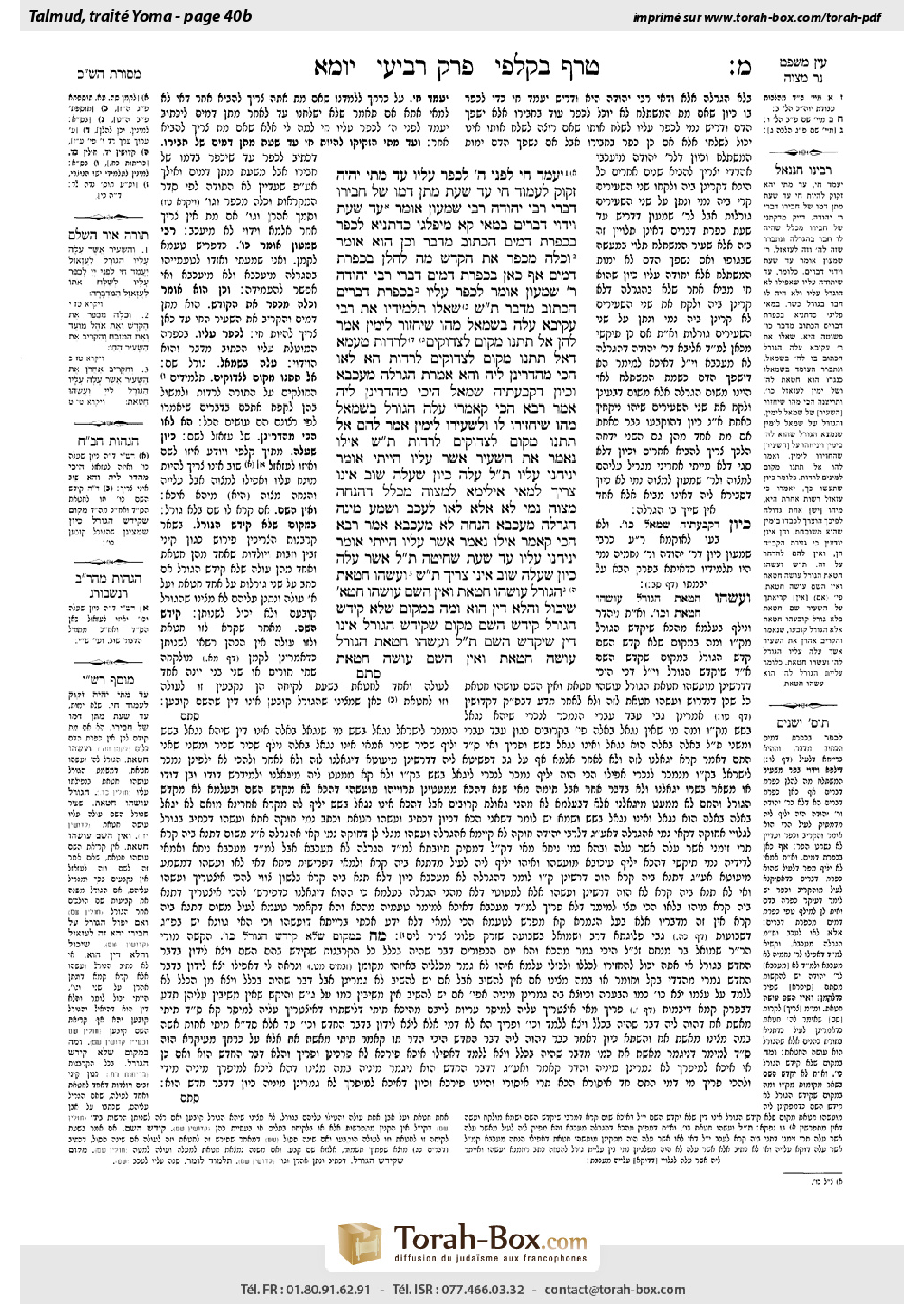
Yoma 40b: Talmud study for Daf Yomi
Daf Yomi is the daily study of one Talmud folio. Explore 37 tractates with scans, Hebrew text, Sefaria English and AI-generated French translations where annotated.
Passage selection and English or AI-generated French translation are available where the scan has annotations. Daf Study is independent of Torah-Box and Sefaria.
Browse Yoma · יומא · All tractatesYoma 40b text and translations
This page of Yoma includes the Aramaic text, an English translation and an AI-generated French translation, alongside the scan above.
יומא מ׳ ב · Aramaic and Hebrew text
״יׇעֳמַד חַי לִפְנֵי ה׳ לְכַפֵּר עָלָיו״, עַד מָתַי יִהְיֶה זָקוּק לַעֲמוֹד חַי? עַד שְׁעַת מַתַּן דָּמוֹ שֶׁל חֲבֵירוֹ — דִּבְרֵי רַבִּי יְהוּדָה. רַבִּי שִׁמְעוֹן אוֹמֵר: עַד שְׁעַת וִידּוּי דְּבָרִים.
בְּמַאי קָא מִיפַּלְגִי? כִּדְתַנְיָא: ״לְכַפֵּר״ — בְּכַפָּרַת דָּמִים הַכָּתוּב מְדַבֵּר, וְכֵן הוּא אוֹמֵר: ״וְכִלָּה מִכַּפֵּר אֶת הַקֹּדֶשׁ״. מָה לְהַלָּן — בְּכַפָּרַת דָּמִים, אַף כָּאן — בְּכַפָּרַת דָּמִים, דִּבְרֵי רַבִּי יְהוּדָה.
רַבִּי שִׁמְעוֹן אוֹמֵר: ״לְכַפֵּר עָלָיו״, בְּכַפָּרַת דְּבָרִים הַכָּתוּב מְדַבֵּר.
תָּא שְׁמַע, שָׁאֲלוּ תַּלְמִידָיו אֶת רַבִּי עֲקִיבָא: עָלָה בִּשְׂמֹאל, מַהוּ שֶׁיַּחֲזוֹר לְיָמִין? אָמַר לָהֶן: אַל תִּתְּנוּ מָקוֹם לַמִּינִין לִרְדּוֹת.
טַעְמָא דְּאַל תִּתְּנוּ מָקוֹם לַמִּינִין לִרְדּוֹת, הָא לָאו הָכִי מַהְדְּרִינַן לֵיהּ, וְהָא אָמְרַתְּ הַגְרָלָה מְעַכְּבָא, וְכֵיוָן דִּקְבַעְתֵּיהּ שְׂמֹאל הֵיכִי מַהְדְּרִינַן לֵיהּ?
אָמַר רָבָא, הָכִי קָאָמְרִי: עָלָה הַגּוֹרָל בִּשְׂמֹאל, מַהוּ שֶׁיַּחֲזִירוּ לוֹ וְלִשְׂעִירוֹ לְיָמִין. אָמַר לָהֶם: אַל תִּתְּנוּ מָקוֹם לַמִּינִין לִרְדּוֹת.
תָּא שְׁמַע: אִילּוּ נֶאֱמַר: ״אֶת הַשָּׂעִיר אֲשֶׁר עָלָיו״, הָיִיתִי אוֹמֵר יַנִּיחֶנּוּ עָלָיו, — תַּלְמוּד לוֹמַר: ״עָלָה״, כֵּיוָן שֶׁעָלָה שׁוּב אֵינוֹ צָרִיךְ.
לְמַאי? אִילֵימָא לְמִצְוָה, מִכְלָל דַּהֲנָחָה מִצְוָה נָמֵי לָא? אֶלָּא לָאו, לְעַכֵּב. וּשְׁמַע מִינַּהּ: הַגְרָלָה מְעַכְּבָא, הַנָּחָה — לָא מְעַכְּבָא!
אָמַר רָבָא, הָכִי קָאָמַר: אִילּוּ נֶאֱמַר ״אֲשֶׁר עָלָיו״, הָיִיתִי אוֹמֵר יַנִּיחֶנּוּ עָלָיו עַד שְׁעַת שְׁחִיטָה, תַּלְמוּד לוֹמַר: ״אֲשֶׁר עָלָה״, כֵּיוָן שֶׁעָלָה שׁוּב אֵינוֹ צָרִיךְ.
תָּא שְׁמַע: ״וְעָשָׂהוּ חַטָּאת״, הַגּוֹרָל עוֹשֵׂהוּ חַטָּאת, וְאֵין הַשֵּׁם עוֹשֵׂהוּ חַטָּאת.
שֶׁיָּכוֹל, וַהֲלֹא דִּין הוּא: וּמָה בִּמְקוֹם שֶׁלֹּא קִידֵּשׁ הַגּוֹרָל — קִידֵּשׁ הַשֵּׁם, מְקוֹם שֶׁקִּידֵּשׁ הַגּוֹרָל, אֵינוֹ דִּין שֶׁיְּקַדֵּשׁ הַשֵּׁם?
תַּלְמוּד לוֹמַר: ״וְעָשָׂהוּ חַטָּאת״, הַגּוֹרָל עוֹשֶׂה חַטָּאת, וְאֵין הַשֵּׁם עוֹשֶׂה חַטָּאת.
Yoma 40b · English translation
The verse states: “But the goat on which the lot came up for Azazel shall be stood alive before the Lord, to make atonement over him, to send him away for Azazel into the wilderness” (Leviticus 16:10). The verse indicates that the goat must remain alive until a certain time. Were it to die beforehand, it would have to be replaced. Until when is the goat for Azazel required to stand alive? Until the time of the application of the blood of its counterpart, i.e., the goat for God; this is the statement of Rabbi Yehuda. Rabbi Shimon says: It must remain alive until the time of the verbal confession over it.
With regard to what do they disagree? As it was taught in a baraita: The verse states that the goat should remain alive “to make atonement” (Leviticus 16:10). This indicates that it must remain alive until it effects atonement. Rabbi Yehuda and Rabbi Shimon dispute which atonement the verse is referring to. The verse speaks of atonement through the application of the blood of the sin-offering goat. And similarly it states: “When he has made an end of atoning for the Sanctuary, and the Tent of Meeting, and the altar, he shall present the live goat” (Leviticus 16:20). Just as there the reference is to atonement through blood, so too here the verse is referring to atonement through blood. This is the statement of Rabbi Yehuda.
Rabbi Shimon says: “To make atonement over it”; the verse speaks of atonement through speech, i.e., the verbal confession that is recited over it.
Come and hear a proof that the drawing of lots is not indispensable. A baraita teaches: Rabbi Akiva’s students asked him: If the lot for God was drawn by the High Priest’s left hand, what is the halakha with regard to whether he may transfer the lot to his right hand? He said to them: Do not give the heretics an opportunity to dominate. If it is allowed, they will adduce this as proof of their claim that the halakhot are not absolute, and the Sages have the power to change them as they see fit.
The Gemara infers: The only reason Rabbi Akiva provided to disallow it was so as not to give heretics an opportunity to dominate, which implies that if not for this reason, it would be permitted to transfer the lot to the right hand. How could this be true? Didn’t you say that the drawing of the lots is indispensable? And, consequently, once the designation of the goat has been defined by the drawing of the left hand, how then could we transfer the lot to the right hand? Perforce, the designation is not created by the actual drawing, and as such it is not indispensable.
The Gemara explains the baraita can be understood in a way in which it does not provide a proof: Rava said: This is what Rabbi Akiva’s students are saying: If the lot was drawn by his left hand, what is the halakha with regard to whether he may transfer it, the lot, and its associated goat to his right side. He said to them: Do not give the heretics an opportunity to dominate. Accordingly, there was never any suggestion of changing the designation of the goats. Therefore, no proof can be brought concerning the indispensability of the drawing of the lots.
Come and hear a proof that the drawing of lots is indispensable. A baraita teaches (Sifra, Aharei Mot 2:4): If the verse had stated only: “The goat upon which the lot” (Leviticus 16:9), I would have said the intention is that he must physically place the lot upon it. Therefore, the verse also states: “On which it came up” (Leviticus 16:9), indicating that once the lot has come up from the receptacle, it is not necessary to do more, i.e., the lot does not have to be physically placed upon the goat.
The Gemara clarifies: To what does the baraita refer when it says it is not necessary to actually place the lot upon the goat? If we say it means that it is no longer necessary to do so even as a mitzva, then, by inference, one must conclude that the placement of the lot upon the goat is not even a mitzva. This is problematic. Since it is clearly part of the Yom Kippur service, it must at least be a mitzva. Rather, is it not that when the baraita teaches that the placing of the lot is not necessary, it means only that the placing of the lot is not indispensable? And conclude from it that the drawing of lots is indispensable, but the placement of the lot upon the goat is not indispensable.
Rava rejects the proof: Rava said: This cannot serve as a proof, since this is what the baraita is saying: If the verse had stated only: “The goat upon which the lot,” I would have said that the intention is that he should physically place the lot upon the goat, and the lot should remain upon it until the time of its slaughter. Therefore, the verse also states: “On which it came up,” indicating that once the lot has come up from the receptacle and been placed upon the goat for even one moment, it is not necessary to do more, i.e., the lot does not have to remain on the goat anymore. Understood in this way, it cannot be determined from this baraita whether or not the placement is indispensable.
Come and hear a proof that Rabbi Yehuda holds that the drawing of the lots is indispensable. A baraita in the Sifra teaches: The verse states: “Aaron shall bring forward the goat upon which the lot came up for the Lord, and he shall offer it for a sin-offering” (Leviticus 16:9). The verse indicates that the lottery makes it a sin-offering, but verbally designating the goat with the status of a sin-offering does not make it a sin-offering.
The baraita continues: A verse is needed to teach this halakha, as I might have thought to come to the opposite conclusion. Is there not an a fortiori inference as follows: Just as in a case in which the use of a lottery does not consecrate the animals with a specific designation, e.g., a woman who has given birth and must bring two birds, one as a sin-offering and one as a burnt-offering, nevertheless a verbal designation of the animals with the required status does consecrate them, so too, in a case in which the use of a lottery does consecrate the animals, is it not logically right that verbally designating the animals with the required status should consecrate them?
In contradiction of this reasoning, the verse states, with regard to the goat: “He shall offer it for a sin-offering” to indicate that the lottery makes it a sin-offering; verbally designating the goat with the status of a sin-offering does not make it a sin-offering.
Yoma 40b · Traduction française (IA)
Le verset déclare : « Mais le bouc sur lequel le sort est tombé pour Azazel sera placé vivant devant l’Éternel, afin de faire expiation par son intermédiaire et de l’envoyer à Azazel dans le désert » (Lévitique 16,10). Le verset indique que le bouc doit rester vivant jusqu’à un certain moment. S’il venait à mourir auparavant, il faudrait le remplacer. Jusqu’à quand le bouc pour Azazel doit-il rester vivant ? Jusqu’au moment où l’on applique le sang de son pendant, c’est-à-dire du bouc pour l’Éternel ; telle est l’opinion de Rabbi Yehuda. Rabbi Shimon dit : Il doit rester vivant jusqu’au moment où l’on prononce la confession sur lui.
Sur quoi porte leur désaccord ? Une baraïta a été enseignée : le verset déclare que le bouc doit rester vivant « afin de faire expiation » (Lévitique 16,10). Cela indique qu’il doit rester vivant jusqu’à ce qu’il accomplisse l’expiation. Rabbi Yehuda et Rabbi Shimon discutent de l’expiation à laquelle le verset fait référence. Le verset parle de l’expiation accomplie par l’application du sang du bouc du sacrifice expiatoire. De même, il est dit : « Quand il aura achevé de faire expiation pour le Sanctuaire, la Tente d’assignation et l’autel, il présentera le bouc vivant » (Lévitique 16,20). De même que, dans ce passage, il s’agit de l’expiation accomplie par le sang, ici aussi, le verset fait référence à l’expiation accomplie par le sang. Telle est l’opinion de Rabbi Yehuda.
Rabbi Shimon dit : « Afin de faire expiation par son intermédiaire » : le verset parle d’une expiation accomplie par la parole, c’est-à-dire la confession prononcée sur lui.
Viens et écoute une preuve que le tirage au sort n’est pas indispensable. Une baraïta enseigne : les élèves de Rabbi Akiva lui demandèrent : Si le sort pour l’Éternel a été tiré de la main gauche du Grand Prêtre, quelle est la halakha quant à la possibilité de transférer le sort dans sa main droite ? Il leur dit : « Ne donnez pas aux hérétiques l’occasion de dominer. » Si cela est permis, ils en tireront la preuve que les halakhot ne sont pas absolues et que les Sages ont le pouvoir de les modifier à leur gré.
La Guemara déduit que la seule raison donnée par Rabbi Akiva pour l’interdire était de ne pas donner aux hérétiques l’occasion de dominer. Cela implique que, sans cette raison, il serait permis de transférer le sort dans la main droite. Comment cela pourrait-il être vrai ? N’as-tu pas dit que le tirage au sort est indispensable ? Par conséquent, une fois que la désignation du bouc a été déterminée par le tirage effectué de la main gauche, comment pourrait-on alors transférer le sort dans la main droite ? Il faut donc conclure que la désignation n’est pas créée par le tirage lui-même et que celui-ci n’est, par conséquent, pas indispensable.
La Guemara explique que la baraïta peut être comprise d’une manière qui ne constitue pas une preuve. Rava dit : Voici ce que demandent les élèves de Rabbi Akiva : Si le sort a été tiré de sa main gauche, quelle est la halakha quant à la possibilité de le transférer — le sort et le bouc qui lui est associé — du côté droit ? Il leur dit : « Ne donnez pas aux hérétiques l’occasion de dominer. » Ainsi, il n’a jamais été question de modifier la désignation des boucs. On ne peut donc tirer de là aucune preuve concernant le caractère indispensable du tirage au sort.
Viens et écoute une preuve que le tirage au sort est indispensable. Une baraïta enseigne (Sifra, Aharei Mot 2:4) : Si le verset avait seulement dit : « Le bouc sur lequel est le sort » (Lévitique 16,9), j’aurais pensé qu’il faut poser matériellement le sort sur le bouc. C’est pourquoi le verset dit aussi : « sur lequel il est tombé » (Lévitique 16,9), ce qui indique qu’une fois que le sort est sorti du récipient, il n’est pas nécessaire d’en faire davantage, c’est-à-dire qu’il n’est pas nécessaire de poser matériellement le sort sur le bouc.
La Guemara précise : À quoi la baraïta fait-elle référence lorsqu’elle dit qu’il n’est pas nécessaire de poser effectivement le sort sur le bouc ? Si l’on dit qu’elle signifie qu’il n’est même pas nécessaire de le faire en tant que mitsva, il faudrait en déduire que le fait de poser le sort sur le bouc n’est même pas une mitsva. Cela pose problème. Puisque cela fait clairement partie du service de Yom Kippour, cela doit au moins être une mitsva. N’est-ce donc pas plutôt que, lorsque la baraïta enseigne qu’il n’est pas nécessaire de poser le sort, elle signifie seulement que cette pose n’est pas indispensable ? Il faut donc en conclure que le tirage au sort est indispensable, mais que le fait de poser le sort sur le bouc ne l’est pas.
Rava rejette cette preuve. Rava dit : Cela ne peut servir de preuve, car voici ce que dit la baraïta : Si le verset avait seulement dit : « Le bouc sur lequel est le sort », j’aurais pensé qu’il faut poser matériellement le sort sur le bouc et l’y laisser jusqu’au moment de son abattage. C’est pourquoi le verset dit aussi : « sur lequel il est tombé », ce qui indique qu’une fois que le sort est sorti du récipient et a été posé sur le bouc, ne serait-ce qu’un instant, il n’est pas nécessaire d’en faire davantage, c’est-à-dire que le sort n’a plus besoin de rester sur le bouc. Ainsi comprise, cette baraïta ne permet pas de déterminer si la pose est indispensable ou non.
Viens et écoute une preuve que Rabbi Yehuda considère le tirage au sort comme indispensable. Une baraïta du Sifra enseigne : le verset déclare : « Aaron fera avancer le bouc sur lequel est tombé le sort pour l’Éternel, et il le présentera en sacrifice expiatoire » (Lévitique 16,9). Le verset indique que c’est le tirage au sort qui en fait un sacrifice expiatoire, tandis que le fait de désigner verbalement le bouc comme sacrifice expiatoire n’en fait pas un sacrifice expiatoire.
La baraïta poursuit : Un verset est nécessaire pour enseigner cette halakha, car j’aurais pu penser le contraire et parvenir à la conclusion opposée. N’y a-t-il pas un raisonnement a fortiori comme suit : de même que dans un cas où le recours au tirage au sort ne confère pas aux animaux une désignation précise — par exemple, celui d’une femme qui a accouché et doit apporter deux oiseaux, l’un en sacrifice expiatoire et l’autre en holocauste —, le fait de désigner verbalement les animaux selon le statut requis leur confère néanmoins ce statut, de même, dans un cas où le recours au tirage au sort confère aux animaux leur désignation, n’est-il pas logique que le fait de désigner verbalement les animaux selon le statut requis leur confère également ce statut ?
Pour contredire ce raisonnement, le verset déclare, au sujet du bouc : « Il le présentera en sacrifice expiatoire », afin d’indiquer que c’est le tirage au sort qui en fait un sacrifice expiatoire ; le fait de désigner verbalement le bouc comme sacrifice expiatoire n’en fait pas un sacrifice expiatoire.
Traduction française générée par IA à partir de l’édition anglaise de Sefaria. Vérifie toujours un passage avec le texte source.
Text from Sefaria: William Davidson Edition - Vocalized Aramaic (CC BY NC); William Davidson Edition - English (CC BY NC).