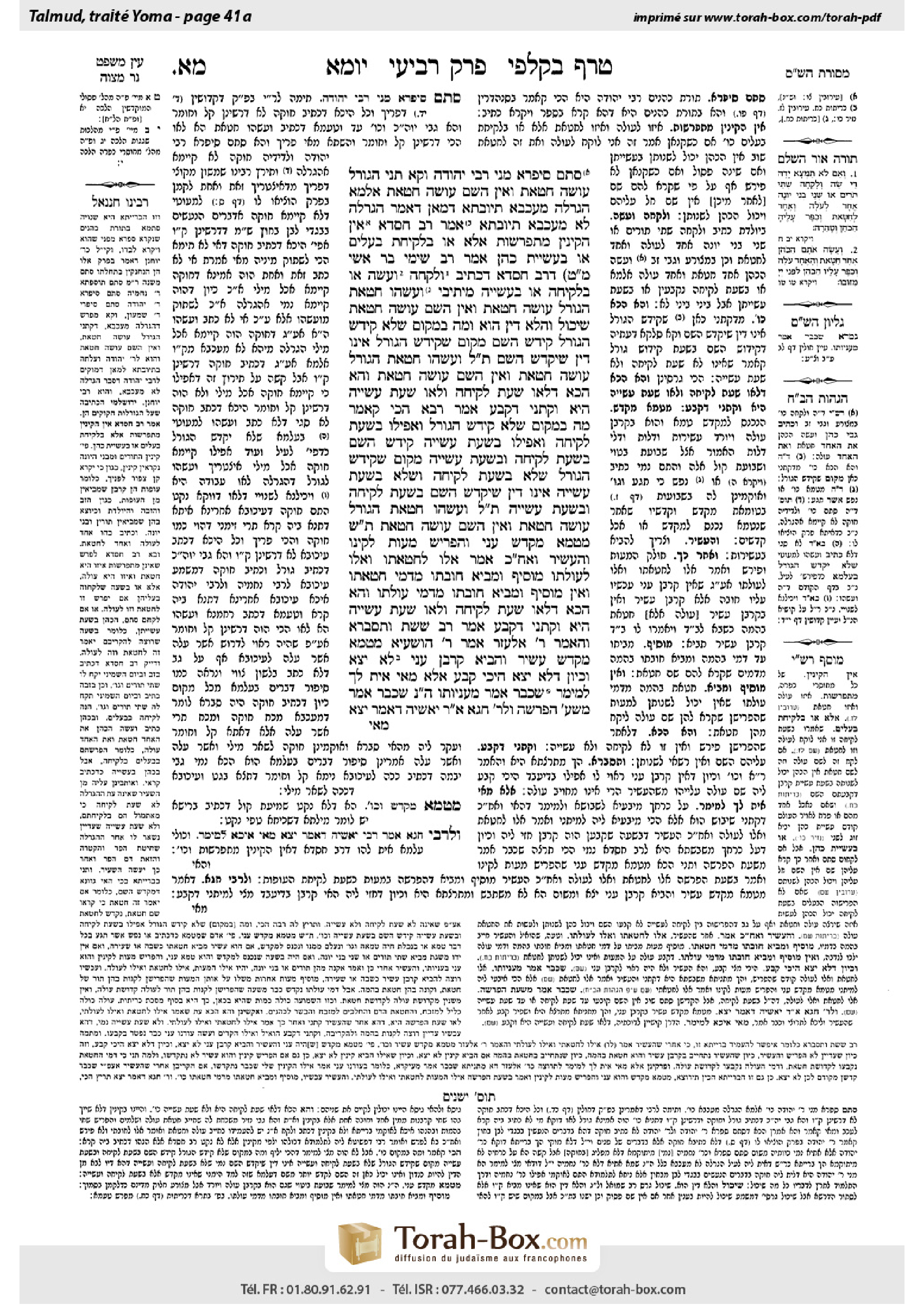
Yoma 41a: Talmud study for Daf Yomi
Daf Yomi is the daily study of one Talmud folio. Explore 37 tractates with scans, Hebrew text, Sefaria English and AI-generated French translations where annotated.
Passage selection and English or AI-generated French translation are available where the scan has annotations. Daf Study is independent of Torah-Box and Sefaria.
Browse Yoma · יומא · All tractatesYoma 41a text and translations
This page of Yoma includes the Aramaic text, an English translation and an AI-generated French translation, alongside the scan above.
יומא מ״א א · Aramaic and Hebrew text
סְתָם סִיפְרָא מַנִּי — רַבִּי יְהוּדָה, וְקָא תָנֵי: הַגּוֹרָל עוֹשֶׂה חַטָּאת, וְאֵין הַשֵּׁם עוֹשֶׂה חַטָּאת. אַלְמָא הַגְרָלָה מְעַכְּבָא, תְּיוּבְתָּא דְּמַאן דְּאָמַר הַגְרָלָה לָא מְעַכְּבָא. תְּיוּבְתָּא.
אָמַר רַב חִסְדָּא: אֵין הַקִּינִּין מִתְפָּרְשׁוֹת אֶלָּא אוֹ בִּלְקִיחַת בְּעָלִים, אוֹ בַּעֲשִׂיַּית כֹּהֵן.
אָמַר רַב שִׁימִי בַּר אָשֵׁי: מַאי טַעְמָא דְּרַב חִסְדָּא, דִּכְתִיב: ״וְלָקְחָה״ ״וְעָשָׂה״. אוֹ בִּלְקִיחָה, אוֹ בַּעֲשִׂיָּיה.
מֵיתִיבִי: ״וְעָשָׂהוּ חַטָּאת״, הַגּוֹרָל עוֹשֶׂה חַטָּאת, וְאֵין הַשֵּׁם עוֹשֶׂה חַטָּאת.
שֶׁיָּכוֹל, וַהֲלֹא דִּין הוּא: וּמָה בִּמְקוֹם שֶׁלֹּא קִידֵּשׁ הַגּוֹרָל — קִידֵּשׁ הַשֵּׁם, מְקוֹם שֶׁקִּידֵּשׁ הַגּוֹרָל, אֵינוֹ דִּין שֶׁיְּקַדֵּשׁ הַשֵּׁם?!
תַּלְמוּד לוֹמַר: ״וְעָשָׂהוּ חַטָּאת״, הַגּוֹרָל עוֹשֶׂה חַטָּאת, וְאֵין הַשֵּׁם עוֹשֶׂה חַטָּאת.
וְהָא הָכָא, דְּלָאו שְׁעַת לְקִיחָה וְלָאו שְׁעַת עֲשִׂיָּיה הִיא, וְקָתָנֵי דְּקָבַע!
אָמַר רָבָא, הָכִי קָאָמַר: מָה בִּמְקוֹם שֶׁלֹּא קִידֵּשׁ הַגּוֹרָל וַאֲפִילּוּ בִּשְׁעַת לְקִיחָה, וַאֲפִילּוּ בִּשְׁעַת עֲשִׂיָּיה — קִידֵּשׁ הַשֵּׁם בִּשְׁעַת לְקִיחָה וּבִשְׁעַת עֲשִׂיָּיה, מְקוֹם שֶׁקִּידֵּשׁ הַגּוֹרָל שֶׁלֹּא בִּשְׁעַת לְקִיחָה וְשֶׁלֹּא בִּשְׁעַת עֲשִׂיָּיה, אֵינוֹ דִּין שֶׁיְּקַדֵּשׁ הַשֵּׁם בִּשְׁעַת לְקִיחָה וּבִשְׁעַת עֲשִׂיָּיה?
תַּלְמוּד לוֹמַר: ״וְעָשָׂהוּ חַטָּאת״, הַגּוֹרָל עוֹשֶׂה חַטָּאת, וְאֵין הַשֵּׁם עוֹשֶׂה חַטָּאת.
תָּא שְׁמַע: מְטַמֵּא מִקְדָּשׁ עָנִי, וְהִפְרִישׁ מָעוֹת לְקִינּוֹ וְהֶעֱשִׁיר, וְאַחַר כָּךְ אָמַר: אֵלּוּ לְחַטָּאתוֹ, וְאֵלּוּ לְעוֹלָתוֹ —
מוֹסִיף וּמֵבִיא חוֹבָתוֹ מִדְּמֵי חַטָּאתוֹ, וְאֵין מוֹסִיף וּמֵבִיא חוֹבָתוֹ מִדְּמֵי עוֹלָתוֹ.
וְהָא הָכָא, דְּלָאו שְׁעַת לְקִיחָה וְלָאו שְׁעַת עֲשִׂיָּיה הִיא, וְקָתָנֵי דְּקָבַע!
אָמַר רַב שֵׁשֶׁת: וְתִסְבְּרָא? וְהָאָמַר רַבִּי אֶלְעָזָר אָמַר רַבִּי הוֹשַׁעְיָא: מְטַמֵּא מִקְדָּשׁ עָשִׁיר וְהֵבִיא קׇרְבַּן עָנִי — לֹא יָצָא, וְכֵיוָן דְּלֹא יָצָא הֵיכִי קָבַע?
אֶלָּא מַאי אִית לָךְ לְמֵימַר — שֶׁכְּבָר אָמַר מֵעֲנִיּוּתוֹ, הָכָא נָמֵי — שֶׁכְּבָר אָמַר מִשְּׁעַת הַפְרָשָׁה.
וּלְרַבִּי חַגָּא אָמַר רַבִּי יֹאשִׁיָּה, דְּאָמַר יָצָא,
Yoma 41a · English translation
The Gemara now formulates the proof: Who is the author of anonymous halakhic statements made in the Sifra? Rabbi Yehuda. And this baraita from the Sifra teaches: The lottery makes it a sin-offering, but verbally designating the goat with the status of a sin-offering does not make it a sin-offering. Apparently, according to Rabbi Yehuda, the lottery is indispensable. This refutation of the opinion of the one who says that the lottery is not indispensable, i.e., Rabbi Yannai, according to the second version of his dispute, is indeed a conclusive refutation.
§ The Gemara addresses a similar case of designating offerings: Rav Ḥisda said: Nests, a pair of birds of which one bird must be sacrificed as a sin-offering and the other as a burnt-offering become designated for the specific type of offering only at one of two distinct points: Either upon the owner’s taking of them, when he initially purchases and consecrates them for his offering, or upon the priest’s actual performance of the sacrificial rite upon them.
Rav Shimi bar Ashi said: What is the reason of Rav Ḥisda? As it is written in one verse: “And she shall take two turtledoves or two young pigeons, the one for a burnt-offering and the other for a sin-offering” (Leviticus 12:8). In another verse, it is also written: “And the priest shall offer them, the one for a sin-offering and the other for a burnt-offering” (Leviticus 15:15). The verses mention only the possibility of designating the offering either upon taking them or upon the performance of the sacrificial rite.
The Gemara raises an objection to Rav Ḥisda’s ruling from the baraita cited above: The verse states, with regard to the goat of Yom Kippur: “And Aaron shall…offer it for a sin-offering” (Leviticus 16:9). This indicates that the lottery makes it a sin-offering, but verbally designating the goat with the status of a sin-offering does not make it a sin-offering.
A verse is needed to teach this halakha, as I might have come to the opposite conclusion: Is there not an a fortiori inference: Just as in a case in which the use of a lottery does not consecrate the animals with a specific designation, nevertheless verbally designating the animals with the required status does consecrate them, so too, in a case in which the use of a lottery does consecrate the animals, is it not logically right that verbally designating the animals with the required status should consecrate them?
To counter this reasoning, the verse states: “He shall make it a sin-offering” to indicate that the lottery makes it a sin-offering, but verbally designating the goat with the status of a sin-offering does not make it a sin-offering.
The Gemara explains the challenge to Rav Ḥisda’s ruling: But here, in the case of designating the goats, the baraita is focusing on the moment at which the lottery is held, which is neither the time of taking the goats nor the time of performing the sacrificial rite. Yet the baraita teaches that were it not for a verse that teaches otherwise, it would be possible to permanently establish the animals’ designation through a verbal designation at that time. This contradicts Rav Ḥisda’s ruling.
The Gemara rejects the challenge: Rava said: The baraita does not contradict Rav Ḥisda’s ruling. This is what the baraita is saying: Just as in a case in which the use of a lottery does not consecrate the animals with a specific designation, even if it is held at the time of taking the animals or at the time of performing the sacrificial rite, nevertheless verbally designating the animals with the required status does consecrate them if that is done at the time of taking the animals or at the time of performing the sacrificial rite; so too, in a case in which the use of a lottery does consecrate the animals, although it is held neither at the time of taking the animals nor at the time of performing the sacrificial rite, is it not logically right that verbally designating the animals with the required status should consecrate them, if it is done at the time of taking the animals or at the time of performing the sacrificial rite?
To counter this reasoning, the verse states: “He shall make it a sin-offering” to indicate that the lottery makes it a sin-offering, but verbally designating the goat with the status of a sin-offering does not make it a sin-offering. Rava has thereby explained the reasoning of the baraita in accordance with Rav Ḥisda’s ruling.
Come and hear another challenge to Rav Ḥisda’s ruling: One who inadvertently enters the Temple while ritually impure is required to bring a sliding-scale offering to achieve atonement. This offering is unique in that the specific offering one is required to bring depends upon his financial situation. With regard to this offering, a baraita teaches about the case of a poor person who ritually impurified the Temple, i.e., entered the Temple while ritually impure; and he set aside money for his nests, his bird pair, as he is required, as a poor person, to bring one bird as a sin-offering and one bird as a burnt-offering for atonement; and then he became wealthy, and he is consequently required to bring an animal sin-offering; and afterward, unaware of the halakha that he is no longer required to bring a bird pair, he separates his money into two portions and said that these coins are for his sin-offering and those coins are for his burnt-offering.
Then, in such a case, he adds more money and brings his obligation of an animal sin-offering from the money set aside for his sin-offering, but he may not add more money and bring his obligation of an animal offering from the money set aside for his burnt-offering.
The Gemara explains the challenge to Rav Ḥisda’s ruling: But here, in the case of designating the money, the baraita is focusing on a moment which is neither the time of taking the money nor the time of performing the sacrificial rite with the birds. And yet the baraita teaches that through a verbal designation one can permanently establish the status of the money, as is apparent from the fact that the money set aside for the burnt-offering may not be used toward the sin-offering. This contradicts Rav Ḥisda’s ruling.
Rav Sheshet said: But how can you understand the baraita that way? Didn’t Rabbi Elazar say that Rabbi Hoshaya said: A wealthy person who ritually impurifies the Temple and brings the offering that a poor person is required to bring does not fulfill his obligation. Since he does not and cannot fulfill his obligation with that offering, how can that designation permanently establish the status of the money?
Rather, what have you to say in order for the baraita to make sense? That he had already said his designation of the money while in his impoverished state. Here also, in order for the baraita not to contradict Rav Ḥisda’s ruling, it may be explained in a similar vein, that he had already said at the time of taking and setting aside his money, which monies were for his sin-offering and which were for his burnt-offering.
The Gemara asks: But according to Rabbi Ḥaga, who said that Rabbi Yoshiya said that a wealthy person who brings the offering that a poor person is required to bring does fulfill his obligation,
Yoma 41a · Traduction française (IA)
La Guemara formule à présent la preuve : qui est l’auteur des énoncés halakhiques anonymes de la Sifra ? Rabbi Yehouda. Or, cette baraïta de la Sifra enseigne : le tirage au sort confère au bouc le statut de sacrifice expiatoire, mais le désigner verbalement comme sacrifice expiatoire ne lui confère pas ce statut. Il semble donc que, selon Rabbi Yehouda, le tirage au sort soit indispensable. Cette réfutation de l’opinion de celui qui affirme que le tirage au sort n’est pas indispensable, à savoir Rabbi Yannai selon la seconde version de sa controverse, est bien une réfutation définitive.
§ La Guemara examine un cas similaire de désignation d’offrandes. Rav Ḥisda a dit : les nids — c’est-à-dire une paire d’oiseaux dont l’un doit être offert en sacrifice expiatoire et l’autre en holocauste — ne sont affectés à un type précis d’offrande qu’à l’un de deux moments distincts : soit lorsque leur propriétaire les prend, au moment où il les achète et les consacre initialement à son offrande, soit lorsque le prêtre accomplit effectivement le rite sacrificiel sur eux.
Rav Shimi bar Ashi a dit : quelle est la raison de Rav Ḥisda ? Car il est écrit dans un verset : « Elle prendra deux tourterelles ou deux jeunes pigeons, l’un pour un holocauste et l’autre pour un sacrifice expiatoire » (Lévitique 12:8). Il est également écrit dans un autre verset : « Le prêtre les offrira, l’un en sacrifice expiatoire et l’autre en holocauste » (Lévitique 15:15). Les versets ne mentionnent que la possibilité de désigner l’offrande soit au moment où l’on prend les oiseaux, soit au moment où le rite sacrificiel est accompli.
La Guemara soulève une objection à la décision de Rav Ḥisda à partir de la baraïta citée plus haut : à propos du bouc de Yom Kippour, le verset dit : « Et Aaron […] l’offrira en sacrifice expiatoire » (Lévitique 16:9). Cela indique que le tirage au sort confère au bouc le statut de sacrifice expiatoire, mais que le désigner verbalement comme sacrifice expiatoire ne lui confère pas ce statut.
Un verset est nécessaire pour enseigner cette halakha, car j’aurais pu parvenir à la conclusion inverse. N’y a-t-il pas un raisonnement a fortiori ? Si, dans un cas où le tirage au sort ne consacre pas les animaux en leur attribuant une désignation précise, les désigner verbalement en leur attribuant le statut requis les consacre néanmoins, à plus forte raison, dans un cas où le tirage au sort consacre les animaux, est-il logique que les désigner verbalement en leur attribuant le statut requis les consacre.
Pour écarter ce raisonnement, le verset dit : « Il en fera un sacrifice expiatoire », afin d’indiquer que le tirage au sort confère au bouc le statut de sacrifice expiatoire, mais que le désigner verbalement comme sacrifice expiatoire ne lui confère pas ce statut.
La Guemara explique la difficulté soulevée contre la décision de Rav Ḥisda : mais ici, dans le cas de la désignation des boucs, la baraïta porte sur le moment du tirage au sort, qui n’est ni celui où l’on prend les boucs ni celui où l’on accomplit le rite sacrificiel. Pourtant, la baraïta enseigne que, sans un verset indiquant le contraire, il serait possible d’établir définitivement la désignation des animaux par une désignation verbale à ce moment-là. Cela contredit la décision de Rav Ḥisda.
La Guemara rejette cette difficulté. Rava a dit : la baraïta ne contredit pas la décision de Rav Ḥisda. Voici ce qu’elle enseigne : de même que, dans un cas où le tirage au sort ne consacre pas les animaux en leur attribuant une désignation précise, même s’il a lieu au moment où l’on prend les animaux ou au moment où l’on accomplit le rite sacrificiel, leur désignation verbale selon le statut requis les consacre néanmoins, à condition qu’elle soit faite au moment où l’on prend les animaux ou au moment où l’on accomplit le rite sacrificiel ; de même, dans un cas où le tirage au sort consacre les animaux, bien qu’il ait lieu ni au moment où l’on prend les animaux ni au moment où l’on accomplit le rite sacrificiel, n’est-il pas logique que leur désignation verbale selon le statut requis les consacre, à condition qu’elle soit faite au moment où l’on prend les animaux ou au moment où l’on accomplit le rite sacrificiel ?
Pour écarter ce raisonnement, le verset dit : « Il en fera un sacrifice expiatoire », afin d’indiquer que le tirage au sort confère au bouc le statut de sacrifice expiatoire, mais que le désigner verbalement comme sacrifice expiatoire ne lui confère pas ce statut. Rava a ainsi expliqué le raisonnement de la baraïta conformément à la décision de Rav Ḥisda.
Viens entendre une autre objection à la décision de Rav Ḥisda : celui qui entre par inadvertance dans le Temple en état d’impureté rituelle doit apporter une offrande à valeur variable pour obtenir l’expiation. Cette offrande est particulière en ce que celle qu’il doit apporter dépend de sa situation financière. À propos de cette offrande, une baraïta enseigne le cas d’un pauvre qui a rendu le Temple rituellement impur, c’est-à-dire qui y est entré en état d’impureté rituelle ; il a mis de côté de l’argent pour ses nids — sa paire d’oiseaux —, puisqu’en tant que pauvre il doit apporter un oiseau en sacrifice expiatoire et un autre en holocauste pour obtenir l’expiation. Puis il s’est enrichi et doit par conséquent apporter un sacrifice expiatoire animal. Ensuite, ignorant la halakha selon laquelle il n’est plus tenu d’apporter une paire d’oiseaux, il répartit son argent en deux parts et dit que ces pièces sont destinées à son sacrifice expiatoire et que ces autres pièces sont destinées à son holocauste.
Dans un tel cas, il ajoute de l’argent et s’acquitte de son obligation d’apporter un sacrifice expiatoire animal avec l’argent mis de côté pour son sacrifice expiatoire, mais il ne peut pas ajouter de l’argent et s’acquitter de son obligation d’apporter un sacrifice animal avec l’argent mis de côté pour son holocauste.
La Guemara explique la difficulté soulevée contre la décision de Rav Ḥisda : mais ici, dans le cas de la désignation de l’argent, la baraïta porte sur un moment qui n’est ni celui où l’on prend l’argent ni celui où l’on accomplit le rite sacrificiel avec les oiseaux. Pourtant, la baraïta enseigne qu’une désignation verbale peut établir définitivement le statut de l’argent, comme le montre le fait que l’argent mis de côté pour l’holocauste ne peut pas être affecté au sacrifice expiatoire. Cela contredit la décision de Rav Ḥisda.
Rav Sheshet a dit : mais comment peux-tu comprendre la baraïta de cette façon ? Rabbi Elazar n’a-t-il pas dit au nom de Rabbi Hoshaya : un riche qui rend le Temple rituellement impur et apporte l’offrande qu’un pauvre est tenu d’apporter ne s’acquitte pas de son obligation ? Puisqu’il ne s’acquitte pas de son obligation avec cette offrande et ne peut pas s’en acquitter ainsi, comment cette désignation pourrait-elle établir définitivement le statut de l’argent ?
Alors, que diras-tu pour rendre la baraïta cohérente ? Qu’il avait déjà désigné l’argent alors qu’il était pauvre. Ici aussi, afin que la baraïta ne contredise pas la décision de Rav Ḥisda, on peut l’expliquer de la même manière : il avait déjà dit, au moment où il prenait et mettait de côté l’argent, quelles sommes étaient destinées à son sacrifice expiatoire et quelles sommes étaient destinées à son holocauste.
La Guemara demande : mais selon Rabbi Ḥaga, qui a dit au nom de Rabbi Yoshiya qu’un riche qui apporte l’offrande qu’un pauvre est tenu d’apporter s’acquitte bien de son obligation,
Traduction française générée par IA à partir de l’édition anglaise de Sefaria. Vérifie toujours un passage avec le texte source.
Text from Sefaria: William Davidson Edition - Vocalized Aramaic (CC BY NC); William Davidson Edition - English (CC BY NC).