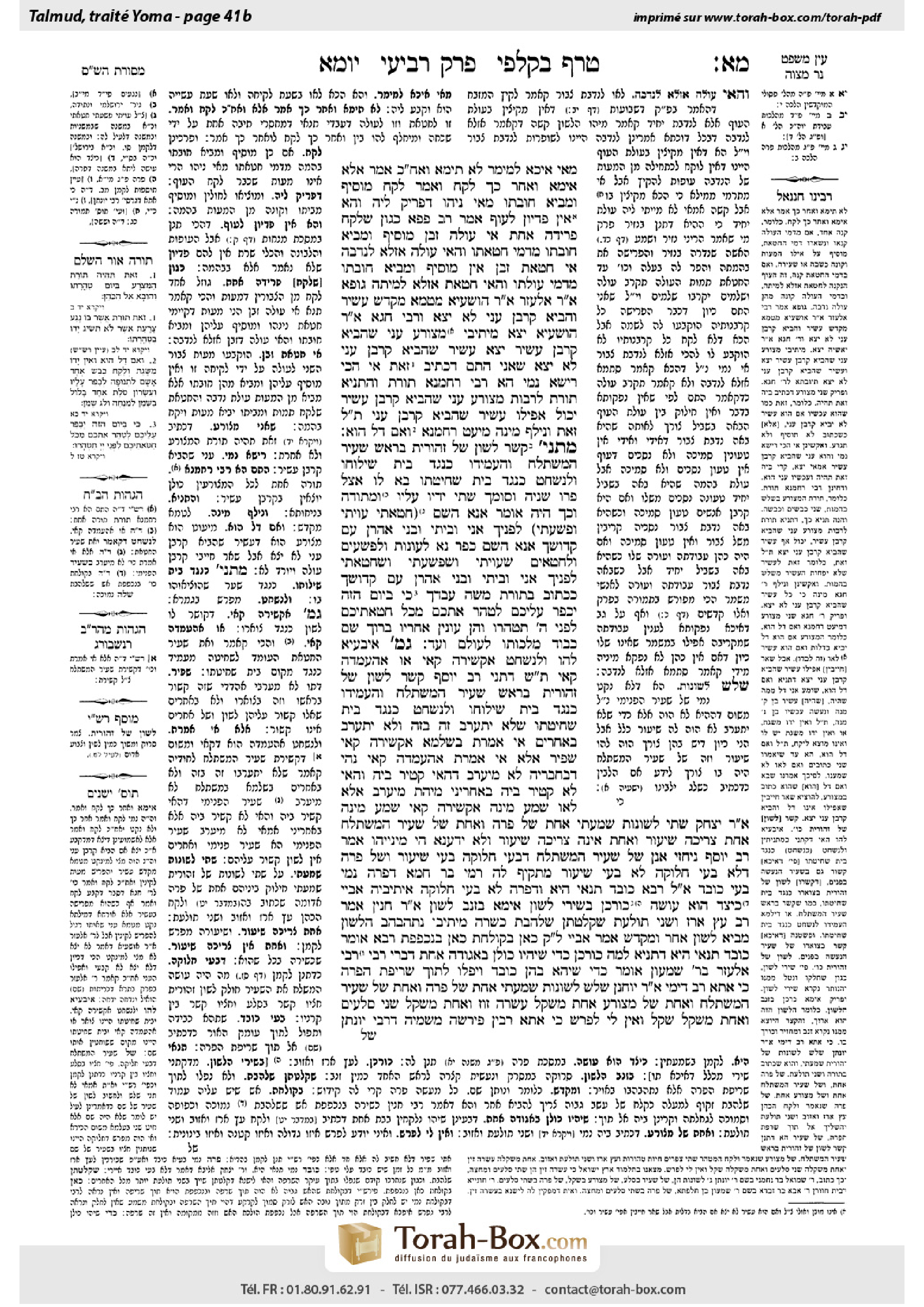
Yoma 41b: Talmud study for Daf Yomi
Daf Yomi is the daily study of one Talmud folio. Explore 37 tractates with scans, Hebrew text, Sefaria English and AI-generated French translations where annotated.
Passage selection and English or AI-generated French translation are available where the scan has annotations. Daf Study is independent of Torah-Box and Sefaria.
Browse Yoma · יומא · All tractatesYoma 41b text and translations
This page of Yoma includes the Aramaic text, an English translation and an AI-generated French translation, alongside the scan above.
יומא מ״א ב · Aramaic and Hebrew text
מַאי אִיכָּא לְמֵימַר? לָא תֵּימָא: וְאַחַר כָּךְ אָמַר, אֶלָּא אֵימָא: וְאַחַר כָּךְ לָקַח וְאָמַר.
לָקַח, מוֹסִיף וּמֵבִיא חוֹבָתוֹ מַאי נִיהוּ?!
דְּפָרֵיק לֵיהּ. וְהָא אֵין פִּדְיוֹן לָעוֹף!
אָמַר רַב פָּפָּא: כְּגוֹן שֶׁלָּקַח פְּרֵידָה אַחַת, אִי עוֹלָה זְבַן — מוֹסִיף וּמֵבִיא חוֹבָתוֹ מִדְּמֵי חַטָּאתוֹ, וְהַאי עוֹלָה אָזְלָא לִנְדָבָה. אִי חַטָּאת זְבַן — אֵין מוֹסִיף וּמֵבִיא חוֹבָתוֹ מִדְּמֵי עוֹלָתוֹ, וְהַאי חַטָּאת אָזְלָא לְמִיתָה.
גּוּפָא. אָמַר רַבִּי אֶלְעָזָר אָמַר רַבִּי הוֹשַׁעְיָא: מְטַמֵּא מִקְדָּשׁ עָשִׁיר וְהֵבִיא קׇרְבַּן עָנִי — לֹא יָצָא. וְרַבִּי חַגָּא אָמַר רַבִּי הוֹשַׁעְיָא: יָצָא.
מֵיתִיבִי: מְצוֹרָע עָנִי שֶׁהֵבִיא קׇרְבַּן עָשִׁיר — יָצָא, עָשִׁיר שֶׁהֵבִיא קׇרְבַּן עָנִי — לֹא יָצָא. שָׁאנֵי הָתָם, דִּכְתִיב: ״זֹאת״.
אִי הָכִי, רֵישָׁא נָמֵי! הָא רַבִּי רַחֲמָנָא ״תּוֹרַת״, וְהָתַנְיָא: ״תּוֹרַת״, לְרַבּוֹת מְצוֹרָע עָנִי שֶׁהֵבִיא קׇרְבַּן עָשִׁיר. יָכוֹל אֲפִילּוּ עָשִׁיר שֶׁהֵבִיא קׇרְבַּן עָנִי — תַּלְמוּד לוֹמַר: ״זֹאת״.
וְנֵילַף מִינַּהּ! מִיעֵט רַחֲמָנָא ״וְאִם דַּל הוּא״.
מַתְנִי׳ קָשַׁר לָשׁוֹן שֶׁל זְהוֹרִית בְּרֹאשׁ שָׂעִיר הַמִּשְׁתַּלֵּחַ, וְהֶעֱמִידוֹ כְּנֶגֶד בֵּית שִׁילּוּחוֹ, וְלַנִּשְׁחָט — כְּנֶגֶד בֵּית שְׁחִיטָתוֹ.
בָּא לוֹ אֵצֶל פָּרוֹ שְׁנִיָּה, וְסוֹמֵךְ שְׁתֵּי יָדָיו עָלָיו וּמִתְוַדֶּה, וְכָךְ הָיָה אוֹמֵר: אָנָא הַשֵּׁם! (חָטָאתִי עָוִיתִי וּפָשַׁעְתִּי) לְפָנֶיךָ אֲנִי וּבֵיתִי וּבְנֵי אַהֲרֹן עַם קְדוֹשֶׁךָ. אָנָא הַשֵּׁם! כַּפֶּר נָא לָעֲוֹנוֹת וְלַפְּשָׁעִים וְלַחֲטָאִים שֶׁעָוִיתִי וְשֶׁפָּשַׁעְתִּי וְשֶׁחָטָאתִי לְפָנֶיךָ אֲנִי וּבֵיתִי וּבְנֵי אַהֲרֹן עַם קְדוֹשֶׁךָ, כַּכָּתוּב בְּתוֹרַת מֹשֶׁה עַבְדֶּךָ: ״כִּי בַיּוֹם הַזֶּה יְכַפֵּר עֲלֵיכֶם לְטַהֵר אֶתְכֶם מִכֹּל חַטֹּאתֵיכֶם לִפְנֵי ה׳ תִּטְהָרוּ״, וְהֵן עוֹנִין אַחֲרָיו: ״בָּרוּךְ שֵׁם כְּבוֹד מַלְכוּתוֹ לְעוֹלָם וְעַד״.
גְּמָ׳ אִיבַּעְיָא לְהוּ: ״וְלַנִּשְׁחָט״ — אַקְּשִׁירָה קָאֵי, אוֹ אַהַעֲמָדָה קָאֵי?
תָּא שְׁמַע, דְּתָנֵי רַב יוֹסֵף: קָשַׁר לָשׁוֹן שֶׁל זְהוֹרִית בְּרֹאשׁ שָׂעִיר הַמִּשְׁתַּלֵּחַ, וְהֶעֱמִידוֹ כְּנֶגֶד בֵּית שִׁילּוּחוֹ, וְלַנִּשְׁחָט — כְּנֶגֶד בֵּית שְׁחִיטָתוֹ, שֶׁלֹּא יִתְעָרֵב זֶה בָּזֶה, וְלֹא יִתְעָרֵב בַּאֲחֵרִים.
אִי אָמְרַתְּ בִּשְׁלָמָא אַקְּשִׁירָה קָאֵי — שַׁפִּיר. אֶלָּא אִי אָמְרַתְּ אַהַעֲמָדָה קָאֵי, נְהִי דִּבְחַבְרֵיהּ לָא מִיעָרַב, דְּהַאי קְטִיר בֵּיהּ וְהַאי לָא קְטִיר בֵּיהּ, בְּאַחֲרִינֵי מִיהַת מִיעָרַב! אֶלָּא לָאו, שְׁמַע מִינַּהּ אַקְּשִׁירָה קָאֵי. שְׁמַע מִינַּהּ.
אָמַר רַבִּי יִצְחָק: שְׁתֵּי לְשׁוֹנוֹת שָׁמַעְתִּי, אַחַת שֶׁל פָּרָה, וְאַחַת שֶׁל שָׂעִיר הַמִּשְׁתַּלֵּחַ. אַחַת צְרִיכָה שִׁיעוּר, וְאַחַת אֵינָהּ צְרִיכָה שִׁיעוּר. וְלָא יָדַעְנָא הֵי מִינַּיְיהוּ.
אָמַר רַב יוֹסֵף, נִיחְזֵי אֲנַן: שֶׁל שָׂעִיר הַמִּשְׁתַּלֵּחַ דְּבָעֵי חֲלוּקָּה — בָּעֵי שִׁיעוּר, וְשֶׁל פָּרָה דְּלָא בָּעֵי חֲלוּקָּה — לָא בָּעֵי שִׁיעוּר.
מַתְקֵיף לַהּ רָמֵי בַּר חָמָא: דְּפָרָה נָמֵי בָּעֵי כּוֹבֶד! אֲמַר לֵיהּ רָבָא: כּוֹבֶד — תַּנָּאֵי הִיא.
וּדְפָרָה לָא בָּעֵי חֲלוּקָּה?! אֵיתִיבֵיהּ אַבָּיֵי: כֵּיצַד הוּא עוֹשֶׂה, כּוֹרְכָן בִּשְׁיָרֵי לָשׁוֹן! אֵימָא, בִּזְנַב לָשׁוֹן.
אָמַר רַבִּי חָנִין אָמַר רַב: עֵץ אֶרֶז וּשְׁנִי תּוֹלַעַת שֶׁקְּלָטָתַן שַׁלְהֶבֶת — כְּשֵׁרָה. מֵיתִיבִי: נִתְהַבְהֵב הַלָּשׁוֹן — מֵבִיא לָשׁוֹן אַחֵר וּמְקַדֵּשׁ!
אָמַר אַבָּיֵי, לָא קַשְׁיָא: כָּאן בְּקוֹלַחַת, כָּאן בְּנִכְפֶּפֶת.
רָבָא אוֹמֵר: כּוֹבֶד תַּנָּאֵי הִיא. דְּתַנְיָא: לָמָּה כּוֹרְכָן — כְּדֵי שֶׁיִּהְיוּ כּוּלָּן בַּאֲגוּדָּה אַחַת, דִּבְרֵי רַבִּי. רַבִּי אֶלְעָזָר בְּרַבִּי שִׁמְעוֹן אוֹמֵר: כְּדֵי שֶׁיְּהֵא בָּהֶן כּוֹבֶד, וְיִפְּלוּ לְתוֹךְ שְׂרֵיפַת הַפָּרָה.
כִּי אֲתָא רַב דִּימִי אָמַר רַבִּי יוֹחָנָן: שָׁלֹשׁ לְשׁוֹנוֹת שָׁמַעְתִּי, אַחַת שֶׁל פָּרָה, וְאַחַת שֶׁל שָׂעִיר הַמִּשְׁתַּלֵּחַ, וְאַחַת שֶׁל מְצוֹרָע. אַחַת מִשְׁקַל עֲשָׂרָה זוּז, וְאַחַת מִשְׁקַל שְׁנֵי סְלָעִים, וְאַחַת מִשְׁקַל שֶׁקֶל, וְאֵין לִי לְפָרֵשׁ.
כִּי אֲתָא רָבִין, פֵּירְשַׁהּ מִשְּׁמֵיהּ דְּרַבִּי יוֹנָתָן,
Yoma 41b · English translation
what can be said? According to this opinion, there is no inherent difficulty in the baraita that requires interpreting it as Rav Sheshet explained; read simply, it appears to contradict Rav Ḥisda’s ruling. The Gemara answers: The baraita should be emended: Do not say that the baraita says: If afterward he said. Rather, say that the baraita says: If afterward he took, i.e., purchased and consecrated the bird pair, and said.
The Gemara asks: How can the baraita be referring to a case where he had taken the birds for his offering? If so, the next statement in the baraita: He adds more money and brings his obligation of an animal sin-offering from the money set aside for his sin-offering, what does it mean? If he had taken them, then clearly he is not holding onto money with which to purchase them.
The Gemara suggests a solution: That statement in the baraita is referring to a case in which he redeemed the bird by transferring its sanctity to money that can then be used toward the purchase of an animal. The Gemara rejects this possibility: But there is no redemption for a bird, so this could not possibly be the case of the baraita.
Rav Pappa said: That statement in the baraita is referring to a case where he took only one bird. As such, the baraita means: If he purchased the bird for his burnt-offering, then he should add more money and bring his obligation of an animal sin-offering from the money he had intended to use to purchase the second bird for his sin-offering. And this bird, which was purchased for his burnt-offering, goes toward a free-will offering. However, if he purchased the bird for his sin-offering, then he cannot add more money and bring his obligation of an animal sin-offering from the money he had intended to use to purchase the second bird for his burnt-offering. And this bird, which was purchased for his sin-offering, goes to its death, i.e., it is left to die, as is the halakha of a sin-offering whose owner has achieved atonement with another offering.
The Gemara proceeds to examine the dispute cited above. Returning to the matter itself, Rabbi Elazar said that Rabbi Hoshaya said: A wealthy person who ritually impurifies the Temple, and brings the offering that a poor person is required to bring, i.e., a bird pair, he does not fulfill his obligation. Rabbi Ḥaga said that Rabbi Hoshaya said: He does fulfill his obligation.
The Gemara raises an objection from a mishna: A poor leper who brings the offering that a wealthy person is required to bring fulfills his obligation. A wealthy person who brings the offering that a poor person is required to bring does not fulfill his obligation. The Gemara answers: It is different there, in the case of leper, as it is written: “This shall be the law of the leper on the day of his purification” (Leviticus 14:2). The word “this” serves to emphasize that the details of the purification process must be carried out without any deviation.
The Gemara asks: If so, if any deviation is unacceptable, then in the case of the first clause, in which a poor leper brings the offering that a wealthy person is required to bring, he should also not fulfill his obligation. The Gemara answers: The Merciful One includes that case by stating: “The law of” (Leviticus 14:2). As it was taught in a baraita: “The law of” was stated in order to include a poor leper who brought the offering that a wealthy person is required to bring. One might have thought that even a wealthy person who brought the offering that a poor person is required to bring also fulfills his obligation. Therefore, the verse states “this” to indicate that the wealthy person may not deviate from what is required of him.
The Gemara asks: And let us derive the halakha for the parallel case of a sliding-scale offering from the halakha with regard to the offering of leper. Consequently, in the case of a sliding-scale offering, if a wealthy person brings the offering that a poor person is required to bring, he does fulfill his obligation, contrary to Rabbi Ḥaga’s opinion. The Gemara answers: With regard to a sliding-scale offering, the Merciful One excludes the validity of such an offering by stating: “If he be poor” (Leviticus 14:21). The word “he” serves to emphasize that the offering required for a poor person is valid only for him.
MISHNA: The High Priest tied a strip of crimson wool upon the head of the scapegoat and positioned the goat opposite the place from which it was dispatched, i.e., near the gate through which it was taken; and the same was done to the goat that was to be slaughtered, opposite the place of its slaughter.
He comes and stands next to his bull a second time, and places his two hands upon it, and confesses. And this is what he would say: Please God, I have sinned, I have done wrong, and I have rebelled before You, I and my family and the children of Aaron, your sacred people. Please God, grant atonement, please, for the sins, and for the wrongs, and for the rebellions that I have sinned, and done wrong, and rebelled before You, I, and my family, and the children of Aaron, your sacred people, as it is written in the Torah of Moses, your servant: “For on this day atonement shall be made for you to cleanse you of all your sins; you shall be clean before the Lord” (Leviticus 16:30). And they, the priests and the people in the Temple courtyard, respond after him upon hearing the name of God: Blessed be the name of His glorious kingdom forever and all time.
GEMARA: A dilemma was raised before them: The mishna teaches two halakhot with regard to the scapegoat: A strip of crimson is tied to it, and it is positioned opposite the place from which it will be dispatched. When the mishna continues: And the same is done to the slaughtered one opposite its place of slaughter, is it referring to the tying of a strip of crimson, and it is teaching that a strip is also tied on the goat being sacrificed around the place of its slaughter, i.e., its neck? Or, is it referring to the positioning of the goat, and it is teaching that the goat being sacrificed should be stood opposite the place where it will be slaughtered?
Come and hear a resolution from a baraita that Rav Yosef taught: He ties a strip of crimson to the head of the scapegoat and positions it opposite the place from which it will be sent; and the same is done to the slaughtered one, opposite its place of slaughter. This is done for two reasons: So that each goat, i.e., the goat for God and the goat for Azazel, cannot become mixed up with the other one, and so that the goats cannot become mixed up with other goats.
The Gemara explains the proof from the baraita. Granted, if you say that the baraita is referring to tying, it works out well. Since both goats have a strip tied to them and to different places upon them, they will always be distinguishable both from one another and also from any other animals. But, if you say that it is referring to positioning the goat being sacrificed, but no strip of crimson is tied to it, granted, each one cannot be mixed up with its counterpart, since this one, the goat to be sent away, has a strip of crimson tied to it, and that one, the goat being sacrificed, does not have a strip of crimson tied to it. However, the goat being sacrificed could still be mixed up with other animals, since it has no strip tied to it. Rather, must one not conclude from the baraita that it is referring to tying? The Gemara confirms: Indeed, learn from it that it is so.
The Gemara discusses halakhot pertaining to the strip of crimson wool: Rabbi Yitzḥak said: I heard a teaching that there is a distinction between two strips of crimson, one of the red heifer and one of the scapegoat. One of them requires a minimum amount, and one does not require a minimum amount. But I do not know to which of them the requirement to have a minimum amount pertains.
Rav Yosef said: Let us see and examine the matter. It is logical that since the strip of the scapegoat, which requires division, it requires a minimum amount to be able to achieve this. Before the goat descends into Azazel, the strip is cut into two; half of it is tied between the goat’s horns and half of it is tied to a nearby rock. However, the crimson strip of the heifer does not require division, therefore it does not require a minimum amount.
Rami bar Ḥama strongly objects to this: The strip of the heifer also requires a minimum amount because it needs to have weight, in order to be heavy enough to fall into the heart of the fire in which the heifer is being burned (see Numbers 19:6). Rava said to him: The requirement for the strip to have weight is the subject of a dispute between tanna’im, and Rav Yosef holds in accordance with the opinion that it does not need to have weight.
The Gemara asks: Is it true that the strip of the red heifer does not require division? Abaye raised an objection to this from a mishna in tractate Para: How does he perform the burning of the items that are burned together with the red heifer? He wraps the cedar wood and the hyssop with the remnants of the strip of crimson and casts them into the fire in which the heifer is being burnt. The reference to the remnant of the strip of crimson indicates that only part is burned. This suggests that it also requires division. The Gemara answers: Emend the mishna in tractate Para. Instead of saying: The remnants of the strip, say: It was done with the tail end of the strip of crimson.
The Torah requires that as part of the preparation of the ashes of the red heifer, cedar wood, hyssop, and a strip of crimson be cast “into the midst of the burning of the heifer” (Number 19:6). The Gemara discusses what happens if these items burn before actually reaching the burning mass of the heifer: Rabbi Ḥanin said that Rav said: If the cedar wood and the strip of crimson were caught by the flame of the burning heifer, and they burned in the air before coming into contact with the mass of the heifer itself, it is valid. The Gemara raises an objection from a baraita: If the strip of crimson was singed before reaching the heart of fire, he brings another strip and sanctifies it by ensuring it burns together with the mass of the heifer.
Abaye said: This is not difficult: Here, the baraita is dealing with a case in which the flame blazes high. Since the strip was still a significant distance from the burning mass, its burning is invalid. There, Rabbi Ḥanin is dealing with a case in which the flame blazes low, in close proximity to the mass of the heifer. Therefore, it is considered to have been burned together with it and is valid.
Rava said: The baraita and Rabbi Ḥanin’s ruling follow different opinions with regard to whether the strip of crimson needs to have weight. The baraita assumes the items must reach the heart of the fire; therefore, they must have weight. Rabbi Ḥanin assumes the items don’t need to reach the heart of the fire; therefore, they do not need to have weight. The issue of whether the strip of crimson needs to have weight is a dispute between tanna’im, as it was taught in a baraita: Why does he wrap the cedar wood and the hyssop together using the strip of crimson? So that they will all be in a single bundle and burn simultaneously, as implied by the fact the Torah mentions all three together; this is the statement of Rabbi Yehuda HaNasi. Rabbi Elazar, son of Rabbi Shimon, says: So that they will have weight and fall into the burning heifer.
When Rav Dimi came from Eretz Yisrael to Babylonia he said in the name of Rabbi Yoḥanan: I heard a teaching that there is a distinction between three strips of crimson: One of the red heifer, and one of the scapegoat, and one of the leper. One of them must have the weight of ten zuz; and one of them must have the weight of two sela, which is eight zuz; and one of them must have the weight of a shekel, which is two zuz, but I cannot explain which is which.
When Ravin came from Eretz Yisrael to Babylonia he explained in the name of Rabbi Yonatan which weight each item requires, as follows:
Yoma 41b · Traduction française (IA)
Que peut-on répondre ? Selon cette opinion, la baraïta ne présente aucune difficulté intrinsèque qui oblige à l’interpréter comme Rav Sheshet l’a expliqué ; prise au sens simple, elle semble contredire la décision de Rav Ḥisda. La Guemara répond : Il faut corriger la baraïta. Au lieu de lire : « S’il a ensuite dit », il faut lire : « S’il a ensuite pris », c’est-à-dire s’il a acheté et consacré la paire d’oiseaux, et qu’il a dit.
La Guemara demande : Comment la baraïta pourrait-elle parler d’un cas où il avait pris les oiseaux pour son offrande ? Si tel était le cas, que signifie la déclaration suivante de la baraïta : « Il ajoute de l’argent et apporte son obligation d’un sacrifice expiatoire animal avec l’argent mis de côté pour son sacrifice expiatoire » ? S’il les avait pris, il est clair qu’il ne lui reste pas d’argent pour les acheter.
La Guemara propose une solution : Cette déclaration de la baraïta concerne un cas où il a racheté l’oiseau en transférant sa sainteté à de l’argent, qui peut ensuite servir à l’achat d’un animal. La Guemara rejette cette possibilité : Mais un oiseau ne peut pas être racheté ; la baraïta ne peut donc pas parler de ce cas.
Rav Pappa dit : Cette déclaration de la baraïta concerne un cas où il n’a pris qu’un seul oiseau. La baraïta signifie donc : S’il a acheté l’oiseau pour son holocauste, il doit ajouter de l’argent et apporter son obligation d’un sacrifice expiatoire animal avec l’argent qu’il comptait utiliser pour acheter le second oiseau, destiné à son sacrifice expiatoire. Quant à cet oiseau, acheté pour son holocauste, il est affecté à une offrande volontaire. En revanche, s’il a acheté l’oiseau pour son sacrifice expiatoire, il ne peut pas ajouter de l’argent et apporter son obligation d’un sacrifice expiatoire animal avec l’argent qu’il comptait utiliser pour acheter le second oiseau, destiné à son holocauste. Quant à cet oiseau, acheté pour son sacrifice expiatoire, il est voué à la mort, c’est-à-dire qu’on le laisse mourir, conformément à la halakha applicable au sacrifice expiatoire dont le propriétaire a obtenu l’expiation au moyen d’une autre offrande.
La Guemara examine ensuite la controverse citée plus haut. Revenant au sujet lui-même, Rabbi Elazar dit au nom de Rabbi Hoshaya : Une personne aisée qui, après avoir contracté une impureté rituelle dans le Temple, apporte l’offrande qu’une personne pauvre est tenue d’apporter, c’est-à-dire une paire d’oiseaux, ne s’acquitte pas de son obligation. Rabbi Ḥaga dit au nom de Rabbi Hoshaya : Elle s’acquitte de son obligation.
La Guemara soulève une objection à partir d’une Michna : Un lépreux pauvre qui apporte l’offrande qu’une personne aisée est tenue d’apporter s’acquitte de son obligation. Une personne aisée qui apporte l’offrande qu’une personne pauvre est tenue d’apporter ne s’acquitte pas de son obligation. La Guemara répond : Le cas du lépreux est différent, car il est écrit : « Telle sera la loi du lépreux au jour de sa purification » (Lévitique 14:2). Le mot « telle » souligne que les détails du processus de purification doivent être respectés sans aucun écart.
La Guemara demande : Si tel est le cas, si aucun écart n’est acceptable, alors, dans le premier membre de la Michna, où un lépreux pauvre apporte l’offrande qu’une personne aisée est tenue d’apporter, il ne devrait pas non plus s’acquitter de son obligation. La Guemara répond : Le Miséricordieux inclut ce cas en disant « la loi de » (Lévitique 14:2). En effet, il a été enseigné dans une baraïta : L’expression « la loi de » a été énoncée pour inclure le cas d’un lépreux pauvre qui apporte l’offrande qu’une personne aisée est tenue d’apporter. On aurait pu penser qu’une personne aisée qui apporte l’offrande qu’une personne pauvre est tenue d’apporter s’acquitte elle aussi de son obligation. Le verset dit donc « telle », pour indiquer que la personne aisée ne peut pas s’écarter de ce qui est exigé d’elle.
La Guemara demande : Ne peut-on pas déduire la halakha relative au cas parallèle d’une offrande à échelons de celle qui concerne l’offrande du lépreux ? Par conséquent, dans le cas d’une offrande à échelons, si une personne aisée apporte l’offrande qu’une personne pauvre est tenue d’apporter, elle s’acquitte bien de son obligation, contrairement à l’opinion de Rabbi Ḥaga. La Guemara répond : En ce qui concerne une offrande à échelons, le Miséricordieux exclut la validité d’une telle offrande en disant : « S’il est pauvre » (Lévitique 14:21). Le mot « il » souligne que l’offrande prescrite pour une personne pauvre n’est valable que pour elle.
MICHNA : Le Grand Prêtre attache un fil de laine cramoisie sur la tête du bouc émissaire et place celui-ci en face de l’endroit d’où il sera envoyé, c’est-à-dire près de la porte par laquelle on le fera sortir ; il fait de même pour le bouc destiné à être égorgé, en le plaçant en face de l’endroit où il sera égorgé.
Il revient se tenir une seconde fois auprès de son taureau, pose ses deux mains sur lui et confesse. Voici ce qu’il disait : « De grâce, ô Dieu, j’ai péché, j’ai commis des fautes et je me suis rebellé devant Toi, moi, ma famille et les enfants d’Aaron, Ton peuple saint. De grâce, ô Dieu, accorde l’expiation, je T’en prie, pour les péchés, les fautes et les rébellions par lesquels j’ai péché, commis des fautes et me suis rebellé devant Toi, moi, ma famille et les enfants d’Aaron, Ton peuple saint, comme il est écrit dans la Torah de Moïse, Ton serviteur : “Car en ce jour, on fera l’expiation pour vous afin de vous purifier de tous vos péchés ; vous serez purs devant le Seigneur” » (Lévitique 16:30). Après qu’il a prononcé le nom de Dieu, les prêtres et le peuple présents dans la cour du Temple lui répondent : « Béni soit le nom de Son glorieux royaume pour toujours et à jamais. »
GUEMARA : Une question leur fut posée : La Michna enseigne deux halakhot au sujet du bouc émissaire : on lui attache un fil de laine cramoisie et on le place en face de l’endroit d’où il sera envoyé. Lorsque la Michna poursuit : « On fait de même pour celui qui sera égorgé, en face de l’endroit où il sera égorgé », cela concerne-t-il le fait d’attacher un fil de laine cramoisie, et enseigne-t-elle qu’on attache également un fil au bouc destiné au sacrifice, autour du cou, à l’endroit où il sera égorgé ? Ou bien cela concerne-t-il le placement du bouc, et enseigne-t-elle qu’il faut placer celui destiné au sacrifice en face de l’endroit où il sera égorgé ?
Viens et entends une réponse tirée d’une baraïta enseignée par Rav Yosef : On attache un fil de laine cramoisie sur la tête du bouc émissaire et on le place en face de l’endroit d’où il sera envoyé ; on fait de même pour celui qui sera égorgé, en le plaçant en face de l’endroit où il sera égorgé. Cela se fait pour deux raisons : afin que les deux boucs, c’est-à-dire le bouc pour Dieu et le bouc pour Azazel, ne soient pas confondus l’un avec l’autre, et afin qu’ils ne soient pas confondus avec d’autres boucs.
La Guemara explique ce que la baraïta permet de démontrer. Il est logique que, si tu dis que la baraïta parle de l’attachement du fil, cela s’explique bien. Puisqu’un fil est attaché à chacun des deux boucs, à des endroits différents de leur corps, ils resteront toujours reconnaissables, aussi bien l’un par rapport à l’autre que par rapport aux autres animaux. En revanche, si tu dis qu’elle parle du placement du bouc destiné au sacrifice, sans qu’un fil de laine cramoisie y soit attaché, il est vrai que les deux boucs ne risquent pas d’être confondus l’un avec l’autre : celui-ci, le bouc qui doit être envoyé, porte un fil de laine cramoisie, tandis que celui-là, le bouc destiné au sacrifice, n’en porte pas. Cependant, le bouc destiné au sacrifice pourrait encore être confondu avec d’autres animaux, puisqu’aucun fil n’y est attaché. Ne faut-il donc pas conclure de la baraïta qu’elle parle de l’attachement du fil ? La Guemara confirme : En effet, conclus-en qu’il en est ainsi.
La Guemara examine les halakhot relatives au fil de laine cramoisie : Rabbi Yitzḥak dit : J’ai entendu un enseignement selon lequel il existe une distinction entre deux fils de laine cramoisie, l’un pour la vache rousse et l’autre pour le bouc émissaire. L’un doit avoir une quantité minimale, tandis que l’autre n’est soumis à aucune quantité minimale. Mais je ne sais pas auquel des deux s’applique l’exigence d’une quantité minimale.
Rav Yosef dit : Examinons la question. Il est logique que le fil du bouc émissaire, qui doit être divisé, soit soumis à une quantité minimale afin que cela soit possible. Avant que le bouc ne descende à Azazel, on coupe le fil en deux : une moitié est attachée entre les cornes du bouc et l’autre à un rocher voisin. En revanche, le fil cramoisi de la vache rousse n’a pas besoin d’être divisé ; il n’est donc soumis à aucune quantité minimale.
Rami bar Ḥama s’y oppose vigoureusement : Le fil de la vache rousse doit lui aussi avoir une quantité minimale, car il doit avoir du poids pour être assez lourd et tomber au cœur du feu dans lequel la vache est brûlée (voir Nombres 19:6). Rava lui dit : L’exigence selon laquelle le fil doit avoir du poids fait l’objet d’une controverse entre des tannaïm, et Rav Yosef suit l’opinion selon laquelle il n’a pas besoin d’avoir du poids.
La Guemara demande : Est-il vrai que le fil de la vache rousse n’a pas besoin d’être divisé ? Abaye soulève une objection à partir d’une Michna du traité Para : Comment procède-t-on pour brûler les objets qui sont brûlés avec la vache rousse ? On enveloppe le bois de cèdre et l’hysope avec les restes du fil de laine cramoisie, puis on les jette dans le feu où la vache est brûlée. La référence aux restes du fil de laine cramoisie indique qu’on n’en brûle qu’une partie. Cela suggère que le fil doit lui aussi être divisé. La Guemara répond : Il faut corriger la Michna du traité Para. Au lieu de dire : « Les restes du fil », il faut dire : « On le faisait avec l’extrémité du fil de laine cramoisie. »
La Torah exige que, dans le cadre de la préparation des cendres de la vache rousse, du bois de cèdre, de l’hysope et un fil de laine cramoisie soient jetés « au milieu du feu où brûle la vache » (Nombres 19:6). La Guemara examine ce qui se passe si ces éléments brûlent avant d’atteindre effectivement la masse en combustion de la vache : Rabbi Ḥanin dit au nom de Rav : Si le bois de cèdre et le fil de laine cramoisie sont pris dans la flamme de la vache en combustion et brûlent dans l’air avant d’entrer en contact avec sa masse en combustion, cela est valide. La Guemara soulève une objection à partir d’une baraïta : Si le fil de laine cramoisie a été roussi avant d’atteindre le cœur du feu, on en apporte un autre et on le consacre en veillant à ce qu’il brûle avec la masse de la vache.
Abaye dit : Il n’y a pas de difficulté : ici, la baraïta traite d’un cas où la flamme monte haut. Comme le fil était encore à bonne distance de la masse en combustion, le fait qu’il ait brûlé ne satisfait pas à l’exigence. Là, Rabbi Ḥanin traite d’un cas où la flamme monte peu, à proximité de la masse de la vache. Le fil est donc considéré comme ayant brûlé avec elle, et cela est valide.
Rava dit : La baraïta et la décision de Rabbi Ḥanin suivent des opinions différentes sur la question de savoir si le fil de laine cramoisie doit avoir du poids. Selon la baraïta, les éléments doivent atteindre le cœur du feu ; ils doivent donc avoir du poids. Selon Rabbi Ḥanin, les éléments n’ont pas besoin d’atteindre le cœur du feu ; ils n’ont donc pas besoin d’avoir du poids. La question de savoir si le fil de laine cramoisie doit avoir du poids fait l’objet d’une controverse entre des tannaïm, comme il a été enseigné dans une baraïta : Pourquoi enveloppe-t-on ensemble le bois de cèdre et l’hysope au moyen du fil de laine cramoisie ? Pour qu’ils forment tous un seul faisceau et brûlent simultanément, comme le laisse entendre le fait que la Torah les mentionne tous les trois ensemble ; telle est l’opinion de Rabbi Yehuda HaNasi. Rabbi Elazar, fils de Rabbi Shimon, dit : Pour qu’ils aient du poids et tombent dans le feu où brûle la vache.
Lorsque Rav Dimi vint d’Eretz Israël en Babylonie, il dit au nom de Rabbi Yoḥanan : J’ai entendu un enseignement selon lequel il existe une distinction entre trois fils de laine cramoisie : l’un pour la vache rousse, l’un pour le bouc émissaire et l’un pour le lépreux. L’un doit peser dix zouz, l’un doit peser deux séla, soit huit zouz, et l’un doit peser un shekel, soit deux zouz ; mais je ne peux pas préciser lequel correspond à chacun.
Lorsque Ravin vint d’Eretz Israël en Babylonie, il précisa au nom de Rabbi Yonatan le poids requis pour chacun de ces fils, comme suit :
Traduction française générée par IA à partir de l’édition anglaise de Sefaria. Vérifie toujours un passage avec le texte source.
Text from Sefaria: William Davidson Edition - Vocalized Aramaic (CC BY NC); William Davidson Edition - English (CC BY NC).