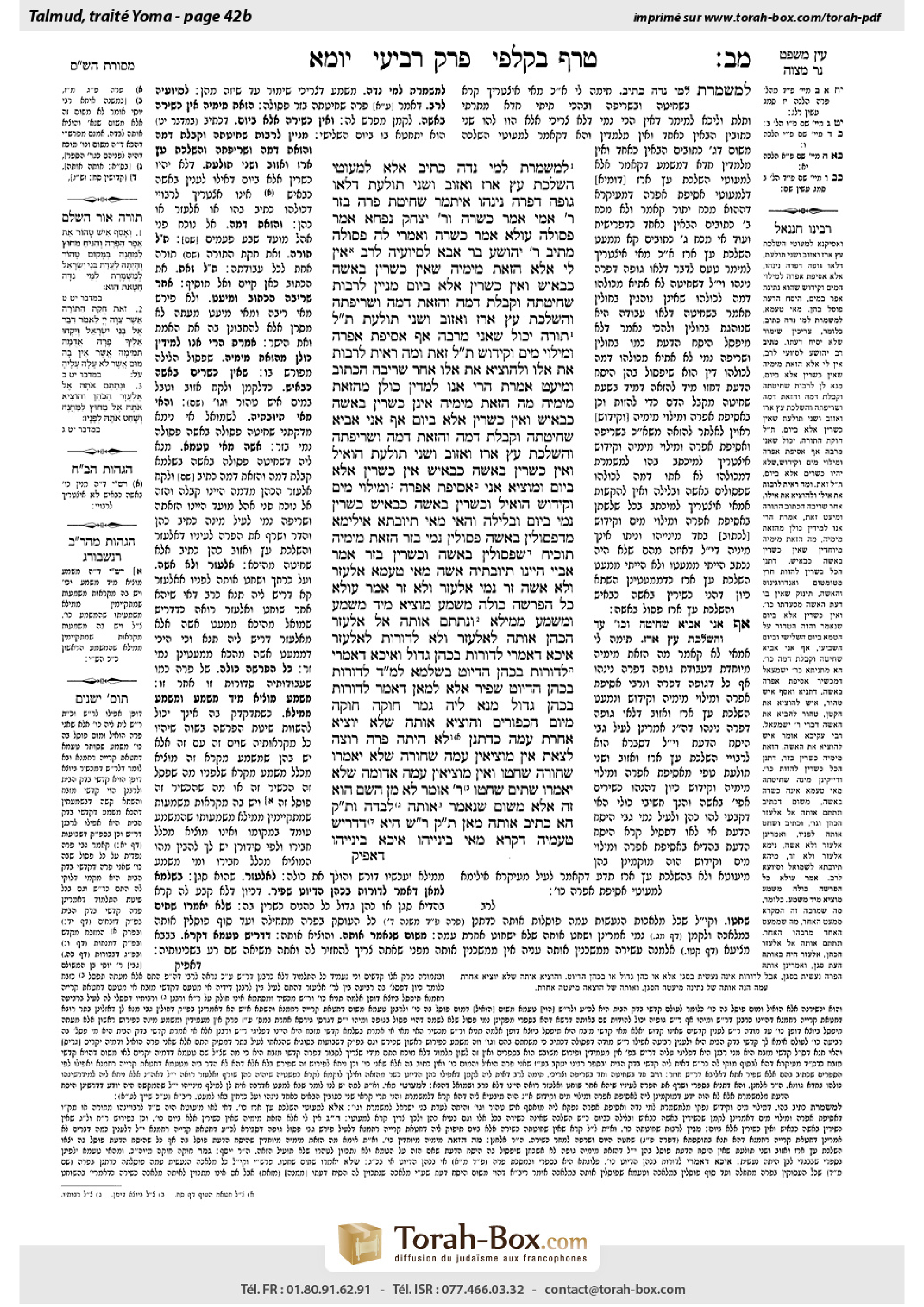
Yoma 42b: Talmud study for Daf Yomi
Daf Yomi is the daily study of one Talmud folio. Explore 37 tractates with scans, Hebrew text, Sefaria English and AI-generated French translations where annotated.
Passage selection and English or AI-generated French translation are available where the scan has annotations. Daf Study is independent of Torah-Box and Sefaria.
Browse Yoma · יומא · All tractatesYoma 42b text and translations
This page of Yoma includes the Aramaic text, an English translation and an AI-generated French translation, alongside the scan above.
יומא מ״ב ב · Aramaic and Hebrew text
״לְמִשְׁמֶרֶת לְמֵי נִדָּה״ כְּתִיב. אֶלָּא לְמַעוֹטֵי הַשְׁלָכַת עֵץ אֶרֶז וְאֵזוֹב וּשְׁנִי תוֹלָעַת, דְּלָאו גּוּפַהּ דְּפָרָה נִינְהוּ.
אִיתְּמַר: שְׁחִיטַת פָּרָה בְּזָר, רַבִּי אַמֵּי אָמַר: כְּשֵׁרָה, וְרַבִּי יִצְחָק נַפָּחָא אָמַר: פְּסוּלָה. עוּלָּא אָמַר: כְּשֵׁרָה, וְאָמְרִי לַהּ: פְּסוּלָה.
מֵתִיב רַבִּי יְהוֹשֻׁעַ בַּר אַבָּא לְסַיּוֹעֵיהּ לְרַב: אֵין לִי אֶלָּא הַזָּאַת מֵימֶיהָ שֶׁאֵין כְּשֵׁרִין בָּאִשָּׁה כְּבָאִישׁ, וְאֵין כְּשֵׁרִין אֶלָּא בַּיּוֹם.
מִנַּיִין לְרַבּוֹת שְׁחִיטָתָהּ וְקַבָּלַת דָּמָהּ וְהַזָּאַת דָּמָהּ וּשְׂרֵיפָתָהּ וְהַשְׁלָכַת עֵץ אֶרֶז וְאֵזוֹב וּשְׁנִי תוֹלָעַת — תַּלְמוּד לוֹמַר: ״תּוֹרָה״. יָכוֹל שֶׁאֲנִי מְרַבֶּה אַף אֲסִיפַת אֶפְרָהּ וּמִילּוּי מַיִם וְקִידּוּשׁ — תַּלְמוּד לוֹמַר: ״זֹאת״.
וּמָה רָאִיתָ לְרַבּוֹת אֶת אֵלּוּ, וּלְהוֹצִיא אֶת אֵלּוּ? אַחַר שֶׁרִיבָּה הַכָּתוּב וּמִיעֵט, אָמְרַתְּ: הֲרֵי אָנוּ לְמֵדִין כּוּלָּן מֵהַזָּאַת מֵימֶיהָ, מָה הַזָּאַת מֵימֶיהָ אֵינָן כְּשֵׁרִין בָּאִשָּׁה כְּבָאִישׁ, וְאֵין כְּשֵׁרִין אֶלָּא בַּיּוֹם — אַף אֲנִי אָבִיא שְׁחִיטָתָהּ וְקַבָּלַת דָּמָהּ, וְהַזָּאַת דָּמָהּ וּשְׂרֵיפָתָהּ, וְהַשְׁלָכַת עֵץ אֶרֶז וְאֵזוֹב וּשְׁנִי תוֹלָעַת
הוֹאִיל וְאֵין כְּשֵׁרִין בָּאִשָּׁה כְּבָאִישׁ — אֵין כְּשֵׁרִין אֶלָּא בַּיּוֹם. וּמוֹצִיא אֲנִי אֲסִיפַת אֶפְרָהּ וּמִילּוּי מַיִם וְקִידּוּשׁ, הוֹאִיל וּכְשֵׁרִין בָּאִשָּׁה כְּבָאִישׁ — כְּשֵׁרִין נָמֵי בַּיּוֹם וּבַלַּיְלָה.
וְהַאי מַאי תְּיוּבְתָּא? אִילֵּימָא מִדִּפְסוּלִין בָּאִשָּׁה פְּסוּלִין נָמֵי בְּזָר, הַזָּאַת מֵימֶיהָ תּוֹכִיחַ, שֶׁפְּסוּלִין בָּאִשָּׁה וּכְשֵׁרִין בְּזָר!
אָמַר אַבָּיֵי, הַיְינוּ תְּיוּבְתֵּיהּ: אִשָּׁה מַאי טַעְמָא? ״אֶלְעָזָר״ — וְלֹא אִשָּׁה, זָר נָמֵי: ״אֶלְעָזָר״ — וְלֹא זָר.
אָמַר עוּלָּא: כׇּל הַפָּרָשָׁה כּוּלָּהּ, מַשְׁמָע מוֹצִיא מִיַּד מַשְׁמָע, וּמַשְׁמָע מִמֵּילָא.
״וּנְתַתֶּם אוֹתָהּ אֶל אֶלְעָזָר הַכֹּהֵן״ — אוֹתָהּ לְאֶלְעָזָר, וְלֹא לְדוֹרוֹת לְאֶלְעָזָר. אִיכָּא דְּאָמְרִי: לְדוֹרוֹת בְּכֹהֵן גָּדוֹל, וְאִיכָּא דְּאָמְרִי: לְדוֹרוֹת בְּכֹהֵן הֶדְיוֹט.
בִּשְׁלָמָא לְמַאן דְּאָמַר לְדוֹרוֹת בְּכֹהֵן הֶדְיוֹט — שַׁפִּיר. אֶלָּא לְמַאן דְּאָמַר לְדוֹרוֹת בְּכֹהֵן גָּדוֹל, מְנָא לֵיהּ? גָּמַר ״חוּקָּה״ ״חוּקָּה״ מִיּוֹם הַכִּפּוּרִים.
״וְהוֹצִיא אוֹתָהּ״ — שֶׁלֹּא יוֹצִיא אַחֶרֶת עִמָּהּ. כְּדִתְנַן: לֹא הָיְתָה פָּרָה רוֹצָה לָצֵאת — אֵין מוֹצִיאִין עִמָּהּ שְׁחוֹרָה, שֶׁלֹּא יֹאמְרוּ שְׁחוֹרָה שָׁחֲטוּ. וְאֵין מוֹצִיאִין עִמָּהּ אֲדוּמָּה, שֶׁלֹּא יֹאמְרוּ שְׁתַּיִם שָׁחֲטוּ. רַבִּי אוֹמֵר: לֹא מִן הַשֵּׁם הוּא זֶה, אֶלָּא מִשּׁוּם שֶׁנֶּאֱמַר: ״אוֹתָהּ״, לְבַדָּהּ.
וְתַנָּא קַמָּא: הָא כְּתִיב ״אוֹתָהּ״? מַאן תַּנָּא קַמָּא — רַבִּי שִׁמְעוֹן הִיא, דְּדָרֵישׁ טַעְמֵיהּ דִּקְרָא. מַאי בֵּינַיְיהוּ? אִיכָּא בֵּינַיְיהוּ,
Yoma 42b · English translation
this is mistaken because: “And it shall be kept for the congregation of the children of Israel for a water of sprinkling” (Numbers 19:9) was written, and the use of the term “shall be kept” indicates that one must maintain attention even during these stages. Rather, it is to exclude from the requirement the stage of casting the cedar wood, and the hyssop, and the strip of crimson into the fire. The requirement does not apply to this stage, as they do not pertain to the heifer itself.
An amoraic dispute was stated with regard to the slaughter of the red heifer by a non-priest: Rabbi Ami said: It is valid. And Rabbi Yitzḥak Nappaḥa said: It is invalid. Ulla said: It is valid, but some say that he said: It is invalid.
Rabbi Yehoshua bar Abba raised an objection to the opinion of Shmuel that the slaughter is valid, thereby providing a support for opinion of Rav, who holds that it is invalid: I have a derivation only with regard to the sprinkling of the red heifer’s waters, that they are not valid if sprinkled by a woman as opposed to when sprinkled by a man, and that the sprinkling is valid only during the day. The verse states: “And the pure one shall sprinkle upon the impure on the third day” (Numbers 19:19). The use of the terms “pure one,” in the masculine form, and “day,” indicate that the sprinkling is valid only if performed by a man during the day.
From where is it derived to include the following stages among those stages that must be performed by a man during the day in order to be valid: Its slaughter; and the collection of its blood; and the sprinkling of its blood; and its burning; and the casting of the cedar wood, and the hyssop, and the strip of crimson into the fire? The verse states: “Law” (Numbers 19:2), at the beginning of the section on the red heifer, to indicate that the same rules govern all stages of the rite. As such, I might have thought that I should include even the collection of its ashes, and the filling of waters, and the sanctification. Therefore, the verse states: “This is the statute of the law” (Numbers 19:2). The word this limits the scope of the requirement that the rite must be performed by a man and during the day from applying to these stages.
And if the word “law” serves to include all stages in the halakha and the word “this” serves to exclude some stages, what did you see to include these stages and to exclude those? After noting that the verse includes some stages and excludes others, you should say the following logical argument: Indeed, we learn all the stages from the sprinkling of its waters: Just as the sprinkling of its waters is not valid if done by a woman as opposed to when done by a man, and it is valid only during the day, so too I will include in the same requirement its slaughter; and the collection of its blood; and the sprinkling of its blood; and its burning; and the casting of the cedar wood, and the hyssop, and the strip of crimson.
Since these stages are not valid if done by a woman as opposed to when done by a man, as indicated by the verses that state that they are to be done by a serving priest, who by definition is a man, then it is logical to also include these cases in the halakha that they are valid only during the day. And I exclude the collection of its ashes, and the filling of water, and the sanctification, since these stages are valid when done by a woman as they are when done by a man, as the verses never suggest a requirement that they be done by a man. Therefore, it is logical that these stages are valid both during the day and during the night.
Rabbi Yehoshua bar Abba originally cited the baraita to challenge Shmuel’s opinion that the slaughter of the red heifer by a non-priest is valid. The Gemara asks: And what is the challenge from this baraita? If we say that since that these stages are invalid if done by a woman one should conclude that they are also invalid if done by a non-priest, then let the stage of sprinkling the waters serve as a proof that one should not necessarily connect these two halakhot, because the sprinkling is invalid if done by a woman and yet valid if done by a non-priest. If so, what was the basis for the challenge?
Abaye said: This is the challenge: With regard to a woman, what is the reason she may not perform these stages? The verse states “Elazar,” indicating the requirement for a man and not a woman. The same logic should also apply to a non-priest: The verse states: “Elazar,” indicating the requirement for a priest and not a non-priest.
The Gemara considers other aspects of the rite of the red heifer: Ulla said: Throughout the entire passage of the red heifer, certain conditions apply to some stages of the rite, but not to others. These conditions are derived from the phrasing of the verses. In some stages, the conditions implied by the phrasing of the verse preclude the application of conditions that are implied by a previous verse describing a previous stage. A verse describing one stage may imply the existence of a certain condition which applies to that stage but a verse describing a subsequent stage indicates that that condition does not apply to the subsequent stage. However, in other stages, the conditions implied by the phrasing of the verse stand on their own and continue to apply in subsequent stages, i.e., the verses in subsequent stages do not exclude the application of the condition derived from the verses in a previous stage.
The Gemara proceeds to demonstrate Ulla’s claim by expounding the verses throughout the passage of the red heifer: The verse states with regard to the red heifer: “And you shall give it to Elazar the priest and he shall take it out to the outside of the camp, and he shall slaughter it before him” (Numbers 19:3). The word “it” implies that only that red heifer, i.e., the first one, was to be given to Elazar, who was the deputy High Priest, to perform its rite, but that the red heifer in future generations does not need to be given to Elazar, i.e., to a priest of similar rank. If so, who does perform the rite of the red heifer? Some say: In future generations, it should be done by the High Priest. And some say: In future generations, it can be done even by a common priest.
Granted, according to the one who says that in future generations it can be done even by a common priest, it works out well, since there is no indication to the contrary. But according to the one who says that in future generations it should be done by the High Priest, from where does he derive this requirement? He derives the halakha from the service of Yom Kippur through a verbal analogy between the word “statute” (Numbers 19:2) written with regard to the red heifer and the word “statute” (Leviticus 16:34) written with regard to the Yom Kippur service: Just as on Yom Kippur the entire service is performed by the High Priest, so too, in future generations the rite of the red heifer must be done entirely by the High Priest.
The Gemara expounds the next phrase in the verse: “And he shall take it out to the outside of the camp” (Numbers 19:3). The use of the word “it” implies that only it should be taken out, but he should not take out another heifer with it. As we learned in a mishna: If the heifer did not want to go out by itself, we do not take out a black cow with it in order to encourage it to leave, so that people will not mistakenly say that they slaughtered the black cow. And we do not take out an additional red heifer with it, so that people will not mistakenly say that they slaughtered two heifers. Slaughtering an additional heifer would invalidate the rite, since performing any additional labor during the rite of the red heifer disqualifies it. Rabbi Yehuda HaNasi says: This is not for that reason, rather it is due to the fact that it is stated “It,” which implies only one heifer may be taken out.
And even according to the first tanna, is it not written “it”? Why does he not derive the halakha from the word “it”? The Gemara explains: Who is the first tanna? It is Rabbi Shimon, who interprets the rationale for the mitzva in the verse and draws halakhic conclusions based on that interpretation. Therefore, he accepts that the halakha is derived from the word “it,” but he also provides a rationale for the halakha. If so, what is the practical difference between them? The practical difference between them is in a case
Yoma 42b · Traduction française (IA)
Cela est erroné, car il est écrit : « Elle sera conservée pour la communauté des enfants d’Israël, afin de servir aux eaux d’aspersion » (Nombres 19:9). L’expression « elle sera conservée » indique qu’il faut maintenir son attention même pendant ces étapes. Il s’agit plutôt d’exclure de cette exigence l’étape où l’on jette dans le feu le bois de cèdre, l’hysope et le fil cramoisi. Cette exigence ne s’applique pas à cette étape, car ces éléments ne font pas partie de la vache elle-même.
Un désaccord entre amoraïm fut énoncé au sujet de l’abattage de la vache rousse par un non-prêtre. Rabbi Ami a dit : Il est valide. Rabbi Yitzḥak Nappaḥa a dit : Il est invalide. Oula a dit : Il est valide, mais certains rapportent qu’il a dit : Il est invalide.
Rabbi Yehoshua bar Abba objecta à l’opinion de Shmuel, selon laquelle l’abattage est valide, apportant ainsi un appui à l’opinion de Rav, qui considère qu’il est invalide : Je n’ai de déduction que concernant l’aspersion des eaux de la vache rousse : elles ne sont pas valides si une femme les asperge, contrairement au cas où c’est un homme qui les asperge, et l’aspersion n’est valide que pendant le jour. Le verset dit : « L’homme pur aspergera l’impur le troisième jour » (Nombres 19:19). Les termes « homme pur », au masculin, et « jour » indiquent que l’aspersion n’est valide que si elle est effectuée par un homme pendant le jour.
D’où déduit-on que les étapes suivantes doivent elles aussi être effectuées par un homme pendant le jour pour être valides : l’abattage de la vache, le recueil de son sang, l’aspersion de son sang, sa combustion, et le fait de jeter dans le feu le bois de cèdre, l’hysope et le fil cramoisi ? Le verset dit « loi » (Nombres 19:2), au début du passage sur la vache rousse, pour indiquer que les mêmes règles régissent toutes les étapes du rite. J’aurais donc pu penser que cela inclut également le recueil de ses cendres, le remplissage des récipients d’eau et la sanctification de l’eau. C’est pourquoi le verset dit : « Telle est la loi » (Nombres 19:2). Le mot « telle » limite l’exigence selon laquelle le rite doit être effectué par un homme et pendant le jour, de sorte qu’elle ne s’applique pas à ces étapes.
Et si le mot « loi » sert à inclure toutes les étapes dans la halakha, tandis que le mot « telle » sert à en exclure certaines, qu’est-ce qui t’a amené à inclure ces étapes et à exclure celles-là ? Après avoir constaté que le verset inclut certaines étapes et en exclut d’autres, il faudrait avancer le raisonnement logique suivant : en effet, nous déduisons les règles de toutes les étapes de l’aspersion de ses eaux. De même que l’aspersion de ses eaux n’est pas valide si elle est effectuée par une femme, contrairement au cas où elle est effectuée par un homme, et qu’elle n’est valide que pendant le jour, de même faut-il inclure dans cette même exigence l’abattage de la vache, le recueil de son sang, l’aspersion de son sang, sa combustion, ainsi que le fait de jeter dans le feu le bois de cèdre, l’hysope et le fil cramoisi.
Puisque ces étapes ne sont pas valides si elles sont effectuées par une femme, contrairement au cas où elles sont effectuées par un homme — comme l’indiquent les versets qui stipulent qu’elles doivent être accomplies par un prêtre officiant, lequel est nécessairement un homme —, il est également logique d’inclure ces cas dans la halakha selon laquelle elles ne sont valides que pendant le jour. En revanche, j’exclus le recueil des cendres de la vache, le remplissage des récipients d’eau et la sanctification de l’eau, puisque ces étapes sont valides qu’elles soient effectuées par une femme ou par un homme, les versets ne suggérant jamais qu’elles doivent être accomplies par un homme. Il est donc logique que ces étapes soient valides aussi bien pendant le jour que pendant la nuit.
Rabbi Yehoshua bar Abba avait d’abord cité la baraïta pour contester l’opinion de Shmuel, selon laquelle l’abattage de la vache rousse par un non-prêtre est valide. La Guemara demande : En quoi cette baraïta constitue-t-elle une objection ? Si l’on dit que, puisque ces étapes sont invalides lorsqu’elles sont effectuées par une femme, on devrait en conclure qu’elles sont également invalides lorsqu’elles sont effectuées par un non-prêtre, alors l’étape de l’aspersion des eaux montre qu’il ne faut pas nécessairement établir de lien entre ces deux halakhot : l’aspersion est invalide si elle est effectuée par une femme, et pourtant elle est valide si elle est effectuée par un non-prêtre. Si tel est le cas, sur quoi se fondait l’objection ?
Abaye a dit : Voici l’objection : concernant une femme, pour quelle raison ne peut-elle pas accomplir ces étapes ? Le verset dit « Elazar », ce qui indique qu’elles sont réservées à un homme et non à une femme. Le même raisonnement devrait aussi s’appliquer à un non-prêtre : le verset dit « Elazar », ce qui indique qu’elles sont réservées à un prêtre et non à un non-prêtre.
La Guemara examine d’autres aspects du rite de la vache rousse. Oula a dit : Dans tout le passage consacré à la vache rousse, certaines conditions s’appliquent à certaines étapes du rite, mais pas à d’autres. Ces conditions se déduisent de la formulation des versets. Pour certaines étapes, les conditions suggérées par la formulation du verset empêchent l’application de conditions suggérées par un verset précédent décrivant une étape antérieure. Un verset décrivant une étape peut suggérer l’existence d’une condition qui s’applique à cette étape, tandis qu’un verset décrivant une étape ultérieure indique que cette condition ne s’applique pas à l’étape ultérieure. Mais, pour d’autres étapes, les conditions suggérées par la formulation du verset s’appliquent de façon autonome et continuent de s’appliquer aux étapes suivantes ; autrement dit, les versets relatifs aux étapes suivantes n’excluent pas l’application de la condition déduite des versets portant sur une étape antérieure.
La Guemara entreprend de démontrer l’affirmation d’Oula en interprétant les versets de tout le passage consacré à la vache rousse. Le verset dit à son sujet : « Tu la remettras à Elazar le prêtre ; il la conduira hors du camp et il l’abattra devant lui » (Nombres 19:3). Le mot « la » implique que seule cette vache rousse, c’est-à-dire la première, devait être remise à Elazar, qui était le grand prêtre adjoint, afin qu’il accomplisse le rite ; mais que, pour les générations futures, il n’est pas nécessaire de remettre la vache rousse à Elazar, c’est-à-dire à un prêtre de rang semblable. Si tel est le cas, qui accomplit le rite de la vache rousse ? Certains disent que, pour les générations futures, il doit être accompli par le grand prêtre. D’autres disent que, pour les générations futures, il peut être accompli même par un prêtre ordinaire.
Certes, selon celui qui dit que, pour les générations futures, le rite peut être accompli même par un prêtre ordinaire, cela s’explique bien, puisqu’il n’y a aucune indication du contraire. Mais, selon celui qui dit que, pour les générations futures, il doit être accompli par le grand prêtre, d’où déduit-il cette exigence ? Il déduit cette halakha du service de Yom Kippour, par une analogie verbale entre le mot « statut » (Nombres 19:2), écrit au sujet de la vache rousse, et le mot « statut » (Lévitique 16:34), écrit au sujet du service de Yom Kippour : de même qu’à Yom Kippour tout le service est accompli par le grand prêtre, de même, pour les générations futures, le rite de la vache rousse doit être entièrement accompli par le grand prêtre.
La Guemara interprète la phrase suivante du verset : « Il la conduira hors du camp » (Nombres 19:3). L’emploi du mot « la » implique qu’elle seule doit être conduite dehors, mais qu’il ne faut pas conduire une autre vache avec elle. Comme nous l’avons appris dans une Michna : si la vache ne veut pas sortir seule, on ne fait pas sortir avec elle une vache noire pour l’encourager à partir, afin que les gens ne disent pas par erreur qu’ils ont abattu la vache noire. On ne fait pas non plus sortir avec elle une autre vache rousse, afin que les gens ne disent pas par erreur qu’ils ont abattu deux vaches. L’abattage d’une autre vache invaliderait le rite, car tout travail supplémentaire accompli pendant le rite de la vache rousse le rend invalide. Rabbi Yehuda HaNasi dit : la raison n’est pas celle-là ; c’est plutôt parce que le verset dit « elle », ce qui implique qu’une seule vache peut être conduite dehors.
Même selon le premier tanna, n’est-il pas écrit « elle » ? Pourquoi ne déduit-il pas la halakha de ce mot ? La Guemara explique : Qui est le premier tanna ? C’est Rabbi Shimon, qui interprète la raison d’être de la mitsva dans le verset et tire des conclusions halakhiques de cette interprétation. Il admet donc que la halakha se déduit du mot « elle », mais il fournit également une raison à cette halakha. Si tel est le cas, quelle est la différence pratique entre eux ? La différence pratique entre eux concerne un cas
Traduction française générée par IA à partir de l’édition anglaise de Sefaria. Vérifie toujours un passage avec le texte source.
Text from Sefaria: William Davidson Edition - Vocalized Aramaic (CC BY NC); William Davidson Edition - English (CC BY NC).