Yoma 43a: Talmud study for Daf Yomi
Daf Yomi is the daily study of one Talmud folio. Explore 37 tractates with scans, Hebrew text, Sefaria English and AI-generated French translations where annotated.
Passage selection and English or AI-generated French translation are available where the scan has annotations. Daf Study is independent of Torah-Box and Sefaria.
Browse Yoma · יומא · All tractatesYoma 43a text and translations
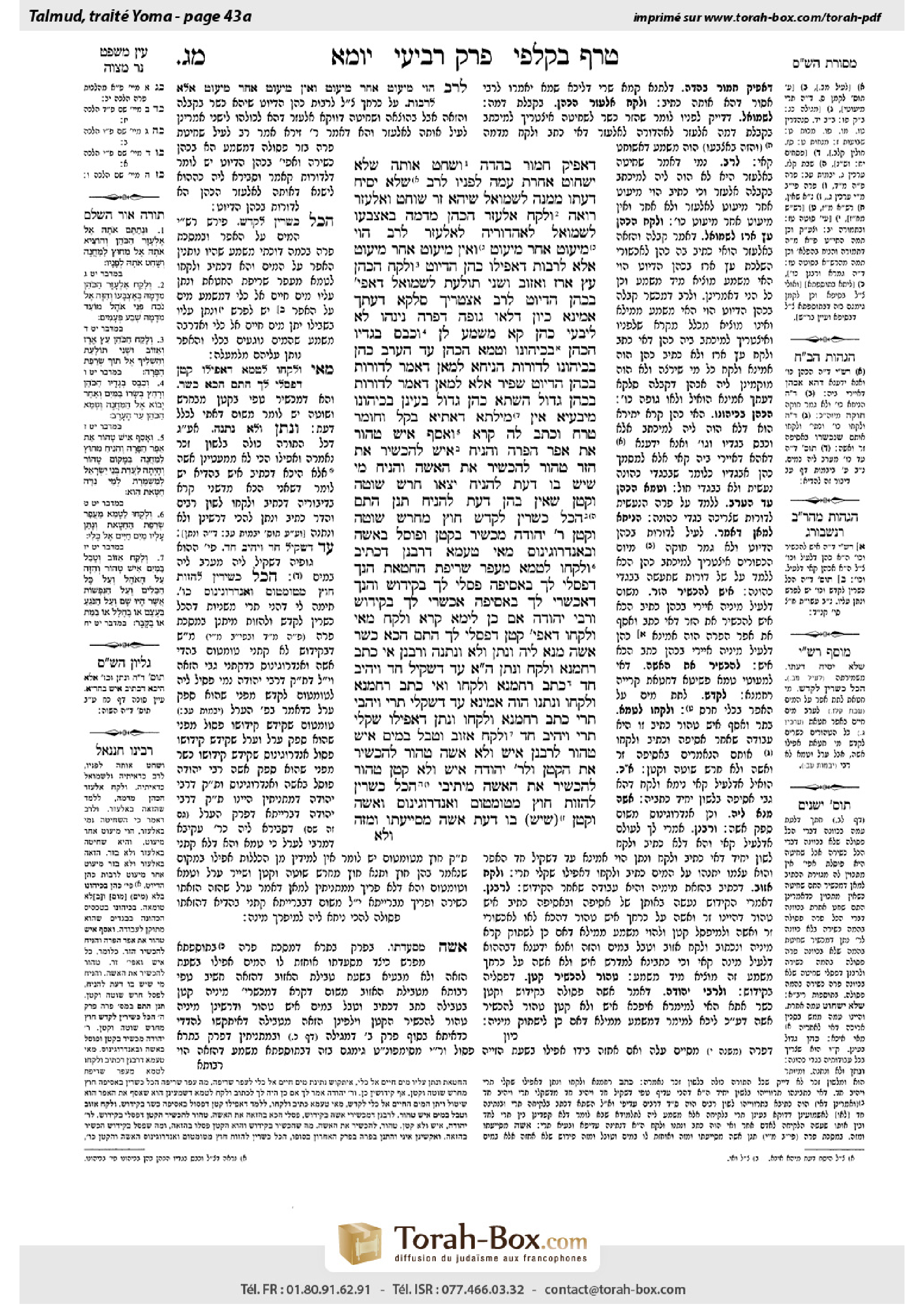
This page of Yoma includes the Aramaic text, an English translation and an AI-generated French translation, alongside the scan above.
יומא מ״ג א · Aramaic and Hebrew text
דְּאַפֵּיק חֲמוֹר בַּהֲדַהּ.
״וְשָׁחַט אוֹתָהּ״ — שֶׁלֹּא יִשְׁחוֹט אַחֶרֶת עִמָּהּ. ״לְפָנָיו״, לְרַב — שֶׁלֹּא יַסִּיחַ דַּעְתּוֹ מִמֶּנָּה, לִשְׁמוּאֵל — שֶׁיְּהֵא זָר שׁוֹחֵט וְאֶלְעָזָר רוֹאֶה.
״וְלָקַח אֶלְעָזָר הַכֹּהֵן מִדָּמָהּ בְּאֶצְבָּעוֹ״, לִשְׁמוּאֵל — לְאַהֲדוֹרֵיהּ לְאֶלְעָזָר. לְרַב — הָוֵי מִיעוּט אַחַר מִיעוּט, וְאֵין מִיעוּט אַחַר מִיעוּט אֶלָּא לְרַבּוֹת, דַּאֲפִילּוּ כֹּהֵן הֶדְיוֹט.
״וְלָקַח הַכֹּהֵן עֵץ אֶרֶז וְאֵזוֹב וּשְׁנִי תוֹלָעַת״, לִשְׁמוּאֵל — דַּאֲפִילּוּ בְּכֹהֵן הֶדְיוֹט. לְרַב — אִצְטְרִיךְ, סָלְקָא דַּעְתָּךְ אָמֵינָא: כֵּיוָן דְּלָאו גּוּפַהּ דְּפָרָה נִינְהוּ, לָא לִיבְעֵי כֹּהֵן, קָא מַשְׁמַע לַן.
״וְכִבֶּס בְּגָדָיו הַכֹּהֵן״ — בְּכִיהוּנּוֹ. ״וְטָמֵא הַכֹּהֵן עַד הָעָרֶב״ — כֹּהֵן בְּכִיהוּנּוֹ לְדוֹרוֹת.
הָנִיחָא לְמַאן דְּאָמַר לְדוֹרוֹת בְּכֹהֵן הֶדְיוֹט — שַׁפִּיר, אֶלָּא לְמַאן דְּאָמַר לְדוֹרוֹת בְּכֹהֵן גָּדוֹל, הַשְׁתָּא כֹּהֵן גָּדוֹל בָּעֵינַן, בְּכִיהוּנּוֹ מִיבַּעְיָא?! אִין, מִילְּתָא דְּאָתְיָא בְּקַל וְחוֹמֶר — טָרַח וְכָתַב לַהּ קְרָא.
״וְאָסַף אִישׁ טָהוֹר אֵת אֵפֶר הַפָּרָה וְהִנִּיחַ״. ״אִישׁ״ — לְהַכְשִׁיר אֶת הַזָּר, ״טָהוֹר״ — לְהַכְשִׁיר אֶת הָאִשָּׁה, ״וְהִנִּיחַ״ — מִי שֶׁיֵּשׁ בּוֹ דַּעַת לְהַנִּיחַ, יָצְאוּ חֵרֵשׁ שׁוֹטֶה וְקָטָן שֶׁאֵין בָּהֶן דַּעַת לְהַנִּיחַ.
תְּנַן הָתָם: הַכֹּל כְּשֵׁרִין לְקַדֵּשׁ, חוּץ מֵחֵרֵשׁ שׁוֹטֶה וְקָטָן. רַבִּי יְהוּדָה מַכְשִׁיר בְּקָטָן, וּפוֹסֵל בְּאִשָּׁה וּבְאַנְדְּרוֹגִינוֹס.
מַאי טַעְמָא דְּרַבָּנַן — דִּכְתִיב: ״וְלָקְחוּ לַטָּמֵא מֵעֲפַר שְׂרֵיפַת הַחַטָּאת״. הָנָךְ דִּפְסַלִי לָךְ בַּאֲסִיפָה — פְּסַלִי לָךְ בְּקִידּוּשׁ, וְהָנָךְ דְּאַכְשַׁרִי לָךְ בַּאֲסִיפָה — אַכְשַׁרִי לָךְ בְּקִידּוּשׁ.
וְרַבִּי יְהוּדָה: אִם כֵּן לֵימָא קְרָא ״וְלָקַח״, מַאי ״וְלָקְחוּ״ — דַּאֲפִילּוּ קָטָן דִּפְסַלִי לָךְ הָתָם, הָכָא — כָּשֵׁר.
אִשָּׁה מְנָא לֵיהּ? ״וְנָתַן״, וְלֹא ״וְנָתְנָה״. וְרַבָּנַן: אִי כְּתַב רַחֲמָנָא: ״וְלָקַח ... וְנָתַן״, הֲוָה אָמֵינָא: עַד דְּשָׁקֵיל חַד וְיָהֵיב חַד, כְּתַב רַחֲמָנָא: ״וְלָקְחוּ״.
וְאִי כְּתַב רַחֲמָנָא ״וְלָקְחוּ ... וְנָתְנוּ״, הֲוָה אָמֵינָא: עַד דְּשָׁקְלִי תְּרֵי וְיָהֲבִי תְּרֵי, כְּתַב רַחֲמָנָא: ״וְלָקְחוּ ... וְנָתַן״, דַּאֲפִילּוּ שָׁקְלִי תְּרֵי וְיָהֵיב חַד.
״וְלָקַח אֵזוֹב וְטָבַל בַּמַּיִם אִישׁ טָהוֹר״, לְרַבָּנַן: אִישׁ וְלֹא אִשָּׁה. ״טָהוֹר״ — לְהַכְשִׁיר אֶת הַקָּטָן, וּלְרַבִּי יְהוּדָה: ״אִישׁ״ — וְלֹא קָטָן, ״טָהוֹר״ — לְהַכְשִׁיר אֶת הָאִשָּׁה.
מֵיתִיבִי: הַכֹּל כְּשֵׁרִין לְהַזּוֹת, חוּץ מִטּוּמְטוּם וְאַנְדְּרוֹגִינוֹס וְאִשָּׁה. וְקָטָן (שֶׁיֵּשׁ) בּוֹ דַּעַת, אִשָּׁה מְסַיַּעְתּוֹ וּמַזֶּה.
Yoma 43a · English translation
where one took out a donkey with it. According to the first tanna, this would be permitted, since there is no concern that people would think that the wrong cow or cows were slaughtered. However, according to Rabbi Yehuda HaNasi, who maintains that this rationale is irrelevant, even this case would be excluded by the word “it.”
The Gemara expounds the next phrase in the verse: “And he shall slaughter it,” means that “it,” the red heifer, should be slaughtered and that no other should be slaughtered with it. And the next phrase: “Before him”; according to Rav, it means that he should not divert his attention from it. According to Shmuel, it indicates that a non-priest can slaughter it and Elazar the priest observes.
The Gemara proceeds to expound the next verse: “And Elazar the priest shall take some of its blood with his finger” (Numbers 19:4). What is indicated by specifying Elazar? According to Shmuel, since the phrase “before him” in the previous verse indicates that Elazar himself did not need to slaughter the red heifer but that rather a non-priest could, it is necessary in this stage to return it to Elazar, to indicate that he must himself take the blood with his finger. According to Rav, this is an example of a restrictive expression following a restrictive expression, as both verses indicate that the rite may be performed only by a priest. And there is a hermeneutical principle that a restrictive expression following a restrictive expression comes only to amplify the halakha and include additional cases. In this case, it serves to teach that even a common priest may perform the rite.
The Gemara expounds another verse in the same passage: “And the priest shall take cedar wood, and hyssop, and a strip of crimson” (Numbers 19:6). What is indicated by specifying that this is done by the priest? According to Shmuel, who holds that in the previous stage the verse stated: “And Elazar the priest” to indicate that Elazar, i.e., a deputy High Priest, was required to perform that stage, the use of the term “the priest” in this stage indicates that a deputy High Priest is no longer required for this stage; rather, even a common priest may perform this stage. According to Rav, who holds that even in the previous stage a common priest may perform the rite, the term “and the priest” is necessary here, as it could enter your mind to say that since these stages do not involve the heifer itself, they do not require a priest at all. Therefore, the verse teaches us that this is not correct.
The Gemara expounds the next verse: “Then the priest shall wash his clothes” (Numbers 19:7). Why is there a need to restate the involvement of the priest? To teach that he should be in his priestly state, i.e., wearing his priestly garments and fit for service. In the next phrase of the verse, the involvement of the priest is restated: “And the priest shall be impure until evening” (Numbers 19:7). This repetition is to teach that even in future generations the rite is to be performed only by a priest in his priestly state.
The Gemara analyzes this derivation according to the two sides of the dispute the Gemara cited previously: It works out well according to the one who said that for future generations the rite of the red heifer may be performed by a common priest. It is therefore understandable that the verse emphasizes that the priest has to perform the rite in his priestly state. But according to the one who said that for future generations it must be performed by a High Priest, now that we require the High Priest, is it necessary to mention that he must be in his priestly state? Yes, sometimes there is a matter that could be derived by means of an a fortiori inference, and the verse nevertheless unnecessarily writes it explicitly.
The Gemara expounds another verse in the passage: “And a man who is pure shall gather up the ashes of the heifer and place them” (Numbers 19:9). The verse states “a man” to qualify a non-priest to perform this stage of the rite. The verse states “pure” to qualify even a woman to perform this stage. The verse states “and place” to indicate that only one who has the basic level of intelligence to be able to intentionally place the ashes in their place is qualified to do so, thereby excluding a deaf-mute, an imbecile, and a minor, since they do not have the basic level of intelligence to be able to intentionally place the ashes in their place.
The Gemara prefaces its exposition of another verse in the passage, which details the sanctification of the ashes of the red heifer, by citing a dispute concerning that stage: We learned in a mishna there, in tractate Para: Everyone is qualified to sanctify the ashes of the red heifer, i.e., to pour the water over them, except for a deaf-mute, an imbecile, and a minor. Rabbi Yehuda qualifies a minor, but disqualifies a woman and a hermaphrodite.
What is the reason of the Rabbis, i.e., the first tanna? As it is written: “And they shall take for the impure of the ashes of the burning of the purification from sin, and he shall put running water thereto in a vessel” (Numbers 19:17). The word “they” is understood as referring to those who perform the previous stage of gathering the ashes. The verse therefore indicates: Those whom I disqualified for you for gathering the ashes, I have disqualified for you also for sanctification; and those whom I have qualified for you for gathering the ashes, I have qualified for you for sanctification.
And why does Rabbi Yehuda not accept this reasoning? If so, let the verse say: And he shall take. What is the meaning of “and they shall take”? The use of the plural serves to qualify additional people who were excluded from the previous stage. It means that with regard to even a minor, who I disqualified there with regard to collecting the ash, here, with regard to sanctification, he is qualified.
From where does Rabbi Yehuda derive that a woman is unfit? The verse states “and he shall put” and not: And she shall put. How do the Rabbis interpret this verse? They assume that if the Merciful One had written: And he shall take…and he shall put, I would have said the rite is not valid unless one person takes and the same one puts the ashes in the water. Therefore, the Merciful One writes “and they shall take” to indicate that the taking and the putting need not necessarily be executed by the same individual.
And if the Merciful One had written two plural forms such as: And they shall take…and they shall put, I would have said the rite is not valid unless two people take and two people put. Therefore, the Merciful One writes “and they shall take” and “and he shall put” (Numbers 19:17), to indicate that even if two take and one puts the rite is nevertheless valid.
The Gemara continues to expound the verses: “And a man who is pure shall take hyssop and dip it into the water” (Numbers 19:18). According to the Rabbis, who hold that the sanctification of the ashes in the previous stage may be performed by woman but not a minor, the word “man” indicates that for this stage, the taking and dipping of hyssop, only a man is qualified but not a woman, and the word “pure” is written to qualify even a minor for this stage. And according to Rabbi Yehuda, who holds the previous stage may be performed by a minor but not by a woman, the word man indicates that for this stage only an adult is qualified but not a minor, and the word pure is written to qualify even a woman for this stage.
The Gemara raises an objection from a mishna in tractate Para: Everyone is qualified to sprinkle the purification waters, except for a person whose sexual organs are concealed [tumtum], and a hermaphrodite [androginus], and a woman. And concerning a minor who has a basic level of intelligence, a woman may assist him and he sprinkles the purification waters. The mishna disqualifies a woman for the sprinkling but qualifies a minor.
Yoma 43a · Traduction française (IA)
dans le cas où l’on a fait sortir un âne avec elle. Selon le premier tanna, cela serait permis, puisqu’on ne craint pas que les gens pensent que la mauvaise vache, ou les mauvaises vaches, ont été abattues. Cependant, selon Rabbi Yehouda HaNassi, qui estime que cette raison n’est pas pertinente, même ce cas serait exclu par le mot « elle ».
La Guemara interprète la phrase suivante du verset : « Il l’égorgera » signifie que « elle », la vache rousse, doit être abattue, et qu’aucune autre ne doit être abattue avec elle. Quant à la phrase suivante, « devant lui », selon Rav, elle signifie qu’il ne doit pas détourner son attention d’elle. Selon Chmouel, elle indique qu’un non-prêtre peut l’abattre et qu’Éléazar, le prêtre, observe.
La Guemara poursuit l’interprétation du verset suivant : « Éléazar le prêtre prendra avec son doigt un peu de son sang » (Nombres 19:4). Pourquoi préciser Éléazar ? Selon Chmouel, puisque l’expression « devant lui », dans le verset précédent, indique qu’Éléazar lui-même n’avait pas besoin d’abattre la vache rousse, mais qu’un non-prêtre pouvait le faire, il faut ici revenir à Éléazar pour indiquer que c’est lui-même qui doit prendre le sang avec son doigt. Selon Rav, il s’agit d’une expression restrictive qui suit une autre expression restrictive, puisque les deux versets indiquent que le rite ne peut être accompli que par un prêtre. Or, un principe herméneutique veut qu’une expression restrictive qui en suit une autre ne vienne qu’amplifier la halakha et inclure des cas supplémentaires. Ici, elle enseigne que même un prêtre ordinaire peut accomplir le rite.
La Guemara interprète un autre verset du même passage : « Le prêtre prendra du bois de cèdre, de l’hysope et un fil écarlate » (Nombres 19:6). Pourquoi préciser que cette étape est accomplie par le prêtre ? Selon Chmouel, qui estime qu’à l’étape précédente le verset disait « Éléazar le prêtre » pour indiquer qu’Éléazar, c’est-à-dire un grand prêtre adjoint, devait accomplir cette étape, l’emploi du terme « le prêtre » à cette étape indique qu’un grand prêtre adjoint n’est plus requis ; même un prêtre ordinaire peut accomplir cette étape. Selon Rav, qui estime que même à l’étape précédente un prêtre ordinaire peut accomplir le rite, l’expression « et le prêtre » est nécessaire ici, car on pourrait penser que, puisque ces étapes ne concernent pas la vache elle-même, elles n’exigent aucun prêtre. Le verset nous enseigne donc que ce n’est pas le cas.
La Guemara interprète le verset suivant : « Puis le prêtre lavera ses vêtements » (Nombres 19:7). Pourquoi est-il nécessaire de rappeler que le prêtre intervient ? Pour enseigner qu’il doit être dans son état sacerdotal, c’est-à-dire porter ses vêtements sacerdotaux et être apte au service. Dans la phrase suivante du verset, l’intervention du prêtre est de nouveau mentionnée : « Le prêtre sera impur jusqu’au soir » (Nombres 19:7). Cette répétition enseigne que, même dans les générations futures, le rite ne doit être accompli que par un prêtre dans son état sacerdotal.
La Guemara examine cette déduction à la lumière des deux positions du désaccord qu’elle a cité précédemment : cela s’accorde bien avec celui qui affirme que, pour les générations futures, un prêtre ordinaire peut accomplir le rite de la vache rousse. On comprend donc que le verset souligne que le prêtre doit accomplir le rite dans son état sacerdotal. Mais, selon celui qui affirme que, pour les générations futures, le rite doit être accompli par un grand prêtre, maintenant que l’on exige un grand prêtre, est-il nécessaire de préciser qu’il doit être dans son état sacerdotal ? Oui : il arrive qu’une règle puisse être déduite par un raisonnement a fortiori et que, malgré cela, le verset l’énonce explicitement sans nécessité.
La Guemara interprète un autre verset du passage : « Un homme pur recueillera les cendres de la vache et les déposera » (Nombres 19:9). Le verset dit « un homme » pour habiliter un non-prêtre à accomplir cette étape du rite. Il dit « pur » pour habiliter même une femme à accomplir cette étape. Le terme « déposera » indique que seul celui qui possède le degré élémentaire d’intelligence nécessaire pour déposer intentionnellement les cendres à leur place est habilité à le faire ; cela exclut un sourd-muet, un déficient mental et un mineur, car ils ne possèdent pas le degré élémentaire d’intelligence nécessaire pour déposer intentionnellement les cendres à leur place.
Avant d’interpréter un autre verset du passage, qui détaille la sanctification des cendres de la vache rousse, la Guemara cite un désaccord concernant cette étape : nous avons appris dans une Michna du traité Para que tous sont habilités à sanctifier les cendres de la vache rousse, c’est-à-dire à verser de l’eau dessus, à l’exception d’un sourd-muet, d’un déficient mental et d’un mineur. Rabbi Yehouda habilite un mineur, mais récuse une femme et une personne androgyne.
Quelle est la raison des Rabbins, c’est-à-dire du premier tanna ? Comme il est écrit : « Ils prendront, pour celui qui est impur, des cendres provenant de la combustion du sacrifice expiatoire, et il y ajoutera de l’eau vive dans un récipient » (Nombres 19:17). Le mot « ils » est compris comme désignant ceux qui accomplissent l’étape précédente, celle du recueil des cendres. Le verset indique donc : ceux que je vous ai déclarés inaptes à recueillir les cendres, je vous les ai également déclarés inaptes à la sanctification ; et ceux que je vous ai déclarés aptes à recueillir les cendres, je vous les ai également déclarés aptes à la sanctification.
Et pourquoi Rabbi Yehouda n’accepte-t-il pas ce raisonnement ? Si tel était le cas, que le verset dise : « Il prendra. » Que signifie alors « ils prendront » ? L’emploi du pluriel sert à habiliter d’autres personnes qui étaient exclues de l’étape précédente. Cela signifie que même un mineur, que j’ai déclaré inapte pour le recueil des cendres à l’étape précédente, est habilité ici, pour la sanctification.
D’où Rabbi Yehouda déduit-il qu’une femme est inapte ? Le verset dit « il ajoutera », et non « elle ajoutera ». Comment les Rabbins interprètent-ils ce verset ? Ils supposent que si le Miséricordieux avait écrit : « Il prendra… et il ajoutera », j’aurais dit que le rite n’est valide que si une seule et même personne prend les cendres et les met dans l’eau. Le Miséricordieux écrit donc « ils prendront » pour indiquer que la prise et l’ajout ne doivent pas nécessairement être effectués par la même personne.
Et si le Miséricordieux avait écrit deux formes au pluriel, telles que : « Ils prendront… et ils ajouteront », j’aurais dit que le rite n’est valide que si deux personnes prennent les cendres et que deux personnes les ajoutent. Le Miséricordieux écrit donc « ils prendront » et « il ajoutera » (Nombres 19:17), pour indiquer que le rite reste valide même si deux personnes prennent les cendres et qu’une seule les ajoute.
La Guemara poursuit l’interprétation des versets : « Un homme pur prendra de l’hysope et la trempera dans l’eau » (Nombres 19:18). Selon les Rabbins, qui estiment que, lors de l’étape précédente, une femme peut sanctifier les cendres, mais pas un mineur, le mot « homme » indique que, pour cette étape, celle de la prise et de l’immersion de l’hysope, seul un homme est habilité, mais pas une femme ; et le mot « pur » est écrit pour habiliter même un mineur à accomplir cette étape. Selon Rabbi Yehouda, qui estime que l’étape précédente peut être accomplie par un mineur, mais pas par une femme, le mot « homme » indique que, pour cette étape, seul un adulte est habilité, mais pas un mineur ; et le mot « pur » est écrit pour habiliter même une femme à accomplir cette étape.
La Guemara soulève une objection à partir d’une Michna du traité Para : tous sont habilités à asperger les eaux de purification, à l’exception d’une personne dont les organes sexuels sont dissimulés [tumtum], d’une personne androgyne [androginus] et d’une femme. Quant à un mineur qui possède le degré élémentaire d’intelligence requis, une femme peut l’aider et il asperge les eaux de purification. La Michna récuse une femme pour l’aspersion, mais habilite un mineur.
Traduction française générée par IA à partir de l’édition anglaise de Sefaria. Vérifie toujours un passage avec le texte source.
Text from Sefaria: William Davidson Edition - Vocalized Aramaic (CC BY NC); William Davidson Edition - English (CC BY NC).