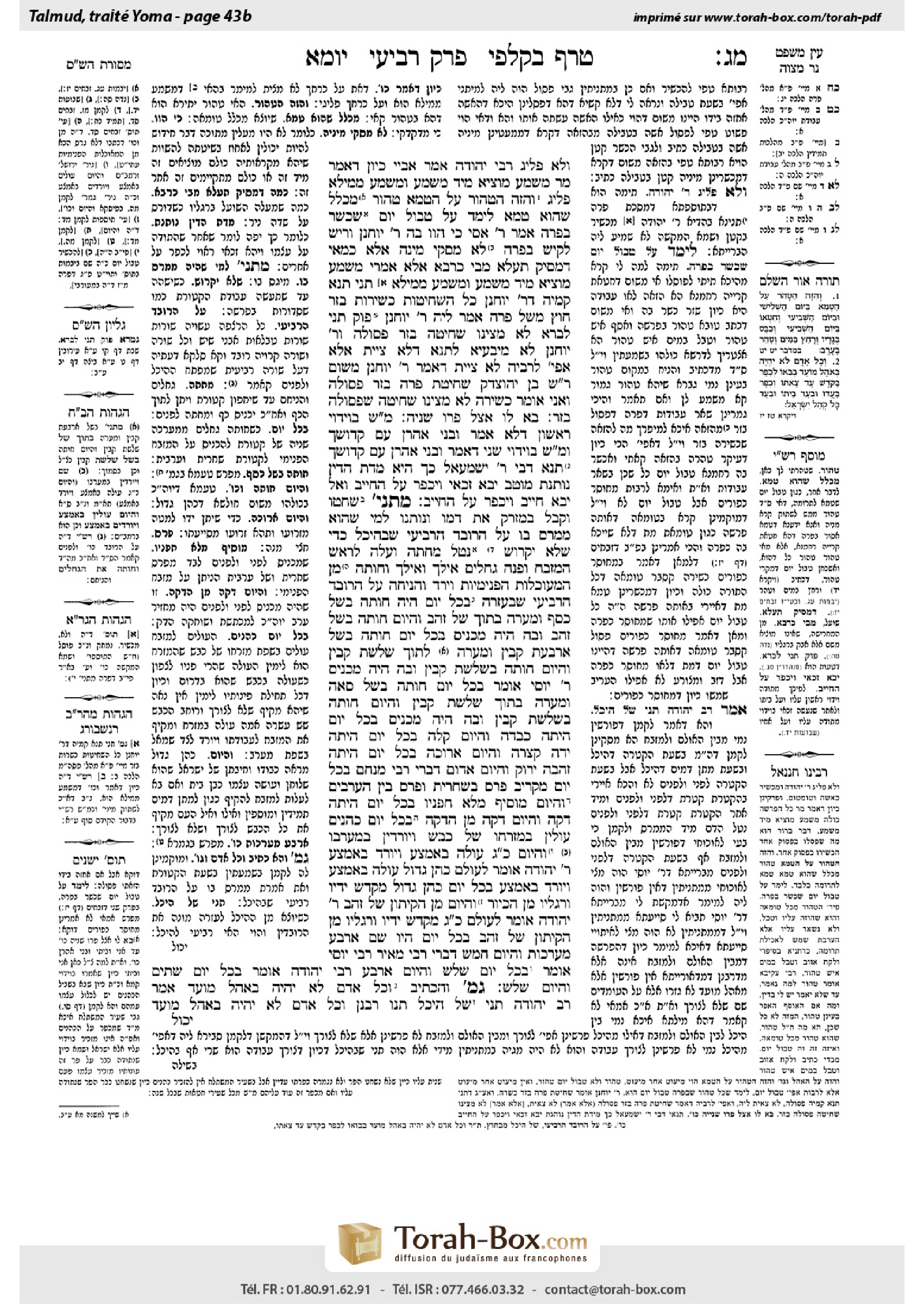
Yoma 43b: Talmud study for Daf Yomi
Daf Yomi is the daily study of one Talmud folio. Explore 37 tractates with scans, Hebrew text, Sefaria English and AI-generated French translations where annotated.
Passage selection and English or AI-generated French translation are available where the scan has annotations. Daf Study is independent of Torah-Box and Sefaria.
Browse Yoma · יומא · All tractatesYoma 43b text and translations
This page of Yoma includes the Aramaic text, an English translation and an AI-generated French translation, alongside the scan above.
יומא מ״ג ב · Aramaic and Hebrew text
וְלָא פְּלִיג רַבִּי יְהוּדָה!
אָמַר אַבָּיֵי: כֵּיוָן דְּאָמַר מָר ״מַשְׁמָע מוֹצִיא מִיַּד מַשְׁמָע וּמַשְׁמָע מִמֵּילָא״ — פְּלִיג.
״וְהִזָּה הַטָּהוֹר עַל הַטָּמֵא״. ״טָהוֹר״ מִכְּלָל שֶׁהוּא טָמֵא, לִימֵּד עַל טְבוּל יוֹם שֶׁכָּשֵׁר בְּפָרָה.
אָמַר רַבִּי אַסִּי: כִּי הֲווֹ בַּהּ רַבִּי יוֹחָנָן וְרֵישׁ לָקִישׁ בְּפָרָה, לָא מַסְּקִי מִינַּהּ אֶלָּא כְּמַאי דְּמַסֵּיק תַּעֲלָא מִבֵּי כְרָבָא. אֶלָּא אָמְרִי: ״מַשְׁמָע מוֹצִיא מִיַּד מַשְׁמָע וּמַשְׁמָע מִמֵּילָא״.
תָּנֵי תַּנָּא קַמֵּיהּ דְּרַבִּי יוֹחָנָן: כׇּל הַשְּׁחִיטוֹת כְּשֵׁירוֹת בְּזָר, חוּץ מִשֶּׁל פָּרָה. אֲמַר לֵיהּ רַבִּי יוֹחָנָן: פּוֹק תְּנִי לְבָרָא: לֹא מָצִינוּ שְׁחִיטָה בְּזָר פְּסוּלָה.
וְרַבִּי יוֹחָנָן, לָא מִיבַּעְיָא לְתַנָּא דְּלָא צָיֵית, אֶלָּא אֲפִילּוּ לְרַבֵּיהּ לָא צָיֵית. דְּאָמַר רַבִּי יוֹחָנָן מִשּׁוּם רַבִּי שִׁמְעוֹן בֶּן יְהוֹצָדָק: שְׁחִיטַת פָּרָה בְּזָר — פְּסוּלָה. וַאֲנִי אוֹמֵר: כְּשֵׁירָה, לֹא מָצִינוּ שְׁחִיטָה שֶׁפְּסוּלָה בְּזָר.
בָּא לוֹ אֵצֶל פָּרוֹ שְׁנִיָּה. מַאי שְׁנָא בְּוִידּוּי רִאשׁוֹן דְּלָא אָמַר: ״וּבְנֵי אַהֲרֹן עַם קְדוֹשֶׁךָ״, וּמַאי שְׁנָא בְּוִידּוּי שֵׁנִי דְּאָמַר: ״וּבְנֵי אַהֲרֹן עַם קְדוֹשֶׁךָ״?
תָּנָא דְּבֵי רַבִּי יִשְׁמָעֵאל, כָּךְ הִיא מִדַּת הַדִּין נוֹתֶנֶת: מוּטָב יָבֹא זַכַּאי וִיכַפֵּר עַל הַחַיָּיב, וְאַל יָבֹא חַיָּיב וִיכַפֵּר עַל הַחַיָּיב.
מַתְנִי׳ שְׁחָטוֹ וְקִבֵּל בְּמִזְרָק אֶת דָּמוֹ, וְנוֹתְנוֹ לְמִי שֶׁהוּא מְמָרֵס בּוֹ עַל הָרוֹבֶד הָרְבִיעִי שֶׁבַּהֵיכָל, כְּדֵי שֶׁלֹּא יִקְרוֹשׁ. נָטַל מַחְתָּה וְעָלָה לְרֹאשׁ הַמִּזְבֵּחַ, וּפִנָּה גֶּחָלִים אֵילָךְ וְאֵילָךְ, וְחוֹתֶה מִן הַמְעוּכָּלוֹת הַפְּנִימִיּוֹת, וְיָרַד וְהִנִּיחָהּ עַל הָרוֹבֶד הָרְבִיעִי שֶׁבָּעֲזָרָה.
בְּכׇל יוֹם הָיָה חוֹתֶה בְּשֶׁל כֶּסֶף וּמְעָרֶה בְּתוֹךְ שֶׁל זָהָב, וְהַיּוֹם חוֹתֶה בְּשֶׁל זָהָב וּבָהּ הָיָה מַכְנִיס.
בְּכׇל יוֹם חוֹתֶה בְּשֶׁל אַרְבַּעַת קַבִּין וּמְעָרֶה לְתוֹךְ שְׁלֹשֶׁת קַבִּין, וְהַיּוֹם חוֹתֶה בִּשְׁלֹשֶׁת קַבִּין וּבָהּ הָיָה מַכְנִיס. רַבִּי יוֹסֵי אוֹמֵר: בְּכׇל יוֹם חוֹתֶה בְּשֶׁל סְאָה וּמְעָרֶה בְּתוֹךְ שְׁלֹשֶׁת קַבִּין, וְהַיּוֹם חוֹתֶה בִּשְׁלֹשֶׁת קַבִּין וּבָהּ הָיָה מַכְנִיס.
בְּכׇל יוֹם הָיְתָה כְּבֵדָה, וְהַיּוֹם קַלָּה. בְּכׇל יוֹם הָיְתָה יָדָהּ קְצָרָה, וְהַיּוֹם אֲרוּכָּה. בְּכׇל יוֹם הָיְתָה זֶהָבָה יָרוֹק, וְהַיּוֹם אָדוֹם. דִּבְרֵי רַבִּי מְנַחֵם.
בְּכׇל יוֹם מַקְרִיב פְּרָס בְּשַׁחֲרִית וּפְרָס בֵּין הָעַרְבַּיִם, וְהַיּוֹם מוֹסִיף מְלֹא חׇפְנָיו. בְּכׇל יוֹם הָיְתָה דַּקָּה, וְהַיּוֹם דַּקָּה מִן הַדַּקָּה.
בְּכׇל יוֹם כֹּהֲנִים עוֹלִין בְּמִזְרָחוֹ שֶׁל כֶּבֶשׁ וְיוֹרְדִין בְּמַעֲרָבוֹ, וְהַיּוֹם כֹּהֵן גָּדוֹל עוֹלֶה בָּאֶמְצַע וְיוֹרֵד בָּאֶמְצַע. רַבִּי יְהוּדָה אוֹמֵר: לְעוֹלָם כֹּהֵן גָּדוֹל עוֹלֶה בָּאֶמְצַע וְיוֹרֵד בָּאֶמְצַע.
בְּכׇל יוֹם כֹּהֵן גָּדוֹל מְקַדֵּשׁ יָדָיו וְרַגְלָיו מִן הַכִּיּוֹר, וְהַיּוֹם מִן הַקִּיתוֹן שֶׁל זָהָב. רַבִּי יְהוּדָה אוֹמֵר: לְעוֹלָם כֹּהֵן גָּדוֹל מְקַדֵּשׁ יָדָיו וְרַגְלָיו מִן הַקִּיתוֹן שֶׁל זָהָב.
בְּכׇל יוֹם הָיוּ שָׁם אַרְבַּע מַעֲרָכוֹת, וְהַיּוֹם חָמֵשׁ, דִּבְרֵי רַבִּי מֵאִיר. רַבִּי יוֹסֵי אוֹמֵר: בְּכׇל יוֹם שָׁלֹשׁ, וְהַיּוֹם אַרְבַּע. רַבִּי יְהוּדָה אוֹמֵר: בְּכׇל יוֹם שְׁתַּיִם, וְהַיּוֹם שָׁלֹשׁ.
גְּמָ׳ וְהָכְתִיב: ״וְכׇל אָדָם לֹא יִהְיֶה בְּאֹהֶל מוֹעֵד״? אָמַר רַב יְהוּדָה: תְּנִי ״שֶׁל הֵיכָל״.
תָּנוּ רַבָּנַן: ״וְכׇל אָדָם לֹא יִהְיֶה בְּאֹהֶל מוֹעֵד״,
Yoma 43b · English translation
And Rabbi Yehuda does not disagree. The mishna implies that even he agrees with the mishna’s ruling.
Abaye said: Since the Master, i.e., Ulla, said: In some stages, the conditions implied by the phrasing of the verse precludes the application of conditions that are implied by a previous verse describing a previous stage, whereas in other stages, the conditions implied by the phrasing of the verse stand on their own and also apply in subsequent stages. Since it is clear from the opinion of the Rabbis that the verse describing the taking and dipping of hyssop is to be understood as indicating a change of conditions, perforce Rabbi Yehuda must also assume that there is a change in conditions, as explained above. Therefore, he certainly disagrees with the mishna’s ruling, even though his dissenting opinion is not recorded in the mishna.
The Gemara expounds the next verse: “And the pure one shall sprinkle upon the impure” (Numbers 19:19). The previous verse already states that the one who sprinkles must be ritually pure. This requirement is repeated here to make the following inference: He is pure, which by inference suggests that initially he was ritually impure and has now removed that impurity. This fact is significant only if the reference is to a person who has still not completed his purification process. As such, the repetition of the requirement that the one who sprinkles be pure teaches about one who immersed that day, that he is qualified to sprinkle the waters in the rite of the red heifer. This is one who was rendered ritually impure with a type of ritual impurity from which he will become fully ritually pure only upon nightfall.
Rabbi Asi said: When Rabbi Yoḥanan and Reish Lakish analyzed the passage of the red heifer to try to identify a consistent pattern in the way the implied conditions should be understood, i.e., when they exist to preclude conditions implied in previous stages, and when they imply conditions that remain in force in subsequent stages. They brought up from it only as the amount of earth that the fox brings up from a plowed field, meaning that they reached few conclusions. Rather, they said in conclusion that in some verses the conditions implied by the phrasing of the verse preclude the application of conditions that are implied by a previous verse; whereas in other verses, the conditions implied by the phrasing of the verse stand on their own and apply also in subsequent verses. However, there is no obvious pattern of how to determine which verse employs which style.
A tanna who would recite baraitot in the study hall recited a baraita before Rabbi Yoḥanan: All slaughterings are valid if performed by a non-priest, except that of the red heifer. Rabbi Yoḥanan said to him: Go out and teach that baraita outside the house of study, but not inside, as it is incorrect. We have not found any case of a slaughtering by a non-priest that is invalid.
The Gemara comments: And Rabbi Yoḥanan was very convinced of this. Needless to say that he did not listen to that tanna, but he did not even listen to his own teacher, who maintained the same opinion as cited by the tanna, as Rabbi Yoḥanan said in the name of Rabbi Shimon ben Yehotzadak: The slaughtering of the red heifer by a non-priest is invalid. Rabbi Yoḥanan added: And I say it is valid, for we have not found any case of a slaughtering by a non-priest that is invalid.
The mishna states: The High Priest comes and stands next to his bull a second time and confesses: Please God, I have sinned…I and my family and the children of Aaron, your sacred people. The Gemara asks: What is different about the first confession that he made over the bull, in which he did not say: And the children of Aaron, your sacred people, and what is different about the second confession in which he said: And the children of Aaron, your sacred people?
The school of Rabbi Yishmael taught: That is the method to which the attribute of justice lends itself: Better that an innocent person should come and gain atonement on behalf of the guilty, and a guilty person should not come and gain atonement on behalf of another guilty person. At the first confession, the High Priest has still not achieved atonement for himself. Therefore, it is more appropriate for him to wait until the second confession to seek atonement for the priesthood.
MISHNA: The High Priest would slaughter the bull and receive its blood in a bowl, and give it to the one who stirs it. The stirrer would stand on the fourth row of tiles in the Sanctuary and stir the blood lest it coagulate while the High Priest sacrificed the incense. He would take a coal pan and ascend to the top of the altar and clear the upper layer of coals to this side and to that side and with the coal pan scoop up coals from among the inner, consumed coals. And he would then descend and place the coal pan with the coals on the fourth row of tiles in the Temple courtyard.
The mishna comments on some of the contrasts between the service and protocols followed on Yom Kippur and those followed throughout the rest of the year: On every other day, a priest would scoop up the coals with a coal pan made of silver and pour the coals from there into a coal pan of gold. But on this day, on Yom Kippur, the High Priest scoops up with a coal pan of gold, and with that coal pan he would bring the coals into the Holy of Holies.
On every other day, a priest scoops up the coals with a coal pan of four kav and pours the coals into a coal pan of three kav. But on this day, the High Priest scoops with one of three kav, and with it he would bring the coals into the Holy of Holies. Rabbi Yosei says a variation of this distinction: On every other day, a priest scoops up the coals with a coal pan of a se’a, which is six kav and then pours the coals into a coal pan of three kav. But on this day, the High Priest scoops with a coal pan of three kav, and with it he would bring the coals into the Holy of Holies.
On every other day, the coal pan was heavy. But on this day it was light, so as not to tire the High Priest. On every other day, its handle was short, but on this day it was long so that he could also use his arm to support its weight. On every other day, it was of greenish gold, but on this day it was of a red gold. These are the statements of Rabbi Menaḥem.
On every other day, a priest sacrificed a peras, half a maneh, of incense in the morning, and a peras in the afternoon, but on this day the High Priest adds an additional handful of incense and burns it in the Holy of Holies. On every other day, the incense was ground fine as prescribed by the Torah, but on this day it was superfine.
On every other day, priests ascend on the eastern side of the ramp and descend on its western side, but on this day the High Priest ascends in the middle of the ramp and descends in the middle. Rabbi Yehuda says: There was no difference in this regard. Even during the rest of the year, the High Priest always ascends in the middle of the ramp and descends in the middle, due to his eminence.
On every other day, the High Priest sanctifies his hands and his feet from the laver like the other priests, and on this day he sanctifies them from the golden flask, due to the eminence of the High Priest. Rabbi Yehuda says there was no difference in this regard. Even during the rest of the year, the High Priest always sanctifies his hands and his feet from the golden flask.
On every other day there were four arrangements of wood there, upon the altar, but on this day there were five; this is the statement of Rabbi Meir. Rabbi Yosei says: On every other day there were three, but on this day there were four. Rabbi Yehuda says: On every other day there were two, but on this day there were three.
GEMARA: The mishna states that the blood of the bull is stirred by a priest standing on the fourth row of tiles in the Sanctuary, while the High Priest sacrifices the incense in the Holy of Holies. The Gemara asks: But is it not written “And there shall be no man in the Tent of Meeting when he goes in to make atonement in the Sanctuary, until he comes out” (Leviticus 16:17). How then could the stirrer be standing in the Sanctuary? Rav Yehuda said: Emend and teach the mishna as saying: The fourth row of tiles of the Sanctuary, i.e., outside the Sanctuary on the fourth row from its entrance.
The Sages taught in a baraita: The verse states: “And there shall be no man in the Tent of Meeting when he goes in to make atonement in the Sanctuary, until he comes out.” The verse prohibits anyone to be inside the Tent of Meeting during the burning of the incense.
Yoma 43b · Traduction française (IA)
Et Rabbi Yehouda n’est pas en désaccord. La Michna laisse entendre que lui aussi est d’accord avec sa décision.
Abayé dit : Puisque le Maître, c’est-à-dire Oulla, a dit que, dans certaines étapes, les conditions suggérées par la formulation du verset excluent l’application des conditions suggérées par un verset antérieur décrivant une étape précédente, tandis que, dans d’autres étapes, les conditions suggérées par la formulation du verset sont autonomes et s’appliquent aussi aux étapes suivantes ; et puisqu’il ressort clairement de l’opinion des Sages que le verset décrivant la prise et l’immersion de l’hysope doit être compris comme indiquant un changement de conditions, Rabbi Yehouda doit nécessairement, lui aussi, considérer qu’il y a un changement de conditions, comme expliqué plus haut. Par conséquent, il est certain qu’il est en désaccord avec la décision de la Michna, même si son opinion dissidente n’y est pas consignée.
La Guemara interprète le verset suivant : « Et celui qui est pur aspergera sur celui qui est impur » (Nombres 19,19). Le verset précédent indique déjà que celui qui asperge doit être rituellement pur. Cette exigence est répétée ici afin de permettre l’inférence suivante : il est pur, ce qui laisse entendre qu’auparavant il était rituellement impur et qu’il s’est maintenant débarrassé de cette impureté. Ce fait n’a d’importance que si le passage parle d’une personne qui n’a pas encore achevé son processus de purification. Ainsi, la répétition de l’exigence selon laquelle celui qui asperge doit être pur enseigne qu’une personne qui s’est immergée ce jour-là est apte à asperger les eaux lors du rite de la vache rousse. Il s’agit d’une personne devenue rituellement impure par une forme d’impureté rituelle dont elle ne sera complètement purifiée qu’à la tombée de la nuit.
Rabbi Assi dit : Lorsque Rabbi Yo’hanan et Rech Lakich examinèrent le passage de la vache rousse pour tenter d’y discerner une règle cohérente sur la manière de comprendre les conditions implicites — c’est-à-dire quand elles servent à exclure les conditions suggérées par les étapes précédentes et quand elles indiquent des conditions qui restent en vigueur aux étapes suivantes —, ils n’en tirèrent que la quantité de terre qu’un renard soulève d’un champ labouré, autrement dit, ils aboutirent à peu de conclusions. Ils conclurent plutôt que, dans certains versets, les conditions suggérées par leur formulation excluent l’application des conditions suggérées par un verset précédent, tandis que, dans d’autres versets, les conditions suggérées par leur formulation sont autonomes et s’appliquent également aux versets suivants. Toutefois, aucun principe évident ne permet de déterminer quels versets suivent l’une ou l’autre de ces formes.
Un tanna qui récitait des baraïtot dans la maison d’étude récita une baraïta devant Rabbi Yo’hanan : Tous les abattages sont valides s’ils sont effectués par un non-prêtre, à l’exception de celui de la vache rousse. Rabbi Yo’hanan lui dit : Va enseigner cette baraïta à l’extérieur de la maison d’étude, mais pas à l’intérieur, car elle est incorrecte. Nous n’avons trouvé aucun cas où un abattage effectué par un non-prêtre soit invalide.
La Guemara fait remarquer que Rabbi Yo’hanan était très fermement convaincu de cela. Il va sans dire qu’il ne prêta pas attention à ce tanna ; mais il ne suivit même pas l’avis de son propre maître, qui soutenait la même opinion que celle citée par le tanna. En effet, Rabbi Yo’hanan dit au nom de Rabbi Chimon ben Yehotsadak : « L’abattage de la vache rousse par un non-prêtre est invalide. » Rabbi Yo’hanan ajouta : « Pour ma part, je dis qu’il est valide, car nous n’avons trouvé aucun cas où un abattage effectué par un non-prêtre soit invalide. »
La Michna dit : Le Grand Prêtre revient se tenir auprès de son taureau et se confesse une deuxième fois : « De grâce, Seigneur, j’ai péché… moi, ma famille et les enfants d’Aaron, ton peuple saint. » La Guemara demande : Pourquoi, dans sa première confession sur le taureau, n’a-t-il pas dit : « et les enfants d’Aaron, ton peuple saint », alors que, dans la deuxième confession, il l’a dit ?
L’école de Rabbi Yichmaël enseigna : Telle est la voie à laquelle se prête l’attribut de justice : mieux vaut qu’un innocent se présente et obtienne l’expiation pour les coupables, plutôt qu’un coupable se présente et obtienne l’expiation pour d’autres coupables. Lors de la première confession, le Grand Prêtre n’a pas encore obtenu l’expiation pour lui-même. Il convient donc davantage qu’il attende la deuxième confession pour demander l’expiation en faveur de la prêtrise.
MICHNA : Le Grand Prêtre égorgeait le taureau, en recueillait le sang dans un récipient et le remettait à celui qui devait le remuer. Celui-ci se tenait sur la quatrième rangée de dalles du Sanctuaire et remuait le sang afin qu’il ne coagule pas pendant que le Grand Prêtre faisait brûler l’encens. Le Grand Prêtre prenait une pelle à braises, montait au sommet de l’autel, écartait la couche supérieure de braises d’un côté puis de l’autre, et prélevait avec la pelle des braises parmi celles qui étaient consumées à l’intérieur. Il descendait ensuite et déposait la pelle à braises contenant les braises sur la quatrième rangée de dalles de la cour du Temple.
La Michna relève certaines différences entre le service et les usages de Yom Kippour et ceux suivis pendant le reste de l’année : les autres jours, un prêtre prélevait les braises avec une pelle à braises en argent, puis les versait de celle-ci dans une pelle à braises en or. Mais ce jour-là, à Yom Kippour, le Grand Prêtre prélevait les braises avec une pelle à braises en or et les apportait avec celle-ci dans le Saint des Saints.
Les autres jours, un prêtre prélevait les braises avec une pelle à braises d’une capacité de quatre kav et les versait dans une pelle à braises de trois kav. Mais ce jour-là, le Grand Prêtre les prélevait avec une pelle de trois kav et les apportait avec celle-ci dans le Saint des Saints. Rabbi Yossi donne une autre version de cette distinction : les autres jours, un prêtre prélevait les braises avec une pelle à braises d’un séa, soit six kav, puis les versait dans une pelle à braises de trois kav. Mais ce jour-là, le Grand Prêtre les prélevait avec une pelle à braises de trois kav et les apportait avec celle-ci dans le Saint des Saints.
Les autres jours, la pelle à braises était lourde. Mais ce jour-là, elle était légère, afin de ne pas fatiguer le Grand Prêtre. Les autres jours, son manche était court ; mais ce jour-là, il était long, afin qu’il puisse également soutenir son poids avec son bras. Les autres jours, elle était en or verdâtre ; mais ce jour-là, elle était en or rouge. Telles sont les paroles de Rabbi Mena’hem.
Les autres jours, un prêtre faisait brûler une peras, soit une demi-mane, d’encens le matin et une peras l’après-midi ; mais ce jour-là, le Grand Prêtre ajoutait une poignée supplémentaire d’encens et la faisait brûler dans le Saint des Saints. Les autres jours, l’encens était finement broyé, comme le prescrit la Torah ; mais ce jour-là, il était broyé en une poudre extrêmement fine.
Les autres jours, les prêtres montaient du côté est de la rampe et descendaient du côté ouest ; mais ce jour-là, le Grand Prêtre montait au milieu de la rampe et en descendait au milieu. Rabbi Yehouda dit : Il n’y avait aucune différence à cet égard. Même le reste de l’année, le Grand Prêtre montait toujours au milieu de la rampe et en descendait au milieu, en raison de son rang.
Les autres jours, le Grand Prêtre sanctifiait ses mains et ses pieds à la cuve, comme les autres prêtres ; mais ce jour-là, il les sanctifiait à l’aide de l’aiguière en or, en raison du rang du Grand Prêtre. Rabbi Yehouda dit qu’il n’y avait aucune différence à cet égard. Même le reste de l’année, le Grand Prêtre sanctifiait toujours ses mains et ses pieds à l’aide de l’aiguière en or.
Les autres jours, il y avait là, sur l’autel, quatre arrangements de bois, mais ce jour-là, il y en avait cinq. Telle est l’opinion de Rabbi Meïr. Rabbi Yossi dit : Les autres jours, il y en avait trois, mais ce jour-là, il y en avait quatre. Rabbi Yehouda dit : Les autres jours, il y en avait deux, mais ce jour-là, il y en avait trois.
GUEMARA : La Michna dit que le sang du taureau est remué par un prêtre qui se tient sur la quatrième rangée de dalles du Sanctuaire, tandis que le Grand Prêtre fait brûler l’encens dans le Saint des Saints. La Guemara demande : Mais n’est-il pas écrit : « Aucun homme ne sera dans la Tente d’assignation lorsqu’il entrera pour faire l’expiation dans le Sanctuaire, jusqu’à ce qu’il en sorte » (Lévitique 16,17) ? Comment celui qui remue le sang pouvait-il donc se tenir dans le Sanctuaire ? Rav Yehouda dit : Corrige et enseigne la Michna ainsi : « sur la quatrième rangée de dalles du Sanctuaire », c’est-à-dire à l’extérieur du Sanctuaire, sur la quatrième rangée à partir de son entrée.
Les Sages enseignèrent dans une baraïta : Le verset dit : « Aucun homme ne sera dans la Tente d’assignation lorsqu’il entrera pour faire l’expiation dans le Sanctuaire, jusqu’à ce qu’il en sorte. » Le verset interdit à quiconque de se trouver à l’intérieur de la Tente d’assignation pendant que l’encens brûle.
Traduction française générée par IA à partir de l’édition anglaise de Sefaria. Vérifie toujours un passage avec le texte source.
Text from Sefaria: William Davidson Edition - Vocalized Aramaic (CC BY NC); William Davidson Edition - English (CC BY NC).