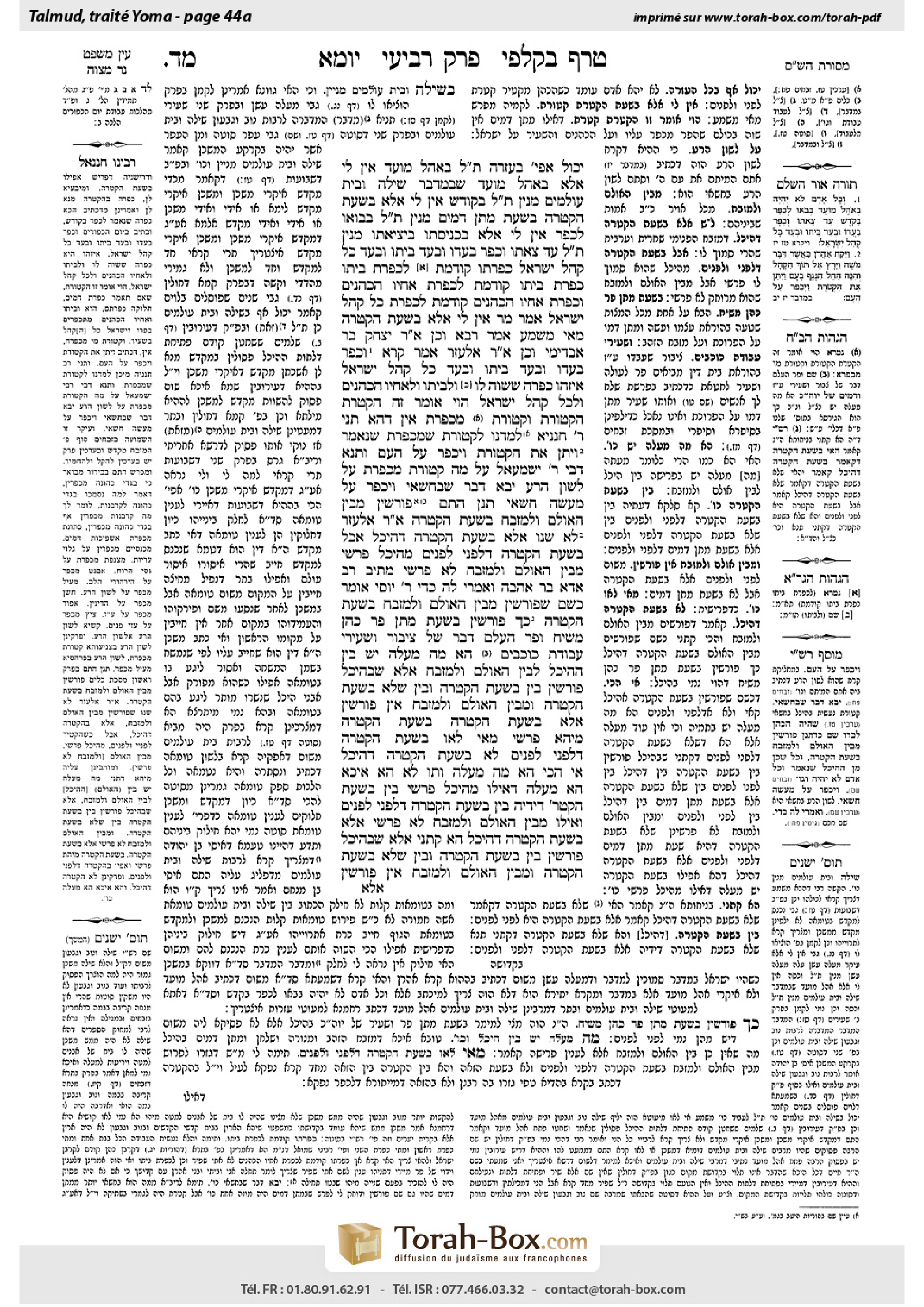
Yoma 44a: Talmud study for Daf Yomi
Daf Yomi is the daily study of one Talmud folio. Explore 37 tractates with scans, Hebrew text, Sefaria English and AI-generated French translations where annotated.
Passage selection and English or AI-generated French translation are available where the scan has annotations. Daf Study is independent of Torah-Box and Sefaria.
Browse Yoma · יומא · All tractatesYoma 44a text and translations
This page of Yoma includes the Aramaic text, an English translation and an AI-generated French translation, alongside the scan above.
יומא מ״ד א · Aramaic and Hebrew text
יָכוֹל אֲפִילּוּ בַּעֲזָרָה — תַּלְמוּד לוֹמַר: ״בְּאֹהֶל מוֹעֵד״. אֵין לִי אֶלָּא בְּאֹהֶל מוֹעֵד שֶׁבַּמִּדְבָּר, שִׁילֹה וּבֵית עוֹלָמִים מִנַּיִן? תַּלְמוּד לוֹמַר: ״בַּקּוֹדֶשׁ״.
אֵין לִי אֶלָּא בִּשְׁעַת הַקְטָרָה, בִּשְׁעַת מַתַּן דָּמִים מִנַּיִן? תַּלְמוּד לוֹמַר: ״בְּבוֹאוֹ לְכַפֵּר״. אֵין לִי אֶלָּא בִּכְנִיסָתוֹ, בִּיצִיאָתוֹ מִנַּיִן? תַּלְמוּד לוֹמַר: ״עַד צֵאתוֹ״.
״וְכִפֶּר בַּעֲדוֹ וּבְעַד בֵּיתוֹ וּבְעַד כׇּל קְהַל יִשְׂרָאֵל״, כַּפָּרָתוֹ קוֹדֶמֶת לְכַפָּרַת בֵּיתוֹ, כַּפָּרַת בֵּיתוֹ קוֹדֶמֶת לְכַפָּרַת אֶחָיו הַכֹּהֲנִים, וְכַפָּרַת אֶחָיו הַכֹּהֲנִים קוֹדֶמֶת לְכַפָּרַת כׇּל קְהַל יִשְׂרָאֵל.
אָמַר מָר: אֵין לִי אֶלָּא בִּשְׁעַת הַקְטָרָה. מַאי מַשְׁמַע? אָמַר רָבָא, וְכֵן אָמַר רַבִּי יִצְחָק בַּר אַבְדִּימִי, וְכֵן אָמַר רַבִּי אֶלְעָזָר, אָמַר קְרָא: ״וְכִפֶּר בַּעֲדוֹ וּבְעַד בֵּיתוֹ וּבְעַד כׇּל קְהַל יִשְׂרָאֵל״, אֵיזֶהוּ כַּפָּרָה שֶׁשָּׁוָה לוֹ וּלְבֵיתוֹ וּלְאֶחָיו הַכֹּהֲנִים וּלְכׇל קְהַל יִשְׂרָאֵל — הֱוֵי אוֹמֵר זֶה הַקְטָרַת הַקְּטוֹרֶת.
וּקְטוֹרֶת מְכַפֶּרֶת? אִין, דְּהָא תָּנֵי רַבִּי חֲנַנְיָא: לָמַדְנוּ לִקְטוֹרֶת שֶׁמְּכַפֶּרֶת, שֶׁנֶּאֱמַר: ״וַיִּתֵּן אֶת הַקְּטוֹרֶת וַיְכַפֵּר עַל הָעָם״, וְתָנָא דְּבֵי רַבִּי יִשְׁמָעֵאל: עַל מָה קְטוֹרֶת מְכַפֶּרֶת — עַל לָשׁוֹן הָרָע. יָבֹא דָּבָר שֶׁבַּחֲשַׁאי, וִיכַפֵּר עַל מַעֲשֵׂה חֲשַׁאי.
תְּנַן הָתָם: פּוֹרְשִׁין מִבֵּין הָאוּלָם וְלַמִּזְבֵּחַ בִּשְׁעַת הַקְטָרָה. אָמַר רַבִּי אֶלְעָזָר: לֹא שָׁנוּ אֶלָּא בִּשְׁעַת הַקְטָרָה דְּהֵיכָל, אֲבָל בִּשְׁעַת הַקְטָרָה דְּלִפְנַי לִפְנִים — מֵהֵיכָל פָּרְשִׁי, מִבֵּין הָאוּלָם וְלַמִּזְבֵּחַ לָא פָּרְשִׁי.
מֵתִיב רַב אַדָּא בַּר אַהֲבָה, וְאָמְרִי לַהּ כְּדִי, רַבִּי יוֹסֵי אוֹמֵר: כְּשֵׁם שֶׁפּוֹרְשִׁין מִבֵּין הָאוּלָם וְלַמִּזְבֵּחַ בִּשְׁעַת הַקְטָרָה, כָּךְ פּוֹרְשִׁין בִּשְׁעַת מַתַּן פַּר כֹּהֵן מָשִׁיחַ וּפַר הֶעְלֵם דָּבָר שֶׁל צִיבּוּר וּשְׂעִירֵי עֲבוֹדָה זָרָה.
הָא מָה מַעֲלָה יֵשׁ בֵּין הַהֵיכָל לְבֵין הָאוּלָם וְלַמִּזְבֵּחַ? אֶלָּא, שֶׁבַּהֵיכָל פּוֹרְשִׁין בֵּין בִּשְׁעַת הַקְטָרָה וּבֵין שֶׁלֹּא בִּשְׁעַת הַקְטָרָה, וּמִבֵּין הָאוּלָם וְלַמִּזְבֵּחַ אֵין פּוֹרְשִׁין אֶלָּא בִּשְׁעַת הַקְטָרָה.
בִּשְׁעַת הַקְטָרָה מִיהָא פָּרְשִׁי. מַאי לָאו, בִּשְׁעַת הַקְטָרָה דְּלִפְנַי לִפְנִים?
לָא, בִּשְׁעַת הַקְטָרָה דְּהֵיכָל. אִי הָכִי, הָא ״מָה מַעֲלָה״ וְתוּ לָא, הָא אִיכָּא הָא מַעֲלָה: דְּאִילּוּ מֵהֵיכָל פָּרְשִׁי בֵּין בִּשְׁעַת הַקְטָרָה דִידֵיהּ, בֵּין בִּשְׁעַת הַקְטָרָה דְּלִפְנַי לִפְנִים, וְאִילּוּ מִבֵּין הָאוּלָם וְלַמִּזְבֵּחַ לָא פָּרְשִׁי אֶלָּא בִּשְׁעַת הַקְטָרָה דְהֵיכָל!
הָא קָתָנֵי: אֶלָּא שֶׁבַּהֵיכָל פּוֹרְשִׁין בֵּין בִּשְׁעַת הַקְטָרָה וּבֵין שֶׁלֹּא בִּשְׁעַת הַקְטָרָה, וּמִבֵּין הָאוּלָם וְלַמִּזְבֵּחַ אֵין פּוֹרְשִׁין
Yoma 44a · English translation
I might have thought nobody should be present, even in the Temple courtyard. Therefore, the verse states “in the Tent of Meeting,” limiting the prohibition to the Temple itself. I have derived only that a prohibition exists in the Tent of Meeting of the Tabernacle that was in the desert, from where do I derive that the prohibition applies also to the Tabernacle that stood in Shiloh, and that it applies also to the Eternal House, i.e., the Temple in Jerusalem? The verse states “in the Sanctuary,” indicating that the prohibition applies to any Sanctuary.
I have derived only that a prohibition exists during the burning of the incense; from where do I derive that the prohibition applies also during the presentations of the bull’s blood in the Holy of Holies? The verse states: “When he goes in to make atonement,” and atonement is achieved through the presentations of blood. I have derived only that a prohibition exists from the time of his entrance into the Holy of Holies; from where is it derived that the prohibition remains in force until his exit? The verse states: “Until he comes out.”
The baraita concludes by expounding the final part of the verse: “And have made atonement for himself, and for his household, and for all the assembly of Israel” (Leviticus 16:17). This teaches that his atonement precedes the atonement of his household; the atonement of his household precedes that atonement of his brethren, the priests; the atonement of his brethren, the priests, precedes the atonement of the entire community of Israel.
The Gemara analyzes the baraita: The Master said in the baraita: I have derived only that a prohibition exists during the burning of the incense. From where in the verse could this have been inferred? Rava said, and similarly Rabbi Yitzḥak bar Avdimi said, and similarly Rabbi Elazar said: The conclusion of that verse states: “And have made atonement for himself, and for his household, and for all the assembly of Israel.” Which act of atonement is the same for him, and for his household, and for his brethren, the priests, and for the entire community of Israel? You must say this is the burning of the incense.
Does incense effect atonement? The Torah mentions the concept of atonement only with regard to offerings. Yes, as Rabbi Ḥananya teaches in a baraita: We learned of the incense that it effects atonement, as it is stated: “And he put on the incense and made atonement for the people” (Numbers 17:12). And the school of Rabbi Yishmael taught: For what does incense effect atonement? For slander. And why is that? Let something that is done in secret, i.e., the incense, which is burned in seclusion within the Sanctuary, come and effect atonement for an act done in secret, i.e., slander, which is generally said in private.
We learned in a mishna there: They remove themselves from the area between the Entrance Hall and the altar during the burning of the incense. Rabbi Elazar said: They taught that this is true only during the burning of the incense of the Sanctuary, but during the burning of the incense in the innermost chamber, i.e., the Holy of Holies, people are required to remove themselves only from the Sanctuary. They do not need to remove themselves from the area between the Entrance Hall and the altar.
Rav Adda bar Ahava raised an objection to Rabbi Elazar’s opinion from a baraita, and some say it unattributed: Rabbi Yosei says: Just as they remove themselves from the area between the Entrance Hall and the altar during the burning of the incense, they similarly remove themselves during the blood presentations of the bull of the anointed priest, i.e., of the High Priest, which he brings if he issues an erroneous halakhic ruling and acts upon it; and also during the blood presentations of the bull for an unwitting communal sin brought if the Sanhedrin issues an erroneous halakhic ruling and the community acts upon it; and also during the blood presentations of the goats of idol worship brought for an inadvertent communal transgression of idol worship.
The baraita continues: If so, what higher standard is applicable to the Sanctuary relative to the area between the Entrance Hall and the altar? Only that those in the Sanctuary remove themselves both during the incense burning and also during the blood presentations, which is not during the incense burning. Those who are in the area between the Entrance Hall and the altar remove themselves only during the incense burning but not during the blood presentations.
The Gemara explains the challenge: In any case, it is evident from the baraita that during the incense burning they do remove themselves. What, is it not referring to during the burning of the incense of the innermost chamber, i.e., the Holy of Holies? This would contradict Rabbi Elazar’s opinion.
The Gemara defends his opinion: No, it is referring to during the burning of the incense of the Sanctuary. The Gemara asks: If so, how can the baraita say: What higher standard is applicable to the Sanctuary? This implies that it is superior only with respect to one higher standard. Are there not more? Surely, there is this higher standard, that whereas the people in the Sanctuary remove themselves both during its own, i.e., the Sanctuary’s, incense burning and during the incense burning of the innermost chamber, i.e., the Holy of Holies, but in the area between the Entrance Hall and the altar they remove themselves only during the burning of the incense of the Sanctuary.
The Gemara explains: This is in fact what the baraita is teaching: It is teaching only that those in the Sanctuary remove themselves both during the burning of the incense and also during the blood presentations, which is not during the burning of the incense; from the area between the Entrance Hall and the altar they do not remove themselves,
Yoma 44a · Traduction française (IA)
J’aurais pu penser que personne ne devait être présent, même dans la cour du Temple. C’est pourquoi le verset dit « dans la Tente d’assignation », limitant ainsi l’interdiction au Temple lui-même. J’ai seulement déduit qu’une interdiction s’applique dans la Tente d’assignation du Tabernacle qui se trouvait dans le désert. D’où déduire qu’elle s’applique aussi au Tabernacle qui se dressait à Silo, ainsi qu’à la Maison éternelle, c’est-à-dire au Temple de Jérusalem ? Le verset dit « dans le Sanctuaire », indiquant que l’interdiction s’applique à tout Sanctuaire.
J’ai seulement déduit qu’une interdiction s’applique pendant la combustion de l’encens. D’où déduire qu’elle s’applique aussi pendant les aspersions du sang du taureau dans le Saint des Saints ? Le verset dit : « Lorsqu’il entre pour faire expiation », et l’expiation s’accomplit par les aspersions du sang. J’ai seulement déduit qu’une interdiction s’applique à partir du moment où il entre dans le Saint des Saints. D’où déduire qu’elle reste en vigueur jusqu’à sa sortie ? Le verset dit : « jusqu’à ce qu’il sorte ».
La baraïta conclut en interprétant la dernière partie du verset : « Et il fera expiation pour lui-même, pour sa maison et pour toute l’assemblée d’Israël » (Lévitique 16:17). Cela enseigne que son expiation précède celle de sa maison ; celle de sa maison précède celle de ses frères, les prêtres ; et celle de ses frères, les prêtres, précède celle de toute la communauté d’Israël.
La Guemara analyse la baraïta. Le Maître a dit dans la baraïta : « J’ai seulement déduit qu’une interdiction s’applique pendant la combustion de l’encens. » D’où cela pouvait-il être déduit du verset ? Rava a dit, et Rabbi Yitzḥak bar Avdimi ainsi que Rabbi Elazar ont dit de même : la fin du verset dit : « Et il fera expiation pour lui-même, pour sa maison et pour toute l’assemblée d’Israël. » Quel acte d’expiation est le même pour lui, pour sa maison, pour ses frères, les prêtres, et pour toute la communauté d’Israël ? Il faut dire qu’il s’agit de la combustion de l’encens.
L’encens produit-il une expiation ? La Torah ne mentionne l’expiation qu’à propos des offrandes. Oui, comme l’enseigne Rabbi Ḥananya dans une baraïta : nous avons appris que l’encens produit une expiation, comme il est dit : « Il mit l’encens et fit expiation pour le peuple » (Nombres 17:12). L’école de Rabbi Yishmael a enseigné : Pour quelle faute l’encens produit-il une expiation ? Pour la médisance. Et pourquoi ? Que ce qui est accompli en secret — l’encens, brûlé à l’écart, dans le Sanctuaire — vienne faire expiation pour un acte accompli en secret, à savoir la médisance, qui se dit généralement en privé.
Nous avons appris dans une Michna, là-bas : ils se retirent de la zone située entre le vestibule et l’autel pendant la combustion de l’encens. Rabbi Elazar a dit : ils ont enseigné que cela ne vaut que pendant la combustion de l’encens dans le Sanctuaire ; en revanche, pendant la combustion de l’encens dans la chambre la plus intérieure, c’est-à-dire le Saint des Saints, les personnes présentes doivent se retirer uniquement du Sanctuaire. Elles n’ont pas besoin de se retirer de la zone située entre le vestibule et l’autel.
Rav Adda bar Ahava objecta à l’opinion de Rabbi Elazar en citant une baraïta, qui, selon certains, est anonyme : Rabbi Yosei dit : de même qu’ils se retirent de la zone située entre le vestibule et l’autel pendant la combustion de l’encens, ils s’en retirent également pendant les aspersions du sang du taureau du prêtre oint, c’est-à-dire du grand prêtre, qu’il apporte s’il rend une décision halakhique erronée et agit en conséquence ; ainsi que pendant les aspersions du sang du taureau offert pour une faute involontaire de la communauté, apporté si le Sanhédrin rend une décision halakhique erronée et que la communauté agit en conséquence ; et également pendant les aspersions du sang des boucs offerts pour l’idolâtrie, apportés en cas de transgression collective involontaire liée à l’idolâtrie.
La baraïta poursuit : En quoi le Sanctuaire est-il soumis à une exigence plus stricte que la zone située entre le vestibule et l’autel ? En ceci seulement : ceux qui se trouvent dans le Sanctuaire se retirent aussi bien pendant la combustion de l’encens que pendant les aspersions du sang, tandis que ceux qui se trouvent dans la zone située entre le vestibule et l’autel se retirent uniquement pendant la combustion de l’encens, mais pas pendant les aspersions du sang.
La Guemara explique l’objection : Quoi qu’il en soit, il ressort de la baraïta qu’ils se retirent pendant la combustion de l’encens. N’est-il pas question de la combustion de l’encens dans la chambre la plus intérieure, c’est-à-dire le Saint des Saints ? Cela contredirait l’opinion de Rabbi Elazar.
La Guemara défend son opinion : Non, il s’agit de la combustion de l’encens dans le Sanctuaire. La Guemara demande : Dans ce cas, comment la baraïta peut-elle dire : « En quoi le Sanctuaire est-il soumis à une exigence plus stricte ? » Cela implique qu’il ne l’est que sur un seul point. N’y a-t-il pas d’autres différences ? Il y a certainement cette exigence supplémentaire : alors que les personnes présentes dans le Sanctuaire se retirent aussi bien pendant la combustion de l’encens qui lui est propre, c’est-à-dire dans le Sanctuaire, que pendant celle de l’encens dans la chambre la plus intérieure, c’est-à-dire le Saint des Saints, celles qui se trouvent dans la zone située entre le vestibule et l’autel se retirent uniquement pendant la combustion de l’encens dans le Sanctuaire.
La Guemara explique : En réalité, voici ce qu’enseigne la baraïta : elle enseigne seulement que les personnes présentes dans le Sanctuaire se retirent aussi bien pendant la combustion de l’encens que pendant les aspersions du sang, mais pas pendant la combustion de l’encens ; elles ne se retirent pas de la zone située entre le vestibule et l’autel,
Traduction française générée par IA à partir de l’édition anglaise de Sefaria. Vérifie toujours un passage avec le texte source.
Text from Sefaria: William Davidson Edition - Vocalized Aramaic (CC BY NC); William Davidson Edition - English (CC BY NC).