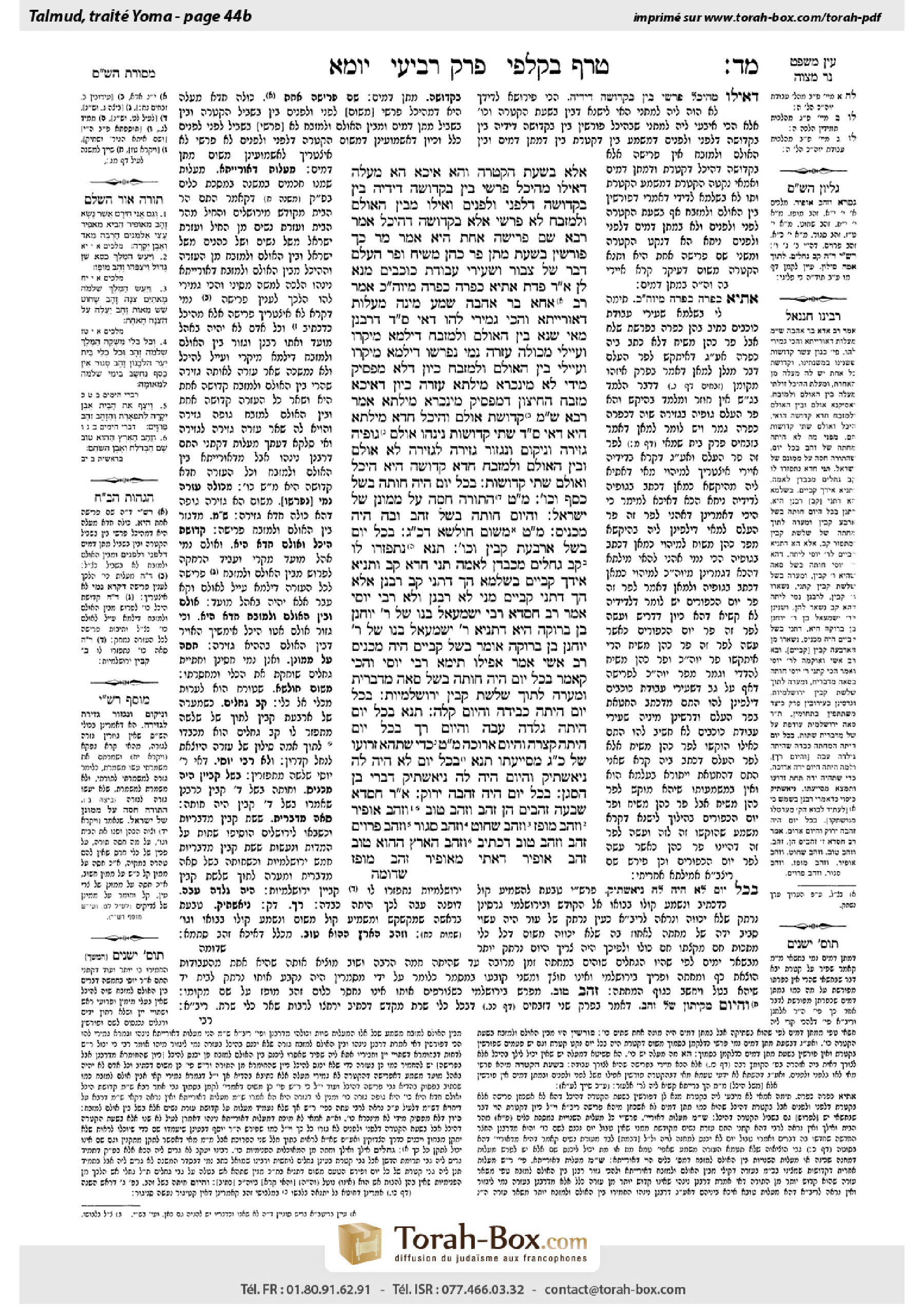
Yoma 44b: Talmud study for Daf Yomi
Daf Yomi is the daily study of one Talmud folio. Explore 37 tractates with scans, Hebrew text, Sefaria English and AI-generated French translations where annotated.
Passage selection and English or AI-generated French translation are available where the scan has annotations. Daf Study is independent of Torah-Box and Sefaria.
Browse Yoma · יומא · All tractatesYoma 44b text and translations
This page of Yoma includes the Aramaic text, an English translation and an AI-generated French translation, alongside the scan above.
יומא מ״ד ב · Aramaic and Hebrew text
אֶלָּא בִּשְׁעַת הַקְטָרָה.
וְהָא אִיכָּא הָא מַעֲלָה, דְּאִילּוּ מֵהֵיכָל פָּרְשִׁי בֵּין בִּקְדוּשָּׁה דִידֵיהּ, בֵּין בִּקְדוּשָּׁה דְּלִפְנַי וְלִפְנִים, וְאִילּוּ מִבֵּין הָאוּלָם וְלַמִּזְבֵּחַ לָא פָּרְשִׁי אֶלָּא בִּקְדוּשָּׁה דְהֵיכָל! אָמַר רָבָא: שֵׁם פְּרִישָׁה אַחַת הִיא.
אָמַר מָר: כָּךְ פּוֹרְשִׁין בִּשְׁעַת מַתַּן פַּר כֹּהֵן מָשִׁיחַ, וּפַר הֶעְלֵם דָּבָר שֶׁל צִבּוּר, וּשְׂעִירֵי עֲבוֹדָה זָרָה. מְנָא לַן? אָמַר רַבִּי פְּדָת: אָתְיָא ״כַּפָּרָה״ ״כַּפָּרָה״ מִיּוֹם הַכִּפּוּרִים.
אָמַר רַב אַחָא בַּר אַהֲבָה, שְׁמַע מִינַּהּ: מַעֲלוֹת דְּאוֹרָיְיתָא, וְהָכִי גְּמִירִי לְהוּ.
דְּאִי סָלְקָא דַעְתָּךְ דְּרַבָּנַן, מַאי שְׁנָא בֵּין הָאוּלָם וְלַמִּזְבֵּחַ? דִּילְמָא מִיקְּרוּ וְעָיְילִי — מִכּוּלַּהּ עֲזָרָה נָמֵי נִפְרְשׁוּ, דִּילְמָא מִיקְּרוּ וְעָיְילִי!
בֵּין הָאוּלָם וְלַמִּזְבֵּחַ, כֵּיוָן דְּלָא מַפְסֵיק מִידֵּי — לָא מִינַּכְרָא מִילְּתָא. עֲזָרָה, כֵּיוָן דְּאִיכָּא מִזְבֵּחַ הַחִיצוֹן דְּמַפְסֵיק — מִינַּכְרָא מִילְּתָא.
אָמַר רָבָא, שְׁמַע מִינַּהּ: קְדוּשַּׁת אוּלָם וְהֵיכָל חֲדָא מִילְּתָא הִיא. דְּאִי סָלְקָא דַּעְתָּךְ שְׁתֵּי קְדוּשּׁוֹת נִינְהוּ, אוּלָם גּוּפֵיהּ גְּזֵירָה, וְנֵיקוּם וְנִגְזוֹר גְּזֵירָה לִגְזֵירָה?!
לָא, אוּלָם וּבֵין הָאוּלָם וְלַמִּזְבֵּחַ חֲדָא קְדוּשָּׁה הִיא, הֵיכָל וְאוּלָם שְׁתֵּי קְדוּשּׁוֹת.
בְּכׇל יוֹם הָיָה חוֹתֶה בְּשֶׁל כֶּסֶף וְכוּ׳. מַאי טַעְמָא? הַתּוֹרָה חָסָה עַל מָמוֹנָן שֶׁל יִשְׂרָאֵל.
וְהַיּוֹם חוֹתֶה בְּשֶׁל זָהָב וּבָהּ הָיָה מַכְנִיס. מַאי טַעְמָא? מִשּׁוּם חוּלְשָׁא דְּכֹהֵן גָּדוֹל.
בְּכׇל יוֹם בְּשֶׁל אַרְבַּעַת קַבִּין וְכוּ׳. תָּנָא: נִתְפַּזְּרוּ לוֹ קַב גֶּחָלִים, מְכַבְּדָן לָאַמָּה.
תָּנֵי חֲדָא: קַב, וְתַנְיָא אִידַּךְ: קַבַּיִים. בִּשְׁלָמָא הָךְ דְּתָנֵי קַב — רַבָּנַן. אֶלָּא הָךְ דְּתָנֵי קַבַּיִים, מַנִּי? לָא רַבָּנַן וְלָא רַבִּי יוֹסֵי!
אָמַר רַב חִסְדָּא: רַבִּי יִשְׁמָעֵאל בְּנוֹ שֶׁל רַבִּי יוֹחָנָן בֶּן בְּרוֹקָה הִיא, דְּתַנְיָא: רַבִּי יִשְׁמָעֵאל בְּנוֹ שֶׁל רַבִּי יוֹחָנָן בֶּן בְּרוֹקָה אוֹמֵר: בְּשֶׁל קַבַּיִים הָיָה מַכְנִיס.
רַב אָשֵׁי אָמַר: אֲפִילּוּ תֵּימָא רַבִּי יוֹסֵי, וְהָכִי קָאָמַר: בְּכׇל יוֹם הָיָה חוֹתֶה בְּשֶׁל סְאָה מִדְבָּרִית, וּמְעָרֶה לְתוֹךְ שְׁלֹשֶׁת קַבִּין יְרוּשַׁלְמִיּוֹת.
בְּכׇל יוֹם הָיְתָה כְּבֵידָה, וְהַיּוֹם קַלָּה. תָּנָא, בְּכׇל יוֹם הָיְתָה גִּלְדָּהּ עָבֶה, וְהַיּוֹם רַךְ. בְּכׇל יוֹם הָיְתָה קְצָרָה, וְהַיּוֹם אֲרוּכָּה. מַאי טַעְמָא — כְּדֵי שֶׁתְּהֵא זְרוֹעוֹ שֶׁל כֹּהֵן גָּדוֹל מְסַיַּיעְתּוֹ.
תָּנָא, בְּכׇל יוֹם לֹא הָיָה לָהּ נִיאַשְׁתִּיק, וְהַיּוֹם הָיָה לָהּ נִיאַשְׁתִּיק. דִּבְרֵי בֶּן הַסְּגָן.
בְּכׇל יוֹם הָיָה זְהָבָהּ יָרוֹק. אָמַר רַב חִסְדָּא: שִׁבְעָה זְהָבִים הֵן: זָהָב, וְזָהָב טוֹב, וּזְהַב אוֹפִיר, וְזָהָב מוּפָז, וְזָהָב שָׁחוּט, וְזָהָב סָגוּר, וּזְהַב פַּרְוַיִם. זָהָב וְזָהָב טוֹב, דִּכְתִיב: ״וּזְהַב הָאָרֶץ הַהִוא טוֹב״. זְהַב אוֹפִיר — דְּאָתֵי מֵאוֹפִיר. זָהָב מוּפָז —
Yoma 44b · English translation
except during the burning of the incense.
But there is also this higher standard, that whereas from the Sanctuary they remove themselves both during its own sanctification, i.e., the blood presentations in the Sanctuary, and during the sanctification of the innermost chamber, i.e., the Holy of Holies, but from the area between the Entrance Hall and the altar, they remove themselves only during the sanctification of the Sanctuary. Rava said: Indeed, there are numerous distinctions, but the baraita teaches only one because all the distinctions fit into one category of removal.
The Gemara continues to analyze the baraita: The Master said in the baraita: Just as they remove themselves from the area between the Entrance Hall and the altar during the burning of the incense, they similarly remove themselves during the blood presentations of the bull of the anointed priest; of the bull for an unwitting communal sin; and of the goats of idol worship. From where do we derive this? Rabbi Pedat said: It is derived by a verbal analogy between the word atonement said in connection with those offerings and the word atonement from the prohibition on Yom Kippur.
Rav Aḥa bar Ahava said: Learn from this that there is a prohibition in the area between the Entrance Hall and the altar. The higher standards applied to the various areas in the Temple are defined by Torah law, and the Sages learned them as a tradition.
As if it could enter your mind that these standards are defined by rabbinic law, what is different about the area between the Entrance Hall and the altar that the prohibition applies only there? Perhaps other priests would accidentally happen to enter the Sanctuary while incense is burning there. But if that is the reason, then the rabbinic decree should require that they remove themselves also from the entire Temple courtyard, since perhaps they would accidentally happen to enter. The fact that the prohibition does not extend to the Temple courtyard suggests that the standards are defined by Torah law.
The Gemara rejects Rav Aḥa bar Ahava’s reasoning: The prohibition could indeed be rabbinic. Nevertheless, it is reasonable to limit it to the area between the Entrance Hall and the altar, as follows: Since there is nothing that separates it from the Sanctuary, the distinction between the two areas is not conspicuous, and therefore people may err and enter. But with regard to the Temple courtyard, since there is the outer altar that separates the rest of the Temple courtyard from the Sanctuary, the distinction between the areas is conspicuous, and therefore there is no need to extend the prohibition throughout the Temple courtyard.
Rava said: Learn from this fact that there is a rabbinic prohibition in the area between the Entrance Hall and the altar. The sanctity of the Entrance Hall and the sanctity of the Sanctuary is one matter, i.e., there they share the same sanctity, and therefore the Torah prohibition applies to the Entrance Hall as well. For if it could enter your mind to say that these areas have two distinct levels of sanctity, it would emerge that the prohibition to be in the Entrance Hall is itself a rabbinic decree. But will we arise and issue one decree to prevent violation of another decree by prohibiting being present in the area between the Entrance Hall and the altar, lest one enter the Entrance Hall itself?
The Gemara rejects Rava’s reasoning: No, this would not be a case of issuing one decree to prevent violation of another decree, because the Entrance Hall and the area between the Entrance Hall and the altar share one sanctity. Consequently, any prohibition applied to one will certainly also apply to the other. However, the Sanctuary and the Entrance Hall have two distinct sanctities.
§ The mishna states: On every other day, a priest would scoop up the coals with a coal pan made of silver and pour the coals from there into a coal pan of gold. The Gemara asks: What is the reason the gold pan was not used to scoop the coals? The Gemara answers: Because the Torah spared the money of the Jewish people. Since the pan is worn away with use, it is preferable to use a less expensive silver pan.
§ The mishna continues: But on this day, on Yom Kippur, the High Priest scoops up with a coal pan of gold, and with that coal pan, he would bring the coals into the Holy of Holies. The Gemara asks: What is the reason that on Yom Kippur only one pan is used? Due to the weakness of the High Priest. He has to perform the entire service by himself while fasting; using only one pan minimizes his exertion.
§ The mishna states: On every other day, a priest scoops up the coals with a coal pan of four kav and pours the coals into a coal pan of three kav. Rabbi Yosei says: On every other day, a priest scoops with a coal pan of a se’a, which is six kav, and then pours the coals into a coal pan of three kav. It was taught in a mishna (Tamid 33a): As he poured from a pan of four kav to a pan of three kav, a kav of coals became scattered, and he swept them into the canal that passed through the Temple and ran to the Kidron brook.
It was taught in one baraita: A kav of coals was scattered. And it was taught in another baraita: Two kav were scattered. The Gemara comments: Granted, this baraita, which teaches that a single kav was scattered, is understandable. It is in accordance with the opinion of the Rabbis, the first tanna of the mishna, who maintain that coals are poured from a coal pan of four kav to one of three. But that baraita, which teaches that two kav of coals were scattered, in accordance with whose opinion is it? It is not in accordance with the opinion of the Rabbis and not in accordance with the opinion of Rabbi Yosei. According to Rabbi Yosei, three kav of coals would have been scattered.
Rav Ḥisda said: It is in accordance with the opinion of Rabbi Yishmael, son of Rabbi Yoḥanan ben Beroka, as it was taught in a baraita: Rabbi Yishmael, son of Rabbi Yoḥanan ben Beroka, says: With a coal pan of two kav he would bring the coals into the Holy of Holies. If one accepts the opinion of the Rabbis that the coals were scooped with a coal pan of four kav, two kav were scattered.
Rav Ashi said: You can even say that this baraita is in accordance with the opinion of Rabbi Yosei, and this is what he is saying: On every other day, a priest scooped with a coal pan of a desert se’a, which is five Jerusalem kav, and then he poured the coals into a coal pan of three Jerusalem kav. Therefore, two kav would be scattered.
§ The mishna states: On every other day, the coal pan was heavy, but on this day it was light. It was taught in a baraita: On every other day its side was thick but on this day it was soft and thin. On every other day its handle was short but on this day it was long. What is the reason? So that the arm of the High Priest could assist him in carrying the coal pan, i.e., he could support the coal pan by resting it against his arm rather than bear the entire weight in his hand.
It was taught in a baraita: On every other day it did not have a ring, but on this day it has a ring on the end of the handle, which clatters against it and makes a noise in fulfillment of the verse “And the sound thereof shall be heard when he goes in to the Sanctuary” (Exodus 28:35); this is the statement of the son of the Deputy.
§ The mishna states: On every other day, it was of greenish gold but on this day it was of a red gold. Rav Ḥisda said: There are seven types of gold mentioned in the Bible: Gold, and good gold, and gold of Ophir (I Kings 10:11), and glistering gold (I Kings 10:18), and shaḥut gold (I Kings 10:17), and closed gold (I Kings 10:21), and parvayim gold (II Chronicles 3:6). The Gemara explains the reason for these names: There is a distinction between gold and good gold, as it is written in the verse: “And the gold of that land is good” (Genesis 2:12), which indicates the existence of gold of a higher quality. Gold of Ophir is gold that comes from Ophir. Glistering [mufaz] gold is so named
Yoma 44b · Traduction française (IA)
sauf pendant la combustion de l’encens.
Mais il existe aussi cette exigence plus stricte : depuis le Sanctuaire, ils se retirent aussi bien pendant sa propre sanctification, c’est-à-dire les aspersions de sang dans le Sanctuaire, que pendant la sanctification de la pièce la plus intérieure, c’est-à-dire le Saint des Saints ; en revanche, de la zone située entre le Vestibule et l’autel, ils ne se retirent que pendant la sanctification du Sanctuaire. Rava dit : En effet, les distinctions sont nombreuses, mais la baraïta n’en enseigne qu’une seule, car elles relèvent toutes d’une même catégorie de retrait.
La Guemara poursuit l’analyse de la baraïta : Le maître a enseigné dans la baraïta : de même qu’ils se retirent de la zone située entre le Vestibule et l’autel pendant la combustion de l’encens, ils s’en retirent également pendant les aspersions de sang du taureau du prêtre oint, du taureau offert pour la faute involontaire de la communauté et des boucs offerts pour l’idolâtrie. D’où le déduisons-nous ? Rabbi Pedat dit : On le déduit par une analogie verbale entre le mot « expiation », employé à propos de ces offrandes, et le mot « expiation » dans l’interdiction relative à Yom Kippour.
Rav Aḥa bar Ahava dit : Apprends de là qu’il existe une interdiction dans la zone située entre le Vestibule et l’autel. Les exigences plus strictes appliquées aux différentes zones du Temple sont définies par la Torah, et les Sages les ont apprises par tradition.
Si l’on pouvait concevoir que ces exigences soient définies par une loi rabbinique, en quoi la zone située entre le Vestibule et l’autel serait-elle différente, pour que l’interdiction ne s’y applique qu’à elle ? Peut-être d’autres prêtres pourraient-ils entrer par inadvertance dans le Sanctuaire pendant que l’encens y brûle. Mais si telle est la raison, le décret rabbinique devrait leur imposer de se retirer également de toute la cour du Temple, car ils pourraient peut-être y entrer par inadvertance. Le fait que l’interdiction ne s’étende pas à la cour du Temple suggère que ces exigences sont définies par la Torah.
La Guemara rejette le raisonnement de Rav Aḥa bar Ahava : l’interdiction pourrait effectivement être rabbinique. Il est néanmoins raisonnable de la limiter à la zone située entre le Vestibule et l’autel, pour la raison suivante : puisqu’aucune séparation ne la distingue du Sanctuaire, la distinction entre ces deux zones n’est pas manifeste, et les gens risquent donc de se tromper et d’y entrer. En revanche, dans la cour du Temple, l’autel extérieur sépare le reste de la cour du Sanctuaire ; la distinction entre ces zones est donc manifeste, et il n’est pas nécessaire d’étendre l’interdiction à toute la cour du Temple.
Rava dit : Apprends de là qu’il existe une interdiction rabbinique dans la zone située entre le Vestibule et l’autel. La sainteté du Vestibule et celle du Sanctuaire sont de même nature, c’est-à-dire qu’ils ont là le même degré de sainteté ; l’interdiction de la Torah s’applique donc également au Vestibule. En effet, si l’on pouvait concevoir que ces zones aient deux degrés de sainteté distincts, il s’ensuivrait que l’interdiction de se trouver dans le Vestibule serait elle-même un décret rabbinique. Mais allons-nous vraiment instituer un décret pour prévenir la transgression d’un autre décret, en interdisant de se trouver dans la zone située entre le Vestibule et l’autel, de peur que l’on entre dans le Vestibule lui-même ?
La Guemara rejette le raisonnement de Rava : non, il ne s’agirait pas d’instituer un décret pour prévenir la transgression d’un autre décret, car le Vestibule et la zone située entre le Vestibule et l’autel ont le même degré de sainteté. Par conséquent, toute interdiction qui s’applique à l’un s’applique certainement aussi à l’autre. En revanche, le Sanctuaire et le Vestibule ont deux degrés de sainteté distincts.
§ La Michna enseigne : Les autres jours, un prêtre recueillait les braises avec une pelle à braises en argent, puis les versait de cette pelle dans une pelle à braises en or. La Guemara demande : Pourquoi n’utilisait-on pas la pelle en or pour recueillir les braises ? La Guemara répond : Parce que la Torah a épargné les ressources du peuple juif. Comme la pelle s’use à l’usage, il est préférable d’utiliser une pelle en argent, moins coûteuse.
§ La Michna poursuit : Mais ce jour-là, à Yom Kippour, le Grand Prêtre recueillait les braises avec une pelle à braises en or et les apportait avec cette même pelle dans le Saint des Saints. La Guemara demande : Pourquoi n’utilisait-on qu’une seule pelle à Yom Kippour ? À cause de la faiblesse du Grand Prêtre. Il devait accomplir seul tout le service alors qu’il jeûnait ; l’utilisation d’une seule pelle réduisait l’effort qu’il devait fournir.
§ La Michna enseigne : Les autres jours, un prêtre recueillait les braises avec une pelle à braises de quatre kav et les versait dans une pelle à braises de trois kav. Rabbi Yosei dit : Les autres jours, un prêtre recueillait les braises avec une pelle à braises d’un séa, soit six kav, puis les versait dans une pelle à braises de trois kav. Il a été enseigné dans une Michna (Tamid 33a) : Lorsqu’il versait les braises d’une pelle de quatre kav dans une pelle de trois kav, un kav de braises se dispersait ; il le balayait alors dans le canal qui traversait le Temple et se déversait dans le torrent du Cédron.
Il a été enseigné dans une baraïta qu’un kav de braises se dispersait. Et il a été enseigné dans une autre baraïta que deux kav se dispersaient. La Guemara fait remarquer : Il est compréhensible que la baraïta qui enseigne qu’un seul kav se dispersait soit conforme à l’opinion des Rabbins, le premier tanna de la Michna, selon lesquels les braises étaient versées d’une pelle à braises de quatre kav dans une pelle de trois kav. Mais à l’opinion de qui la baraïta qui enseigne que deux kav de braises se dispersaient est-elle conforme ? Elle n’est conforme ni à l’opinion des Rabbins ni à celle de Rabbi Yosei. Selon Rabbi Yosei, trois kav de braises se seraient dispersés.
Rav Ḥisda dit : Elle est conforme à l’opinion de Rabbi Yishmael, fils de Rabbi Yoḥanan ben Beroka, comme cela a été enseigné dans une baraïta : Rabbi Yishmael, fils de Rabbi Yoḥanan ben Beroka, dit : Avec une pelle à braises de deux kav, il apportait les braises dans le Saint des Saints. Si l’on accepte l’opinion des Rabbins, selon laquelle les braises étaient recueillies avec une pelle à braises de quatre kav, deux kav se dispersaient.
Rav Ashi dit : On peut même dire que cette baraïta est conforme à l’opinion de Rabbi Yosei, et voici ce qu’il enseigne : Les autres jours, un prêtre recueillait les braises avec une pelle à braises d’un séa du désert, qui équivaut à cinq kav de Jérusalem, puis les versait dans une pelle à braises de trois kav de Jérusalem. Par conséquent, deux kav se dispersaient.
§ La Michna enseigne : Les autres jours, la pelle à braises était lourde, mais ce jour-là, elle était légère. Il a été enseigné dans une baraïta : Les autres jours, son bord était épais, mais ce jour-là, il était souple et mince. Les autres jours, son manche était court, mais ce jour-là, il était long. Pourquoi ? Pour que le bras du Grand Prêtre l’aide à porter la pelle à braises, c’est-à-dire qu’il puisse la soutenir en l’appuyant contre son bras plutôt que de porter tout son poids à la main.
Il a été enseigné dans une baraïta : Les autres jours, elle n’avait pas d’anneau, mais ce jour-là, elle avait un anneau à l’extrémité du manche, qui s’entrechoquait avec la pelle et faisait du bruit, conformément au verset : « Et on en entendra le bruit lorsqu’il entrera dans le Sanctuaire » (Exode 28:35) ; telle est l’opinion du fils du Segan.
§ La Michna enseigne : Les autres jours, elle était en or verdâtre, mais ce jour-là, elle était en or rouge. Rav Ḥisda dit : Sept sortes d’or sont mentionnées dans la Bible : l’or, l’or de qualité, l’or d’Ophir (I Rois 10:11), l’or resplendissant (I Rois 10:18), l’or shaḥut (I Rois 10:17), l’or fermé (I Rois 10:21) et l’or de Parvaïm (II Chroniques 3:6). La Guemara explique l’origine de ces appellations : il existe une différence entre l’or et l’or de qualité, comme il est écrit dans le verset : « Et l’or de ce pays est bon » (Genèse 2:12), ce qui indique l’existence d’un or de qualité supérieure. L’or d’Ophir est l’or qui vient d’Ophir. L’or resplendissant [mufaz] est ainsi nommé
Traduction française générée par IA à partir de l’édition anglaise de Sefaria. Vérifie toujours un passage avec le texte source.
Text from Sefaria: William Davidson Edition - Vocalized Aramaic (CC BY NC); William Davidson Edition - English (CC BY NC).