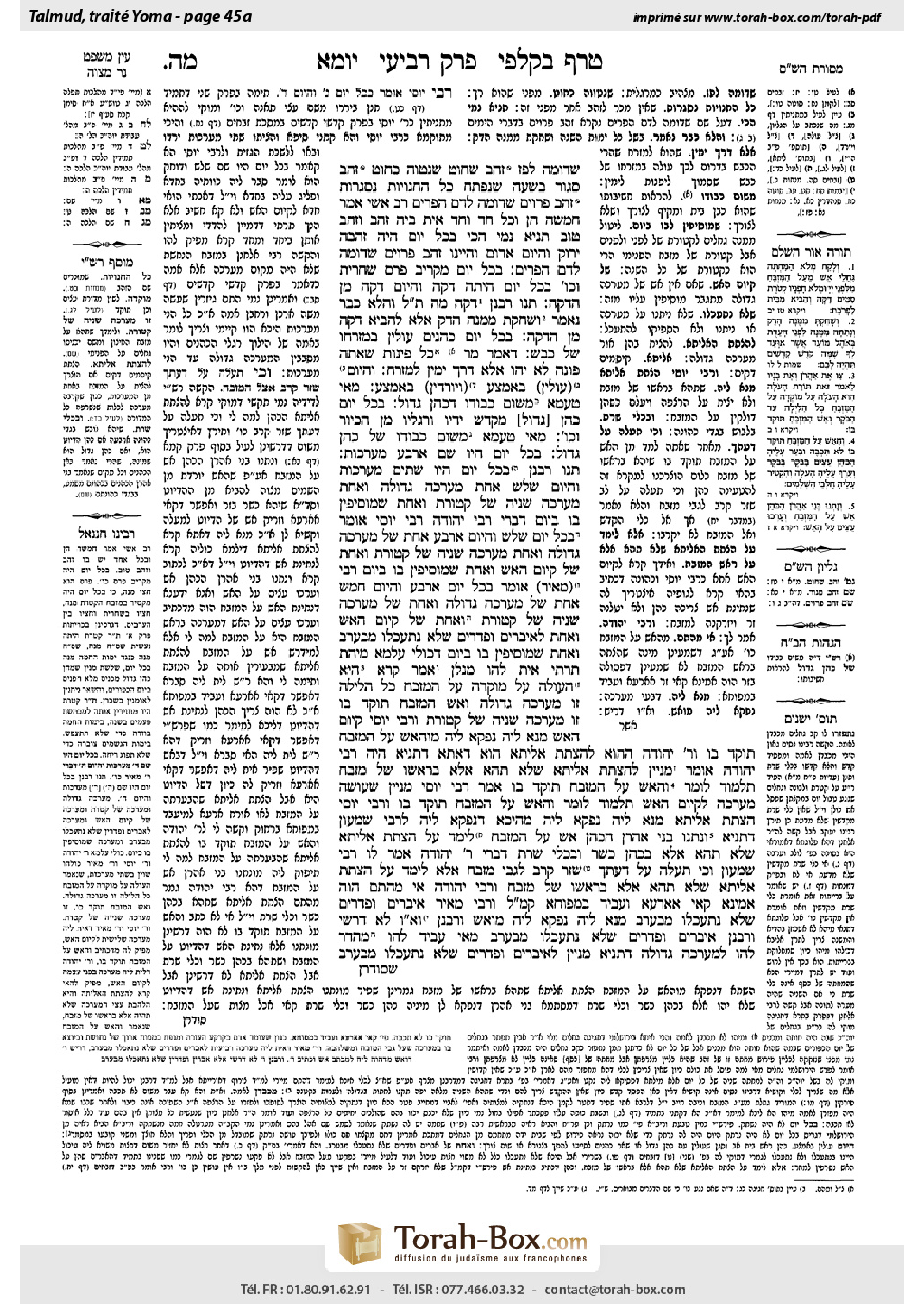
Yoma 45a: Talmud study for Daf Yomi
Daf Yomi is the daily study of one Talmud folio. Explore 37 tractates with scans, Hebrew text, Sefaria English and AI-generated French translations where annotated.
Passage selection and English or AI-generated French translation are available where the scan has annotations. Daf Study is independent of Torah-Box and Sefaria.
Browse Yoma · יומא · All tractatesYoma 45a text and translations
This page of Yoma includes the Aramaic text, an English translation and an AI-generated French translation, alongside the scan above.
יומא מ״ה א · Aramaic and Hebrew text
שֶׁדּוֹמֶה לְפָז. זָהָב שָׁחוּט — שֶׁנִּטְוֶה כְּחוּט. זָהָב סָגוּר — בְּשָׁעָה שֶׁנִּפְתָּח כָּל הַחֲנוּיוֹת נִסְגָּרוֹת. זְהַב פַּרְוַיִם — שֶׁדּוֹמֶה לְדַם הַפָּרִים.
רַב אָשֵׁי אָמַר: חֲמִשָּׁה הֵן, וְכׇל חַד וְחַד אִית בֵּיהּ זָהָב וְזָהָב טוֹב. תַּנְיָא נָמֵי הָכִי: בְּכׇל יוֹם הָיָה זְהָבָהּ יָרוֹק, וְהַיּוֹם אָדוֹם — וְהַיְינוּ זְהַב פַּרְוַיִם שֶׁדּוֹמֶה לְדַם הַפָּרִים.
בְּכׇל יוֹם מַקְרִיב פְּרָס שַׁחֲרִית וְכוּ׳. בְּכׇל יוֹם הָיְתָה דַּקָּה, וְהַיּוֹם דַּקָּה מִן הַדַּקָּה. תָּנוּ רַבָּנַן: ״דַּקָּה״ מָה תַּלְמוּד לוֹמַר? וַהֲלֹא כְּבָר נֶאֱמַר: ״וְשָׁחַקְתָּ מִמֶּנָּה הָדֵק״! אֶלָּא, לְהָבִיא דַּקָּה מִן הַדַּקָּה.
בְּכׇל יוֹם כֹּהֲנִים עוֹלִין בְּמִזְרָחוֹ שֶׁל כֶּבֶשׁ. דְּאָמַר מָר: כׇּל פִּינּוֹת שֶׁאַתָּה פּוֹנֶה לֹא יְהוּ אֶלָּא דֶּרֶךְ יָמִין לַמִּזְרָח.
וְהַיּוֹם (עוֹלִין) בָּאֶמְצַע (וְיוֹרְדִין) בָּאֶמְצַע. מַאי טַעְמָא — מִשּׁוּם כְּבוֹדוֹ דְּכֹהֵן גָּדוֹל.
בְּכׇל יוֹם כֹּהֵן [גָּדוֹל] מְקַדֵּשׁ יָדָיו וְרַגְלָיו מִן הַכִּיּוֹר וְכוּ׳. מַאי טַעְמָא — מִשּׁוּם כְּבוֹדוֹ שֶׁל כֹּהֵן גָּדוֹל.
בְּכׇל יוֹם הָיוּ שָׁם אַרְבַּע מַעֲרָכוֹת. תָּנוּ רַבָּנַן: בְּכׇל יוֹם הָיוּ שְׁתַּיִם מַעֲרָכוֹת, וְהַיּוֹם שָׁלֹשׁ. אַחַת מַעֲרָכָה גְּדוֹלָה, וְאַחַת מַעֲרָכָה שְׁנִיָּה שֶׁל קְטוֹרֶת, וְאַחַת שֶׁמּוֹסִיפִין בּוֹ בַּיּוֹם, דִּבְרֵי רַבִּי יְהוּדָה.
רַבִּי יוֹסֵי אוֹמֵר: בְּכׇל יוֹם שָׁלֹשׁ, וְהַיּוֹם אַרְבַּע. אַחַת שֶׁל מַעֲרָכָה גְּדוֹלָה, וְאַחַת מַעֲרָכָה שְׁנִיָּה שֶׁל קְטוֹרֶת, וְאַחַת שֶׁל קִיּוּם הָאֵשׁ, וְאַחַת שֶׁמּוֹסִיפִין בּוֹ בַּיּוֹם.
רַבִּי (מֵאִיר) אוֹמֵר: בְּכׇל יוֹם אַרְבַּע, וְהַיּוֹם חָמֵשׁ. אַחַת שֶׁל מַעֲרָכָה גְּדוֹלָה, וְאַחַת שֶׁל מַעֲרָכָה שְׁנִיָּה שֶׁל קְטוֹרֶת, וְאַחַת שֶׁל קִיּוּם הָאֵשׁ, וְאַחַת לְאֵיבָרִים וּפְדָרִים שֶׁלֹּא נִתְעַכְּלוּ מִבָּעֶרֶב, וְאַחַת שֶׁמּוֹסִיפִין בּוֹ בַּיּוֹם.
דְּכוּלֵּי עָלְמָא מִיהַת תַּרְתֵּי אִית לְהוּ, מְנָלַן? אָמַר קְרָא: ״הִיא הָעוֹלָה עַל מוֹקְדָה עַל הַמִּזְבֵּחַ כׇּל הַלַּיְלָה״ — זוֹ מַעֲרָכָה גְּדוֹלָה. ״וְאֵשׁ הַמִּזְבֵּחַ תּוּקַד בּוֹ״ — זוֹ מַעֲרָכָה שְׁנִיָּה שֶׁל קְטוֹרֶת. וְרַבִּי יוֹסֵי, קִיּוּם הָאֵשׁ מְנָא לֵיהּ? נָפְקָא לֵיהּ: מִ״וְּהָאֵשׁ עַל הַמִּזְבֵּחַ תּוּקַד בּוֹ״.
וְרַבִּי יְהוּדָה: הָהוּא, לְהַצָּתַת אֲלִיתָא הוּא דַּאֲתָא. דְּתַנְיָא, הָיָה רַבִּי יְהוּדָה אוֹמֵר: מִנַּיִין לְהַצָּתַת אֲלִיתָא שֶׁלֹּא תְּהֵא אֶלָּא בְּרֹאשׁוֹ שֶׁל מִזְבֵּחַ? תַּלְמוּד לוֹמַר: ״וְהָאֵשׁ עַל הַמִּזְבֵּחַ תּוּקַד בּוֹ״. אָמַר רַבִּי יוֹסֵי: מִנַּיִין שֶׁעוֹשֶׂה מַעֲרָכָה לְקִיּוּם הָאֵשׁ? תַּלְמוּד לוֹמַר: ״וְהָאֵשׁ עַל הַמִּזְבֵּחַ תּוּקַד בּוֹ״.
וְרַבִּי יוֹסֵי, הַצָּתַת אֲלִיתָא מְנָא לֵיהּ? נָפְקָא לֵיהּ מֵהֵיכָא דְּנָפְקָא לֵיהּ לְרַבִּי שִׁמְעוֹן. דְּתַנְיָא: ״וְנָתְנוּ בְּנֵי אַהֲרֹן הַכֹּהֵן אֵשׁ עַל הַמִּזְבֵּחַ״ — לִימֵּד עַל הַצָּתַת אֲלִיתָא שֶׁלֹּא תְּהֵא אֶלָּא בְּכֹהֵן כָּשֵׁר וּבִכְלִי שָׁרֵת, דִּבְרֵי רַבִּי יְהוּדָה. אָמַר לוֹ רַבִּי שִׁמְעוֹן: וְכִי תַּעֲלֶה עַל דַּעְתְּךָ שֶׁזָּר קָרֵב לְגַבֵּי מִזְבֵּחַ? אֶלָּא, לִימֵּד עַל הַצָּתַת אֲלִיתָא שֶׁלֹּא תְּהֵא אֶלָּא בְּרֹאשׁוֹ שֶׁל מִזְבֵּחַ.
וְרַבִּי יְהוּדָה? אִי מֵהָתָם, הֲוָה אָמֵינָא: קָאֵי אַאַרְעָא וְעָבֵיד בְּמַפּוּחָא, קָא מַשְׁמַע לַן.
וְרַבִּי מֵאִיר, אֵיבָרִים וּפְדָרִים שֶׁלֹּא נִתְעַכְּלוּ מִבָּעֶרֶב, מְנָא לֵיהּ? נָפְקָא לֵיהּ: מִ״וְּאֵשׁ״. וְרַבָּנַן — וָאו לָא דָּרְשִׁי.
וְרַבָּנַן, אֵיבָרִים וּפְדָרִים שֶׁלֹּא נִתְעַכְּלוּ מִבָּעֶרֶב מַאי עָבֵיד לְהוּ? מַהְדַּר לְהוּ לְמַעֲרָכָה גְּדוֹלָה. דְּתַנְיָא: מִנַּיִין לְאֵיבָרִים וּפְדָרִים שֶׁלֹּא נִתְעַכְּלוּ מִבָּעֶרֶב
Yoma 45a · English translation
because it resembles the luster of pearls [paz] in the way it glistens. Shaḥut gold is named as such because it is very malleable and is spun like thread [shenitve keḥut]. Shaḥut is a contraction of the words shenitve keḥut. Closed gold is so called because when a shop opens to sell it, all the other shops close, as no one is interested in purchasing any other type of gold. Parvayim gold is so called because its redness resembles the blood of bulls [parim].
Rav Ashi said: There are in fact only five types of gold, the last five in Rav Ḥisda’s list. Gold and good gold are not independent categories; rather, each and every one of the types of gold has two varieties: Regular gold and a superior variety called good gold. That was also taught in a baraita with regard to parvayim gold: On every other day the coal pan was made of greenish gold, but on this day it was made of a red gold, and this is the parvayim gold which resembles the blood of bulls.
§ The mishna states: On every other day, a priest sacrificed a peras, half of a maneh, of incense in the morning, and a peras in the afternoon, but on this day the High Priest adds an additional handful of incense and burns it in the Holy of Holies. On every other day, the incense was ground fine as prescribed by the Torah, but on this day it was superfine. The Sages taught in a baraita: The verse states with regard to the incense on Yom Kippur that it is “finely ground aromatic incense” (Leviticus 16:12). What does the verse mean to teach by this? Has it not already been stated: “And you shall grind some of it finely” (Exodus 30:36)? Rather, it teaches that on Yom Kippur the incense has to be superfine.
§ The mishna states: On every other day, priests ascend on the eastern side of the ramp. A baraita explains the reason for this: As the Master said: All the turns that you turn should be only to the right, which, after ascending the altar, means one will turn to the east and will mean one will circulate the altar in a counter-clockwise fashion. When they descended, they again turned to the right, which is to the west of the ramp.
§ The mishna continues: But on this day the priests ascend in the middle of the ramp and descend in the middle. What is the reason? Due to the eminence of the High Priest he should not walk on the side but in the middle.
§ We learned in the mishna that every other day the High Priest sanctifies his hands and his feet from the laver like the other priests, and on this day he sanctifies them from the golden flask. What is the reason? Due to the eminence of the High Priest.
§ The mishna states: On every other day, there were four arrangements of wood there, upon the altar, but on this day there were five. The Sages taught in the Tosefta: On every other day there were two arrangements of wood on the altar, but on this day there were three: One, the large arrangement; and one, the second arrangement for coals for the incense; and one, the additional arrangement of wood, which they add on that day for the incense that is burned in the Holy of Holies. This is the statement of Rabbi Yehuda.
Rabbi Yosei says: On every other day there were three arrangements, but on this day there were four: One, the large arrangement; and one, the second arrangement for the incense; and one, for the upkeep of the fire, so that if the fire of the large arrangement begins to die down, wood from this arrangement may be added to it to raise the flames; and one, the additional arrangement of wood that they add on that day for the incense that is burned in the Holy of Holies.
Rabbi Meir says: On every other day there were four arrangements of wood on the altar but on this day there were five: One, the large arrangement; and one, the second arrangement for the incense; and one, for the upkeep of the fire; and one, for burning the limbs and fats that were not fully consumed on the altar the previous evening; and one, the additional arrangement of wood that they add on that day for the incense that is burned in the Holy of Holies.
The Gemara analyzes the different opinions: At any rate, everyone has at least two arrangements in their calculations. From where do we derive this? The verse states: “It is the burnt-offering on the flame on the altar all night” (Leviticus 6:2); this is referring to the large arrangement. It states further: “And the fire of the altar shall be kept burning thereby” (Leviticus 6:2), this additional mention of a fire is referring to the second arrangement, which is for the incense. And from where does Rabbi Yosei learn about the additional arrangement for the upkeep of the fire? He derives it from the verse: “And the fire upon the altar shall be kept burning thereby” (Leviticus 6:5), which mentions fire for the third time.
And how does Rabbi Yehuda, who holds that normally there are only two arrangements, explain this third mention of a fire? That additional mention comes to teach about the kindling of the thin wood chips, which were used to ignite the fires on the altar, as it was taught in a baraita: Rabbi Yehuda would say: From where is it derived that the kindling of the wood chips should be done only at the top of the altar, rather than setting them alight at the bottom of the altar and carrying them up? The verse states: “And the fire upon the altar shall be kept burning thereby” (Leviticus 6:5), which indicates that the fire that is brought there has to be lit on the altar itself. Rabbi Yosei said: From where is it derived that an arrangement for the upkeep of the fire is made? The verse states: “And the fire upon the altar shall be kept burning thereby” (Leviticus 6:5).
And from where does Rabbi Yosei derive that the kindling of the wood chips should be at the top of the altar? He derives it from the same place that Rabbi Shimon derives it. As it was taught in a baraita: The verse states: “And the sons of Aaron the priest shall put fire upon the altar” (Leviticus 1:7), which teaches about the kindling of the wood chips that it may be done only by a fit priest and one who is robed in the priestly vestments of service; this is the statement of Rabbi Yehuda. Rabbi Shimon said to him: There is no need for a verse to teach that a priest must kindle the chips, for could it enter your mind that a non-priest could approach the altar? Rather, this verse teaches about the kindling of the wood chips, that they may be lit only at the top of the altar.
And what would Rabbi Yehuda respond to Rabbi Shimon’s reasoning? If this halakha was derived from there, I would have said a non-priest could light the fire on the altar by standing on the ground below and using a bellows to fan the flames on the top of the altar. Therefore, this verse teaches us that in all circumstances the person kindling the fire must be a priest.
And from where does Rabbi Meir learn about an additional arrangement for the limbs and the fats that were not fully consumed on the altar the previous evening? He derives it from the phrase “and the fire.” The apparently superfluous word “and” alludes to the existence of an additional arrangement. And the Rabbis, i.e., Rabbi Yosei and Rabbi Yehuda, who disagree, do not expound the word “and.”
And according to the Rabbis, what do they do with the limbs and the fats that were not fully consumed on the altar the previous evening? Where are they burned? A priest returns them to the large arrangement, where the process of their burning is completed. As it was taught in a baraita: From where is it derived that for limbs and fats that were not fully consumed on the altar the previous evening,
Yoma 45a · Traduction française (IA)
parce que son éclat rappelle celui des perles [paz]. L’or shaḥut est ainsi nommé parce qu’il est très malléable et qu’on le file comme un fil [shenitve keḥut]. Shaḥut est une contraction des mots shenitve keḥut. L’or « fermé » est ainsi appelé parce que, lorsqu’une boutique ouvre pour en vendre, toutes les autres boutiques ferment, car personne ne souhaite acheter un autre type d’or. L’or de Parvaïm est ainsi nommé parce que sa couleur rouge rappelle le sang des taureaux [parim].
Rav Ashi dit : En réalité, il n’existe que cinq types d’or, les cinq derniers de la liste de Rav Ḥisda. L’or et le bon or ne sont pas des catégories distinctes ; chaque type d’or possède plutôt deux variétés : l’or ordinaire et une variété supérieure appelée bon or. Cela a également été enseigné dans une baraïta au sujet de l’or de Parvaïm : les autres jours, le brasero était en or verdâtre, mais ce jour-là, il était en or rouge ; c’est l’or de Parvaïm, qui rappelle le sang des taureaux.
§ La Michna enseigne : les autres jours, un prêtre offrait un peras, soit la moitié d’un maneh, d’encens le matin et un peras l’après-midi ; mais ce jour-là, le Grand Prêtre ajoute une poignée supplémentaire d’encens et la brûle dans le Saint des saints. Les autres jours, l’encens était broyé finement, comme le prescrit la Torah, mais ce jour-là, il était broyé très finement. Les Sages ont enseigné dans une baraïta : au sujet de l’encens de Yom Kippour, le verset dit : « un encens aromatique finement broyé » (Lévitique 16, 12). Que nous apprend ce verset ? N’est-il pas déjà dit : « Tu en broieras une partie finement » (Exode 30, 36) ? Il enseigne plutôt que, le jour de Yom Kippour, l’encens doit être broyé très finement.
§ La Michna enseigne : les autres jours, les prêtres montaient du côté est de la rampe. Une baraïta en explique la raison : comme l’a enseigné le Maître, tous les virages que l’on prend doivent se faire uniquement vers la droite ; après être monté sur l’autel, on tourne donc vers l’est et l’on fait le tour de l’autel dans le sens inverse des aiguilles d’une montre. En redescendant, ils tournaient de nouveau vers la droite, c’est-à-dire vers l’ouest de la rampe.
§ La Michna poursuit : mais ce jour-là, les prêtres montent au milieu de la rampe et en redescendent au milieu. Pour quelle raison ? En raison de la dignité du Grand Prêtre, celui-ci ne doit pas marcher sur le côté, mais au milieu.
§ Nous avons appris dans la Michna que les autres jours, le Grand Prêtre sanctifie ses mains et ses pieds à la cuve, comme les autres prêtres, tandis que ce jour-là, il les sanctifie à l’aide d’une aiguière d’or. Pour quelle raison ? En raison de la dignité du Grand Prêtre.
§ La Michna enseigne : les autres jours, il y avait quatre bûchers sur l’autel, mais ce jour-là, il y en avait cinq. Les Sages ont enseigné dans la Tossefta : les autres jours, il y avait deux bûchers sur l’autel, mais ce jour-là, il y en avait trois : l’un était le grand bûcher ; l’un était le second bûcher, destiné aux braises pour l’encens ; et l’un était le bûcher supplémentaire, que l’on ajoutait ce jour-là pour l’encens brûlé dans le Saint des saints. Telle est l’opinion de Rabbi Yehuda.
Rabbi Yosei dit : les autres jours, il y avait trois bûchers, mais ce jour-là, il y en avait quatre : l’un était le grand bûcher ; l’un était le second bûcher, destiné à l’encens ; l’un servait à entretenir le feu, afin que, si le feu du grand bûcher commençait à faiblir, on puisse y ajouter du bois provenant de ce bûcher pour raviver les flammes ; et l’un était le bûcher supplémentaire, que l’on ajoutait ce jour-là pour l’encens brûlé dans le Saint des saints.
Rabbi Meir dit : les autres jours, il y avait quatre bûchers sur l’autel, mais ce jour-là, il y en avait cinq : l’un était le grand bûcher ; l’un était le second bûcher, destiné à l’encens ; l’un servait à entretenir le feu ; l’un servait à brûler les membres et les graisses qui n’avaient pas été entièrement consumés sur l’autel la veille au soir ; et l’un était le bûcher supplémentaire, que l’on ajoutait ce jour-là pour l’encens brûlé dans le Saint des saints.
La Guemara examine les différentes opinions : en tout cas, tous comptent au moins deux bûchers. D’où le déduisons-nous ? Le verset dit : « C’est l’holocauste sur le feu de l’autel, toute la nuit » (Lévitique 6, 2) ; cela désigne le grand bûcher. Il est ensuite dit : « et le feu de l’autel y sera entretenu » (Lévitique 6, 2) ; cette mention supplémentaire du feu désigne le second bûcher, destiné à l’encens. Et d’où Rabbi Yosei déduit-il l’existence du bûcher supplémentaire destiné à entretenir le feu ? Il le déduit du verset : « Et le feu sur l’autel y sera entretenu » (Lévitique 6, 5), qui mentionne le feu pour la troisième fois.
Et comment Rabbi Yehuda, qui estime qu’il n’y a normalement que deux bûchers, explique-t-il cette troisième mention du feu ? Cette mention supplémentaire vient enseigner que l’allumage des copeaux de bois, qui servaient à allumer les feux sur l’autel, devait se faire uniquement au sommet de l’autel, comme cela a été enseigné dans une baraïta : Rabbi Yehuda disait : d’où déduit-on que les copeaux de bois doivent être allumés uniquement au sommet de l’autel, plutôt que d’être allumés au pied de l’autel puis transportés en haut ? Le verset dit : « Et le feu sur l’autel y sera entretenu » (Lévitique 6, 5), ce qui indique que le feu apporté là doit être allumé sur l’autel même. Rabbi Yosei dit : d’où déduit-on qu’on prépare un bûcher pour entretenir le feu ? Le verset dit : « Et le feu sur l’autel y sera entretenu » (Lévitique 6, 5).
Et d’où Rabbi Yosei déduit-il que les copeaux de bois doivent être allumés au sommet de l’autel ? Il le déduit du même passage que celui dont Rabbi Shimon tire cette règle. En effet, il a été enseigné dans une baraïta : le verset dit : « Et les fils d’Aaron, le prêtre, mettront du feu sur l’autel » (Lévitique 1, 7). Selon Rabbi Yehuda, ce verset enseigne, au sujet de l’allumage des copeaux de bois, que celui-ci ne peut être effectué que par un prêtre apte au service et vêtu des vêtements sacerdotaux de service. Rabbi Shimon lui dit : Il n’est pas nécessaire qu’un verset enseigne que le prêtre doit allumer les copeaux, car pourrais-tu imaginer qu’un non-prêtre puisse s’approcher de l’autel ? Ce verset enseigne plutôt, au sujet de l’allumage des copeaux de bois, qu’ils ne peuvent être allumés qu’au sommet de l’autel.
Et que répondrait Rabbi Yehuda au raisonnement de Rabbi Shimon ? Si cette halakha avait été déduite de ce passage, j’aurais dit qu’un non-prêtre pouvait allumer le feu sur l’autel en restant au sol, en contrebas, et en attisant à l’aide d’un soufflet les flammes au sommet de l’autel. Le verset nous enseigne donc que, dans tous les cas, celui qui allume le feu doit être un prêtre.
Et d’où Rabbi Meir déduit-il l’existence d’un bûcher supplémentaire pour les membres et les graisses qui n’avaient pas été entièrement consumés sur l’autel la veille au soir ? Il la déduit des mots « et le feu ». Le mot « et », apparemment superflu, indique l’existence d’un bûcher supplémentaire. Quant aux Sages, c’est-à-dire Rabbi Yosei et Rabbi Yehuda, qui sont en désaccord avec lui, ils n’interprètent pas le mot « et ».
Et selon les Sages, que fait-on des membres et des graisses qui n’avaient pas été entièrement consumés sur l’autel la veille au soir ? Où les brûle-t-on ? Un prêtre les remet sur le grand bûcher, où leur combustion s’achève. En effet, il a été enseigné dans une baraïta : d’où déduit-on que, pour les membres et les graisses qui n’avaient pas été entièrement consumés sur l’autel la veille au soir,
Traduction française générée par IA à partir de l’édition anglaise de Sefaria. Vérifie toujours un passage avec le texte source.
Text from Sefaria: William Davidson Edition - Vocalized Aramaic (CC BY NC); William Davidson Edition - English (CC BY NC).