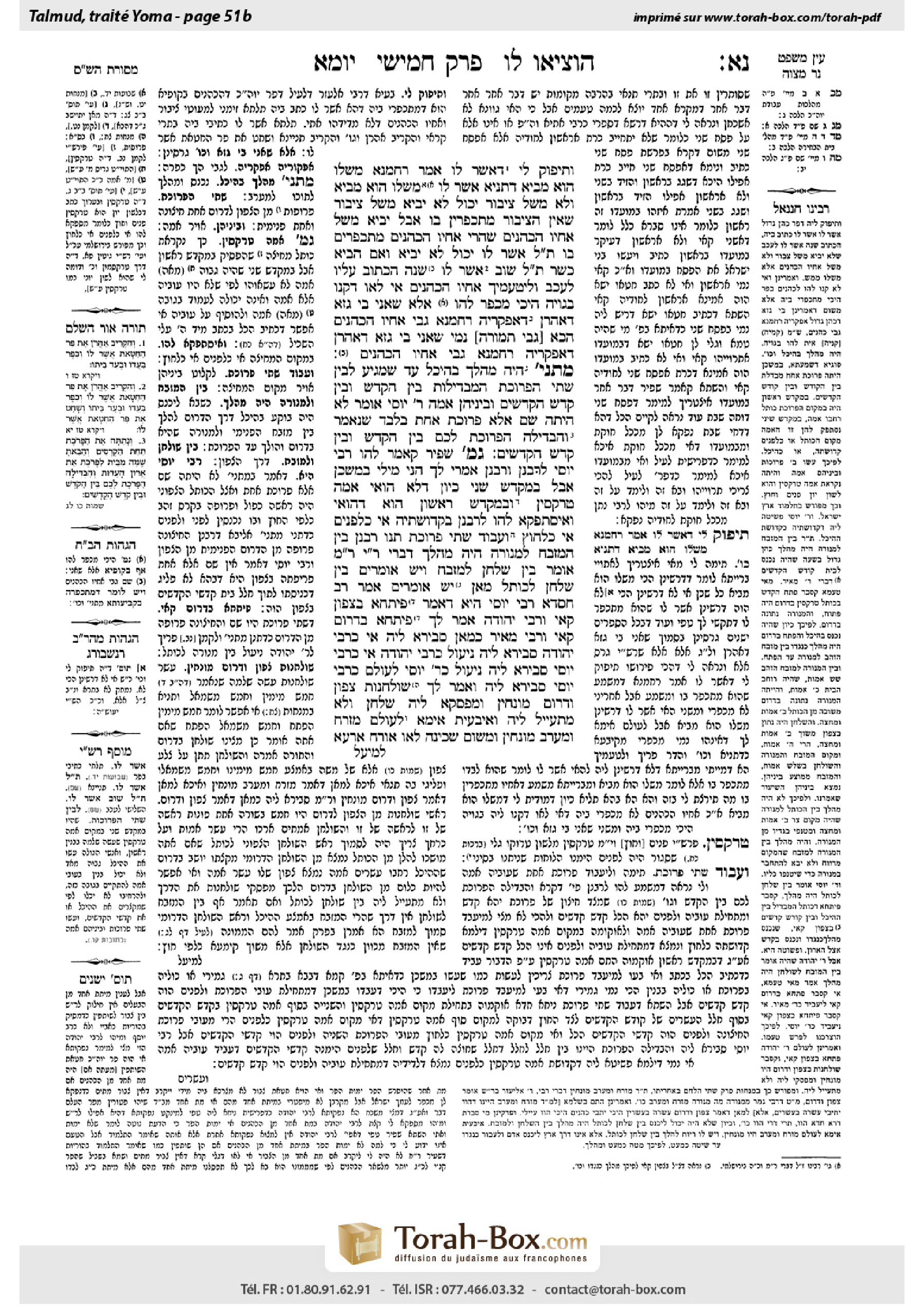
Yoma 51b: Talmud study for Daf Yomi
Daf Yomi is the daily study of one Talmud folio. Explore 37 tractates with scans, Hebrew text, Sefaria English and AI-generated French translations where annotated.
Passage selection and English or AI-generated French translation are available where the scan has annotations. Daf Study is independent of Torah-Box and Sefaria.
Browse Yoma · יומא · All tractatesYoma 51b text and translations
This page of Yoma includes the Aramaic text, an English translation and an AI-generated French translation, alongside the scan above.
יומא נ״א ב · Aramaic and Hebrew text
וְתִיפּוֹק לִי דַּ״אֲשֶׁר לוֹ״ אָמַר רַחֲמָנָא — מִשֶּׁלּוֹ הוּא מֵבִיא.
דְּתַנְיָא: ״אֲשֶׁר לוֹ״ — מִשֶּׁלּוֹ הוּא מֵבִיא, וְלֹא מִשֶּׁל צִיבּוּר. יָכוֹל לֹא יָבִיא מִשֶּׁל צִיבּוּר — שֶׁאֵין הַצִּיבּוּר מִתְכַּפְּרִין בּוֹ, אֲבָל יָבִיא מִשֶּׁל אֶחָיו הַכֹּהֲנִים — שֶׁהֲרֵי אֶחָיו הַכֹּהֲנִים מִתְכַּפְּרִים בּוֹ, תַּלְמוּד לוֹמַר: ״אֲשֶׁר לוֹ״.
יָכוֹל לֹא יָבִיא, וְאִם הֵבִיא כָּשֵׁר — תַּלְמוּד לוֹמַר שׁוּב: ״אֲשֶׁר לוֹ״ — שָׁנָה הַכָּתוּב עָלָיו לְעַכֵּב.
וְלִיטַעְמָיךְ, אֶחָיו הַכֹּהֲנִים אִי לָאו דְּקָנוּ בְּגַוֵּיהּ הֵיכִי מְכַפַּר לְהוּ? אֶלָּא שָׁאנֵי בֵּי גַזָּא דְּאַהֲרֹן דְּאַפְקְרֵיהּ רַחֲמָנָא גַּבֵּי אֶחָיו הַכֹּהֲנִים. הָכָא [גַּבֵּי תְּמוּרָה] נָמֵי: שָׁאנֵי בֵּי גַזָּא דְּאַהֲרֹן דְּאַפְקְרֵיהּ רַחֲמָנָא גַּבֵּי אֶחָיו הַכֹּהֲנִים.
מַתְנִי׳ הָיָה מְהַלֵּךְ בַּהֵיכָל עַד שֶׁמַּגִּיעַ לְבֵין שְׁתֵּי הַפָּרוֹכֹת הַמַּבְדִּילוֹת בֵּין הַקֹּדֶשׁ וּבֵין קֹדֶשׁ הַקֳּדָשִׁים, וּבֵינֵיהֶן אַמָּה. רַבִּי יוֹסֵי אוֹמֵר: לֹא הָיְתָה שָׁם אֶלָּא פָּרוֹכֶת אַחַת בִּלְבַד, שֶׁנֶּאֱמַר: ״וְהִבְדִּילָה הַפָּרוֹכֶת לָכֶם בֵּין הַקֹּדֶשׁ וּבֵין קֹדֶשׁ הַקֳּדָשִׁים״.
גְּמָ׳ שַׁפִּיר קָאָמַר לְהוּ רַבִּי יוֹסֵי לְרַבָּנַן! וְרַבָּנַן אָמְרִי לְךָ: הָנֵי מִילֵּי בְּמִשְׁכָּן, אֲבָל בְּמִקְדָּשׁ שֵׁנִי כֵּיוָן דְּלָא הֲוַאי אַמָּה טְרַקְסִין, וּבְמִקְדָּשׁ רִאשׁוֹן הוּא דַּהֲוַאי, וְאִיסְתַּפַּקָא לְהוּ לְרַבָּנַן בִּקְדוּשְּׁתֵיהּ, אִי כְּלִפְנִים אִי כְּלַחוּץ, וַעֲבוּד שְׁתֵּי פָּרוֹכֹת.
תָּנוּ רַבָּנַן: בֵּין הַמִּזְבֵּחַ לַמְּנוֹרָה הָיָה מְהַלֵּךְ, דִּבְרֵי רַבִּי יְהוּדָה. רַבִּי מֵאִיר אוֹמֵר: בֵּין שֻׁלְחָן לַמִּזְבֵּחַ. וְיֵשׁ אוֹמְרִים: בֵּין שֻׁלְחָן לַכּוֹתֶל. מַאן יֵשׁ אוֹמְרִים? אָמַר רַב חִסְדָּא: רַבִּי יוֹסֵי הִיא, דְּאָמַר: פִּיתְחָא בְּצָפוֹן קָאֵי.
וְרַבִּי יְהוּדָה אָמַר לָךְ: פִּיתְחָא בְּדָרוֹם קָאֵי. וְרַבִּי מֵאִיר כְּמַאן סְבִירָא לֵיהּ? אִי כְּרַבִּי יְהוּדָה סְבִירָא לֵיהּ — נֵיעוּל כְּרַבִּי יְהוּדָה, אִי כְּרַבִּי יוֹסֵי סְבִירָא לֵיהּ — נֵיעוּל כְּרַבִּי יוֹסֵי!
לְעוֹלָם כְּרַבִּי יוֹסֵי סְבִירָא לֵיהּ, וַאֲמַר לְךָ: שׁוּלְחָנוֹת צָפוֹן וְדָרוֹם מוּנָּחִין, וּמַפְסְקָא לֵיהּ שֻׁלְחָן וְלָא מִתְעַיֵּיל לֵיהּ.
וְאִיבָּעֵית אֵימָא: לְעוֹלָם מִזְרָח וּמַעֲרָב מוּנָּחִין, וּמִשּׁוּם שְׁכִינָה לָאו אוֹרַח אַרְעָא
Yoma 51b · English translation
§ Returning to Rabbi Elazar’s question as to whether a High Priest can perform substitution for his bull, the Gemara seeks to prove that the other priests were not full partners in this offering but only gained atonement incidentally. And let me derive this halakha from the fact that the Merciful One states: “And Aaron shall sacrifice the bull of the sin-offering, which is for himself” (Leviticus 16:11), indicating that the High Priest brings the bull from his own property.
As it was taught in a baraita: “Which is for himself” means that he brings it from his own property and not from the property of the community. I might have thought that the High Priest may not bring this offering from the property of the community because the community as a whole does not gain atonement through it, but he may bring it from the property of his fellow priests, as his fellow priests do gain atonement through it. Therefore the verse states: “Which is for himself,” i.e., it must belong to him and no one else.
I might have thought that the High Priest should not bring the bull from the property of the other priests ab initio, but if he did bring it from their property, the offering is valid. Therefore, the verse continues and states again: “And he shall slaughter the bull for the sin-offering, which is for himself” (Leviticus 16:11); the text repeats this phrase: “Which is for himself,” to emphasize that this requirement is indispensable and that if the High Priest brings a bull that belongs to someone else, the offering is invalid.
The Gemara rejects this proof: And according to your reasoning, if his fellow priests do not acquire a share in the bull, how does it atone for them? Since they achieve atonement through the offering, they must own a share in it. Rather, you must say that the property [bei gazza] of Aaron the High Priest is different in that the Merciful One rendered it ownerless with regard to his fellow priests. Although the High Priest brings a bull from his own funds, it is as though he sanctifies it on behalf of all of the priests. But if so, here too, with regard to substitution, we could likewise say that the property of Aaron is different in that the Merciful One rendered it ownerless with regard to his fellow priests. Consequently, there is no proof from here that a High Priest can perform substitution for his bull.
MISHNA: The High Priest would then walk west through the Sanctuary until he reaches the area between the two curtains that separated the Sanctuary and the Holy of Holies, and the space between them was one cubit. Rabbi Yosei says: There was only one curtain there, as it is stated: “And the curtain shall divide for you between the Sanctuary and the Holy of Holies” (Exodus 26:33).
GEMARA: The Gemara asks: Rabbi Yosei is saying well to the Rabbis, i.e., Rabbi Yosei provides solid support for his opinion. And the Rabbis could say to you: This applies only in the Tabernacle, which had but one curtain. However, in the Second Temple, since there was no one-cubit partition [teraksin] separating the Holy of Holies from the Sanctuary of the Temple, as it was only in the First Temple that there was a one-cubit partition, and the Rabbis were uncertain with regard to the sanctity of the space occupied by the one-cubit partition, whether it had the sanctity of the inside of the Holy of Holies, or the sanctity of the outside area of the Sanctuary, therefore the Sages of the time prepared two curtains to enclose this space of uncertain status.
§ The Sages taught: When the High Priest walked to the Holy of Holies, he walked on the south side between the inner altar and the candelabrum. This is the statement of Rabbi Yehuda. Rabbi Meir says that he walked on the north side between the table and the altar. And some say he passed between the table and the wall. The Gemara asks: Whose opinion is introduced by the title: Some say? Rav Ḥisda said: It is the opinion of Rabbi Yosei in our mishna, according to whom there is only one curtain and who said that the entrance was positioned in the north. According to all opinions, the entrance to the Holy of Holies was located in the north, and since Rabbi Yosei believed that there was just one curtain, the High Priest would walk in a straight line toward this entrance along the north side of the Sanctuary.
And Rabbi Yehuda maintains that there were two curtains, and therefore he could have said to you that although the entrance to the Holy of Holies was on the north side, because there were two curtains, one behind the other, the entrance was positioned in the south. The High Priest entered on the south side and walked between the curtains to the north of the inner curtain where he entered the Holy of Holies. The Gemara asks: And Rabbi Meir, in accordance with whose opinion does he hold? If he holds in accordance with the opinion of Rabbi Yehuda with regard to the place of the entrance, the High Priest should enter as explained by Rabbi Yehuda; conversely, if he holds in accordance with the opinion of Rabbi Yosei, he should enter as explained by Rabbi Yosei.
The Gemara answers: Actually, Rabbi Meir holds in accordance with the opinion of Rabbi Yosei, and he could have said to you: The tables, the one holding the shewbread and other tables next to it, were arranged north to south, and the table blocked him on the north side, and therefore the High Priest could not enter in a direct line, as the space was too narrow.
And if you wish, say instead: Actually the tables were arranged east to west, and due to the honor of the Divine Presence, it was not proper conduct
Yoma 51b · Traduction française (IA)
§ Revenant à la question de Rabbi Elazar, qui se demandait si un grand prêtre peut procéder à une substitution pour son taureau, la Guemara cherche à prouver que les autres prêtres n’étaient pas pleinement associés à cette offrande, mais qu’ils n’en obtenaient l’expiation qu’à titre accessoire. Ne puis-je pas déduire cette halakha du fait que le Miséricordieux dit : « Aaron présentera le taureau du sacrifice expiatoire qui est pour lui » (Lévitique 16:11), ce qui indique que le grand prêtre apporte le taureau de ses propres biens ?
Comme il a été enseigné dans une baraïta : « Qui est pour lui » signifie qu’il l’apporte de ses propres biens, et non des biens de la communauté. J’aurais pu penser que le grand prêtre ne peut pas apporter cette offrande avec les biens de la communauté, puisque la communauté dans son ensemble n’en obtient pas l’expiation, mais qu’il peut l’apporter avec les biens de ses confrères prêtres, puisque ceux-ci en obtiennent l’expiation. C’est pourquoi le verset dit : « Qui est pour lui », c’est-à-dire qu’elle doit lui appartenir, à lui seul.
J’aurais pu penser que le grand prêtre ne doit pas, a priori, apporter le taureau avec les biens des autres prêtres, mais que, s’il l’a apporté avec leurs biens, l’offrande est valide. C’est pourquoi le verset poursuit et dit de nouveau : « Il égorgera le taureau du sacrifice expiatoire qui est pour lui » (Lévitique 16:11). Le texte répète l’expression « qui est pour lui » afin de souligner que cette exigence est indispensable et que, si le grand prêtre apporte un taureau appartenant à quelqu’un d’autre, l’offrande est invalide.
La Guemara rejette cette preuve : selon votre raisonnement, si ses confrères prêtres n’acquièrent pas une part du taureau, comment celui-ci peut-il leur procurer l’expiation ? Puisqu’ils obtiennent l’expiation grâce à l’offrande, ils doivent en posséder une part. Il faut plutôt dire que les biens [bei gazza] d’Aaron le grand prêtre sont particuliers : le Miséricordieux les a rendus sans propriétaire à l’égard de ses confrères prêtres. Bien que le grand prêtre apporte un taureau avec ses propres fonds, c’est comme s’il le consacrait au nom de tous les prêtres. Mais dans ce cas, pour la substitution aussi, nous pourrions dire de même que les biens d’Aaron sont particuliers, car le Miséricordieux les a rendus sans propriétaire à l’égard de ses confrères prêtres. Par conséquent, on ne peut pas en déduire qu’un grand prêtre peut procéder à une substitution pour son taureau.
Michna : Le grand prêtre marchait alors vers l’ouest à travers le Sanctuaire, jusqu’à l’espace situé entre les deux rideaux qui séparaient le Sanctuaire du Saint des Saints ; cet espace mesurait une coudée. Rabbi Yosei dit : Il n’y avait là qu’un seul rideau, comme il est dit : « Le rideau séparera pour vous le Sanctuaire du Saint des Saints » (Exode 26:33).
Guemara : La Guemara demande : Rabbi Yosei présente un argument convaincant aux Rabbins, c’est-à-dire qu’il étaye solidement son opinion. Les Rabbins pourraient lui répondre : Cela ne s’applique qu’au Tabernacle, qui ne comportait qu’un seul rideau. En revanche, dans le Second Temple, il n’y avait pas de cloison d’une coudée [teraksin] séparant le Saint des Saints du Sanctuaire du Temple, car seule le Premier Temple possédait une telle cloison. Les Rabbins ne savaient pas quel degré de sainteté avait l’espace occupé par cette cloison : avait-il la sainteté de l’intérieur du Saint des Saints ou celle de la zone extérieure du Sanctuaire ? C’est pourquoi les Sages de l’époque installèrent deux rideaux pour délimiter cet espace au statut incertain.
§ Les Sages ont enseigné : Lorsque le grand prêtre se rendait au Saint des Saints, il marchait du côté sud, entre l’autel intérieur et le candélabre. Telle est l’opinion de Rabbi Yehuda. Rabbi Meir dit qu’il marchait du côté nord, entre la table et l’autel. Certains disent qu’il passait entre la table et le mur. La Guemara demande : De qui est l’opinion introduite par l’expression « certains disent » ? Rav Ḥisda dit : C’est l’opinion de Rabbi Yosei dans notre Michna, selon laquelle il n’y a qu’un seul rideau, et qui affirme que l’entrée se trouvait au nord. Selon toutes les opinions, l’entrée du Saint des Saints se trouvait au nord. Puisque Rabbi Yosei pensait qu’il n’y avait qu’un seul rideau, le grand prêtre marchait en ligne droite vers cette entrée, le long du côté nord du Sanctuaire.
Rabbi Yehuda, lui, soutient qu’il y avait deux rideaux. Il aurait donc pu vous dire que, bien que l’entrée du Saint des Saints se trouvât au nord, la présence de deux rideaux, l’un derrière l’autre, plaçait l’entrée au sud. Le grand prêtre entrait du côté sud et passait entre les rideaux jusqu’au nord du rideau intérieur, où il pénétrait dans le Saint des Saints. La Guemara demande : Et quelle opinion Rabbi Meir suit-il ? S’il suit l’opinion de Rabbi Yehuda concernant l’emplacement de l’entrée, le grand prêtre devrait entrer comme l’explique Rabbi Yehuda ; à l’inverse, s’il suit l’opinion de Rabbi Yosei, il devrait entrer comme l’explique Rabbi Yosei.
La Guemara répond : En réalité, Rabbi Meir suit l’opinion de Rabbi Yosei, et il aurait pu vous dire que les tables — celle qui portait les pains de proposition et les autres tables placées à côté — étaient disposées du nord au sud. La table lui barrait le passage du côté nord ; le grand prêtre ne pouvait donc pas entrer en ligne droite, car l’espace était trop étroit.
Et si tu préfères, dis plutôt : En réalité, les tables étaient disposées d’est en ouest et, par égard pour la Présence divine, il n’était pas convenable d’agir ainsi.
Traduction française générée par IA à partir de l’édition anglaise de Sefaria. Vérifie toujours un passage avec le texte source.
Text from Sefaria: William Davidson Edition - Vocalized Aramaic (CC BY NC); William Davidson Edition - English (CC BY NC).