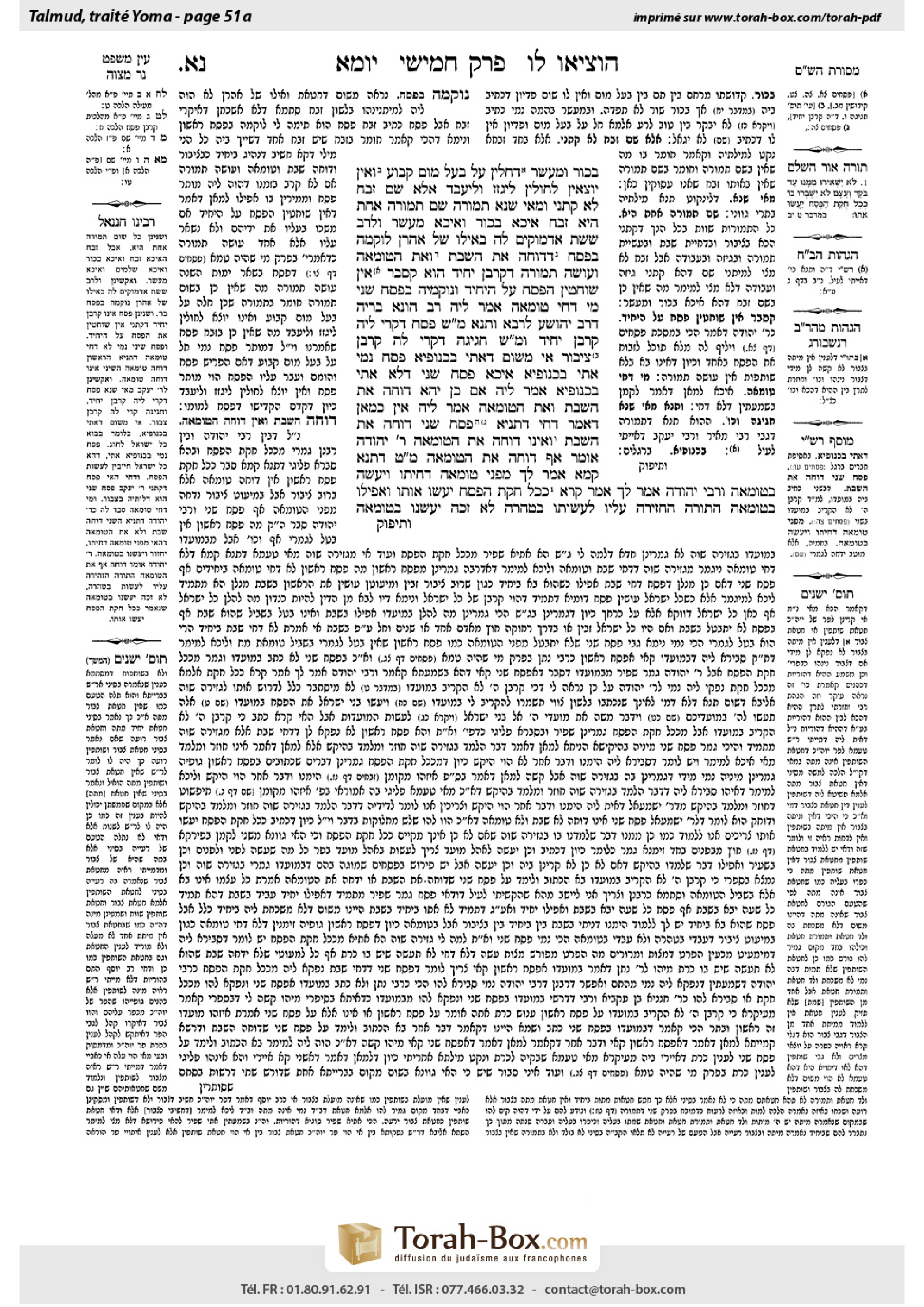
Yoma 51a: Talmud study for Daf Yomi
Daf Yomi is the daily study of one Talmud folio. Explore 37 tractates with scans, Hebrew text, Sefaria English and AI-generated French translations where annotated.
Passage selection and English or AI-generated French translation are available where the scan has annotations. Daf Study is independent of Torah-Box and Sefaria.
Browse Yoma · יומא · All tractatesYoma 51a text and translations
This page of Yoma includes the Aramaic text, an English translation and an AI-generated French translation, alongside the scan above.
יומא נ״א א · Aramaic and Hebrew text
בְּכוֹר וּמַעֲשֵׂר, דְּחָלִין עַל בַּעַל מוּם קָבוּעַ, וְאֵין יוֹצְאִין לְחוּלִּין לִיגָּזֵז וְלֵיעָבֵד. אֶלָּא שֵׁם זֶבַח לָא קָתָנֵי.
וּמַאי שְׁנָא? תְּמוּרָה — שֵׁם תְּמוּרָה אַחַת הִיא. זֶבַח — אִיכָּא בְּכוֹר וְאִיכָּא מַעֲשֵׂר.
וּלְרַב שֵׁשֶׁת, אַדְּמוֹקֵים לַהּ בְּאֵילוֹ שֶׁל אַהֲרֹן, לוֹקְמַהּ בְּפֶסַח, דְּדוֹחֶה אֶת הַשַּׁבָּת וְאֶת הַטּוּמְאָה וְעוֹשֶׂה תְּמוּרָה, דְּקׇרְבַּן יָחִיד הוּא? קָסָבַר: אֵין שׁוֹחֲטִין הַפֶּסַח עַל הַיָּחִיד.
וְנוֹקְמֵיהּ בְּפֶסַח שֵׁנִי! מִי דָּחֵי טוּמְאָה?
אֲמַר לֵיהּ רַב הוּנָא בְּרֵיהּ דְּרַב יְהוֹשֻׁעַ לְרָבָא: וְתַנָּא, מַאי שְׁנָא פֶּסַח דְּקָרֵי לֵיהּ קׇרְבַּן יָחִיד, וּמַאי שְׁנָא חֲגִיגָה דְּקָרֵי לַהּ קׇרְבַּן צִיבּוּר? אִי מִשּׁוּם דְּאָתֵי בְּכִנּוּפְיָא — פֶּסַח נָמֵי אָתֵי בְּכִנּוּפְיָא? אִיכָּא פֶּסַח שֵׁנִי דְּלָא אָתֵי בְּכִנּוּפְיָא.
אֲמַר לֵיהּ: אִם כֵּן יְהֵא דּוֹחֶה אֶת הַשַּׁבָּת וְאֶת הַטּוּמְאָה! אֲמַר לֵיהּ: אִין, כְּמַאן דְּאָמַר דָּחֵי, דְּתַנְיָא: פֶּסַח שֵׁנִי דּוֹחֶה אֶת הַשַּׁבָּת, וְאֵינוֹ דּוֹחֶה אֶת הַטּוּמְאָה. רַבִּי יְהוּדָה אוֹמֵר: אַף דּוֹחֶה אֶת הַטּוּמְאָה. מַאי טַעְמָא דְּתַנָּא קַמָּא — אָמַר לָךְ: מִפְּנֵי טוּמְאָה דְּחִיתוֹ וְיֵעָשֶׂה בְּטוּמְאָה?!
וְרַבִּי יְהוּדָה אָמַר לָךְ, אָמַר קְרָא: ״כְּכׇל חֻקַּת הַפֶּסַח יַעֲשׂוּ אוֹתוֹ״, וַאֲפִילּוּ בְּטוּמְאָה. הַתּוֹרָה הֶחְזִירָה עָלָיו לַעֲשׂוֹתוֹ בְּטׇהֳרָה, לֹא זָכָה — יַעֲשֶׂנּוּ בְּטוּמְאָה.
Yoma 51a · English translation
e.g., a firstborn or an animal tithe, the sanctity of which takes effect even on a permanently blemished animal, and this offering cannot vacate its sanctified status and assume non-sacred status for its wool to be sheared and to be worked. Rather, you must say that the baraita is not teaching a general category of sacrifices, but when it states: Offering, it is referring to a particular one.
The Gemara asks: And what is different about the two statements, i.e., why does the tanna deal with a specific case in one area, but a general category in the other? The Gemara explains: Substitution is one category, as there is no difference between one case of substitution and another. By contrast, with regard to sacrifices, there is a firstborn and there is the animal tithe, whose halakhot differ from other offerings, and therefore one cannot establish a single general principle. Consequently, the tanna certainly is referring to a specific offering.
The Gemara continues the previous discussion: And according to the opinion of Rav Sheshet, who explains that the offering in question is not the bull of the High Priest but his ram, rather than establishing and interpreting this baraita as referring to the ram of Aaron, let him establish that it deals with the Paschal offering, which overrides Shabbat and ritual impurity and one can perform substitution for it, as according to all opinions, it is the offering of an individual. The Gemara answers: Rav Sheshet maintains that one may not slaughter the Paschal lamb on behalf of an individual, but only for a group. This means that it is not an offering of an individual but, at the very least, that of partners. For this reason, one cannot perform substitution for a Paschal lamb.
The Gemara asks: And let Rav Sheshet establish the baraita as referring to the second Pesaḥ, which is slaughtered by an individual. The Gemara answers: Does the second Pesaḥ override ritual impurity? Since this offering does not override ritual impurity, it cannot be the offering referred to in the baraita.
§ Rav Huna, son of Rav Yehoshua, said to Rava: And according to the tanna of the aforementioned baraita, concerning the dispute between Rabbi Meir and Rabbi Ya’akov, what is different with regard to the Paschal offering, that he calls it the offering of an individual? And what is different with regard to the Festival peace-offering, which is eaten with the Paschal offering, that he calls it a communal offering? If this distinction is because the Festival peace-offering is brought by a multitude, i.e., the entire nation brings it, the Paschal offering is also brought by a multitude, not as an individual offering. Rava replied: There is the second Pesaḥ, which is not brought by a multitude, and therefore the tanna does not call the Paschal offering a communal offering.
He said to him: If so, that the second Pesaḥ is a communal offering, it should override Shabbat and ritual impurity. He said to him: Yes, as the opinion of this tanna is in accordance with the one who said that the second Pesaḥ overrides ritual impurity. As it was taught in a baraita: The second Pesaḥ overrides Shabbat, but it does not override ritual impurity. Rabbi Yehuda says: It even overrides ritual impurity. The Gemara asks: What is the reason of the first tanna? The first tanna could have said to you that one brings a second Pesaḥ solely because ritual impurity overrode his obligation to sacrifice the first Pesaḥ, i.e., he did not sacrifice the first Pesaḥ because he was impure at that time. And should he now perform the second Pesaḥ in a state of ritual impurity?
And Rabbi Yehuda could have said to you that, with regard to the second Pesaḥ, the verse states: “According to all the statute of the Paschal offering they shall keep it” (Numbers 9:12), which indicates that it should even be brought in a state of ritual impurity, unlike the first Pesaḥ. As for the claim of the first tanna, that the whole reason for the second Pesaḥ is due to ritual impurity, Rabbi Yehuda could respond: The Torah sought an opportunity for one who was impure at the time of the first Pesaḥ to perform it in a state of ritual purity; if he did not merit to perform it in purity, he should nevertheless perform it even in a state of ritual impurity.
Yoma 51a · Traduction française (IA)
Par exemple, un premier-né ou un animal soumis à la dîme animale, dont la sainteté prend effet même sur un animal atteint d’un défaut permanent. Cette offrande ne peut pas perdre son statut sacré et devenir profane afin que sa laine soit tondue et que l’on puisse travailler avec lui. Il faut donc dire que la baraïta n’enseigne pas une catégorie générale de sacrifices, mais que, lorsqu’elle dit « offrande », elle désigne une offrande particulière.
La Guemara demande : En quoi les deux énoncés diffèrent-ils, c’est-à-dire pourquoi le tanna traite-t-il d’un cas particulier dans un domaine, mais d’une catégorie générale dans l’autre ? La Guemara explique : La substitution constitue une catégorie unique, car il n’y a pas de différence entre un cas de substitution et un autre. En revanche, pour les sacrifices, il y a le premier-né et l’animal soumis à la dîme animale, dont les halakhot diffèrent de celles des autres offrandes ; on ne peut donc établir un principe général unique. Par conséquent, le tanna désigne certainement une offrande particulière.
La Guemara poursuit la discussion précédente : Selon l’opinion de Rav Sheshet, qui explique que l’offrande en question n’est pas le taureau du Grand Prêtre, mais son bélier, plutôt que d’interpréter cette baraïta comme portant sur le bélier d’Aaron, qu’il l’interprète comme portant sur le sacrifice de Pessaḥ, qui repousse le Chabbat et l’impureté rituelle, et pour lequel on peut procéder à une substitution, puisqu’il s’agit, selon toutes les opinions, d’une offrande individuelle. La Guemara répond : Rav Sheshet soutient qu’on ne peut pas abattre l’agneau pascal pour un individu, mais seulement pour un groupe. Cela signifie qu’il ne s’agit pas d’une offrande individuelle, mais au moins d’une offrande apportée par des associés. C’est pourquoi on ne peut pas procéder à une substitution pour un agneau pascal.
La Guemara demande : Que Rav Sheshet interprète donc la baraïta comme portant sur le second Pessaḥ, qui est abattu par un individu. La Guemara répond : Le second Pessaḥ repousse-t-il l’impureté rituelle ? Puisque cette offrande ne repousse pas l’impureté rituelle, elle ne peut pas être celle dont parle la baraïta.
§ Rav Houna, fils de Rav Yehoshoua, dit à Rava : Selon le tanna de la baraïta susmentionnée, dans le débat entre Rabbi Meïr et Rabbi Ya’akov, pourquoi qualifie-t-il le sacrifice de Pessaḥ d’offrande individuelle ? Et pourquoi qualifie-t-il d’offrande communautaire le sacrifice de paix de la fête, qui est consommé avec le sacrifice de Pessaḥ ? Si cette distinction tient au fait que le sacrifice de paix de la fête est apporté par une multitude, c’est-à-dire par tout le peuple, le sacrifice de Pessaḥ est lui aussi apporté par une multitude, et non à titre d’offrande individuelle. Rava lui répondit : Il y a le second Pessaḥ, qui n’est pas apporté par une multitude ; le tanna ne qualifie donc pas le sacrifice de Pessaḥ d’offrande communautaire.
Il lui dit : Si c’est le cas, si le second Pessaḥ est une offrande communautaire, il devrait repousser le Chabbat et l’impureté rituelle. Il lui répondit : Oui, car l’opinion de ce tanna est conforme à celle qui soutient que le second Pessaḥ repousse l’impureté rituelle. En effet, il a été enseigné dans une baraïta : Le second Pessaḥ repousse le Chabbat, mais il ne repousse pas l’impureté rituelle. Rabbi Yehouda dit : Il repousse même l’impureté rituelle. La Guemara demande : Quelle est la raison du premier tanna ? Le premier tanna aurait pu te répondre qu’on apporte un second Pessaḥ uniquement parce que l’impureté rituelle a fait obstacle à l’obligation d’offrir le premier Pessaḥ, c’est-à-dire qu’il n’a pas offert le premier Pessaḥ parce qu’il était impur à ce moment-là. Devrait-il maintenant accomplir le second Pessaḥ en état d’impureté rituelle ?
Et Rabbi Yehouda aurait pu te répondre qu’au sujet du second Pessaḥ, le verset dit : « Selon toutes les prescriptions du sacrifice de Pessaḥ, ils l’observeront » (Nombres 9:12), ce qui indique qu’il doit être offert même en état d’impureté rituelle, contrairement au premier Pessaḥ. Quant à l’argument du premier tanna, selon lequel le second Pessaḥ n’a été institué qu’en raison de l’impureté rituelle, Rabbi Yehouda pourrait répondre : La Torah a voulu donner à celui qui était impur au moment du premier Pessaḥ l’occasion de l’accomplir en état de pureté rituelle ; s’il n’a pas eu le mérite de l’accomplir en état de pureté, il doit néanmoins l’accomplir même en état d’impureté rituelle.
Traduction française générée par IA à partir de l’édition anglaise de Sefaria. Vérifie toujours un passage avec le texte source.
Text from Sefaria: William Davidson Edition - Vocalized Aramaic (CC BY NC); William Davidson Edition - English (CC BY NC).