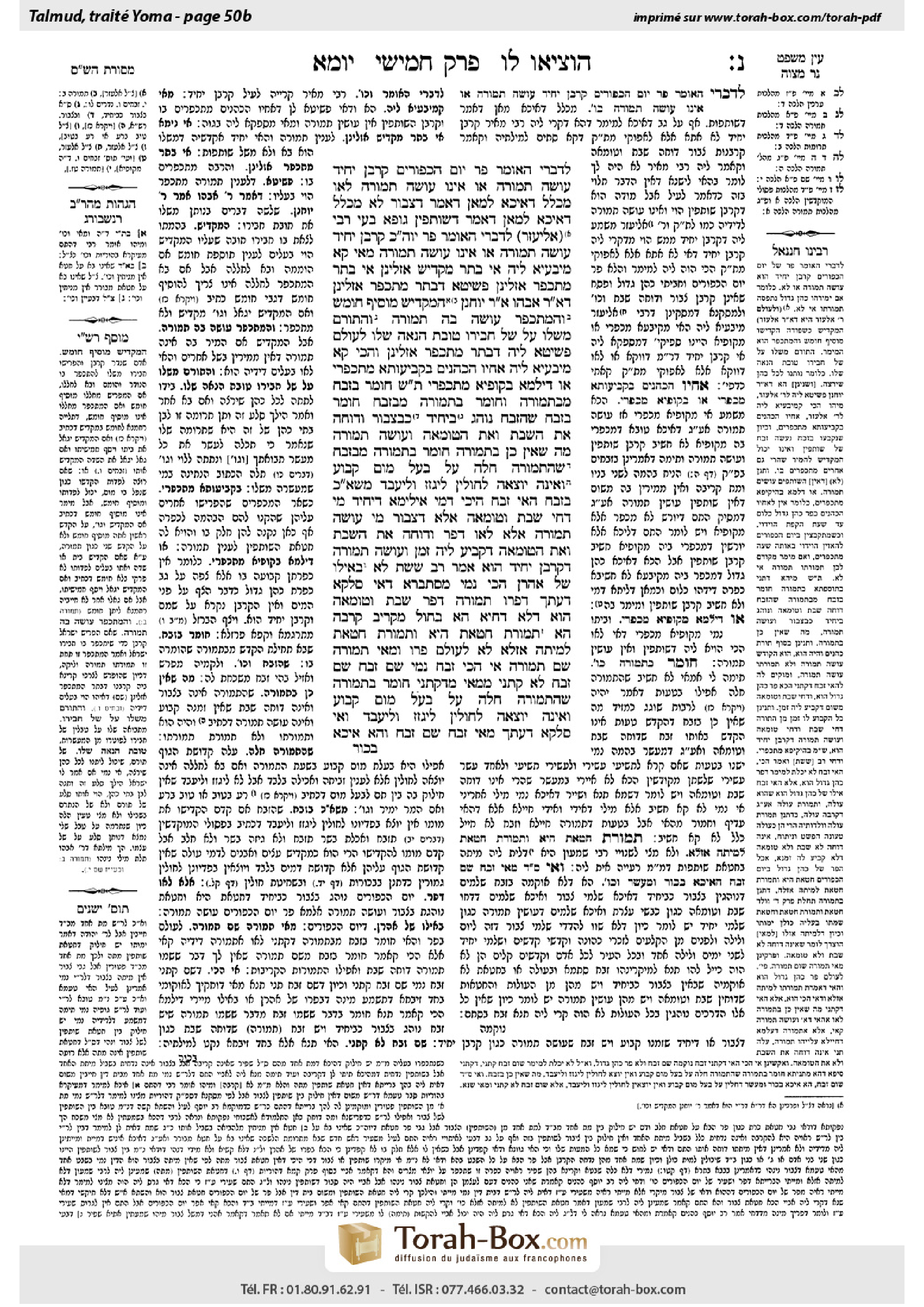
Yoma 50b: Talmud study for Daf Yomi
Daf Yomi is the daily study of one Talmud folio. Explore 37 tractates with scans, Hebrew text, Sefaria English and AI-generated French translations where annotated.
Passage selection and English or AI-generated French translation are available where the scan has annotations. Daf Study is independent of Torah-Box and Sefaria.
Browse Yoma · יומא · All tractatesYoma 50b text and translations
This page of Yoma includes the Aramaic text, an English translation and an AI-generated French translation, alongside the scan above.
יומא נ׳ ב · Aramaic and Hebrew text
לְדִבְרֵי הָאוֹמֵר פַּר יוֹם הַכִּפּוּרִים קׇרְבַּן יָחִיד, עוֹשֶׂה תְּמוּרָה אוֹ אֵינוֹ עוֹשֶׂה תְּמוּרָה. לָאו מִכְּלָל דְּאִיכָּא לְמַאן דְּאָמַר דְּצִבּוּר?
לָא, מִכְּלָל דְּאִיכָּא לְמַאן דְּאָמַר דְּשׁוּתָּפִין.
גּוּפָא. בָּעֵי רַבִּי (אֱלִיעֶזֶר): לְדִבְרֵי הָאוֹמֵר פַּר יוֹם הַכִּפּוּרִים קׇרְבַּן יָחִיד, עוֹשֶׂה תְּמוּרָה אוֹ אֵינוֹ עוֹשֶׂה תְּמוּרָה. מַאי קָא מִיבַּעְיָא לֵיהּ?
אִי בָּתַר מַקְדִּישׁ אָזְלִינַן, אִי בָּתַר מִתְכַּפֵּר אָזְלִינַן.
פְּשִׁיטָא דְּבָתַר מִתְכַּפֵּר אָזְלִינַן, דְּאָמַר רַבִּי אֲבָהוּ אָמַר רַבִּי יוֹחָנָן: הַמַּקְדִּישׁ — מוֹסִיף חוֹמֶשׁ, וְהַמִּתְכַּפֵּר — עוֹשֶׂה (בָּהּ) תְּמוּרָה.
וְהַתּוֹרֵם מִשֶּׁלּוֹ עַל שֶׁל חֲבֵירוֹ — טוֹבַת הֲנָאָה שֶׁלּוֹ!
לְעוֹלָם פְּשִׁיטָא לֵיהּ דְּבָתַר מִתְכַּפֵּר אָזְלִינַן, וְהָכִי קָא מִיבַּעְיָא לֵיהּ: אֶחָיו הַכֹּהֲנִים בִּקְבִיעוּתָא מִתְכַּפְּרִי, אוֹ דִילְמָא בְּקוּפְיָא מִתְכַּפְּרִי.
תָּא שְׁמַע: חוֹמֶר בְּזֶבַח מִבִּתְמוּרָה, וְחוֹמֶר בִּתְמוּרָה מִבְּזֶבַח. חוֹמֶר בְּזֶבַח: שֶׁהַזֶּבַח נוֹהֵג בְּיָחִיד כִּבְצִבּוּר, וְדוֹחֶה אֶת הַשַּׁבָּת וְאֶת הַטּוּמְאָה, וְעוֹשֶׂה תְּמוּרָה — מַה שֶּׁאֵין כֵּן בִּתְמוּרָה.
חוֹמֶר בִּתְמוּרָה מִבְּזֶבַח: שֶׁהַתְּמוּרָה חָלָה עַל בַּעַל מוּם קָבוּעַ, וְאֵינָהּ יוֹצְאָה לְחוּלִּין לִיגָּזֵז וְלֵיעָבֵד — מַה שֶּׁאֵין כֵּן בְּזֶבַח.
הַאי זֶבַח הֵיכִי דָמֵי? אִילֵּימָא דְּיָחִיד — מִי דָּחֵי שַׁבָּת וְטוּמְאָה? אֶלָּא דְּצִבּוּר — מִי עוֹשֶׂה תְּמוּרָה? אֶלָּא לָאו דְּפַר, וְדוֹחֶה אֶת הַשַּׁבָּת וְאֶת הַטּוּמְאָה — דִּקְבִיעַ לֵיהּ זְמַן, וְעוֹשֶׂה תְּמוּרָה — דְּקָרְבַּן יָחִיד הוּא.
אָמַר רַב שֵׁשֶׁת: לָא, בְּאֵילוֹ שֶׁל אַהֲרֹן.
הָכִי נָמֵי מִסְתַּבְּרָא, דְּאִי סָלְקָא דַעְתָּךְ דְּפָרוֹ, תְּמוּרָה דְּפַר שַׁבָּת וְטוּמְאָה הוּא דְּלָא דָּחֲיָא, הָא בְּחוֹל מִיקְרָב קָרְבָה?! הָא תְּמוּרַת חַטָּאת הִיא, וּתְמוּרַת חַטָּאת לְמִיתָה אָזְלָא!
לָא, לְעוֹלָם פָּרוֹ. וּמַאי תְּמוּרָה — שֵׁם תְּמוּרָה.
אִי הָכִי, זֶבַח נָמֵי — שֵׁם זֶבַח? שֵׁם זֶבַח לָא קָתָנֵי.
מִמַּאי — מִדְּקָתָנֵי: חוֹמֶר בִּתְמוּרָה, שֶׁהַתְּמוּרָה חָלָה עַל בַּעַל מוּם קָבוּעַ, וְאֵינָהּ יוֹצְאָה לְחוּלִּין לִיגָּזֵז וְלֵיעָבֵד. וְאִי סָלְקָא דַּעְתָּךְ: מַאי זֶבַח — שֵׁם זֶבַח, וְהָא אִיכָּא
Yoma 50b · English translation
According to Rabbi Meir, who says that the bull of Yom Kippur is an offering of an individual, can one perform substitution for this animal or can one not perform substitution in this case? In other words, if the High Priest violated a prohibition and designated a substitute by saying that this bull should be switched with another, does the substitution take effect or not? Is it not correct to say by inference from the wording of Rabbi Elazar’s dilemma that there is one who says that these offerings are communal?
The Gemara rejects this contention: No, this is no proof, as one can say by inference that there is one who says that these offerings are of partners. There is no definitive proof that the bull of Yom Kippur is a communal sacrifice. In any event, the question of why the bull is not invalidated upon the death of the High Priest has been resolved, as the reason is either because it is a communal sacrifice or because it is a sacrifice of partners.
§ Since the Gemara has mentioned Rabbi Elazar’s dilemma, the Gemara addresses the matter itself. Rabbi Elazar asked: According to Rabbi Meir, who says that the bull of Yom Kippur is an individual offering, can one perform substitution for this animal or can one not perform substitution? The Gemara asks: What is the dilemma he is raising? What is the basis of his inquiry?
The Gemara suggests that his dilemma is as follows: Do we follow the one who consecrates the animal, i.e., the High Priest, as he was the one who paid for it, in which case it is considered an individual sacrifice and his substitution is effective? Or do we follow the one who seeks atonement by the offering, and as this bull atones both for the High Priest and the entire community of his fellow priests, it is considered a communal sacrifice, and therefore his substitution is not effective? The question is: Which party is followed for the purposes of substitution?
The Gemara expresses surprise at this possible interpretation of Rabbi Elazar’s dilemma: It is obvious that we follow the one who seeks atonement, as Rabbi Abbahu said that Rabbi Yoḥanan said: With regard to one who consecrates his animal for an offering but intends it for someone else’s atonement, if he subsequently redeems the animal, he adds a fifth to it. This is in accordance with the halakha that one who redeems an animal that he himself dedicated must add a fifth of its value to the redemption, whereas if the person for whom it atones redeems it, he does not add a fifth. And the one for whom the sacrifice atones can perform substitution for it, whereas the one who consecrated the animal cannot effect substitution, as he is not considered its owner for the halakhot of substitution.
And likewise, with regard to one who separates teruma from his wheat for the wheat of another, to spare his friend from having to separate his own teruma, although the friend’s produce is now exempt from the obligation of teruma, the benefit of discretion is his, the one who separated the teruma. The one who separated the teruma is entitled to determine which priest receives the teruma, despite the fact that the teruma was separated for the crop of another. Similarly, when someone consecrates an animal for another person, it is the one who gains atonement that can perform substitution. If so, there is no place for Rabbi Elazar’s dilemma.
The Gemara rejects this suggested explanation of Rabbi Elazar’s dilemma: Actually, it is obvious to Rabbi Elazar that we follow the one who seeks atonement by the offering, and this is his dilemma: Do his fellow priests achieve atonement by the essence of the offering, i.e., part of the offering is sacrificed on their behalf, which means they are partners in the bull? Or perhaps they achieve atonement incidentally, while the main atonement is that of the High Priest. If the atonement of the other priests is merely incidental, the High Priest can effect substitution with this bull.
The Gemara suggests: Come and hear a resolution to this dilemma: There is a stricture that applies to the initial sacrifice, beyond the strictures that apply to the designated substitute; and there is a stricture that applies to the substitution, beyond the strictures that apply to the sacrifice. The baraita elaborates: There is a stricture that applies to the initial sacrifice, as the sanctity of the sacrifice applies to an individual as it does to a community, and the sacrifice overrides Shabbat and ritual impurity, and one can perform substitution for the original sacrifice, which is not the case with regard to the substitute, to which these halakhot do not apply.
The baraita continues: There is a stricture that applies to the substitute beyond the strictures that apply to the initial sacrifice, in that the sanctity of the substitution takes effect even on a permanently blemished animal. And the substitute cannot vacate its sanctified status and assume non-sacred status; that is, it may only be sacrificed as an offering and eaten but under no circumstance can it be redeemed for its wool to be sheared and to be worked, which is not the case with regard to the initial sacrifice, as it can be redeemed in certain situations.
The Gemara explains: What are the circumstances of this sacrifice? What exactly is the sacrifice referred to in this baraita? If we say it is the sacrifice of an individual, does the sacrifice of an individual override Shabbat and ritual impurity? Rather, if you say that we are dealing with the sacrifice of a community, can one perform substitution for a communal sacrifice? Rather, is it not the case that we are dealing here with the Yom Kippur bull, which overrides Shabbat and ritual impurity, as it is a sacrifice that has a fixed time? And likewise, one can perform substitution for this offering, as it is an offering of an individual. This interpretation resolves Rabbi Elazar’s dilemma.
The Gemara rejects this contention. Rav Sheshet said: No, this is no proof, as it can be claimed that the baraita is referring to the ram of Aaron that the High Priest sacrifices as a burnt-offering on Yom Kippur, as the verse states: “With this Aaron shall come into the sacred place, with a young bull for a sin-offering and a ram for a burnt-offering” (Leviticus 16:3). This offering is certainly the High Priest’s alone and is therefore classified as the offering of an individual.
The Gemara comments: So, too, it is reasonable that this is the offering referred to in the baraita, for if it should enter your mind to say that we are dealing with the bull of the High Priest, consider the following: Is it only Shabbat and ritual impurity that the substitution of the bull does not override, which indicates that one may sacrifice this substitute on a weekday? It is a substitute for a sin-offering, and the halakha is that the substitute for a sin-offering is left to die. Rather, we certainly must be dealing with the ram for a burnt-offering, as the substitute for a burnt-offering cannot be sacrificed.
The Gemara rejects this supporting argument: No, it is actually possible that the offering referred to in the baraita is the Yom Kippur bull of the High Priest, and what is the substitution that was mentioned? It does not refer to a substitution of the bull, but rather the baraita deals with the general category of substitution, i.e., it means that the phenomenon of substitution in general includes halakhot that do not apply to offerings.
The Gemara asks: If so, one can also say that the sacrifice mentioned in the baraita means the general category of sacrifices, rather than a specific offering. The Gemara rejects this suggestion: The baraita is not teaching about a general category of sacrifices, i.e., it is definitely not dealing with the phenomenon of offerings in general.
The Gemara continues: From where do I know that this is so? From the fact that it is taught: There is a stricture that applies to the substitution beyond the strictures that apply to the initial offering, in that the sanctity of the substitution takes effect even on a permanently blemished animal, and the substitute cannot vacate its sanctified status and assume non-sacred status for its wool to be sheared and to be worked. And should it enter your mind to say: What is the sacrifice mentioned here, it means the general category of sacrifices; this cannot be the case, as there is an example of an offering to which these halakhot also apply,
Yoma 50b · Traduction française (IA)
Selon Rabbi Meïr, qui affirme que le taureau de Yom Kippour est un sacrifice individuel, peut-on effectuer une substitution avec cet animal ou non ? Autrement dit, si le Grand Prêtre transgresse une interdiction et désigne un substitut en disant que ce taureau doit être échangé contre un autre, la substitution prend-elle effet ou non ? Ne faut-il pas déduire des termes du dilemme de Rabbi Elazar que certains affirment que ces sacrifices sont communautaires ?
La Guemara rejette cette affirmation : non, ce n’est pas une preuve, car on peut déduire que certains affirment que ces sacrifices appartiennent à des associés. Il n’y a donc pas de preuve concluante que le taureau de Yom Kippour soit un sacrifice communautaire. Quoi qu’il en soit, la question de savoir pourquoi le taureau n’est pas invalidé à la mort du Grand Prêtre est résolue : soit parce qu’il s’agit d’un sacrifice communautaire, soit parce qu’il s’agit d’un sacrifice appartenant à des associés.
§ Puisque la Guemara a mentionné le dilemme de Rabbi Elazar, elle examine la question elle-même. Rabbi Elazar a demandé : selon Rabbi Meïr, qui affirme que le taureau de Yom Kippour est un sacrifice individuel, peut-on effectuer une substitution avec cet animal ou non ? La Guemara demande : quel est le dilemme qu’il soulève ? Sur quoi porte sa question ?
La Guemara propose que son dilemme soit le suivant : faut-il s’en tenir à celui qui consacre l’animal, c’est-à-dire le Grand Prêtre, puisqu’il l’a payé, auquel cas il est considéré comme un sacrifice individuel et la substitution qu’il effectue prend effet ? Ou faut-il s’en tenir à celui qui obtient l’expiation grâce au sacrifice ? Puisque ce taureau expie à la fois pour le Grand Prêtre et pour tous ses confrères prêtres, il est considéré comme un sacrifice communautaire et, par conséquent, la substitution qu’il effectue ne prend pas effet. La question est de savoir quelle partie doit être prise en compte pour les règles de substitution.
La Guemara s’étonne de cette interprétation possible du dilemme de Rabbi Elazar : il est évident qu’il faut s’en tenir à celui qui obtient l’expiation. En effet, Rabbi Abbahou a dit au nom de Rabbi Yoḥanan : celui qui consacre son animal en offrande pour l’expiation d’une autre personne, puis rachète l’animal, lui ajoute un cinquième. Cela correspond à la halakha selon laquelle celui qui rachète un animal qu’il a lui-même consacré doit ajouter au prix du rachat un cinquième de sa valeur, tandis que la personne pour laquelle l’animal expie n’a pas à ajouter de cinquième si elle le rachète. Celui pour qui le sacrifice expie peut effectuer une substitution avec celui-ci, tandis que celui qui a consacré l’animal ne peut pas effectuer de substitution, car il n’est pas considéré comme son propriétaire au regard des halakhot de substitution.
De même, lorsqu’une personne prélève la terouma sur son blé pour le blé d’une autre, afin d’éviter à son ami d’avoir à prélever lui-même sa terouma, le droit de décider quel prêtre recevra la terouma revient à celui qui l’a prélevée, même si les produits de son ami sont désormais dispensés de l’obligation de terouma. Celui qui a prélevé la terouma a le droit de déterminer quel prêtre la recevra, bien qu’elle ait été prélevée pour la récolte d’un autre. De même, lorsqu’une personne consacre un animal pour quelqu’un d’autre, c’est celui qui obtient l’expiation qui peut effectuer une substitution avec celui-ci. Dès lors, le dilemme de Rabbi Elazar n’a pas lieu d’être.
La Guemara rejette cette explication proposée du dilemme de Rabbi Elazar : en réalité, il est évident pour Rabbi Elazar qu’il faut s’en tenir à celui qui obtient l’expiation grâce au sacrifice, et son dilemme est le suivant : ses confrères prêtres obtiennent-ils l’expiation par l’essence même du sacrifice, c’est-à-dire qu’une partie du sacrifice est offerte pour eux, ce qui signifie qu’ils sont associés dans le taureau ? Ou bien obtiennent-ils l’expiation de manière accessoire, tandis que l’expiation principale est celle du Grand Prêtre ? Si l’expiation des autres prêtres n’est qu’accessoire, le Grand Prêtre peut effectuer une substitution avec ce taureau.
La Guemara propose : viens et entends une réponse à ce dilemme. Le sacrifice initial présente une rigueur qui ne s’applique pas au substitut désigné, et la substitution présente une rigueur qui ne s’applique pas au sacrifice. La baraïta précise : le sacrifice initial présente une rigueur, car sa sainteté s’applique aussi bien à une offrande individuelle qu’à une offrande communautaire ; il repousse le Chabbat et l’impureté rituelle, et on peut effectuer une substitution avec le sacrifice initial, contrairement au substitut, auquel ces halakhot ne s’appliquent pas.
La baraïta poursuit : le substitut présente une rigueur qui ne s’applique pas au sacrifice initial : la sainteté du substitut prend effet même sur un animal présentant une infirmité permanente. De plus, le substitut ne peut pas perdre son statut d’animal consacré pour acquérir un statut profane ; autrement dit, il ne peut qu’être offert et consommé et ne peut en aucun cas être racheté afin que sa laine soit tondue et que l’animal soit utilisé pour le travail. Il en va autrement du sacrifice initial, qui peut être racheté dans certaines situations.
La Guemara explique : dans quelles circonstances ce sacrifice est-il offert ? De quel sacrifice cette baraïta parle-t-elle précisément ? Si l’on dit qu’il s’agit d’un sacrifice individuel, un sacrifice individuel repousse-t-il le Chabbat et l’impureté rituelle ? Mais si l’on dit qu’il s’agit d’un sacrifice communautaire, peut-on effectuer une substitution avec un sacrifice communautaire ? N’est-ce pas plutôt du taureau de Yom Kippour qu’il est question ici, lui qui repousse le Chabbat et l’impureté rituelle, puisqu’il s’agit d’un sacrifice dont le moment est fixé ? De même, on peut effectuer une substitution avec cette offrande, puisqu’il s’agit d’une offrande individuelle. Cette interprétation résout le dilemme de Rabbi Elazar.
La Guemara rejette cette affirmation. Rav Sheshet a dit : non, ce n’est pas une preuve, car on peut soutenir que la baraïta parle du bélier d’Aaron, que le Grand Prêtre offre en holocauste à Yom Kippour, comme le dit le verset : « C’est avec ceci qu’Aaron entrera dans le sanctuaire : avec un jeune taureau pour sacrifice expiatoire et un bélier pour holocauste » (Lévitique 16,3). Cette offrande appartient certainement au seul Grand Prêtre et est donc considérée comme une offrande individuelle.
La Guemara commente : il est également raisonnable que ce soit cette offrande que mentionne la baraïta. En effet, si l’on envisage que la baraïta parle du taureau du Grand Prêtre, considère ceci : le seul fait que la substitution du taureau ne repousse ni le Chabbat ni l’impureté rituelle signifierait-il que l’on peut offrir ce substitut un jour de semaine ? Il s’agit du substitut d’un sacrifice expiatoire, et la halakha veut que le substitut d’un sacrifice expiatoire soit laissé à mourir. Il faut donc certainement comprendre qu’il s’agit du bélier destiné à l’holocauste, puisque le substitut d’un holocauste ne peut pas être offert.
La Guemara rejette cet argument à l’appui : non, il est en réalité possible que l’offrande dont parle la baraïta soit le taureau de Yom Kippour du Grand Prêtre. Mais alors, à quelle substitution est-il fait référence ? Il ne s’agit pas de la substitution du taureau ; la baraïta traite plutôt de la catégorie générale de la substitution, c’est-à-dire qu’elle indique que la substitution, en général, comporte des halakhot qui ne s’appliquent pas aux offrandes.
La Guemara demande : si tel est le cas, on peut aussi dire que le sacrifice mentionné dans la baraïta désigne la catégorie générale des sacrifices, et non une offrande précise. La Guemara rejette cette proposition : la baraïta n’enseigne pas au sujet d’une catégorie générale de sacrifices ; autrement dit, elle ne traite certainement pas du phénomène des offrandes en général.
La Guemara poursuit : d’où savons-nous qu’il en est ainsi ? Du fait qu’il est enseigné : la substitution présente une rigueur qui ne s’applique pas à l’offrande initiale : la sainteté du substitut prend effet même sur un animal présentant une infirmité permanente, et le substitut ne peut pas perdre son statut d’animal consacré pour acquérir un statut profane, afin que sa laine soit tondue et que l’animal soit utilisé pour le travail. Or, si l’on envisageait que le sacrifice mentionné ici désigne la catégorie générale des sacrifices, cela ne pourrait pas être le cas, puisqu’il existe un exemple d’offrande auquel ces halakhot s’appliquent également,
Traduction française générée par IA à partir de l’édition anglaise de Sefaria. Vérifie toujours un passage avec le texte source.
Text from Sefaria: William Davidson Edition - Vocalized Aramaic (CC BY NC); William Davidson Edition - English (CC BY NC).