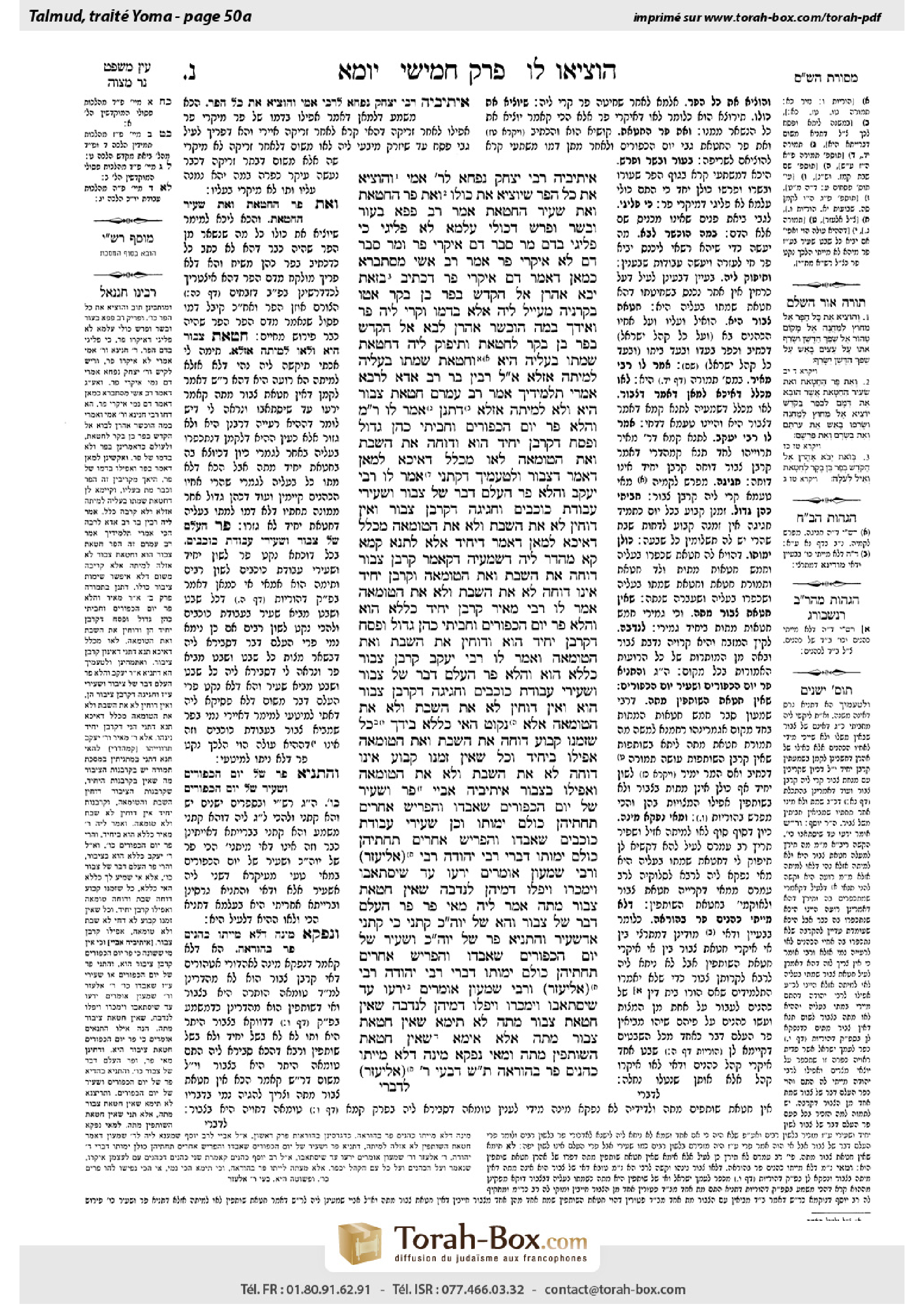
Yoma 50a: Talmud study for Daf Yomi
Daf Yomi is the daily study of one Talmud folio. Explore 37 tractates with scans, Hebrew text, Sefaria English and AI-generated French translations where annotated.
Passage selection and English or AI-generated French translation are available where the scan has annotations. Daf Study is independent of Torah-Box and Sefaria.
Browse Yoma · יומא · All tractatesYoma 50a text and translations
This page of Yoma includes the Aramaic text, an English translation and an AI-generated French translation, alongside the scan above.
יומא נ׳ א · Aramaic and Hebrew text
אֵיתִיבֵיהּ רַבִּי יִצְחָק נַפָּחָא לְרַבִּי אַמֵּי: ״וְהוֹצִיא אֶת כׇּל הַפָּר״! שֶׁיּוֹצִיא אֶת כּוּלּוֹ.
״וְאֵת פַּר הַחַטָּאת וְאֵת שְׂעִיר הַחַטָּאת״, אָמַר רַב פָּפָּא: בְּעוֹר וּבָשָׂר וָפֶרֶשׁ דְּכוּלֵּי עָלְמָא לָא פְּלִיגִי. כִּי פְּלִיגִי בְּדָם. מָר סָבַר: דָּם אִיקְּרִי פַּר, וּמָר סָבַר: דָּם לָא אִיקְּרִי פַּר.
אָמַר רַב אָשֵׁי: מִסְתַּבְּרָא כְּמַאן דְּאָמַר דָּם אִיקְּרִי פַּר, דִּכְתִיב: ״בְּזֹאת יָבֹא אַהֲרֹן אֶל הַקֹּדֶשׁ בְּפַר בֶּן בָּקָר״, אַטּוּ בְּקַרְנֵיהּ מְעַיֵּיל לֵיהּ?! אֶלָּא בְּדָמוֹ, וְקָרֵי לֵיהּ ״פַּר״.
וְאִידַּךְ? בַּמָּה הוּכְשַׁר אַהֲרֹן לָבֹא אֶל הַקֹּדֶשׁ — בְּפַר בֶּן בָּקָר לְחַטָּאת.
וְתִיפּוֹק לֵיהּ דְּחַטָּאת שֶׁמֵּתוּ בְּעָלֶיהָ הִיא, וְחַטָּאת שֶׁמֵּתוּ בְּעָלֶיהָ לְמִיתָה אָזְלָא! אֲמַר לֵיהּ רָבִין בַּר רַב אַדָּא לְרָבָא: אָמְרִי תַּלְמִידָיךָ, אָמַר רַב עַמְרָם: חַטַּאת צִבּוּר הִיא, וְלָא לְמִיתָה אָזְלָא.
דִּתְנַן, אָמַר לוֹ רַבִּי מֵאִיר: וַהֲלֹא פַּר יוֹם הַכִּפּוּרִים, וַחֲבִיתֵּי כֹּהֵן גָּדוֹל, וּפֶסַח — דְּקָרְבַּן יָחִיד הוּא, וְדוֹחֶה אֶת הַשַּׁבָּת וְאֶת הַטּוּמְאָה. לָאו מִכְּלָל דְּאִיכָּא לְמַאן דְּאָמַר דְּצִבּוּר?
וּלְטַעְמָיךְ, דְּקָתָנֵי: אָמַר לוֹ רַבִּי יַעֲקֹב: וַהֲלֹא פַּר הֶעְלֵם דָּבָר שֶׁל צִבּוּר, וּשְׂעִירֵי עֲבוֹדָה זָרָה, וַחֲגִיגָה — דְּקָרְבַּן צִבּוּר, וְאֵין דּוֹחִין לֹא אֶת הַשַּׁבָּת וְלֹא אֶת הַטּוּמְאָה! מִכְּלָל דְּאִיכָּא לְמַאן דְּאָמַר דְּיָחִיד!
אֶלָּא: לְתַנָּא קַמָּא קָא מַהְדַּר לֵיהּ, דְּשַׁמְעֵיהּ דְּקָאָמַר: קׇרְבַּן צִבּוּר דּוֹחֶה אֶת הַשַּׁבָּת וְאֶת הַטּוּמְאָה, וְקָרְבַּן יָחִיד אֵינוֹ דּוֹחֶה לֹא אֶת הַשַּׁבָּת וְלֹא אֶת הַטּוּמְאָה. אָמַר לוֹ רַבִּי מֵאִיר: קׇרְבַּן יָחִיד כְּלָלָא הוּא? וַהֲלֹא פַּר יוֹם הַכִּפּוּרִים, וַחֲבִיתֵּי כֹּהֵן גָּדוֹל, וּפֶסַח — דְּקָרְבַּן יָחִיד הוּא, וְדוֹחִין אֶת הַשַּׁבָּת וְאֶת הַטּוּמְאָה!
וְאָמַר לוֹ רַבִּי יַעֲקֹב: קׇרְבַּן צִבּוּר כְּלָלָא הוּא? וַהֲלֹא פַּר הֶעְלֵם דָּבָר שֶׁל צִבּוּר, וּשְׂעִירֵי עֲבוֹדָה זָרָה, וַחֲגִיגָה — דְּקָרְבַּן צִבּוּר הוּא, וְאֵין דּוֹחִין לֹא אֶת הַשַּׁבָּת וְלֹא אֶת הַטּוּמְאָה!
אֶלָּא, נְקוֹט הַאי כְּלָלָא בִּידָךְ: כֹּל שֶׁזְּמַנּוֹ קָבוּעַ — דּוֹחֶה אֶת הַשַּׁבָּת וְאֶת הַטּוּמְאָה אֲפִילּוּ בְּיָחִיד, וְכֹל שֶׁאֵין זְמַנּוֹ קָבוּעַ — אֵינוֹ דּוֹחֶה לֹא אֶת הַשַּׁבָּת וְלֹא אֶת הַטּוּמְאָה וַאֲפִילּוּ בְּצִבּוּר.
אֵיתִיבֵיהּ אַבָּיֵי: פַּר וְשָׂעִיר שֶׁל יוֹם הַכִּפּוּרִים שֶׁאָבְדוּ, וְהִפְרִישׁ אֲחֵרִים תַּחְתֵּיהֶן — כּוּלָּם יָמוּתוּ. וְכֵן שְׂעִירֵי עֲבוֹדָה זָרָה שֶׁאָבְדוּ, וְהִפְרִישׁ אֲחֵרִים תַּחְתֵּיהֶן — כּוּלָּם יָמוּתוּ, דִּבְרֵי רַבִּי יְהוּדָה. רַבִּי (אֱלִיעֶזֶר) וְרַבִּי שִׁמְעוֹן אוֹמְרִים: יִרְעוּ עַד שֶׁיִּסְתָּאֲבוּ וְיִמָּכְרוּ וְיִפְּלוּ דְּמֵיהֶן לִנְדָבָה, שֶׁאֵין חַטַּאת צִבּוּר מֵתָה.
אֲמַר לֵיהּ: מַאי פַּר — פַּר הֶעְלֵם דָּבָר שֶׁל צִבּוּר. וְהָא ״שֶׁל יוֹם הַכִּפּוּרִים״ קָתָנֵי! כִּי קָתָנֵי — אַדְּשָׂעִיר.
וְהָתַנְיָא: פַּר שֶׁל יוֹם הַכִּפּוּרִים וְשָׂעִיר שֶׁל יוֹם הַכִּפּוּרִים שֶׁאָבְדוּ וְהִפְרִישׁ אֲחֵרִים תַּחְתֵּיהֶן — כּוּלָּם יָמוּתוּ, דִּבְרֵי רַבִּי יְהוּדָה. רַבִּי (אֱלִיעֶזֶר) וְרַבִּי שִׁמְעוֹן אוֹמְרִים: יִרְעוּ עַד שֶׁיִּסְתָּאֲבוּ וְיִמָּכְרוּ וְיִפְּלוּ דְּמֵיהֶן לִנְדָבָה, שֶׁאֵין חַטַּאת צִבּוּר מֵתָה.
לָא תֵּימָא: ״שֶׁאֵין חַטַּאת צִבּוּר מֵתָה״, אֶלָּא אֵימָא: ״שֶׁאֵין חַטַּאת הַשּׁוּתָּפִין מֵתָה״. וּמַאי נָפְקָא מִינַּהּ?
דְּלָא מַיְיתוּ כֹּהֲנִים פַּר בְּהוֹרָאָה.
תָּא שְׁמַע, דְּבָעֵי רַבִּי (אֱלִיעֶזֶר):
Yoma 50a · English translation
§ Rabbi Yitzḥak Nappaḥa raised an objection to Rabbi Ami: “And he shall remove the entire bull outside the camp” (Leviticus 4:12). This verse speaks of a bull that has been slaughtered and its fats and sacrificial parts have been burned, which proves that even after it has been slaughtered, it is still called a bull. Rabbi Ami replied: The animal itself is not called a bull at this stage; rather, it means that he should remove the entire carcass, all that remains of the bull.
The Gemara raises another difficulty by citing a verse: “And the bull of the sin-offering and the goat of the sin-offering, whose blood was brought in to make atonement in the Sanctuary, shall be taken outside the camp” (Leviticus 16:27). Once again, the verse proves that even after it has been slaughtered and its blood is brought into the Holy of Holies, the animal is still called a bull. Rav Pappa said: Everyone agrees that when it is intact, with its hide, its flesh, and its excrement, it is called a bull. When they disagree is with regard to the blood. One Sage holds that its blood is called a bull, and one Sage holds that blood alone is not called a bull.
Rav Ashi said: It is reasonable to say in accordance with the one who said that blood is called part of the bull, as it is written: “With this Aaron shall come into the sacred place, with a bull” (Leviticus 16:3). Is that to say that he brings it in, to the Holy of Holies, with its horns? Rather, he enters with its blood, and yet the Torah calls that “a bull.” This proves that the blood itself is called a bull.
The Gemara asks: And the other one, who maintains that blood is not called a bull, how does he interpret this verse? The Gemara answers that he can explain the verse as follows: With what did Aaron become qualified to enter the sacred place? With his bringing of a young bull for a sin-offering. However, the blood itself, which he brings inside, is not called a bull.
§ The Gemara returns to the issue of a replacement High Priest entering with the blood of the first bull: And let him derive the answer to this problem from the fact that it is a sin-offering whose owners have died. After all, the bull of the first High Priest is a sin-offering and its owner has died. Since there is a principle that a sin-offering whose owners have died is left to die, this should resolve the dilemma. Ravin bar Rav Adda said to Rava: Your students say that Rav Amram said that the sin-offering bull of the High Priest is a communal sin-offering, as the High Priest brings it both on his own behalf and for his fellow priests, and a communal sin-offering is not left to die.
As we learned in a mishna in tractate Temura that tanna’im debate which offerings override Shabbat and ritual impurity. Rabbi Meir said to him: But consider the Yom Kippur bull, and the meal-offering resembling a wafer brought specially by the High Priest, and the Paschal offering, each of which is an individual offering and overrides Shabbat and ritual impurity. Since Rabbi Meir says that these are individual offerings, is it not correct to say by inference that there is one who says that these offerings are communal?
The Gemara rejects this proof. And according to your reasoning, consider that which was taught there: Rabbi Ya’akov said to him: But there are the cases of the bull for an unwitting communal sin, and the goats for a sin of idolatry, and the Festival peace-offering, which are all communal offerings and override neither Shabbat nor ritual impurity. According to the above reasoning, it can be claimed by inference that there is one who says that these are individual offerings, which is incorrect.
Rather, Rabbi Meir responded to the first tanna, as he heard him say in the form of a general principle: Communal sacrifices override Shabbat and ritual impurity, but individual sacrifices override neither Shabbat nor ritual impurity. In response to this claim, Rabbi Meir said to him: Is this statement with regard to an individual offering a general principle? But consider the Yom Kippur bull, and the meal-offering resembling a wafer of the High Priest, and the Paschal offering, each of which is an individual offering and overrides Shabbat and ritual impurity.
And Rabbi Ya’akov responded to the first tanna from a different perspective: Is this statement with regard to a communal offering a general principle, which overrides ritual impurity? But there are the cases of the bull for an unwitting communal sin, and the goats for a sin of idolatry, and the Festival peace-offering, which are all communal offerings and override neither Shabbat nor ritual impurity.
Rather, grasp this principle: Any offering that has a fixed time for its sacrifice overrides Shabbat and ritual impurity even if it is an individual offering; and any offering of no fixed time overrides neither Shabbat nor ritual impurity, and this is the case even if it is a communal offering. With regard to the issue at hand, as the emphasis of both Rabbi Meir’s and Rabbi Ya’akov’s statements is whether the offerings they referred to override Shabbat and ritual impurity, not their classification as individual or communal offerings, nothing can be inferred from their comments in this regard. Consequently, it remains possible that the bull of the High Priest is an individual offering.
§ Abaye raised an objection to Rava: Is the bull of the High Priest an individual offering? But we learned in a baraita: With regard to the bull and the goat of Yom Kippur that were lost, and he separated others in their stead, and the first animals were subsequently found, all of the second set shall be left to die. And likewise, goats for a sin of idolatry that were lost and he separated others in their stead, all of them shall be left to die. This is the statement of Rabbi Yehuda. Rabbi Elazar and Rabbi Shimon say: They shall be left to graze until they become unfit, whereupon they are sold and their proceeds go for a free-will offering, as a communal sin-offering is not left to die. This proves that the Yom Kippur bull is called a communal sin-offering.
Rava said to Abaye: What bull is referred to here? A bull for an unwitting communal sin. Abaye retorted: But the baraita taught: Of Yom Kippur, which clearly indicates that it is referring to the bull of Yom Kippur. Rava answered: When the tanna of this baraita taught: Of Yom Kippur, he was referring only to the goat. That is, the baraita should be read as follows: The communal bull and the goat of Yom Kippur, which is also a communal offering.
Abaye further asks: But wasn’t it taught in a baraita: With regard to the bull of Yom Kippur and the goat of Yom Kippur that were lost and he separated others in their stead, and the first animals were subsequently found, all of the second set shall be left to die. This is the statement of Rabbi Yehuda. Rabbi Elazar and Rabbi Shimon say: They shall be left to graze until they become unfit, whereupon they are sold and their proceeds go for a free-will offering, as a communal sin-offering is not left to die. This baraita explicitly states that the bull of Yom Kippur is considered a communal offering.
Rava answered him: Do not say: As a communal sin-offering is not left to die. Rather, say: As a sin-offering of partners is not left to die. Since some of the partners are still alive, the sin-offering is not left to die. The bull of the High Priest on Yom Kippur is considered a sin-offering of partners because it atones not only for the High Priest, but for his fellow priests, as well. The Gemara asks: And if ultimately the bull is not left to die, what is the practical difference whether the bull of the High Priest is considered a communal sin-offering or a sin-offering of partners? Why did Rava insist on calling it a sin-offering of partners?
The Gemara answers that there is a difference between these two categories with regard to a court that issues an incorrect ruling to an entire community, e.g., a tribe of Israel, and the people act in accordance with that ruling. The halakha in this case is that the court must bring a bull for an unwitting communal sin. Rava insisted on referring to the bull that atones for all of the priests on Yom Kippur as a sin-offering of partners, not a communal sin-offering, for the following reason: If a court composed of priests issued a mistaken ruling, and the priests acted in accordance with that teaching, the priests do not bring a bull for this ruling, as they are not considered a community but a large partnership.
The Gemara offers another solution to the question. Come and hear, as Rabbi Elazar raised the following dilemma:
Yoma 50a · Traduction française (IA)
§ Rabbi Yitzḥak Nappaḥa souleva une objection à Rabbi Ami : « Il emportera le taureau entier hors du camp » (Lévitique 4:12). Ce verset parle d’un taureau qui a été égorgé et dont les graisses et les parties sacrificielles ont été brûlées, ce qui prouve que, même après avoir été égorgé, il est encore appelé « taureau ». Rabbi Ami répondit : À ce stade, l’animal lui-même n’est pas appelé « taureau » ; il faut plutôt comprendre qu’il emportera la carcasse entière, tout ce qui reste du taureau.
La Guemara soulève une autre difficulté en citant un verset : « Le taureau du sacrifice expiatoire et le bouc du sacrifice expiatoire, dont le sang a été introduit pour faire l’expiation dans le Sanctuaire, seront emportés hors du camp » (Lévitique 16:27). Une fois encore, le verset prouve que, même après avoir été égorgé et son sang introduit dans le Saint des saints, l’animal est encore appelé « taureau ». Rav Pappa dit : Tous conviennent que, lorsqu’il est intact, avec sa peau, sa chair et ses excréments, il est appelé « taureau ». Leur désaccord porte sur le sang. Un Sage soutient que son sang est appelé « taureau », tandis qu’un autre soutient que le sang seul n’est pas appelé « taureau ».
Rav Ashi dit : Il est raisonnable de suivre celui qui affirme que le sang est appelé une partie du taureau, car il est écrit : « C’est avec ceci qu’Aaron entrera dans le lieu sacré : avec un taureau » (Lévitique 16:3). Faut-il comprendre qu’il fait entrer le taureau dans le Saint des saints avec ses cornes ? Il y entre plutôt avec son sang, et pourtant la Torah appelle cela « un taureau ». Cela prouve que le sang lui-même est appelé « taureau ».
La Guemara demande : Et l’autre, qui soutient que le sang n’est pas appelé « taureau », comment interprète-t-il ce verset ? La Guemara répond qu’il peut expliquer le verset ainsi : Grâce à quoi Aaron a-t-il été habilité à entrer dans le lieu sacré ? Grâce au fait qu’il a apporté un jeune taureau comme sacrifice expiatoire. Cependant, le sang lui-même, qu’il fait entrer, n’est pas appelé « taureau ».
§ La Guemara revient à la question du grand prêtre qui remplace son prédécesseur et entre avec le sang du premier taureau : Qu’il déduise donc la réponse à ce problème du fait qu’il s’agit d’un sacrifice expiatoire dont les propriétaires sont morts. Après tout, le taureau du premier grand prêtre est un sacrifice expiatoire et son propriétaire est mort. Puisqu’un principe veut qu’un sacrifice expiatoire dont les propriétaires sont morts soit laissé à mourir, cela devrait résoudre le dilemme. Ravin bar Rav Adda dit à Rava : Tes élèves disent que Rav Amram a affirmé que le taureau du grand prêtre offert en sacrifice expiatoire est un sacrifice expiatoire communautaire, car le grand prêtre l’apporte à la fois en son propre nom et au nom de ses collègues prêtres ; or, un sacrifice expiatoire communautaire n’est pas laissé à mourir.
Comme nous l’avons appris dans une Michna du traité Temoura, les tannaïm débattent des sacrifices qui l’emportent sur le Chabbat et l’impureté rituelle. Rabbi Meïr lui dit : Mais considère le taureau de Yom Kippour, l’oblation ressemblant à une galette apportée spécialement par le grand prêtre et le sacrifice pascal : chacun est un sacrifice individuel et l’emporte sur le Chabbat et l’impureté rituelle. Puisque Rabbi Meïr dit qu’il s’agit de sacrifices individuels, n’est-il pas juste d’en déduire qu’il en est un qui affirme que ces sacrifices sont communautaires ?
La Guemara rejette cette preuve. Et, selon ton raisonnement, considère ce qui a été enseigné là-bas : Rabbi Ya’akov lui dit : Mais il y a le cas du taureau offert pour une faute involontaire de la communauté, celui des boucs offerts pour une faute d’idolâtrie et celui du sacrifice de paix de la fête ; tous sont des sacrifices communautaires et ne l’emportent ni sur le Chabbat ni sur l’impureté rituelle. Selon le raisonnement précédent, on pourrait en déduire qu’il en est un qui affirme qu’il s’agit de sacrifices individuels, ce qui est inexact.
En réalité, Rabbi Meïr répondit au premier tanna, car il l’avait entendu énoncer une règle générale : les sacrifices communautaires l’emportent sur le Chabbat et l’impureté rituelle, tandis que les sacrifices individuels ne l’emportent ni sur le Chabbat ni sur l’impureté rituelle. En réponse à cette affirmation, Rabbi Meïr lui dit : Cette déclaration au sujet d’un sacrifice individuel est-elle une règle générale ? Mais considère le taureau de Yom Kippour, l’oblation du grand prêtre ressemblant à une galette et le sacrifice pascal : chacun est un sacrifice individuel et l’emporte sur le Chabbat et l’impureté rituelle.
Et Rabbi Ya’akov répondit au premier tanna d’un autre point de vue : Cette déclaration au sujet d’un sacrifice communautaire, selon laquelle il l’emporte sur l’impureté rituelle, est-elle une règle générale ? Mais il y a le cas du taureau offert pour une faute involontaire de la communauté, celui des boucs offerts pour une faute d’idolâtrie et celui du sacrifice de paix de la fête ; tous sont des sacrifices communautaires et ne l’emportent ni sur le Chabbat ni sur l’impureté rituelle.
Il faut plutôt retenir ce principe : tout sacrifice dont le moment de l’offrande est fixé l’emporte sur le Chabbat et l’impureté rituelle, même s’il s’agit d’un sacrifice individuel ; et tout sacrifice dont le moment de l’offrande n’est pas fixé ne l’emporte ni sur le Chabbat ni sur l’impureté rituelle, même s’il s’agit d’un sacrifice communautaire. Pour ce qui est de la question en discussion, puisque l’accent des propos de Rabbi Meïr comme de Rabbi Ya’akov porte sur le fait que les sacrifices qu’ils ont mentionnés l’emportent ou non sur le Chabbat et l’impureté rituelle, et non sur leur classification comme sacrifices individuels ou communautaires, on ne peut rien déduire de leurs remarques à cet égard. Il reste donc possible que le taureau du grand prêtre soit un sacrifice individuel.
§ Abaye souleva une objection à Rava : Le taureau du grand prêtre est-il un sacrifice individuel ? Or, nous avons appris dans une baraïta : Lorsque le taureau et le bouc de Yom Kippour ont été perdus, qu’on en a désigné d’autres à leur place, puis que les premiers animaux ont été retrouvés, tous les animaux du second groupe doivent être laissés à mourir. Il en va de même des boucs destinés à expier une faute d’idolâtrie qui ont été perdus et remplacés par d’autres : tous doivent être laissés à mourir. Telle est l’opinion de Rabbi Yehouda. Rabbi Elazar et Rabbi Shimon disent : Ils doivent paître jusqu’à devenir impropres ; ils sont alors vendus et le produit de leur vente sert à une offrande volontaire, car un sacrifice expiatoire communautaire n’est pas laissé à mourir. Cela prouve que le taureau de Yom Kippour est appelé sacrifice expiatoire communautaire.
Rava dit à Abaye : De quel taureau est-il question ici ? D’un taureau offert pour une faute involontaire de la communauté. Abaye rétorqua : Mais la baraïta enseigne : « de Yom Kippour », ce qui indique clairement qu’elle parle du taureau de Yom Kippour. Rava répondit : Lorsque le tanna de cette baraïta a enseigné « de Yom Kippour », il ne faisait référence qu’au bouc. Autrement dit, il faut lire la baraïta ainsi : le taureau communautaire et le bouc de Yom Kippour, qui est lui aussi un sacrifice communautaire.
Abaye demande encore : Mais n’a-t-on pas enseigné dans une baraïta : Lorsque le taureau de Yom Kippour et le bouc de Yom Kippour ont été perdus, qu’on en a désigné d’autres à leur place, puis que les premiers animaux ont été retrouvés, tous les animaux du second groupe doivent être laissés à mourir. Telle est l’opinion de Rabbi Yehouda. Rabbi Elazar et Rabbi Shimon disent : Ils doivent paître jusqu’à devenir impropres ; ils sont alors vendus et le produit de leur vente sert à une offrande volontaire, car un sacrifice expiatoire communautaire n’est pas laissé à mourir. Cette baraïta affirme explicitement que le taureau de Yom Kippour est considéré comme un sacrifice communautaire.
Rava lui répondit : Ne dis pas : « car un sacrifice expiatoire communautaire n’est pas laissé à mourir ». Dis plutôt : « car un sacrifice expiatoire appartenant à des associés n’est pas laissé à mourir ». Puisque certains des associés sont encore en vie, le sacrifice expiatoire n’est pas laissé à mourir. Le taureau du grand prêtre à Yom Kippour est considéré comme un sacrifice expiatoire appartenant à des associés, car il fait expiation non seulement pour le grand prêtre, mais aussi pour ses collègues prêtres. La Guemara demande : Et si, en définitive, le taureau n’est pas laissé à mourir, quelle différence pratique y a-t-il entre considérer le taureau du grand prêtre comme un sacrifice expiatoire communautaire ou comme un sacrifice expiatoire appartenant à des associés ? Pourquoi Rava a-t-il insisté pour l’appeler sacrifice expiatoire appartenant à des associés ?
La Guemara répond qu’il existe une différence entre ces deux catégories dans le cas où un tribunal rend une décision erronée à l’intention d’une communauté entière, par exemple une tribu d’Israël, et où les membres agissent conformément à cette décision. La halakha dans ce cas est que le tribunal doit apporter un taureau pour une faute involontaire de la communauté. Rava a insisté pour qualifier de sacrifice expiatoire appartenant à des associés le taureau qui fait expiation pour tous les prêtres à Yom Kippour, et non de sacrifice expiatoire communautaire, pour la raison suivante : si un tribunal composé de prêtres rendait une décision erronée et que les prêtres agissaient conformément à cette décision, ils n’apporteraient pas de taureau à ce titre, car ils ne sont pas considérés comme une communauté, mais comme un grand groupe d’associés.
La Guemara propose une autre solution à la question. Viens et entends, car Rabbi Elazar souleva le dilemme suivant :
Traduction française générée par IA à partir de l’édition anglaise de Sefaria. Vérifie toujours un passage avec le texte source.
Text from Sefaria: William Davidson Edition - Vocalized Aramaic (CC BY NC); William Davidson Edition - English (CC BY NC).