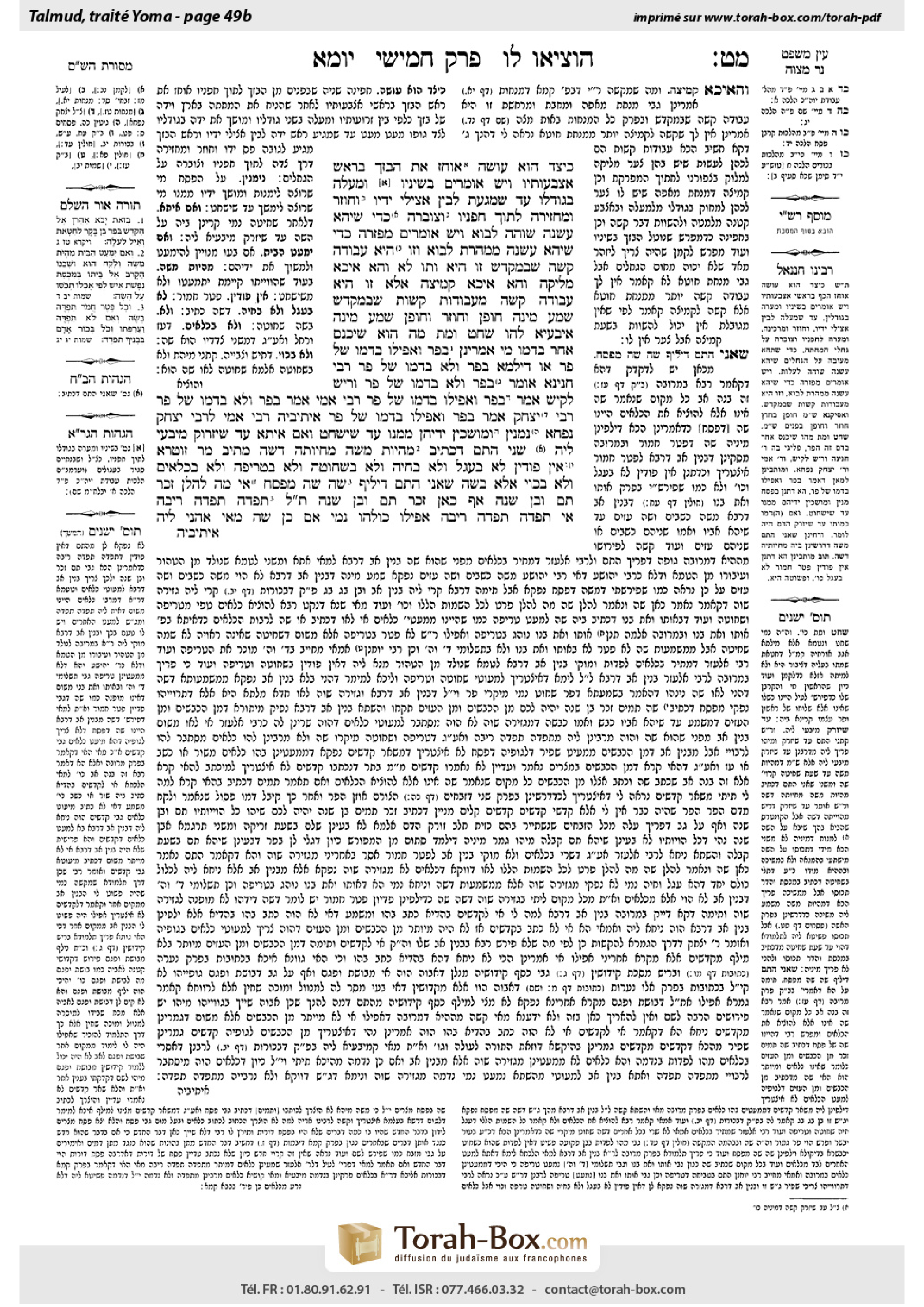
Yoma 49b: Talmud study for Daf Yomi
Daf Yomi is the daily study of one Talmud folio. Explore 37 tractates with scans, Hebrew text, Sefaria English and AI-generated French translations where annotated.
Passage selection and English or AI-generated French translation are available where the scan has annotations. Daf Study is independent of Torah-Box and Sefaria.
Browse Yoma · יומא · All tractatesYoma 49b text and translations
This page of Yoma includes the Aramaic text, an English translation and an AI-generated French translation, alongside the scan above.
יומא מ״ט ב · Aramaic and Hebrew text
כֵּיצַד הוּא עוֹשֶׂה? אוֹחֵז אֶת הַבָּזֵךְ בְּרֹאשׁ אֶצְבְּעוֹתָיו, וְיֵשׁ אוֹמְרִים בְּשִׁינָּיו, וּמַעֲלֶה בְּגוּדָלוֹ עַד שֶׁמַּגַּעַת לְבֵין אַצִּילֵי יָדָיו, וְחוֹזֵר וּמַחְזִירָהּ לְתוֹךְ חׇפְנָיו, וְצוֹבְרָהּ, כְּדֵי שֶׁיְּהֵא עֲשָׁנָהּ שׁוֹהֶה לָבוֹא. וְיֵשׁ אוֹמְרִים: מְפַזְּרָהּ, כְּדֵי שֶׁיְּהֵא עֲשָׁנָהּ מְמַהֶרֶת לָבוֹא.
וְזוֹ הִיא עֲבוֹדָה קָשָׁה שֶׁבַּמִּקְדָּשׁ. זוֹ הִיא וְתוּ לָא? וְהָא אִיכָּא מְלִיקָה! וְהָא אִיכָּא קְמִיצָה! אֶלָּא: זוֹ הִיא עֲבוֹדָה קָשָׁה מֵעֲבוֹדוֹת קָשׁוֹת שֶׁבַּמִּקְדָּשׁ. שְׁמַע מִינַּהּ: חוֹפֵן וְחוֹזֵר וְחוֹפֵן. שְׁמַע מִינַּהּ.
אִיבַּעְיָא לְהוּ: שָׁחַט וָמֵת, מַה הוּא שֶׁיִּכָּנֵס אַחֵר בְּדָמוֹ? מִי אָמְרִינַן: ״בְּפַר״ — וַאֲפִילּוּ בְּדָמוֹ שֶׁל פַּר, אוֹ דִילְמָא: ״בְּפַר״ — וְלֹא בְּדָמוֹ שֶׁל פַּר.
רַבִּי חֲנִינָא אוֹמֵר: ״בְּפַר״ — וְלֹא בְּדָמוֹ שֶׁל פַּר, וְרֵישׁ לָקִישׁ אָמַר: ״בְּפַר״ — וַאֲפִילּוּ בְּדָמוֹ שֶׁל פַּר. רַבִּי אַמֵּי אָמַר: ״בְּפַר״ — וְלֹא בְּדָמוֹ שֶׁל פַּר, רַבִּי יִצְחָק אָמַר: ״בְּפַר״ — וַאֲפִילּוּ בְּדָמוֹ שֶׁל פַּר.
אֵיתִיבֵיהּ רַבִּי אַמֵּי לְרַבִּי יִצְחָק נַפָּחָא: נִמְנִין וּמוֹשְׁכִין יְדֵיהֶן מִמֶּנּוּ עַד שֶׁיִּשָּׁחֵט, וְאִם אִיתָא — ״עַד שֶׁיִּזְרוֹק״ מִיבְּעֵי לֵיהּ!
שָׁנֵי הָתָם, דִּכְתִיב: ״מִהְיוֹת מִשֶּׂה״ — מֵחַיּוּתֵהּ דְּשֶׂה.
מֵתִיב מָר זוּטְרָא: וְאֵין פּוֹדִין — לֹא בָּעֵגֶל וְלֹא בְּחַיָּה וְלֹא בִּשְׁחוּטָה וְלֹא בִּטְרֵיפָה וְלֹא בְּכִלְאַיִם וְלֹא בְּכוֹי, אֶלָּא בְּשֶׂה. שָׁאנֵי הָתָם, דְּיָלֵיף ״שֶׂה״ ״שֶׂה״ מִפֶּסַח.
אִי מָה לְהַלָּן זָכָר תָּם וּבֶן שָׁנָה, אַף כָּאן זָכָר תָּם וּבֶן שָׁנָה? תַּלְמוּד לוֹמַר: ״תִּפְדֶּה״ ״תִּפְדֶּה״ רִיבָּה.
אִי ״תִּפְדֶּה״ ״תִּפְדֶּה״ רִיבָּה, אֲפִילּוּ כּוּלְּהוּ נָמֵי! אִם כֵּן, ״שֶׂה״ מַאי אַהֲנִי לֵיהּ?
Yoma 49b · English translation
How should the High Priest act in the Holy of Holies, when he needs to place the incense on the coals by taking a handful from the spoon and placing it in his hands? After he places the coal pan on the ground, he holds the front of the ladle, i.e., the spoon of incense, with his fingertips, and some say he holds it with his teeth. At this stage the handle of the spoon rests between his arms. And he pushes it and raises it up slowly with his thumb toward his body until it reaches between his elbows, which he then uses to turn it over. He then returns the incense into his palms, after which he pours it from his hands into the coal pan. And he heaps the incense into a pile on the coals so that its smoke rises slowly. And some say he does the opposite, that he scatters it so that its smoke rises quickly.
And this taking of a handful of incense is the most difficult sacrificial rite in the Temple. The Gemara asks: This one is the hardest rite, and no other? But there is pinching, which is also considered extremely difficult; and there is taking a handful of a meal-offering, another complex rite. Rather, this taking of a handful of incense is one of the most difficult rites in the Temple, rather than the single most difficult one. In any event, you can learn from this that the High Priest scoops a handful and again scoops. The Gemara concludes: Indeed, learn from this that it is so.
§ A dilemma was raised before the Sages: If a High Priest slaughtered the bull and died, what is the halakha with regard to whether another High Priest may enter the Holy of Holies with the blood of the bull that his predecessor slaughtered? Do we say that the verse: “With this Aaron shall come into the sacred place, with a bull” (Leviticus 16:3) teaches that the priest must enter with the blood of a bull, but it need not necessarily be the blood of the bull he himself slaughtered, and in that case he may enter even with the blood of a bull slaughtered by someone else? Or perhaps the verse should be interpreted precisely: “With a bull,” and not with the blood of a bull slaughtered by another?
The Sages disputed this matter. Rabbi Ḥanina says: “With a bull,” and not with the blood of a bull, which means that the newly appointed High Priest must slaughter another bull, as he can enter only with the blood of a bull he himself slaughtered. And Reish Lakish said: “With a bull,” and even with the blood of a bull. Likewise, Rabbi Ami said: “With a bull” and not with the blood of a bull; Rabbi Yitzḥak said: “With a bull,” and even with the blood of a bull.
Rabbi Ami raised an objection to Rabbi Yitzḥak Nappaḥa, the smith: To join a group of people who arranged to partake together of a single Paschal offering, individuals may register as part of a group and they may withdraw from it and join another group until the offering is slaughtered. And if it is so, that the blood of an animal is considered part of the offering, this tanna who authored this statement should have said that they may withdraw until the blood is sprinkled. If, as you maintain, the blood of an offering is part of the offering itself, why can’t a person register to or withdraw from a group of a Paschal offering until its blood is sprinkled?
He answered him: It is different there, as it is written: “And if the household is too small for a lamb [mehiyot miseh], he and his neighbor who is next to his house” (Exodus 12:4). The phrase “mehiyot miseh” is read as meiḥiyutei deseh, from the life of a lamb. In other words, one can withdraw from a group only as long as the lamb is alive. If so, its blood is not considered part of the Paschal lamb by a special decree of the Torah, which does not apply to Yom Kippur.
Mar Zutra raised an objection: And one may not redeem a male firstborn donkey with a calf, nor with an undomesticated animal, nor with a slaughtered lamb, nor with an animal with a condition that will cause it to die within twelve months [tereifa], nor with the product of the prohibited crossbreeding of a lamb and a goat, nor with a koy, a kosher animal with characteristics of both a domesticated animal and a non-domesticated animal, but with a lamb. This proves that a slaughtered animal is not considered a lamb. The Gemara rejects this claim: It is different there, as that tanna derives a verbal analogy of “lamb” (Exodus 13:13) and “lamb” (Exodus 12:4) from the Paschal offering: Just as a slaughtered lamb cannot be used for a Paschal offering, the same applies to the case of a firstborn donkey.
The Gemara asks: If so, just as there, the Paschal offering must be male, unblemished, and a year old, so too here, for the redemption of a firstborn donkey, one should be obligated to use a male that is unblemished and a year old. Therefore the verse states: “And every firstborn of a donkey you shall redeem with a lamb; and if you shall not redeem it, then you shall break its neck” (Exodus 13:13). The repetition of: “You shall redeem,” “you shall not redeem,” serves to amplify the definition of the offering and include other animals as acceptable for this redemption, not merely those fit for the Paschal offering.
The Gemara asks: If the phrases “You shall redeem” “you shall redeem” serve to amplify, even all animals should also be fit for the redemption of a firstborn donkey, including a calf, undomesticated beast, a slaughtered animal, and the other exceptions listed above. The Gemara answers: If so, what purpose does the verbal analogy of “lamb” serve? Rather, it is evident that certain animals are included while others are excluded. In any case, it is clear that the halakha of the blood of the bull on Yom Kippur cannot be derived from here.
Yoma 49b · Traduction française (IA)
Comment le grand prêtre doit-il agir dans le Saint des Saints lorsqu’il doit déposer l’encens sur les braises, après en avoir pris une poignée dans la cuillère pour la mettre dans ses mains ? Après avoir posé le brasero à terre, il saisit du bout des doigts l’avant de la louche, c’est-à-dire la cuillère contenant l’encens ; certains disent qu’il la tient avec les dents. À ce stade, le manche de la cuillère repose entre ses bras. Il la pousse et la soulève lentement avec son pouce vers son corps, jusqu’à ce qu’elle atteigne l’espace entre ses coudes ; il s’en sert alors pour la retourner. Il remet ensuite l’encens dans ses paumes, puis le verse de ses mains dans le brasero. Il entasse l’encens en un tas sur les braises, afin que sa fumée s’élève lentement. Certains disent qu’il fait le contraire et le disperse, afin que sa fumée s’élève rapidement.
Cette prise d’une poignée d’encens est le rite sacrificiel le plus difficile du Temple. La Guemara demande : Est-ce le rite le plus difficile, à l’exclusion de tout autre ? Pourtant, il y a la mélika, qui est elle aussi considérée comme extrêmement difficile, ainsi que la prise d’une poignée d’offrande végétale, autre rite complexe. Il faut donc dire que cette prise d’une poignée d’encens est l’un des rites les plus difficiles du Temple, et non le rite le plus difficile à elle seule. Quoi qu’il en soit, on peut en déduire que le grand prêtre prend une poignée, puis en prend une autre. La Guemara conclut : En effet, déduis-en qu’il en est ainsi.
§ Un dilemme fut posé aux Sages : si un grand prêtre égorge le taureau puis meurt, quelle est la halakha quant à la possibilité pour un autre grand prêtre d’entrer dans le Saint des Saints avec le sang du taureau égorgé par son prédécesseur ? Faut-il dire que le verset « C’est avec cela qu’Aaron entrera dans le sanctuaire : avec un taureau » (Lévitique 16, 3) enseigne que le prêtre doit entrer avec le sang d’un taureau, sans qu’il soit nécessaire que ce soit le sang du taureau qu’il a lui-même égorgé ; dans ce cas, il peut entrer même avec le sang d’un taureau égorgé par quelqu’un d’autre ? Ou peut-être faut-il interpréter le verset avec précision : « avec un taureau », et non avec le sang d’un taureau égorgé par un autre ?
Les Sages sont en désaccord sur cette question. Rabbi Ḥanina dit : « Avec un taureau », et non avec le sang d’un taureau ; cela signifie que le grand prêtre nouvellement nommé doit égorger un autre taureau, car il ne peut entrer qu’avec le sang d’un taureau qu’il a lui-même égorgé. Reish Lakish dit : « Avec un taureau », et même avec le sang d’un taureau. De même, Rabbi Ami dit : « Avec un taureau », et non avec le sang d’un taureau ; Rabbi Yitzḥak dit : « Avec un taureau », et même avec le sang d’un taureau.
Rabbi Ami objecta à Rabbi Yitzḥak Nappaḥa, le forgeron : Pour prendre part à un groupe qui s’est organisé afin de manger ensemble un même sacrifice pascal, des personnes peuvent s’inscrire dans le groupe, puis s’en retirer et rejoindre un autre groupe jusqu’à ce que le sacrifice soit égorgé. Or, s’il en est ainsi, si le sang d’un animal est considéré comme faisant partie du sacrifice, le tanna qui a enseigné cette règle aurait dû dire qu’elles peuvent s’en retirer jusqu’à l’aspersion du sang. Si, comme tu le soutiens, le sang d’un sacrifice fait partie du sacrifice lui-même, pourquoi une personne ne pourrait-elle pas s’inscrire à un groupe constitué pour un sacrifice pascal, ou s’en retirer, jusqu’à l’aspersion de son sang ?
Il lui répondit : Le cas est différent, car il est écrit : « Si la maison est trop peu nombreuse pour un agneau [mehiyot miseh], lui et son voisin le plus proche de sa maison » (Exode 12, 4). L’expression « mehiyot miseh » se lit meiḥiyutei deseh, « du vivant de l’agneau ». Autrement dit, on ne peut se retirer d’un groupe que tant que l’agneau est vivant. Ainsi, par décret particulier de la Torah, son sang n’est pas considéré comme faisant partie de l’agneau pascal ; ce décret ne s’applique pas à Yom Kippour.
Mar Zutra objecta : On ne peut pas racheter un ânon premier-né avec un veau, ni avec un animal sauvage, ni avec un agneau égorgé, ni avec un animal atteint d’une affection qui entraînera sa mort dans les douze mois [tereifa], ni avec le produit du croisement interdit d’un agneau et d’une chèvre, ni avec un koy, animal cachère présentant à la fois les caractéristiques d’un animal domestique et d’un animal sauvage, mais avec un agneau. Cela prouve qu’un animal égorgé n’est pas considéré comme un agneau. La Guemara rejette cette preuve : le cas est différent, car ce tanna déduit une analogie verbale entre « agneau » (Exode 13, 13) et « agneau » (Exode 12, 4) à partir du sacrifice pascal : de même qu’un agneau égorgé ne peut pas être utilisé pour le sacrifice pascal, il en va de même dans le cas d’un ânon premier-né.
La Guemara demande : Dans ce cas, de même que le sacrifice pascal doit être un mâle, sans défaut et âgé d’un an, ici aussi, pour le rachat d’un ânon premier-né, ne devrait-on pas être tenu d’utiliser un mâle sans défaut et âgé d’un an ? Le verset dit donc : « Tout premier-né d’un âne, tu le rachèteras par un agneau ; et si tu ne le rachètes pas, tu lui briseras la nuque » (Exode 13, 13). La répétition de « tu le rachèteras » et « tu ne le rachèteras pas » sert à élargir la définition de l’offrande et à inclure d’autres animaux parmi ceux qui conviennent à ce rachat, et pas seulement ceux qui conviennent au sacrifice pascal.
La Guemara demande : Si les expressions « tu le rachèteras » et « tu le rachèteras » servent à élargir, alors tous les animaux devraient aussi convenir au rachat d’un ânon premier-né, y compris un veau, un animal sauvage, un animal égorgé et les autres exceptions énumérées ci-dessus. La Guemara répond : Dans ce cas, à quoi sert l’analogie verbale fondée sur le terme « agneau » ? Il est donc évident que certains animaux sont inclus et d’autres exclus. Quoi qu’il en soit, il est clair qu’on ne peut pas déduire de là la halakha concernant le sang du taureau à Yom Kippour.
Traduction française générée par IA à partir de l’édition anglaise de Sefaria. Vérifie toujours un passage avec le texte source.
Text from Sefaria: William Davidson Edition - Vocalized Aramaic (CC BY NC); William Davidson Edition - English (CC BY NC).