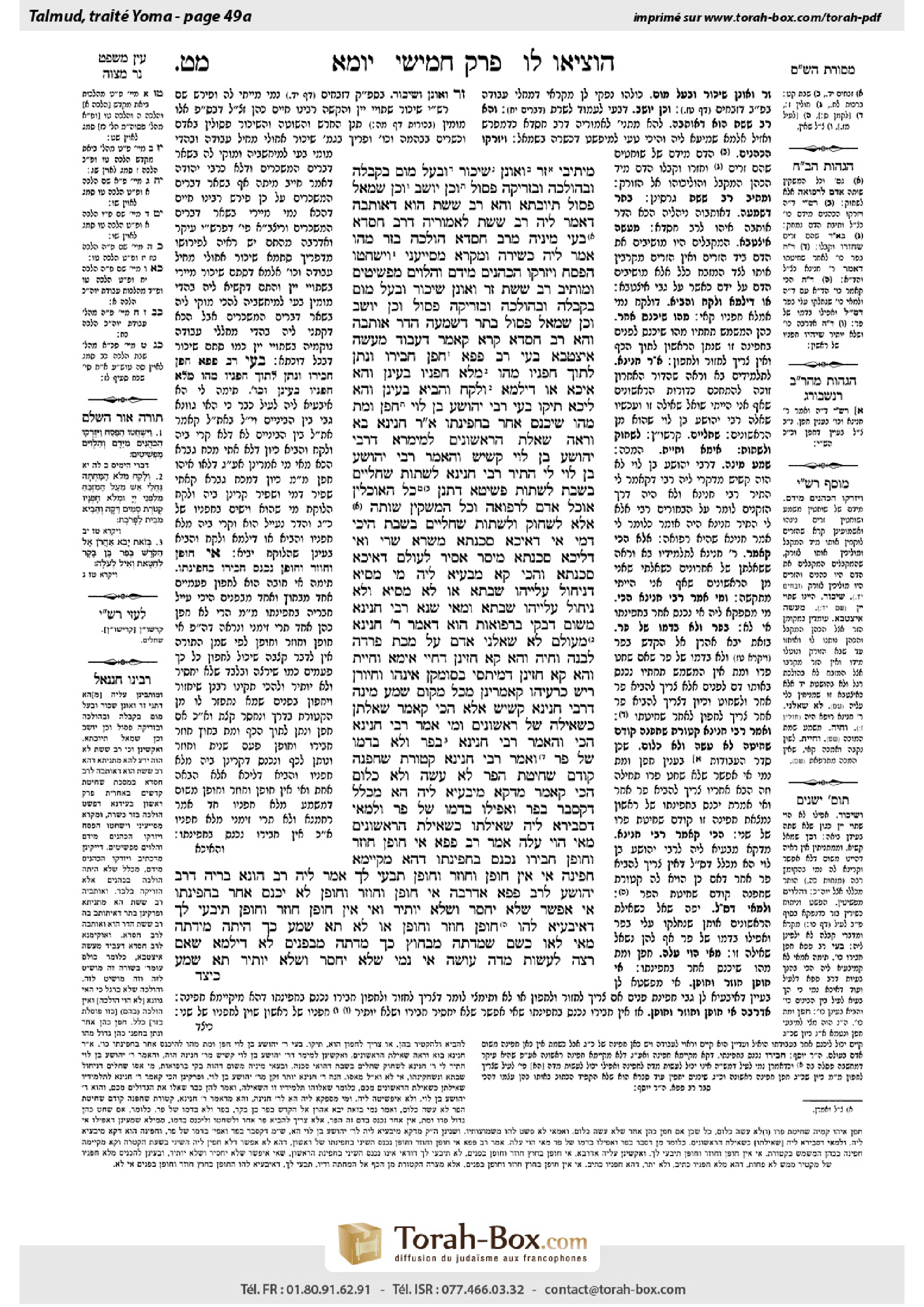
Yoma 49a: Talmud study for Daf Yomi
Daf Yomi is the daily study of one Talmud folio. Explore 37 tractates with scans, Hebrew text, Sefaria English and AI-generated French translations where annotated.
Passage selection and English or AI-generated French translation are available where the scan has annotations. Daf Study is independent of Torah-Box and Sefaria.
Browse Yoma · יומא · All tractatesYoma 49a text and translations
This page of Yoma includes the Aramaic text, an English translation and an AI-generated French translation, alongside the scan above.
יומא מ״ט א · Aramaic and Hebrew text
מֵיתִיבִי: זָר, וְאוֹנֵן, שִׁיכּוֹר, וּבַעַל מוּם, בְּקַבָּלָה וּבְהוֹלָכָה וּבִזְרִיקָה — פָּסוּל. וְכֵן יוֹשֵׁב, וְכֵן שְׂמֹאל — פָּסוּל! תְּיוּבְתָּא.
וְהָא רַב שֵׁשֶׁת הוּא דְּאוֹתְבַהּ, דַּאֲמַר לֵיהּ רַב שֵׁשֶׁת לְאָמוֹרֵיהּ דְּרַב חִסְדָּא, בְּעִי מִינֵּיהּ מֵרַב חִסְדָּא: הוֹלָכָה בְּזָר מַהוּ? אֲמַר לֵיהּ: כְּשֵׁירָה, וּמִקְרָא מְסַיְּיעֵנִי: ״וַיִּשְׁחֲטוּ הַפָּסַח וַיִּזְרְקוּ הַכֹּהֲנִים מִיָּדָם וְהַלְוִיִּם מַפְשִׁיטִים״!
וּמוֹתֵיב רַב שֵׁשֶׁת: זָר וְאוֹנֵן, שִׁיכּוֹר וּבַעַל מוּם, בְּקַבָּלָה וּבְהוֹלָכָה וּבִזְרִיקָה — פָּסוּל, וְכֵן יוֹשֵׁב וְכֵן שְׂמֹאל — פָּסוּל.
בָּתַר דְּשַׁמְעַהּ הֲדַר אוֹתְבַהּ. וְהָא רַב חִסְדָּא קְרָא קָאָמַר? דַּעֲבוּד מַעֲשֵׂה אִיצְטְבָא.
בָּעֵי רַב פָּפָּא: חָפַן חֲבֵירוֹ, וְנָתַן לְתוֹךְ חׇפְנָיו מַהוּ? ״מְלֹא חׇפְנָיו״ בָּעֵינַן, וְהָא אִיכָּא! אוֹ דִילְמָא: ״וְלָקַח״ ״וְהֵבִיא״ בָּעֵינַן? וְהָא לֵיכָּא! תֵּיקוּ.
בָּעֵי רַבִּי יְהוֹשֻׁעַ בֶּן לֵוִי: חָפַן וָמֵת, מַהוּ שֶׁיִּכָּנֵס אַחֵר בַּחֲפִינָתוֹ? אָמַר רַבִּי חֲנִינָא: בֹּא וּרְאֵה שְׁאֵלַת הָרִאשׁוֹנִים.
לְמֵימְרָא דְּרַבִּי יְהוֹשֻׁעַ בֶּן לֵוִי קַשִּׁישׁ? וְהָאָמַר רַבִּי יְהוֹשֻׁעַ בֶּן לֵוִי: לִי הִתִּיר רַבִּי חֲנִינָא לִשְׁתּוֹת שַׁחֲלַיִים בְּשַׁבָּת!
לִשְׁתּוֹת, פְּשִׁיטָא? דִּתְנַן: כׇּל הָאוֹכָלִין אוֹכֵל אָדָם לִרְפוּאָה, וְכׇל הַמַּשְׁקִין שׁוֹתֶה!
אֶלָּא: לִשְׁחוֹק וְלִשְׁתּוֹת שַׁחֲלַיִים בְּשַׁבָּת. הֵיכִי דָמֵי? אִי דְּאִיכָּא סַכַּנְתָּא — מִשְׁרָא שְׁרֵי. וְאִי דְּלֵיכָּא סַכַּנְתָּא — מֵיסָר אֲסִיר! לְעוֹלָם דְּאִיכָּא סַכַּנְתָּא, וְהָכִי קָא מִבַּעְיָא לֵיהּ: מִי מַסְּיָא, דְּנֵיחוּל עֲלַיְיהוּ שַׁבְּתָא, אוֹ לָא מַסְּיָא וְלָא נֵיחוּל עֲלַיְיהוּ שַׁבְּתָא.
וּמַאי שְׁנָא רַבִּי חֲנִינָא? מִשּׁוּם דְּבָקִי בִּרְפוּאוֹת הוּא. דְּאָמַר רַבִּי חֲנִינָא: מֵעוֹלָם לֹא שְׁאָלַנִי אָדָם עַל מַכַּת פִּרְדָּה לְבָנָה וְחָיָה.
וְהָא קָא חָזֵינַן דְּחַיֵּי! אֵימָא: וְחָיָית. וְהָא קָא חָזֵינַן דְּמִיתַּסִּי! בְּסוּמָּקָן אִינְהוּ וְחִיוָּרָן רֵישׁ כַּרְעַיְהוּ קָאָמְרִינַן.
מִכׇּל מָקוֹם, שְׁמַע מִינַּהּ דְּרַבִּי חֲנִינָא קַשִּׁישׁ? אֶלָּא הָכִי קָאָמַר: שְׁאֵלָתָן כִּשְׁאֵילָה שֶׁל רִאשׁוֹנִים.
וּמֵי אָמַר רַבִּי חֲנִינָא הָכִי? וְהָאָמַר רַבִּי חֲנִינָא: ״בְּפַר״, וְלֹא בְּדָמוֹ שֶׁל פַּר.
וְאָמַר רַבִּי חֲנִינָא: קְטוֹרֶת שֶׁחֲפָנָהּ קוֹדֶם שְׁחִיטַת הַפָּר לֹא עָשָׂה וְלֹא כְלוּם!
הָכִי קָאָמַר: מִדְּקָא מִיבַּעְיָא לֵיהּ, הָא מִכְּלָל דְּקָסָבַר ״בְּפַר״, וַאֲפִילּוּ בְּדָמוֹ שֶׁל פַּר. וּלְמַאי דִּסְבִירָא לֵיהּ — שְׁאִילָתוֹ כִּשְׁאֵילַת הָרִאשׁוֹנִים.
מַאי הָוֵי עֲלַהּ? אָמַר רַב פָּפָּא: אִי חוֹפֵן חוֹזֵר וְחוֹפֵן — חֲבֵירוֹ נִכְנָס בַּחֲפִינָתוֹ — דְּהָא מִקַּיְימָא חֲפִינָה. אִי אֵין חוֹפֵן וְחוֹזֵר וְחוֹפֵן — תִּבְּעֵי לָךְ.
אֲמַר לֵיהּ רַב הוּנָא בְּרֵיהּ דְּרַב יְהוֹשֻׁעַ לְרַב פָּפָּא: אַדְּרַבָּה, אִי חוֹפֵן וְחוֹזֵר וְחוֹפֵן, לֹא יִכָּנֵס אַחֵר בַּחֲפִינָתוֹ — אִי אֶפְשָׁר שֶׁלֹּא יְחַסֵּר וְשֶׁלֹּא יוֹתִיר. וְאִי אֵין חוֹפֵן חוֹזֵר וְחוֹפֵן — תִּיבְּעֵי לָךְ.
דְּאִיבַּעְיָא לְהוּ: חוֹפֵן חוֹזֵר וְחוֹפֵן, אוֹ לָא? תָּא שְׁמַע: כָּךְ הָיְתָה מִידָּתָהּ. מַאי לָאו: כְּשֵׁם שֶׁמִּדָּתָהּ מִבַּחוּץ כָּךְ מִדָּתָהּ מִבִּפְנִים!
לָא, דִּילְמָא שֶׁאִם רָצָה לַעֲשׂוֹת מִדָּה — עוֹשֶׂה, אִי נָמֵי: שֶׁלֹּא יְחַסֵּר וְשֶׁלֹּא יוֹתִיר.
תָּא שְׁמַע:
Yoma 49a · English translation
The Gemara raises an objection from a baraita: With regard to receiving, carrying, or sprinkling blood, if a non-priest, a mourner on his first day of mourning, a drunk priest, and a blemished priest, performed the rite, it is disqualified. And likewise if the priest was sitting, and likewise if he performed one of these rites with his left hand, it is disqualified. This statement contradicts the ruling of Rav Sheshet. The Gemara concludes: This is indeed a conclusive refutation, and Rav Sheshet’s opinion is rejected.
The Gemara asks: But wasn’t Rav Sheshet the one who objected on the basis of this very baraita? As Rav Sheshet said to the interpreter of Rav Ḥisda: Raise the following dilemma before Rav Ḥisda: What is the halakha with regard to carrying the blood performed by a non-priest? He said to him: It is valid, and a verse supports me: “And they slaughtered the Paschal offering and the priests sprinkled with their hand, and the Levites flayed” (II Chronicles 35:11). This verse indicates that the priests took the blood from the hands of the Levites, from which it can be inferred that the Levites carried the blood from the place of slaughtering to the place of sprinkling.
And Rav Sheshet objected based on the aforementioned baraita: With regard to receiving, carrying, or sprinkling blood, if a non-priest, a mourner on his first day of mourning, a drunk priest, and a blemished priest, performed the rite, it is disqualified. This statement proves that carrying cannot be performed by a non-priest. Since Rav Sheshet himself cited this baraita in his objection, he was certainly familiar with it. How, then, could he issue a ruling in contradiction to the baraita?
The Gemara explains: After Rav Sheshet heard the baraita that was cited against his opinion, he objected to the ruling of Rav Ḥisda from that same baraita. At first Rav Sheshet was unaware of the baraita, which is why he ruled against it, but when he learned it, he relied upon it to object to Rav Ḥisda’s statement. The Gemara asks: But didn’t Rav Ḥisda cite a verse in support of his opinion? How can a baraita contradict a verse? The Gemara answers: The verse does not mean that the Levites walked with the blood, but rather that they acted like benches and merely stood holding the bowls of blood in their hands.
§ The Gemara returns to the issue of appropriate methods for taking handfuls of incense. Rav Pappa raised a dilemma: What is the halakha with regard to a case where another priest scooped and placed the incense into the hands of the High Priest? The Gemara clarifies the two sides of the question: Do we require: “His full hands,” and that is fulfilled here, as in practice the High Priest has a handful of incense? Or perhaps we require that the High Priest must fulfill the mitzvot: “And he shall take…and he shall bring” (Leviticus 16:12), and that is not the case here, as the High Priest did not scoop and take the incense himself? This question was also left unanswered, and the Gemara concludes: Let it stand unresolved.
§ Rabbi Yehoshua ben Levi raised a dilemma: If the High Priest scooped and died, what is the halakha with regard to the possibility that another High Priest may replace him and enter with his handful? May the second priest enter the Holy of Holies with the incense that the first priest scooped, or must he start from the beginning of the process? Rabbi Ḥanina said to his students in excitement: Come and see that Sages from a later generation were able to ask a difficult question on par with the question of the earlier generations. Even I, Rabbi Ḥanina, asked this same question, which was posed by my elder, Rabbi Yehoshua ben Levi.
The Gemara analyzes this comment: Is that to say that Rabbi Yehoshua ben Levi was older than Rabbi Ḥanina, which is why Rabbi Ḥanina referred to him as an early Sage? But didn’t Rabbi Yehoshua ben Levi say: Rabbi Ḥanina permitted me to drink cress juice on Shabbat for medicinal purposes. Rabbi Yehoshua ben Levi’s deference to Rabbi Ḥanina shows that Rabbi Ḥanina was older than him.
Since it has been raised, the Gemara addresses the issue of cress juice on Shabbat: Did Rabbi Ḥanina permit him to drink cress juice? It is obvious that it is permitted to drink this juice; why would it be prohibited? As we learned in a mishna: All types of food that healthy people eat may be eaten by people even for medicinal purposes, and one may likewise drink all drinks for medicinal purposes, as the Sages did not include these in their decree against taking medicine on Shabbat.
Rather, Rabbi Yehoshua ben Levi’s question was: Is it permitted to grind and drink cress on Shabbat? The Gemara asks: What are the circumstances? If it involves a situation where there is danger to life, and this is the prescribed cure, it is certainly permitted; and if it is a case where there is no danger, it is prohibited as labor on Shabbat. The Gemara answers: Actually, the question concerns a case where there is a life-threatening danger, and this is the dilemma that he raised before him: Does this drink heal, which would mean that it is appropriate to violate Shabbat for it, or does it not heal, and therefore one should not violate Shabbat for it?
The Gemara asks: And if this was not a halakhic question but a medical one, what is different about this question that led him to ask it specifically of Rabbi Ḥanina? The Gemara explains: Rabbi Yehoshua ben Levi asked Rabbi Ḥanina because he is an expert in medicines, as Rabbi Ḥanina said: No man ever consulted me about a wound inflicted by a white mule and recovered. This shows that people came to Rabbi Ḥanina for medical advice.
The Gemara expresses surprise at this claim: But we see that people who are kicked by mules do survive. The Gemara answers that instead it should say: No man ever consulted me about a wound of this kind and the wound survives, i.e., the wound never heals. The Gemara challenges this statement as well: But we see that it does heal. The Gemara responds: We say that the wound will never heal only when the mules are red and the tops of their legs are white.
The Gemara returns to its previous question. In any event, one can learn from this discussion that Rabbi Ḥanina was older than Rabbi Yehoshua ben Levi. Why, then, does Rabbi Ḥanina refer to Rabbi Yehoshua ben Levi as a member of an earlier generation? Rather, we must explain that this is what he said, i.e., that Rabbi Ḥanina’s statement should be understood as follows: Their question is like the question of the early ones. In other words, Rabbi Ḥanina meant that this question, posed by a member of a later generation, is as difficult as that of the early Sages.
The Gemara asks: And did Rabbi Ḥanina actually say that this question, of one High Priest using the incense scooped by another, was difficult to answer? But didn’t Rabbi Ḥanina say: “With this Aaron shall come into the sacred place, with a bull” (Leviticus 16:3); this means that the High Priest must enter with the offering of a bull and not with the blood of the bull? In other words, the High Priest himself must slaughter his bull. Should a different priest slaughter the bull, receive its blood, and then die, the priest who replaces him may not enter the Holy of Holies with the blood of the bull slaughtered by his predecessor. Instead, he must bring a new bull, slaughter it, collect its blood, and take that blood inside.
And likewise, Rabbi Ḥanina said: If the priest scooped the incense before the slaughtering of the bull, he did nothing, as the handful of incense must be taken after the slaughter of the bull. If so, in accordance with the opinion of Rabbi Ḥanina, it is impossible for a priest to enter the Sanctuary with the handful taken by his fellow priest. The reason is that if the first priest died after the handful was taken, he certainly has not yet entered with the blood he collected from the bull. Consequently, his slaughter was not effective for the substitute priest, who must repeat the entire service from the slaughter onward.
The Gemara explains that this is what Rabbi Ḥanina said: From the fact that Rabbi Yehoshua ben Levi raised this dilemma, it can be understood by inference that he holds that the verse “with a bull” means that the High Priest may enter the Holy of Holies even with the blood of a bull. This means that the second priest does not have to go back and slaughter a second bull. And according to that which Rabbi Yehoshua ben Levi maintains, his question is like the question of the earlier generations. Although the question does not arise according to the opinion of Rabbi Ḥanina himself, according to the ruling of Rabbi Yehoshua ben Levi, the question is indeed a difficult one.
The Gemara asks: What halakhic conclusion was reached about this matter? What in fact is the ruling in a situation where the High Priest took a handful of incense and then died? May the newly appointed High Priest use the handful that has already been scooped, or does he require a new handful? Rav Pappa said: The resolution of this question depends on a different problem. If the High Priest scoops the handful when he takes the incense from the coal pan, and again scoops a handful in the Holy of Holies, this would mean that another priest may enter with the handful of the first High Priest, as the mitzva of scooping the handful has been fulfilled. However, if the High Priest does not scoop and again scoop, let the dilemma be raised.
Rav Huna, son of Rav Yehoshua, said to Rav Pappa: On the contrary, if the High Priest scoops and again scoops, another priest should not be permitted to enter with his handful, as it is impossible that the new handful will be neither less nor more than the amount of the first handful, which means the handful will not have been taken properly. But conversely, if he does not scoop and again scoop, let the dilemma be raised, as the mitzva of taking a handful has already been fulfilled by the first priest, and the second priest has merely to place the incense on the coals.
The Gemara explains the background to this problem. As a dilemma was raised before the Sages: Does the High Priest scoop a handful from the incense once and again scoop a handful a second time in the Holy of Holies, or does he not scoop a second time? The Gemara suggests: Come and hear a resolution to this dilemma from the mishna: This was the measure of the spoon. What, is it not correct to infer from the mishna that just as its measure is on the outside, so is its measure on the inside, i.e., there is no need to scoop another handful, as this is its fixed measure that he pours onto the coal pan.
The Gemara rejects this suggestion: No, that is not necessarily the correct interpretation of the mishna. Perhaps it means that if he wants to measure a precise amount for his handful, he may measure with a utensil for this purpose. Alternatively, it could mean that he may take neither less nor more than the measure he initially took. Consequently, there is no proof from the mishna with regard to whether the High Priest must scoop a second handful.
The Gemara further suggests: Come and hear a resolution to this dilemma from a baraita:
Yoma 49a · Traduction française (IA)
La Guemara soulève une objection à partir d’une baraïta : si un non-prêtre, un endeuillé le premier jour de son deuil, un prêtre ivre ou un prêtre atteint d’une infirmité accomplit le rite de réception, de transport ou d’aspersion du sang, le rite est invalide. Il en va de même si le prêtre était assis ou s’il a accompli l’un de ces rites de la main gauche. Cette déclaration contredit la décision de Rav Chéchet. La Guemara conclut : il s’agit bien d’une réfutation définitive, et l’opinion de Rav Chéchet est rejetée.
La Guemara demande : Mais Rav Chéchet n’est-il pas celui qui a objecté en s’appuyant précisément sur cette baraïta ? En effet, Rav Chéchet dit à l’interprète de Rav Ḥisda : « Présente à Rav Ḥisda le dilemme suivant : quelle est la halakha concernant le transport du sang par un non-prêtre ? » Celui-ci lui répondit : « C’est valide, et un verset appuie mon opinion : “On égorgea le sacrifice pascal, les prêtres firent l’aspersion de leur main et les Lévites écorchèrent” (II Chroniques 35, 11). » Ce verset indique que les prêtres prirent le sang des mains des Lévites ; on peut en déduire que les Lévites transportèrent le sang du lieu de l’égorgement jusqu’au lieu de l’aspersion.
Et Rav Chéchet objecta en s’appuyant sur la baraïta susmentionnée : si un non-prêtre, un endeuillé le premier jour de son deuil, un prêtre ivre ou un prêtre atteint d’une infirmité accomplit le rite de réception, de transport ou d’aspersion du sang, le rite est invalide. Cette déclaration prouve que le transport ne peut pas être effectué par un non-prêtre. Puisque Rav Chéchet a lui-même cité cette baraïta dans son objection, il la connaissait certainement. Comment a-t-il donc pu rendre une décision contraire à la baraïta ?
La Guemara explique : après avoir entendu la baraïta invoquée contre son opinion, Rav Chéchet objecta à la décision de Rav Ḥisda en s’appuyant sur cette même baraïta. Auparavant, Rav Chéchet ignorait l’existence de la baraïta, ce qui explique qu’il ait statué à son encontre ; mais lorsqu’il en prit connaissance, il s’en servit pour objecter à la déclaration de Rav Ḥisda. La Guemara demande : Mais Rav Ḥisda n’a-t-il pas cité un verset à l’appui de son opinion ? Comment une baraïta peut-elle contredire un verset ? La Guemara répond : Le verset ne signifie pas que les Lévites marchaient en transportant le sang, mais plutôt qu’ils faisaient office de supports et se tenaient simplement là, tenant dans leurs mains les coupes contenant le sang.
§ La Guemara revient à la question des méthodes appropriées pour prélever des poignées d’encens. Rav Pappa soulève un dilemme : quelle est la halakha dans le cas où un autre prêtre a prélevé l’encens et l’a déposé dans les mains du Grand Prêtre ? La Guemara précise les deux aspects de la question : exige-t-on « ses mains pleines », condition satisfaite ici, puisque, en pratique, le Grand Prêtre a une poignée d’encens ? Ou bien exige-t-on que le Grand Prêtre accomplisse lui-même les mitsvot : « Et il prendra… et il apportera » (Lévitique 16, 12), ce qui n’est pas le cas ici, puisque le Grand Prêtre n’a pas lui-même prélevé et pris l’encens ? Cette question est elle aussi restée sans réponse, et la Guemara conclut : qu’elle reste en suspens.
§ Rabbi Yehoshua ben Levi soulève un dilemme : si le Grand Prêtre a prélevé l’encens puis est mort, quelle est la halakha quant à la possibilité qu’un autre Grand Prêtre le remplace et entre avec la poignée qu’il a prélevée ? Le second prêtre peut-il entrer dans le Saint des Saints avec l’encens prélevé par le premier, ou doit-il reprendre le processus depuis le début ? Rabbi Ḥanina dit avec enthousiasme à ses élèves : « Venez voir : des Sages d’une génération ultérieure ont pu poser une question difficile, à la mesure de celle des générations antérieures. Moi aussi, Rabbi Ḥanina, j’ai posé cette même question, soulevée par mon aîné, Rabbi Yehoshua ben Levi. »
La Guemara analyse cette remarque : faut-il en déduire que Rabbi Yehoshua ben Levi était plus âgé que Rabbi Ḥanina, raison pour laquelle Rabbi Ḥanina le désigne comme un Sage des premières générations ? Mais Rabbi Yehoshua ben Levi n’a-t-il pas dit : « Rabbi Ḥanina m’a autorisé à boire du jus de cresson le Chabbat à des fins médicinales » ? La déférence de Rabbi Yehoshua ben Levi envers Rabbi Ḥanina montre que Rabbi Ḥanina était plus âgé que lui.
Puisque cette question a été soulevée, la Guemara traite du jus de cresson le Chabbat : Rabbi Ḥanina lui a-t-il vraiment permis d’en boire ? Il est évident qu’il est permis de boire ce jus ; pourquoi serait-ce interdit ? En effet, nous avons appris dans une Michna : on peut manger toutes sortes d’aliments que les personnes en bonne santé mangent, même à des fins médicinales, et on peut également boire toutes sortes de boissons à des fins médicinales, car les Sages ne les ont pas incluses dans leur décret interdisant la prise de médicaments le Chabbat.
La question de Rabbi Yehoshua ben Levi était plutôt : est-il permis de piler du cresson et de le boire le Chabbat ? La Guemara demande : Dans quelles circonstances ? S’il y a danger de mort et que c’est le remède prescrit, c’est certainement permis ; s’il n’y a pas de danger, c’est interdit, car cela constitue un travail le Chabbat. La Guemara répond : En réalité, la question porte sur un cas où il y a danger de mort, et voici le dilemme qu’il lui a présenté : cette boisson guérit-elle, auquel cas il convient de transgresser le Chabbat pour la prendre, ou ne guérit-elle pas, auquel cas il ne faut pas transgresser le Chabbat pour elle ?
La Guemara demande : Et si ce n’était pas une question de halakha, mais une question médicale, qu’y avait-il de particulier dans cette question pour qu’il la pose précisément à Rabbi Ḥanina ? La Guemara explique : Rabbi Yehoshua ben Levi interrogea Rabbi Ḥanina parce que celui-ci était expert en remèdes, comme le montre cette déclaration de Rabbi Ḥanina : « Aucun homme ne m’a jamais consulté au sujet d’une blessure infligée par une mule blanche et n’a guéri. » Cela montre que les gens venaient demander à Rabbi Ḥanina des conseils médicaux.
La Guemara exprime son étonnement devant cette affirmation : pourtant, nous voyons que des personnes frappées par des mules survivent. La Guemara répond qu’il faudrait plutôt dire : « Aucun homme ne m’a jamais consulté au sujet d’une blessure de ce genre sans que la blessure ne survive », c’est-à-dire que la blessure ne guérit jamais. La Guemara conteste également cette déclaration : pourtant, nous voyons que la blessure guérit. La Guemara répond : nous disons que la blessure ne guérira jamais uniquement lorsque les mules sont rousses et que le haut de leurs pattes est blanc.
La Guemara revient à sa question précédente. Quoi qu’il en soit, on peut déduire de cette discussion que Rabbi Ḥanina était plus âgé que Rabbi Yehoshua ben Levi. Pourquoi Rabbi Ḥanina désigne-t-il donc Rabbi Yehoshua ben Levi comme appartenant à une génération antérieure ? Il faut plutôt expliquer qu’il voulait dire ceci, autrement dit, que sa déclaration doit se comprendre ainsi : « Leur question est à la mesure de celle des premiers. » Rabbi Ḥanina voulait dire que cette question, posée par un membre d’une génération ultérieure, est aussi difficile que celle des premiers Sages.
La Guemara demande : Rabbi Ḥanina a-t-il vraiment dit que cette question — celle de savoir si un Grand Prêtre peut utiliser l’encens prélevé par un autre — était difficile à résoudre ? Mais Rabbi Ḥanina n’a-t-il pas dit : « C’est avec un taureau qu’Aaron entrera dans le lieu sacré » (Lévitique 16, 3) ? Cela signifie que le Grand Prêtre doit entrer avec l’offrande d’un taureau, et non avec le sang du taureau. Autrement dit, le Grand Prêtre doit lui-même égorger son taureau. Si un autre prêtre égorge le taureau, en recueille le sang, puis meurt, le prêtre qui le remplace ne peut pas entrer dans le Saint des Saints avec le sang du taureau égorgé par son prédécesseur. Il doit plutôt apporter un nouveau taureau, l’égorger, en recueillir le sang et porter ce sang à l’intérieur.
De même, Rabbi Ḥanina a dit : si le prêtre a prélevé l’encens avant l’égorgement du taureau, il n’a rien fait, car la poignée d’encens doit être prélevée après l’égorgement du taureau. Selon l’opinion de Rabbi Ḥanina, il est donc impossible qu’un prêtre entre dans le Sanctuaire avec la poignée prélevée par son collègue. En effet, si le premier prêtre est mort après avoir prélevé la poignée, il n’est certainement pas encore entré avec le sang qu’il a recueilli du taureau. Par conséquent, son égorgement n’est pas valable pour le prêtre qui le remplace, lequel doit reprendre tout le service à partir de l’égorgement.
La Guemara explique que voici ce qu’a dit Rabbi Ḥanina : du fait que Rabbi Yehoshua ben Levi a soulevé ce dilemme, on peut déduire qu’il considère que l’expression du verset « avec un taureau » signifie que le Grand Prêtre peut entrer dans le Saint des Saints même avec le sang d’un taureau. Cela signifie que le second prêtre n’a pas à revenir pour égorger un second taureau. Selon Rabbi Yehoshua ben Levi, sa question est à la mesure de celles des générations antérieures. Bien que cette question ne se pose pas selon l’opinion de Rabbi Ḥanina lui-même, elle est effectivement difficile selon la décision de Rabbi Yehoshua ben Levi.
La Guemara demande : quelle conclusion halakhique a-t-on tirée à ce sujet ? Quelle est en fait la décision dans le cas où le Grand Prêtre a prélevé une poignée d’encens, puis est mort ? Le Grand Prêtre nouvellement nommé peut-il utiliser la poignée déjà prélevée, ou lui en faut-il une nouvelle ? Rav Pappa a dit : la résolution de cette question dépend d’un autre problème. Si le Grand Prêtre prélève la poignée lorsqu’il prend l’encens dans le brasero, puis en prélève une autre dans le Saint des Saints, cela signifierait qu’un autre prêtre peut entrer avec la poignée du premier Grand Prêtre, puisque la mitsva du prélèvement de la poignée a été accomplie. Cependant, si le Grand Prêtre ne prélève pas une seconde poignée, que le dilemme soit soulevé.
Rav Houna, fils de Rav Yehoshua, dit à Rav Pappa : au contraire, si le Grand Prêtre prélève une poignée puis en prélève une autre, un autre prêtre ne devrait pas être autorisé à entrer avec sa poignée, car il est impossible que la nouvelle poignée soit exactement de la même quantité que la première, ni moindre ni supérieure ; la poignée n’aura donc pas été prélevée correctement. À l’inverse, s’il ne prélève pas une seconde poignée, que le dilemme soit soulevé, car le premier prêtre a déjà accompli la mitsva de prélever une poignée, et le second prêtre n’a qu’à déposer l’encens sur les braises.
La Guemara explique le contexte de ce problème. Les Sages ont soulevé le dilemme suivant : le Grand Prêtre prélève-t-il une poignée d’encens, puis en prélève-t-il une seconde dans le Saint des Saints, ou n’effectue-t-il pas de second prélèvement ? La Guemara propose : « Venez et écoutez » une réponse à ce dilemme tirée de la Michna : « Telle était la mesure de la cuillère. » N’est-il pas juste d’en déduire que la mesure est la même à l’extérieur et à l’intérieur, c’est-à-dire qu’il n’est pas nécessaire de prélever une autre poignée, puisqu’il s’agit de sa mesure fixe, qu’il verse sur le brasero ?
La Guemara rejette cette proposition : non, ce n’est pas nécessairement ainsi qu’il faut interpréter la Michna. Peut-être signifie-t-elle que, s’il veut mesurer une quantité précise pour sa poignée, il peut le faire à l’aide d’un ustensile prévu à cet effet. Ou bien elle pourrait signifier qu’il ne peut prendre ni moins ni plus que la mesure qu’il a prélevée au départ. Par conséquent, la Michna ne permet pas de déterminer si le Grand Prêtre doit prélever une seconde poignée.
La Guemara propose encore : « Venez et écoutez » une réponse à ce dilemme tirée d’une baraïta :
Traduction française générée par IA à partir de l’édition anglaise de Sefaria. Vérifie toujours un passage avec le texte source.
Text from Sefaria: William Davidson Edition - Vocalized Aramaic (CC BY NC); William Davidson Edition - English (CC BY NC).