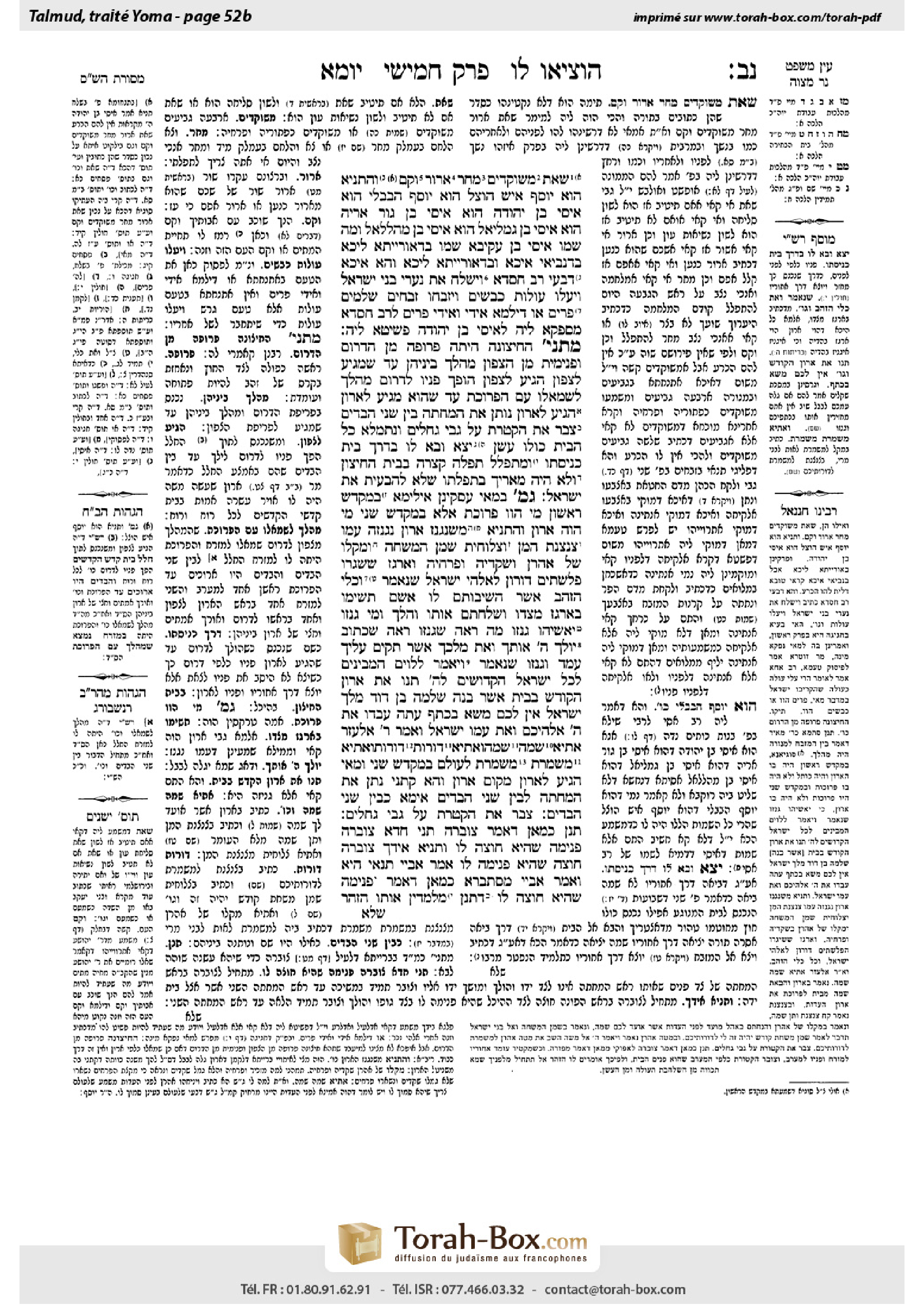
Yoma 52b: Talmud study for Daf Yomi
Daf Yomi is the daily study of one Talmud folio. Explore 37 tractates with scans, Hebrew text, Sefaria English and AI-generated French translations where annotated.
Passage selection and English or AI-generated French translation are available where the scan has annotations. Daf Study is independent of Torah-Box and Sefaria.
Browse Yoma · יומא · All tractatesYoma 52b text and translations
This page of Yoma includes the Aramaic text, an English translation and an AI-generated French translation, alongside the scan above.
יומא נ״ב ב · Aramaic and Hebrew text
״שְׂאֵת״.
״מְשׁוּקָּדִים״.
״מָחָר״.
״אָרוּר״.
״וְקָם״.
וְהָתַנְיָא: הוּא יוֹסֵף אִישׁ הוּצָל, הוּא יוֹסֵף הַבַּבְלִי, הוּא אִיסִי בֶּן יְהוּדָה, הוּא אִיסִי בֶּן גּוּר אַרְיֵה, הוּא אִיסִי בֶּן גַּמְלִיאֵל, הוּא אִיסִי בֶּן מַהֲלַלְאֵל, וּמָה שְׁמוֹ — אִיסִי בֶּן עֲקִיבָא שְׁמוֹ. בִּדְאוֹרָיְיתָא — לֵיכָּא, בְּדִנְבִיאֵי — אִיכָּא.
וּבִדְאוֹרָיְיתָא לֵיכָּא? וְהָא אִיכָּא דְּבָעֵי רַב חִסְדָּא: ״וַיִּשְׁלַח אֶת נַעֲרֵי בְּנֵי יִשְׂרָאֵל וַיַּעֲלוּ עוֹלוֹת כְּבָשִׂים וַיִּזְבְּחוּ זְבָחִים שְׁלָמִים פָּרִים״ — אוֹ דִילְמָא אִידֵּי וְאִידֵּי פָּרִים! לְרַב חִסְדָּא מְסַפְּקָא לֵיהּ, לְאִיסִי בֶּן יְהוּדָה פְּשִׁיטָא לֵיהּ.
מַתְנִי׳ הַחִיצוֹנָה הָיְתָה פְּרוּפָה מִן הַדָּרוֹם, וּפְנִימִית מִן הַצָּפוֹן. מְהַלֵּךְ בֵּינֵיהֶן, עַד שֶׁמַּגִּיעַ לַצָּפוֹן. הִגִּיעַ לַצָּפוֹן — הוֹפֵךְ פָּנָיו לַדָּרוֹם, מְהַלֵּךְ לִשְׂמֹאלוֹ עִם הַפָּרוֹכֶת עַד שֶׁהוּא מַגִּיעַ לָאָרוֹן,
הִגִּיעַ לָאָרוֹן — נוֹתֵן אֶת הַמַּחְתָּה בֵּין שְׁנֵי הַבַּדִּים. צָבַר אֶת הַקְּטֹרֶת עַל גַּבֵּי גֶּחָלִים, וְנִתְמַלֵּא כָּל הַבַּיִת כּוּלּוֹ עָשָׁן. יָצָא וּבָא לוֹ בְּדֶרֶךְ בֵּית כְּנִיסָתוֹ, וּמִתְפַּלֵּל תְּפִלָּה קְצָרָה בַּבַּיִת הַחִיצוֹן. וְלֹא הָיָה מַאֲרִיךְ בִּתְפִלָּתוֹ, שֶׁלֹּא לְהַבְעִית אֶת יִשְׂרָאֵל.
גְּמָ׳ בְּמַאי עָסְקִינַן? אִילֵימָא בְּמִקְדָּשׁ רִאשׁוֹן, מִי הֲווֹ פָּרוֹכֶת? אֶלָּא בְּמִקְדָּשׁ שֵׁנִי, מִי הֲוָה אָרוֹן?
וְהָתַנְיָא: מִשֶּׁנִּגְנַז אָרוֹן — נִגְנְזָה עִמּוֹ צִנְצֶנֶת הַמָּן, וּצְלוֹחִית שֶׁמֶן הַמִּשְׁחָה, וּמַקְלוֹ שֶׁל אַהֲרֹן וּשְׁקֵדֶיהָ וּפְרָחֶיהָ, וְאַרְגַּז שֶׁשִּׁגְּרוּ פְּלִשְׁתִּים דּוֹרוֹן לֵאלֹהֵי יִשְׂרָאֵל, שֶׁנֶּאֱמַר: ״וּכְלֵי הַזָּהָב אֲשֶׁר הֲשֵׁיבוֹתֶם לוֹ אָשָׁם תָּשִׂימוּ בָאַרְגַּז מִצִּדּוֹ וְשִׁלַּחְתֶּם אוֹתוֹ וְהָלָךְ״.
וּמִי גְּנָזוֹ — יֹאשִׁיָּהוּ גְּנָזוֹ. מָה רָאָה שֶׁגְּנָזוֹ? רָאָה שֶׁכָּתוּב: ״יוֹלֵךְ ה׳ אוֹתְךָ וְאֶת מַלְכְּךָ אֲשֶׁר תָּקִים עָלֶיךָ״, עָמַד וּגְנָזוֹ.
שֶׁנֶּאֱמַר: ״וַיֹּאמֶר לַלְוִיִּם הַמְּבִינִים לְכׇל יִשְׂרָאֵל הַקְּדוֹשִׁים לַה׳ תְּנוּ אֶת אֲרוֹן הַקּוֹדֶשׁ בַּבַּיִת אֲשֶׁר בָּנָה שְׁלֹמֹה בֶן דָּוִד מֶלֶךְ יִשְׂרָאֵל אֵין לָכֶם מַשָּׂא בַּכָּתֵף עַתָּה עִבְדוּ אֶת ה׳ אֱלֹהֵיכֶם וְאֵת עַמּוֹ יִשְׂרָאֵל״.
וְאָמַר רַבִּי אֶלְעָזָר: אָתְיָא ״שָׁמָּה״ ״שָׁמָּה״, וְאָתְיָא ״דּוֹרוֹת״ ״דּוֹרוֹת״.
וְאָתְיָא ״מִשְׁמֶרֶת״ ״מִשְׁמֶרֶת״.
לְעוֹלָם בְּמִקְדָּשׁ שֵׁנִי, וּמַאי ״הִגִּיעַ לָאָרוֹן״ — מְקוֹם אָרוֹן. וְהָא קָתָנֵי: נָתַן אֶת הַמַּחְתָּה לְבֵין שְׁנֵי הַבַּדִּים! אֵימָא: ״כְּבֵין שְׁנֵי הַבַּדִּים״.
צָבַר אֶת הַקְּטֹרֶת עַל גַּבֵּי גֶּחָלִים. תְּנַן כְּמַאן דְּאָמַר צוֹבְרָהּ. תָּנֵי חֲדָא: צוֹבְרָהּ פְּנִימָה שֶׁהִיא חוּצָה לוֹ. וְתַנְיָא אִידַּךְ: צוֹבְרָהּ חוּצָה שֶׁהִיא פְּנִימָה לוֹ.
אָמַר אַבָּיֵי: תַּנָּאֵי הִיא. וְאָמַר אַבָּיֵי: מִסְתַּבְּרָא כְּמַאן דְּאָמַר פְּנִימָה שֶׁהִיא חוּצָה לוֹ — דִּתְנַן, מְלַמְּדִין אוֹתוֹ: הִזָּהֵר
Yoma 52b · English translation
The first example is the term: “Se’et” (Genesis 4:7). It is unclear whether the verse should be read: “If you do well, shall it not be lifted up [se’et]?” in which case se’et involves forgiveness and pardon; or: “If you do well, but you will lift up [se’et] your sin if you do not do well.” According to this interpretation, se’et is referring to remembrance: If you do not do well, your sin will be remembered.
The second uncertain case is the term: “Meshukkadim” (Exodus 25:34). This verse can be read: “And in the candelabrum four cups made like almond blossoms [meshukkadim]”; or as: “Its knops and its flowers made like almond blossoms [meshukkadim].” In other words, the term meshukkadim can be read either with the first part or the last part of the verse.
Likewise, the term: “Maḥar” (Exodus 17:9) can be read: “And go out, fight with Amalek tomorrow [maḥar]”. Alternatively, it can mean that Joshua must go out to war with Amalek immediately, and Moses added: “Tomorrow [maḥar] I will stand on the top of the hill” (Exodus 17:9), but today you do not need my prayer. Once again, the issue is whether this term belongs to the beginning or the end of the verse.
The fourth case is the term: “Arur” (Genesis 49:7). This verse can be read: “Cursed [arur] be their anger for it was fierce, and their wrath for it was cruel,” on account of Levi and Simeon’s treatment of Shechem. Alternatively, this term, which appears at the beginning of the verse, can be read as the last word of the previous verse: “And in their anger they cut off cursed [arur] oxen” (Genesis 49:6–7). According to this interpretation, “cursed oxen” is referring to the oxen of Shechem, who descended from the accursed Canaan.
Finally, the term: “Vekam” (Deuteronomy 31:16) can be read as: “Behold, you are about to sleep with your fathers and rise up [vekam]” at the time of the resurrection of the dead; or: “And this people will rise up [vekam] and go astray.”
The Gemara explains the objection presented by this baraita. And wasn’t it taught in a baraita that Yosef of Hutzal is the one called Yosef the Babylonian, as Hutzal is a city in Babylonia; and he is also the person called Isi ben Yehuda, as Isi is a shortened form of Yosef; he is Isi ben Gur Arye, a nickname for Yehuda; he is Isi ben Gamliel; he is Isi ben Mahalalel? And what is his real name? Isi ben Akiva is his name. If they are indeed the same person, Isi ben Yehuda, who is Yosef of Hutzal, says that there are only five verses whose punctuation is unclear, whereas here he adds an additional verse. The Gemara explains: In the Torah itself, there are indeed no more than five verses, but in the Prophets there are more examples of equivocal punctuation, one of which is the verse from I Kings.
The Gemara raises a difficulty: And in the Torah itself, are there no other examples of indeterminate punctuation? But there is this dilemma that Rav Ḥisda raised with regard to the verse: “And he sent the young men of the children of Israel who sacrificed burnt-offerings” (Exodus 24:5); were these burnt-offerings sheep, and when the verse continues: “And sacrificed peace-offerings of bulls to the Lord,” these peace-offerings alone were bulls? Or perhaps these and these were bulls, as the word “bulls” is referring both to the burnt-offerings and the peace-offerings? This is another verse whose punctuation is unclear. The Gemara rejects this contention: This is not difficult; according to Rav Ḥisda it was uncertain how to read the verse, but the interpretation was obvious to Isi ben Yehuda.
MISHNA: The outer curtain between the Sanctuary and the Holy of Holies was hooked [perufa] slightly open on the south side of the Sanctuary, and the inner curtain hooked slightly open on the north side of the Sanctuary, and therefore the High Priest could not enter the Holy of Holies directly. Rather, he enters through the southern opening and walks between the curtains until he reaches the opening to the north. When he reaches the opening to the north, he enters the Holy of Holies through that opening, turns his face to the south, and walks to his left along the curtain until he reaches the area before the Ark.
When he reaches the Ark, he places the coal pan between the two staves. He piles the incense atop the coals, and the whole chamber in its entirety would fill with smoke. He then exits and comes out the way that he entered. He does not turn around but leaves the Holy of Holies walking while facing the Ark. And he recites a brief prayer in the outer chamber, in the Sanctuary. And he would not extend his prayer there so as not to alarm the Jewish people, who would otherwise conclude that something happened and that he died in the Holy of Holies.
GEMARA: The Gemara asks: With what are we dealing here? To which time period is the mishna referring? If we say it is speaking about the First Temple, were there curtains then? There was only one curtain over the one-cubit partition. Rather, if we say that the mishna is dealing with the Second Temple, was there an Ark there?
The Gemara elaborates: But wasn’t it taught in a baraita that when the Ark was buried, along with it was buried the jar of manna that was next to it, and the flask of oil used for anointing, and Aaron’s staff with its almonds and blossoms, and the chest that the Philistines sent as a gift [doron] to the God of Israel after they captured the Ark and were stricken by several plagues, as it is stated: “And put the jewels of gold that you return to Him for a guilt-offering, in a coffer by its side, and send it away that it may go” (I Samuel 6:8)?
§ And who buried the Ark? Josiah, king of Judea, buried it. And what did he see that he decided to bury it? He saw that it is written: “The Lord will bring you, and your king whom you shall set over you, to a nation that you have not known” (Deuteronomy 28:36). Since he knew that the Jewish people would ultimately be exiled, he felt it was better that the Ark should not be disgraced in exile, and therefore he arose and buried it.
The Gemara cites the source for the tradition that Josiah buried the Ark. As it is stated: “And he said to the Levites who taught all of Israel, who were sacred to the Lord: Put the sacred Ark in the house that Solomon, son of David, king of Israel, built. There shall no more be a burden upon your shoulders; now serve the Lord your God, and His people Israel” (I Chronicles 35:3). In other words, from now onward the Levites will no longer carry the Ark on their shoulders, and they should dedicate themselves to their service of singing and locking the gates of the Temple.
And Rabbi Elazar said: The matter is derived by means of a verbal analogy, as it is written with regard to the Ark: “That is by the Ark of the Testimony, before the Ark cover that is above the testimony, there will I meet with you” (Exodus 30:6), and it is written: “Take a jar and put a full omer of manna there, and place it before the Lord for safekeeping throughout your generations” (Exodus 16:33). And it is further derived by verbal analogy from the term “Generations” written here and “generations” written with regard to the oil used for anointing: “This shall be a sacred anointing oil for Me throughout your generations” (Exodus 30:31).
Rabbi Elazar continued: And it is likewise derived by verbal analogy from the term “safekeeping” stated here and “safekeeping” stated in connection to the staff of Aaron: “Place back the rod of Aaron before the testimony for safekeeping” (Numbers 17:25). These verbal analogies teach that all of these items were hidden together with the Ark. Evidently, there was no Ark in the Holy of Holies even before the First Temple period ended. How, then, can the mishna speak of the Ark during the Second Temple period?
The Gemara answers: Actually, the mishna is referring to the Second Temple, and what is the meaning of the phrase: Reaches the Ark? It means the place of the Ark. The Gemara raises a difficulty: But it is taught that he places the coal pan between the two staves, which indicates that the staves of the Ark were present. The Gemara answers: Emend the text and say: As though it was between the two staves, i.e., in the place where the staves had been located when the Ark was there.
§ The mishna taught: He piles the incense atop the coals. The Gemara comments: We learned in the mishna in accordance with the opinion of the one who said that he piles the incense on the coals and does not scatter it there. It was taught in one baraita: He piles the incense in the section of the coal pan closest to the Ark, which is farthest from the High Priest, until he reaches the other side of the coal pan. And it was taught in another baraita: He piles it in the section of the coal pan farthest from the Ark, which is closest to him.
Abaye said that this issue is a dispute between tanna’im. And Abaye said: It is reasonable to explain in accordance with the opinion of the one who said that he piles the incense in the section of the coal pan closest to the Ark, which is farthest from him. As we learned in a mishna that they would teach the priest who burns the incense: Be careful
Yoma 52b · Traduction française (IA)
Le premier exemple est le terme « Se’et » (Genèse 4:7). On ne sait pas s’il faut lire le verset ainsi : « Si tu agis bien, ne sera-t-il pas relevé [se’et] ? », auquel cas se’et implique le pardon et la rémission ; ou bien : « Si tu n’agis pas bien, tu porteras [se’et] ton péché. » Selon cette interprétation, se’et renvoie au souvenir : si tu n’agis pas bien, ton péché sera gardé en mémoire.
Le deuxième cas incertain concerne le terme « Meshukkadim » (Exode 25:34). Ce verset peut se lire : « Et sur le candélabre, quatre coupes en forme de fleurs d’amandier [meshukkadim] » ; ou bien : « Ses boutons et ses fleurs étaient en forme de fleurs d’amandier [meshukkadim]. » Autrement dit, le terme meshukkadim peut être rattaché soit à la première partie du verset, soit à la dernière.
De même, le terme « Maḥar » (Exode 17:9) peut se lire : « Sors et combats Amalek demain [maḥar]. » Il peut aussi signifier que Josué doit partir immédiatement combattre Amalek, et que Moïse a ajouté : « Demain [maḥar], je me tiendrai au sommet de la colline » (Exode 17:9), mais qu’aujourd’hui tu n’as pas besoin de ma prière. Là encore, la question est de savoir si ce terme se rattache au début ou à la fin du verset.
Le quatrième cas concerne le terme « Arur » (Genèse 49:7). On peut lire le verset ainsi : « Maudite [arur] soit leur colère, car elle fut violente, et leur fureur, car elle fut cruelle », en raison de la conduite de Lévi et de Siméon envers Sichem. On peut aussi rattacher ce terme, qui figure au début du verset, à la fin du verset précédent : « Dans leur colère, ils ont mutilé des taureaux maudits [arur] » (Genèse 49:6–7). Selon cette interprétation, les « taureaux maudits » désignent les taureaux de Sichem, qui descendaient de Canaan, le maudit.
Enfin, le terme « Vekam » (Deutéronome 31:16) peut se lire ainsi : « Voici, tu vas dormir avec tes pères et te relever [vekam] » au moment de la résurrection des morts ; ou bien : « Et ce peuple se lèvera [vekam] et se fourvoiera. »
La Guemara explique l’objection soulevée par cette baraïta. N’est-il pas enseigné dans une baraïta que Yosef de Houtzal est celui qu’on appelle Yosef le Babylonien, puisque Houtzal est une ville de Babylonie, et qu’il est aussi celui qu’on appelle Isi ben Yehouda, Isi étant une forme abrégée de Yosef ? Il est également appelé Isi ben Gur Arye, surnom de Yehouda, Isi ben Gamliel et Isi ben Mahalalel. Quel est son véritable nom ? Il s’appelle Isi ben Akiva. Si ce sont bien une seule et même personne, Isi ben Yehouda, qui est Yosef de Houtzal, affirme qu’il n’y a que cinq versets dont la ponctuation est incertaine, alors qu’ici il en ajoute un autre. La Guemara explique : dans la Torah elle-même, il n’y a effectivement pas plus de cinq versets, mais les Prophètes contiennent d’autres exemples de ponctuation équivoque, dont le verset du Premier Livre des Rois.
La Guemara soulève une difficulté : dans la Torah elle-même, n’y a-t-il pas d’autres exemples de ponctuation indéterminée ? Rav Ḥisda a pourtant soulevé une question au sujet du verset : « Il envoya les jeunes gens des enfants d’Israël, qui offrirent des holocaustes » (Exode 24:5) : ces holocaustes étaient-ils des moutons, tandis que, dans la suite du verset — « ils offrirent au Seigneur des sacrifices de paix, des taureaux » —, seuls ces sacrifices de paix étaient des taureaux ? Ou bien les uns et les autres étaient-ils des taureaux, le mot « taureaux » se rapportant à la fois aux holocaustes et aux sacrifices de paix ? Voici un autre verset dont la ponctuation est incertaine. La Guemara rejette cette objection : il n’y a pas de difficulté ; pour Rav Ḥisda, la lecture du verset était incertaine, mais son interprétation était évidente pour Isi ben Yehouda.
MICHNA : Le rideau extérieur, entre le Sanctuaire et le Saint des Saints, était légèrement ouvert [perufa] du côté sud du Sanctuaire, tandis que le rideau intérieur était légèrement ouvert du côté nord du Sanctuaire. Le Grand Prêtre ne pouvait donc pas entrer directement dans le Saint des Saints. Il entrait plutôt par l’ouverture sud et marchait entre les rideaux jusqu’à l’ouverture nord. Lorsqu’il arrivait à cette ouverture, il entrait dans le Saint des Saints, tournait le visage vers le sud et marchait vers sa gauche le long du rideau jusqu’à atteindre l’espace situé devant l’Arche.
Lorsqu’il arrivait à l’Arche, il plaçait le brasier entre les deux barres. Il déposait l’encens sur les braises, et toute la pièce se remplissait de fumée. Puis il sortait par le chemin par lequel il était entré. Il ne se retournait pas, mais quittait le Saint des Saints en marchant face à l’Arche. Il récitait une brève prière dans la salle extérieure, dans le Sanctuaire. Il ne prolongeait pas sa prière à cet endroit, afin de ne pas alarmer le peuple juif, qui aurait pu conclure qu’il s’était passé quelque chose et qu’il était mort dans le Saint des Saints.
GUEMARA : La Guemara demande : De quelle période s’agit-il ici ? À quelle époque la Michna fait-elle référence ? Si l’on dit qu’elle parle du Premier Temple, y avait-il des rideaux à cette époque ? Il n’y avait qu’un seul rideau au niveau de la séparation d’une coudée. Si l’on dit plutôt que la Michna concerne le Second Temple, y avait-il alors une Arche ?
La Guemara développe : N’est-il pas enseigné dans une baraïta que lorsque l’Arche fut ensevelie, on ensevelit également avec elle le récipient de manne qui se trouvait à côté, la fiole d’huile d’onction, le bâton d’Aaron avec ses amandes et ses fleurs, ainsi que le coffre que les Philistins envoyèrent en cadeau [doron] au Dieu d’Israël après avoir capturé l’Arche et avoir été frappés par plusieurs fléaux, comme il est dit : « Déposez dans un coffre, à côté de l’Arche, les objets d’or que vous Lui restituez en sacrifice de culpabilité, puis renvoyez-la, afin qu’elle s’en aille » (I Samuel 6:8) ?
§ Et qui ensevelit l’Arche ? Josias, roi de Judée, l’ensevelit. Qu’a-t-il vu pour décider de l’ensevelir ? Il a vu qu’il est écrit : « Le Seigneur te conduira, toi et le roi que tu établiras sur toi, vers une nation que tu n’as pas connue » (Deutéronome 28:36). Sachant que le peuple juif finirait par être exilé, il estima préférable que l’Arche ne soit pas profanée en exil ; il se leva donc et l’ensevelit.
La Guemara cite la source de la tradition selon laquelle Josias ensevelit l’Arche. Il est dit : « Il dit aux Lévites qui instruisaient tout Israël et qui étaient consacrés au Seigneur : Placez l’Arche sainte dans la maison que Salomon, fils de David, roi d’Israël, a bâtie. Vous n’aurez plus de charge sur les épaules ; servez maintenant le Seigneur, votre Dieu, et Israël, son peuple » (II Chroniques 35:3). Autrement dit, désormais, les Lévites ne porteront plus l’Arche sur leurs épaules et devront se consacrer à leurs fonctions : chanter et fermer les portes du Temple.
Et Rabbi Elazar a dit : Cette règle se déduit par analogie verbale, car il est écrit au sujet de l’Arche : « C’est auprès de l’Arche du Témoignage, devant le propitiatoire qui recouvre le Témoignage, que je te rencontrerai » (Exode 30:6), et il est écrit : « Prends un récipient, mets-y un omer plein de manne et dépose-le devant le Seigneur, afin qu’il soit conservé pour vos générations » (Exode 16:33). On le déduit également par analogie verbale du terme « générations », écrit ici, et du terme « générations », écrit au sujet de l’huile d’onction : « Ce sera pour moi une huile d’onction sainte, pour vos générations » (Exode 30:31).
Rabbi Elazar poursuivit : On le déduit également par analogie verbale du terme « conservation », employé ici, et du terme « conservation », employé à propos du bâton d’Aaron : « Replace le bâton d’Aaron devant le Témoignage, afin qu’il soit conservé » (Nombres 17:25). Ces analogies verbales enseignent que tous ces objets furent ensevelis avec l’Arche. Il apparaît donc qu’il n’y avait déjà plus d’Arche dans le Saint des Saints avant même la fin de la période du Premier Temple. Comment, dès lors, la Michna peut-elle parler de l’Arche à l’époque du Second Temple ?
La Guemara répond : En réalité, la Michna fait référence au Second Temple. Que signifie alors l’expression « il arrive à l’Arche » ? Elle désigne l’emplacement de l’Arche. La Guemara soulève une difficulté : il est pourtant enseigné qu’il place le brasier entre les deux barres, ce qui indique que les barres de l’Arche étaient présentes. La Guemara répond : corrige le texte et lis : « comme si c’était entre les deux barres », c’est-à-dire à l’endroit où se trouvaient les barres lorsque l’Arche était là.
§ La Michna a enseigné : Il dépose l’encens sur les braises. La Guemara fait remarquer : Nous avons appris dans la Michna conformément à l’opinion de celui qui dit qu’il dépose l’encens sur les braises sans le répandre. Une baraïta enseigne : Il dépose l’encens dans la partie du brasier la plus proche de l’Arche, donc la plus éloignée du Grand Prêtre, jusqu’à atteindre l’autre côté du brasier. Une autre baraïta enseigne : Il le dépose dans la partie du brasier la plus éloignée de l’Arche, donc la plus proche de lui.
Abayé a dit que cette question fait l’objet d’un désaccord entre tannaïm. Abayé a également dit : Il est raisonnable d’expliquer les choses conformément à l’opinion de celui qui dit qu’il dépose l’encens dans la partie du brasier la plus proche de l’Arche, donc la plus éloignée de lui. En effet, nous avons appris dans une Michna qu’on donnait cette instruction au prêtre qui brûlait l’encens : « Prends garde… »
Traduction française générée par IA à partir de l’édition anglaise de Sefaria. Vérifie toujours un passage avec le texte source.
Text from Sefaria: William Davidson Edition - Vocalized Aramaic (CC BY NC); William Davidson Edition - English (CC BY NC).