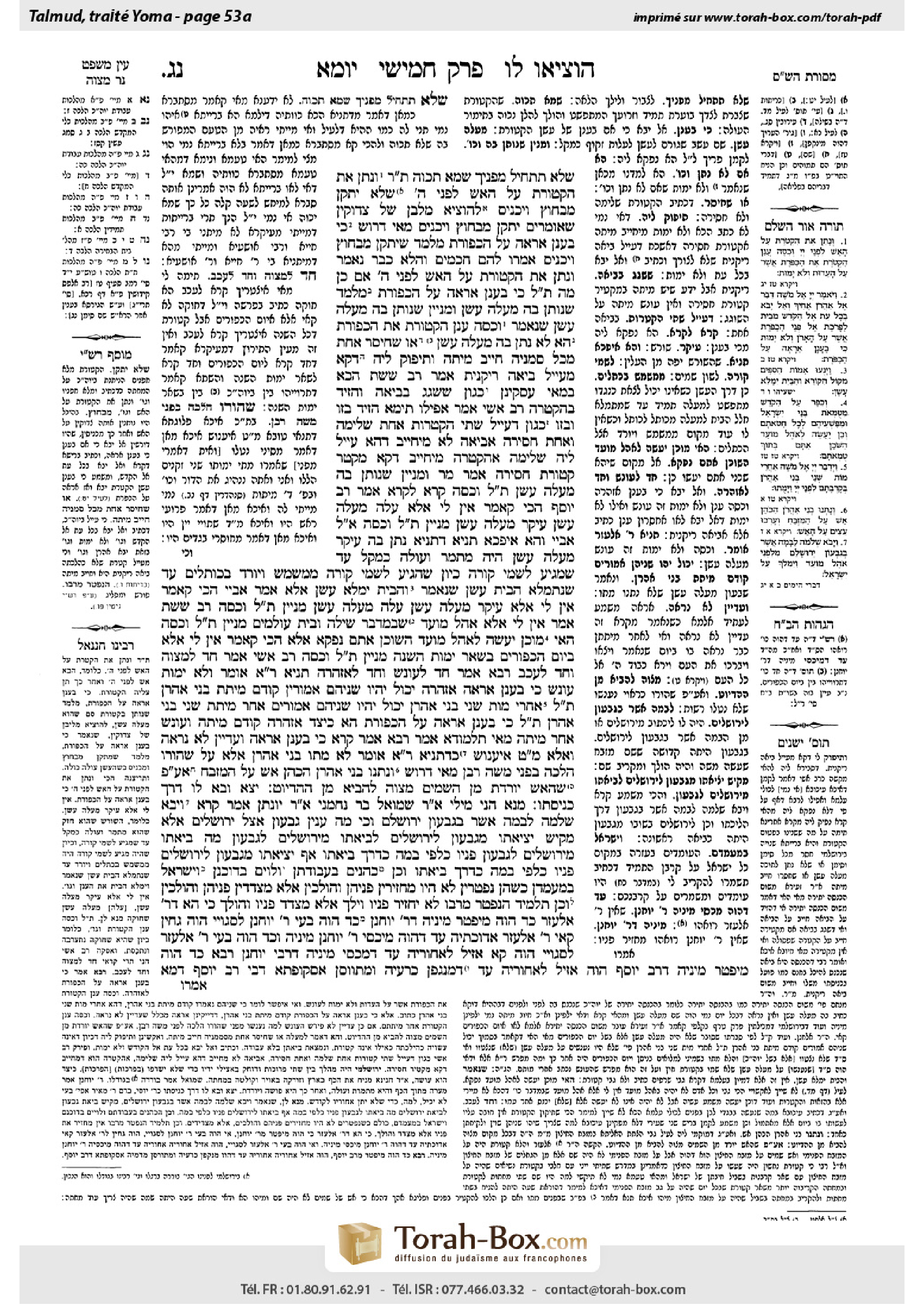
Yoma 53a: Talmud study for Daf Yomi
Daf Yomi is the daily study of one Talmud folio. Explore 37 tractates with scans, Hebrew text, Sefaria English and AI-generated French translations where annotated.
Passage selection and English or AI-generated French translation are available where the scan has annotations. Daf Study is independent of Torah-Box and Sefaria.
Browse Yoma · יומא · All tractatesYoma 53a text and translations
This page of Yoma includes the Aramaic text, an English translation and an AI-generated French translation, alongside the scan above.
יומא נ״ג א · Aramaic and Hebrew text
שֶׁלֹּא תַּתְחִיל מִפָּנֶיךָ, שֶׁמָּא תִּכָּוֶה.
תָּנוּ רַבָּנַן: ״וְנָתַן אֶת הַקְּטוֹרֶת עַל הָאֵשׁ לִפְנֵי ה׳״ — שֶׁלֹּא יְתַקֵּן מִבַּחוּץ וְיַכְנִיס. לְהוֹצִיא מִלִּבָּן שֶׁל צַדּוּקִין, שֶׁאוֹמְרִים יְתַקֵּן מִבַּחוּץ וְיַכְנִיס.
מַאי דְּרוּשׁ? ״כִּי בֶּעָנָן אֵרָאֶה עַל הַכַּפּוֹרֶת״ — מְלַמֵּד שֶׁיְּתַקֵּן מִבַּחוּץ וְיַכְנִיס.
אָמְרוּ לָהֶם חֲכָמִים, וַהֲלֹא כְּבָר נֶאֱמַר: ״וְנָתַן אֶת הַקְּטוֹרֶת עַל הָאֵשׁ לִפְנֵי ה׳״. אִם כֵּן, מָה תַּלְמוּד לוֹמַר: ״כִּי בֶּעָנָן אֵרָאֶה עַל הַכַּפּוֹרֶת״ —
מְלַמֵּד שֶׁנּוֹתֵן בָּהּ מַעֲלֵה עָשָׁן. וּמִנַּיִין שֶׁנּוֹתֵן בָּהּ מַעֲלֵה עָשָׁן? שֶׁנֶּאֱמַר: ״וְכִסָּה עֲנַן הַקְּטוֹרֶת אֶת הַכַּפּוֹרֶת״. הָא לֹא נָתַן בָּהּ מַעֲלֵה עָשָׁן, אוֹ שֶׁחִיסַּר אַחַת מִכׇּל סַמָּנֶיהָ — חַיָּיב מִיתָה.
וְתִיפּוֹק לֵיהּ — דְּקָא מְעַיֵּיל בִּיאָה רֵיקָנִית!
אָמַר רַב שֵׁשֶׁת: הָכָא בְּמַאי עָסְקִינַן, כְּגוֹן שֶׁשָּׁגַג בְּבִיאָה, וְהֵזִיד בְּהַקְטָרָה.
רַב אָשֵׁי אָמַר: אֲפִילּוּ תֵּימָא הֵזִיד בְּזוֹ וּבָזוֹ, וּכְגוֹן דְּעַיֵּיל שְׁתֵּי הַקְטָרוֹת, אַחַת שְׁלֵימָה וְאַחַת חֲסֵירָה. אַבִּיאָה לָא מִיחַיַּיב — דְּהָא עַיֵּיל לֵיהּ שְׁלֵימָה, אַהַקְטָרָה — מִיחַיַּיב, דְּקָא מַקְטַר קְטוֹרֶת חֲסֵירָה.
אָמַר מָר: וּמִנַּיִין שֶׁנּוֹתֵן בָּהּ מַעֲלֵה עָשָׁן, תַּלְמוּד לוֹמַר: ״וְכִסָּה״. קְרָא לִקְרָא?
אָמַר רַב יוֹסֵף, הָכִי קָאָמַר: אֵין לִי אֶלָּא עֲלֵה מַעֲלֵה עָשָׁן, עִיקַּר מַעֲלֵה עָשָׁן מִנַּיִין? תַּלְמוּד לוֹמַר: ״וְכִסָּה״.
אֲמַר לֵיהּ אַבָּיֵי: וְהָא אִיפְּכָא תַּנְיָא! דְּתַנְיָא: נָתַן בָּהּ עִיקַּר מַעֲלֵה עָשָׁן, הָיָה מִתַּמֵּר וְעוֹלֶה כְּמַקֵּל עַד שֶׁמַּגִּיעַ לִשְׁמֵי קוֹרָה. כֵּיוָן שֶׁהִגִּיעַ לִשְׁמֵי קוֹרָה, מְמַשְׁמֵשׁ וְיוֹרֵד בַּכּוֹתָלִים עַד שֶׁנִּתְמַלֵּא הַבַּיִת עָשָׁן, שֶׁנֶּאֱמַר: ״וְהַבַּיִת יִמָּלֵא עָשָׁן״!
אֶלָּא אָמַר אַבָּיֵי, הָכִי קָאָמַר: אֵין לִי אֶלָּא עִיקַּר מַעֲלֵה עָשָׁן, עֲלֵה מַעֲלֵה עָשָׁן מִנַּיִין? תַּלְמוּד לוֹמַר: ״וְכִסָּה״.
רַב שֵׁשֶׁת אָמַר: אֵין לִי אֶלָּא אֹהֶל מוֹעֵד שֶׁבַּמִּדְבָּר. שִׁילֹה וּבֵית עוֹלָמִים מִנַּיִין? תַּלְמוּד לוֹמַר: ״וְכִסָּה״.
הַאי, מִ״וְּכֵן יַעֲשֶׂה לְאֹהֶל מוֹעֵד הַשּׁוֹכֵן אִתָּם״ נָפְקָא!
אֶלָּא הָכִי קָאָמַר: אֵין לִי אֶלָּא בְּיוֹם הַכִּפּוּרִים. בִּשְׁאָר יְמוֹת הַשָּׁנָה מִנַּיִין? תַּלְמוּד לוֹמַר: ״וְכִסָּה״.
רַב אָשֵׁי אָמַר: חַד לְמִצְוָה, וְחַד לְעַכֵּב. רָבָא אָמַר: חַד לְעוֹנֶשׁ, וְחַד לְאַזְהָרָה.
תַּנְיָא, רַבִּי אֱלִיעֶזֶר אוֹמֵר: ״וְלֹא יָמוּת״ — עוֹנֶשׁ, ״כִּי בֶּעָנָן אֵרָאֶה״ — אַזְהָרָה.
יָכוֹל יִהְיוּ שְׁנֵיהֶם אֲמוּרִין קוֹדֶם מִיתַת בְּנֵי אַהֲרֹן — תַּלְמוּד לוֹמַר: ״אַחֲרֵי מוֹת שְׁנֵי בְּנֵי אַהֲרֹן״. יָכוֹל יִהְיוּ שְׁנֵיהֶם אֲמוּרִים אַחַר מִיתַת שְׁנֵי בְּנֵי אַהֲרֹן — תַּלְמוּד לוֹמַר: ״כִּי בֶּעָנָן אֵרָאֶה עַל הַכַּפּוֹרֶת״. הָא כֵּיצַד? אַזְהָרָה קוֹדֶם מִיתָה, וְעוֹנֶשׁ אַחַר מִיתָה.
מַאי תַּלְמוּדָא? אָמַר רָבָא, אָמַר קְרָא: ״כִּי בֶּעָנָן אֵרָאֶה״ — וַעֲדַיִין לֹא נִרְאָה. וְאֶלָּא מַאי טַעְמָא אִיעֲנוּשׁ?
כִּדְתַנְיָא, רַבִּי אֱלִיעֶזֶר אוֹמֵר: לֹא מֵתוּ בְּנֵי אַהֲרֹן אֶלָּא עַל שֶׁהוֹרוּ הֲלָכָה בִּפְנֵי מֹשֶׁה רַבָּן. מַאי דְּרוּשׁ? ״וְנָתְנוּ בְּנֵי אַהֲרֹן הַכֹּהֵן אֵשׁ עַל הַמִּזְבֵּחַ״ — אַף עַל פִּי שֶׁהָאֵשׁ יוֹרֶדֶת מִן הַשָּׁמַיִם, מִצְוָה לְהָבִיא מִן הַהֶדְיוֹט.
יָצָא וּבָא לוֹ דֶּרֶךְ כְּנִיסָתוֹ. מְנָא הָנֵי מִילֵּי? אָמַר רַבִּי שְׁמוּאֵל בַּר נַחְמָנִי, אָמַר רַבִּי יוֹנָתָן, אָמַר קְרָא: ״וַיָּבֹא שְׁלֹמֹה לַבָּמָה אֲשֶׁר בְּגִבְעוֹן יְרוּשָׁלִַם״, וְכִי מָה עִנְיַן גִּבְעוֹן אֵצֶל יְרוּשָׁלַיִם?
אֶלָּא: מַקִּישׁ יְצִיאָתוֹ מִגִּבְעוֹן לִירוּשָׁלַיִם, לְבִיאָתוֹ מִירוּשָׁלַיִם לְגִבְעוֹן: מָה בִּיאָתוֹ מִירוּשָׁלַיִם לְגִבְעוֹן — פָּנָיו כְּלַפֵּי בָמָה, כְּדֶרֶךְ בִּיאָתוֹ, אַף יְצִיאָתוֹ מִגִּבְעוֹן לִירוּשָׁלַיִם — פָּנָיו כְּלַפֵּי בָמָה, כְּדֶרֶךְ בִּיאָתוֹ.
וְכֵן כֹּהֲנִים בַּעֲבוֹדָתָן, וּלְוִיִּם בְּדוּכָנָן, וְיִשְׂרָאֵל בְּמַעֲמָדָן, כְּשֶׁהֵן נִפְטָרִין — לֹא הָיוּ מַחֲזִירִין פְּנֵיהֶן וְהוֹלְכִין, אֶלָּא מְצַדְּדִין פְּנֵיהֶן וְהוֹלְכִין.
וְכֵן תַּלְמִיד הַנִּפְטָר מֵרַבּוֹ לֹא יַחֲזִיר פָּנָיו וְיֵלֵךְ, אֶלָּא מְצַדֵּד פָּנָיו וְהוֹלֵךְ. כִּי הָא דְּרַבִּי אֶלְעָזָר כַּד הֲוָה מִיפְּטַר מִינֵּיהּ דְּרַבִּי יוֹחָנָן, כַּד הֲוָה בָּעֵי רַבִּי יוֹחָנָן לְסַגּוֹיֵי, הֲוָה גָּחֵין קָאֵי רַבִּי אֶלְעָזָר אַדּוּכְתֵּיהּ עַד דַּהֲוָה מִיכַּסֵּי רַבִּי יוֹחָנָן מִינֵּיהּ.
וְכַד הֲוָה בָּעֵי רַבִּי אֶלְעָזָר לְסַגּוֹיֵי, הֲוָה קָא אָזֵיל לַאֲחוֹרֵיהּ עַד דְּמִכַּסֵּי מִינֵּיהּ דְּרַבִּי יוֹחָנָן. רָבָא כַּד הֲוָה מִיפְּטַר מִינֵּיהּ דְּרַב יוֹסֵף, הֲוָה אָזֵיל לַאֲחוֹרֵיהּ עַד דְּמִנַּגְּפָן כַּרְעֵיהּ וּמִתַּוְּוסָן אִסְקוּפָּתָא דְּבֵי רַב יוֹסֵף דְּמָא.
Yoma 53a · English translation
not to begin piling the incense in front of you, i.e., from the side closest to you, lest you be burned. If the priest were to place the incense on the side directly in front of him and then proceed to spread it toward the Ark, his hands would pass over the incense that is already burning and he might burn himself.
§ The Sages taught in a baraita: “And he shall put the incense upon the fire before the Lord” (Leviticus 16:13); this means that he should not prepare by placing the incense outside, in the Sanctuary, and bring into the Holy of Holies a coal pan holding the burning incense. This was emphasized in order to exclude the opinion of the Sadducees, who say that he should prepare the incense outside and then bring it in.
The Gemara asks: What did the Sadducees interpret; what verse do they cite as the basis for their opinion? The Gemara answers that it was the verse: “For I will appear in a cloud upon the Ark cover” (Leviticus 16:2), which the Sadducees say teaches that he should prepare it outside, so there would already be a cloud of incense, and only then should he bring it inside the Holy of Holies.
The Sages said to them: Wasn’t it already stated explicitly: “And he shall put the incense upon the fire before the Lord” (Leviticus 16:13), which indicates that the High Priest should present the incense only when he stands before God in the Holy of Holies? If so, what is the meaning when the verse states: “For I will appear in a cloud upon the Ark cover” (Leviticus 16:2)? This verse does not mean that there should already be an incense cloud before he enters.
Instead, this verse is referring to the shape of the incense cloud, and it teaches that he includes a smoke-raiser in its spices, a plant that causes the smoke to rise straight up like a staff. And from where is it derived that he includes a smoke-raiser in its spices? As it is stated: “And the incense cloud shall cover the Ark cover” (Leviticus 16:13). Therefore, if he did not include a smoke-raiser, or if he omitted any one of its spices, he is liable to receive the death penalty.
The Gemara analyzes this last halakha: Why does one incur the death penalty for omitting one of the spices? And let the tanna derive the fact that he incurs the death penalty for a different action, as his entry into the Holy of Holies is for no purpose. It is prohibited to enter the Holy of Holies unless one is performing a mitzva. If the incense lacks an ingredient, the High Priest is not truly performing the mitzva, and therefore he has entered the Holy of Holies for no purpose. Consequently, he incurs the death penalty on account of his entry, even without burning the incense.
Rav Sheshet said: With what are we dealing here? We are dealing with a case where he acted unwittingly with regard to the entry, i.e., he was unaware that entering for no reason renders him liable, or he did not mean to enter the Holy of Holies at all; and he acted intentionally with regard to the burning, knowing that one who burns incense that lacks an ingredient incurs the death penalty. In that case, he is liable to receive the death penalty only for burning incomplete incense.
Rav Ashi said a different explanation: Even if you say that he acted intentionally with regard to both this and that, i.e., he knew full well that he would be liable to receive the death penalty both for burning incomplete incense and for entering the Holy of Holies for no purpose, it is nevertheless possible that he is not liable to receive the death penalty for his entry. And Rav Ashi explains that this is the halakha in a case where he brought two sets of incense into the Holy of Holies, one complete with all the spices and one incomplete, both of which he burned. For his entry to the Holy of Holies he is not liable to be put to death, as he brought in a coal pan with complete incense and thereby fulfilled the mitzva. However, for burning he is liable to receive the death penalty, as he burns incomplete incense.
§ The Gemara analyzes the above baraita. The Master said in the baraita: And from where is it derived that he includes a smoke-raiser in its spices? The verse states: “And it shall cover” (Leviticus 16:13). The Gemara expresses surprise at this statement: One verse for another verse? The requirement of a smoke-raiser was already proven from the verse: “For I will appear in a cloud upon the Ark cover” (Leviticus 16:2); why cite a second verse in support of the first one?
Rav Yosef said: This is what the baraita said; this is how to understand the matter: I have derived nothing other than the obligation to bring a leaf of a smoke-raising plant. From where is it derived that he must also bring a root of a smoke-raiser? The verse states: “And it shall cover,” which indicates the requirement for more of the smoke-raiser than might have been supposed from the other verse.
Abaye said to Rav Yosef: Your interpretation indicates that the leaf of the smoke-raiser raises smoke better than its root, as the requirement for a root is merely considered an addition. But wasn’t the opposite taught in a baraita? As it was taught in a baraita: He put into the incense a root of a smoke-raiser, and the smoke would rise in a column like a staff until it reached the Temple ceiling. When it reached the ceiling there was nowhere for the smoke to exit the building, and therefore it slowly descended the walls until the entire House was filled with smoke, as it is stated: “And the House was filled with smoke” (Isaiah 6:4). This baraita indicates that the root of the smoke-raiser raises smoke better than its leaf.
Rather, Abaye said that this is what the baraita said; this is how it should be understood: I have derived nothing other than the obligation to bring a root of a smoke-raising plant. From where is it derived that he must also bring a leaf of a smoke-raiser? The verse states: “And it shall cover.”
Rav Sheshet said that the baraita means the following: I have derived nothing other than the inclusion of a smoke-raiser amongst the other spices in the Tent of Meeting that was in the wilderness; from where is it derived that this obligation extends to the Tabernacle at Shiloh and in the eternal Temple in Jerusalem? The verse states: “And it shall cover,” which indicates that wherever the High Priest enters the Holy of Holies to burn incense, he must include a smoke-raiser in its ingredients.
The Gemara raises a difficulty with regard to this interpretation: This halakha is derived from the verse: “And so shall he do for the Tent of Meeting that dwells with them” (Leviticus 16:16). This verse teaches that this rite must be performed not only that first time in the wilderness, but wherever the Divine Presence dwells.
Rather, this is what the baraita said: I have derived nothing other than the obligation to include a smoke-raiser in the spices of the incense offered on Yom Kippur in the Holy of Holies; from where is it derived that this obligation applies to the incense offered on the rest of the days of the year in the Sanctuary? The verse states: “And it shall cover,” to teach that every incense burned in the Temple must include a smoke-raiser.
Rav Ashi said: One verse teaches us the mitzva itself, and one verse teaches that this requirement is indispensable, i.e., the rite is invalid if one omits this ingredient. Rava said: One verse teaches that the omission of the smoke-raiser renders one liable to receive the punishment of death, and one verse serves as a warning that it is prohibited to omit it, as the Torah does not require punishment without issuing a warning.
§ It was taught in a baraita that Rabbi Eliezer says: “Speak to Aaron your brother that he should not come at all times into the sacred place within the curtain, before the Ark cover that is upon the Ark; that he not die” (Leviticus 16:2). This verse teaches the punishment for the omission of the smoke-raiser from the spices of the incense. With regard to the verse: “For I will appear in a cloud upon the Ark cover” (Leviticus 16:2); this is the warning that it is prohibited to omit the smoke-raiser, which causes the cloud to rise.
One might have thought that both verses were said before the deaths of Aaron’s sons, who died upon entering the sacred place. Therefore, the verse states: “After the deaths of the two sons of Aaron” (Leviticus 16:1). One might have thought that both of them, the punishment and the warning, were said after the deaths of Aaron’s two sons. Therefore, the verse states: “For I will appear in a cloud upon the Ark cover.” How so; how should these verses be understood? The warning was said before the death of Aaron’s sons, and the punishment associated with it was stated after the death of his sons.
The Gemara expresses puzzlement at Rabbi Eliezer’s statement: What is the biblical derivation? How does Rabbi Eliezer learn from the phrase “I will appear” that the warning was stated earlier? Rava said that the verse states: “For I will appear in a cloud”; the future tense indicates that the cloud over the Ark cover had not yet appeared, as the Tabernacle had not been built, which means that this command was issued before Aaron’s sons entered and died. The Gemara asks: Rather, what is the reason that Aaron’s sons were punished with death, if the punishment had not been stated? The Torah does not punish one who is unaware of the sin’s punishment.
The Gemara answers: They were not punished for their entry into the sacred place but for a different reason, as it was taught in a baraita that Rabbi Eliezer says: Aaron’s sons died only because they taught a halakha before Moses their teacher; they should have asked him for his ruling, but they neglected to do so. The Gemara asks: What did they interpret from the verse that led them to enter the sacred place with fire? The verse states: “And the sons of Aaron the priest shall put fire upon the altar” (Leviticus 1:7), which indicates that although fire descends from the heavens, it is a mitzva to bring man-made fire. To fulfill this mitzva, Aaron’s sons entered and brought fire to the altar. Although their ruling was in accordance with the halakha, they incurred the death penalty for failing to ask Moses.
§ The mishna teaches that the High Priest exits and comes out the way that he entered, i.e., he does not turn around, but walks backward with his face toward the Ark. The Gemara asks: From where are these matters derived; what is the source in the Torah for this halakha? Rabbi Shmuel bar Naḥmani said that Rabbi Yonatan said that the verse states: “And Solomon came to the high place that was at Gibeon, Jerusalem” (II Chronicles 1:13). Now, what does Gibeon have to do with Jerusalem? Either he came to Gibeon or to Jerusalem; these are two different places.
Rather, the verse compares his exit from Gibeon to Jerusalem to his arrival from Jerusalem to Gibeon. Just as in the case of his arrival from Jerusalem to Gibeon his face was necessarily turned toward the high place, in the usual manner of a person’s arrival, so too, upon his exit from Gibeon to Jerusalem his face was still turned toward the high place, in the manner of his arrival. This teaches that one does not turn his face away from a sacred place; rather, he must walk backward.
And likewise, with regard to priests in their service; and Levites on their platform in the Temple, where they recited songs; and Israelites at their watches, where they observed the sacrifice of the daily offering: When they departed from the sacred place, they would not turn their faces and walk but would turn their faces sideways and walk, so as not to turn their backs on the sacred place.
And likewise, a student who takes leave of his teacher should not turn his face and walk but turn his face sideways and walk. This is in accordance with that practice of Rabbi Elazar when he took leave of his teacher, Rabbi Yoḥanan. When Rabbi Yoḥanan wanted to leave him, Rabbi Elazar would bend down and stand in his place as a sign of respect and humility, until Rabbi Yoḥanan disappeared from his sight; only then would Rabbi Elazar turn to leave.
And when Rabbi Elazar wanted to leave, he would walk backward until he disappeared from Rabbi Yoḥanan’s sight, and only then would he walk normally, so as not to turn his back on his teacher. The Gemara further relates: When Rava took leave of Rav Yosef, he would walk backward, paying no attention to the obstacles in his path, until his legs were bruised and the threshold of Rav Yosef’s house was bloodied from Rava’s wounds.
Yoma 53a · Traduction française (IA)
ne pas commencer à déposer l’encens devant soi, c’est-à-dire du côté le plus proche de soi, de peur de se brûler. Si le prêtre plaçait l’encens juste devant lui, puis entreprenait de l’étaler en direction de l’Arche, ses mains passeraient au-dessus de l’encens déjà en train de brûler et il risquerait de se brûler.
§ Les Sages ont enseigné dans une baraïta : « Il mettra l’encens sur le feu devant le Seigneur » (Lévitique 16:13). Cela signifie qu’il ne doit pas préparer l’encens en le plaçant à l’extérieur, dans le Sanctuaire, puis faire entrer dans le Saint des Saints une pelle à braises contenant l’encens en train de brûler. Cette précision vise à exclure l’opinion des Sadducéens, qui disent qu’il doit préparer l’encens à l’extérieur, puis le faire entrer.
La Guemara demande : Qu’ont interprété les Sadducéens ? Quel verset citent-ils à l’appui de leur opinion ? La Guemara répond qu’il s’agit du verset : « Car j’apparaîtrai dans une nuée au-dessus du propitiatoire » (Lévitique 16:2), que les Sadducéens comprennent comme enseignant qu’il doit préparer l’encens à l’extérieur, afin qu’une nuée d’encens se forme déjà, puis seulement le faire entrer dans le Saint des Saints.
Les Sages leur dirent : N’est-il pas déjà écrit explicitement : « Il mettra l’encens sur le feu devant le Seigneur » (Lévitique 16:13), ce qui indique que le Grand Prêtre ne doit présenter l’encens que lorsqu’il se tient devant Dieu dans le Saint des Saints ? Que signifie donc le verset : « Car j’apparaîtrai dans une nuée au-dessus du propitiatoire » (Lévitique 16:2) ? Ce verset ne signifie pas qu’une nuée d’encens doit déjà être présente avant qu’il entre.
Ce verset fait plutôt référence à la forme de la nuée d’encens et enseigne qu’il ajoute à ses aromates un redresse-fumée, une plante qui fait monter la fumée droit vers le haut, comme une colonne. Et d’où déduit-on qu’il ajoute un redresse-fumée à ses aromates ? Comme il est dit : « Et la nuée d’encens couvrira le propitiatoire » (Lévitique 16:13). Par conséquent, s’il n’a pas ajouté de redresse-fumée, ou s’il a omis l’un de ses aromates, il est passible de la peine de mort.
La Guemara examine cette dernière halakha : Pourquoi est-on passible de la peine de mort pour avoir omis l’un des aromates ? Que le tanna déduise plutôt qu’il est passible de la peine de mort pour une autre action, car son entrée dans le Saint des Saints est sans objet. Il est interdit d’entrer dans le Saint des Saints à moins d’accomplir une mitsva. Si l’encens ne contient pas un ingrédient, le Grand Prêtre n’accomplit pas véritablement la mitsva et est donc entré dans le Saint des Saints sans raison. Par conséquent, il est passible de la peine de mort en raison de son entrée, même sans avoir brûlé l’encens.
Rav Sheshet dit : De quel cas s’agit-il ici ? Il s’agit du cas où il a agi par inadvertance concernant son entrée, c’est-à-dire qu’il ignorait qu’entrer sans raison le rendait passible de la peine de mort, ou qu’il n’avait pas l’intention d’entrer dans le Saint des Saints, et où il a agi intentionnellement concernant la combustion, sachant que celui qui brûle un encens auquel il manque un ingrédient est passible de la peine de mort. Dans ce cas, il n’est passible de la peine de mort que pour avoir brûlé un encens incomplet.
Rav Ashi donne une autre explication : Même si l’on dit qu’il a agi intentionnellement dans les deux cas, c’est-à-dire qu’il savait parfaitement qu’il serait passible de la peine de mort aussi bien pour avoir brûlé un encens incomplet que pour être entré dans le Saint des Saints sans raison, il est néanmoins possible qu’il ne soit pas passible de la peine de mort pour son entrée. Rav Ashi explique que telle est la halakha dans le cas où il a fait entrer deux préparations d’encens dans le Saint des Saints, l’une complète, contenant tous les aromates, et l’autre incomplète, et qu’il a brûlé les deux. Il n’est pas passible de la peine de mort pour son entrée dans le Saint des Saints, car il a fait entrer une pelle à braises contenant de l’encens complet et a ainsi accompli la mitsva. En revanche, il est passible de la peine de mort pour la combustion, puisqu’il brûle un encens incomplet.
§ La Guemara examine la baraïta citée plus haut. Le maître a dit dans la baraïta : « Et d’où déduit-on qu’il ajoute un redresse-fumée à ses aromates ? » Le verset dit : « Et elle couvrira » (Lévitique 16:13). La Guemara s’étonne de cette affirmation : Un verset pour un autre verset ? L’obligation d’ajouter un redresse-fumée a déjà été établie à partir du verset : « Car j’apparaîtrai dans une nuée au-dessus du propitiatoire » (Lévitique 16:2) ; pourquoi citer un second verset à l’appui du premier ?
Rav Yossef dit : Voici ce que disait la baraïta, et comment il faut comprendre la question : Je n’ai déduit que l’obligation d’apporter une feuille d’une plante qui fait monter la fumée. D’où déduit-on qu’il doit également apporter une racine de redresse-fumée ? Le verset dit : « Et elle couvrira », ce qui indique qu’il faut aussi apporter une racine de redresse-fumée, en plus de ce qu’on aurait pu conclure de l’autre verset.
Abayé dit à Rav Yossef : Ton interprétation indique que la feuille du redresse-fumée fait mieux monter la fumée que sa racine, puisque l’obligation d’apporter une racine n’est considérée que comme un ajout. Mais une baraïta n’enseigne-t-elle pas le contraire ? En effet, une baraïta enseigne : Il mettait dans l’encens une racine de redresse-fumée, et la fumée montait en colonne, comme une tige, jusqu’au plafond du Temple. Lorsqu’elle atteignait le plafond, elle ne pouvait sortir du bâtiment ; elle descendait donc lentement le long des murs, jusqu’à ce que toute la Maison soit remplie de fumée, comme il est dit : « La Maison fut remplie de fumée » (Isaïe 6:4). Cette baraïta indique que la racine du redresse-fumée fait mieux monter la fumée que sa feuille.
Abayé dit plutôt que voici ce que disait la baraïta et comment il faut la comprendre : Je n’ai déduit que l’obligation d’apporter une racine d’une plante qui fait monter la fumée. D’où déduit-on qu’il doit également apporter une feuille de redresse-fumée ? Le verset dit : « Et elle couvrira ».
Rav Sheshet dit que la baraïta signifie ceci : Je n’ai déduit que l’obligation d’ajouter un redresse-fumée aux autres aromates dans la Tente d’assignation qui se trouvait dans le désert ; d’où déduit-on que cette obligation s’étend au Tabernacle de Silo et au Temple permanent de Jérusalem ? Le verset dit : « Et la nuée d’encens couvrira le propitiatoire » (Lévitique 16:13), ce qui indique que partout où le Grand Prêtre entre dans le Saint des Saints pour brûler de l’encens, il doit inclure un redresse-fumée parmi ses ingrédients.
La Guemara soulève une difficulté concernant cette interprétation : Cette halakha est déduite du verset : « Et ainsi fera-t-il pour la Tente d’assignation qui réside parmi eux » (Lévitique 16:16). Ce verset enseigne que ce rite doit être accompli non seulement cette première fois dans le désert, mais partout où réside la Présence divine.
Il faut plutôt comprendre ainsi la baraïta : Je n’ai déduit que l’obligation d’ajouter un redresse-fumée aux aromates de l’encens offert à Yom Kippour dans le Saint des Saints ; d’où déduit-on que cette obligation s’applique à l’encens offert les autres jours de l’année dans le Sanctuaire ? Le verset dit : « Et elle couvrira », pour enseigner que tout encens brûlé dans le Temple doit inclure un redresse-fumée.
Rav Ashi dit : Un verset nous enseigne la mitsva elle-même, et un autre enseigne que cette exigence est indispensable, c’est-à-dire que le rite est invalide si l’on omet cet ingrédient. Rava dit : Un verset enseigne que l’omission du redresse-fumée rend passible de la peine de mort, et l’autre sert d’avertissement qu’il est interdit de l’omettre, car la Torah ne prévoit pas de peine sans avertissement préalable.
§ Une baraïta enseigne que Rabbi Eliezer dit : « Parle à Aaron, ton frère, afin qu’il n’entre pas à tout moment dans le lieu saint, au-delà du rideau, devant le propitiatoire qui est sur l’Arche, afin qu’il ne meure pas » (Lévitique 16:2). Ce verset enseigne la peine encourue si l’on omet le redresse-fumée des aromates de l’encens. Quant au verset : « Car j’apparaîtrai dans une nuée au-dessus du propitiatoire » (Lévitique 16:2), il constitue l’avertissement qu’il est interdit d’omettre le redresse-fumée, qui fait monter la nuée.
On aurait pu penser que ces deux versets avaient été prononcés avant la mort des fils d’Aaron, qui moururent en entrant dans le lieu saint. Le verset dit donc : « Après la mort des deux fils d’Aaron » (Lévitique 16:1). On aurait pu penser que les deux éléments, la peine et l’avertissement, avaient été énoncés après la mort des deux fils d’Aaron. Le verset dit donc : « Car j’apparaîtrai dans une nuée au-dessus du propitiatoire. » Comment faut-il comprendre ces versets ? L’avertissement fut énoncé avant la mort des fils d’Aaron, et la peine qui lui est associée fut énoncée après la mort de ses fils.
La Guemara s’étonne de la déclaration de Rabbi Eliezer : Quelle est la déduction biblique ? Comment Rabbi Eliezer déduit-il de l’expression « j’apparaîtrai » que l’avertissement fut énoncé plus tôt ? Rava dit que le verset précise : « Car j’apparaîtrai dans une nuée » ; le futur indique que la nuée au-dessus du propitiatoire ne s’était pas encore formée, puisque le Tabernacle n’avait pas encore été construit, ce qui signifie que cet ordre fut donné avant que les fils d’Aaron n’entrent et ne meurent. La Guemara demande : Pourquoi, alors, les fils d’Aaron furent-ils punis de mort, si la peine n’avait pas encore été énoncée ? La Torah ne punit pas celui qui ignore la peine encourue pour sa faute.
La Guemara répond : Ils ne furent pas punis pour être entrés dans le lieu saint, mais pour une autre raison, comme l’enseigne une baraïta où Rabbi Eliezer dit : Les fils d’Aaron ne moururent que parce qu’ils enseignèrent une halakha avant Moïse, leur maître ; ils auraient dû lui demander sa décision, mais ils ne l’ont pas fait. La Guemara demande : Qu’ont-ils déduit du verset pour entrer dans le lieu saint avec du feu ? Le verset dit : « Les fils d’Aaron, le prêtre, mettront du feu sur l’autel » (Lévitique 1:7), ce qui indique que, bien que le feu descende des cieux, c’est une mitsva d’apporter un feu d’origine humaine. Pour accomplir cette mitsva, les fils d’Aaron entrèrent et apportèrent du feu à l’autel. Bien que leur décision fût conforme à la halakha, ils furent passibles de la peine de mort pour ne pas avoir consulté Moïse.
§ La Michna enseigne que le Grand Prêtre sort par le chemin qu’il a emprunté pour entrer, c’est-à-dire qu’il ne se retourne pas, mais marche à reculons, le visage tourné vers l’Arche. La Guemara demande : D’où déduit-on cette règle ? Quelle en est la source dans la Torah ? Rabbi Shmuel bar Naḥmani dit que Rabbi Yonatan a dit que le verset déclare : « Salomon vint au haut lieu qui se trouvait à Gabaon, depuis Jérusalem » (II Chroniques 1:13). Mais quel rapport Gabaon a-t-il avec Jérusalem ? Il est allé soit à Gabaon, soit à Jérusalem ; ce sont deux lieux différents.
Le verset compare plutôt son départ de Gabaon vers Jérusalem à son arrivée de Jérusalem à Gabaon. De même que, lorsqu’il arriva de Jérusalem à Gabaon, son visage était nécessairement tourné vers le haut lieu, comme il est d’usage lorsqu’on arrive quelque part, de même, lorsqu’il repartit de Gabaon vers Jérusalem, son visage demeura tourné vers le haut lieu, comme lors de son arrivée. Cela enseigne qu’on ne détourne pas le visage d’un lieu saint ; il faut au contraire marcher à reculons.
Il en va de même des prêtres pendant leur service, des Lévites sur leur estrade dans le Temple, où ils récitaient des chants, et des Israélites affectés aux gardes, où ils observaient le sacrifice quotidien : lorsqu’ils quittaient le lieu saint, ils ne se retournaient pas pour marcher, mais tournaient le visage de côté, afin de ne pas tourner le dos au lieu saint.
De même, un élève qui prend congé de son maître ne doit pas se détourner pour s’en aller, mais tourner le visage de côté et marcher. C’est ainsi que faisait Rabbi Elazar lorsqu’il prenait congé de son maître, Rabbi Yoḥanan. Lorsque Rabbi Yoḥanan voulait le quitter, Rabbi Elazar s’inclinait et restait à sa place, en signe de respect et d’humilité, jusqu’à ce que Rabbi Yoḥanan disparaisse de sa vue ; alors seulement Rabbi Elazar se tournait pour partir.
Et lorsque Rabbi Elazar voulait partir, il marchait à reculons jusqu’à disparaître de la vue de Rabbi Yoḥanan ; alors seulement il marchait normalement, afin de ne pas tourner le dos à son maître. La Guemara rapporte également que, lorsque Rava prenait congé de Rav Yossef, il marchait à reculons, sans prêter attention aux obstacles sur son chemin, jusqu’à ce que ses jambes soient contusionnées et que le seuil de la maison de Rav Yossef soit ensanglanté par ses blessures.
Traduction française générée par IA à partir de l’édition anglaise de Sefaria. Vérifie toujours un passage avec le texte source.
Text from Sefaria: William Davidson Edition - Vocalized Aramaic (CC BY NC); William Davidson Edition - English (CC BY NC).