Yoma 53b: Talmud study for Daf Yomi
Daf Yomi is the daily study of one Talmud folio. Explore 37 tractates with scans, Hebrew text, Sefaria English and AI-generated French translations where annotated.
Passage selection and English or AI-generated French translation are available where the scan has annotations. Daf Study is independent of Torah-Box and Sefaria.
Browse Yoma · יומא · All tractatesYoma 53b text and translations
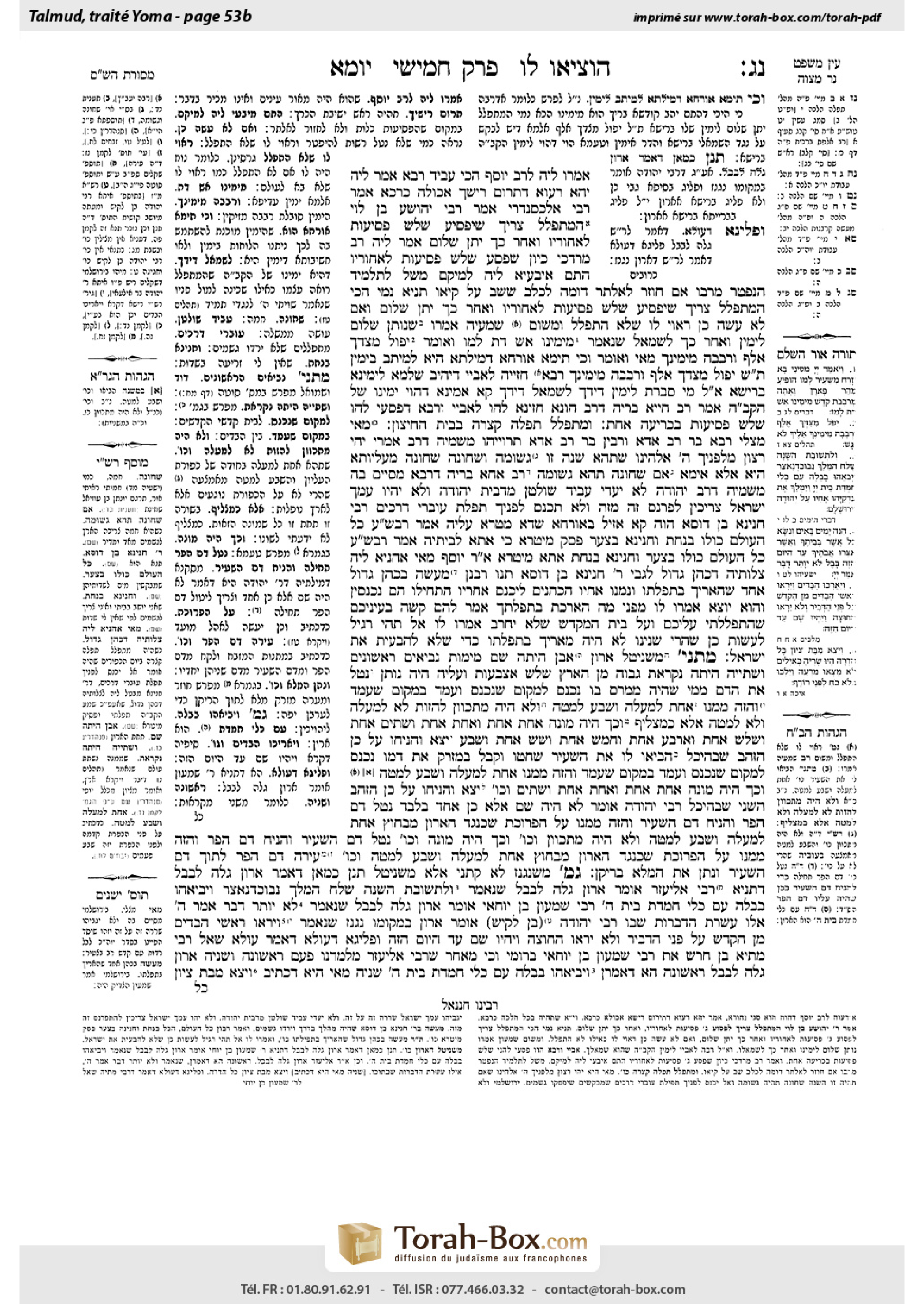
This page of Yoma includes the Aramaic text, an English translation and an AI-generated French translation, alongside the scan above.
יומא נ״ג ב · Aramaic and Hebrew text
אֲמַרוּ לֵיהּ לְרַב יוֹסֵף: הָכִי עָבֵיד רָבָא. אֲמַר לֵיהּ: יְהֵא רַעֲוָא דִּתְרוּם רֵישָׁךְ אַכּוּלֵּהּ כַּרְכָּא.
אָמַר רַבִּי אֲלֶכְּסַנְדְּרִי אָמַר רַבִּי יְהוֹשֻׁעַ בֶּן לֵוִי: הַמִּתְפַּלֵּל, צָרִיךְ שֶׁיַּפְסִיעַ שָׁלֹשׁ פְּסִיעוֹת לַאֲחוֹרָיו, וְאַחַר כָּךְ יִתֵּן שָׁלוֹם. אָמַר לֵיהּ רַב מָרְדֳּכַי: כֵּיוָן שֶׁפָּסַע שָׁלֹשׁ פְּסִיעוֹת לַאֲחוֹרָיו — הָתָם אִיבַּעְיָא לֵיהּ לְמֵיקַם. מָשָׁל לְתַלְמִיד הַנִּפְטָר מֵרַבּוֹ, אִם חוֹזֵר לְאַלְתַּר, דּוֹמֶה לְכֶלֶב שֶׁשָּׁב עַל קִיאוֹ.
תַּנְיָא נָמֵי הָכִי: הַמִּתְפַּלֵּל, צָרִיךְ שֶׁיַּפְסִיעַ שָׁלֹשׁ פְּסִיעוֹת לַאֲחוֹרָיו וְאַחַר כָּךְ יִתֵּן שָׁלוֹם, וְאִם לֹא עָשָׂה כֵּן רָאוּי לוֹ שֶׁלֹּא הִתְפַּלֵּל. וּמִשּׁוּם שְׁמַעְיָה אָמְרוּ: שֶׁנּוֹתֵן שָׁלוֹם לְיָמִין, וְאַחַר כָּךְ לִשְׂמֹאל, שֶׁנֶּאֱמַר: ״מִימִינוֹ אֵשׁ דָּת לָמוֹ״, וְאוֹמֵר: ״יִפּוֹל מִצִּדְּךָ אֶלֶף וּרְבָבָה מִימִינֶךָ״.
מַאי וְאוֹמֵר? וְכִי תֵּימָא אוֹרְחָא דְמִילְּתָא הִיא לְמִיתַּב בְּיָמִין, תָּא שְׁמַע: ״יִפּוֹל מִצִּדְּךָ אֶלֶף וּרְבָבָה מִימִינֶךָ״.
רָבָא חַזְיֵיהּ לְאַבָּיֵי דְּיָהֵיב שְׁלָמָא לְיַמִּינָא בְּרֵישָׁא אֲמַר לֵיהּ: מִי סָבְרַתְּ לִימִין דִּידָךְ? לִשְׂמֹאל דִּידָךְ קָא אָמֵינָא, דְּהָוֵי יְמִינוֹ שֶׁל הַקָּדוֹשׁ בָּרוּךְ הוּא. אָמַר רַב חִיָּיא בְּרֵיהּ דְּרַב הוּנָא: חֲזֵינָא לְהוּ לְאַבָּיֵי וְרָבָא דְּפָסְעִי לְהוּ שָׁלֹשׁ פְּסִיעוֹת בִּכְרִיעָה אַחַת.
וּמִתְפַּלֵּל תְּפִלָּה קְצָרָה בַּבַּיִת הַחִיצוֹן. מַאי מְצַלֵּי? רָבָא בַּר רַב אַדָּא וְרָבִין בַּר רַב אַדָּא תַּרְוַיְיהוּ מִשְּׁמֵיהּ דְּרַב אָמְרִי: יְהִי רָצוֹן מִלְּפָנֶיךָ ה׳ אֱלֹהֵינוּ שֶׁתְּהֵא שָׁנָה זוֹ גְּשׁוּמָה וּשְׁחוּנָה. שְׁחוּנָה מְעַלְּיוּתָא הִיא?! אֶלָּא אֵימָא: אִם שְׁחוּנָה תְּהֵא גְּשׁוּמָה.
רַב אַחָא בְּרֵיהּ דְּרָבָא מְסַיֵּים בַּהּ מִשְּׁמֵיהּ דְּרַב יְהוּדָה: לָא יִעְדֵּי עָבֵיד שׁוּלְטָן מִדְּבֵית יְהוּדָה, וְלֹא יִהְיוּ עַמְּךָ יִשְׂרָאֵל צְרִיכִין לְפַרְנָסָה זֶה מִזֶּה, וְלֹא תִּכָּנֵס לְפָנֶיךָ תְּפִלַּת עוֹבְרֵי דְּרָכִים.
רַבִּי חֲנִינָא בֶּן דּוֹסָא הֲוָה קָא אָזֵיל בְּאוֹרְחָא. שְׁדָא מִטְרָא עֲלֵיהּ, אֲמַר: רִבּוֹנוֹ שֶׁל עוֹלָם! כׇּל הָעוֹלָם כּוּלּוֹ בְּנַחַת, וַחֲנִינָא בְּצַעַר. פְּסַק מִיטְרָא. כִּי אֲתָא לְבֵיתֵיהּ, אָמַר: רִבּוֹנוֹ שֶׁל עוֹלָם! כׇּל הָעוֹלָם כּוּלּוֹ בְּצַעַר, וַחֲנִינָא בְּנַחַת. אֲתָא מִיטְרָא. אָמַר רַב יוֹסֵף: מַאי אַהְנְיָא לֵיהּ צְלוֹתֵיהּ דְּכֹהֵן גָּדוֹל לְגַבֵּי רַבִּי חֲנִינָא בֶּן דּוֹסָא.
תָּנוּ רַבָּנַן: מַעֲשֶׂה בְּכֹהֵן גָּדוֹל אֶחָד שֶׁהֶאֱרִיךְ בִּתְפִלָּתוֹ, וְנִמְנוּ אֶחָיו הַכֹּהֲנִים לִיכָּנֵס אַחֲרָיו. הִתְחִילוּ הֵם נִכְנָסִין וְהוּא יוֹצֵא. אָמְרוּ לוֹ: מִפְּנֵי מָה הֶאֱרַכְתָּ בִּתְפִלָּתֶךָ? אָמַר לָהֶם: קָשֶׁה בְּעֵינֵיכֶם שֶׁהִתְפַּלַּלְתִּי עֲלֵיכֶם וְעַל בֵּית הַמִּקְדָּשׁ שֶׁלֹּא יֵחָרֵב? אָמְרוּ לוֹ: אַל תְּהִי רָגִיל לַעֲשׂוֹת כֵּן, שֶׁהֲרֵי שָׁנִינוּ: לֹא הָיָה מַאֲרִיךְ בִּתְפִלָּתוֹ כְּדֵי שֶׁלֹּא לְהַבְעִית אֶת יִשְׂרָאֵל.
מַתְנִי׳ מִשֶּׁנִּיטַּל אָרוֹן, אֶבֶן הָיְתָה שָׁם מִימוֹת נְבִיאִים רִאשׁוֹנִים, וּשְׁתִיָּיה הָיְתָה נִקְרֵאת, גְּבוֹהָה מִן הָאָרֶץ שָׁלֹשׁ אֶצְבָּעוֹת וְעָלֶיהָ הָיָה נוֹתֵן. נָטַל אֶת הַדָּם מִמִּי שֶׁהָיָה מְמָרֵס בּוֹ, נִכְנַס לַמָּקוֹם שֶׁנִּכְנַס, וְעָמַד בַּמָּקוֹם שֶׁעָמַד, וְהִזָּה מִמֶּנּוּ אַחַת לְמַעְלָה וְשֶׁבַע לְמַטָּה.
וְלֹא הָיָה מִתְכַּוֵּון לְהַזּוֹת לֹא לְמַעְלָה וְלֹא לְמַטָּה אֶלָּא כְּמַצְלִיף. וְכָךְ הָיָה מוֹנֶה: אַחַת, אַחַת וְאַחַת, אַחַת וּשְׁתַּיִם, אַחַת וְשָׁלֹשׁ, אַחַת וְאַרְבַּע, אַחַת וְחָמֵשׁ, אַחַת וְשֵׁשׁ, אַחַת וָשֶׁבַע. יָצָא וְהִנִּיחוֹ עַל כַּן הַזָּהָב שֶׁבַּהֵיכָל.
הֵבִיאוּ לוֹ אֶת הַשָּׂעִיר, שְׁחָטוֹ, וְקִבֵּל בְּמִזְרָק אֶת דָּמוֹ, נִכְנַס לַמָּקוֹם שֶׁנִּכְנַס, וְעָמַד בַּמָּקוֹם שֶׁעָמַד, וְהִזָּה מִמֶּנּוּ אַחַת לְמַעְלָה וְשֶׁבַע לְמַטָּה, וְכָךְ הָיָה מוֹנֶה: אַחַת, אַחַת וְאַחַת, אַחַת וּשְׁתַּיִם וְכוּ׳. יָצָא וְהִנִּיחוֹ עַל כַּן הַזָּהָב הַשֵּׁנִי שֶׁבַּהֵיכָל. רַבִּי יְהוּדָה אוֹמֵר: לֹא הָיָה שָׁם אֶלָּא כֵּן אֶחָד בִּלְבַד. נָטַל דַּם הַפָּר וְהִנִּיחַ דַּם הַשָּׂעִיר,
וְהִזָּה מִמֶּנּוּ עַל הַפָּרוֹכֶת שֶׁכְּנֶגֶד הָאָרוֹן מִבַּחוּץ, אַחַת לְמַעְלָה וְשֶׁבַע לְמַטָּה וְלֹא הָיָה מִתְכַּוֵּון וְכוּ׳. וְכָךְ הָיָה מוֹנֶה וְכוּ׳. נָטַל דַּם הַשָּׂעִיר וְהִנִּיחַ דַּם הַפָּר, וְהִזָּה מִמֶּנּוּ עַל הַפָּרוֹכֶת שֶׁכְּנֶגֶד הָאָרוֹן מִבַּחוּץ, אַחַת לְמַעְלָה וְשֶׁבַע לְמַטָּה וְכוּ׳. עֵירָה דַּם הַפָּר לְתוֹךְ דַּם הַשָּׂעִיר, וְנָתַן אֶת הַמָּלֵא בָּרֵיקָן.
גְּמָ׳ ״מִשֶּׁנִּגְנַז״ לָא קָתָנֵי, אֶלָּא ״מִשֶּׁנִּיטַּל״. תְּנַן כְּמַאן דְּאָמַר אָרוֹן גָּלָה לְבָבֶל. דְּתַנְיָא, רַבִּי אֱלִיעֶזֶר אוֹמֵר: אָרוֹן גָּלָה לְבָבֶל, שֶׁנֶּאֱמַר: ״וְלִתְשׁוּבַת הַשָּׁנָה שָׁלַח הַמֶּלֶךְ נְבוּכַדְנֶאצַּר וַיְבִיאֵהוּ בָבֶלָה עִם כְּלֵי חֶמְדַּת בֵּית ה׳״.
רַבִּי שִׁמְעוֹן בֶּן יוֹחַאי אוֹמֵר: אָרוֹן גָּלָה לְבָבֶל, שֶׁנֶּאֱמַר: ״לֹא יִוָּתֵר דָּבָר אָמַר ה׳״ — אֵלּוּ עֲשֶׂרֶת הַדִּבְּרוֹת שֶׁבּוֹ.
רַבִּי יְהוּדָה (בֶּן לָקִישׁ) אוֹמֵר: אָרוֹן בִּמְקוֹמוֹ נִגְנַז, שֶׁנֶּאֱמַר: ״וַיֵּרָאוּ רָאשֵׁי הַבַּדִּים מִן הַקֹּדֶשׁ עַל פְּנֵי הַדְּבִיר וְלֹא יֵרָאוּ הַחוּצָה וַיִּהְיוּ שָׁם עַד הַיּוֹם הַזֶּה״.
וּפְלִיגָא דְּעוּלָּא. דְּאָמַר עוּלָּא, שָׁאַל רַבִּי מַתְיָא בֶּן חָרָשׁ אֶת רַבִּי שִׁמְעוֹן בֶּן יוֹחַאי בְּרוֹמִי: וְכִי מֵאַחַר שֶׁרַבִּי אֱלִיעֶזֶר מְלַמְּדֵנוּ פַּעַם רִאשׁוֹנָה וּשְׁנִיָּה: אָרוֹן גָּלָה לְבָבֶל, רִאשׁוֹנָה הָא דַּאֲמַרַן: ״וַיְבִיאֵהוּ בָבֶלָה עִם כְּלֵי חֶמְדַּת בֵּית ה׳״, שְׁנִיָּה מַאי הִיא? — דִּכְתִיב: ״וַיֵּצֵא מִבַּת צִיּוֹן
Yoma 53b · English translation
They said to Rav Yosef: This is what Rava does. Rav Yosef was blind and could not see for himself. Rav Yosef said to him: May it be God’s will that you lift your head over the entire city, in reward for honoring your teacher.
§ Apropos the obligation of a student to walk backward when taking leave of his teacher, the Gemara discusses a similar topic. Rabbi Alexandri said that Rabbi Yehoshua ben Levi said: One who prays must take three steps backward upon concluding his prayer and then recite: Peace, in a manner befitting one who departs from before the Holy One, Blessed be He. Rav Mordekhai said to him: Since he has taken three steps backward, he should stand there and not return to his place immediately. This is analogous to a student who takes leave of his teacher. If he returns immediately to the place where was first standing, he is similar to a dog who returns to its vomit, and his previous action is spoiled.
The Gemara comments that this was also taught in a baraita: One who prays must take three steps backward upon concluding his prayer and then recite: Peace. And if he did not do so, it is better for him not to have prayed, as his actions are disrespectful toward God. And they said in the name of Shemaya the Sage that when one recites: Peace, he first bows to the right and then to the left, as it is stated: “At His right hand was a fiery law to them” (Deuteronomy 33:2), and it says: “A thousand may fall at your side, and ten thousand at your right side” (Psalms 91:7).
The Gemara asks: What is the reason for: And it says? Why is it necessary to cite another source? The Gemara explains: If you say that it is merely the usual manner to give an object with the right hand, but this bears no special significance, come and hear: “A thousand may fall at your side, and ten thousand at your right side,” which indicates that the right side is the more significant one.
The Gemara relates that Rava saw Abaye reciting: Peace, by bowing at the end of his prayer to his right first. Rava said to him: Do you maintain that you should bow to your right? I say you should bow to your left first, as it is the right of the Holy One, Blessed be He, since He is opposite you face-to-face, as it were. Rav Ḥiyya, son of Rav Huna, said: I observed that Abaye and Rava both took those three steps all in one act of bowing, without standing upright in between, by way of submission to and acceptance of God’s authority.
§ The mishna taught: And the High Priest recites a brief prayer in the outer chamber. The Gemara asks: What does he pray? Rava bar Rav Adda and Ravin bar Rav Adda both said in the name of Rav that this was his prayer: May it be your will, Lord our God, that this year shall be rainy and hot. The Gemara immediately expresses surprise at this request: Is heat a good matter? Why should he request that the year be hot? Rather, say and emend it as follows: If the upcoming year is hot, may it also be rainy, lest the heat harm the crops.
Rav Aḥa, son of Rava, concluded the language of this prayer in the name of Rav Yehuda: May the rule of power not depart from the house of Judah; and may your nation Israel not depend on each other for sustenance, rather, they should be sustained from the produce of their land; and let not the prayer of travelers enter Your presence when they pray for the rain to stop on their travels.
The Gemara relates: Rabbi Ḥanina ben Dosa was walking on the road when rain fell upon him. He said: Master of the Universe, the entire world is comfortable and Ḥanina is suffering. The rain stopped. When he came to his house he said: Master of the Universe, the entire world is suffering for lack of rain and Ḥanina is comfortable. The rain came back. Rav Yosef said: What effect does the prayer of the High Priest have with regard to Rabbi Ḥanina ben Dosa? Notwithstanding the prayer of the High Priest in the Holy of Holies, Rabbi Ḥanina ben Dosa’s sanctity is greater, as God fulfills his bidding.
§ The mishna stated that the High Priest would not extend his prayer. The Sages taught in the Tosefta: There was an incident involving a certain High Priest who extended his prayer, and his fellow priests took a vote, counted, and decided to go in after him out of concern that he had died or fainted and required assistance. They began to enter and at that moment he emerged. They said to him: Why did you extend your prayer? He said to them: Why not? Does it trouble you that I prayed for you and for the Temple not to be destroyed? They said to him: Do not make a habit of doing so, as we learned: He would not extend his prayer, so as not to alarm the Jewish people, who might fear he had died.
MISHNA: After the Ark was taken into exile, there was a rock in the Holy of Holies from the days of the early prophets, David and Samuel, who laid the groundwork for construction of the Temple, and this stone was called the foundation rock. It was three fingerbreadths higher than the ground, and the High Priest would place the incense on it. After the High Priest left the Holy of Holies, he took the blood of the bull sacrificed as a sin-offering from the one who was stirring it, so it would not coagulate. He entered into the place that he had previously entered, the Holy of Holies, and stood at the place where he had previously stood to offer the incense, between the staves. And he sprinkled from the blood, one time upward and seven times downward.
And he would neither intend to sprinkle the blood upward nor to sprinkle it downward, but rather like one who whips, with the blood sprinkled in a single column, one drop below the other. And this is how he would count as he sprinkled, to avoid error: One; one and one; one and two; one and three; one and four; one and five; one and six; one and seven. The High Priest then emerged from there and placed the bowl with the remaining blood on the golden pedestal in the Sanctuary.
They brought him the goat to be sacrificed as a sin-offering to God. He slaughtered it and received its blood in the bowl. He again entered into the place that he had previously entered, the Holy of Holies, and stood at the place that he previously stood, and sprinkled from the blood of the goat one time upward and seven times downward. And this is how he would count, just as he counted when sprinkling the blood of the bull: One; one and one; one and two; etc. The High Priest then emerged from the Holy of Holies and placed the bowl with the remaining blood on the second golden pedestal in the Sanctuary. Rabbi Yehuda says: There was only one pedestal there, and he took the blood of the bull from the pedestal and placed the blood of the goat in its place.
And he sprinkled from the blood of the bull on the curtain opposite the Ark from outside the Holy of Holies, one time upward and seven times downward, and he would not intend, etc. And this is how he would count, etc. When he concluded, he took the blood of the goat from the pedestal and placed blood of the bull in its place on the pedestal. And he sprinkled from the goat’s blood on the curtain opposite the Ark from outside, just as he did with the blood of the bull, one time upward and seven times downward, etc. Afterward, he poured the blood of the bull into the blood of the goat and placed the blood from the full bowl into the empty bowl, so that the blood would be mixed well.
GEMARA: The Gemara comments with regard to the wording of the mishna: It does not teach: After the Ark was buried, but: After it was taken. If so, we learned this mishna in accordance with the opinion of the one who said that the Ark was exiled to Babylonia and was not buried in its place, as it was taught in a baraita: Rabbi Eliezer says: The Ark was exiled to Babylonia, as it is stated: “And at the turn of the year King Nebuchadnezzar sent and brought him to Babylonia, along with the precious vessels of the House of the Lord” (II Chronicles 36:10). These precious vessels must include the Ark.
Likewise, Rabbi Shimon ben Yoḥai says: The Ark was exiled to Babylonia, as it is stated: “Behold, the days come that all that is in your house, and that which your fathers have stored until this day, shall be carried to Babylonia; nothing [davar] shall be left, says the Lord” (Isaiah 39:6). These are the Ten Commandments [dibrot] that are inside it; they too shall not be left behind.
Rabbi Yehuda ben Lakish says: The Ark was buried in its place, as it is stated: “And the ends of the staves were seen from the sacred place before the partition, but they could not be seen without; and they are there to this day” (I Kings 8:8). The expression “to this day” means forever, as the text might be read at any time. This teaches that the Ark is hidden in its place.
The Gemara comments: And this opinion that the Ark was exiled to Babylonia disagrees with that of Ulla, as Ulla said: Rabbi Matya ben Ḥarash asked Rabbi Shimon ben Yoḥai in Rome: And since Rabbi Eliezer taught us once and twice, i.e., from two separate verses, that the Ark was exiled to Babylonia. The Gemara interrupts its citation of Rabbi Matya ben Ḥarash’s question to identify these two verses. The first verse is that which we said: “And brought him to Babylonia, along with the precious vessels of the House of the Lord.” What is the second verse? Rabbi Eliezer said: As it is written: “And gone from the daughter of Zion is
Yoma 53b · Traduction française (IA)
On dit à Rav Yosef : « C’est ainsi que Rava agit. » Rav Yosef était aveugle et ne pouvait pas le voir lui-même. Rav Yosef lui dit : « Puisse Dieu vouloir que tu élèves la tête au-dessus de toute la ville, en récompense de l’honneur que tu as témoigné à ton maître. »
§ À propos de l’obligation pour un élève de reculer en prenant congé de son maître, la Guemara aborde un sujet similaire. Rabbi Alexandri dit au nom de Rabbi Yehoshua ben Levi : Celui qui prie doit faire trois pas en arrière à la fin de sa prière, puis réciter : « Paix », comme il convient à quelqu’un qui prend congé du Saint, béni soit-Il. Rav Mordekhai lui dit : Puisqu’il a fait trois pas en arrière, qu’il reste là et ne retourne pas immédiatement à sa place. Cela ressemble au cas d’un élève qui prend congé de son maître. S’il revient aussitôt à l’endroit où il se tenait auparavant, il ressemble à un chien qui retourne à son vomi, et son geste précédent est annulé.
La Guemara fait remarquer que cela a également été enseigné dans une baraïta : Celui qui prie doit faire trois pas en arrière à la fin de sa prière, puis réciter : « Paix ». S’il ne l’a pas fait, mieux aurait valu qu’il n’ait pas prié, car son comportement manque de respect envers Dieu. On a aussi enseigné au nom de Shemaya le Sage que, lorsqu’on récite : « Paix », on s’incline d’abord vers la droite, puis vers la gauche, comme il est dit : « À sa droite se trouvait une loi de feu pour eux » (Deutéronome 33:2), et il est dit : « Mille tomberont à ton côté, et dix mille à ta droite » (Psaumes 91:7).
La Guemara demande : Pourquoi ajouter : « Et il est dit » ? Pourquoi est-il nécessaire de citer une autre source ? La Guemara explique : Si tu dis qu’il est simplement habituel de donner un objet de la main droite, sans que cela ait de signification particulière, viens donc entendre : « Mille tomberont à ton côté, et dix mille à ta droite », ce qui indique que le côté droit a plus d’importance.
Rava vit Abaye réciter : « Paix », en s’inclinant d’abord vers sa droite à la fin de sa prière. Rava lui dit : « Penses-tu qu’il faut s’incliner vers sa droite ? Moi, je dis qu’il faut d’abord s’incliner vers sa gauche, car c’est la droite du Saint, béni soit-Il, puisqu’Il se trouve face à toi, pour ainsi dire. » Rav Ḥiyya, fils de Rav Huna, dit : « J’ai observé qu’Abaye et Rava faisaient tous deux ces trois pas en une seule inclination, sans se redresser entre-temps, en signe de soumission à l’autorité de Dieu et d’acceptation de celle-ci. »
§ La Michna enseignait : Et le grand prêtre récite une brève prière dans la chambre extérieure. La Guemara demande : Que prie-t-il ? Rava bar Rav Adda et Ravin bar Rav Adda ont tous deux dit au nom de Rav que telle était sa prière : « Puisse-t-il être Ta volonté, Seigneur notre Dieu, que cette année soit pluvieuse et chaude. » La Guemara exprime aussitôt son étonnement devant cette requête : La chaleur est-elle une bonne chose ? Pourquoi demander que l’année soit chaude ? Il faut plutôt dire et corriger ainsi : « Si l’année qui vient est chaude, qu’elle soit aussi pluvieuse, afin que la chaleur ne nuise pas aux récoltes. »
Rav Aḥa, fils de Rava, conclut la formule de cette prière au nom de Rav Yehuda : « Que le pouvoir souverain ne quitte pas la maison de Juda ; que Ton peuple, Israël, ne dépende pas les uns des autres pour sa subsistance, mais soit nourri par les produits de sa terre ; et que la prière des voyageurs qui demandent que la pluie cesse pendant leur voyage ne parvienne pas devant Toi. »
La Guemara rapporte : Rabbi Ḥanina ben Dosa marchait sur la route lorsque la pluie se mit à tomber sur lui. Il dit : « Maître de l’Univers, le monde entier est à l’aise et Ḥanina souffre. » La pluie s’arrêta. Lorsqu’il arriva chez lui, il dit : « Maître de l’Univers, le monde entier souffre du manque de pluie et Ḥanina est à l’aise. » La pluie reprit. Rav Yosef dit : « Quel effet la prière du grand prêtre a-t-elle sur Rabbi Ḥanina ben Dosa ? » Malgré la prière du grand prêtre dans le Saint des Saints, la sainteté de Rabbi Ḥanina ben Dosa est supérieure, car Dieu accomplit sa volonté.
§ La Michna indiquait que le grand prêtre ne prolongeait pas sa prière. Les Sages enseignèrent dans la Tosefta : Un incident eut lieu avec un certain grand prêtre qui prolongea sa prière. Ses collègues prêtres se concertèrent, comptèrent les voix et décidèrent d’entrer auprès de lui, craignant qu’il ne fût mort ou évanoui et qu’il eût besoin d’aide. Ils commencèrent à entrer et, à ce moment-là, il sortit. Ils lui dirent : « Pourquoi as-tu prolongé ta prière ? » Il leur répondit : « Pourquoi pas ? Cela vous dérange-t-il que j’aie prié pour vous et pour que le Temple ne soit pas détruit ? » Ils lui dirent : « N’en fais pas une habitude, car nous avons appris qu’il ne prolongeait pas sa prière, afin de ne pas alarmer le peuple juif, qui pourrait craindre qu’il soit mort. »
MICHNA : Après que l’Arche eut été emmenée en exil, il y avait dans le Saint des Saints une pierre datant de l’époque des premiers prophètes, David et Samuel, qui avaient posé les fondations de la construction du Temple ; cette pierre était appelée la pierre de fondation. Elle dépassait le sol de trois largeurs de doigt, et le grand prêtre y déposait l’encens. Après être sorti du Saint des Saints, le grand prêtre prenait le sang du taureau offert en sacrifice expiatoire auprès de celui qui le remuait, afin qu’il ne coagule pas. Il entrait de nouveau dans le lieu où il était entré auparavant, le Saint des Saints, et se tenait à l’endroit où il s’était tenu auparavant pour offrir l’encens, entre les barres. Il faisait une aspersion de sang vers le haut et sept vers le bas.
Il ne visait ni à asperger le sang vers le haut ni vers le bas, mais procédait comme quelqu’un qui fouette : le sang était aspergé en une seule colonne, une goutte sous l’autre. Voici comment il comptait en aspergeant, pour éviter toute erreur : « Un ; un et un ; un et deux ; un et trois ; un et quatre ; un et cinq ; un et six ; un et sept. » Le grand prêtre sortait alors de là et déposait le bassin contenant le sang restant sur le support d’or, dans le Sanctuaire.
On lui amenait le bouc destiné à être offert à Dieu en sacrifice expiatoire. Il l’égorgeait et en recueillait le sang dans le bassin. Il entrait de nouveau dans le lieu où il était entré auparavant, le Saint des Saints, et se tenait à l’endroit où il s’était tenu auparavant ; il faisait une aspersion du sang du bouc vers le haut et sept vers le bas. Voici comment il comptait, comme il avait compté en aspergeant le sang du taureau : « Un ; un et un ; un et deux », etc. Le grand prêtre sortait alors du Saint des Saints et déposait le bassin contenant le sang restant sur le second support d’or, dans le Sanctuaire. Rabbi Yehuda dit : « Il n’y avait là qu’un seul support ; le grand prêtre prenait le sang du taureau posé dessus et mettait à sa place le sang du bouc. »
Il aspergeait le sang du taureau sur le rideau, en face de l’Arche, depuis l’extérieur du Saint des Saints : une fois vers le haut et sept fois vers le bas, et il ne visait pas, etc. Voici comment il comptait, etc. Lorsqu’il avait terminé, il prenait le sang du bouc sur le support et mettait à sa place, sur le support, le sang du taureau. Il aspergeait le sang du bouc sur le rideau, en face de l’Arche, depuis l’extérieur, comme il l’avait fait avec le sang du taureau : une fois vers le haut et sept fois vers le bas, etc. Ensuite, il versait le sang du taureau dans celui du bouc et transvasait le sang du bassin plein dans le bassin vide, afin que le sang se mélange bien.
GUEMARA : La Guemara fait remarquer, à propos de la formulation de la Michna, qu’elle n’enseigne pas : « Après que l’Arche eut été enterrée », mais : « Après qu’elle eut été emmenée ». Si tel est le cas, cette Michna suit l’opinion de celui qui dit que l’Arche fut emmenée en exil à Babylone et ne fut pas enterrée à son emplacement, comme cela a été enseigné dans une baraïta : Rabbi Eliezer dit : « L’Arche fut emmenée en exil à Babylone », comme il est dit : « Au tournant de l’année, le roi Nabuchodonosor envoya et l’emmena à Babylone, avec les précieux objets de la Maison du Seigneur » (II Chroniques 36:10). Ces précieux objets doivent inclure l’Arche.
De même, Rabbi Shimon ben Yoḥai dit : « L’Arche fut emmenée en exil à Babylone », comme il est dit : « Voici que viennent les jours où tout ce qui se trouve dans ta maison et ce que tes pères ont amassé jusqu’à ce jour sera emporté à Babylone ; rien [davar] ne restera, dit le Seigneur » (Isaïe 39:6). Il s’agit des Dix Commandements [dibrot] qui se trouvent à l’intérieur ; eux non plus ne resteront pas.
Rabbi Yehuda ben Lakish dit : « L’Arche fut enterrée à son emplacement », comme il est dit : « Les extrémités des barres étaient visibles depuis le lieu saint, devant la cloison, mais elles ne pouvaient pas être vues de l’extérieur ; elles y sont encore à ce jour » (I Rois 8:8). L’expression « à ce jour » signifie « pour toujours », car le texte peut être lu à n’importe quel moment. Cela enseigne que l’Arche est cachée à son emplacement.
La Guemara fait remarquer que cette opinion, selon laquelle l’Arche fut emmenée en exil à Babylone, est contraire à celle d’Ulla, car Ulla dit : « Rabbi Matya ben Ḥarash demanda à Rabbi Shimon ben Yoḥai, à Rome : “Puisque Rabbi Eliezer nous a enseigné à deux reprises, c’est-à-dire à partir de deux versets distincts, que l’Arche fut emmenée en exil à Babylone…” » La Guemara interrompt la citation de la question de Rabbi Matya ben Ḥarash pour identifier ces deux versets. Le premier verset est celui que nous avons cité : « Et l’emmena à Babylone, avec les précieux objets de la Maison du Seigneur. » Quel est le second verset ? Rabbi Eliezer dit : « Comme il est écrit : “Et s’en est allée de la fille de Sion…” »
Traduction française générée par IA à partir de l’édition anglaise de Sefaria. Vérifie toujours un passage avec le texte source.
Text from Sefaria: William Davidson Edition - Vocalized Aramaic (CC BY NC); William Davidson Edition - English (CC BY NC).