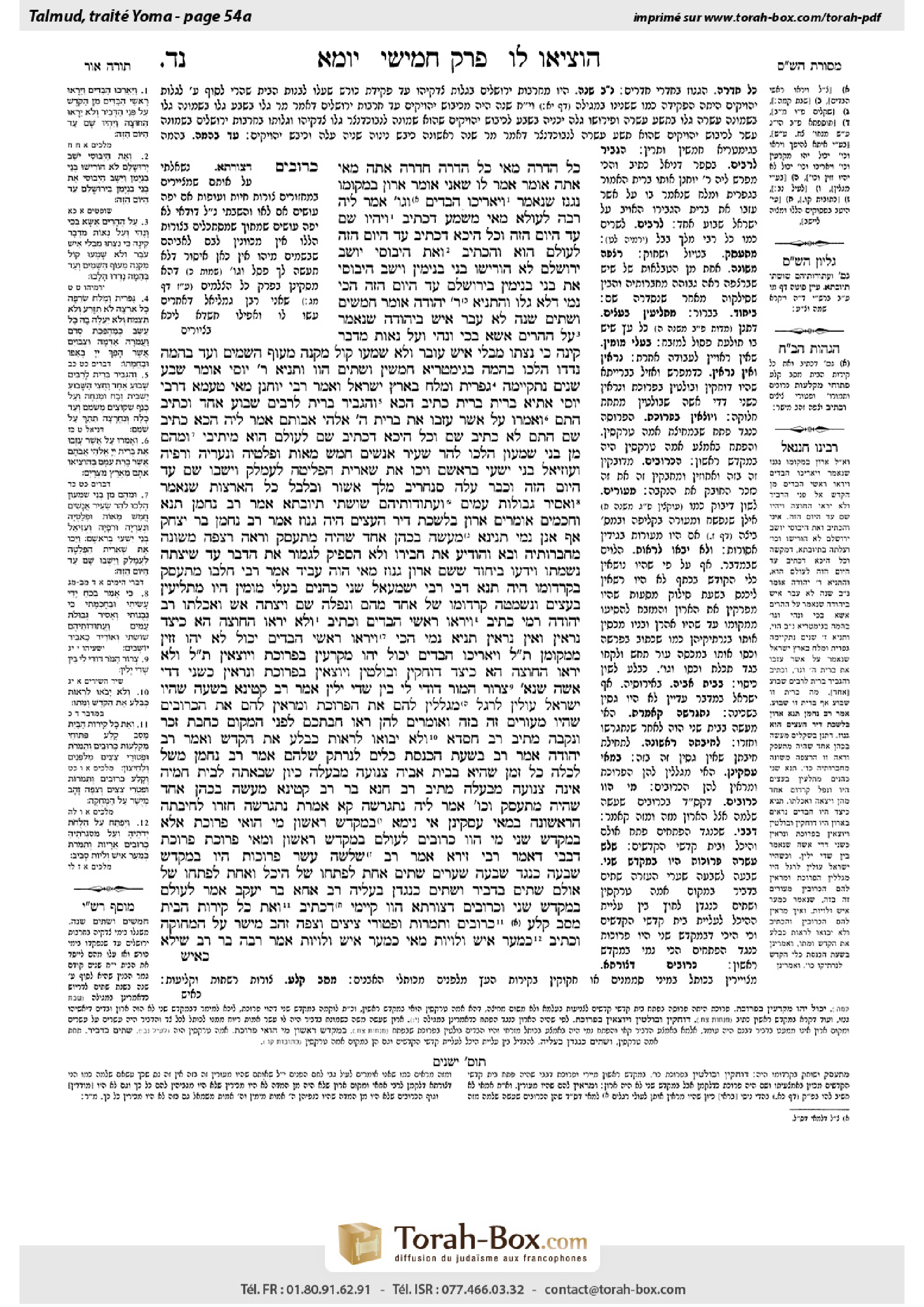
Yoma 54a: Talmud study for Daf Yomi
Daf Yomi is the daily study of one Talmud folio. Explore 37 tractates with scans, Hebrew text, Sefaria English and AI-generated French translations where annotated.
Passage selection and English or AI-generated French translation are available where the scan has annotations. Daf Study is independent of Torah-Box and Sefaria.
Browse Yoma · יומא · All tractatesYoma 54a text and translations
This page of Yoma includes the Aramaic text, an English translation and an AI-generated French translation, alongside the scan above.
יומא נ״ד א · Aramaic and Hebrew text
כׇּל הֲדָרָהּ״. מַאי: ״כׇּל הֲדָרָהּ״ — חַדְרָהּ. אַתָּה, מַאי אַתָּה אוֹמֵר? אָמַר לוֹ, שֶׁאֲנִי אוֹמֵר: אָרוֹן בִּמְקוֹמוֹ נִגְנַז, שֶׁנֶּאֱמַר: ״וַיַּאֲרִיכוּ הַבַּדִּים וְגוֹ׳״.
אֲמַר לֵיהּ רַבָּה לְעוּלָּא: מַאי מַשְׁמַע? דִּכְתִיב: ״וַיִּהְיוּ שָׁם עַד הַיּוֹם הַזֶּה״, וְכׇל הֵיכָא דִּכְתִיב: ״עַד הַיּוֹם הַזֶּה״ לְעוֹלָם הוּא? וְהָכְתִיב: ״וְאֶת הַיְבוּסִי יוֹשֵׁב יְרוּשָׁלִַם לֹא הוֹרִישׁוּ בְּנֵי בִנְיָמִין וַיֵּשֶׁב הַיְבוּסִי אֶת בְּנֵי בִנְיָמִין בִּירוּשָׁלִַם עַד הַיּוֹם הַזֶּה״, הָכִי נָמֵי דְּלָא גְּלוֹ?
וְהָתַנְיָא, רַבִּי יְהוּדָה אוֹמֵר: חֲמִשִּׁים וּשְׁתַּיִם שָׁנָה לֹא עָבַר אִישׁ בִּיהוּדָה, שֶׁנֶּאֱמַר: ״עַל הֶהָרִים אֶשָּׂא בְכִי וָנֶהִי וְעַל נְאוֹת מִדְבָּר קִינָה כִּי נִצְּתוּ מִבְּלִי אִישׁ עוֹבֵר וְלֹא שָׁמְעוּ קוֹל מִקְנֶה מֵעוֹף הַשָּׁמַיִם וְעַד בְּהֵמָה נָדְדוּ הָלָכוּ״, ״בְּהֵמָה״ בְּגִימַטְרִיָּא חַמְשִׁין וּשְׁתַּיִם הָווּ!
וְתַנְיָא, רַבִּי יוֹסֵי אוֹמֵר: שֶׁבַע שָׁנִים נִתְקַיְּימָה גׇּפְרִית וּמֶלַח בְּאֶרֶץ יִשְׂרָאֵל. וְאָמַר רַבִּי יוֹחָנָן: מַאי טַעְמָא דְּרַבִּי יוֹסֵי — אָתְיָא ״בְּרִית״ ״בְּרִית״. כְּתִיב הָכָא: ״וְהִגְבִּיר בְּרִית לָרַבִּים שָׁבוּעַ אֶחָד״, וּכְתִיב הָתָם: ״וְאָמְרוּ עַל אֲשֶׁר עָזְבוּ אֶת בְּרִית ה׳ אֱלֹהֵי אֲבוֹתָם״!
אֲמַר לֵיהּ: הָכָא כְּתִיב ״שָׁם״, הָתָם לָא כְּתִיב ״שָׁם״, וְכׇל הֵיכָא דִּכְתִיב: ״שָׁם״ — לְעוֹלָם הוּא. מֵיתִיבִי: ״וּמֵהֶם מִן בְּנֵי שִׁמְעוֹן הָלְכוּ לְהַר שֵׂעִיר אֲנָשִׁים חֲמֵשׁ מֵאוֹת וּפְלַטְיָה וּנְעַרְיָה וּרְפָיָה וְעוּזִּיאֵל בְּנֵי יִשְׁעִי בְּרֹאשָׁם. וַיַּכּוּ אֶת שְׁאֵרִית הַפְּלֵיטָה לַעֲמָלֵק וַיֵּשְׁבוּ שָׁם עַד הַיּוֹם הַזֶּה״.
וּכְבָר עָלָה סַנְחֵרִיב מֶלֶךְ אַשּׁוּר וּבִלְבֵּל כׇּל הָאֲרָצוֹת, שֶׁנֶּאֱמַר: ״וְאָסִיר גְּבוּלוֹת עַמִּים וַעֲתוּדוֹתֵיהֶם שׁוֹשֵׂתִי״. תְּיוּבְתָּא.
אָמַר רַב נַחְמָן: תָּנָא, וַחֲכָמִים אוֹמְרִים: אָרוֹן בְּלִשְׁכַּת דִּיר הָעֵצִים הָיָה גָּנוּז. אָמַר רַב נַחְמָן בַּר יִצְחָק: אַף אֲנַן נָמֵי תְּנֵינָא: מַעֲשֶׂה בְּכֹהֵן אֶחָד שֶׁהָיָה מִתְעַסֵּק, וְרָאָה רִצְפָּה מְשׁוּנָּה מֵחַבְרוֹתֶיהָ, וּבָא וְהוֹדִיעַ אֶת חֲבֵירוֹ, וְלֹא הִסְפִּיק לִגְמוֹר אֶת הַדָּבָר עַד שֶׁיָּצְתָה נִשְׁמָתוֹ. וְיָדְעוּ בְּיִחוּד שֶׁשָּׁם אָרוֹן גָּנוּז.
מַאי הֲוָה עָבֵיד? אָמַר רַבִּי חֶלְבּוֹ: מִתְעַסֵּק בְּקַרְדּוּמּוֹ הָיָה. תָּנָא דְּבֵי רַבִּי יִשְׁמָעֵאל: שְׁנֵי כֹהֲנִים בַּעֲלֵי מוּמִין הָיוּ מַתְלִיעִין בְּעֵצִים, וְנִשְׁמְטָה קַרְדּוּמּוֹ שֶׁל אֶחָד מֵהֶם וְנָפְלָה שָׁם, וְיָצְתָה אֵשׁ וַאֲכָלַתּוּ.
רַב יְהוּדָה רָמֵי. כְּתִיב: ״וַיֵּרָאוּ רָאשֵׁי הַבַּדִּים״, וּכְתִיב: ״וְלֹא יֵרָאוּ הַחוּצָה״. הָא כֵּיצַד? נִרְאִין וְאֵין נִרְאִין. תַּנְיָא נָמֵי הָכִי: ״וַיֵּרָאוּ רָאשֵׁי הַבַּדִּים״, יָכוֹל לֹא יְהוּ זָזִין מִמְּקוֹמָן — תַּלְמוּד לוֹמַר: ״וַיַּאֲרִיכוּ הַבַּדִּים״, יָכוֹל יְהוּ מְקָרְעִין בַּפָּרוֹכֶת וְיוֹצְאִין — תַּלְמוּד לוֹמַר: ״וְלֹא יֵרָאוּ הַחוּצָה״.
הָא כֵּיצַד? דּוֹחֲקִין וּבוֹלְטִין וְיוֹצְאִין בַּפָּרוֹכֶת, וְנִרְאִין כִּשְׁנֵי דַּדֵּי אִשָּׁה, שֶׁנֶּאֱמַר: ״צְרוֹר הַמּוֹר דּוֹדִי לִי בֵּין שָׁדַי יָלִין״.
אָמַר רַב קַטִּינָא: בְּשָׁעָה שֶׁהָיוּ יִשְׂרָאֵל עוֹלִין לָרֶגֶל, מְגַלְּלִין לָהֶם אֶת הַפָּרוֹכֶת, וּמַרְאִין לָהֶם אֶת הַכְּרוּבִים שֶׁהָיוּ מְעוֹרִים זֶה בָּזֶה, וְאוֹמְרִים לָהֶן: רָאוּ חִבַּתְכֶם לִפְנֵי הַמָּקוֹם כְּחִבַּת זָכָר וּנְקֵבָה.
מֵתִיב רַב חִסְדָּא: ״וְלֹא יָבוֹאוּ לִרְאוֹת כְּבַלַּע אֶת הַקֹּדֶשׁ״, וְאָמַר רַב יְהוּדָה אָמַר רַב: בִּשְׁעַת הַכְנָסַת כֵּלִים לְנַרְתֵּק שֶׁלָּהֶם!
אָמַר רַב נַחְמָן: מָשָׁל לְכַלָּה, כׇּל זְמַן שֶׁהִיא בְּבֵית אָבִיהָ צְנוּעָה מִבַּעְלָהּ. כֵּיוָן שֶׁבָּאתָה לְבֵית חָמִיהָ — אֵינָהּ צְנוּעָה מִבַּעְלָהּ.
מֵתִיב רַב חָנָא בַּר רַב קַטִּינָא: מַעֲשֶׂה בְּכֹהֵן אֶחָד שֶׁהָיָה מִתְעַסֵּק וְכוּ׳! אֲמַר לֵיהּ: נִתְגָּרְשָׁה קָא אָמְרַתְּ, נִתְגָּרְשָׁה חָזְרוּ לְחִיבָּתָהּ הָרִאשׁוֹנָה.
בְּמַאי עָסְקִינַן? אִי נֵימָא בְּמִקְדָּשׁ רִאשׁוֹן — מִי הֲוַאי פָּרוֹכֶת? אֶלָּא בְּמִקְדָּשׁ שֵׁנִי — מִי הֲווֹ כְּרוּבִים? לְעוֹלָם בְּמִקְדָּשׁ רִאשׁוֹן, וּמַאי פָּרוֹכֶת — פָּרוֹכֶת דְּבָבֵי.
דְּאָמַר רַבִּי זֵירָא אָמַר רַב: שְׁלֹשָׁה עָשָׂר פָּרוֹכוֹת הָיוּ בְּמִקְדָּשׁ, שִׁבְעָה כְּנֶגֶד שִׁבְעָה שְׁעָרִים, שְׁתַּיִם — אַחַת לְפִתְחוֹ שֶׁל הֵיכָל, וְאַחַת לְפִתְחוֹ שֶׁל אוּלָם. שְׁתַּיִם בַּדְּבִיר, וּשְׁתַּיִם כְּנֶגְדָּן בָּעֲלִיָּה.
רַב אַחָא בַּר יַעֲקֹב אָמַר: לְעוֹלָם בְּמִקְדָּשׁ שֵׁנִי, וּכְרוּבִים דְּצוּרְתָּא הֲווֹ קָיְימִי, דִּכְתִיב: ״וְאֶת כׇּל קִירוֹת הַבַּיִת מֵסַב קָלַע כְּרוּבִים וְתִמֹרוֹת וּפְטוּרֵי צִיצִּים וְצִפָּה זָהָב מְיֻשָּׁר עַל הַמְּחוּקֶּה״.
וּכְתִיב: ״כְּמַעַר אִישׁ וְלוֹיוֹת״. מַאי ״כְּמַעַר אִישׁ וְלוֹיוֹת״? אָמַר רַבָּה בַּר רַב שֵׁילָא:
Yoma 54a · English translation
all her splendor” (Lamentations 1:6). What is the meaning of: “All her splendor [hadara]”? It means: Her chamber [ḥadra], i.e., something that was hidden within the innermost chambers, namely the Ark. You, Rabbi Shimon ben Yoḥai, what do you say in response to this? He said to him: As I say, the Ark was buried in its place and not exiled, as it is stated: “And the staves were so long that the ends of the staves were seen from the sacred place before the partition, but they could not be seen without; and they are there to this day” (I Kings 8:8).
Rabba said to Ulla: From where in this verse may it be inferred that the Ark was buried in its place? Ulla replied that the source is as it is written: “And they are there to this day,” which is referring to any day when one might read this sentence, i.e., forever. Rabba objected to this explanation: And is it the case that anywhere that it is written “to this day” it means forever, as opposed to the time when the verse was written? But isn’t it written: “And the children of Benjamin did not drive out the Jebusites who inhabited Jerusalem; but the Jebusites dwelt with the children of Benjamin in Jerusalem, to this day” (Judges 1:21)? So too here, let us say that the Jebusites were not exiled from Jerusalem.
But wasn’t it taught in a baraita that Rabbi Yehuda says: No person passed through the land of Judea for fifty-two years after the destruction of the Temple by Nebuchadnezzar, as it is stated: “I will raise crying and wailing for the mountains, and a lamentation for the pastures of the wilderness, for they have been burned, with no person passing through. And they do not hear the sound of the cattle; from the bird of the heavens to the beast [behema], all have fled and gone” (Jeremiah 9:9). Behema, spelled beit, heh, mem, heh, has a numerical value of fifty-two, alluding to the fact that no one passed through the land for fifty-two years.
And it was taught in another baraita that Rabbi Yosei says: For seven years a curse of brimstone and salt endured in Eretz Yisrael, rendering it unfit for human habitation. And Rabbi Yoḥanan said: What is the rationale of Rabbi Yosei; from where does he learn this? It is derived from a verbal analogy between “covenant” and “covenant.” It is written here: “And he shall make a firm covenant with many for one week” (Daniel 9:27), i.e., seven years. And it is written there: “And that its entire land is brimstone and salt…They shall say: Because they forsook the covenant of the Lord, the God of their fathers” (Deuteronomy 29:22; 24). Evidently, the Jebusites must have been exiled from Jerusalem, which proves that the phrase “to this day” does not always mean forever.
Ulla said to him: Here, with regard to the Ark, it is written: “And they are there”; whereas there, in the verse that deals with the Jebusites, it is not written. And anywhere that “there” is written with the phrase “to this day” it means forever. The Gemara raises an objection from the following verse: “And some of them, even of the sons of Simeon, five hundred men, went to Mount Seir having for their captains Pelatiah and Neariah and Rephaiah and Uzziel, the sons of Ishi. And they smote the remnant of the Amalekites who escaped, and dwelt there to this day” (I Chronicles 4:42–43).
The Gemara explains its objection: But Sennacherib, king of Assyria, had already come, and through his policy of forced population transfer he had scrambled all the nations of the lands, as it is stated in reference to Sennacherib: “And I have removed the bounds of the peoples, and have robbed their treasures” (Isaiah 10:13). This indicates that the children of Simeon were also exiled, despite the fact that the verse states: “There to this day.” The Gemara concludes: Indeed, this is a conclusive refutation of Ulla’s statement.
Rav Naḥman said that a Sage taught in the Tosefta: And the Rabbis say that the Ark of the Covenant was buried in the Chamber of the Woodshed. Rav Naḥman bar Yitzḥak said: We, too, have learned in a mishna: There was an incident involving a certain priest who was occupied with various matters, and he saw a floor tile in the woodshed that was different from the others. One of the marble floor tiles was higher than the rest, suggesting it had been lifted out and replaced. He came and informed his friend of the uneven tile, but was unable to finish his report and provide the exact location of the tile before his soul departed from his body. And consequently they knew definitively that the Ark was buried there, but its location was meant to be kept secret.
The Gemara asks: What was he doing, that priest who noticed the misplaced tile? Rabbi Ḥelbo said: He was occupied with his axe, i.e., he was banging the floor with his axe. He thereby discovered an empty space under a tile, which he guessed was the opening of a tunnel. The school of Rabbi Yishmael taught: Two blemished priests were sorting wormy wood when the axe of one of them dropped and fell there, into the hole in the floor. Blemished priests were appointed to inspect the wood for worms, as these logs were unfit for use on the altar. And fire burst out and consumed that priest, so the exact location remains unknown.
§ Rabbi Yehuda raised a contradiction. It is written: “The ends of the staves were seen,” and it is written in that same verse: “But they could not be seen without” (I Kings 8:8). How can one reconcile this contradiction? They were seen and yet not seen, i.e., the staves were partially visible. This was also taught in a baraita: “The ends of the staves were seen”; one might have thought that they did not move from their position and did not protrude at all. Therefore, the verse states: “And the staves were so long.” One might have thought that they ripped through the curtain and emerged on the other side; therefore, the verse states: “They could not be seen without.”
How is this so? The staves of the Ark pushed and protruded and stuck out against the curtain toward the outside, and appeared like the two breasts of a woman pushing against her clothes. As it is stated: “My beloved is to me like a bundle of myrrh, that lies between my breasts” (Song of Songs 1:13). For this reason the Ark of the Covenant, where the Divine Presence rests, is positioned so that its staves protrude through the curtain, like the breasts of a woman.
Continuing the previous discussion, Rav Ketina said: When the Jewish people would ascend for one of the pilgrimage Festivals, the priests would roll up the curtain for them and show them the cherubs, which were clinging to one another, and say to them: See how you are beloved before God, like the love of a male and female. The two cherubs symbolize the Holy One, Blessed be He, and the Jewish people.
Rav Ḥisda raised an objection: How could the priests allow the people to see this? After all, it is stated with regard to the Tabernacle: “But they shall not go in to see the sacred objects as they are being covered, lest they die” (Numbers 4:20), and Rav Yehuda said that Rav said: When the vessels were put into their containers for transport, it was prohibited even for the Levites to look at them. The prohibition against viewing the vessels should be even more severe when they are fixed in their sacred place within the Temple. How could they be publicly displayed?
Rav Naḥman said in answer: This is analogous to a bride; as long as she is engaged but still in her father’s house, she is modest in the presence of her husband. However, once she is married and comes to her father-in-law’s house to live with her husband, she is no longer modest in the presence of her husband. Likewise, in the wilderness, when the Divine Presence did not dwell in a permanent place, it was prohibited to see the sacred objects. By contrast, all were allowed to see the sacred objects in their permanent place in the Temple.
Rav Ḥana bar Rav Ketina raised an objection from the aforementioned mishna: There was an incident involving a certain priest who was occupied and discovered the place where the Ark was hidden, and he subsequently died before he could reveal its location. Since he was prevented from seeing the Ark, it was evidently prohibited to see the sacred objects even after the Temple was built. Rav Naḥman said to him: This is not difficult, as you are speaking of when she was divorced. Since the Jewish people were exiled after the destruction of the First Temple, they are compared to a woman divorced from her husband, and when a woman is divorced she returns to her original beloved but reserved state. She is once again modest and does not reveal herself. Likewise, the Divine Presence will remain hidden until the glory of the First Temple is restored.
The Gemara poses a question concerning Rav Ketina’s statement: With what are we dealing here; in what circumstance did the priests roll up the curtain to show everyone the cherubs? If we say this is referring to the First Temple, was there a curtain between the Sanctuary and the Holy of Holies? In the First Temple, there was a wall there. Rather, we will say this is referring to the Second Temple; but were there cherubs there? Since there was no Ark, it follows that there were no cherubs on it. The Gemara answers: Actually, Rav Ketina is referring to the First Temple, and what is the curtain that he mentioned? It is the curtain of the gates. For all of the Jewish people to be able to see, they had to raise the curtains hanging on all the gates.
As Rabbi Zeira said that Rav said: There were thirteen curtains in the Second Temple: Seven opposite, i.e., on the inside of, seven gates; two additional ones within the Temple, one of which was at the entrance to the Sanctuary and the other one of which was at the entrance to the Entrance Hall. Two additional curtains were within the partition, in the Holy of Holies in place of the one-cubit partition, and two corresponding to them were above in the upper chamber. Above the Holy of Holies, there was another level in the same layout as the one below, and a curtain was affixed there, too, as no one climbed up to the higher chamber above the Holy of Holies without a pressing need. These curtains were most likely hanging in the First Temple as well.
Rav Aḥa bar Ya’akov said: Actually, Rav Ketina’s statement is referring to the Second Temple: There was a curtain at the entrance of the Holy of Holies, and indeed there were images of cherubs there, i.e., drawn or engraved pictures of the cherubs on the walls. As it is written: “And he carved all the walls of the house round about with carved figures of cherubs and palm trees and open flowers, within and without” (I Kings 6:29), and it is further stated: “And he overlaid them with gold fitted upon the graven work” (I Kings 6:35), which teaches that in addition to the cherubs within the sacred place, other cherubs were drawn on the walls.
And it is written: “According to the space of each with loyot” (I Kings 7:36). The Gemara asks: What is the meaning of: “According to the space of each with loyot”? Rabba bar Rav Sheila said:
Yoma 54a · Traduction française (IA)
« toute sa splendeur » (Lamentations 1,6). Que signifie « toute sa splendeur [hadara] » ? Cela désigne sa chambre [ḥadra], c’est-à-dire quelque chose qui était caché dans les pièces les plus intérieures : l’Arche. Et toi, Rabbi Shimon ben Yoḥai, que réponds-tu à cela ? Il lui dit : Comme je l’affirme, l’Arche fut enfouie à son emplacement et ne fut pas emportée en exil, ainsi qu’il est dit : « Les barres étaient si longues que leurs extrémités se voyaient depuis le lieu saint, devant le voile, mais on ne pouvait les voir de l’extérieur ; elles y sont encore aujourd’hui » (I Rois 8,8).
Rabba dit à Ulla : D’où peut-on déduire de ce verset que l’Arche fut enfouie à son emplacement ? Ulla répondit que la source est l’expression « et elles y sont encore aujourd’hui », qui désigne tout jour où l’on pourrait lire cette phrase, c’est-à-dire pour toujours. Rabba objecta : Est-il vrai que partout où il est écrit « jusqu’à ce jour », cela signifie « pour toujours », et non pas seulement jusqu’à l’époque où le verset fut écrit ? N’est-il pas écrit : « Les fils de Benjamin ne chassèrent pas les Jébuséens qui habitaient Jérusalem ; les Jébuséens habitèrent avec les fils de Benjamin à Jérusalem jusqu’à ce jour » (Juges 1,21) ? De même ici, dirions-nous que les Jébuséens ne furent pas exilés de Jérusalem ?
Mais n’a-t-il pas été enseigné dans une baraïta que Rabbi Yehuda dit : Personne ne traversa le pays de Judée pendant cinquante-deux ans après la destruction du Temple par Nabuchodonosor, ainsi qu’il est dit : « Je ferai entendre des cris et des lamentations sur les montagnes, et une complainte sur les pâturages du désert, car ils ont été brûlés, sans que personne y passe. On n’y entend pas le bruit du bétail ; depuis l’oiseau du ciel jusqu’à la bête [behema], tous ont fui et sont partis » (Jérémie 9,9). Behema, qui s’écrit avec les lettres beit, hé, mem, hé, a une valeur numérique de cinquante-deux, ce qui indique que personne ne traversa le pays pendant cinquante-deux ans.
Et il a été enseigné dans une autre baraïta que Rabbi Yosei dit : Pendant sept ans, une malédiction de soufre et de sel sévit en Eretz Israël, la rendant impropre à l’habitation humaine. Rabbi Yoḥanan dit : Quel est le fondement de l’opinion de Rabbi Yosei ? De quoi la déduit-il ? On l’établit au moyen d’une analogie verbale entre « alliance » et « alliance ». Il est écrit ici : « Il conclura une alliance ferme avec beaucoup pendant une semaine » (Daniel 9,27), c’est-à-dire sept ans. Et il est écrit là : « Tout son pays sera soufre et sel… Ils diront : Parce qu’ils ont abandonné l’alliance du Seigneur, Dieu de leurs pères » (Deutéronome 29,22 ; 24). De toute évidence, les Jébuséens durent être exilés de Jérusalem, ce qui prouve que l’expression « jusqu’à ce jour » ne signifie pas toujours « pour toujours ».
Ulla lui dit : Ici, au sujet de l’Arche, il est écrit : « Et elles y sont », tandis que là, dans le verset concernant les Jébuséens, ce n’est pas écrit. Partout où « là » est écrit avec l’expression « jusqu’à ce jour », cela signifie « pour toujours ». La Guemara soulève une objection à partir du verset suivant : « Certains d’entre eux, des fils de Siméon, cinq cents hommes, allèrent au mont Séïr, ayant pour chefs Pelatiah, Neariah, Rephaiah et Uzziel, fils d’Ishi. Ils frappèrent le reste des Amalécites qui avaient échappé, et s’y établirent jusqu’à ce jour » (I Chroniques 4,42-43).
La Guemara explique son objection : Or Sennachérib, roi d’Assyrie, était déjà venu et, par sa politique de transfert forcé des populations, avait bouleversé toutes les nations des pays, ainsi qu’il est dit à son sujet : « J’ai déplacé les frontières des peuples et pillé leurs trésors » (Isaïe 10,13). Cela indique que les fils de Siméon furent eux aussi exilés, bien que le verset dise : « Ils s’y établirent jusqu’à ce jour ». La Guemara conclut : En effet, c’est une réfutation décisive de l’affirmation d’Ulla.
Rav Naḥman dit qu’un Sage a enseigné dans la Tossefta : Les Sages disent que l’Arche de l’Alliance fut enfouie dans la Chambre du Bois. Rav Naḥman bar Yitzḥak dit : Nous aussi, nous avons appris dans une Michna : Il arriva qu’un certain prêtre, occupé à diverses tâches, remarqua dans la Chambre du Bois une dalle de sol qui différait des autres. L’une des dalles de marbre était plus élevée que les autres, laissant penser qu’elle avait été soulevée puis remise en place. Il alla informer son compagnon de cette dalle inégale, mais ne put achever son récit ni indiquer son emplacement exact avant que son âme ne quitte son corps. On sut donc avec certitude que l’Arche était enfouie là, mais son emplacement devait rester secret.
La Guemara demande : Que faisait ce prêtre qui avait remarqué la dalle déplacée ? Rabbi Ḥelbo dit : Il s’occupait de sa hache, c’est-à-dire qu’il frappait le sol avec celle-ci. Il découvrit ainsi un espace vide sous une dalle, qu’il supposa être l’entrée d’un tunnel. L’école de Rabbi Yishmael enseigna : Deux prêtres présentant des infirmités triaient du bois véreux lorsque la hache de l’un d’eux tomba dans le trou du sol. Des prêtres présentant des infirmités étaient chargés d’inspecter le bois pour y déceler les vers, car ces bûches ne pouvaient pas être utilisées sur l’autel. Un feu jaillit et consuma ce prêtre ; l’emplacement exact demeure donc inconnu.
§ Rabbi Yehuda souleva une contradiction. Il est écrit : « Les extrémités des barres se voyaient », et il est écrit dans le même verset : « Mais on ne pouvait les voir de l’extérieur » (I Rois 8,8). Comment résoudre cette contradiction ? Elles étaient visibles sans l’être, c’est-à-dire que les barres n’étaient que partiellement visibles. Cela a également été enseigné dans une baraïta : « Les extrémités des barres se voyaient » ; on aurait pu penser qu’elles n’avaient pas bougé de leur position et ne dépassaient pas du tout. Le verset dit donc : « Les barres étaient si longues ». On aurait pu penser qu’elles avaient déchiré le voile et dépassaient de l’autre côté ; le verset dit donc : « On ne pouvait les voir de l’extérieur ».
Comment cela se passait-il ? Les barres de l’Arche poussaient le voile vers l’extérieur, y faisaient saillie et ressemblaient aux deux seins d’une femme pressant contre ses vêtements. Ainsi qu’il est dit : « Mon bien-aimé est pour moi comme un sachet de myrrhe, qui repose entre mes seins » (Cantique des Cantiques 1,13). C’est pourquoi l’Arche de l’Alliance, où réside la Présence divine, était placée de telle manière que ses barres faisaient saillie contre le voile, comme les seins d’une femme.
Poursuivant la discussion précédente, Rav Ketina dit : Lorsque le peuple juif montait pour l’une des fêtes de pèlerinage, les prêtres enroulaient le voile pour lui montrer les chérubins qui s’étreignaient. Ils lui disaient : « Voyez combien vous êtes aimés de Dieu, comme dans l’amour entre un homme et une femme. » Les deux chérubins symbolisent le Saint, béni soit-Il, et le peuple juif.
Rav Ḥisda souleva une objection : Comment les prêtres pouvaient-ils permettre au peuple de voir cela ? En effet, au sujet du Tabernacle, il est dit : « Ils ne doivent pas entrer pour voir les objets sacrés pendant qu’on les recouvre, de peur qu’ils ne meurent » (Nombres 4,20), et Rav Yehuda a dit au nom de Rav : Lorsque les objets étaient placés dans leurs contenants pour être transportés, il était même interdit aux Lévites de les regarder. L’interdiction de regarder les objets devrait être encore plus stricte lorsqu’ils sont installés à demeure dans leur lieu saint, au Temple. Comment pouvaient-ils les montrer au public ?
Rav Naḥman répondit : Cela ressemble au cas d’une fiancée : tant qu’elle est fiancée et demeure dans la maison de son père, elle est pudique en présence de son mari. Cependant, une fois mariée et venue vivre avec son mari dans la maison de son beau-père, elle n’est plus pudique en présence de son mari. De même, dans le désert, lorsque la Présence divine ne résidait pas en un lieu permanent, il était interdit de voir les objets sacrés. En revanche, tous pouvaient les voir à leur emplacement permanent dans le Temple.
Rav Ḥana bar Rav Ketina souleva une objection à partir de la Michna susmentionnée : Il arriva qu’un certain prêtre, occupé à diverses tâches, découvrit l’endroit où l’Arche était cachée, puis mourut avant de pouvoir en révéler l’emplacement. Puisqu’il lui fut impossible de voir l’Arche, il est évident qu’il était interdit de voir les objets sacrés même après la construction du Temple. Rav Naḥman lui dit : Ce n’est pas difficile, car tu parles du cas où elle avait été répudiée. Puisque le peuple juif fut exilé après la destruction du Premier Temple, il est comparé à une femme répudiée par son mari ; or, lorsqu’une femme est répudiée, elle retrouve son état initial de bien-aimée, mais réservée. Elle redevient pudique et ne se dévoile pas. De même, la Présence divine restera cachée jusqu’à ce que la gloire du Premier Temple soit rétablie.
La Guemara pose une question concernant la déclaration de Rav Ketina : De quelle situation s’agit-il ici ? Dans quelles circonstances les prêtres enroulaient-ils le voile pour montrer à tous les chérubins ? Si l’on dit qu’il s’agit du Premier Temple, y avait-il un voile entre le Sanctuaire et le Saint des Saints ? Dans le Premier Temple, il y avait là un mur. Disons plutôt qu’il s’agit du Second Temple ; mais y avait-il des chérubins dans ce Temple ? Puisqu’il n’y avait pas d’Arche, il s’ensuit qu’il n’y avait pas de chérubins sur celle-ci. La Guemara répond : En réalité, Rav Ketina parle du Premier Temple ; et quel est le voile qu’il mentionne ? C’est le voile des portes. Pour que tout le peuple juif puisse voir, il fallait soulever les voiles suspendus à toutes les portes.
Rabbi Zeira a dit au nom de Rav : Il y avait treize voiles dans le Second Temple : sept à l’intérieur des sept portes ; deux autres à l’intérieur du Temple, l’un à l’entrée du Sanctuaire et l’autre à l’entrée du Vestibule. Deux autres voiles se trouvaient dans la cloison, dans le Saint des Saints, à la place de la cloison d’une coudée, et deux voiles leur correspondaient à l’étage supérieur. Au-dessus du Saint des Saints se trouvait un autre niveau, aménagé comme celui du dessous, et un voile y était également fixé, car personne ne montait dans la pièce supérieure, au-dessus du Saint des Saints, sans nécessité impérieuse. Ces voiles étaient probablement suspendus également dans le Premier Temple.
Rav Aḥa bar Ya’akov dit : En réalité, la déclaration de Rav Ketina concerne le Second Temple : il y avait un voile à l’entrée du Saint des Saints, et il y avait effectivement des images de chérubins, c’est-à-dire des représentations peintes ou gravées sur les murs. Ainsi qu’il est écrit : « Il sculpta tout autour les murs de la maison, avec des figures sculptées de chérubins, de palmiers et de fleurs épanouies, à l’intérieur et à l’extérieur » (I Rois 6,29). Il est également dit : « Il les recouvrit d’or ajusté sur les ouvrages sculptés » (I Rois 6,35), ce qui enseigne qu’en plus des chérubins à l’intérieur du lieu saint, d’autres chérubins étaient représentés sur les murs.
Et il est écrit : « Selon l’espace de chacun, avec loyot » (I Rois 7,36). La Guemara demande : Que signifie « selon l’espace de chacun, avec loyot » ? Rabba bar Rav Sheila dit :
Traduction française générée par IA à partir de l’édition anglaise de Sefaria. Vérifie toujours un passage avec le texte source.
Text from Sefaria: William Davidson Edition - Vocalized Aramaic (CC BY NC); William Davidson Edition - English (CC BY NC).