Yoma 60a: Talmud study for Daf Yomi
Daf Yomi is the daily study of one Talmud folio. Explore 37 tractates with scans, Hebrew text, Sefaria English and AI-generated French translations where annotated.
Passage selection and English or AI-generated French translation are available where the scan has annotations. Daf Study is independent of Torah-Box and Sefaria.
Browse Yoma · יומא · All tractatesYoma 60a text and translations
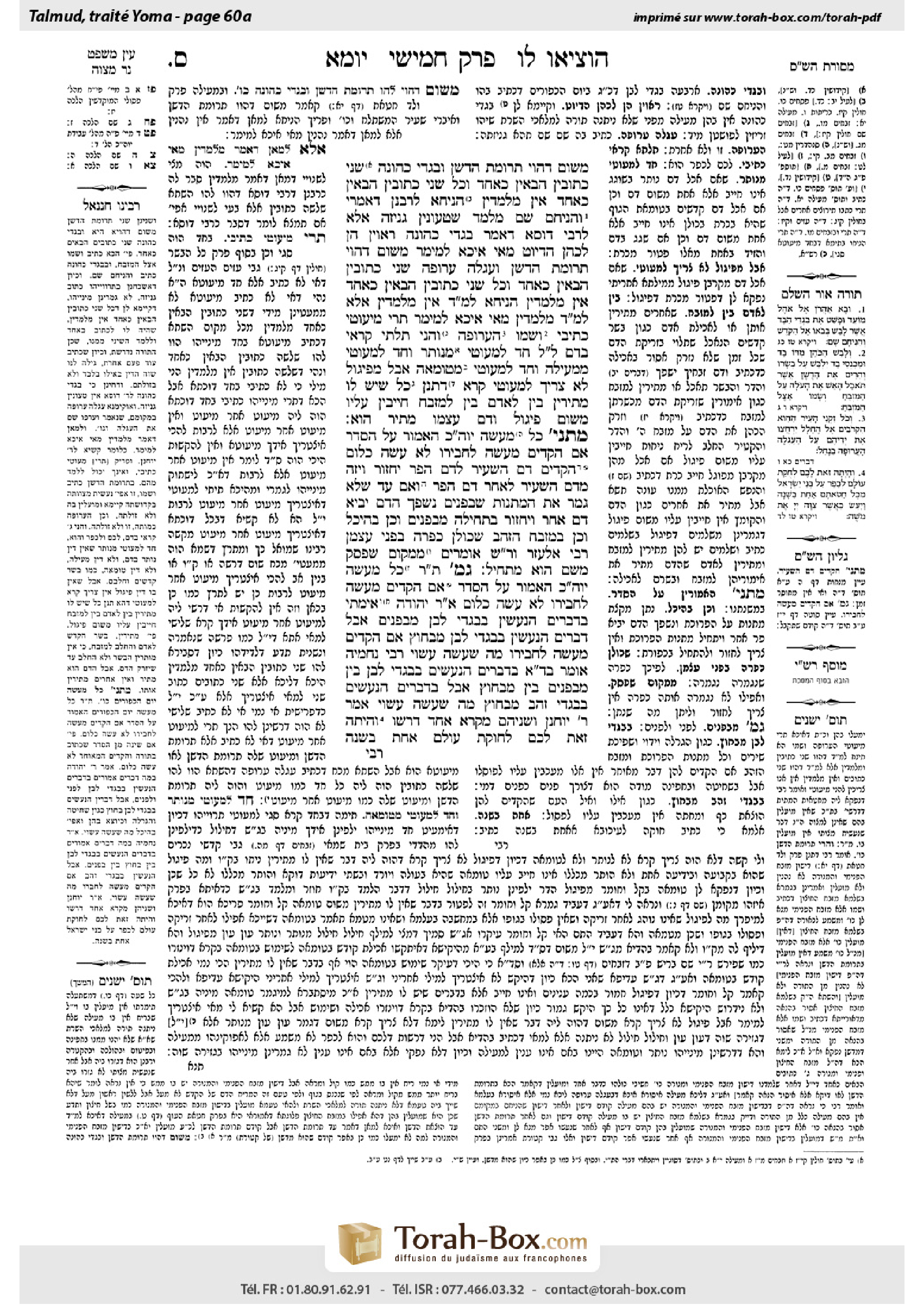
This page of Yoma includes the Aramaic text, an English translation and an AI-generated French translation, alongside the scan above.
יומא ס׳ א · Aramaic and Hebrew text
מִשּׁוּם דְּהָוֵי תְּרוּמַת הַדֶּשֶׁן וּבִגְדֵי כְהוּנָּה שְׁנֵי כְתוּבִין הַבָּאִין כְּאֶחָד, וְכׇל שְׁנֵי כְתוּבִין הַבָּאִין כְּאֶחָד — אֵין מְלַמְּדִין.
הָנִיחָא לְרַבָּנַן, דְּאָמְרִי: ״וְהִנִּיחָם שָׁם״, מְלַמֵּד שֶׁטְּעוּנִין גְּנִיזָה.
אֶלָּא לְרַבִּי דּוֹסָא, דְּאָמַר: בִּגְדֵי כְהוּנָּה רְאוּיִן הֵן לְכֹהֵן הֶדְיוֹט, מַאי אִיכָּא לְמֵימַר?
מִשּׁוּם דְּהָוֵי תְּרוּמַת הַדֶּשֶׁן וְעֶגְלָה עֲרוּפָה שְׁנֵי כְתוּבִין הַבָּאִין כְּאֶחָד, וְכׇל שְׁנֵי כְתוּבִין הַבָּאִין כְּאֶחָד — אֵין מְלַמְּדִין.
הָנִיחָא לְמַאן דְּאָמַר אֵין מְלַמְּדִין, אֶלָּא לְמַאן דְּאָמַר מְלַמְּדִין, מַאי אִיכָּא לְמֵימַר? תְּרֵי מִיעוּטֵי כְּתִיבִי: ״וְשָׂמוֹ״, ״הָעֲרוּפָה״.
וְהָנֵי תְּלָתָא קְרָאֵי בְּדָם — לְמָה לִי?
חַד לְמַעוֹטֵי מִנּוֹתָר, וְחַד לְמַעוֹטֵי מִמְּעִילָה, וְחַד לְמַעוֹטֵי מִטּוּמְאָה.
אֲבָל מִפִּיגּוּל לָא צְרִיךְ לְמַעוֹטֵי קְרָא, דִּתְנַן: כׇּל שֶׁיֵּשׁ לוֹ מַתִּירִין, בֵּין לְאָדָם, בֵּין לְמִזְבֵּחַ — חַיָּיבִין עָלָיו מִשּׁוּם פִּיגּוּל. וְדָם עַצְמוֹ מַתִּיר הוּא.
מַתְנִי׳ כׇּל מַעֲשֵׂה יוֹם הַכִּפּוּרִים הָאָמוּר — עַל הַסֵּדֶר. אִם הִקְדִּים מַעֲשֶׂה לַחֲבֵירוֹ — לֹא עָשָׂה כְּלוּם. הִקְדִּים דַּם הַשָּׂעִיר לְדַם הַפָּר — יַחְזוֹר וְיַזֶּה מִדַּם הַשָּׂעִיר לְאַחַר דַּם הַפָּר. וְאִם עַד שֶׁלֹּא גָּמַר אֶת הַמַּתָּנוֹת שֶׁבִּפְנִים נִשְׁפַּךְ הַדָּם — יָבִיא דָּם אַחֵר, וְיַחְזוֹר בַּתְּחִילָּה מִבִּפְנִים.
וְכֵן בַּהֵיכָל, וְכֵן בְּמִזְבַּח הַזָּהָב — שֶׁכּוּלָּן כַּפָּרָה בִּפְנֵי עַצְמָן. רַבִּי אֶלְעָזָר וְרַבִּי שִׁמְעוֹן אוֹמְרִים: מִמָּקוֹם שֶׁפָּסַק, מִשָּׁם הוּא מַתְחִיל.
גְּמָ׳ תָּנוּ: רַבָּנַן כׇּל מַעֲשֵׂה יוֹם הַכִּפּוּרִים הָאָמוּר — עַל הַסֵּדֶר. אִם הִקְדִּים מַעֲשֶׂה לַחֲבֵירוֹ — לֹא עָשָׂה כְּלוּם. אָמַר רַבִּי יְהוּדָה: אֵימָתַי? בִּדְבָרִים הַנַּעֲשִׂין בְּבִגְדֵי לָבָן מִבִּפְנִים, אֲבָל דְּבָרִים הַנַּעֲשִׂין בְּבִגְדֵי לָבָן מִבַּחוּץ, אִם הִקְדִּים מַעֲשֶׂה לַחֲבֵירוֹ — מַה שֶּׁעָשָׂה עָשׂוּי.
רַבִּי נְחֶמְיָה אוֹמֵר: בַּמֶּה דְּבָרִים אֲמוּרִים — בִּדְבָרִים הַנַּעֲשִׂים בְּבִגְדֵי לָבָן, בֵּין מִבִּפְנִים בֵּין מִבַּחוּץ. אֲבָל בִּדְבָרִים הַנַּעֲשִׂים בְּבִגְדֵי זָהָב מִבַּחוּץ — מַה שֶּׁעָשָׂה עָשׂוּי. אָמַר רַבִּי יוֹחָנָן, וּשְׁנֵיהֶם מִקְרָא אֶחָד דָּרְשׁוּ: ״וְהָיְתָה זֹּאת לָכֶם לְחוּקַּת עוֹלָם אַחַת בַּשָּׁנָה״,
Yoma 60a · English translation
The Gemara answers: The reason is because the mitzva of the removal of the ashes and the priestly vestments, the four white garments worn by the High Priest on Yom Kippur, are both subject to the special halakha that misuse of consecrated objects applies to them even after their mitzva has been performed. Consequently, they are two verses that come as one, i.e., they share a unique halakha not found elsewhere. And there is a principle: Any two verses that come as one do not teach, i.e., an analogy may not be derived from these two similar cases. Instead, they are considered exceptional instances that cannot serve as models for other cases.
The Gemara raises a further difficulty: This works out well according to the opinion of the Rabbis, who say that the verse: “And he shall take off the linen garments, which he wore when he went into the sacred place, and shall leave them there” (Leviticus 16:23), teaches that the four white garments worn by the High Priest on Yom Kippur are not fit for further use, and they require interment.
However, according to the opinion of Rabbi Dosa, who said that these priestly vestments are fit for a common priest and do not require interment, one does not misuse consecrated property by using them, and therefore what is there to say? In his opinion, the halakha of misuse of consecrated objects after the performance of a mitzva applies only to the removal of ashes from the altar, not to the priestly vestments, which means it is stated in only a single case. Why, then, does this case not serve as a model for other instances in the Torah?
The Gemara responds: The reason is because the cases of the removal of the ashes and the heifer whose neck is broken are two verses that come as one, as it is prohibited to derive benefit from either of them even after their mitzva is completed, and any two verses that come as one do not teach their common feature to other cases. The heifer whose neck is broken is a ritual performed when a murder victim’s body is found outside a town, and it is not known who caused his death.
The Gemara challenges this reply from a different angle: It works out well according to the one who said that two verses that come as one do not teach their common feature to other cases, but according to the one who says that two verses that come as one do teach with regard to other cases, what is there to say? The Gemara answers: Two exclusions are written in these two cases, which indicate that this halakha applies to them alone. With respect to the removal of ashes, it states: “And he shall put it” (Leviticus 6:3), implying “it” and nothing else. With regard to the heifer whose neck is broken, it is written: “Whose neck was broken” (Deuteronomy 21:6), which teaches that this halakha applies solely to this case.
The Gemara asks: And if this halakha is derived from those two cases, why do I need these three verses stated with regard to blood, from which it is derived that the prohibition against misuse of consecrated objects does not apply to the remainder of blood that flows to the Kidron River? The reference is to the three phrases singled out above from the verse: “I have given it to you upon the altar to make atonement for your souls, for it is the blood that makes atonement by reason of the life” (Leviticus 17:11).
The Gemara answers: One of those phrases comes to exclude the blood from the prohibition of notar, offerings that remain after the time when they may be eaten has expired. If one ate leftover blood, he is not punished with karet, as generally incurred by one who consumes notar. Rather, he is liable only for violating the prohibition against eating blood. And one phrase comes to exclude it from the prohibition against misuse of consecrated objects, and one other phrase comes to exclude it from ritual impurity. If one ate this blood in a state of ritual impurity, he is liable only for the transgression of eating blood, but not on account of eating consecrated food while ritually impure.
However, no verse is required to exclude this blood from the halakha of piggul, an offering disqualified by improper intention, because this is already derived from another source, as we learned in a mishna: With regard to any offering that has another rite that permits it, e.g., an offering that is permitted by the sprinkling of blood or by means of a second offering, one is liable to receive karet if he eats it after it is rendered piggul. This is the case whether the other rite permits it for human consumption or whether it enables the offering to be sacrificed on the altar. However, the permitting factor itself is not subject to piggul. Consequently, piggul does not apply to blood itself, as it renders the offering permitted for human consumption or for the altar.
MISHNA: Each action performed in the context of the service of Yom Kippur stated in the mishna, as in the Torah, is listed in order. If the High Priest performed one of the actions before another, he has done nothing. If he performed the sprinkling of the blood of the goat before the sprinkling of the blood of the bull, he must repeat the action and sprinkle the blood of the goat after sprinkling the blood of the bull, so that the actions are performed in the proper order. And if the blood spills before he completed the presentations that were sprinkled inside the Holy of Holies, he must slaughter another bull or goat, and bring other blood, and then repeat all the services from the beginning inside the Holy of Holies.
And similarly, if the blood spills before he finishes the presentations in the Sanctuary, he must begin the service in the Sanctuary from the beginning, and likewise with regard to the sprinkling of blood on the golden altar. Since they are each acts of atonement in and of themselves, there is no need to repeat the service of the entire day from the beginning. Rather, he need only repeat the specific element that he failed to complete. Rabbi Elazar and Rabbi Shimon say: From the place that he interrupted that particular service, when the blood spilled, there he resumes performance of that service. In their opinion, each individual sprinkling in each of these services is an act in and of itself, and there is no need to repeat what he has already done.
GEMARA: The Sages taught: Each action performed in the context of the service of Yom Kippur stated in the Torah is listed in order. If the High Priest performed one of the actions before another, he has done nothing. Rabbi Yehuda said: When does this apply? It applies to those actions performed in white garments inside the Sanctuary, e.g., burning the incense and sprinkling the blood, which are the essential services of the day. However, with regard to those actions performed in white garments outside, such as the lottery and the confession, if he performed one action before another, what he did is done and he need not repeat the rite.
In contrast, Rabbi Neḥemya says: In what case is this statement said, that the order is indispensable? It is said with regard to actions performed in white garments, whether inside or outside the Sanctuary. However, with regard to those actions performed in golden garments outside the Sanctuary, the regular Temple service and additional services, if the order was altered, what he did is done. Rabbi Yoḥanan said: And both of them, Rabbi Yehuda and Rabbi Neḥemya, derived their opinions from one verse: “And this shall be an everlasting statute to you, to make atonement for the children of Israel for all their sins once a year” (Leviticus 16:34).
Yoma 60a · Traduction française (IA)
La Guemara répond : La raison en est que la mitsva du retrait des cendres et les vêtements sacerdotaux — les quatre vêtements blancs portés par le grand prêtre à Yom Kippour — sont tous deux soumis à la halakha particulière selon laquelle l’usage profane d’objets consacrés s’applique même après l’accomplissement de la mitsva correspondante. Ce sont donc deux versets qui viennent comme un seul, c’est-à-dire qu’ils partagent une halakha particulière qui ne se trouve nulle part ailleurs. Or, il existe un principe : deux versets qui viennent comme un seul n’enseignent pas, c’est-à-dire qu’on ne peut pas établir d’analogie à partir de ces deux cas similaires. Ils sont plutôt considérés comme des cas exceptionnels qui ne peuvent servir de modèles pour d’autres cas.
La Guemara soulève une difficulté supplémentaire : cela s’explique bien selon l’opinion des rabbins, qui disent que le verset « Il ôtera les vêtements de lin qu’il portait lorsqu’il entrait dans le lieu saint, et les déposera là » (Lévitique 16, 23) enseigne que les quatre vêtements blancs portés par le grand prêtre à Yom Kippour ne peuvent plus être utilisés et doivent être enterrés.
Cependant, selon l’opinion de Rabbi Dosa, qui dit que ces vêtements sacerdotaux peuvent être utilisés par un prêtre ordinaire et n’ont pas besoin d’être enterrés, leur utilisation ne constitue pas un usage profane de biens consacrés. Que peut-on donc répondre ? Selon lui, la halakha de l’usage profane d’objets consacrés après l’accomplissement d’une mitsva ne s’applique qu’au retrait des cendres de l’autel, et non aux vêtements sacerdotaux ; elle n’est donc énoncée que dans un seul cas. Pourquoi, dès lors, ce cas ne sert-il pas de modèle pour d’autres cas dans la Torah ?
La Guemara répond : La raison en est que les cas du retrait des cendres et de la génisse dont la nuque est brisée constituent deux versets qui viennent comme un seul, car il est interdit de tirer profit de l’un comme de l’autre même une fois leur mitsva accomplie ; or, deux versets qui viennent comme un seul n’enseignent pas leur caractéristique commune pour d’autres cas. La génisse dont la nuque est brisée fait l’objet d’un rite accompli lorsque le corps d’une victime de meurtre est découvert hors d’une ville et que l’on ignore qui l’a tuée.
La Guemara conteste cette réponse sous un autre angle : cela s’explique bien selon celui qui dit que deux versets qui viennent comme un seul n’enseignent pas leur caractéristique commune pour d’autres cas ; mais que peut-on répondre selon celui qui dit que deux versets qui viennent comme un seul enseignent quelque chose au sujet d’autres cas ? La Guemara répond : Deux exclusions sont écrites dans ces deux cas et indiquent que cette halakha ne s’applique qu’à eux. Pour le retrait des cendres, il est dit : « Il la déposera » (Lévitique 6, 3), ce qui implique : « elle », et rien d’autre. Concernant la génisse dont la nuque est brisée, il est écrit : « dont la nuque a été brisée » (Deutéronome 21, 6), ce qui enseigne que cette halakha ne s’applique qu’à ce cas.
La Guemara demande : Et si cette halakha se déduit de ces deux cas, pourquoi faut-il les trois expressions énoncées au sujet du sang, desquelles on déduit que l’interdiction d’usage profane d’objets consacrés ne s’applique pas au reste du sang qui s’écoule vers le torrent du Cédron ? Il s’agit des trois expressions relevées plus haut dans le verset : « Je vous l’ai donné sur l’autel pour faire expiation pour vos âmes, car c’est le sang qui fait expiation par la vie » (Lévitique 17, 11).
La Guemara répond : L’une de ces expressions vient exclure le sang de l’interdiction de notar, qui concerne les offrandes restant après l’expiration du délai pendant lequel elles peuvent être consommées. Celui qui mange du sang restant n’encourt pas le karet, peine généralement encourue par celui qui consomme du notar. Il n’est passible que pour avoir enfreint l’interdiction de consommer du sang. Une expression vient l’exclure de l’interdiction d’usage profane d’objets consacrés, et une autre vient l’exclure de l’impureté rituelle. Celui qui mange ce sang alors qu’il est en état d’impureté rituelle n’est passible que pour la transgression consistant à manger du sang, et non pour avoir consommé de la nourriture consacrée en état d’impureté rituelle.
Cependant, aucun verset n’est nécessaire pour exclure ce sang de la halakha du piggoul, une offrande invalidée par une intention incorrecte, car cela se déduit déjà d’une autre source, comme nous l’avons appris dans une Michna : pour toute offrande dont un autre rite rend l’accomplissement valide — par exemple, une offrande rendue permise par l’aspersion du sang ou par une seconde offrande —, celui qui la mange après qu’elle est devenue piggoul encourt le karet. Il en va ainsi que l’autre rite la rende consommable par l’homme ou qu’il permette de l’offrir sur l’autel. Toutefois, l’élément qui rend l’offrande permise n’est pas lui-même susceptible de devenir piggoul. Par conséquent, le piggoul ne s’applique pas au sang lui-même, puisqu’il rend l’offrande permise à la consommation humaine ou à son offrande sur l’autel.
MICHNA : Chaque acte accompli dans le cadre du service de Yom Kippour, tel qu’il est énoncé dans la Michna comme dans la Torah, est présenté dans l’ordre. Si le grand prêtre a accompli un acte avant un autre, il n’a rien fait. S’il a aspergé le sang du bouc avant celui du taureau, il doit recommencer et asperger le sang du bouc après celui du taureau, afin que les actes soient accomplis dans l’ordre requis. Et si le sang se répand avant qu’il ait terminé les aspersions à l’intérieur du Saint des Saints, il doit abattre un autre taureau ou un autre bouc, apporter un autre sang, puis reprendre tous les services depuis le début à l’intérieur du Saint des Saints.
De même, si le sang se répand avant qu’il ait terminé les aspersions dans le Sanctuaire, il doit reprendre le service dans le Sanctuaire depuis le début ; il en va de même pour l’aspersion du sang sur l’autel d’or. Puisque chacun de ces rites constitue en soi un acte d’expiation, il n’est pas nécessaire de reprendre depuis le début le service de toute la journée. Il lui suffit plutôt de reprendre l’élément précis qu’il n’a pas achevé. Rabbi Elazar et Rabbi Shimon disent : Là où il a interrompu ce service particulier, lorsque le sang s’est répandu, c’est à cet endroit qu’il reprend ce service. Selon eux, chaque aspersion individuelle dans chacun de ces services constitue en soi un acte, et il n’est pas nécessaire de répéter ce qu’il a déjà accompli.
GUEMARA : Les Sages ont enseigné : Chaque acte accompli dans le cadre du service de Yom Kippour tel qu’il est énoncé dans la Torah est présenté dans l’ordre. Si le grand prêtre a accompli un acte avant un autre, il n’a rien fait. Rabbi Yehouda a dit : Dans quel cas cela s’applique-t-il ? Aux actes accomplis en vêtements blancs à l’intérieur du Sanctuaire, par exemple la combustion de l’encens et l’aspersion du sang, qui constituent les services essentiels de la journée. Cependant, pour les actes accomplis en vêtements blancs à l’extérieur, tels que le tirage au sort et la confession, s’il a accompli un acte avant un autre, ce qu’il a fait est valable et il n’a pas besoin de répéter le rite.
À l’inverse, Rabbi Neḥemya dit : Dans quel cas cette affirmation est-elle énoncée, à savoir que l’ordre est indispensable ? Elle concerne les actes accomplis en vêtements blancs, à l’intérieur comme à l’extérieur du Sanctuaire. Cependant, pour les actes accomplis en vêtements d’or à l’extérieur du Sanctuaire — le service régulier du Temple et les services supplémentaires —, si l’ordre a été modifié, ce qu’il a fait est valable. Rabbi Yoḥanan a dit : Tous deux, Rabbi Yehouda et Rabbi Neḥemya, ont déduit leurs opinions d’un seul verset : « Ce sera pour vous une loi perpétuelle, afin de faire expiation pour les enfants d’Israël de tous leurs péchés, une fois par an » (Lévitique 16, 34).
Traduction française générée par IA à partir de l’édition anglaise de Sefaria. Vérifie toujours un passage avec le texte source.
Text from Sefaria: William Davidson Edition - Vocalized Aramaic (CC BY NC); William Davidson Edition - English (CC BY NC).