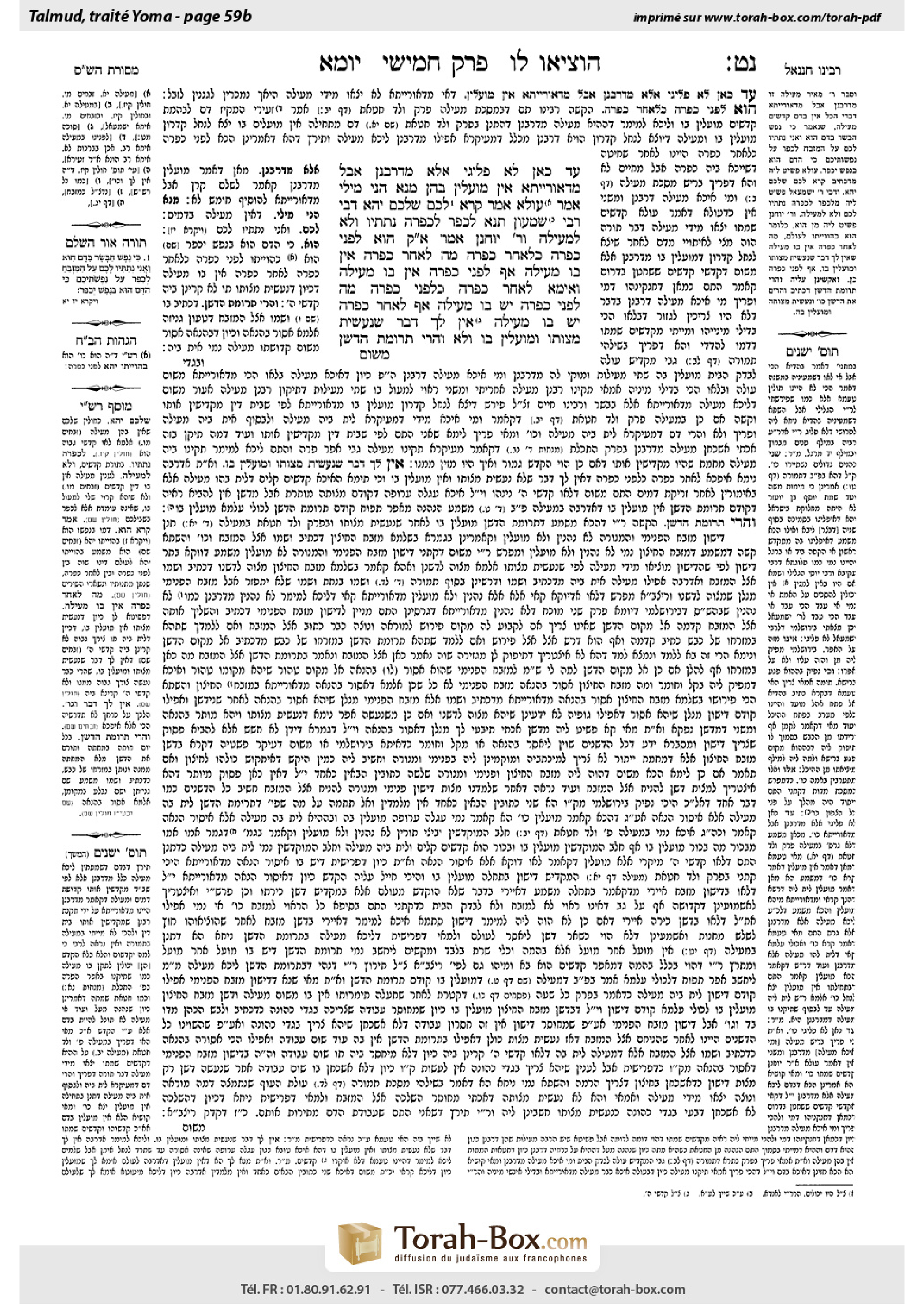
Yoma 59b: Talmud study for Daf Yomi
Daf Yomi is the daily study of one Talmud folio. Explore 37 tractates with scans, Hebrew text, Sefaria English and AI-generated French translations where annotated.
Passage selection and English or AI-generated French translation are available where the scan has annotations. Daf Study is independent of Torah-Box and Sefaria.
Browse Yoma · יומא · All tractatesYoma 59b text and translations
This page of Yoma includes the Aramaic text, an English translation and an AI-generated French translation, alongside the scan above.
יומא נ״ט ב · Aramaic and Hebrew text
עַד כָּאן לָא פְּלִיגִי אֶלָּא מִדְּרַבָּנַן, אֲבָל מִדְּאוֹרָיְיתָא אֵין מוֹעֲלִין בָּהֶן.
מְנָא הָנֵי מִילֵּי? אָמַר עוּלָּא, אָמַר קְרָא: ״לָכֶם״ — שֶׁלָּכֶם יְהֵא. דְּבֵי רַבִּי שִׁמְעוֹן תָּנָא: ״לְכַפֵּר״ — לְכַפָּרָה נְתַתִּיו, וְלֹא לִמְעִילָה.
וְרַבִּי יוֹחָנָן אָמַר, אָמַר קְרָא: ״הוּא״, לִפְנֵי כַפָּרָה כִּלְאַחַר כַּפָּרָה: מָה לְאַחַר כַּפָּרָה אֵין בּוֹ מְעִילָה — אַף לִפְנֵי כַּפָּרָה אֵין בּוֹ מְעִילָה.
וְאֵימָא, לְאַחַר כַּפָּרָה כְּלִפְנֵי כַפָּרָה: מָה לִפְנֵי כַפָּרָה יֵשׁ בּוֹ מְעִילָה — אַף לְאַחַר כַּפָּרָה יֵשׁ בּוֹ מְעִילָה! אֵין לְךָ דָּבָר שֶׁנַּעֲשֵׂית מִצְוָתוֹ וּמוֹעֲלִין בּוֹ. וְלָא? וַהֲרֵי תְּרוּמַת הַדֶּשֶׁן!
Yoma 59b · English translation
The Gemara comments: The Rabbis disagree only with regard to misuse of consecrated property that applies by rabbinic law, as it was the Sages who prohibited the use of blood; however, everyone agrees that by Torah law one does not misuse consecrated property by benefiting from these remainders of blood. Clearly, the Temple treasurers would not have sold it to gardeners ab initio had the Torah prohibited the use of this blood (Tosafot).
The Gemara asks: From where are these matters, that there is no misuse for blood, derived? Ulla said that the verse states: “For the life of the flesh is in the blood, and I have given it to you upon the altar to make atonement for your souls” (Leviticus 17:11). “To you” indicates that it shall be yours. It is not the property of the Temple; rather, it belongs to all of the Jewish people. The school of Rabbi Shimon likewise taught that the phrase “to make atonement” teaches that God says: I gave it for atonement and not for the prohibition against misuse of consecrated objects.
And Rabbi Yoḥanan said that this halakha is derived from a different phrase. The verse states: “For it is the blood that makes atonement by reason of the life” (Leviticus 17:11), which indicates that it retains the same status before atonement as after atonement: Just as after atonement it is not subject to the prohibition against misuse of consecrated objects, as the mitzva has been performed, so too, before atonement it is not subject to misuse of consecrated objects. As the Gemara states below, there is a general principle that once the mitzva involving a certain object has been performed, the object is no longer subject to misuse of consecrated objects.
The Gemara asks: But if the status of blood before atonement is compared to its status after atonement, one can say the opposite: Just as before atonement it is subject to misuse of consecrated objects, so too, after atonement it is subject to misuse of consecrated objects. The Gemara rejects this contention: This cannot be the case, as there is a general principle: There is nothing whose mitzva has been performed that is still subject to misuse of consecrated property. The Gemara asks: And is there no such case? But there is the instance of the removal of the ashes of offerings burned on the altar. These ashes require burial, and yet any benefit derived from them is misuse of consecrated property, despite the fact that their mitzva has already been performed.
Yoma 59b · Traduction française (IA)
La Guemara fait remarquer : les rabbins ne sont en désaccord qu’au sujet de l’interdit d’usage profane des biens consacrés qui relève de la loi rabbinique, car ce sont les Sages qui ont interdit l’usage de ce sang. Toutefois, tous conviennent que, selon la Torah, tirer profit de ces restes de sang ne constitue pas un usage profane des biens consacrés. Il est évident que les trésoriers du Temple ne les auraient pas vendus d’emblée à des jardiniers si la Torah avait interdit l’usage de ce sang (Tosafot).
La Guemara demande : De quelle source déduit-on ces règles, selon lesquelles le sang n’est pas soumis à l’interdit d’usage profane des biens consacrés ? Oulla dit que cela est indiqué par le verset : « Car la vie de la chair est dans le sang, et Je vous l’ai donné sur l’autel pour faire expiation pour vos âmes » (Lévitique 17:11). L’expression « Je vous l’ai donné » indique que le sang vous appartient. Il n’est pas la propriété du Temple ; il appartient plutôt à l’ensemble du peuple juif. L’école de Rabbi Shimon enseignait elle aussi que l’expression « pour faire expiation » enseigne que Dieu dit : « Je vous l’ai donné pour faire expiation, et non pour qu’il soit soumis à l’interdit d’usage profane des objets consacrés. »
Rabbi Yoḥanan dit que cette halakha se déduit d’une autre expression. Le verset dit : « Car c’est le sang qui fait expiation en raison de la vie » (Lévitique 17:11), ce qui indique qu’il conserve le même statut avant et après l’expiation : de même qu’après l’expiation, il n’est pas soumis à l’interdit d’usage profane des objets consacrés, puisque la mitsva a été accomplie, de même, avant l’expiation, il n’est pas soumis à cet interdit. Comme la Guemara l’indiquera plus loin, il existe un principe général selon lequel, une fois accomplie la mitsva liée à un objet donné, celui-ci n’est plus soumis à l’interdit d’usage profane des biens consacrés.
La Guemara demande : Mais si l’on compare le statut du sang avant l’expiation à son statut après l’expiation, on peut soutenir l’inverse : de même qu’avant l’expiation, il est soumis à l’interdit d’usage profane des objets consacrés, de même, après l’expiation, il y est soumis. La Guemara rejette cette affirmation : cela ne peut pas être le cas, car il existe un principe général : aucun objet dont la mitsva a été accomplie ne reste soumis à l’interdit d’usage profane des biens consacrés. La Guemara demande : N’existe-t-il aucun cas de ce genre ? Pourtant, il y a le cas de l’enlèvement des cendres des offrandes brûlées sur l’autel. Ces cendres doivent être enterrées, et pourtant, en tirer profit constitue un usage profane des biens consacrés, bien que la mitsva les concernant ait déjà été accomplie.
Traduction française générée par IA à partir de l’édition anglaise de Sefaria. Vérifie toujours un passage avec le texte source.
Text from Sefaria: William Davidson Edition - Vocalized Aramaic (CC BY NC); William Davidson Edition - English (CC BY NC).