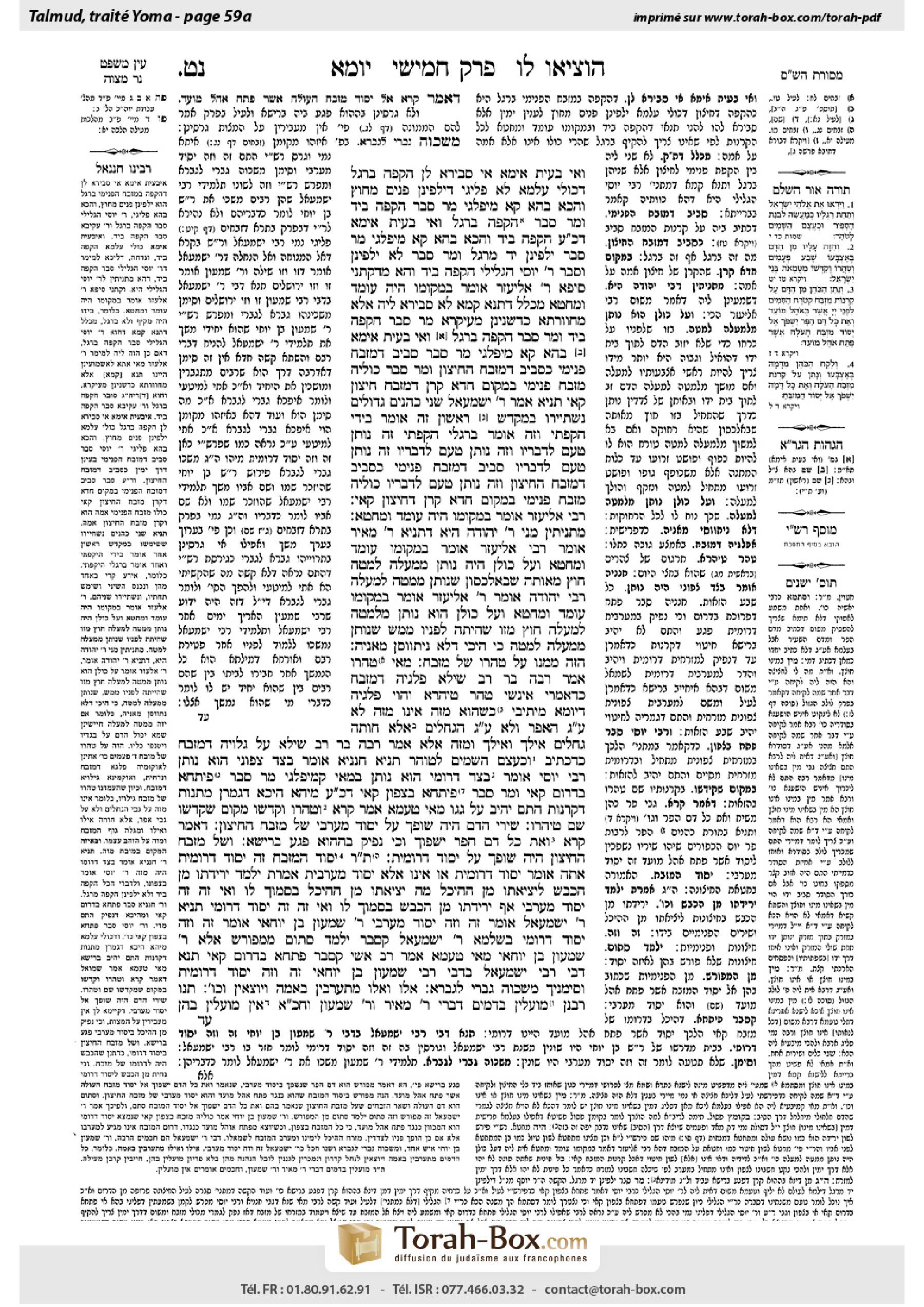
Yoma 59a: Talmud study for Daf Yomi
Daf Yomi is the daily study of one Talmud folio. Explore 37 tractates with scans, Hebrew text, Sefaria English and AI-generated French translations where annotated.
Passage selection and English or AI-generated French translation are available where the scan has annotations. Daf Study is independent of Torah-Box and Sefaria.
Browse Yoma · יומא · All tractatesYoma 59a text and translations
This page of Yoma includes the Aramaic text, an English translation and an AI-generated French translation, alongside the scan above.
יומא נ״ט א · Aramaic and Hebrew text
וְאִי בָּעֵית אֵימָא: אִי סְבִירָא לַן הַקָּפָה בָּרֶגֶל — דְּכוּלֵּי עָלְמָא לָא פְּלִיגִי דְּיָלְפִינַן פְּנִים מִחוּץ. וְהָכָא בְּהָא קָא מִיפַּלְגִי: מָר סָבַר הַקָּפָה בַּיָּד, וּמָר סָבַר הַקָּפָה בָּרֶגֶל.
וְאִי בָּעֵית אֵימָא: דְּכוּלֵּי עָלְמָא הַקָּפָה בַּיָּד, וְהָכָא בְּהָא קָא מִיפַּלְגִי: מָר סָבַר יָלְפִינַן יָד מֵרֶגֶל, וּמָר סָבַר: לָא יָלְפִינַן.
וְסָבַר רַבִּי יוֹסֵי הַגְּלִילִי הַקָּפָה בַּיָּד? וְהָא מִדְּקָתָנֵי סֵיפָא: רַבִּי אֱלִיעֶזֶר אוֹמֵר: בִּמְקוֹמוֹ הָיָה עוֹמֵד וּמְחַטֵּא, מִכְּלָל דְּתַנָּא קַמָּא לָא סְבִירָא לֵיהּ. אֶלָּא מְחַוַּורְתָּא כִדְשַׁנִּינַן מֵעִיקָּרָא: מָר סָבַר הַקָּפָה בַּיָּד, וּמָר סָבַר הַקָּפָה בָּרֶגֶל.
וְאִי בָּעֵית אֵימָא, בְּהָא קָא מִיפַּלְגִי: מָר סָבַר: סָבִיב דְּמִזְבֵּחַ פְּנִימִי כְּסָבִיב דְּמִזְבֵּחַ הַחִיצוֹן, וּמָר סָבַר: כּוּלֵּיהּ מִזְבֵּחַ פְּנִימִי בִּמְקוֹם חֲדָא קֶרֶן דְּמִזְבֵּחַ חִיצוֹן קָאֵי.
תַּנְיָא, אָמַר רַבִּי יִשְׁמָעֵאל: שְׁנֵי כֹהֲנִים גְּדוֹלִים נִשְׁתַּיְּירוּ בְּמִקְדָּשׁ רִאשׁוֹן, זֶה אוֹמֵר: בְּיָדִי הִקַּפְתִּי, וְזֶה אוֹמֵר: בְּרַגְלַי הִקַּפְתִּי. זֶה נוֹתֵן טַעַם לִדְבָרָיו, וְזֶה נוֹתֵן טַעַם לִדְבָרָיו.
זֶה נוֹתֵן טַעַם לִדְבָרָיו: סָבִיב דְּמִזְבֵּחַ פְּנִימִי כְּסָבִיב דְּמִזְבֵּחַ הַחִיצוֹן, וְזֶה נוֹתֵן טַעַם לִדְבָרָיו: כּוּלֵּיהּ מִזְבֵּחַ פְּנִימִי בִּמְקוֹם חֲדָא קֶרֶן דְּחִיצוֹן קָאֵי.
רַבִּי אֱלִיעֶזֶר אוֹמֵר: בִּמְקוֹמוֹ הָיָה עוֹמֵד וּמְחַטֵּא. מַתְנִיתִין מַנִּי — רַבִּי יְהוּדָה הִיא. דְּתַנְיָא, רַבִּי מֵאִיר אוֹמֵר: רַבִּי אֱלִיעֶזֶר אוֹמֵר: בִּמְקוֹמוֹ עוֹמֵד וּמְחַטֵּא, וְעַל כּוּלָּן הָיָה נוֹתֵן מִמַּעְלָה לְמַטָּה, חוּץ מֵאוֹתָהּ שֶׁבַּאֲלַכְסוֹן, שֶׁנּוֹתֵן מִמַּטָּה לְמַעְלָה.
רַבִּי יְהוּדָה אוֹמֵר: רַבִּי אֱלִיעֶזֶר אוֹמֵר: בִּמְקוֹמוֹ עוֹמֵד וּמְחַטֵּא, וְעַל כּוּלָּן הוּא נוֹתֵן מִלְּמַטָּה לְמַעְלָה, חוּץ מִזּוֹ שֶׁהָיְתָה לְפָנָיו מַמָּשׁ, שֶׁנּוֹתֵן מִמַּעְלָה לְמַטָּה, כִּי הֵיכִי דְּלָא נִיתַּוְּוסָן מָאנֵיהּ.
הִזָּה מִמֶּנּוּ עַל טׇהֳרוֹ שֶׁל מִזְבֵּחַ. מַאי ״טׇהֳרוֹ״? אָמַר רַבָּה בַּר רַב שֵׁילָא: פַּלְגֵיהּ דְּמִזְבֵּחַ, כִּדְאָמְרִי אִינָשֵׁי: ״טְהַר טִיהֲרָא וְהָוֵי פַּלְגֵיהּ דְּיוֹמָא״.
מֵיתִיבִי: כְּשֶׁהוּא מַזֶּה — אֵינוֹ מַזֶּה לֹא עַל גַּבֵּי הָאֵפֶר וְלֹא עַל גַּבֵּי הַגֶּחָלִים, אֶלָּא חוֹתֶה גֶּחָלִים אֵילָךְ וְאֵילָךְ, וּמַזֶּה. אֶלָּא אָמַר רַבָּה בַּר רַב שֵׁילָא: עַל גִּלּוּיֵהּ דְּמִזְבֵּחַ, כְּדִכְתִיב: ״וּכְעֶצֶם הַשָּׁמַיִם לָטוֹהַר״.
תַּנְיָא, חֲנַנְיָא אוֹמֵר: בְּצַד צְפוֹנִי הוּא נוֹתֵן, רַבִּי יוֹסֵי אוֹמֵר: בְּצַד דְּרוֹמִי הוּא נוֹתֵן. בְּמַאי קָמִיפַּלְגִי? מָר סָבַר: פִּיתְחָא בְּדָרוֹם קָאֵי, וּמָר סָבַר: פִּיתְחָא בְּצָפוֹן קָאֵי.
דְּכוּלֵּי עָלְמָא מִיהָא, הֵיכָא דְּגָמְרָן מַתָּנוֹת דִּקְרָנוֹת, הָתָם יָהֵיב עַל גַּגּוֹ. מַאי טַעְמָא? אָמַר קְרָא: ״וְטִהֲרוֹ וְקִדְּשׁוֹ״ — מָקוֹם שֶׁקִּדְּשׁוֹ, שָׁם טִיהֲרוֹ.
שְׁיָרֵי הַדָּם הָיָה שׁוֹפֵךְ עַל יְסוֹד מַעֲרָבִי שֶׁל מִזְבֵּחַ הַחִיצוֹן. דְּאָמַר קְרָא: ״וְאֶת כׇּל דַּם הַפָּר יִשְׁפּוֹךְ״, וְכִי נָפֵיק — בְּהָהוּא פָּגַע בְּרֵישָׁא.
וְשֶׁל מִזְבֵּחַ הַחִיצוֹן הָיָה שׁוֹפֵךְ עַל יְסוֹד דְּרוֹמִית. תָּנוּ רַבָּנַן: יְסוֹד הַמִּזְבֵּחַ — זֶה יְסוֹד דְּרוֹמִית. אַתָּה אוֹמֵר יְסוֹד דְּרוֹמִית, אוֹ אֵינוֹ אֶלָּא יְסוֹד מַעֲרָבִית?
אָמַרְתָּ: יִלְמַד יְרִידָתוֹ מִן הַכֶּבֶשׁ לִיצִיאָתוֹ מִן הַהֵיכָל. מָה יְצִיאָתוֹ מִן הַהֵיכָל בְּסָמוּךְ לוֹ, וְאֵי זֶה — זֶה יְסוֹד מַעֲרָבִי, אַף יְרִידָתוֹ מִן הַכֶּבֶשׁ, בְּסָמוּךְ לוֹ, וְאֵי זֶה — זֶה יְסוֹד דְּרוֹמִי.
תַּנְיָא, רַבִּי יִשְׁמָעֵאל אוֹמֵר: זֶה וָזֶה יְסוֹד מַעֲרָבִי. רַבִּי שִׁמְעוֹן בֶּן יוֹחַאי אוֹמֵר: זֶה וָזֶה יְסוֹד דְּרוֹמִי. בִּשְׁלָמָא, רַבִּי יִשְׁמָעֵאל קָסָבַר: יִלְמַד סָתוּם מִמְּפוֹרָשׁ.
אֶלָּא, רַבִּי שִׁמְעוֹן בֶּן יוֹחַאי, מַאי טַעְמָא? אָמַר רַב אָשֵׁי: קָסָבַר פִּתְחָא בְּדָרוֹם קָאֵי.
תָּנָא דְּבֵי רַבִּי יִשְׁמָעֵאל בִּדְבֵי רַבִּי שִׁמְעוֹן בֶּן יוֹחַאי: זֶה וָזֶה יְסוֹד דְּרוֹמִית. וְסִימָנָיךְ: מַשְׁכוּהּ גַּבְרֵי לְגַבְרָא.
אֵלּוּ וָאֵלּוּ מִתְעָרְבִין בָּאַמָּה וְיוֹצְאִין וְכוּ׳. תָּנוּ רַבָּנַן: מוֹעֲלִין בְּדָמִים — דִּבְרֵי רַבִּי מֵאִיר וְרַבִּי שִׁמְעוֹן. וַחֲכָמִים אוֹמְרִים: אֵין מוֹעֲלִין בָּהֶן.
Yoma 59a · English translation
And if you wish, say instead: If we hold that the encircling is performed by foot, i.e., the priest walks around the inner altar, everyone agrees that we learn the method of sprinkling inside from the sprinkling outside. And here they disagree about this matter: One Sage, Rabbi Akiva, holds that the priest stands in his place and sprinkles on all the corners from there, which means his encircling is performed by hand; and one Sage, Rabbi Yosei, holds that the encircling is done by foot.
And if you wish, say instead: Everyone agrees that the encircling was performed by hand, and here they disagree about this matter: One Sage, Rabbi Yosei, holds that we derive the halakhot of an encircling performed by hand from those of an encircling by foot, and therefore the ritual of the inner altar is the same as that of the outer altar. And one Sage, Rabbi Akiva, holds that we do not derive the encircling performed by hand from the encircling done by foot.
§ The Gemara asks: And does Rabbi Yosei HaGelili hold that the encircling is performed by hand? But from the fact that it is taught in the latter clause of the mishna that Rabbi Eliezer says: He stood in one place and sprinkled the blood from there, it can be learned by inference that the first tanna, whom the Gemara identified as Rabbi Yosei HaGelili, does not maintain that the rite is performed in this manner. Rather, it is clear as we originally answered, that one Sage, Rabbi Akiva, holds that the encircling is performed by hand; and one Sage, Rabbi Yosei, holds that the encircling is performed by foot.
And if you wish, say instead that they disagree about this matter: One Sage, Rabbi Akiva, holds that the perimeter of the inner altar is like the perimeter of the outer altar, and one Sage, Rabbi Yosei, holds that the entire inner altar stands in place of one corner of the outer altar. Since the entire inner altar is only one cubit by one cubit, like a single corner of the outer altar, the halakhot of the outer altar are not relevant to the inner altar.
It was taught in a baraita that Rabbi Yishmael said: Two High Priests remained from the days of the First Temple. This one says: I encircled by hand and sprinkled, and I did not encircle the perimeter of the inner altar by foot. And that one says: I encircled by foot. This one gave a reason for his statement, and that one gave a reason for his statement.
The one who said that he encircled by foot gave the following reason for his statement: The perimeter of the inner altar is like the perimeter of the outer altar, which is encircled by foot for sprinkling. And the one who said that he encircled by hand gave the following reason for his statement: The entire inner altar stands in place of one corner of the outer altar. Just as for one corner of the outer altar, the priest sprinkles the blood by hand, the same applies to the entire inner altar.
§ It was taught in the mishna that Rabbi Eliezer says: He stood in one place and sprinkled the blood from there. The Gemara asks: In accordance with whose opinion is the mishna? The Gemara answers: The mishna is taught in accordance with the opinion of Rabbi Yehuda, who explained Rabbi Eliezer’s ruling in the following manner. As it was taught in a baraita, later tanna’im disagreed with regard to the opinion of Rabbi Eliezer. Rabbi Meir says that Rabbi Eliezer says as follows: He stood in one place and sprinkled, and on all of the corners he presented the blood from above downward, so as not to drip blood down the sleeve of his garment, except for that corner on the diagonal [alakhson] across from him. Since it was difficult for him to sprinkle on that corner from top to bottom, he sprinkled from below upward.
Conversely, Rabbi Yehuda says that Rabbi Eliezer says: He stood in one place and sprinkled, and on all of the corners he sprinkled from below upward, as it is more convenient to sprinkle in that manner, except for that one which was directly before him, on which he would present from above downward. The reason is so as not to dirty his garments with blood. If he sprinkled on the corner next to him from below upward, the blood might fall on his clothes, and he would have to change garments, as dirty priestly garments may not be worn for the Temple service.
§ The mishna taught: He sprinkled blood on the pure gold [tohoro] of the altar. The Gemara asks: What is the meaning of the term tohoro? Rabba bar Rav Sheila said: It means half of the altar, as people commonly say: Tehar tihara, the light of noon shines and it is the middle of the day. Here, too, tohoro of the altar means half the altar, i.e., he sprinkled on the midpoint of the altar wall.
The Gemara raises an objection: When he sprinkles on the inner altar, he sprinkles neither on top of the ash nor on top of the coals; rather, he rakes and removes the coals to both sides and sprinkles. This indicates that this sprinkling was performed on top of the altar, not on its side. Rather, Rabba bar Rav Sheila retracted his previous interpretation and said: On tohoro of the altar means on the exposed area of the altar, as it is written: “And the like of the very heaven for clearness [letohar]” (Exodus 24:10), which shows that tohar is an expression of clarity.
§ It was taught in a baraita that Ḥananya says: The priest presents seven sprinklings on the north side of the altar, and Rabbi Yosei says: He presents them on the south side. The Gemara asks: With regard to what principle do they disagree? The Gemara explains: One Sage, Ḥananya, holds that the entrance was positioned in the south, and therefore the High Priest begins the sprinklings from that side. And one Sage, Rabbi Yosei, holds that the entrance was positioned in the north, and he therefore begins to sprinkle on the altar from the north side.
The Gemara comments: Everyone agrees in any case that in the place where he finishes the presentations of the corners, that is where he places the blood on the altar’s top. They disagree only about the location of the final presentation, whether it is on the south or the north side. The Gemara asks: What is the reason for this agreement? The Gemara answers that the verse states: “And he shall sprinkle of the blood upon it with his finger seven times, and cleanse it and sanctify it” (Leviticus 16:19), which indicates that the place he sanctified by sprinkling blood, the corner of the altar where he sprinkled last, there he shall also begin to cleanse and sprinkle on top.
§ The mishna taught: And he would pour the remainder of the blood on the western base of the outer altar. The Gemara explains: The reason is that the verse states with regard to the sin-offering bull of the High Priest during the rest of the year: “And he shall pour out all the blood of the bull at the base of the altar of burnt-offering, which is at the door of the Tent of Meeting” (Leviticus 4:7), and when he goes out from the Sanctuary to pour the remainder of the blood, he first reaches that western side of the base of the altar.
§ The mishna further taught: And he would pour the remaining blood after the blood of an offering was sprinkled on the outer altar, on its southern base. The Sages taught in a baraita: “The base of the altar” (Leviticus 4:30), which is mentioned with regard to pouring the remainder of the blood of an individual offering, is the southern base. Do you say it is the southern base? Or perhaps that is not the case, but rather it is the western base?
You said: Let his descent from the ramp of the outer altar after sprinkling blood from the sin-offerings be derived from his exit from the Sanctuary with the remaining blood in his hand: Just as upon his exit from the Sanctuary he pours the remainder of the blood on the side closest to him, and which is that, it is the western base; so too, upon his descent from the ramp of the outer altar after sprinkling blood from a sin-offering, he pours the blood on the side closest to him, and which is that? It is the southern base, as when he descends from the ramp he turns to the right, i.e., the east, which means the southern base is the one closest to him.
It was taught in a baraita that Rabbi Yishmael says: Both this and that, the blood of an inner sin-offering and that of an outer sin-offering, were spilled at the western base of the altar. Rabbi Shimon ben Yoḥai says: Both this and that blood were spilled at the southern base. The Gemara asks: Granted, Rabbi Yishmael maintains that the halakha of outer sin-offerings, which is not clarified in the Torah, is derived from the inner sin-offerings, whose halakha is explicit: Just as the remains of the inner sprinklings are poured at the western base, so too, the remains of the outer sprinklings are poured at the western base.
However, with regard to Rabbi Shimon ben Yoḥai, what is the reason that he holds that both sets of remainders of blood are spilled at the southern base? Rav Ashi said: Rabbi Shimon ben Yoḥai maintains that the entrance of the Sanctuary is positioned at the south side of the altar, i.e., the altar is not located in the middle of the courtyard but to the north. Consequently, the southern base of the altar is closest to the High Priest’s exit from the Sanctuary.
The school of Rabbi Yishmael taught a different version of his opinion, which they learned in the school of Rabbi Shimon ben Yoḥai: Both this and that, the blood of an inner sin-offering and that of an outer sin-offering, were presented at the southern base. According to this version, Rabbi Yishmael changed his opinion and agreed with Rabbi Shimon. The Gemara comments: And your mnemonic to remember the shift in opinion is: The men pulled the man, i.e., the majority overruled the individual. In this case, the numerous students of Rabbi Shimon convinced the individual Sage, Rabbi Yishmael, to accept their ruling.
§ It was taught in the mishna: These remainders of blood from the outer altar and those remainders of blood from the inner altar are mixed in the canal beneath the altar and flow out with the water used to rinse the area to the Kidron River, where they are sold to gardeners. Any blood that was not redeemed was subject to the prohibition against misuse of consecrated property. The Sages taught: One who takes these remainders without redeeming them misuses property consecrated in the Temple by unlawfully using blood, which is consecrated and is Temple property. It is prohibited to use consecrated objects for mundane purposes, and one who does so is committing the sin of misusing consecrated property. This is the statement of Rabbi Meir and Rabbi Shimon. And the Rabbis say: One does not misuse consecrated property by benefiting from these remainders of the blood of offerings.
Yoma 59a · Traduction française (IA)
Et si tu veux, dis plutôt : Si nous considérons que le circuit se fait à pied, c’est-à-dire que le prêtre contourne l’autel intérieur, tous s’accordent à dire que nous apprenons le mode d’aspersion à l’intérieur de celui de l’aspersion à l’extérieur. Ils sont ici en désaccord sur ce point : Rabbi Akiva tient que le prêtre reste à sa place et asperge tous les angles depuis cet endroit, ce qui signifie que le circuit se fait à la main ; Rabbi Yosei, quant à lui, tient que le circuit se fait à pied.
Et si tu veux, dis plutôt : Tous s’accordent à dire que le circuit se faisait à la main, et ils sont ici en désaccord sur ce point : Rabbi Yosei tient que nous déduisons les halakhot d’un circuit effectué à la main de celles d’un circuit effectué à pied ; le rite de l’autel intérieur est donc identique à celui de l’autel extérieur. Rabbi Akiva, quant à lui, tient que nous ne déduisons pas les règles du circuit effectué à la main de celles du circuit effectué à pied.
§ La Guemara demande : Rabbi Yosei HaGelili tient-il donc que le circuit se fait à la main ? Or, puisque la dernière partie de la Michna enseigne que Rabbi Eliezer dit : « Il se tenait à un seul endroit et aspergeait le sang depuis là », on peut en déduire que le premier tanna, que la Guemara a identifié comme étant Rabbi Yosei HaGelili, ne considère pas que le rite se déroule de cette manière. Il est donc clair, comme nous l’avons répondu initialement, que Rabbi Akiva tient que le circuit se fait à la main, tandis que Rabbi Yosei tient que le circuit se fait à pied.
Et si tu veux, dis plutôt qu’ils sont en désaccord sur ce point : Rabbi Akiva tient que le périmètre de l’autel intérieur est comparable à celui de l’autel extérieur, tandis que Rabbi Yosei tient que l’autel intérieur tout entier occupe la place d’un seul angle de l’autel extérieur. Puisque l’autel intérieur tout entier ne mesure qu’une coudée sur une coudée, comme un seul angle de l’autel extérieur, les halakhot de l’autel extérieur ne s’appliquent pas à l’autel intérieur.
Une baraïta enseigne que Rabbi Yishmael a dit : Deux grands prêtres étaient encore en vie depuis l’époque du Premier Temple. L’un dit : « J’ai fait le circuit à la main et aspergé, sans contourner à pied le périmètre de l’autel intérieur. » L’autre dit : « J’ai fait le circuit à pied. » Chacun donna une raison à son affirmation.
Celui qui disait avoir fait le circuit à pied donna la raison suivante : le périmètre de l’autel intérieur est comparable à celui de l’autel extérieur, que l’on contourne à pied pour l’aspersion. Celui qui disait avoir fait le circuit à la main donna la raison suivante : l’autel intérieur tout entier occupe la place d’un seul angle de l’autel extérieur. De même que, pour un seul angle de l’autel extérieur, le prêtre asperge le sang à la main, il en va de même pour l’autel intérieur tout entier.
§ La Michna enseigne que Rabbi Eliezer dit : « Il se tenait à un seul endroit et aspergeait le sang depuis là. » La Guemara demande : Selon l’opinion de qui la Michna est-elle formulée ? La Guemara répond : La Michna suit l’opinion de Rabbi Yehuda, qui a expliqué la décision de Rabbi Eliezer de la manière suivante. Une baraïta enseigne en effet que des tannaïm ultérieurs étaient en désaccord sur l’opinion de Rabbi Eliezer. Rabbi Meir dit que Rabbi Eliezer enseigne ceci : « Il se tenait à un seul endroit et aspergeait ; à tous les angles, il présentait le sang de haut en bas, afin que le sang ne coule pas le long de la manche de son vêtement, à l’exception de l’angle situé en diagonale [alakhson], en face de lui. Comme il lui était difficile d’asperger cet angle de haut en bas, il aspergeait de bas en haut. »
À l’inverse, Rabbi Yehuda dit que Rabbi Eliezer enseigne ceci : « Il se tenait à un seul endroit et aspergeait ; à tous les angles, il aspergeait de bas en haut, car il est plus facile d’asperger de cette manière, à l’exception de celui qui se trouvait directement devant lui, sur lequel il présentait le sang de haut en bas. » Il agissait ainsi pour ne pas tacher ses vêtements avec le sang. S’il aspergeait de bas en haut l’angle situé près de lui, le sang risquait de tomber sur ses vêtements et il aurait dû en changer, car des vêtements sacerdotaux souillés ne peuvent être portés pour le service du Temple.
§ La Michna enseigne : Il aspergeait le sang sur la partie pure [tohoro] de l’autel. La Guemara demande : Que signifie le terme tohoro ? Rabba bar Rav Sheila a dit : Cela désigne la moitié de l’autel, car les gens disent couramment : Tehar tihara, « la lumière de midi brille », c’est-à-dire que le milieu de la journée est arrivé. Ici aussi, tohoro de l’autel signifie la moitié de l’autel : il aspergeait au milieu du mur de l’autel.
La Guemara soulève une objection : Lorsqu’il asperge sur l’autel intérieur, il n’asperge ni sur les cendres ni sur les braises ; il écarte plutôt les braises des deux côtés et asperge. Cela indique que cette aspersion se faisait sur le dessus de l’autel, et non sur son côté. Rabba bar Rav Sheila revint donc sur son interprétation précédente et dit : « Sur tohoro de l’autel » signifie sur la partie dégagée de l’autel, comme il est écrit : « Et l’éclat du ciel lui-même était d’une grande pureté [letohar] » (Exode 24:10), ce qui montre que tohar exprime la clarté.
§ Une baraïta enseigne que Ḥananya dit : Le prêtre présente les sept aspersions sur le côté nord de l’autel, tandis que Rabbi Yosei dit : Il les présente sur le côté sud. La Guemara demande : Sur quel principe sont-ils en désaccord ? La Guemara explique : Ḥananya tient que l’entrée se trouvait au sud ; le grand prêtre commence donc les aspersions de ce côté. Rabbi Yosei, quant à lui, tient que l’entrée se trouvait au nord ; il commence donc à asperger l’autel du côté nord.
La Guemara fait remarquer : Tous s’accordent, en tout état de cause, à dire que l’endroit où il achève les présentations aux angles est celui où il dépose le sang sur le dessus de l’autel. Ils ne sont en désaccord que sur l’emplacement de la dernière présentation : se trouve-t-elle du côté sud ou du côté nord ? La Guemara demande : Quelle est la raison de cet accord ? La Guemara répond que le verset dit : « Il en aspergera sept fois avec son doigt, purifiera et sanctifiera l’autel » (Lévitique 16:19). Cela indique que l’endroit qu’il a sanctifié en y aspergeant du sang — l’angle de l’autel où il a aspergé en dernier — est aussi celui où il doit commencer à purifier et à asperger sur le dessus.
§ La Michna enseigne : Il versait le reste du sang sur la base occidentale de l’autel extérieur. La Guemara explique que cela découle du verset concernant le taureau offert en sacrifice expiatoire par le grand prêtre pendant le reste de l’année : « Il versera tout le sang du taureau à la base de l’autel de l’holocauste, qui se trouve à l’entrée de la Tente d’assignation » (Lévitique 4:7). Lorsqu’il sort du Sanctuaire pour verser le reste du sang, il atteint d’abord le côté occidental de la base de l’autel.
§ La Michna enseigne encore : Il versait le reste du sang après l’aspersion du sang d’un sacrifice sur l’autel extérieur, à la base méridionale de celui-ci. Les Sages enseignent dans une baraïta : « La base de l’autel » (Lévitique 4:30), mentionnée à propos du versement du reste du sang d’un sacrifice individuel, désigne la base méridionale. Dis-tu qu’il s’agit de la base méridionale ? Ou peut-être n’en est-il pas ainsi, et s’agit-il plutôt de la base occidentale ?
Tu as dit : Déduisons la destination du sang lors de la descente de la rampe de l’autel extérieur après l’aspersion du sang des sacrifices expiatoires de celle du reste du sang qu’il tient à la main lorsqu’il sort du Sanctuaire. De même qu’en sortant du Sanctuaire, il verse le reste du sang du côté le plus proche de lui — et lequel est-ce ? C’est la base occidentale —, de même, en descendant la rampe de l’autel extérieur après l’aspersion du sang d’un sacrifice expiatoire, il verse le sang du côté le plus proche de lui. Et lequel est-ce ? C’est la base méridionale, car en descendant de la rampe, il tourne à droite, c’est-à-dire vers l’est ; la base méridionale est donc celle qui est la plus proche de lui.
Une baraïta enseigne que Rabbi Yishmael dit : Le sang des deux sacrifices, celui du sacrifice expiatoire intérieur et celui du sacrifice expiatoire extérieur, était versé à la base occidentale de l’autel. Rabbi Shimon ben Yoḥai dit : Le sang des deux sacrifices était versé à la base méridionale. La Guemara demande : On comprend que Rabbi Yishmael considère que la halakha relative aux sacrifices expiatoires extérieurs, qui n’est pas précisée dans la Torah, se déduit de celle des sacrifices expiatoires intérieurs, dont la halakha est explicite : de même que le reste des aspersions intérieures est versé à la base occidentale, le reste des aspersions extérieures est lui aussi versé à la base occidentale.
Mais concernant Rabbi Shimon ben Yoḥai, quelle est la raison pour laquelle il tient que les deux restes de sang sont versés à la base méridionale ? Rav Ashi a dit : Rabbi Shimon ben Yoḥai tient que l’entrée du Sanctuaire se trouvait du côté sud de l’autel, c’est-à-dire que l’autel n’était pas situé au milieu du parvis, mais au nord. Par conséquent, la base méridionale de l’autel est la plus proche de la sortie du grand prêtre du Sanctuaire.
L’école de Rabbi Yishmael a enseigné une autre version de son opinion, transmise à l’école de Rabbi Shimon ben Yoḥai : Le sang des deux sacrifices, celui du sacrifice expiatoire intérieur et celui du sacrifice expiatoire extérieur, était versé à la base méridionale. Selon cette version, Rabbi Yishmael a changé d’avis et s’est rangé à l’opinion de Rabbi Shimon. La Guemara fait remarquer que le moyen mnémotechnique pour se rappeler ce changement d’opinion est : « Les hommes ont entraîné l’homme », c’est-à-dire que la majorité a prévalu sur l’individu. Dans ce cas, les nombreux élèves de Rabbi Shimon ont convaincu le Sage isolé, Rabbi Yishmael, d’accepter leur décision.
§ La Michna enseigne : Ces restes de sang provenant de l’autel extérieur et ceux provenant de l’autel intérieur se mêlent dans le canal situé sous l’autel et s’écoulent avec l’eau utilisée pour laver la zone jusqu’au fleuve Kidron, où ils sont vendus aux jardiniers. Tout sang qui n’avait pas été racheté était soumis à l’interdiction d’utiliser illicitement des biens consacrés. Les Sages enseignent : Celui qui prend ces restes sans les racheter commet un détournement de biens consacrés au Temple, en faisant un usage illicite du sang, qui est consacré et appartient au Temple. Il est interdit d’utiliser des objets consacrés à des fins profanes, et celui qui le fait commet le péché de détournement de biens consacrés. Telle est la déclaration de Rabbi Meir et de Rabbi Shimon. Les Sages disent, quant à eux, qu’on ne commet pas de détournement de biens consacrés en tirant profit de ces restes du sang des sacrifices.
Traduction française générée par IA à partir de l’édition anglaise de Sefaria. Vérifie toujours un passage avec le texte source.
Text from Sefaria: William Davidson Edition - Vocalized Aramaic (CC BY NC); William Davidson Edition - English (CC BY NC).