Yoma 58b: Talmud study for Daf Yomi
Daf Yomi is the daily study of one Talmud folio. Explore 37 tractates with scans, Hebrew text, Sefaria English and AI-generated French translations where annotated.
Passage selection and English or AI-generated French translation are available where the scan has annotations. Daf Study is independent of Torah-Box and Sefaria.
Browse Yoma · יומא · All tractatesYoma 58b text and translations
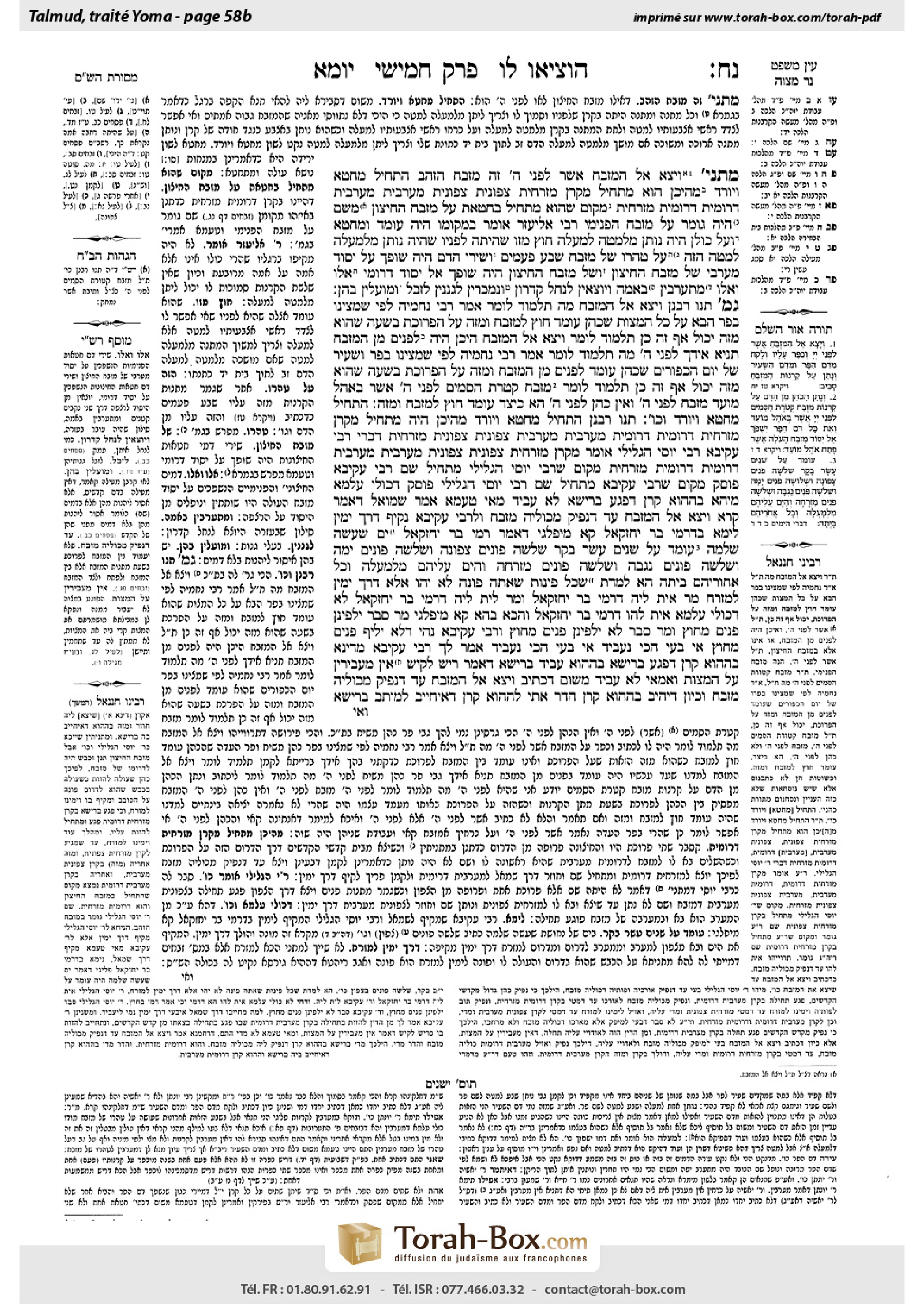
This page of Yoma includes the Aramaic text, an English translation and an AI-generated French translation, alongside the scan above.
יומא נ״ח ב · Aramaic and Hebrew text
מַתְנִי׳ ״וְיָצָא אֶל הַמִּזְבֵּחַ אֲשֶׁר לִפְנֵי ה׳״, זֶה מִזְבַּח הַזָּהָב. הִתְחִיל מְחַטֵּא וְיוֹרֵד, מֵהֵיכָן הוּא מַתְחִיל? מִקֶּרֶן מִזְרָחִית צְפוֹנִית, צְפוֹנִית מַעֲרָבִית, מַעֲרָבִית דְּרוֹמִית, דְּרוֹמִית מִזְרָחִית. מָקוֹם שֶׁהוּא מַתְחִיל בַּחַטָּאת עַל מִזְבֵּחַ הַחִיצוֹן — מִשָּׁם הָיָה גּוֹמֵר עַל מִזְבֵּחַ הַפְּנִימִי.
רַבִּי אֱלִיעֶזֶר אוֹמֵר: בִּמְקוֹמוֹ הָיָה עוֹמֵד וּמְחַטֵּא.
וְעַל כּוּלָּן הָיָה נוֹתֵן מִלְּמַטָּה לְמַעְלָה, חוּץ מִזּוֹ שֶׁהָיְתָה לְפָנָיו, שֶׁהָיָה נוֹתֵן מִלְּמַעְלָה לְמַטָּה. הִזָּה עַל טׇהֳרוֹ שֶׁל מִזְבֵּחַ שֶׁבַע פְּעָמִים, וּשְׁיָרֵי הַדָּם הָיָה שׁוֹפֵךְ עַל יְסוֹד מַעֲרָבִי שֶׁל מִזְבֵּחַ הַחִיצוֹן, וְשֶׁל מִזְבֵּחַ הַחִיצוֹן הָיָה שׁוֹפֵךְ אֶל יְסוֹד דְּרוֹמִי. אֵלּוּ וְאֵלּוּ מִתְעָרְבִין בָּאַמָּה וְיוֹצְאִין לְנַחַל קִדְרוֹן, וְנִמְכָּרִין לַגַּנָּנִין לְזַבֵּל, וּמוֹעֲלִין בָּהֶן.
גְּמָ׳ תָּנוּ רַבָּנַן: ״וְיָצָא אֶל הַמִּזְבֵּחַ״, מָה תַּלְמוּד לוֹמַר? אָמַר רַבִּי נְחֶמְיָה: לְפִי שֶׁמָּצִינוּ בְּפַר הַבָּא עַל כׇּל הַמִּצְוֹת, שֶׁכֹּהֵן עוֹמֵד חוּץ לַמִּזְבֵּחַ וּמַזֶּה עַל הַפָּרוֹכֶת בְּשָׁעָה שֶׁהוּא מַזֶּה, יָכוֹל אַף זֶה כֵּן,
תַּלְמוּד לוֹמַר: ״וְיָצָא אֶל הַמִּזְבֵּחַ״. הֵיכָן הָיָה — לִפְנִים מִן הַמִּזְבֵּחַ.
תַּנְיָא אִידַּךְ: ״לִפְנֵי ה׳״, מָה תַּלְמוּד לוֹמַר? אָמַר רַבִּי נְחֶמְיָה: לְפִי שֶׁמָּצִינוּ בְּפַר וְשָׂעִיר שֶׁל יוֹם הַכִּפּוּרִים שֶׁכֹּהֵן עוֹמֵד לִפְנִים מִן הַמִּזְבֵּחַ וּמַזֶּה עַל הַפָּרוֹכֶת בְּשָׁעָה שֶׁהוּא מַזֶּה, יָכוֹל אַף זֶה, כֵּן,
תַּלְמוּד לוֹמַר: ״מִזְבַּח קְטֹרֶת הַסַּמִּים לִפְנֵי ה׳ אֲשֶׁר בְּאֹהֶל מוֹעֵד״ — מִזְבֵּחַ לִפְנֵי ה׳, וְאֵין כֹּהֵן לִפְנֵי ה׳. הָא כֵּיצַד? עוֹמֵד חוּץ לַמִּזְבֵּחַ וּמַזֶּה.
הִתְחִיל מְחַטֵּא וְיוֹרֵד וְכוּ׳. תָּנוּ רַבָּנַן: הִתְחִיל מְחַטֵּא וְיוֹרֵד. מֵהֵיכָן הָיָה מַתְחִיל? מִקֶּרֶן מִזְרָחִית דְּרוֹמִית, דְּרוֹמִית מַעֲרָבִית, מַעֲרָבִית צְפוֹנִית, צְפוֹנִית מִזְרָחִית, דִּבְרֵי רַבִּי עֲקִיבָא. רַבִּי יוֹסֵי הַגְּלִילִי אוֹמֵר: מִקֶּרֶן מִזְרָחִית צְפוֹנִית, צְפוֹנִית מַעֲרָבִית, מַעֲרָבִית דְּרוֹמִית, דְּרוֹמִית מִזְרָחִית.
מָקוֹם שֶׁרַבִּי יוֹסֵי הַגְּלִילִי מַתְחִיל, שָׁם רַבִּי עֲקִיבָא פּוֹסֵק. מָקוֹם שֶׁרַבִּי עֲקִיבָא מַתְחִיל, שָׁם רַבִּי יוֹסֵי הַגְּלִילִי פּוֹסֵק.
דְּכוּלֵּי עָלְמָא מִיהָא, בְּהָהוּא קֶרֶן דְּפָגַע בְּרֵישָׁא — לָא עָבֵיד. מַאי טַעְמָא? אָמַר שְׁמוּאֵל, דְּאָמַר קְרָא: ״וְיָצָא אֶל הַמִּזְבֵּחַ״, עַד דְּנָפֵיק מִכּוּלֵּיהּ מִזְבֵּחַ.
וּלְרַבִּי עֲקִיבָא, נַקֵּיף דֶּרֶךְ יָמִין? לֵימָא בִּדְרָמֵי בַּר יְחֶזְקֵאל קָא מִיפַּלְגִי,
דְּאָמַר רָמֵי בַּר יְחֶזְקֵאל: יָם שֶׁעָשָׂה שְׁלֹמֹה — ״עוֹמֵד עַל שְׁנֵים עָשָׂר בָּקָר שְׁלֹשָׁה פוֹנִים צָפוֹנָה וּשְׁלֹשָׁה פוֹנִים יָמָּה וּשְׁלֹשָׁה פּוֹנִים נֶגְבָּה וּשְׁלֹשָׁה פּוֹנִים מִזְרָחָה וְהַיָּם עֲלֵיהֶם מִלְמָעְלָה וְכׇל אֲחוֹרֵיהֶם בָּיְתָה״. הָא לָמַדְתָּ, שֶׁכׇּל פִּינּוֹת שֶׁאַתָּה פּוֹנֶה לֹא יְהוּ אֶלָּא דֶּרֶךְ יָמִין, לַמִּזְרָח. מָר אִית לֵיהּ דְּרָמֵי בַּר יְחֶזְקֵאל, וּמָר לֵית לֵיהּ דְּרָמֵי בַּר יְחֶזְקֵאל.
לָא, דְּכוּלֵּי עָלְמָא אִית לְהוּ דְּרָמֵי בַּר יְחֶזְקֵאל. וְהָכָא בְּהָא קָא מִיפַּלְגִי, מָר סָבַר: יָלְפִינַן פְּנִים מִחוּץ, וּמָר סָבַר: לָא יָלְפִינַן פְּנִים מִחוּץ.
וְרַבִּי עֲקִיבָא נְהִי דְּלָא יָלֵיף פְּנִים מִחוּץ, אִי בָּעֵי — הָכִי נַעֲבֵיד, אִי בָּעֵי — הָכִי נַעֲבֵיד? אָמַר לָךְ רַבִּי עֲקִיבָא: מִדִּינָא בְּהָהוּא קֶרֶן דְּפָגַע בְּרֵישָׁא — בְּהָהוּא עָבֵיד בְּרֵישָׁא, דְּאָמַר רֵישׁ לָקִישׁ: אֵין מַעֲבִירִין עַל הַמִּצְוֹת.
וְאַמַּאי לָא עָבֵיד — מִשּׁוּם דִּכְתִיב: ״וְיָצָא אֶל הַמִּזְבֵּחַ״, עַד דְּנָפֵיק מִכּוּלֵּיהּ מִזְבֵּחַ. וְכֵיוָן דְּיָהֵיב בְּהָהוּא קֶרֶן — הָדַר אָתֵי לְהָהוּא קֶרֶן דְּאִיחַיַּיב לְמִיתַּב בְּרֵישָׁא.
Yoma 58b · English translation
MISHNA: It is stated: “And he shall go out to the altar that is before the Lord, and make atonement for it; and he shall take of the blood of the bull, and of the blood of the goat, and place it upon the corners of the altar round about” (Leviticus 16:18). This altar is the golden altar, since the outer altar is not before the Lord in the Sanctuary. He began to cleanse the altar, sprinkling the blood downward. From where does he begin? He begins from the northeast corner, and proceeds to the northwest corner, and then to the southwest corner, and finally to the southeast corner. A way to remember this is: At the place where he begins sprinkling the blood for a sin-offering sacrificed on the outer altar, the southeast corner, there he finishes sprinkling the blood on the inner altar.
Rabbi Eliezer says: The priest would not circle the altar; rather, he stood in one place and sprinkled the blood from there. Since the altar was only one square cubit, he could sprinkle the blood on all four corners without moving.
And on all the corners he would present the blood from below upward, except for that corner that was directly before him, on which he would present the blood from above downward. He sprinkled blood on the pure gold of the altar seven times after clearing away the ashes. And he would pour the remainder of the blood on the western base of the outer altar. On a related topic, the mishna teaches that he would pour the remaining blood of an offering, after it was sprinkled, on the outer altar, on its southern base. These remainders of blood from the outer altar and those remainders of blood from the inner altar are mixed in the canal beneath the altar and flow out with the water used to rinse the area to the Kidron River. This water was sold to gardeners for use as fertilizer. The gardeners paid for this water and thereby redeemed it from its sanctity. Failure to do so would render them guilty of misuse of consecrated property.
GEMARA: The Sages taught: “And he shall go out to the altar” (Leviticus 16:18). What is the meaning when the verse states this? Upon his exit, after sprinkling toward the curtain, the High Priest must necessarily reach the golden altar. Rabbi Neḥemya said: It is because we find with regard to the bull brought for a violation of all the mitzvot, i.e., the bull that must be brought in the event that the community errs with regard to any of the mitzvot, which is called the bull for an unwitting communal sin, that when the priest sprinkles toward the curtain he stands past the altar and sprinkles back toward the curtain; therefore, one might have thought that here, too, the rite should be performed in the same manner.
Therefore, the verse states: “And he shall go out to the altar.” Where was he before? He was on the inner side of the altar, i.e., the western side, close to the curtain, when he sprinkled, not on the outer side of the altar.
It was taught in another baraita: With regard to the bull for an unwitting communal sin the verse states: “And he shall sprinkle seven times before the Lord in front of the curtain” (Leviticus 4:17). What is the meaning when the verse states: Before the Lord? Rabbi Neḥemya said: It is because we find with regard to the bull and the goat of Yom Kippur that when he sprinkles the High Priest stands on the inner side of the altar, close to the curtain, and sprinkles toward the curtain; therefore, one might have thought that here, too, in the case of the bull for an unwitting communal sin, it should be the same rite.
Therefore, the verse states: “And the priest shall put the blood upon the corners of the altar of sweet incense before the Lord, which is in the Tent of Meeting” (Leviticus 4:7). This verse teaches that the altar is before the Lord, but the priest is not before the Lord. How so? The priest stands on the outer side of the altar and sprinkles.
§ The mishna taught: He began to cleanse the altar, sprinkling the blood downward. The Sages taught in a baraita: He began to cleanse downward. From where would he begin? He would begin from the southeast corner of the altar, and from there he would turn to the southwest corner, onward to the northwest corner, and finally to the northeast corner. This is the statement of Rabbi Akiva. Rabbi Yosei HaGelili says: He began from the northeast corner, from which he turned to the northwest corner, then to the southwest corner, and finished at the southeast corner.
The Gemara notes: The place where the High Priest begins according to the opinion of Rabbi Yosei HaGelili, i.e., the northeast corner, there is where Rabbi Akiva says he ends; and the place where the High Priest begins according to the opinion of Rabbi Akiva, the southeast corner, there is where Rabbi Yosei HaGelili says he ends.
The Gemara asks: Everyone agrees, in any case, that he does not perform the service at the corner that he encounters first. Since the High Priest approaches the altar from the west side, the first corner he encounters is located on the west side. What is the reason for this? Shmuel said: The reason is that the verse states: “And he shall go out to the altar,” which indicates that he does not begin until he goes out from the sacred area beyond the entire area of the altar. At this stage, he is no longer on the western side of the altar but on its eastern side.
The Gemara asks: And according to the opinion of Rabbi Akiva, let him go around via the right. Since the High Priest is standing at the eastern side of the altar facing the west, the corner on his right is the northeast one. Let us say that they disagree with regard to the opinion of Rami bar Yeḥezkel.
As Rami bar Yeḥezkel said: A verse describes the sea, the basin that Solomon built, in the following terms: “It stood upon twelve oxen, three looking toward the north, and three looking toward the west, and three looking toward the south, and three looking toward the east; and the sea was set upon them above, and all their hinder parts were inward” (II Chronicles 4:4). From the direction in which the text lists the groups of oxen under the basin, you learn that all turns that you turn should be only to the right and to the east side. Let us say that this Sage, Rabbi Yosei HaGelili, is of the opinion that the ruling is in accordance with the opinion of Rami bar Yeḥezkel, and this Sage, Rabbi Akiva, is of the opinion that the ruling is not in accordance with the opinion of Rami bar Yeḥezkel.
The Gemara rejects this suggestion: No, everyone is of the opinion that the ruling is in accordance with the opinion of Rami bar Yeḥezkel, but here they disagree with regard to this matter: One Sage, Rabbi Yosei HaGelili, holds: We derive the order of the rite inside the Sanctuary from the manner of the sprinkling on the outside: Just as the priest sprinkles on the corners of the outer altar in that order, he sprinkles similarly on the inner altar. And one Sage, Rabbi Akiva, holds: We do not derive the order of the rite inside of the Sanctuary from the rite performed outside.
§ The Gemara asks: And according to the opinion of Rabbi Akiva, although he does not derive the inside from the outside, nevertheless if the High Priest wants, let him perform the rite in this manner, and if he wants, let him perform the rite in that manner. Why must he begin specifically at the southeast corner? The Gemara answers: Rabbi Akiva could have said to you: Indeed, by right he should begin sprinkling by that corner of the altar that he reaches first, as Reish Lakish said: One does not pass on an opportunity to perform mitzvot. If one has the chance to perform a mitzva, he should not put it off for later but should do it immediately.
And why does he not do so; why does the High Priest not begin the sprinkling on one of the western corners? This is due to that which is written: “He shall go out to the altar,” meaning that he does not begin until he goes out from the area of the entire altar. And since he presents the blood at that corner on the outside of the altar, he then comes to that corner on the west side where he should have presented the blood first.
Yoma 58b · Traduction française (IA)
MICHNA : Il est dit : « Il sortira vers l’autel qui est devant l’Éternel et fera expiation pour lui ; il prendra du sang du taureau et du sang du bouc, et en mettra sur les cornes de l’autel tout autour » (Lévitique 16,18). Cet autel est l’autel d’or, car l’autel extérieur ne se trouve pas devant l’Éternel, dans le Sanctuaire. Il commençait à purifier l’autel en aspergeant le sang vers le bas. Par où commençait-il ? Il commençait par l’angle nord-est, puis passait à l’angle nord-ouest, ensuite à l’angle sud-ouest et enfin à l’angle sud-est. On peut s’en souvenir ainsi : à l’endroit où il commence à asperger le sang pour un sacrifice expiatoire offert sur l’autel extérieur, c’est-à-dire l’angle sud-est, il termine l’aspersion du sang sur l’autel intérieur.
Rabbi Eliezer dit : Le prêtre ne faisait pas le tour de l’autel ; il restait au même endroit et aspergeait le sang de là. Comme l’autel ne mesurait qu’une coudée carrée, il pouvait asperger le sang sur ses quatre angles sans se déplacer.
Sur tous les angles, il présentait le sang du bas vers le haut, sauf sur celui qui se trouvait directement devant lui, où il présentait le sang du haut vers le bas. Après avoir écarté les cendres, il aspergeait sept fois le sang sur l’or pur de l’autel. Il versait le reste du sang au pied ouest de l’autel extérieur. À ce propos, la Michna enseigne qu’il versait le reste du sang d’une offrande, après l’aspersion, sur l’autel extérieur, à son pied sud. Les restes de sang provenant de l’autel extérieur et ceux provenant de l’autel intérieur se mêlaient dans le canal sous l’autel et s’écoulaient avec l’eau utilisée pour laver les lieux jusqu’au torrent du Cédron. Cette eau était vendue aux jardiniers pour servir d’engrais. Les jardiniers la payaient et la rachetaient ainsi de sa sainteté. Sinon, ils auraient été coupables d’usage illicite de biens consacrés.
GUEMARA : Les Sages ont enseigné : « Il sortira vers l’autel » (Lévitique 16,18). Que signifie cette mention dans le verset ? En sortant, après avoir aspergé en direction du rideau, le Grand Prêtre devait nécessairement parvenir à l’autel d’or. Rabbi Neḥemya dit : C’est parce que nous constatons, à propos du taureau apporté pour une transgression de toutes les mitsvot, c’est-à-dire le taureau qui doit être offert lorsque la communauté se trompe au sujet de l’une des mitsvot, appelé taureau pour une faute collective involontaire, que lorsque le prêtre asperge en direction du rideau, il se tient au-delà de l’autel et asperge en direction du rideau. On aurait donc pu penser qu’ici aussi, le rite devait être accompli de la même manière.
C’est pourquoi le verset dit : « Il sortira vers l’autel. » Où se trouvait-il auparavant ? Lorsqu’il aspergeait, il se tenait du côté intérieur de l’autel, c’est-à-dire du côté ouest, près du rideau, et non du côté extérieur de l’autel.
Il a été enseigné dans une autre baraïta : À propos du taureau pour une faute collective involontaire, le verset dit : « Il aspergera sept fois devant l’Éternel, devant le rideau » (Lévitique 4,17). Que signifie la mention « devant l’Éternel » dans le verset ? Rabbi Neḥemya dit : C’est parce que nous constatons, à propos du taureau et du bouc de Yom Kippour, que lorsque le Grand Prêtre asperge, il se tient du côté intérieur de l’autel, près du rideau, et asperge en direction du rideau. On aurait donc pu penser qu’ici aussi, dans le cas du taureau pour une faute collective involontaire, le rite devait être le même.
C’est pourquoi le verset dit : « Le prêtre mettra du sang sur les cornes de l’autel de l’encens parfumé, devant l’Éternel, qui est dans la Tente d’assignation » (Lévitique 4,7). Ce verset enseigne que l’autel se trouve devant l’Éternel, mais que le prêtre, lui, ne se trouve pas devant l’Éternel. Comment cela ? Le prêtre se tient du côté extérieur de l’autel et asperge.
§ La Michna enseigne : Il commençait à purifier l’autel en aspergeant le sang vers le bas. Les Sages ont enseigné dans une baraïta : Il commençait la purification par le bas. Par où commençait-il ? Il commençait par l’angle sud-est de l’autel, puis se tournait vers l’angle sud-ouest, ensuite vers l’angle nord-ouest et enfin vers l’angle nord-est. Telle est l’opinion de Rabbi Akiva. Rabbi Yosei HaGelili dit : Il commençait par l’angle nord-est, se tournait vers l’angle nord-ouest, puis vers l’angle sud-ouest, et terminait à l’angle sud-est.
La Guemara remarque : L’endroit où le Grand Prêtre commence selon l’opinion de Rabbi Yosei HaGelili, c’est-à-dire l’angle nord-est, est celui où il termine selon Rabbi Akiva ; et l’endroit où le Grand Prêtre commence selon l’opinion de Rabbi Akiva, l’angle sud-est, est celui où il termine selon Rabbi Yosei HaGelili.
La Guemara demande : Quoi qu’il en soit, tous conviennent qu’il n’accomplit pas le rite à l’angle qu’il rencontre en premier. Puisque le Grand Prêtre s’approche de l’autel par le côté ouest, le premier angle qu’il rencontre se trouve du côté ouest. Quelle en est la raison ? Chmouel dit : Le verset dit : « Il sortira vers l’autel », ce qui indique qu’il ne commence qu’après être sorti de la zone sacrée et avoir dépassé toute la zone de l’autel. À ce stade, il ne se trouve plus du côté ouest de l’autel, mais du côté est.
La Guemara demande : Et selon l’opinion de Rabbi Akiva, qu’il fasse le tour en passant par la droite. Puisque le Grand Prêtre se tient du côté est de l’autel, tourné vers l’ouest, l’angle à sa droite est celui du nord-est. Faut-il dire qu’ils sont en désaccord au sujet de l’opinion de Rami bar Yeḥezkel ?
En effet, Rami bar Yeḥezkel a dit : Un verset décrit la mer, le bassin que Salomon avait construit, en ces termes : « Elle reposait sur douze bœufs, trois tournés vers le nord, trois vers l’ouest, trois vers le sud et trois vers l’est ; la mer était posée sur eux, au-dessus, et toutes leurs parties postérieures étaient tournées vers l’intérieur » (II Chroniques 4,4). De l’ordre dans lequel le texte énumère les groupes de bœufs sous le bassin, on apprend que tous les déplacements que l’on effectue doivent se faire uniquement vers la droite et vers le côté est. Faut-il dire que ce Sage, Rabbi Yosei HaGelili, estime que la halakha suit l’opinion de Rami bar Yeḥezkel, tandis que cet autre Sage, Rabbi Akiva, estime que la halakha ne suit pas l’opinion de Rami bar Yeḥezkel ?
La Guemara rejette cette proposition : Non, tous estiment que la halakha suit l’opinion de Rami bar Yeḥezkel ; mais ils sont ici en désaccord sur la question suivante : un Sage, Rabbi Yosei HaGelili, estime que nous déduisons l’ordre du rite à l’intérieur du Sanctuaire de la manière dont se déroule l’aspersion à l’extérieur : de même que le prêtre asperge les angles de l’autel extérieur dans cet ordre, il asperge de la même manière l’autel intérieur. L’autre Sage, Rabbi Akiva, estime que nous ne déduisons pas l’ordre du rite à l’intérieur du Sanctuaire du rite accompli à l’extérieur.
§ La Guemara demande : Et selon l’opinion de Rabbi Akiva, bien qu’il ne déduise pas le rite intérieur du rite extérieur, si le Grand Prêtre le souhaite, qu’il accomplisse le rite d’une manière, et s’il le souhaite, qu’il l’accomplisse de l’autre manière. Pourquoi doit-il commencer précisément par l’angle sud-est ? La Guemara répond : Rabbi Akiva aurait pu te dire : En réalité, il aurait dû commencer à asperger par l’angle de l’autel qu’il atteint en premier, comme l’a dit Reish Lakish : On ne laisse pas passer une occasion d’accomplir une mitsva. Si l’on a la possibilité d’accomplir une mitsva, il ne faut pas la remettre à plus tard, mais l’accomplir immédiatement.
Et pourquoi ne procède-t-il pas ainsi ? Pourquoi le Grand Prêtre ne commence-t-il pas l’aspersion à l’un des angles occidentaux ? C’est en raison de ce qui est écrit : « Il sortira vers l’autel », ce qui signifie qu’il ne commence qu’après être sorti de la zone de l’autel dans son ensemble. Et puisqu’il présente le sang à cet angle, du côté extérieur de l’autel, il parvient ensuite à cet angle situé du côté ouest, où il aurait dû présenter le sang en premier.
Traduction française générée par IA à partir de l’édition anglaise de Sefaria. Vérifie toujours un passage avec le texte source.
Text from Sefaria: William Davidson Edition - Vocalized Aramaic (CC BY NC); William Davidson Edition - English (CC BY NC).