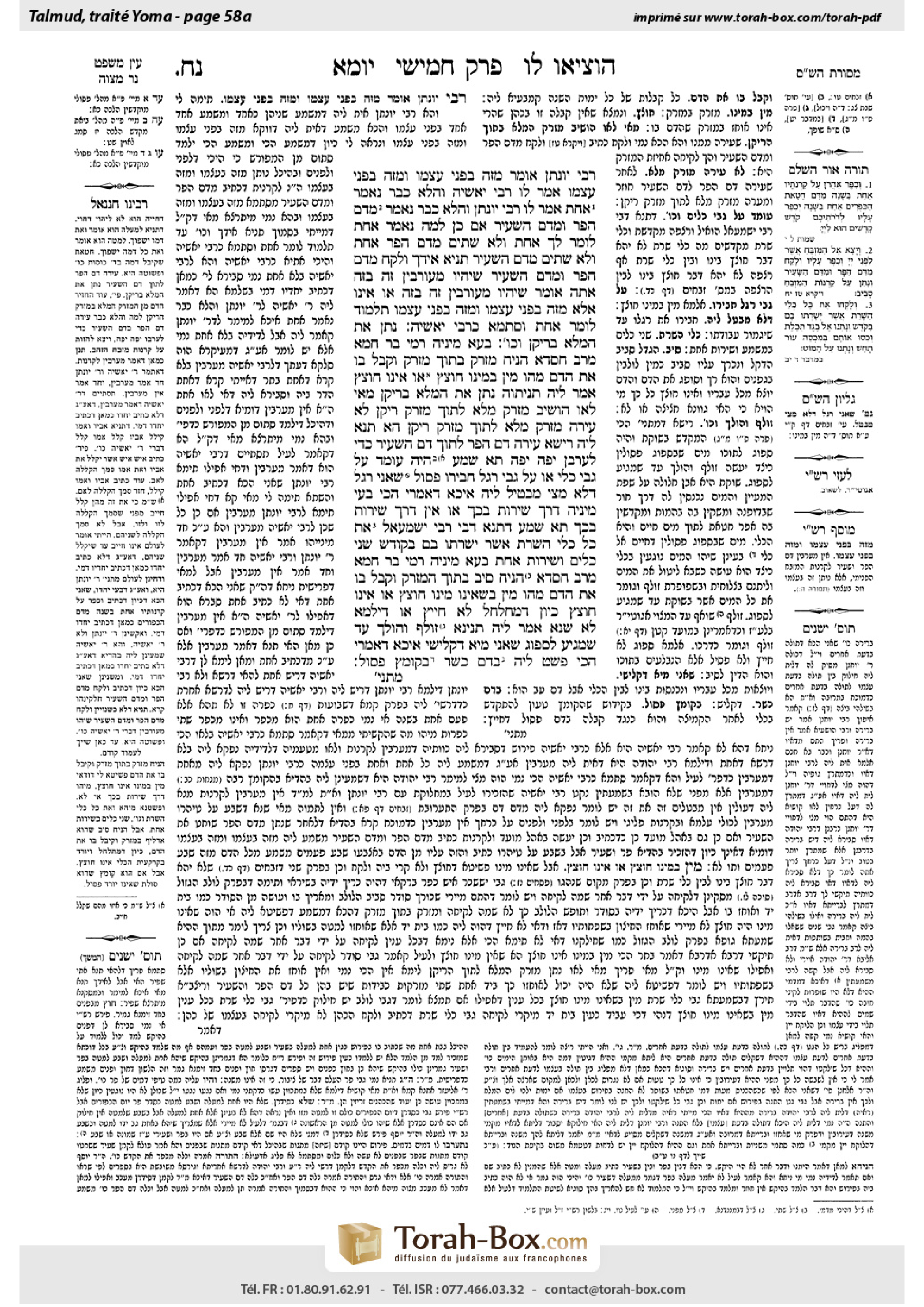
Yoma 58a: Talmud study for Daf Yomi
Daf Yomi is the daily study of one Talmud folio. Explore 37 tractates with scans, Hebrew text, Sefaria English and AI-generated French translations where annotated.
Passage selection and English or AI-generated French translation are available where the scan has annotations. Daf Study is independent of Torah-Box and Sefaria.
Browse Yoma · יומא · All tractatesYoma 58a text and translations
This page of Yoma includes the Aramaic text, an English translation and an AI-generated French translation, alongside the scan above.
יומא נ״ח א · Aramaic and Hebrew text
רַבִּי יוֹנָתָן אוֹמֵר: מִזֶּה בִּפְנֵי עַצְמוֹ, וּמִזֶּה בִּפְנֵי עַצְמוֹ. אָמַר לוֹ רַבִּי יֹאשִׁיָּה: וַהֲלֹא כְּבָר נֶאֱמַר: ״אַחַת״!
אָמַר לוֹ רַבִּי יוֹנָתָן, וַהֲלֹא כְּבָר נֶאֱמַר: ״מִדַּם הַפָּר וּמִדַּם הַשָּׂעִיר״! אִם כֵּן, לָמָּה נֶאֱמַר ״אַחַת״? לוֹמַר לָךְ: אַחַת וְלֹא שְׁתַּיִם מִדַּם הַפָּר, אַחַת וְלֹא שְׁתַּיִם מִדַּם הַשָּׂעִיר.
תַּנְיָא אִידַּךְ: ״וְלָקַח מִדַּם הַפָּר וּמִדַּם הַשָּׂעִיר״ — שֶׁיִּהְיוּ מְעוֹרָבִין זֶה בָּזֶה. אַתָּה אוֹמֵר שֶׁיִּהְיוּ מְעוֹרָבִין זֶה בָּזֶה, אוֹ אֵינוֹ אֶלָּא מִזֶּה בִּפְנֵי עַצְמוֹ וּמִזֶּה בִּפְנֵי עַצְמוֹ? תַּלְמוּד לוֹמַר: ״אַחַת״. וּסְתָמָא כְּרַבִּי יֹאשִׁיָּה.
נָתַן אֶת הַמָּלֵא בָּרֵיקָן וְכוּ׳. בְּעָא מִינֵּיהּ רָמֵי בַּר חָמָא מֵרַב חִסְדָּא: הִנִּיחַ מִזְרָק בְּתוֹךְ מִזְרָק, וְקִבֵּל בּוֹ אֶת הַדָּם, מַהוּ? מִין בְּמִינוֹ חוֹצֵץ, אוֹ אֵינוֹ חוֹצֵץ?
אֲמַר לֵיהּ, תְּנֵיתוּהָ: נָתַן אֶת הַמָּלֵא בָּרֵיקָן. מַאי לָאו: הוֹשִׁיב מִזְרָק מָלֵא לְתוֹךְ מִזְרָק רֵיקָן?
לָא, עֵירָה מִזְרָק מָלֵא לְתוֹךְ מִזְרָק רֵיקָן. הָא תְּנָא לֵיהּ רֵישָׁא: עֵירָה דַּם הַפָּר לְתוֹךְ דַּם הַשָּׂעִיר! כְּדֵי לְעָרְבָן יָפֶה יָפֶה.
תָּא שְׁמַע: הָיָה עוֹמֵד עַל גַּבֵּי כְּלִי, אוֹ עַל גַּבֵּי רֶגֶל חֲבֵירוֹ — פָּסוּל! שָׁאנֵי רֶגֶל, דְּלָא מָצֵי מְבַטֵּיל לֵיהּ.
אִיכָּא דְאָמְרִי, הָכִי בְּעָא מִינֵּיהּ: דֶּרֶךְ שֵׁירוּת בְּכָךְ, אוֹ אֵין דֶּרֶךְ שֵׁירוּת בְּכָךְ? תָּא שְׁמַע, דְּתָנָא דְּבֵי רַבִּי יִשְׁמָעֵאל: ״אֶת כׇּל כְּלֵי הַשָּׁרֵת אֲשֶׁר יְשָׁרְתוּ בָם בַּקּוֹדֶשׁ״ — שְׁנֵי כֵלִים וְשֵׁירוּת אַחַת.
בְּעָא מִינֵּיהּ רָמֵי בַּר חָמָא מֵרַב חִסְדָּא: הִנִּיחַ סִיב בְּתוֹךְ הַמִּזְרָק, וְקִבֵּל בּוֹ אֶת הַדָּם, מַהוּ: מִין בְּשֶׁאֵינוֹ מִינוֹ חוֹצֵץ, אוֹ אֵינוֹ חוֹצֵץ? כֵּיוָן דִּמְחַלְחֵל — לָא חָיֵיץ, אוֹ דִילְמָא לָא שְׁנָא?
אֲמַר לֵיהּ, תְּנֵינָא: זוֹלֵף וְהוֹלֵךְ עַד שֶׁמַּגִּיעַ לַסְּפוֹג! שָׁאנֵי מַיָּא דִּקְלִישִׁי.
אִיכָּא דְאָמְרִי, הָכִי פְּשַׁט לֵיהּ: בְּדָם — כָּשֵׁר. בְּקוֹמֶץ — פָּסוּל.
Yoma 58a · English translation
Rabbi Yonatan says: He presents from this one, the bull’s blood, by itself, and he presents from that one, the goat’s blood, by itself and does not mix them. Rabbi Yoshiya said to him: But wasn’t it already stated: “And Aaron shall make atonement upon its corners once a year; with the blood of the sin-offering of atonement” (Exodus 30:10), which indicates that the High Priest does not present twice?
Rabbi Yonatan said to him: But wasn’t it already stated: “Of the blood of the bull and of the blood of the goat” (Leviticus 16:18), which teaches that each set of sprinklings must be performed by itself? If so, why is “once” stated? This verse comes to tell you that he must perform the rite once and not perform two sets of sprinklings from the blood of the bull; and likewise he must perform the rite once and not perform two sets of sprinklings from the blood of the goat. From the blood of each of the animals, the High Priest presents only one set of sprinklings. This shows that Rabbi Yoshiya and Rabbi Yonatan indeed disagree with regard to this issue.
It was taught in another baraita: “And he shall take of the blood of the bull and of the blood of the goat” (Leviticus 16:18). This verse teaches that the blood of the bull and the goat should be mixed together. Do you say that they should be mixed together, or perhaps that is not the case; rather, he presents from this blood by itself and from that by itself? Therefore, the verse states: “Once.” The Gemara comments: And this unattributed baraita is in accordance with the opinion of Rabbi Yoshiya, who said the two sets of blood are mixed, as stated in the mishna.
§ It was taught in the mishna that after the High Priest poured the bull’s blood into the goat’s blood, he placed the blood from the full bowl into the empty bowl, to mix the blood well. Rami bar Ḥama raised a dilemma before Rav Ḥisda: What is the halakha if he placed one bowl inside a second bowl and collected the blood in the inner bowl? Does one type of object mingled with another of its own type interpose, which would mean that the priest has not collected the blood himself, as the outer bowl interposed between him and the vessel? Or perhaps an object of one type does not interpose for another object of the same type, and therefore the two bowls are considered one object.
Rav Ḥisda said to him: We have already learned the answer to this question in the mishna: He placed the blood from the full bowl into the empty bowl. What, is it not correct to infer from this statement that he inserted the full bowl into the empty bowl?
Rami bar Ḥama responded: No, it means that he poured the full bowl into an empty bowl. Rav Ḥisda said to him: But this statement is unnecessary, as the tanna of the mishna already taught the requirement to pour from one vessel into another in the first clause: He poured the blood of the bull into the blood of the goat. The subsequent phrase: He placed the full into the empty, must therefore refer to the placement of one vessel inside another. Rami bar Ḥama responded: No, it means that he pours the blood from the full bowl into the empty bowl a second time in order to mix them very well. To this end, he pours from one vessel into the other before again pouring the mixture back into the first vessel, thereby mixing them thoroughly.
The Gemara suggests: Come and hear a solution to this question: If a priest performed the Temple service while he was standing on top of a vessel, or on the foot of another priest, his service is disqualified, as the priest must stand directly on the floor of the Temple. The fact that the foot of another person is considered an interposition proves that one type serves as an interposition with regard to another object of the same type. The Gemara rejects this contention: A foot is different, as he cannot nullify it. The foot of another person cannot be considered nullified with respect to the priest’s foot, but in the case of a vessel it is possible to say that one vessel is nullified in favor of another vessel.
Some say that Rami bar Ḥama did not refer to the issue of interposition at all. Rather, this is the dilemma he raised before Rav Ḥisda: Is placing one vessel inside another vessel a proper manner of service; or is this not a proper manner of service, and if one does so his service is disqualified? The Gemara answers: Come and hear that which the school of Rabbi Yishmael taught: “And they shall take all the service vessels, with which they serve in the Sanctuary” (Numbers 4:12). This verse is referring to two vessels and one service, which indicates that this is a proper manner of service.
§ Rami bar Ḥama raised another dilemma before Rav Ḥisda along the same lines: What is the halakha if he placed bast, the material that grows around palm trees, inside the bowl, and collected the blood in the bowl through the bast, such that the blood seeps through into the bowl? Does one type of object mixed with another not of its own type interpose; or perhaps it does not interpose? Could one say that since the blood seeps through, it therefore does not interpose? Or perhaps this case is no different, and as there is a foreign object in the vessel it is considered an interposition even if the blood seeps through.
Rav Ḥisda said to him in response: We already learned this matter with regard to sanctifying the purification waters, i.e., the water mixed with ashes of the red heifer. If a sponge was placed inside the container of water, the water in the sponge is disqualified and the priest may not sprinkle with it. How should he proceed? He sprinkles from the water and continues until he reaches the sponge. This shows that the presence of the sponge in the water container is not considered an interposition for the water in the container, despite the fact that it itself is unfit for the service. Rami bar Ḥama replied: This is no proof. Water is different, as it is thin and therefore it certainly seeps through the sponge and reaches the bowl; whereas the thicker blood will perhaps not seep into the fiber.
Some say that this is how Rav Ḥisda resolved the problem of placing the bast in the bowl for Rami bar Ḥama: In the case of the blood it is valid, as blood passes through, and the bast does not obstruct it. However, in the case of the handful of a meal-offering, which must be sanctified in a vessel immediately after the handful is taken, if he put bast in a vessel and placed the handful on top of it, it is disqualified. The reason is that the handful of a meal-offering consists of dough, which does not pass through the bast, and it is therefore considered a proper interposition.
Yoma 58a · Traduction française (IA)
Rabbi Yonatan dit : Il fait les aspersions avec ce sang-ci, le sang du taureau, séparément, puis avec cet autre sang, celui du bouc, séparément, sans les mélanger. Rabbi Yoshiya lui dit : Mais n’est-il pas déjà écrit : « Aaron fera une fois par an l’expiation sur ses cornes, avec le sang du sacrifice expiatoire » (Exode 30, 10), ce qui indique que le grand prêtre ne fait pas deux fois les aspersions ?
Rabbi Yonatan lui dit : Mais n’est-il pas déjà écrit : « Du sang du taureau et du sang du bouc » (Lévitique 16, 18), ce qui enseigne que chaque série d’aspersion doit être effectuée séparément ? Si tel est le cas, pourquoi est-il écrit « une fois » ? Ce verset vient t’enseigner qu’il doit accomplir le rite une fois et ne pas effectuer deux séries d’aspersion avec le sang du taureau ; de même, il doit accomplir le rite une fois et ne pas effectuer deux séries d’aspersion avec le sang du bouc. Le grand prêtre ne fait qu’une seule série d’aspersion avec le sang de chacun des animaux. Cela montre que Rabbi Yoshiya et Rabbi Yonatan sont effectivement en désaccord sur cette question.
Il a été enseigné dans une autre baraïta : « Il prendra du sang du taureau et du sang du bouc » (Lévitique 16, 18). Ce verset enseigne que le sang du taureau et celui du bouc doivent être mélangés. Dis-tu qu’ils doivent être mélangés, ou peut-être n’en est-il pas ainsi, mais il fait plutôt les aspersions avec ce sang séparément et avec cet autre sang séparément ? Le verset dit donc : « Une fois ». La Guemara fait remarquer : cette baraïta anonyme est conforme à l’opinion de Rabbi Yoshiya, qui a dit que les deux sangs sont mélangés, comme l’enseigne la Michna.
§ La Michna enseigne qu’après que le grand prêtre eut versé le sang du taureau dans le sang du bouc, il plaça le sang du récipient plein dans le récipient vide afin de bien mélanger les sangs. Rami bar Ḥama posa une question à Rav Ḥisda : quelle est la halakha s’il a placé un récipient dans un second récipient et recueilli le sang dans le récipient intérieur ? Un objet fait-il écran lorsqu’il est mêlé à un autre objet de même nature, ce qui signifierait que le prêtre n’a pas recueilli le sang lui-même, puisque le récipient extérieur s’interpose entre lui et le récipient ? Ou peut-être un objet ne fait-il pas écran à un autre objet de même nature, de sorte que les deux récipients sont considérés comme un seul objet ?
Rav Ḥisda lui dit : Nous avons déjà appris la réponse à cette question dans la Michna : il plaça le sang du récipient plein dans le récipient vide. Ne peut-on pas déduire de cette formulation qu’il a introduit le récipient plein dans le récipient vide ?
Rami bar Ḥama répondit : Non, cela signifie qu’il a versé le contenu du récipient plein dans un récipient vide. Rav Ḥisda lui dit : Mais cette précision est superflue, puisque le tanna de la Michna a déjà enseigné, dans la première partie, l’obligation de verser d’un récipient dans un autre : il a versé le sang du taureau dans le sang du bouc. La phrase suivante, « il plaça le récipient plein dans le récipient vide », doit donc désigner le placement d’un récipient dans un autre. Rami bar Ḥama répondit : Non, cela signifie qu’il verse une seconde fois le sang du récipient plein dans le récipient vide, afin de bien mélanger les sangs. Pour cela, il verse le contenu d’un récipient dans l’autre, puis reverse le mélange dans le premier récipient, les mélangeant ainsi soigneusement.
La Guemara propose : Viens et entends une réponse à cette question. Si un prêtre a effectué le service du Temple alors qu’il se tenait sur un récipient ou sur le pied d’un autre prêtre, son service est invalide, car le prêtre doit se tenir directement sur le sol du Temple. Le fait que le pied d’une autre personne soit considéré comme faisant écran prouve qu’un objet fait écran à un autre objet de même nature. La Guemara rejette cette preuve : le pied est différent, car il ne peut pas être annulé. Le pied d’une autre personne ne peut pas être considéré comme annulé par rapport au pied du prêtre ; tandis que, dans le cas d’un récipient, on peut dire qu’un récipient est annulé au profit d’un autre récipient.
Certains disent que Rami bar Ḥama ne soulevait pas du tout la question de l’interposition. Voici plutôt la question qu’il posa à Rav Ḥisda : placer un récipient dans un autre récipient est-il une manière convenable d’accomplir le service ? Ou bien n’en est-ce pas une, de sorte que si l’on agit ainsi, le service est invalide ? La Guemara répond : Viens et entends ce qu’enseigna l’école de Rabbi Yishmaël : « Ils prendront tous les ustensiles de service dont ils se servent dans le Sanctuaire » (Nombres 4, 12). Ce verset parle de deux récipients et d’un seul service, ce qui indique qu’il s’agit bien d’une manière convenable d’accomplir le service.
§ Rami bar Ḥama posa à Rav Ḥisda une autre question dans le même ordre d’idées : quelle est la halakha s’il a placé du liber, la matière qui pousse autour des palmiers, dans le récipient, puis y a recueilli le sang à travers le liber, de sorte que le sang s’écoule dans le récipient ? Un objet fait-il écran lorsqu’il est mêlé à un objet d’une autre nature, ou peut-être ne fait-il pas écran ? Peut-on dire que, puisque le sang s’écoule à travers, le liber ne fait donc pas écran ? Ou peut-être ce cas n’est-il pas différent et, puisqu’un objet étranger se trouve dans le récipient, il est considéré comme faisant écran, même si le sang s’écoule à travers ?
Rav Ḥisda lui répondit : Nous avons déjà appris cette question à propos de la sanctification des eaux de purification, c’est-à-dire de l’eau mêlée aux cendres de la vache rousse. Si une éponge a été placée dans le récipient d’eau, l’eau retenue dans l’éponge est invalide et le prêtre ne peut pas en faire l’aspersion. Comment doit-il procéder ? Il fait l’aspersion avec l’eau et continue jusqu’à atteindre l’éponge. Cela montre que la présence de l’éponge dans le récipient d’eau n’est pas considérée comme faisant écran à l’eau contenue dans le récipient, bien que l’eau retenue dans l’éponge ne convienne pas au service. Rami bar Ḥama répondit : Ce n’est pas une preuve. L’eau est différente, car elle est fluide et s’écoule donc certainement à travers l’éponge pour atteindre le récipient ; tandis que le sang, plus épais, ne s’infiltrera peut-être pas dans les fibres.
Certains disent que Rav Ḥisda résolut ainsi, pour Rami bar Ḥama, la question du liber placé dans le récipient : dans le cas du sang, cela est valide, car le sang passe à travers et le liber ne lui fait pas obstacle. En revanche, dans le cas de la poignée d’une offrande végétale, qui doit être sanctifiée dans un récipient immédiatement après avoir été prélevée, si l’on a mis du liber dans un récipient et posé la poignée dessus, celle-ci est invalide. La raison en est que la poignée d’une offrande végétale est constituée de pâte, qui ne passe pas à travers le liber ; celui-ci est donc considéré comme faisant véritablement écran.
Traduction française générée par IA à partir de l’édition anglaise de Sefaria. Vérifie toujours un passage avec le texte source.
Text from Sefaria: William Davidson Edition - Vocalized Aramaic (CC BY NC); William Davidson Edition - English (CC BY NC).