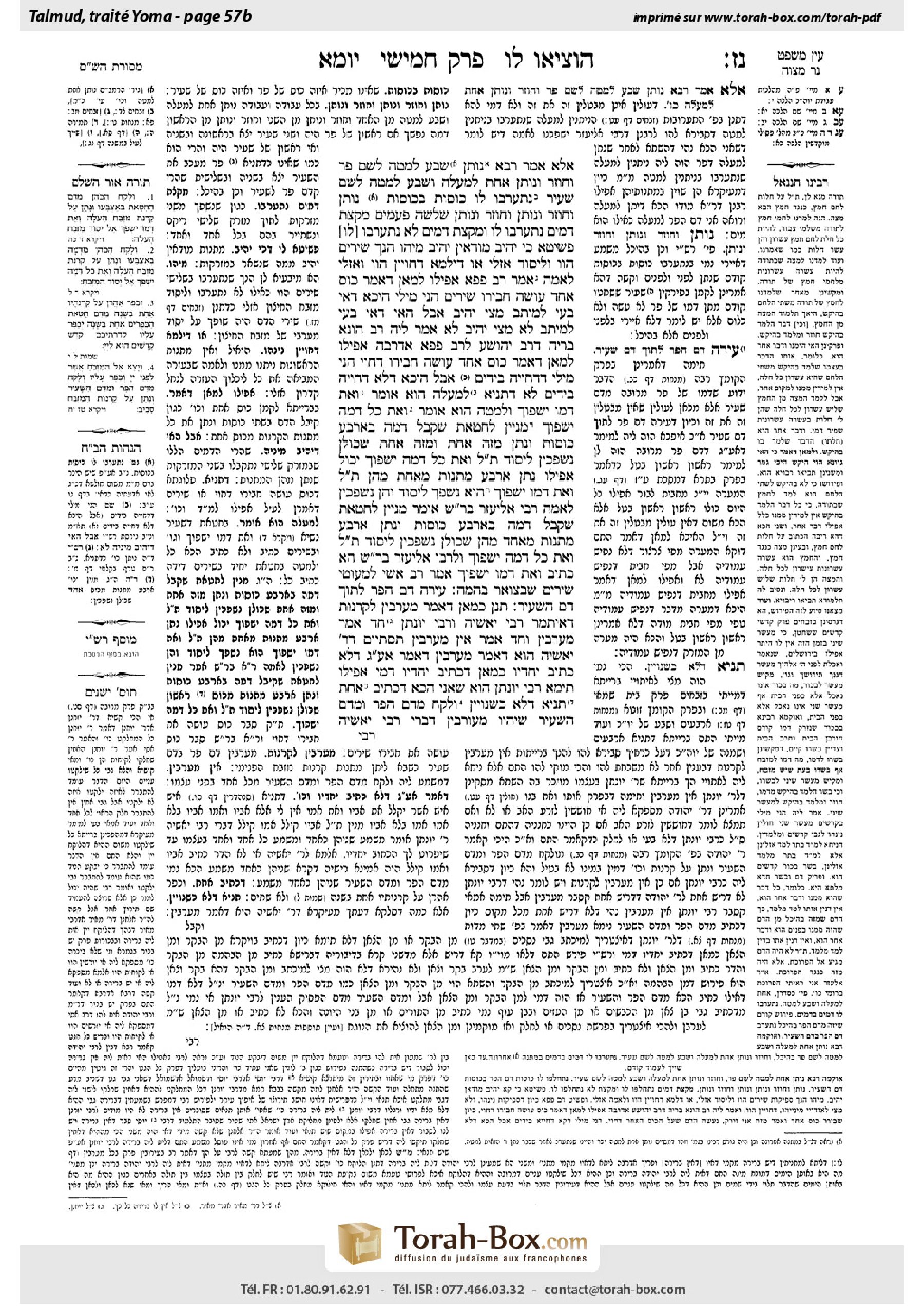
Yoma 57b: Talmud study for Daf Yomi
Daf Yomi is the daily study of one Talmud folio. Explore 37 tractates with scans, Hebrew text, Sefaria English and AI-generated French translations where annotated.
Passage selection and English or AI-generated French translation are available where the scan has annotations. Daf Study is independent of Torah-Box and Sefaria.
Browse Yoma · יומא · All tractatesYoma 57b text and translations
This page of Yoma includes the Aramaic text, an English translation and an AI-generated French translation, alongside the scan above.
יומא נ״ז ב · Aramaic and Hebrew text
אֶלָּא אָמַר רָבָא: נוֹתֵן שֶׁבַע לְמַטָּה לְשֵׁם פַּר, וְחוֹזֵר וְנוֹתֵן אַחַת לְמַעְלָה וְשֶׁבַע לְמַטָּה לְשֵׁם שָׂעִיר.
נִתְעָרְבוּ לוֹ כּוֹסוֹת בְּכוֹסוֹת — נוֹתֵן, וְחוֹזֵר וְנוֹתֵן,
וְחוֹזֵר וְנוֹתֵן, שְׁלֹשָׁה פְּעָמִים.
מִקְצָת דָּמִים נִתְעָרְבוּ לוֹ, וּמִקְצָת דָּמִים לֹא נִתְעָרְבוּ [לוֹ], פְּשִׁיטָא: כִּי יָהֵיב — מִוַּדָּאִין יְהֵיב.
מִיהוּ, הָנָךְ: שִׁירַיִם הָווּ, וְלִיסוֹד אָזְלִי, אוֹ דִילְמָא: דְּחוּיִין הָווּ, וְאָזְלִי לְאַמָּה?
אָמַר רַב פָּפָּא: אֲפִילּוּ לְמַאן דְּאָמַר כּוֹס אֶחָד עוֹשֶׂה חֲבֵירוֹ שִׁירַיִם — הָנֵי מִילֵּי הֵיכָא דְּאִי בָּעֵי לְמֵיתַב מָצֵי יָהֵיב. אֲבָל הַאי, דְּאִי בָּעֵי לְמֵיתַב לָא מָצֵי יָהֵיב — לָא.
אֲמַר לֵיהּ רַב הוּנָא בְּרֵיהּ דְּרַב יְהוֹשֻׁעַ לְרַב פָּפָּא: אַדְּרַבָּה: אֲפִילּוּ לְמַאן דְּאָמַר כּוֹס אֶחָד עוֹשֶׂה חֲבֵירוֹ דָּחוּי — הָנֵי מִילֵּי, דְּדַחְיֵיהּ בְּיָדַיִם, אֲבָל הֵיכָא דְּלָא דַּחְיֵיהּ בְּיָדַיִם — לָא.
דְּתַנְיָא, לְמַעְלָה הוּא אוֹמֵר: ״וְאֶת דָּמוֹ יִשְׁפּוֹךְ״, וּלְמַטָּה הוּא אוֹמֵר: ״וְאֶת כׇּל דָּמָהּ יִשְׁפּוֹךְ״.
מִנַּיִין לְחַטָּאת שֶׁקִּבֵּל דָּמָה בְּאַרְבַּע כּוֹסוֹת וְנָתַן מִזֶּה אַחַת וּמִזֶּה אַחַת, שֶׁכּוּלָּן נִשְׁפָּכִין לַיְּסוֹד — תַּלְמוּד לוֹמַר: ״וְאֶת כׇּל דָּמָהּ יִשְׁפּוֹךְ״.
יָכוֹל אֲפִילּוּ נָתַן אַרְבַּע מַתָּנוֹת מֵאַחַת מֵהֶן — תַּלְמוּד לוֹמַר: ״וְאֶת דָּמוֹ יִשְׁפּוֹךְ״ — הָהוּא נִשְׁפָּךְ לַיְּסוֹד, וְהֵן נִשְׁפָּכִין לָאַמָּה. רַבִּי אֱלִיעֶזֶר בְּרַבִּי שִׁמְעוֹן אוֹמֵר: מִנַּיִין לְחַטָּאת שֶׁקִּבֵּל דָּמָה בְּאַרְבַּע כּוֹסוֹת וְנָתַן אַרְבַּע מַתָּנוֹת מֵאֶחָד מֵהֶן, שֶׁכּוּלָּן נִשְׁפָּכִין לַיְּסוֹד — תַּלְמוּד לוֹמַר: ״וְאֶת כׇּל דָּמָהּ יִשְׁפּוֹךְ״.
וּלְרַבִּי אֱלִיעֶזֶר בְּרַבִּי שִׁמְעוֹן, הָא כְּתִיב: ״וְאֶת דָּמוֹ יִשְׁפּוֹךְ״? אָמַר רַב אָשֵׁי: לְמַעוֹטֵי שִׁירַיִם שֶׁבְּצַוַּאר בְּהֵמָה.
עֵירָה דַּם הַפָּר לְתוֹךְ דַּם הַשָּׂעִיר. תְּנַן כְּמַאן דְּאָמַר: מְעָרְבִין לִקְרָנוֹת. דְּאִיתְּמַר: רַבִּי יֹאשִׁיָּה וְרַבִּי יוֹנָתָן, חַד אָמַר: מְעָרְבִין, וְחַד אָמַר: אֵין מְעָרְבִין.
תִּסְתַּיֵּים דְּרַבִּי יֹאשִׁיָּה הוּא דְּאָמַר מְעָרְבִין, דְּאָמַר: אַף עַל גַּב דְּלָא כְּתִיב ״יַחְדָּיו״ — כְּמַאן דִּכְתִיב ״יַחְדָּיו״ דָּמֵי.
אֲפִילּוּ תֵּימָא רַבִּי יוֹנָתָן הוּא, שָׁאנֵי הָכָא דִּכְתִיב: ״אַחַת״.
תַּנְיָא דְּלָא כְּשִׁנּוּיַין: ״וְלָקַח מִדַּם הַפָּר וּמִדַּם הַשָּׂעִיר״, שֶׁיִּהְיוּ מְעוֹרָבִין, דִּבְרֵי רַבִּי יֹאשִׁיָּה.
Yoma 57b · English translation
Rather, Rava said: He presents downward seven times for the purpose of the bull, and he again presents upward once and downward seven times for the purpose of the goat.
The Gemara asks another question: What if the cups became mixed, i.e., if the bowl containing the blood of the bull was confused with that of the blood of the goat? The Gemara explains: He presents blood from one cup by sprinkling upward once and downward seven times, and he again presents a second set of sprinklings from the second cup.
And he again presents another set of sprinklings, again from the first cup, which amounts to a total of three times. In this manner, he fulfills the obligation no matter which cup was which. If the first cup was that of the bull’s blood and the second was that of the goat, he fulfilled his obligation with the first and second sprinklings. If the first cup contained the blood of the goat, he performed the sprinkling of the goat’s blood before that of the bull, which means his first set of sprinklings are discounted. Consequently, when he sprinkled from the second cup, which contains the bull’s blood, and a third time from the cup of the goat’s blood, he fulfilled his obligation with the second and third sets of sprinklings.
The Gemara asks yet another question: If only part of the blood became mixed together and part of the blood did not become mixed, e.g., if some of the blood spilled and became mixed in a third vessel, the solution is obvious: When he presents, he presents from the blood of certain identity.
However, one could still ask a question with regard to this case: What is the status of the mixed blood in the other vessel or vessels? Are they considered the remainder of the blood, and the remainder of the blood goes to the base of the altar like the remainder of all blood of sin-offerings? Or perhaps this mixture of blood is rejected, as the blood from this vessel was not used for the first sprinklings, and therefore the two types of blood are spilled and go to the canal beneath the altar, which rinses all the dirt from the courtyard into the Kidron River.
Rav Pappa said: Even according to the one who says that one cup renders its counterpart a remainder, i.e., if a one collected blood in two cups, the blood in the second cup is considered the remainder of the first cup, this applies only in a case where he could present blood from the second cup if he wanted to, i.e., if both cups were filled with blood from the offering. However, in this case, as the blood in this vessel could not be presented even if he wanted to, it does not become a remainder, and it is therefore certainly rejected.
Rav Huna, son of Rav Yehoshua, said to Rav Pappa: On the contrary, even according to the one who says that when blood is collected in two cups one cup renders the blood of its counterpart rejected, that applies only when he rejects the second cup with his own hands, i.e., by means of a direct act. However, in a case where he does not reject it with his own hands, as no act of rejection was performed but rather the blood became a remainder by itself, the blood is not rejected.
As it was taught in a baraita: In the verse above, it says: “And the priest shall take of the blood of the sin-offering with his finger, and put it upon the corners of the altar of the burnt-offering, and he shall pour its blood out at the base of the altar of burnt-offering” (Leviticus 4:25). And in the verse below it says: “And the priest shall take of its blood with his finger, and put it upon the corners of the altar of burnt-offering, and he shall pour all its blood out at the base of the altar” (Leviticus 4:30). The second verse adds the word “all.”
The baraita explains: From where is it derived with regard to a sin-offering that if one collected its blood in four cups and presented blood from each of them by sprinkling once from this cup and once from that cup until he has sprinkled four times, once from each cup, that the leftover blood in all the cups is poured out as remainders on the base of the altar? The verse states: “And he shall pour all its blood.”
One might have thought that even if he presented four presentations from one of them, all the rest should be spilled on the base of the altar as remainder; therefore, the verse states: “And he shall pour its blood.” This indicates that not all the blood, but only that blood in the bowl from which blood was sprinkled on the altar, is poured on the base as a remainder, and the rest of the cups of blood are poured into the canal. Rabbi Eliezer, son of Rabbi Shimon, says: From where is it derived with regard to a sin-offering that if one collected its blood in four cups and presented four presentations from one of them, that they are all poured at the base of the altar? The verse states: “And he shall pour all its blood.”
The Gemara asks: And according to the opinion of Rabbi Eliezer, son of Rabbi Shimon, isn’t it also written: “And he shall pour its blood”? How does he explain this difference between the verses? Rav Ashi said: When the Torah states “its blood,” it comes to exclude the remainders that are in the throat of the animal. If more blood comes out of the throat after the collection of the blood, that blood is certainly not poured on the base of the altar but is swept into the canal of the Temple.
§ The mishna states that after the High Priest sprinkled the blood toward the curtain he poured the blood of the bull into the blood of the goat. The Gemara comments: We learned this mishna in accordance with the opinion of the one who said that the High Priest mixes the two types of blood before placing them on the corners of the inner altar, and he does not present each one separately. As it was stated: The later tanna’im, Rabbi Yoshiya and Rabbi Yonatan, debated this issue. One of them said: The High Priest mixes the blood for the purpose of placing the blood on the altar’s corners, and one of them said: He does not mix the blood.
The Gemara comments: Conclude that Rabbi Yoshiya was the tanna who said that the High Priest mixes the blood. In general, he maintains that whenever a verse mentions two matters, although the term: Together, is not written explicitly, it is considered as though the term: Together, is indeed written. In other words, two items that appear in the same verse are treated as combined unless expressly stated otherwise. By contrast, Rabbi Yonatan maintains that even if two matters are mentioned together they are treated separately unless the verse uses the term: Together. In this case, the verse states: “And he shall take of the blood of the bull and of the blood of the goat” (Leviticus 16:18). Therefore, Rabbi Yoshiya rules that the High Priest must place the two sets of blood together.
The Gemara rejects this contention. Even if you say that the mishna is in accordance with the opinion of Rabbi Yonatan, it remains possible to explain its ruling, since it is different here, as it is written “once” (Exodus 30:10), which indicates that there must be one act of sprinkling and not two. Consequently, the High Priest must mix the blood to ensure that there is only one presentation.
The Gemara comments: It was taught in a baraita contrary to our response, but in accordance with the initial assumption: “And he shall go out to the altar that is before the Lord, and make atonement for it; and he shall take of the blood of the bull and of the blood of the goat, and put it on the corners of the altar round about” (Leviticus 16:18). This verse teaches that the blood of the bull and the goat should be mixed. This is the statement of Rabbi Yoshiya.
Yoma 57b · Traduction française (IA)
Rava dit plutôt : il fait sept aspersions vers le bas pour le taureau, puis il fait de nouveau une aspersion vers le haut et sept aspersions vers le bas pour le bouc.
La Guemara pose une autre question : que faire si les coupes se sont mélangées, c’est-à-dire si la coupe contenant le sang du taureau a été confondue avec celle contenant le sang du bouc ? La Guemara explique : il fait une aspersion vers le haut et sept vers le bas à partir du sang d’une coupe, puis il fait une deuxième série d’aspersions à partir de la seconde coupe.
Puis il fait encore une série d’aspersions, de nouveau à partir de la première coupe, ce qui fait trois séries au total. De cette manière, il s’acquitte de son obligation, quelle que soit la coupe qui contenait l’un ou l’autre sang. Si la première coupe contenait le sang du taureau et la seconde celui du bouc, il s’est acquitté de son obligation avec les première et deuxième séries d’aspersions. Si la première coupe contenait le sang du bouc, il a effectué les aspersions du sang du bouc avant celles du taureau, ce qui signifie que sa première série d’aspersions n’est pas prise en compte. Par conséquent, lorsqu’il a aspergé à partir de la seconde coupe, qui contenait le sang du taureau, puis une troisième fois à partir de la coupe contenant le sang du bouc, il s’est acquitté de son obligation avec les deuxième et troisième séries d’aspersions.
La Guemara pose encore une autre question : que faire si seule une partie du sang s’est mélangée, tandis que le reste ne s’est pas mélangé, par exemple si une partie du sang s’est répandue et mélangée dans un troisième récipient ? La solution est évidente : lorsqu’il fait les aspersions, il les fait à partir du sang dont l’identité est certaine.
Toutefois, on peut encore poser une question au sujet de ce cas : quel est le statut du sang mélangé qui se trouve dans l’autre récipient, ou dans les autres récipients ? Est-il considéré comme le reste du sang, lequel est versé à la base de l’autel, comme le reste de tout sang de sacrifice expiatoire ? Ou bien ce mélange de sang est-il écarté, puisque le sang de ce récipient n’a pas servi aux premières aspersions, de sorte que les deux sortes de sang sont déversées dans le canal sous l’autel, qui entraîne toutes les saletés de la cour jusqu’au fleuve du Cédron ?
Rav Pappa dit : même selon celui qui affirme qu’une coupe fait de l’autre le reste, c’est-à-dire que, si quelqu’un a recueilli le sang dans deux coupes, le sang de la seconde coupe est considéré comme le reste de celui de la première, cela ne s’applique que dans un cas où il aurait pu, s’il l’avait voulu, faire des aspersions à partir de la seconde coupe, c’est-à-dire si les deux coupes contenaient le sang de l’offrande. Mais dans notre cas, puisque le sang de ce récipient n’aurait pas pu servir aux aspersions, même s’il l’avait voulu, il ne devient pas un reste et est donc certainement écarté.
Rav Houna, fils de Rav Yehoshoua, dit à Rav Pappa : au contraire, même selon celui qui affirme que, lorsque le sang est recueilli dans deux coupes, une coupe rend le sang de l’autre impropre, cela ne s’applique que lorsqu’il rend lui-même la seconde coupe impropre, c’est-à-dire par un acte direct. Mais dans un cas où il ne la rend pas lui-même impropre, puisqu’aucun acte visant à l’écarter n’a été accompli et que le sang est devenu de lui-même un reste, le sang n’est pas impropre.
Comme cela a été enseigné dans une baraïta : dans le verset précédent, il est dit : « Le prêtre prendra avec son doigt du sang du sacrifice expiatoire, il en mettra sur les cornes de l’autel de l’holocauste, et il versera son sang à la base de l’autel de l’holocauste » (Lévitique 4:25). Et dans le verset suivant, il est dit : « Le prêtre prendra avec son doigt de son sang, il en mettra sur les cornes de l’autel de l’holocauste, et il versera tout son sang à la base de l’autel » (Lévitique 4:30). Le second verset ajoute le mot « tout ».
La baraïta explique : d’où apprend-on, au sujet d’un sacrifice expiatoire, que si quelqu’un en a recueilli le sang dans quatre coupes et a fait les aspersions à partir de chacune d’elles, une fois depuis cette coupe et une fois depuis celle-là, jusqu’à avoir fait quatre aspersions, une depuis chaque coupe, le sang restant dans toutes les coupes est versé à la base de l’autel comme reste ? Le verset dit : « Et il versera tout son sang. »
On aurait pu penser que même s’il avait fait quatre aspersions à partir de l’une des coupes, tout le reste devait être déversé à la base de l’autel comme reste. Le verset dit donc : « Et il versera son sang. » Cela indique que ce n’est pas tout le sang, mais seulement le sang de la coupe à partir de laquelle le sang a été aspergé sur l’autel, qui est versé à la base comme reste ; le sang des autres coupes est versé dans le canal. Rabbi Éliézer, fils de Rabbi Chimon, dit : d’où apprend-on, au sujet d’un sacrifice expiatoire, que si quelqu’un en a recueilli le sang dans quatre coupes et a fait quatre aspersions à partir de l’une d’elles, tout le sang est versé à la base de l’autel ? Le verset dit : « Et il versera tout son sang. »
La Guemara demande : mais, selon l’opinion de Rabbi Éliézer, fils de Rabbi Chimon, n’est-il pas également écrit : « Et il versera son sang » ? Comment explique-t-il cette différence entre les versets ? Rav Achi dit : lorsque la Torah écrit « son sang », cela vient exclure le sang restant dans la gorge de l’animal. Si du sang s’écoule de la gorge après le prélèvement du sang, ce sang n’est certainement pas versé à la base de l’autel, mais est entraîné dans le canal du Temple.
§ La Michna enseigne qu’après que le Grand Prêtre a aspergé le sang en direction du rideau, il a versé le sang du taureau dans celui du bouc. La Guemara commente : cette Michna suit l’opinion de celui qui affirme que le Grand Prêtre mélange les deux sortes de sang avant de les placer sur les cornes de l’autel intérieur, au lieu de faire les aspersions séparément pour chacune. Car il a été rapporté que les tannaïm tardifs, Rabbi Yochiya et Rabbi Yonatan, ont débattu de cette question. L’un a dit : le Grand Prêtre mélange le sang pour le placer sur les cornes de l’autel ; l’autre a dit : il ne le mélange pas.
La Guemara commente : concluons que Rabbi Yochiya est le tanna qui a dit que le Grand Prêtre mélange le sang. De manière générale, il soutient que, chaque fois qu’un verset mentionne deux éléments, même si le terme « ensemble » n’y figure pas explicitement, on considère que ce terme y figure effectivement. Autrement dit, deux éléments qui apparaissent dans un même verset sont considérés comme réunis, sauf indication contraire explicite. À l’inverse, Rabbi Yonatan soutient que même si deux éléments sont mentionnés ensemble, ils sont considérés séparément, sauf si le verset emploie le terme « ensemble ». Dans notre cas, le verset dit : « Il prendra du sang du taureau et du sang du bouc » (Lévitique 16:18). Rabbi Yochiya décide donc que le Grand Prêtre doit placer ensemble les deux sangs.
La Guemara rejette cette déduction. Même si l’on dit que la Michna suit l’opinion de Rabbi Yonatan, il reste possible d’expliquer sa décision, car ce cas est différent : le mot « une fois » est écrit (Exode 30:10), ce qui indique qu’il doit y avoir un seul acte d’aspersion et non deux. Par conséquent, le Grand Prêtre doit mélanger les sangs afin qu’il n’y ait qu’une seule aspersion.
La Guemara commente : une baraïta a été enseignée à l’encontre de notre réponse, mais conformément à l’hypothèse initiale : « Il sortira vers l’autel qui est devant l’Éternel et fera expiation pour lui ; il prendra du sang du taureau et du sang du bouc, et en mettra sur les cornes de l’autel tout autour » (Lévitique 16:18). Ce verset enseigne que le sang du taureau et celui du bouc doivent être mélangés. Telle est l’opinion de Rabbi Yochiya.
Traduction française générée par IA à partir de l’édition anglaise de Sefaria. Vérifie toujours un passage avec le texte source.
Text from Sefaria: William Davidson Edition - Vocalized Aramaic (CC BY NC); William Davidson Edition - English (CC BY NC).