Yoma 57a: Talmud study for Daf Yomi
Daf Yomi is the daily study of one Talmud folio. Explore 37 tractates with scans, Hebrew text, Sefaria English and AI-generated French translations where annotated.
Passage selection and English or AI-generated French translation are available where the scan has annotations. Daf Study is independent of Torah-Box and Sefaria.
Browse Yoma · יומא · All tractatesYoma 57a text and translations
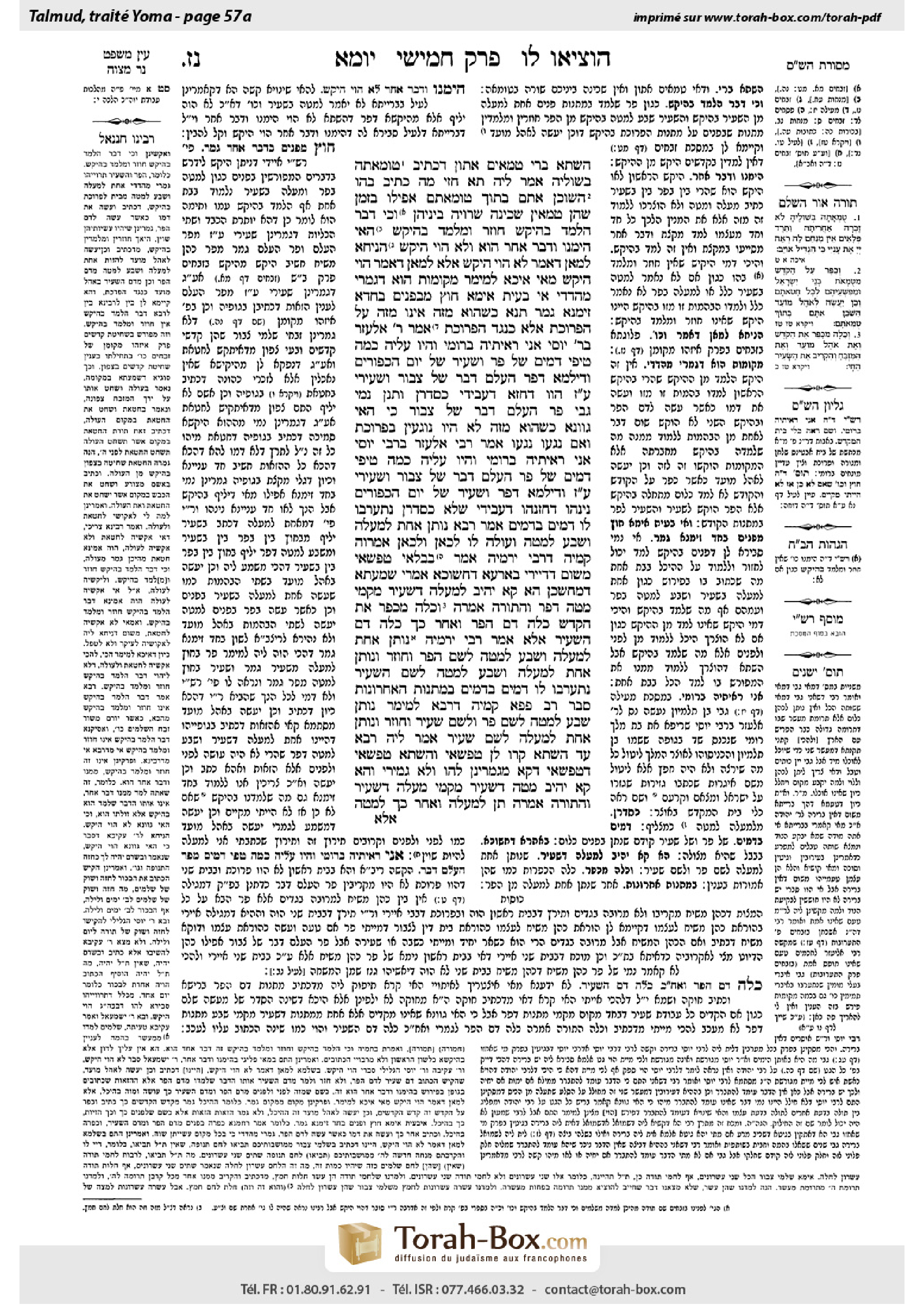
This page of Yoma includes the Aramaic text, an English translation and an AI-generated French translation, alongside the scan above.
יומא נ״ז א · Aramaic and Hebrew text
הַשְׁתָּא בָּרִי טְמֵאִים אַתּוּן, דִּכְתִיב: ״טוּמְאָתָהּ בְּשׁוּלֶיהָ״. אֲמַר לֵיהּ, תָּא חֲזִי מָה כְּתִיב בְּהוּ: ״הַשּׁוֹכֵן אִתָּם בְּתוֹךְ טוּמְאֹתָם״, אֲפִילּוּ בִּזְמַן שֶׁהֵן טְמֵאִין — שְׁכִינָה שְׁרוּיָה בֵּינֵיהֶן.
וְכִי דָּבָר הַלָּמֵד בְּהֶיקֵּשׁ, חוֹזֵר וּמְלַמֵּד בְּהֶיקֵּשׁ?
הַאי, הֵימֶנּוּ וְדָבָר אַחֵר הוּא, וְלָא הָוֵי הֶיקֵּשׁ.
הָנִיחָא לְמַאן דְּאָמַר לָא הָוֵי הֶיקֵּשׁ. אֶלָּא לְמַאן דְּאָמַר הָוֵי הֶיקֵּשׁ, מַאי אִיכָּא לְמֵימַר?
מְקוֹמוֹת הוּא דְּגָמְרִי מֵהֲדָדֵי.
אִי בָּעֵית אֵימָא: חוּץ מִבִּפְנִים בַּחֲדָא זִימְנָא גָּמַר.
תָּנָא: כְּשֶׁהוּא מַזֶּה, אֵינוֹ מַזֶּה עַל הַפָּרוֹכֶת, אֶלָּא כְּנֶגֶד הַפָּרוֹכֶת. אָמַר רַבִּי אֶלְעָזָר בְּרַבִּי יוֹסֵי: אֲנִי רְאִיתִיהָ בְּרוֹמִי, וְהָיוּ עָלֶיהָ כַּמָּה טִיפֵּי דָמִים שֶׁל פַּר וְשָׂעִיר שֶׁל יוֹם הַכִּפּוּרִים.
וְדִילְמָא דְּפַר הֶעְלֵם דָּבָר שֶׁל צִבּוּר וּשְׂעִירֵי עֲבוֹדָה זָרָה הֲווֹ!
דַּחֲזָא דַּעֲבִידִי כְּסִדְרָן. וּתְנַן נָמֵי גַּבֵּי פַּר הֶעְלֵם דָּבָר שֶׁל צִבּוּר כִּי הַאי גַוְונָא: כְּשֶׁהוּא מַזֶּה, לֹא הָיוּ נוֹגְעִין בַּפָּרוֹכֶת, וְאִם נָגְעוּ — נָגְעוּ.
אָמַר רַבִּי אֶלְעָזָר בְּרַבִּי יוֹסֵי: אֲנִי רְאִיתִיהָ בְּרוֹמִי, וְהָיוּ עָלֶיהָ כַּמָּה טִיפֵּי דָמִים שֶׁל פַּר הֶעְלֵם דָּבָר שֶׁל צִבּוּר, וּשְׂעִירֵי עֲבוֹדָה זָרָה. וְדִילְמָא דְּפַר וְשָׂעִיר שֶׁל יוֹם הַכִּפּוּרִים נִינְהוּ? דַּחֲזַנְהוּ דַּעֲבִידִי שֶׁלֹּא כְּסִדְרָן.
נִתְעָרְבוּ לוֹ דָּמִים בְּדָמִים, אָמַר רָבָא: נוֹתֵן אַחַת לְמַעְלָה וְשֶׁבַע לְמַטָּה, וְעוֹלֶה לוֹ לְכָאן וּלְכָאן.
אַמְרוּהָ קַמֵּיהּ דְּרַבִּי יִרְמְיָה, אָמַר: בַּבְלָאֵי טַפְשָׁאֵי, מִשּׁוּם דְּדָיְירִי בְּאַרְעָא דַחֲשׁוֹכָא — אָמְרִי שְׁמַעְתָּא דִּמְחַשְּׁכָן! הָא קָא יָהֵיב לְמַעְלָה דְּשָׂעִיר מִקַּמֵּי מַטָּה דְּפַר, וְהַתּוֹרָה אָמְרָה: ״וְכִלָּה מִכַּפֵּר אֶת הַקֹּדֶשׁ״, כַּלֵּה דַּם הַפָּר וְאַחַר כָּךְ כַּלֵּה דַּם הַשָּׂעִיר!
אֶלָּא, אָמַר רַבִּי יִרְמְיָה: נוֹתֵן אַחַת לְמַעְלָה וְשֶׁבַע לְמַטָּה לְשֵׁם הַפָּר, וְחוֹזֵר וְנוֹתֵן אַחַת לְמַעְלָה וְשֶׁבַע לְמַטָּה לְשֵׁם הַשָּׂעִיר.
נִתְעָרְבוּ לוֹ דָּמִים בְּדָמִים בְּמַתָּנוֹת הָאַחֲרוֹנוֹת, סְבַר רַב פָּפָּא קַמֵּיהּ דְּרָבָא לְמֵימַר: נוֹתֵן שֶׁבַע לְמַטָּה לְשֵׁם פַּר וּלְשֵׁם שָׂעִיר, וְחוֹזֵר וְנוֹתֵן אַחַת לְמַעְלָה לְשֵׁם שָׂעִיר.
אֲמַר לֵיהּ רָבָא: עַד הַשְׁתָּא קָרוּ לַן טַפְשָׁאֵי, וְהַשְׁתָּא — טַפְשָׁאֵי דְטַפְשָׁאֵי, דְּקָא מַגְמְרִינַן לְהוּ וְלָא גְּמִירִי. וְהָא קָא יָהֵיב מַטָּה דְשָׂעִיר מִקַּמֵּי מַעְלָה דְשָׂעִיר, וְהַתּוֹרָה אָמְרָה: תֵּן לְמַעְלָה, וְאַחַר כָּךְ לְמַטָּה!
Yoma 57a · English translation
Now you are certainly impure, as it is written about the Jewish people: “Her impurity was in her skirts” (Lamentations 1:9), and the Divine Presence does not dwell upon the Jews when they are impure. Rabbi Ḥanina said to him: Come and see what is written about the Jewish people: “That dwells with them in the midst of their impurity” (Leviticus 16:16). This indicates that even when they are impure, the Divine Presence dwells among them.
The Gemara raises a difficulty with regard to the aforementioned halakha. It was stated above that the comparison to the goat teaches that the High Priest sprinkles the bull’s blood once upward; and the seven downward sprinklings of the goat’s blood are derived from the rite of the blood of the bull. Subsequently, the order of sprinkling toward the curtain in the Sanctuary is again derived by means of a similar comparison. The Gemara asks: And does a matter derived by juxtaposition, i.e., a halakha not written explicitly in the Torah but learned by means of a comparison, again teach by juxtaposition? There is a general principle that a halakha derived by juxtaposition with regard to offerings cannot subsequently teach another halakha by juxtaposition.
The Gemara answers that the first juxtaposition was not a proper inference by verbal analogy, as this halakha that the High Priest must sprinkle once upward and seven times downward is derived both from that juxtaposition and something else as well. Since the basic requirement that he must sprinkle upward and downward for the bull and the goat is stated explicitly in both cases, and the comparison was necessary only to teach the precise number of sprinklings, this inference is not considered a juxtaposition to the extent that one cannot derive further comparisons from it.
The Gemara continues to question this explanation: It works out well according to the one who said that a juxtaposition that is also inferred from something else is not considered a juxtaposition in this regard; but according to the one who says that this too is called a juxtaposition, what can be said?
The Gemara answers: It is the locations that are derived from one another. The halakha of the blood of the bull was not derived from that of the goat, nor the halakha of sprinkling the bull’s blood outside the curtain from that of sprinkling the bull’s blood inside. Instead, the first comparison equates the sprinkling of the bull’s blood and the goat’s blood, while the second comparison equates the locations, i.e., he sprinkles outside the curtain in the same manner that he sprinkles inside. Consequently, the two juxtapositions are not connected to each other, which means that there is no problem of a halakha derived by juxtaposition itself teaching by juxtaposition.
If you wish, say instead a different resolution: The sprinkling outside is derived from the sprinkling inside all at once, i.e., the juxtaposition includes not only the blood of the bull and the goat, but also the manners of sprinkling the blood inside and outside. There are not two comparisons here, one derived from the other, but a single, complex juxtaposition.
§ A Sage taught: When the High Priest sprinkles the blood, he does not actually sprinkle on the curtain but opposite the curtain. Rabbi Elazar, son of Rabbi Yosei, said: I saw the curtain in Rome. After a miracle was performed on his behalf and he healed the daughter of the Roman emperor, Rabbi Elazar was permitted to view the ruler’s treasures and take whatever he wanted. He saw the Temple vessels that the Romans captured, including the curtain. Rabbi Elazar continued: And on the curtain were several drops of blood from the bull and the goat of Yom Kippur. This shows that the blood was actually sprinkled on the curtain.
The Gemara questions this conclusion: But how can Rabbi Elazar be sure that these drops of blood were from the bull and goat of Yom Kippur? Perhaps they were from the bull for an unwitting communal sin or the goats for a sin of idolatry, both of whose blood is also sprinkled on the curtain.
The Gemara explains that he saw that these sprinklings of blood were performed in their order, one drop after another, a sequence that is followed only in the Yom Kippur service. And we also learned in a mishna about a case like this with regard to the bull for an unwitting communal sin: When he sprinkles, the blood would not touch the curtain, but if it did touch, it touched, and this did not invalidate the service.
Rabbi Elazar, son of Rabbi Yosei, said: I saw the curtain in Rome, and there were several drops of blood on it from the bull for an unwitting communal sin and the goats for a sin of idolatry. The Gemara asks: But how could he identify the source of the blood; perhaps they were from the bull and goat of Yom Kippur? The Gemara answers: He saw that they were performed not in their order and inferred that they must be sprinklings from communal sin-offerings, which are not presented in a sequence.
The Gemara asks a question: What should the High Priest do if the blood of the bull became mixed with the blood of the goat before he finished all the sprinklings? Rava said: He should present from the mixture once upward and seven times downward, and that counts toward both this one and that one, as he has sprinkled from both of them.
They said this answer before Rabbi Yirmeya in Eretz Yisrael, whereupon he said: Foolish Babylonians! Because they live in a dark, low land, they speak darkened halakhot, devoid of logic. If this solution is followed, when the High Priest sprinkles the mixture of bull and goat blood, he thereby presents the upward sprinklings of the goat before he sprinkles the downward presentations of the bull; and the Torah said: “And when he has finished atoning for the sacred place” (Leviticus 16:20), which teaches: He finishes the blood of the bull by sprinkling upward and downward, and only afterward he finishes the blood of the goat.
Rather, Rabbi Yirmeya said that the High Priest proceeds as follows: He presents once upward and seven times downward for the purpose of sprinkling the blood of the bull, as the blood of the bull is in this mixture. And he again presents once upward and seven times downward for the purpose of sprinkling the blood of the goat. Although the blood is mixed together and by sprinkling for the purpose of the bull’s blood he also sprinkles some of the goat’s blood, since he has only the bull’s blood in mind it is as though he did not sprinkle the blood of the goat at all.
The Gemara asks another question: What should the High Priest do if the blood of the bull became mixed with the blood of the goat during the final presentations that he performs in the Sanctuary? Rav Pappa, who was sitting before Rava, thought to say: He presents seven times downward for the purpose of the bull and for the purpose of the goat, and he again presents once upward for the purpose of the goat.
Rava said to him: Until now they called us Babylonians merely foolish, and now they will call us the foolish of the foolish, as they will say that we teach them and yet they do not learn. In response to your statement one could simply repeat Rabbi Yirmeya’s previous argument: But he presents downward sprinklings for the goat before the upward sprinklings for the goat, and the Torah said: Present upward and then downward.
Yoma 57a · Traduction française (IA)
À présent, vous êtes certainement impurs, comme il est écrit au sujet du peuple juif : « Son impureté était sur ses pans » (Lamentations 1:9), et la Présence divine ne réside pas parmi les Juifs lorsqu’ils sont impurs. Rabbi Ḥanina lui dit : « Viens voir ce qui est écrit au sujet du peuple juif : “qui réside avec eux au milieu de leur impureté” » (Lévitique 16:16). Cela indique que, même lorsqu’ils sont impurs, la Présence divine réside parmi eux.
La Guemara soulève une difficulté concernant la halakha susmentionnée. Il a été dit plus haut que la comparaison avec le bouc enseigne que le grand prêtre asperge une fois vers le haut le sang du taureau ; les sept aspersions vers le bas du sang du bouc sont, elles, déduites du rite du sang du taureau. Ensuite, l’ordre des aspersions en direction du rideau dans le Sanctuaire est de nouveau déduit au moyen d’une comparaison similaire. La Guemara demande : Une règle déduite par juxtaposition, c’est-à-dire une halakha qui n’est pas explicitement énoncée dans la Torah, mais qui est apprise au moyen d’une comparaison, peut-elle à son tour enseigner par juxtaposition ? Il existe un principe général selon lequel une halakha relative aux offrandes, déduite par juxtaposition, ne peut ensuite servir à déduire une autre halakha par juxtaposition.
La Guemara répond que le premier rapprochement n’était pas une véritable déduction par analogie verbale, car cette halakha — selon laquelle le grand prêtre doit asperger une fois vers le haut et sept fois vers le bas — est déduite à la fois de ce rapprochement et d’un autre élément. En effet, l’obligation fondamentale d’asperger vers le haut et vers le bas pour le taureau et le bouc est énoncée explicitement dans les deux cas, et le rapprochement n’était nécessaire que pour enseigner le nombre exact d’aspersions. Cette déduction n’est donc pas considérée comme une juxtaposition au point qu’on ne puisse en tirer d’autres comparaisons.
La Guemara poursuit en contestant cette explication : elle convient selon celui qui dit qu’un rapprochement également déduit d’un autre élément n’est pas considéré comme un rapprochement à cet égard ; mais, selon celui qui dit que cela aussi est considéré comme un rapprochement, que peut-on répondre ?
La Guemara répond : ce sont les emplacements qui sont déduits les uns des autres. La halakha concernant le sang du taureau n’a pas été déduite de celle concernant le bouc, pas plus que la halakha relative à l’aspersion du sang du taureau à l’extérieur du rideau n’a été déduite de celle concernant l’aspersion du sang du taureau à l’intérieur. Le premier rapprochement établit plutôt une équivalence entre l’aspersion du sang du taureau et celle du sang du bouc ; le second établit une équivalence entre les emplacements, c’est-à-dire que le grand prêtre asperge à l’extérieur du rideau de la même manière qu’à l’intérieur. Par conséquent, les deux juxtapositions ne sont pas liées entre elles, et il n’y a donc pas de difficulté à ce qu’une halakha déduite par juxtaposition enseigne elle-même par juxtaposition.
Si tu le souhaites, on peut proposer une autre réponse : l’aspersion à l’extérieur est déduite en une seule fois de l’aspersion à l’intérieur, c’est-à-dire que le rapprochement inclut non seulement le sang du taureau et celui du bouc, mais aussi les modalités d’aspersion du sang à l’intérieur et à l’extérieur. Il n’y a donc pas ici deux comparaisons, l’une déduite de l’autre, mais une seule juxtaposition complexe.
§ Un Sage a enseigné : lorsque le grand prêtre asperge le sang, il ne l’asperge pas directement sur le rideau, mais en face du rideau. Rabbi Elazar, fils de Rabbi Yosei, dit : « J’ai vu le rideau à Rome. » Après qu’un miracle eut été accompli en sa faveur et qu’il eut guéri la fille de l’empereur romain, Rabbi Elazar fut autorisé à voir les trésors du souverain et à prendre ce qu’il voulait. Il vit les objets du Temple que les Romains avaient capturés, notamment le rideau. Rabbi Elazar poursuivit : « Sur le rideau se trouvaient plusieurs gouttes du sang du taureau et du bouc de Yom Kippour. » Cela montre que le sang était bel et bien aspergé sur le rideau.
La Guemara conteste cette conclusion : mais comment Rabbi Elazar pouvait-il être certain que ces gouttes de sang provenaient du taureau et du bouc de Yom Kippour ? Peut-être provenaient-elles du taureau offert pour une faute involontaire de la communauté ou des boucs offerts pour une faute d’idolâtrie ; leur sang est lui aussi aspergé sur le rideau.
La Guemara explique qu’il vit que ces aspersions avaient été effectuées dans l’ordre, l’une après l’autre, une séquence qui n’est suivie que dans le service de Yom Kippour. Et nous avons également appris dans une Michna un cas semblable concernant le taureau offert pour une faute involontaire de la communauté : lorsqu’il asperge, le sang ne touchait pas le rideau ; mais s’il le touchait, cela n’invalidait pas le service.
Rabbi Elazar, fils de Rabbi Yosei, dit : « J’ai vu le rideau à Rome, et il y avait dessus plusieurs gouttes de sang provenant du taureau offert pour une faute involontaire de la communauté et des boucs offerts pour une faute d’idolâtrie. » La Guemara demande : mais comment pouvait-il identifier l’origine du sang ? Peut-être provenait-il du taureau et du bouc de Yom Kippour. La Guemara répond : il vit que les aspersions n’avaient pas été effectuées dans l’ordre et en déduisit qu’il devait s’agir d’aspersions de sacrifices expiatoires communautaires, qui ne sont pas présentées selon une séquence.
La Guemara pose une question : que doit faire le grand prêtre si le sang du taureau s’est mélangé à celui du bouc avant qu’il ait terminé toutes les aspersions ? Rava dit : il doit asperger une fois vers le haut et sept fois vers le bas à partir du mélange, et cela compte pour l’un comme pour l’autre, puisqu’il a aspergé le sang des deux.
On rapporta cette réponse à Rabbi Yirmeya en Eretz Israël, et il dit alors : « Sots de Babyloniens ! Parce qu’ils vivent dans un pays sombre et bas, ils énoncent des halakhot obscures, dépourvues de logique. » Si l’on suivait cette solution, lorsque le grand prêtre aspergerait le mélange du sang du taureau et du bouc, il effectuerait les aspersions vers le haut du bouc avant les aspersions vers le bas du taureau. Or la Torah dit : « Lorsqu’il aura achevé de faire expiation pour le lieu saint » (Lévitique 16:20), ce qui enseigne qu’il achève d’asperger le sang du taureau vers le haut et vers le bas, et qu’ensuite seulement il achève d’asperger le sang du bouc.
Rabbi Yirmeya dit plutôt que le grand prêtre procède ainsi : il asperge une fois vers le haut et sept fois vers le bas au titre du sang du taureau, puisque le mélange contient le sang du taureau. Puis il asperge de nouveau une fois vers le haut et sept fois vers le bas au titre du sang du bouc. Bien que les sangs soient mélangés et qu’en aspergeant au titre du sang du taureau il asperge également une partie du sang du bouc, puisqu’il ne pense qu’au sang du taureau, c’est comme s’il n’avait pas aspergé du tout le sang du bouc.
La Guemara pose une autre question : que doit faire le grand prêtre si le sang du taureau s’est mélangé à celui du bouc pendant les aspersions finales qu’il effectue dans le Sanctuaire ? Rav Pappa, qui était assis devant Rava, pensa répondre : il asperge sept fois vers le bas au titre du taureau et du bouc, puis il asperge de nouveau une fois vers le haut au titre du bouc.
Rava lui dit : « Jusqu’à présent, on nous appelait simplement des Babyloniens stupides ; à présent, on nous appellera les plus stupides des stupides, car on dira que nous leur enseignons et qu’ils n’apprennent pourtant pas. » Pour répondre à ta proposition, il suffirait de reprendre l’argument précédent de Rabbi Yirmeya : mais alors il aspergerait vers le bas au titre du bouc avant d’asperger vers le haut au titre du bouc, alors que la Torah ordonne d’asperger vers le haut, puis vers le bas.
Traduction française générée par IA à partir de l’édition anglaise de Sefaria. Vérifie toujours un passage avec le texte source.
Text from Sefaria: William Davidson Edition - Vocalized Aramaic (CC BY NC); William Davidson Edition - English (CC BY NC).