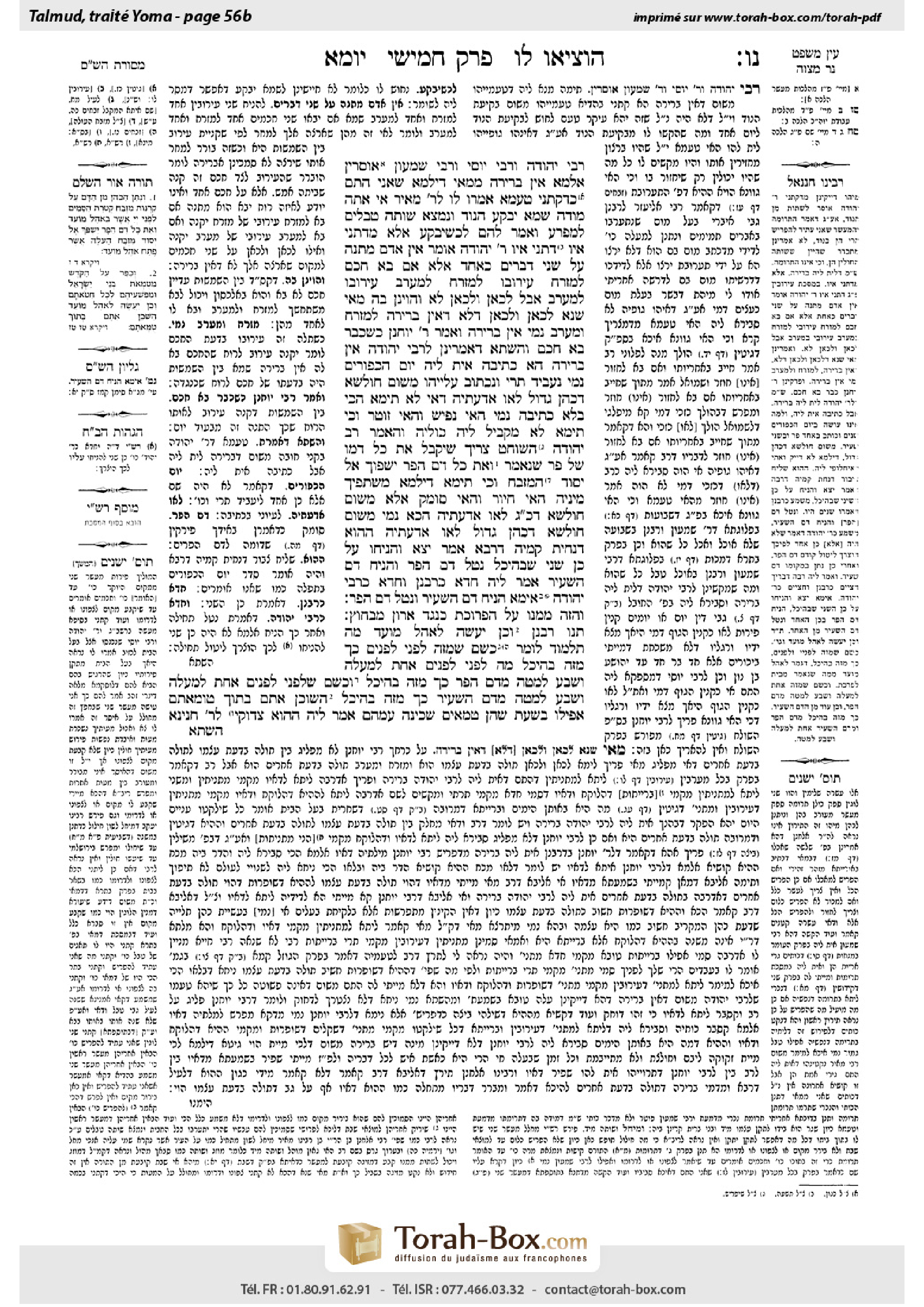
Yoma 56b: Talmud study for Daf Yomi
Daf Yomi is the daily study of one Talmud folio. Explore 37 tractates with scans, Hebrew text, Sefaria English and AI-generated French translations where annotated.
Passage selection and English or AI-generated French translation are available where the scan has annotations. Daf Study is independent of Torah-Box and Sefaria.
Browse Yoma · יומא · All tractatesYoma 56b text and translations
This page of Yoma includes the Aramaic text, an English translation and an AI-generated French translation, alongside the scan above.
יומא נ״ו ב · Aramaic and Hebrew text
רַבִּי יְהוּדָה וְרַבִּי יוֹסֵי וְרַבִּי שִׁמְעוֹן אוֹסְרִין. אַלְמָא אֵין בְּרֵירָה.
מִמַּאי? דִּילְמָא שָׁאנֵי הָתָם כִּדְקָתָנֵי טַעְמָא, אָמְרוּ לוֹ לְרַבִּי מֵאִיר: אִי אַתָּה מוֹדֶה שֶׁמָּא יִבָּקַע הַנּוֹד וְנִמְצָא שׁוֹתֶה טְבָלִים לְמַפְרֵעַ? וְאָמַר לָהֶם: לִכְשֶׁיִּבָּקַע.
אֶלָּא, מִדְּתָנֵי אַיּוֹ. דְּתָנֵי אַיּוֹ, רַבִּי יְהוּדָה אוֹמֵר: אֵין אָדָם מַתְנֶה עַל שְׁנֵי דְבָרִים כְּאֶחָד.
אֶלָּא: אִם בָּא חָכָם לַמִּזְרָח — עֵירוּבוֹ לַמִּזְרָח. לַמַּעֲרָב — עֵירוּבוֹ לַמַּעֲרָב. אֲבָל לְכָאן וּלְכָאן — לָא.
וְהָוֵינַן בַּהּ: מַאי שְׁנָא לְכָאן וּלְכָאן דְּלָא, דְּאֵין בְּרֵירָה.
לְמִזְרָח וּמַעֲרָב נָמֵי אֵין בְּרֵירָה?
וְאָמַר רַבִּי יוֹחָנָן: כְּשֶׁכְּבָר בָּא חָכָם.
וְהַשְׁתָּא דְּאָמְרִינַן לְרַבִּי יְהוּדָה אֵין בְּרֵירָה, הָא כְּתִיבָה אִית לֵיהּ! יוֹם הַכִּפּוּרִים נָמֵי, נַעֲבֵיד תְּרֵי וְנִכְתּוֹב עֲלַיְיהוּ!
מִשּׁוּם חוּלְשָׁא דְּכֹהֵן גָּדוֹל לָאו אַדַּעְתֵּיהּ. דְּאִי לָא תֵּימָא הָכִי, בְּלָא כְּתִיבָה נָמֵי, הַאי נְפִישׁ וְהַאי זוּטַר.
וְכִי תֵּימָא לָא מְקַבֵּיל לֵיהּ כּוּלֵּיהּ, וְהָאָמַר רַב יְהוּדָה: הַשּׁוֹחֵט צָרִיךְ שֶׁיְּקַבֵּל אֶת כׇּל דָּמוֹ שֶׁל פַּר, שֶׁנֶּאֱמַר: ״וְאֵת כׇּל דַּם הַפָּר יִשְׁפּוֹךְ אֶל יְסוֹד הַמִּזְבֵּחַ״.
וְכִי תֵּימָא: דִּילְמָא מִשְׁתְּפִיךְ מִינֵּיהּ — הַאי חִיוָּר וְהַאי סוּמָּק. אֶלָּא, מִשּׁוּם חוּלְשָׁא דְּכֹהֵן גָּדוֹל לָאו אַדַּעְתֵּיהּ. הָכָא נָמֵי, מִשּׁוּם חוּלְשָׁא דְּכֹהֵן גָּדוֹל לָאו אַדַּעְתֵּיהּ.
הָהוּא דִּנְחֵית קַמֵּיהּ דְּרָבָא, אֲמַר: יָצָא וְהִנִּיחוֹ עַל כַּן שֵׁנִי שֶׁבַּהֵיכָל, נָטַל דַּם הַפָּר, וְהִנִּיחַ דַּם הַשָּׂעִיר.
אֲמַר לֵיהּ: חֲדָא כְּרַבָּנַן וַחֲדָא כְּרַבִּי יְהוּדָה?! אֵימָא: הִנִּיחַ דַּם הַשָּׂעִיר, וְנָטַל דַּם הַפָּר.
וְהִזָּה מִמֶּנּוּ עַל הַפָּרוֹכֶת כְּנֶגֶד אָרוֹן מִבַּחוּץ. תָּנוּ רַבָּנַן: ״וְכֵן יַעֲשֶׂה לְאֹהֶל מוֹעֵד״, מָה תַּלְמוּד לוֹמַר? כְּשֵׁם שֶׁמַּזֶּה לִפְנַי לְפָנִים — כָּךְ מַזֶּה בַּהֵיכָל.
מָה לִפְנַי לִפְנִים, אַחַת לְמַעְלָה וְשֶׁבַע לְמַטָּה מִדַּם הַפָּר — כָּךְ מַזֶּה בַּהֵיכָל. וּכְשֵׁם שֶׁלִּפְנַי לִפְנִים, אַחַת לְמַעְלָה וְשֶׁבַע לְמַטָּה מִדַּם הַשָּׂעִיר — כָּךְ מַזֶּה בַּהֵיכָל. ״הַשּׁוֹכֵן אִתָּם בְּתוֹךְ טוּמְאֹתָם״, אֲפִילּוּ בִּשְׁעַת שֶׁהֵן טְמֵאִים — שְׁכִינָה עִמָּהֶם.
אֲמַר לֵיהּ הָהוּא צַדּוּקִי לְרַבִּי חֲנִינָא:
Yoma 56b · English translation
Rabbi Yehuda, Rabbi Yosei, and Rabbi Shimon prohibit this practice. Apparently, Rabbi Yehuda maintains that there is no retroactive clarification.
The Gemara explains the difficulty: From where do you reach this conclusion? Perhaps it is different there, as the reason is taught: The Rabbis said to Rabbi Meir: Do you not concede that the jug might split open before he removes the portions of terumot and tithes from the mixture, causing all the wine to spill out? And he will then be found drinking untithed wine retroactively. Therefore, he cannot rely on separation that has not yet occurred. And he said to them: Although there will be a problem if it splits open, there is no cause to be concerned for this contingency in advance. Since this reasoning is based on the possibility that the jug might break, there is no proof from here that Rabbi Yehuda rejects the principle of retroactive clarification.
Rather, the proof that Rabbi Yehuda does not accept the principle of retroactive clarification is from a baraita the Sage Ayo taught. As Ayo taught that Rabbi Yehuda says: A person cannot stipulate conditions about two matters at once, e. g., one cannot establish a joining of Shabbat boundaries [eiruv] in each of two different directions on Friday afternoon while making the following stipulation: If tomorrow, on Shabbat, two Sages arrive from two different directions, I will decide then which of the two lecturers I prefer to hear at that point in time, which will determine which eiruv is in effect.
Rather, he may say that if the Sage comes to the east, his eiruv is to the east, and if the Sage comes to the west, his eiruv is to the west. However, he may not say that if one Sage comes from here, and another Sage comes from there, he will go wherever he wishes, in either direction.
And we discussed this passage in the Gemara and asked: What is different about a case in which one stipulated that if Sages came from here and from there that he may go to whichever side he chooses, such that his eiruv is not effective? Apparently, Rabbi Yehuda maintains that there is no retroactive clarification, i.e., this person cannot claim after the fact that the place where he walked is designated as the place that he initially intended for his eiruv.
However, according to this principle, when an individual establishes an eiruv to the east and to the west for the anticipated arrival of a single Sage, one should also invoke the principle that there is no retroactive clarification. Why does Rabbi Yehuda agree that if one anticipates the arrival of a single Sage and stipulates that if he comes to the east his eiruv will be to the east, the eiruv is valid?
And Rabbi Yoḥanan said: This is not a true case of retroactive clarification, as the Sage had already come by twilight, but the one who established the eiruv did not yet know at which side of the town the Sage had arrived. Therefore, at the time the eiruv establishes his Shabbat residence, it is clear which eiruv he wants, although he himself will become aware of that only later. In this case, Rabbi Yehuda agrees that the eiruv is valid, but he nonetheless maintains in general that there is no retroactive clarification. This accounts for Rabbi Yehuda’s opinion that there was no container for nests of obligatory sin-offerings and burnt-offerings, as he maintains that there is no solution for the possible mixture of the different coins.
The Gemara asks: And now that we have said and proven that according to Rabbi Yehuda there is no retroactive clarification, nevertheless he is of the opinion that one may rely on writing, as proven from the halakha of the collection horns. If so, on Yom Kippur as well, let us place two pedestals and write on them which one is for the blood of the bull and which is for the blood of the goat.
The Gemara answers: The reason they did not place two pedestals with writing on them is due to the High Priest’s weakness. Since he is fasting during the entire day’s service, the writing will not be on his mind; he will pay no attention to it and might become confused. As, if you do not say so, that there is concern for the High Priest’s weakness, even without writing he should also not err, as this bowl in which he collects the bull’s blood is relatively large and this one for the goat’s blood is small.
And if you say that he does not collect all the bull’s blood but only some of it, so that the bowls are of equal size, didn’t Rav Yehuda say: One who slaughters the bull must receive all of the blood of the bull, as it is stated: “And all the blood of the bull he shall pour out on the base of the altar” (Leviticus 4:7).
And if you say that perhaps some of the bull’s blood might spill, yielding equal amounts of blood, there should still be no mistake, as this blood, that of the goat, is white and bright compared to the blood of the bull, and this blood of the bull is red and darker than the other. Rather, the reason must be that due to the High Priest’s weakness, these differences will not be on his mind. Here, too, the writing will not help, as due to the High Priest’s weakness the inscriptions will not be on his mind.
§ The Gemara relates: A certain person descended to lead the prayer service on Yom Kippur before Rava. He included the order of the High Priest’s Yom Kippur service in his prayer, and he recited: The High Priest then emerged from the Holy of Holies and placed the bowl on the second golden pedestal in the Sanctuary; he took the blood of the bull from the pedestal and placed the blood of the goat in its place.
Rava said to him: This is problematic, as one statement is in accordance with the opinion of the Rabbis, and the other one is in accordance with the opinion of Rabbi Yehuda. According to the Rabbis, each of these bowls sat on its own pedestal in the Sanctuary, whereas Rabbi Yehuda maintains that the High Priest must first lift up the container with the blood of the bull and then put down that of the goat. Rather, you should recite the entire order of the service entirely in accordance with the opinion of the Rabbis: He placed the blood of the goat on its designated pedestal and took the blood of the bull from the second stand.
§ The mishna taught: And the High Priest sprinkled from the blood of the bull on the curtain opposite the Ark from outside the Holy of Holies. The Sages taught: “And he shall make atonement for the sacred place because of the impurities of the children of Israel, and because of their transgressions, even all their sins; and so shall he do for the Tent of Meeting that dwells with them in the midst of their impurity” (Leviticus 16:16). What is the meaning when the verse states this? Just as he sprinkles in the innermost sanctum, the Holy of Holies, so he sprinkles in the Sanctuary, the Tent of Meeting, toward the curtain.
Furthermore: Just as in the innermost sanctum he sprinkles once upward and seven times downward from the blood of the bull, so he sprinkles in the Sanctuary. And just as in the innermost sanctum he sprinkles once upward and seven times downward from the blood of the goat, so he sprinkles in the Sanctuary. The last part of the verse: “That dwells with them in the midst of their impurity,” teaches that even when the Jewish people are impure, the Divine Presence is with them.
With regard to this verse, the Gemara relates: A certain Sadducee said to Rabbi Ḥanina:
Yoma 56b · Traduction française (IA)
Rabbi Yehuda, Rabbi Yosei et Rabbi Shimon interdisent cette pratique. Il semble donc que Rabbi Yehuda considère qu’il n’y a pas de clarification rétroactive.
La Guemara explique la difficulté : d’où tire-t-on cette conclusion ? Peut-être le cas est-il différent là-bas, car la raison est formulée ainsi : les Sages dirent à Rabbi Meïr : « Ne reconnais-tu pas que la cruche pourrait se fendre avant qu’il ne prélève du mélange les parts de terouma et les dîmes, et que tout le vin se répande ? Il se trouverait alors qu’il a bu, rétroactivement, du vin non soumis aux dîmes. » Il ne peut donc pas s’appuyer sur un prélèvement qui n’a pas encore eu lieu. Il leur répondit : « Même si la cruche se fendait, ce qui poserait problème, il n’y a pas lieu de s’inquiéter à l’avance de cette éventualité. » Puisque ce raisonnement repose sur la possibilité que la cruche se brise, il ne prouve pas que Rabbi Yehuda rejette le principe de clarification rétroactive.
La preuve que Rabbi Yehuda n’accepte pas le principe de clarification rétroactive vient plutôt d’une baraïta enseignée par le tanna Ayo. Ayo enseigna que Rabbi Yehuda dit : une personne ne peut pas stipuler simultanément des conditions portant sur deux éventualités. Par exemple, on ne peut pas établir le vendredi après-midi un érouv de תחומין [eiruv] dans chacune de deux directions différentes, en stipulant : « Si, demain, à Chabbat, deux Sages arrivent de deux directions différentes, je déciderai alors lequel des deux enseignants je préfère entendre », ce qui déterminera quel érouv sera en vigueur.
Il peut plutôt dire : « Si le Sage arrive de l’est, mon érouv sera à l’est ; s’il arrive de l’ouest, mon érouv sera à l’ouest. » Cependant, il ne peut pas dire : « Si un Sage arrive d’ici et un autre Sage de là-bas, j’irai dans la direction que je souhaite, d’un côté ou de l’autre. »
Nous avons examiné ce passage dans la Guemara et demandé : en quoi le cas où quelqu’un a stipulé que, si des Sages arrivaient d’ici et de là-bas, il pourrait aller du côté de son choix diffère-t-il, de sorte que son érouv n’est pas valide ? Il semble que Rabbi Yehuda considère qu’il n’y a pas de clarification rétroactive, c’est-à-dire que cette personne ne peut pas affirmer après coup que l’endroit où elle s’est rendue était celui qu’elle avait initialement désigné pour son érouv.
Cependant, selon ce principe, lorsqu’une personne établit un érouv à l’est et à l’ouest en prévision de l’arrivée d’un seul Sage, il faudrait également invoquer le principe selon lequel il n’y a pas de clarification rétroactive. Pourquoi Rabbi Yehuda admet-il que l’érouv est valide si quelqu’un prévoit l’arrivée d’un seul Sage et stipule que, si celui-ci arrive à l’est, son érouv sera à l’est ?
Rabbi Yoḥanan dit : ce n’est pas un véritable cas de clarification rétroactive, car le Sage était déjà arrivé au crépuscule, mais celui qui avait établi l’érouv ne savait pas encore de quel côté de la ville le Sage était arrivé. Par conséquent, au moment où l’érouv fixe sa résidence de Chabbat, il est clair quel érouv il souhaite, même s’il ne l’apprend lui-même que plus tard. Dans ce cas, Rabbi Yehuda admet que l’érouv est valide, mais il maintient néanmoins, de manière générale, qu’il n’y a pas de clarification rétroactive. Cela explique l’opinion de Rabbi Yehuda selon laquelle il n’y avait pas de récipient destiné aux oiseaux des sacrifices expiatoires obligatoires et des holocaustes obligatoires, puisqu’il considère qu’il n’existe aucune solution au risque de mélange des différentes pièces.
La Guemara demande : à présent que nous avons dit et prouvé que, selon Rabbi Yehuda, il n’y a pas de clarification rétroactive, il estime néanmoins qu’on peut se fier à une inscription, comme le montre la halakha des troncs de collecte. Dans ce cas, le jour de Yom Kippour également, installons deux supports et inscrivons sur eux lequel est destiné au sang du taureau et lequel au sang du bouc.
La Guemara répond : s’ils n’ont pas installé deux supports portant des inscriptions, c’est à cause de la faiblesse du Grand Prêtre. Comme il jeûne pendant tout le service de la journée, il ne gardera pas les inscriptions à l’esprit ; il n’y prêtera aucune attention et risque de s’embrouiller. Car, si l’on ne dit pas qu’il faut tenir compte de la faiblesse du Grand Prêtre, même sans inscription, il ne devrait pas se tromper : ce bol, dans lequel il recueille le sang du taureau, est relativement grand, tandis que celui-ci, destiné au sang du bouc, est petit.
Et si tu dis qu’il ne recueille pas tout le sang du taureau, mais seulement une partie, de sorte que les bols soient de même taille, Rav Yehuda n’a-t-il pas dit : celui qui égorge le taureau doit recueillir tout son sang, comme il est dit : « Et tout le sang du taureau, il le versera à la base de l’autel » (Lévitique 4:7) ?
Et si tu dis qu’une partie du sang du taureau pourrait se répandre, de sorte que les quantités de sang soient égales, il ne devrait toujours pas y avoir de confusion, car ce sang-ci, celui du bouc, est clair et brillant comparé au sang du taureau, tandis que celui-là, le sang du taureau, est rouge et plus foncé que l’autre. Il faut donc plutôt dire que, du fait de la faiblesse du Grand Prêtre, ces différences ne lui viendront pas à l’esprit. Ici aussi, l’inscription ne sera d’aucune aide, car, du fait de la faiblesse du Grand Prêtre, il ne la gardera pas à l’esprit.
§ La Guemara rapporte : un certain homme descendit pour diriger l’office de prière de Yom Kippour devant Rava. Il inclut dans sa prière l’ordre du service de Yom Kippour du Grand Prêtre et récita : « Le Grand Prêtre sortit alors du Saint des Saints et posa le bol sur le deuxième support d’or dans le Sanctuaire ; il prit le sang du taureau sur le support et plaça le sang du bouc à sa place. »
Rava lui dit : « Cela pose problème, car l’une de ces affirmations est conforme à l’opinion des Sages, tandis que l’autre est conforme à celle de Rabbi Yehuda. Selon les Sages, chacun de ces bols reposait sur son propre support dans le Sanctuaire, tandis que Rabbi Yehuda considère que le Grand Prêtre doit d’abord soulever le récipient contenant le sang du taureau, puis poser celui contenant le sang du bouc. Tu dois plutôt réciter l’ensemble de l’ordre du service conformément à l’opinion des Sages : il posa le sang du bouc sur le support qui lui était destiné et prit le sang du taureau sur le deuxième support. »
§ La Michna enseignait : le Grand Prêtre aspergeait le rideau, face à l’Arche et depuis l’extérieur du Saint des Saints, avec le sang du taureau. Les Sages enseignèrent : « Il fera expiation pour le sanctuaire à cause des impuretés des enfants d’Israël et de leurs transgressions, de tous leurs péchés ; il fera de même pour la Tente d’assignation, qui demeure parmi eux au milieu de leurs impuretés » (Lévitique 16:16). Que signifie cette formulation du verset ? De même qu’il asperge dans le sanctuaire le plus intérieur, le Saint des Saints, de même il asperge dans le Sanctuaire, la Tente d’assignation, en direction du rideau.
De plus, de même que dans le sanctuaire le plus intérieur il asperge une fois vers le haut et sept fois vers le bas avec le sang du taureau, de même il asperge dans le Sanctuaire. Et de même que dans le sanctuaire le plus intérieur il asperge une fois vers le haut et sept fois vers le bas avec le sang du bouc, de même il asperge dans le Sanctuaire. La dernière partie du verset, « qui demeure parmi eux au milieu de leurs impuretés », enseigne que, même lorsque le peuple juif est impur, la Présence divine est avec lui.
À propos de ce verset, la Guemara rapporte : un certain sadducéen dit à Rabbi Ḥanina :
Traduction française générée par IA à partir de l’édition anglaise de Sefaria. Vérifie toujours un passage avec le texte source.
Text from Sefaria: William Davidson Edition - Vocalized Aramaic (CC BY NC); William Davidson Edition - English (CC BY NC).