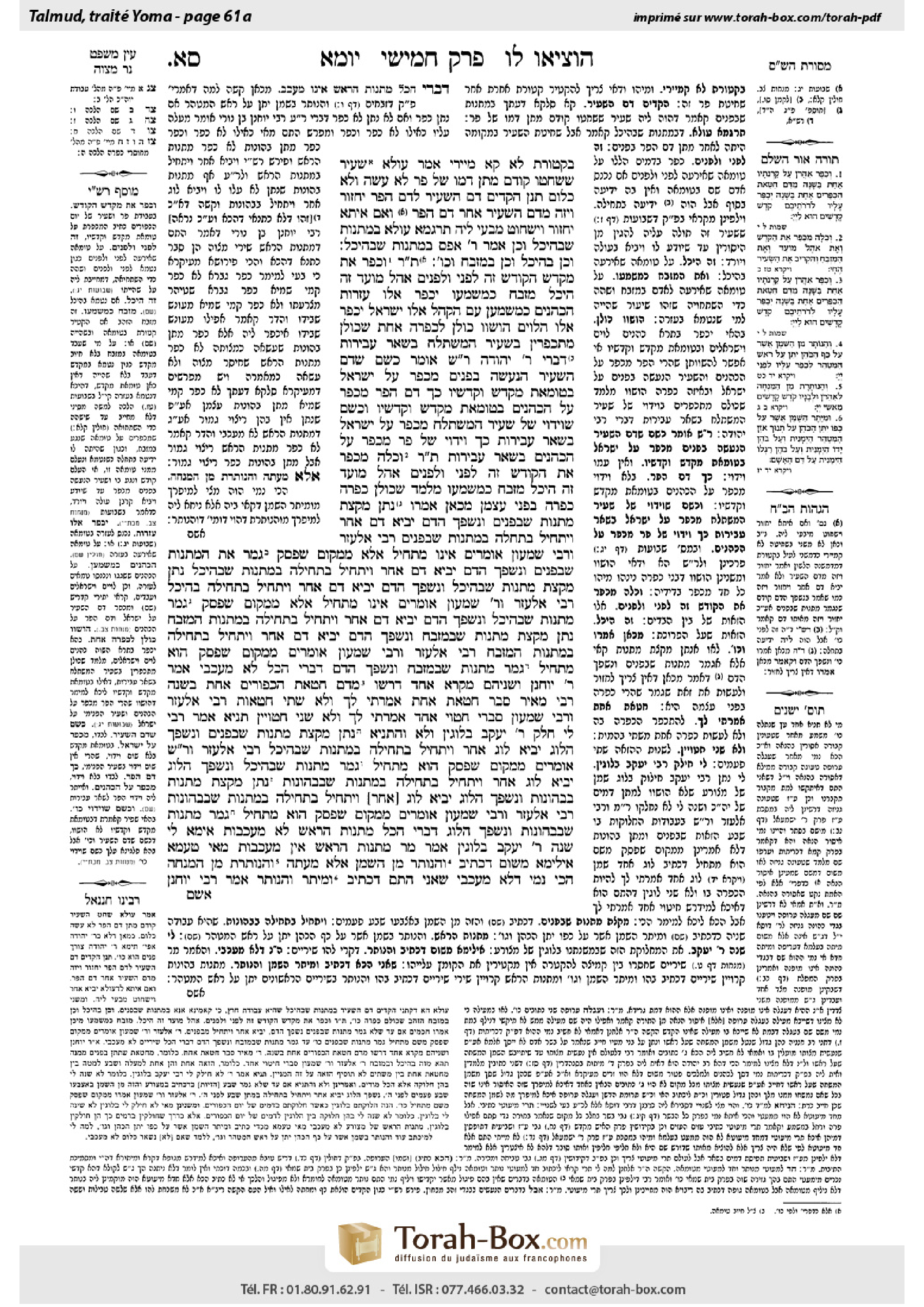
Yoma 61a: Talmud study for Daf Yomi
Daf Yomi is the daily study of one Talmud folio. Explore 37 tractates with scans, Hebrew text, Sefaria English and AI-generated French translations where annotated.
Passage selection and English or AI-generated French translation are available where the scan has annotations. Daf Study is independent of Torah-Box and Sefaria.
Browse Yoma · יומא · All tractatesYoma 61a text and translations
This page of Yoma includes the Aramaic text, an English translation and an AI-generated French translation, alongside the scan above.
יומא ס״א א · Aramaic and Hebrew text
בִּקְטוֹרֶת לָא קָא מַיְירֵי.
אָמַר עוּלָּא: שָׂעִיר שֶׁשְּׁחָטוֹ קוֹדֶם מַתַּן דָּמוֹ שֶׁל פַּר — לֹא עָשָׂה וְלֹא כְלוּם. תְּנַן: הִקְדִּים דַּם הַשָּׂעִיר לְדַם הַפָּר — יַחְזוֹר וְיַזֶּה מִדַּם הַשָּׂעִיר אַחַר דַּם הַפָּר. וְאִם אִיתָא — יַחְזוֹר וְיִשְׁחוֹט מִבְּעֵי לֵיהּ! תַּרְגְּמָא עוּלָּא, בְּמַתָּנוֹת שֶׁבַּהֵיכָל. וְכֵן אָמַר רַבִּי אַפָּס, בְּמַתָּנוֹת שֶׁבַּהֵיכָל.
וְכֵן בַּהֵיכָל וְכֵן בַּמִּזְבֵּחַ וְכוּ׳. תָּנוּ רַבָּנַן: ״וְכִפֶּר אֶת מִקְדַּשׁ הַקּוֹדֶשׁ״ — זֶה לִפְנַי וְלִפְנִים, ״אֹהֶל מוֹעֵד״ — זֶה הֵיכָל, ״מִזְבֵּחַ״ — כְּמַשְׁמָעוֹ, ״יְכַפֵּר״ — אֵלּוּ עֲזָרוֹת.
״הַכֹּהֲנִים״ — כְּמַשְׁמָעָן, ״עַם הַקָּהָל״ — אֵלּוּ יִשְׂרָאֵל, ״יְכַפֵּר״ — אֵלּוּ הַלְוִיִּם. הוּשְׁווּ כּוּלָּן לְכַפָּרָה אַחַת, שֶׁכּוּלָּן מִתְכַּפְּרִין בְּשָׂעִיר הַמִּשְׁתַּלֵּחַ בִּשְׁאָר עֲבֵירוֹת, דִּבְרֵי רַבִּי יְהוּדָה.
רַבִּי שִׁמְעוֹן אוֹמֵר: כְּשֵׁם שֶׁדַּם הַשָּׂעִיר הַנַּעֲשֶׂה בִּפְנִים מְכַפֵּר עַל יִשְׂרָאֵל בְּטוּמְאַת מִקְדָּשׁ וְקָדָשָׁיו — כָּךְ דַּם הַפָּר מְכַפֵּר עַל הַכֹּהֲנִים בְּטוּמְאַת מִקְדָּשׁ וְקָדָשָׁיו. וּכְשֵׁם שֶׁוִּידּוּי שֶׁל שָׂעִיר הַמִּשְׁתַּלֵּחַ מְכַפֵּר עַל יִשְׂרָאֵל בִּשְׁאָר עֲבֵירוֹת — כָּךְ וִידּוּי שֶׁל פָּר מְכַפֵּר עַל הַכֹּהֲנִים בִּשְׁאָר עֲבֵירוֹת.
תָּנוּ רַבָּנַן: ״וְכִלָּה מִכַּפֵּר אֶת הַקּוֹדֶשׁ״ — זֶה לִפְנַי וְלִפְנִים, ״אֹהֶל מוֹעֵד״ — זֶה הֵיכָל, ״מִזְבֵּחַ״ — כְּמַשְׁמָעוֹ, מְלַמֵּד שֶׁכּוּלָּן כַּפָּרָה כַּפָּרָה בִּפְנֵי עַצְמָן.
מִכָּאן אָמְרוּ: נָתַן מִקְצָת מַתָּנוֹת שֶׁבִּפְנִים וְנִשְׁפַּךְ הַדָּם — יָבִיא דָּם אַחֵר וְיַתְחִיל בַּתְּחִלָּה בְּמַתָּנוֹת שֶׁבִּפְנִים. רַבִּי אֶלְעָזָר וְרַבִּי שִׁמְעוֹן אוֹמְרִים: אֵינוֹ מַתְחִיל אֶלָּא מִמָּקוֹם שֶׁפָּסַק. גָּמַר אֶת הַמַּתָּנוֹת שֶׁבִּפְנִים וְנִשְׁפַּךְ הַדָּם — יָבִיא דָּם אַחֵר וְיַתְחִיל בַּתְּחִילָּה בְּמַתָּנוֹת שֶׁבַּהֵיכָל.
נָתַן מִקְצָת מַתָּנוֹת שֶׁבַּהֵיכָל וְנִשְׁפַּךְ הַדָּם — יָבִיא דָּם אַחֵר וְיַתְחִיל בַּתְּחִילָּה בַּהֵיכָל. רַבִּי אֶלְעָזָר וְרַבִּי שִׁמְעוֹן אוֹמְרִים: אֵינוֹ מַתְחִיל אֶלָּא מִמָּקוֹם שֶׁפָּסַק.
גָּמַר מַתָּנוֹת שֶׁבַּהֵיכָל וְנִשְׁפַּךְ הַדָּם — יָבִיא דָּם אַחֵר וְיַתְחִיל בַּתְּחִילָּה בְּמַתְּנוֹת הַמִּזְבֵּחַ. נָתַן מִקְצָת מַתָּנוֹת שֶׁבַּמִּזְבֵּחַ וְנִשְׁפַּךְ הַדָּם — יָבִיא דָּם אַחֵר וְיַתְחִיל בַּתְּחִילָּה בְּמַתְּנוֹת הַמִּזְבֵּחַ. רַבִּי אֶלְעָזָר וְרַבִּי שִׁמְעוֹן אוֹמְרִים: מִמָּקוֹם שֶׁפָּסַק הוּא מַתְחִיל. גָּמַר מַתָּנוֹת שֶׁבַּמִּזְבֵּחַ וְנִשְׁפַּךְ הַדָּם — דִּבְרֵי הַכֹּל לָא מְעַכְּבִי.
אָמַר רַבִּי יוֹחָנָן: וּשְׁנֵיהֶם מִקְרָא אֶחָד דָּרְשׁוּ: ״מִדַּם חַטַּאת הַכִּפּוּרִים אַחַת בַּשָּׁנָה״,
רַבִּי מֵאִיר סָבַר: חַטָּאת אַחַת אָמַרְתִּי לָךְ, וְלֹא שְׁתֵּי חַטָּאוֹת. רַבִּי אֶלְעָזָר וְרַבִּי שִׁמְעוֹן סָבְרִי: חִטּוּי אֶחָד אָמַרְתִּי לָךְ, וְלֹא שְׁנֵי חִטּוּיִין.
תַּנְיָא, אָמַר רַבִּי: לִי חִלֵּק רַבִּי יַעֲקֹב בַּלּוּגִּין.
וְלֹא? וְהָתַנְיָא: נָתַן מִקְצָת מַתָּנוֹת שֶׁבִּפְנִים וְנִשְׁפַּךְ הַלּוֹג — יָבִיא לוֹג אַחֵר וְיַתְחִיל בַּתְּחִילָּה בְּמַתָּנוֹת שֶׁבַּהֵיכָל. רַבִּי אֶלְעָזָר וְרַבִּי שִׁמְעוֹן אוֹמְרִים: מִמָּקוֹם שֶׁפָּסַק הוּא מַתְחִיל.
גָּמַר מַתָּנוֹת שֶׁבַּהֵיכָל וְנִשְׁפַּךְ הַלּוֹג — יָבִיא לוֹג אַחֵר וְיַתְחִיל בַּתְּחִילָּה בְּמַתָּנוֹת שֶׁבַּבְּהוֹנוֹת. נָתַן מִקְצָת מַתָּנוֹת בַּבְּהוֹנוֹת וְנִשְׁפַּךְ הַלּוֹג — יָבִיא לוֹג [אַחֵר] וְיַתְחִיל בַּתְּחִילָּה בְּמַתָּנוֹת שֶׁבַּבְּהוֹנוֹת. רַבִּי אֶלְעָזָר וְרַבִּי שִׁמְעוֹן אוֹמְרִים: מִמָּקוֹם שֶׁפָּסַק הוּא מַתְחִיל. גָּמַר מַתָּנוֹת שֶׁבַּבְּהוֹנוֹת וְנִשְׁפַּךְ הַלּוֹג — דִּבְרֵי הַכֹּל מַתְּנוֹת הָרֹאשׁ לָא מְעַכְּבוֹת.
אֵימָא: לִי שָׁנָה רַבִּי יַעֲקֹב בַּלּוּגִּין.
אָמַר מָר: מַתְּנוֹת הָרֹאשׁ — אֵין מְעַכְּבוֹת. מַאי טַעְמָא? אִילֵּימָא מִשּׁוּם דִּכְתִיב: ״וְהַנּוֹתָר מִן הַשֶּׁמֶן״ — אֶלָּא מֵעַתָּה: ״וְהַנּוֹתֶרֶת מִן הַמִּנְחָה״ הָכִי נָמֵי דְּלָא מְעַכְּבִי?!
שָׁאנֵי הָתָם, דִּכְתִיב: ״וּמִיֶּתֶר ... וְהַנּוֹתָר״.
אָמַר רַבִּי יוֹחָנָן:
Yoma 61a · English translation
The Gemara answers that this is no proof, as he is not dealing with the incense. In practice, the High Priest must indeed go back and scoop new incense after slaughtering the bull. The mishna did not mention this detail because it is discussing the issue of the sprinkling of blood, not the incense service.
§ Ulla said: With regard to a goat that he slaughtered before presentation of the blood of the bull, it is as though he did nothing. The Gemara asks: But we learned in the mishna that if he performed the sprinkling of the blood of the goat before the sprinkling of the blood of the bull, he must repeat the action and sprinkle the blood of the goat after sprinkling the blood of the bull. And if it is so that Ulla is correct, the mishna should have said that he must return and slaughter another bull. The Gemara answers: Ulla interpreted the mishna as referring only to the presentations in the Sanctuary that were performed out of order. However, it is essential that the presentations in the Holy of Holies must be performed before the slaughter of the goat. And likewise, Rabbi Afes said that the mishna is referring to the presentations in the Sanctuary.
§ The mishna states: And similarly in the Sanctuary, and likewise on the golden altar, if the blood spills he must go back and begin that cycle of sprinklings afresh. The Sages taught: “And he shall make atonement for the most sacred place, and he shall make atonement for the Tent of Meeting and for the altar; and he shall make atonement for the priests and for all the people of the assembly” (Leviticus 16:33). “And he shall make atonement for the most sacred place,” this is the innermost sanctum, the Holy of Holies; “the Tent of Meeting,” this is the Sanctuary; “altar” is meant as per its plain meaning; “he shall make atonement,” is referring to the second mention of this phrase in the verse, these are the courtyards.
“The priests” is meant as per its plain meaning; “people of the assembly,” these are the Israelites; “he shall make atonement,” these are the Levites, who also gain atonement. They are all equated in this verse in that they achieve one atonement in this verse, which indicates that they all achieve atonement through the scapegoat for all other transgressions, apart from the ritual impurity of the Temple and consecrated objects, i.e., entering the Temple or eating consecrated food while ritually impure. The bull presented inside atones only for the priests, while the goats atone solely for Israelites. Only the scapegoat atones equally for all Jews. This is the statement of Rabbi Yehuda.
Rabbi Shimon says: Just as the blood of the goat presented inside atones for Israelites who sinned with the ritual impurity of the Temple and its consecrated objects, so too, the blood of the High Priest’s bull atones for the priests who sinned with the ritual impurity of the Temple and its consecrated objects. And just as the confession over the scapegoat atones for Israelites with regard to all other transgressions, so too, the confession over the bull atones for the priests with regard to all other transgressions, and therefore the priests do not require atonement through the scapegoat.
The Sages taught in another baraita: “And when he has finished atoning for the sacred place, and the Tent of Meeting, and the altar, he shall present the live goat” (Leviticus 16:20). “And when he has finished atoning for the sacred place,” this is the sprinklings in the innermost sanctum, the Holy of Holies; “Tent of Meeting,” this is the sprinklings toward the curtain in the Sanctuary; “altar,” as per its plain meaning. This teaches that they each constitute a separate atonement unto themselves, i.e., each one of these actions achieves a distinct atonement. If a disqualification occurs in any of the atoning actions, he must return to the beginning of that action.
From here the Sages stated: If the High Priest presented some of the presentations inside the Holy of Holies and then the blood spilled, he brings other blood and begins from the start of the presentations inside. Rabbi Elazar and Rabbi Shimon say: He need not start the cycle of sprinklings again; rather, he begins only from the place where he stopped. If he finished the presentations inside and then the blood spilled, he brings other blood and starts at the beginning of the presentations in the Sanctuary. However, he does not begin the presentations inside anew, as he has already sprinkled all the required blood inside, and that stage of the service is complete.
If he presented some of the presentations in the Sanctuary and the blood spilled, he brings other blood and begins again from the start in the Sanctuary, as he has not yet completed all the sprinklings in the Sanctuary. Rabbi Elazar and Rabbi Shimon say: He begins only from the place where he stopped.
If he finished the presentations in the Sanctuary and the blood spilled, he brings other blood and begins at the start of the presentations at the altar, as he has already achieved the atonement of the sprinklings in the Sanctuary. If he presented some of the presentations at the altar and the blood spilled, he brings other blood and begins at the start of the presentations at the altar, as the atonement of the altar has yet not been completed. In this case, too, Rabbi Elazar and Rabbi Shimon say that he begins from the place where he stopped. If he finished the presentations at the altar and the blood spilled before he poured the remainder of the blood at the base of the outer altar, everyone agrees that the remainders are not indispensable, and he need not slaughter another offering for this mitzva.
Rabbi Yoḥanan said: And both of them, meaning the first tanna, i.e., Rabbi Meir, the accepted author of unattributed mishnayot, Rabbi Elazar, and Rabbi Shimon, derived their opinions from one verse: “And Aaron shall make atonement upon its corners once a year; with the blood of the sin-offering of atonement once a year he shall make atonement for it throughout your generations; it is most sacred to the Lord” (Exodus 30:10).
Rabbi Yoḥanan elaborates: Rabbi Meir holds that God said: I said to you to bring one sin-offering and not two sin-offerings. In other words, the High Priest may not sprinkle the blood of two offerings on the inner altar. Consequently, if the blood of the sin-offering spilled in the middle of the rite, he may not complete the presentation with the blood of another animal; rather, he must slaughter new offerings so that he can present all the sprinklings at the altar from one sin-offering. Rabbi Elazar and Rabbi Shimon hold that God said: I said to you to perform one sprinkling and not two sprinklings. If he already sprinkled once, the High Priest need not sprinkle again, and if the blood spilled in the middle, the rite is completed with the blood of another offering.
§ It was taught in a baraita that Rabbi Yehuda HaNasi said: Rabbi Ya’akov differentiated for me with respect to lugin. In other words, Rabbi Ya’akov said that although Rabbi Elazar and Rabbi Shimon disagree with Rabbi Meir with respect to the sprinkling on Yom Kippur, maintaining that the High Priest restarts from where he stopped, if some of the oil from the log used for purifying the leper spills in the middle of the sprinkling, these tanna’im do not disagree that the priest must start that rite afresh.
The Gemara expresses surprise at this claim: And do they not disagree with regard to this issue as well? But wasn’t it taught explicitly in a baraita: If he presented some of the presentations of oil that he sprinkles inside the Temple and the log spilled, he brings another log and begins from the start of the presentations in the Sanctuary; and Rabbi Elazar and Rabbi Shimon say: He begins from the place where he stopped.
Likewise, if he finished the presentations in the Sanctuary and the log spilled, he brings another log and begins from the start of the presentations that he puts on the thumbs of the leper. If he put some of the presentations on the leper’s thumbs and the log spilled, he brings another log and begins from the start of the presentations on his thumbs. Rabbi Elazar and Rabbi Shimon say: He begins from the place where he stopped. If he finished the presentations on his thumbs and the log spilled, everyone agrees that the presentations on the head are not indispensable. This baraita proves that Rabbi Elazar and Rabbi Shimon also disagree with Rabbi Meir with regard to the purifying oil of the leper.
The Gemara answers: Rather, Rabbi Yehuda HaNasi’s statement must be amended, as one should say: Rabbi Ya’akov taught me this dispute with regard to lugin. Just as there is a dispute with regard to spilled blood during the presentations on Yom Kippur, Rabbi Ya’akov taught that a similar dispute applies to the leper’s log of oil.
The Gemara analyzes this issue: The Master said above that everyone agrees that the presentations of oil placed on the head of the leper are not indispensable. The Gemara asks: What is the reason for this? If we say it is because it is written: “And the rest of the oil that is in the priest’s hand he shall put upon the head of him that is to be purified, to make atonement for him before the Lord” (Leviticus 14:29), which indicates that this presentation involves only the rest of the oil and is therefore not an essential element of atonement, however, if that is so, consider the verse: “But the rest of the meal-offering shall be for Aharon and his sons; it is one of the sacred offerings of the Lord by fire” (Leviticus 2:3). Should we say, so too, that they are not indispensable? This cannot be the case, as the halakha is that if the remnants of the meal-offering are lost before the handful is burnt, the owner of the offering must bring another handful.
The Gemara answers: It is different there, with regard to the leper’s log of oil, as it is written earlier: “And of the rest of the oil that is in his hand, the priest shall put upon the tip of the right ear of him that is to be purified, and upon the thumb of his right hand, and upon the big toe of his right foot” (Leviticus 14:17), and it is also written: “And of the rest of the oil that is in the priest’s hand, he shall put upon the head of him that is to be purified” (Leviticus 14:18). This shows that the presentation on the head is performed only with the remainder of the oil, and therefore this action is certainly not indispensable.
Rabbi Yoḥanan said:
Yoma 61a · Traduction française (IA)
La Guemara répond que cela ne prouve rien, car il ne parle pas de l’encens. En pratique, le grand prêtre doit bien retourner prélever une nouvelle portion d’encens après avoir égorgé le taureau. La Michna n’a pas mentionné ce détail, car elle traite de l’aspersion du sang et non du service de l’encens.
§ Oulla a dit : s’il a égorgé le bouc avant les aspersions du sang du taureau, c’est comme s’il n’avait rien fait. La Guemara demande : Mais nous avons appris dans la Michna que, s’il a effectué les aspersions du sang du bouc avant celles du sang du taureau, il doit recommencer et asperger le sang du bouc après avoir aspergé celui du taureau. Or, si Oulla a raison, la Michna aurait dû dire qu’il doit retourner égorger un autre taureau. La Guemara répond : Oulla interprète la Michna comme ne traitant que des aspersions dans le Sanctuaire, effectuées dans le mauvais ordre. Toutefois, les aspersions dans le Saint des Saints doivent impérativement être effectuées avant l’égorgement du bouc. De même, Rabbi Afès a dit que la Michna parle des aspersions dans le Sanctuaire.
§ La Michna enseigne : De même dans le Sanctuaire, et pareillement sur l’autel d’or, si le sang se répand, il doit retourner au début de ce cycle d’aspersions. Les Sages ont enseigné : « Il fera expiation pour le sanctuaire le plus saint, il fera expiation pour la Tente d’assignation et pour l’autel ; il fera expiation pour les prêtres et pour toute l’assemblée du peuple » (Lévitique 16, 33). « Il fera expiation pour le sanctuaire le plus saint » désigne le sanctuaire le plus intérieur, le Saint des Saints ; « la Tente d’assignation » désigne le Sanctuaire ; « l’autel » s’entend dans son sens littéral ; « il fera expiation » renvoie à la seconde occurrence de cette expression dans le verset : cela désigne les parvis.
« Les prêtres » s’entend dans son sens littéral ; « l’assemblée du peuple » désigne les Israélites ; « il fera expiation » désigne les Lévites, qui bénéficient eux aussi de l’expiation. Tous sont mis sur le même plan dans ce verset, en ce qu’ils obtiennent une seule expiation par ce verset ; cela indique qu’ils bénéficient tous de l’expiation apportée par le bouc émissaire pour toutes les autres transgressions, à l’exception des cas d’impureté rituelle du Temple et de ses objets consacrés, c’est-à-dire le fait d’entrer dans le Temple ou de consommer des aliments consacrés en état d’impureté rituelle. Le taureau présenté à l’intérieur expie uniquement pour les prêtres, tandis que les boucs expient uniquement pour les Israélites. Seul le bouc émissaire expie de la même manière pour tous les Juifs. Telle est l’opinion de Rabbi Yehouda.
Rabbi Shimon dit : De même que le sang du bouc présenté à l’intérieur expie pour les Israélites qui ont fauté en matière d’impureté rituelle du Temple et de ses objets consacrés, ainsi le sang du taureau du grand prêtre expie pour les prêtres qui ont fauté en matière d’impureté rituelle du Temple et de ses objets consacrés. Et de même que la confession prononcée sur le bouc émissaire expie pour les Israélites en ce qui concerne toutes les autres transgressions, ainsi la confession prononcée sur le taureau expie pour les prêtres en ce qui concerne toutes les autres transgressions ; les prêtres n’ont donc pas besoin d’obtenir expiation par le bouc émissaire.
Les Sages ont enseigné dans une autre baraïta : « Lorsqu’il aura achevé d’expier pour le sanctuaire, la Tente d’assignation et l’autel, il présentera le bouc vivant » (Lévitique 16, 20). « Lorsqu’il aura achevé d’expier pour le sanctuaire » désigne les aspersions dans le sanctuaire le plus intérieur, le Saint des Saints ; « la Tente d’assignation » désigne les aspersions en direction du rideau dans le Sanctuaire ; « l’autel » s’entend dans son sens littéral. Cela enseigne que chacune de ces actions constitue une expiation distincte, accomplie en soi. Si une invalidation survient lors de l’une des actions expiatoires, il doit reprendre cette action depuis le début.
De là, les Sages ont déduit : si le grand prêtre a effectué une partie des aspersions à l’intérieur du Saint des Saints, puis que le sang s’est répandu, il apporte du sang provenant d’un autre animal et reprend les aspersions à l’intérieur depuis le début. Rabbi Elazar et Rabbi Shimon disent : il n’a pas besoin de reprendre le cycle des aspersions depuis le début ; il reprend seulement à l’endroit où il s’est arrêté. S’il a achevé les aspersions à l’intérieur, puis que le sang s’est répandu, il apporte du sang provenant d’un autre animal et commence au début des aspersions dans le Sanctuaire. Toutefois, il ne recommence pas les aspersions à l’intérieur, puisqu’il y a déjà aspergé tout le sang requis et que cette étape du service est achevée.
S’il a effectué une partie des aspersions dans le Sanctuaire et que le sang s’est répandu, il apporte du sang provenant d’un autre animal et recommence au début dans le Sanctuaire, car il n’a pas encore achevé toutes les aspersions dans le Sanctuaire. Rabbi Elazar et Rabbi Shimon disent : il reprend seulement à l’endroit où il s’est arrêté.
S’il a achevé les aspersions dans le Sanctuaire et que le sang s’est répandu, il apporte du sang provenant d’un autre animal et commence au début des aspersions sur l’autel, car l’expiation accomplie par les aspersions dans le Sanctuaire est déjà acquise. S’il a effectué une partie des aspersions sur l’autel et que le sang s’est répandu, il apporte du sang provenant d’un autre animal et commence au début des aspersions sur l’autel, car l’expiation liée à l’autel n’est pas encore achevée. Dans ce cas aussi, Rabbi Elazar et Rabbi Shimon disent qu’il reprend à l’endroit où il s’est arrêté. S’il a achevé les aspersions sur l’autel et que le sang s’est répandu avant qu’il ne verse le reste du sang à la base de l’autel extérieur, tous conviennent que le reste n’est pas indispensable et qu’il n’a pas besoin d’égorger un autre sacrifice pour cette mitsva.
Rabbi Yoḥanan a dit : Tous trois — le premier tanna, c’est-à-dire Rabbi Meïr, qui est l’auteur habituel des Michnayot anonymes, Rabbi Elazar et Rabbi Shimon — ont tiré leurs opinions d’un même verset : « Aaron fera expiation sur les cornes de l’autel une fois par an ; avec le sang du sacrifice expiatoire d’expiation, une fois par an, il fera expiation pour lui au fil de vos générations ; il est très saint pour le Seigneur » (Exode 30, 10).
Rabbi Yoḥanan précise : Rabbi Meïr considère que Dieu a dit : « Je vous ai ordonné d’apporter un seul sacrifice expiatoire, et non deux. » Autrement dit, le grand prêtre ne peut pas asperger sur l’autel intérieur le sang de deux sacrifices. Par conséquent, si le sang du sacrifice expiatoire se répand au milieu du rite, il ne peut pas achever les aspersions avec le sang d’un autre animal ; il doit plutôt égorger de nouveaux sacrifices afin d’effectuer toutes les aspersions sur l’autel avec le sang d’un seul sacrifice expiatoire. Rabbi Elazar et Rabbi Shimon considèrent que Dieu a dit : « Je vous ai ordonné d’effectuer une seule aspersion, et non deux. » S’il a déjà effectué une aspersion, le grand prêtre n’a pas besoin d’en effectuer une autre ; si le sang s’est répandu au milieu du rite, celui-ci est achevé avec le sang d’un autre sacrifice.
§ Il a été enseigné dans une baraïta que Rabbi Yehouda HaNassi a dit : Rabbi Ya’akov a distingué pour moi le cas des log d’huile. Autrement dit, Rabbi Ya’akov a dit que, bien que Rabbi Elazar et Rabbi Shimon soient en désaccord avec Rabbi Meïr au sujet des aspersions de Yom Kippour, puisqu’ils estiment que le grand prêtre reprend là où il s’est arrêté, ces tannaïm ne sont pas en désaccord sur le fait que, si une partie de l’huile contenue dans le log utilisé pour purifier le lépreux se répand au milieu des aspersions, le prêtre doit reprendre ce rite depuis le début.
La Guemara s’étonne de cette affirmation : Ne sont-ils pas également en désaccord sur cette question ? N’a-t-on pas explicitement enseigné dans une baraïta : s’il a effectué une partie des aspersions d’huile à l’intérieur du Temple et que le log s’est répandu, il apporte un autre log et recommence au début des aspersions dans le Sanctuaire ; Rabbi Elazar et Rabbi Shimon disent : il reprend à l’endroit où il s’est arrêté.
De même, s’il a achevé les aspersions dans le Sanctuaire et que le log s’est répandu, il apporte un autre log et recommence au début des aspersions qu’il applique sur les pouces du lépreux. S’il a appliqué une partie des aspersions sur les pouces du lépreux et que le log s’est répandu, il apporte un autre log et recommence au début des aspersions sur ses pouces. Rabbi Elazar et Rabbi Shimon disent : il reprend à l’endroit où il s’est arrêté. S’il a achevé les aspersions sur ses pouces et que le log s’est répandu, tous conviennent que les aspersions sur la tête ne sont pas indispensables. Cette baraïta prouve que Rabbi Elazar et Rabbi Shimon sont également en désaccord avec Rabbi Meïr au sujet de l’huile de purification du lépreux.
La Guemara répond : Il faut plutôt corriger la déclaration de Rabbi Yehouda HaNassi et dire : Rabbi Ya’akov m’a enseigné cette controverse au sujet des log d’huile. De même qu’il existe une controverse concernant le sang qui s’est répandu pendant les aspersions de Yom Kippour, Rabbi Ya’akov a enseigné qu’une controverse semblable s’applique au log d’huile du lépreux.
La Guemara analyse cette question : Le maître a dit plus haut que tous conviennent que les applications d’huile sur la tête du lépreux ne sont pas indispensables. La Guemara demande : Quelle en est la raison ? Si l’on dit que c’est parce qu’il est écrit : « Le reste de l’huile qui est dans la main du prêtre, il le mettra sur la tête de celui qui doit être purifié, afin de faire expiation pour lui devant le Seigneur » (Lévitique 14, 29), ce qui indique que cette application porte uniquement sur le reste de l’huile et ne constitue donc pas un élément essentiel de l’expiation, alors considérons le verset : « Le reste de l’oblation appartiendra à Aaron et à ses fils ; c’est une chose très sainte parmi les offrandes du Seigneur consumées par le feu » (Lévitique 2, 3). Faudrait-il dire, là aussi, que ces restes ne sont pas indispensables ? Cela ne peut pas être le cas, car la halakha est que si les restes de l’oblation sont perdus avant que la poignée en soit brûlée, le propriétaire du sacrifice doit apporter une autre poignée.
La Guemara répond : Le cas du log d’huile du lépreux est différent, car il est écrit plus haut : « Le prêtre prendra du reste de l’huile qui est dans sa main et en mettra sur le lobe de l’oreille droite de celui qui doit être purifié, sur le pouce de sa main droite et sur le gros orteil de son pied droit » (Lévitique 14, 17), et il est également écrit : « Du reste de l’huile qui est dans la main du prêtre, il en mettra sur la tête de celui qui doit être purifié » (Lévitique 14, 18). Cela montre que l’application sur la tête se fait uniquement avec le reste de l’huile et que cette action n’est donc certainement pas indispensable.
Rabbi Yoḥanan a dit :
Traduction française générée par IA à partir de l’édition anglaise de Sefaria. Vérifie toujours un passage avec le texte source.
Text from Sefaria: William Davidson Edition - Vocalized Aramaic (CC BY NC); William Davidson Edition - English (CC BY NC).