Yoma 61b: Talmud study for Daf Yomi
Daf Yomi is the daily study of one Talmud folio. Explore 37 tractates with scans, Hebrew text, Sefaria English and AI-generated French translations where annotated.
Passage selection and English or AI-generated French translation are available where the scan has annotations. Daf Study is independent of Torah-Box and Sefaria.
Browse Yoma · יומא · All tractatesYoma 61b text and translations
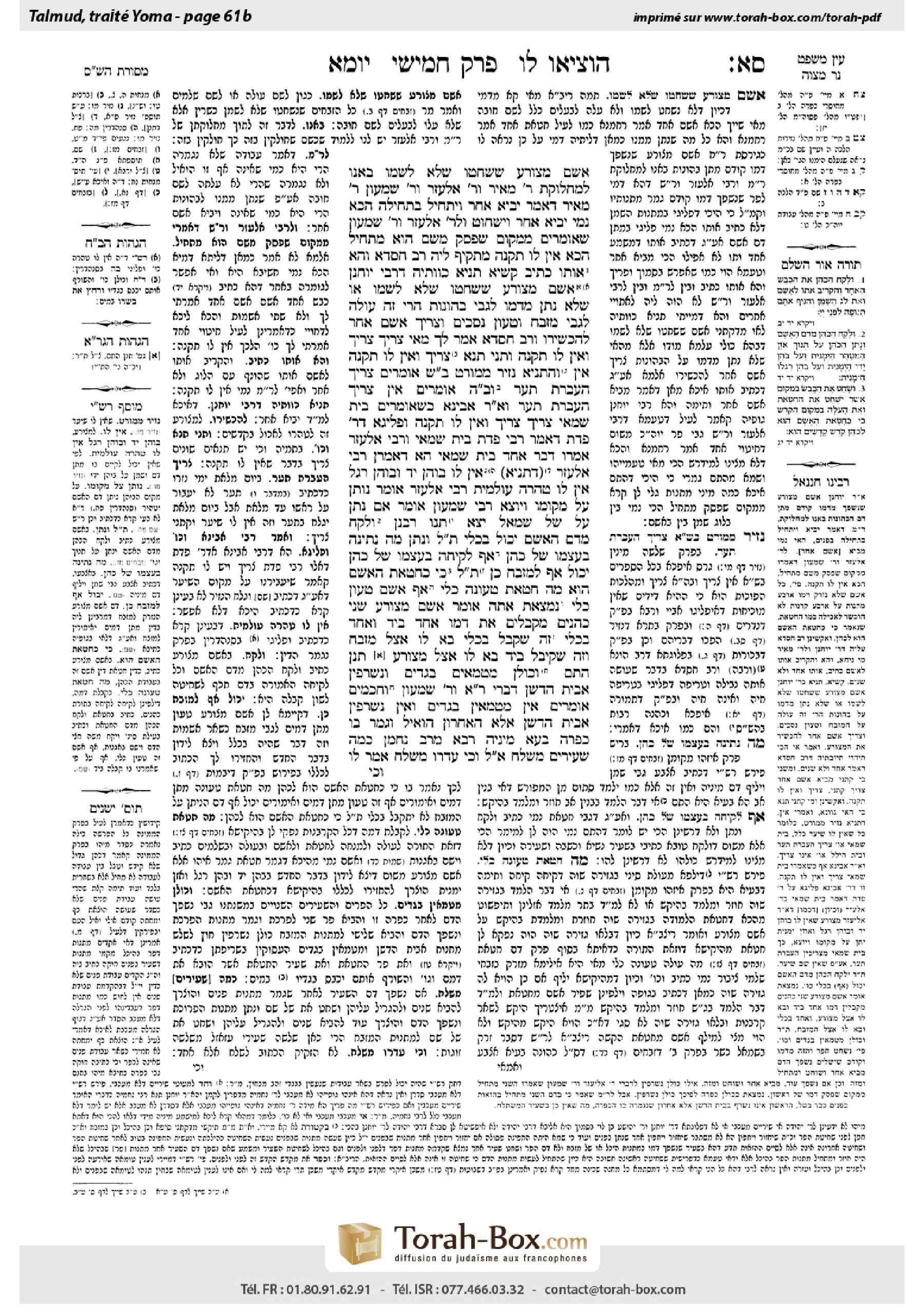
This page of Yoma includes the Aramaic text, an English translation and an AI-generated French translation, alongside the scan above.
יומא ס״א ב · Aramaic and Hebrew text
אֲשַׁם מְצוֹרָע שֶׁשְּׁחָטוֹ שֶׁלֹּא לִשְׁמוֹ — בָּאנוּ לְמַחְלוֹקֶת רַבִּי מֵאִיר וְרַבִּי אֶלְעָזָר וְרַבִּי שִׁמְעוֹן. רַבִּי מֵאִיר, דְּאָמַר יָבִיא אַחֵר וְיַתְחִיל בַּתְּחִילָּה — הָכָא נָמֵי יָבִיא אַחֵר וְיִשְׁחוֹט.
וּלְרַבִּי אֶלְעָזָר וְרַבִּי שִׁמְעוֹן שֶׁאוֹמְרִים מִמָּקוֹם שֶׁפָּסַק מִשָּׁם הוּא מַתְחִיל — הָכָא אֵין לוֹ תַּקָּנָה.
מַתְקֵיף לֵיהּ רַב חִסְדָּא: וְהָא ״אוֹתוֹ״ כְּתִיב? קַשְׁיָא.
תַּנְיָא כְּווֹתֵיהּ דְּרַבִּי יוֹחָנָן: אֲשַׁם מְצוֹרָע שֶׁשְּׁחָטוֹ שֶׁלֹּא לִשְׁמוֹ, אוֹ שֶׁלֹּא נָתַן מִדָּמוֹ לְגַבֵּי בְהוֹנוֹת — הֲרֵי זֶה עוֹלֶה לְגַבֵּי מִזְבֵּחַ, וְטָעוּן נְסָכִים, וְצָרִיךְ אָשָׁם אַחֵר לְהַכְשִׁירוֹ. וְרַב חִסְדָּא אָמַר לְךָ: מַאי צָרִיךְ — צָרִיךְ וְאֵין לוֹ תַּקָּנָה.
וְתָנֵי תַּנָּא: ״צָרִיךְ״ — וְאֵין לוֹ תַּקָּנָה? אִין, וְהָתַנְיָא: נָזִיר מְמוֹרָט, בֵּית שַׁמַּאי אוֹמְרִים: צָרִיךְ הַעֲבָרַת תַּעַר, וּבֵית הִלֵּל אוֹמְרִים: אֵין צָרִיךְ הַעֲבָרַת תַּעַר. וְאָמַר רַבִּי אֲבִינָא: כְּשֶׁאוֹמְרִים בֵּית שַׁמַּאי ״צָרִיךְ״, צָרִיךְ — וְאֵין לוֹ תַּקָּנָה.
וּפְלִיגָא דְּרַבִּי פְּדָת. דְּאָמַר רַבִּי פְּדָת: בֵּית שַׁמַּאי וְרַבִּי אֶלְעָזָר אָמְרוּ דָּבָר אֶחָד. בֵּית שַׁמַּאי — הָא דַּאֲמַרַן. רַבִּי אֶלְעָזָר, (דְּתַנְיָא:) אֵין לוֹ בּוֹהֶן יָד וּבוֹהֶן רֶגֶל — אֵין לוֹ טׇהֳרָה עוֹלָמִית. רַבִּי אֶלְעָזָר אוֹמֵר: נוֹתֵן עַל מְקוֹמוֹ וְיוֹצֵא. רַבִּי שִׁמְעוֹן אוֹמֵר: אִם נָתַן עַל שֶׁל שְׂמֹאל — יָצָא.
תָּנוּ רַבָּנַן: ״וְלָקַח מִדַּם הָאָשָׁם״, יָכוֹל בִּכְלִי — תַּלְמוּד לוֹמַר: ״וְנָתַן״. מָה נְתִינָה בְּעַצְמוֹ שֶׁל כֹּהֵן — אַף לְקִיחָה בְּעַצְמוֹ שֶׁל כֹּהֵן.
יָכוֹל אַף לַמִּזְבֵּחַ כֵּן — תַּלְמוּד לוֹמַר: ״כִּי כַּחַטָּאת הָאָשָׁם הוּא״. מָה חַטָּאת טְעוּנָה כְּלִי — אַף אָשָׁם טָעוּן כְּלִי. נִמְצֵאתָ אַתָּה אוֹמֵר: אֲשַׁם מְצוֹרָע שְׁנֵי כֹהֲנִים מְקַבְּלִים אֶת דָּמוֹ, אֶחָד בַּיָּד וְאֶחָד בִּכְלִי. זֶה שֶׁקִּבֵּל בִּכְלִי בָּא לוֹ אֵצֶל מִזְבֵּחַ, וְזֶה שֶׁקִּיבֵּל בַּיָּד בָּא לוֹ אֵצֶל מְצוֹרָע.
תְּנַן הָתָם: וְכוּלָּן מְטַמְּאִים בְּגָדִים וְנִשְׂרָפִין אַבֵּית הַדֶּשֶׁן, דִּבְרֵי רַבִּי אֶלְעָזָר וְרַבִּי שִׁמְעוֹן. וַחֲכָמִים אוֹמְרִים: אֵין מְטַמְּאִין בְּגָדִים, וְאֵין נִשְׂרָפִין אַבֵּית הַדֶּשֶׁן אֶלָּא הָאַחֲרוֹן, הוֹאִיל וְגָמַר בּוֹ כַּפָּרָה.
בְּעָא מִינֵּיהּ רָבָא מֵרַב נַחְמָן: כַּמָּה שְׂעִירִים מְשַׁלֵּחַ? אֲמַר לֵיהּ: וְכִי עֶדְרוֹ מְשַׁלֵּחַ? אָמַר לוֹ:
Yoma 61b · English translation
With regard to a leper’s guilt-offering that was slaughtered not for its own sake but for the purpose of a burnt-offering or peace-offering, we have arrived at the dispute between Rabbi Meir on the one hand and Rabbi Elazar and Rabbi Shimon on the other hand. Rabbi Yoḥanan clarifies his statement: According to the opinion of Rabbi Meir, who said that in the case of a service that was not completed he brings another animal and starts from the beginning, here too, in the case of the leper’s guilt-offering, he brings another animal and slaughters it, as Rabbi Meir maintains that a service that has not been completed is considered as though it had not been performed at all.
And according to the opinion of Rabbi Elazar and Rabbi Shimon, who say that he begins from the place where he stopped, here he has no remedy. According to their opinion, a service that has not been completed properly remains valid. In this case, once he has slaughtered the animal he cannot bring a second guilt-offering, as the verse states: “And offer it for a guilt-offering” (Leviticus 14:12), and not two guilt-offerings.
Rav Ḥisda strongly objects to this: But isn’t it written: “And offer it for a guilt-offering” (Leviticus 14:12), which indicates that he must offer that same guilt-offering he waved earlier, and if he does not do so the rite is invalid? If so, even according to the opinion of Rabbi Meir, he cannot use another offering. The Gemara comments: Indeed, this is difficult for Rabbi Yoḥanan.
Even so, it was taught in a baraita in accordance with the opinion of Rabbi Yoḥanan: With regard to a leper’s guilt-offering that the priest slaughtered not for its own sake, or if the priest did not put some of its blood on the leper’s thumbs, this guilt-offering is raised and sacrificed on the altar and requires libations as though it were valid. And yet the leper must bring another guilt-offering to make him eligible, i.e., pure of his leprosy. Evidently, there is an opinion that he may offer another guilt-offering, which apparently contradicts the opinion of Rav Ḥisda that everyone agrees that he cannot use another offering. And Rav Ḥisda could have said to you: What is the meaning of the term: Must, stated here? It means that he must do so, but since it is impossible he has no remedy.
The Gemara expresses surprise at this contention: But would a tanna teach: Must, when he means that he has no remedy? The Gemara answers: Yes, and indeed it was taught in a baraita: With regard to a totally bald nazirite, who cannot shave his hair with a razor as required, Beit Shammai say: He must perform the act of the passing of a razor anyway, and Beit Hillel say: He need not perform the act of the passing of a razor. And Rabbi Avina said that when Beit Shammai say: Must, they mean he must do so, but since it is impossible, he has no remedy.
The Gemara comments: And Rabbi Avina, in his interpretation of this matter, disagrees with Rabbi Pedat. As Rabbi Pedat said: Beit Shammai and Rabbi Elazar said the same thing, i.e., they have the same opinion in this regard. The opinion of Beit Shammai is that which we said, that a bald nazirite must pass a razor over his head. The opinion of Rabbi Elazar is as it was taught in a mishna: A leper who has no thumb or big toe on which to sprinkle can never attain ritual purity. Rabbi Elazar says: The priest puts it on the spot where the thumb was, and he thereby fulfills his obligation. Rabbi Shimon says: If he put it on the left hand or foot, he has fulfilled his obligation. According to Rabbi Pedat, Rabbi Elazar and Beit Shammai both maintain that even if the rite cannot be performed in the precise manner, one fulfills his obligation regardless.
§ The Sages taught: “And the priest shall take of the blood of the guilt-offering, and the priest shall put it upon the tip of the right ear of him who is to be purified, and upon the thumb of his right hand, and upon the big toe of his right foot” (Leviticus 14:14). One might have thought that he should take it in a vessel; therefore, the verse states: “And put.” Just as putting means with the priest’s own body, so too, taking means with the priest’s own body.
The baraita continues: One might have thought that even with regard to the blood of the leper’s guilt-offering that he presents on the altar, like the blood of other guilt-offerings, it is so that he collects the blood in his hand rather than with a vessel. Therefore, the verse states: “For as the sin-offering is, so is the guilt-offering” (Leviticus 14:13): Just as a sin-offering requires a vessel for collection of its blood, so too, the blood of a guilt-offering requires collection in a vessel. And you find that you must say: The leper’s guilt-offering requires two priests to collect its blood; one collects by hand, and the other one collects in a vessel. The one who collected in a vessel comes to the altar and sprinkles some of the blood on it, and the one who collected by hand comes to the leper and sprinkles some of the blood on him.
§ We learned in a mishna there: And all of the animals whose blood was spilled, as stated in the mishna, render ritually impure the garments of those who are occupied with burning them. If a bull or goat was slaughtered, but their blood spilled after one stage of atonement, and another animal is brought to complete the sprinkling, the first animal is burned, an action that renders ritually impure the garments of the individuals who perform the burning. And each of these first animals is burned in the place of the ashes, in accordance with the halakha of inner sin-offerings. This is the statement of Rabbi Elazar and Rabbi Shimon. And the Rabbis say: They do not render the garments impure and they are not burned in the place of the ashes, except for the last animal, since the atonement is completed with it.
Rava inquired before Rav Naḥman: How many goats does he send away? If the blood of the goat presented inside is spilled, the High Priest must bring an additional pair of goats and perform a new lottery. This might even happen several times, which would mean that one goat is offered on the altar while several goats are designated for sending away. What should be done with those goats? He said to him: Does he send away his flock? In other words, the Torah said to send only one goat, not an entire flock. Rava said to him:
Yoma 61b · Traduction française (IA)
À propos du sacrifice de culpabilité d’un lépreux abattu non pour lui-même, mais en vue d’un holocauste ou d’un sacrifice de paix, nous en arrivons à la controverse entre Rabbi Meïr, d’une part, et Rabbi Elazar et Rabbi Shimon, d’autre part. Rabbi Yoḥanan précise ses propos : selon Rabbi Meïr, qui dit que, lorsqu’un service n’a pas été mené à son terme, on apporte un autre animal et on recommence depuis le début, ici aussi, dans le cas du sacrifice de culpabilité du lépreux, on apporte un autre animal et on l’abat, car Rabbi Meïr considère qu’un service qui n’a pas été mené à son terme est comme s’il n’avait pas été accompli du tout.
Selon Rabbi Elazar et Rabbi Shimon, qui disent qu’on reprend à l’endroit où l’on s’est arrêté, il n’a ici aucun moyen d’y remédier. À leur avis, un service qui n’a pas été accompli correctement reste valide. Dans ce cas, une fois l’animal abattu, il ne peut pas apporter un second sacrifice de culpabilité, car le verset dit : « Et offre-le comme sacrifice de culpabilité » (Lévitique 14:12), et non deux sacrifices de culpabilité.
Rav Ḥisda s’insurge contre cela : Mais n’est-il pas écrit : « Et offre-le comme sacrifice de culpabilité » (Lévitique 14:12), ce qui indique qu’il doit offrir ce même sacrifice de culpabilité qu’il a agité auparavant, faute de quoi le rite est invalide ? Si tel est le cas, même selon Rabbi Meïr, il ne peut pas utiliser un autre sacrifice. La Guemara fait remarquer : En effet, cela pose une difficulté à Rabbi Yoḥanan.
Pourtant, une baraïta a été enseignée conformément à l’opinion de Rabbi Yoḥanan : si le prêtre abat le sacrifice de culpabilité d’un lépreux non pour lui-même, ou s’il ne met pas une partie de son sang sur les pouces du lépreux, ce sacrifice de culpabilité est porté et offert sur l’autel, et requiert des libations comme s’il était valide. Pourtant, le lépreux doit apporter un autre sacrifice de culpabilité pour pouvoir être déclaré apte, c’est-à-dire purifié de sa lèpre. Il ressort de là qu’il existe une opinion selon laquelle il peut offrir un autre sacrifice de culpabilité, ce qui semble contredire l’opinion de Rav Ḥisda, selon laquelle tous conviennent qu’il ne peut pas utiliser un autre sacrifice. Rav Ḥisda aurait pu te répondre : Que signifie ici le terme « doit » ? Cela signifie qu’il doit le faire, mais que, puisque c’est impossible, il n’a aucun moyen d’y remédier.
La Guemara s’étonne de cette affirmation : Un tanna enseignerait-il « doit » alors qu’il veut dire que l’intéressé n’a aucun moyen d’y remédier ? La Guemara répond : Oui. En effet, une baraïta a été enseignée : au sujet d’un nazir entièrement chauve, qui ne peut pas se raser avec un rasoir comme il le faudrait, Beit Shammaï disent : Il doit tout de même passer le rasoir sur sa tête ; Beit Hillel disent : Il n’a pas besoin de passer le rasoir sur sa tête. Rabbi Avina a dit que, lorsque Beit Shammaï disent « doit », ils veulent dire qu’il doit le faire, mais que, puisque c’est impossible, il n’a aucun moyen d’y remédier.
La Guemara fait remarquer que Rabbi Avina, dans son interprétation de cette question, est en désaccord avec Rabbi Pedat. Car Rabbi Pedat a dit : Beit Shammaï et Rabbi Elazar ont exprimé la même opinion, c’est-à-dire qu’ils sont du même avis à cet égard. L’opinion de Beit Shammaï est celle que nous avons mentionnée : un nazir chauve doit passer un rasoir sur sa tête. Celle de Rabbi Elazar est celle qui a été enseignée dans une Michna : un lépreux qui n’a ni pouce ni gros orteil sur lequel on puisse faire l’aspersion ne peut jamais atteindre la pureté rituelle. Rabbi Elazar dit : Le prêtre met le sang à l’endroit où se trouvait le pouce, et s’acquitte ainsi de son obligation. Rabbi Shimon dit : S’il l’a mis sur la main ou le pied gauche, il s’est acquitté de son obligation. Selon Rabbi Pedat, Rabbi Elazar et Beit Shammaï soutiennent tous deux que, même si le rite ne peut pas être accompli exactement de la manière prescrite, on s’acquitte néanmoins de son obligation.
§ Les Sages ont enseigné : « Le prêtre prendra du sang du sacrifice de culpabilité, et le prêtre le mettra sur le bord de l’oreille droite de celui qui doit être purifié, sur le pouce de sa main droite et sur le gros orteil de son pied droit » (Lévitique 14:14). On aurait pu penser qu’il doit le prendre dans un récipient ; c’est pourquoi le verset dit : « Et le mettre ». De même que « mettre » signifie le faire avec le corps même du prêtre, « prendre » signifie aussi le faire avec le corps même du prêtre.
La baraïta poursuit : On aurait pu penser que, même pour le sang du sacrifice de culpabilité du lépreux qu’il présente sur l’autel, comme pour le sang des autres sacrifices de culpabilité, il recueille le sang dans sa main plutôt qu’avec un récipient. C’est pourquoi le verset dit : « Car le sacrifice expiatoire est comme le sacrifice de culpabilité » (Lévitique 14:13) : de même qu’un sacrifice expiatoire exige un récipient pour recueillir son sang, de même le sang d’un sacrifice de culpabilité doit être recueilli dans un récipient. Il faut donc en conclure que deux prêtres doivent recueillir le sang du sacrifice de culpabilité du lépreux : l’un le recueille à la main, et l’autre dans un récipient. Celui qui l’a recueilli dans un récipient s’approche de l’autel et en asperge une partie sur celui-ci, tandis que celui qui l’a recueilli à la main s’approche du lépreux et en asperge une partie sur lui.
§ Nous avons appris dans une Michna, là-bas : tous les animaux dont le sang a été répandu, comme l’indique la Michna, rendent rituellement impurs les vêtements de ceux qui s’occupent de les brûler. Si un taureau ou un bouc a été abattu, mais que son sang s’est répandu après une étape de l’expiation, et qu’un autre animal est apporté pour achever les aspersions, le premier animal est brûlé, ce qui rend rituellement impurs les vêtements de ceux qui le brûlent. Chacun de ces premiers animaux est brûlé à l’endroit des cendres, conformément à la halakha des sacrifices expiatoires intérieurs. Telle est l’opinion de Rabbi Elazar et de Rabbi Shimon. Les Sages disent : Ces animaux ne rendent pas les vêtements impurs et ne sont pas brûlés à l’endroit des cendres ; seul le dernier animal l’est, puisque l’expiation est achevée avec lui.
Rava demanda à Rav Naḥman : Combien de boucs doit-on envoyer ? Si le sang du bouc présenté à l’intérieur est répandu, le Grand Prêtre doit apporter une paire supplémentaire de boucs et procéder à un nouveau tirage au sort. Cela peut même se produire plusieurs fois, ce qui signifie qu’un bouc est offert sur l’autel, tandis que plusieurs boucs sont désignés pour être envoyés. Que faut-il faire de ces boucs ? Il lui répondit : Va-t-il envoyer tout son troupeau ? Autrement dit, la Torah a ordonné d’envoyer un seul bouc, et non tout un troupeau. Rava lui dit :
Traduction française générée par IA à partir de l’édition anglaise de Sefaria. Vérifie toujours un passage avec le texte source.
Text from Sefaria: William Davidson Edition - Vocalized Aramaic (CC BY NC); William Davidson Edition - English (CC BY NC).