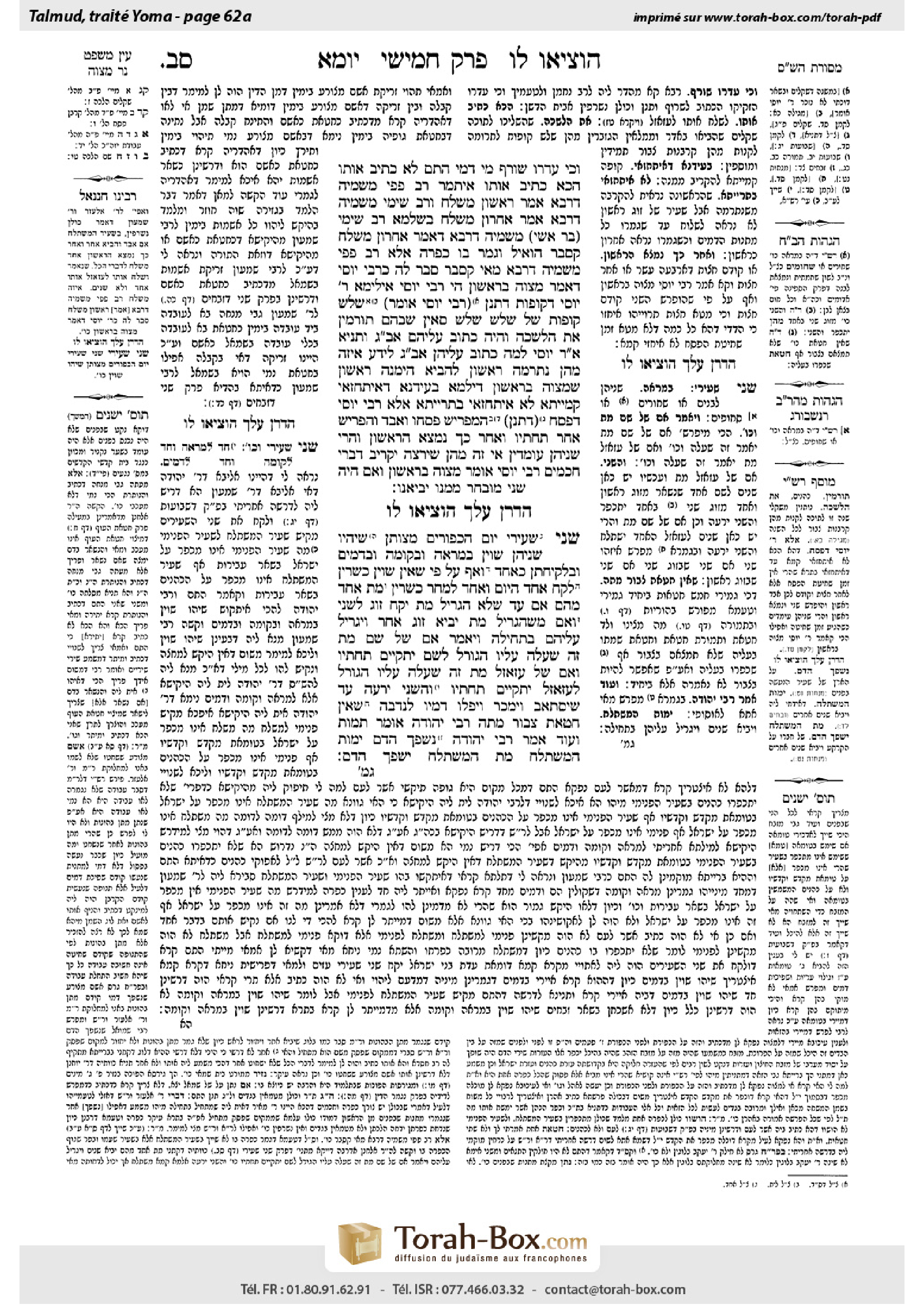
Yoma 62a: Talmud study for Daf Yomi
Daf Yomi is the daily study of one Talmud folio. Explore 37 tractates with scans, Hebrew text, Sefaria English and AI-generated French translations where annotated.
Passage selection and English or AI-generated French translation are available where the scan has annotations. Daf Study is independent of Torah-Box and Sefaria.
Browse Yoma · יומא · All tractatesYoma 62a text and translations
This page of Yoma includes the Aramaic text, an English translation and an AI-generated French translation, alongside the scan above.
יומא ס״ב א · Aramaic and Hebrew text
וְכִי עֶדְרוֹ שׂוֹרֵף? מִי דָּמֵי — הָתָם לָא כְּתִיב ״אוֹתוֹ״, הָכָא כְּתִיב ״אוֹתוֹ״.
אִיתְּמַר, רַב פַּפִּי מִשְּׁמֵיהּ דְּרָבָא אָמַר: רִאשׁוֹן מְשַׁלֵּחַ, וְרַב שִׁימִי מִשְּׁמֵיהּ דְּרָבָא אָמַר: אַחֲרוֹן מְשַׁלֵּחַ. בִּשְׁלָמָא רַב שִׁימִי (בַּר אָשֵׁי) מִשְּׁמֵיהּ דְּרָבָא, דְּאָמַר אַחֲרוֹן מְשַׁלֵּחַ — קָסָבַר: הוֹאִיל וְגָמַר בּוֹ כַּפָּרָה. אֶלָּא רַב פַּפִּי מִשְּׁמֵיהּ דְּרָבָא, מַאי קָסָבַר? סָבַר לַהּ כְּרַבִּי יוֹסֵי, דְּאָמַר: מִצְוָה בָּרִאשׁוֹן.
הֵי רַבִּי יוֹסֵי? אִילֵּימָא רַבִּי יוֹסֵי דְּקוּפּוֹת, דִּתְנַן (רַבִּי יוֹסֵי אוֹמֵר): שָׁלֹשׁ קוּפּוֹת שֶׁל שָׁלֹשׁ שָׁלֹשׁ סְאִין שֶׁבָּהֶם תּוֹרְמִין אֶת הַלִּשְׁכָּה, וְהָיָה כָּתוּב עֲלֵיהֶם אב״ג.
וְתַנְיָא, אָמַר רַבִּי יוֹסֵי: לָמָּה כָּתוּב עֲלֵיהֶן אב״ג — לֵידַע אֵיזֶה מֵהֶן נִתְרְמָה רִאשׁוֹן, לְהָבִיא הֵימֶנָּה רִאשׁוֹן, שֶׁמִּצְוָה בָּרִאשׁוֹן.
דִּילְמָא בְּעִידָּנָא דְּאִיתְחֲזַאי קַמַּיְיתָא, לָא אִיתְחֲזַאי בָּתְרָיְיתָא.
אֶלָּא רַבִּי יוֹסֵי דְּפֶסַח (דִּתְנַן): הַמַּפְרִישׁ פִּסְחוֹ וְאָבַד, וְהִפְרִישׁ אַחֵר תַּחְתָּיו, וְאַחַר כָּךְ נִמְצָא הָרִאשׁוֹן, וַהֲרֵי שְׁנֵיהֶן עוֹמְדִין — אֵי זֶה מֵהֶן שֶׁיִּרְצֶה יַקְרִיב, דִּבְרֵי חֲכָמִים. רַבִּי יוֹסֵי אוֹמֵר: מִצְוָה בָּרִאשׁוֹן, וְאִם הָיָה שֵׁנִי מוּבְחָר מִמֶּנּוּ — יְבִיאֶנּוּ.
הֲדַרַן עֲלָךְ הוֹצִיאוּ לוֹ
שְׁנֵי שְׂעִירֵי יוֹם הַכִּפּוּרִים — מִצְוָתָן שֶׁיִּהְיוּ שְׁנֵיהֶן שָׁוִין בַּמַּרְאֶה וּבַקּוֹמָה וּבַדָּמִים וּבִלְקִיחָתָן כְּאֶחָד. וְאַף עַל פִּי שֶׁאֵין שָׁוִין — כְּשֵׁרִין. לָקַח אֶחָד הַיּוֹם וְאֶחָד לְמָחָר — כְּשֵׁרִין.
מֵת אֶחָד מֵהֶם, אִם עַד שֶׁלֹּא הִגְרִיל מֵת — יִקַּח זוּג לַשֵּׁנִי. וְאִם מִשֶּׁהִגְרִיל מֵת — יָבִיא זוּג אַחֵר וְיַגְרִיל עֲלֵיהֶם בַּתְּחִילָּה,
וְיֹאמַר: אִם שֶׁל שֵׁם מֵת — זֶה שֶׁעָלָה עָלָיו הַגּוֹרָל לַשֵּׁם יִתְקַיֵּים תַּחְתָּיו, וְאִם שֶׁל עֲזָאזֵל מֵת — זֶה שֶׁעָלָה עָלָיו הַגּוֹרָל לַעֲזָאזֵל יִתְקַיֵּים תַּחְתָּיו. וְהַשֵּׁנִי יִרְעֶה עַד שֶׁיִּסְתָּאֵב, וְיִמָּכֵר, וְיִפְּלוּ דָּמָיו לִנְדָבָה, שֶׁאֵין חַטַּאת צִבּוּר מֵתָה. רַבִּי יְהוּדָה אוֹמֵר: תָּמוּת.
וְעוֹד אָמַר רַבִּי יְהוּדָה: נִשְׁפַּךְ הַדָּם — יָמוּת הַמִּשְׁתַּלֵּחַ. מֵת הַמִּשְׁתַּלֵּחַ — יִשָּׁפֵךְ הַדָּם.
Yoma 62a · English translation
And does he burn his flock? The Torah obligated him to burn only one goat, and yet there are times when he must burn several, as stated in the mishna. Rabbi Naḥman retorts: Is it comparable? There, with respect to burning the goats, it is not written: “It,” which would restrict the burning to only one animal, whereas here, with regard to the scapegoat, it is written: “It,” which indicates that one animal alone is sent away. The objection has been refuted and indeed only one scapegoat is used.
§ It was stated that amora’im disagreed about the following issue. Rav Pappi said in the name of Rava: He sends the first goat; and Rav Shimi said in the name of Rava: He sends the last of them. The Gemara analyzes the matter: Granted, according to the opinion of Rav Shimi bar Ashi in the name of Rava, who said that he sends the last of them, it works out well, as he probably holds as stated above, that the last goat is used, since the atonement is completed with it. However, with regard to Rav Pappi in the name of Rava, what does he hold? The Gemara answers: He holds in accordance with the opinion of Rabbi Yosei, who said that when several identical items are available for a mitzva, the mitzva is performed with the first of them.
The Gemara asks: To which of the halakhot of Rabbi Yosei is this referring? From which of Rabbi Yosei’s statements is this conclusion derived? If we say it is the statement of Rabbi Yosei with regard to containers, this is problematic. As we learned in a mishna that Rabbi Yosei says: There were three containers of three se’a each, with which they collect the donation from the chamber. Every year the money donated to the Temple by the people in the month of Adar was placed in a special chamber. The treasurers subsequently filled three containers with these coins and used the funds to purchase the communal offerings, e.g., the daily offerings and the additional offerings for Festivals. And the letters alef, beit, gimmel were written on the containers.
And it was taught in a baraita that Rabbi Yosei said: Why were the letters alef, beit, gimmel written on them? It was to ascertain from which of them the donation was collected first, so that they could bring the money from it first, as the mitzva is to use the coins of the first container. This apparently proves that according to the opinion of Rabbi Yosei, it is a mitzva to use the first item.
The Gemara responds: This is no proof, as perhaps at the time when the first container was fit to be used, the last was not yet fit to be used. When the first container was brought it was fit and designated for the offerings, whereas the coins in the second container had not yet been collected, and therefore the coins in the first container must be used first as they were sanctified first. Here, however, the scapegoat is consecrated only when its pair is sacrificed, and therefore the two cases are dissimilar.
Rather, the principle that one uses the first item is derived from the statement of Rabbi Yosei with regard to the Paschal offering, as it was taught in a baraita: With regard to one who separated a sheep for his Paschal offering and the sheep was lost, and he separated another sheep in its stead, and afterward the first sheep was found, and they both stand before him, he sacrifices whichever of them he wants; this is the statement of the Rabbis. Rabbi Yosei says: The mitzva is performed with the first sheep. And if the second was of superior quality to it, he brings the second sheep. This proves that according to Rabbi Yosei, if there are two animals equally fit for an offering, one brings the animal that was chosen first.
MISHNA: The mitzva of the two Yom Kippur goats, the goat sacrificed to God and the goat sent to Azazel that are brought as a pair, is as follows, ab initio: That they will both be identical in appearance, i.e., color, and in height, and in monetary value, and their acquisition must be as one, i.e., they must be purchased together. And even if they are not identical, nevertheless, they are valid. And similarly, if he acquired one today and one tomorrow, they are valid.
If one of the goats died, if it died before the High Priest drew the lots, he immediately takes a counterpart for the second, since neither has yet been designated. And if it died after the High Priest drew the lots, he brings another pair of goats and draws lots over them from the start.
After that lottery he utters a stipulation: If the one to be sacrificed to God died, that goat upon which the lot for God was drawn in the second lottery shall stand in its stead; and if the one to be sent to Azazel died, that goat upon which the lot for Azazel was drawn shall stand in its stead. And the second, superfluous goat, i.e., in the case where a new pair of goats was brought, should graze until it becomes unfit, at which point it will be sold, and the money received from its sale will go toward the purchase of a public gift-offering. Although for individual sin-offerings in similar circumstances there is no remedy and it is left to die, that is not the case here, as a communal sin-offering is not left to die. On the other hand, Rabbi Yehuda says: In this it should be left to die.
And furthermore, Rabbi Yehuda said: If the blood of the goat sacrificed to God spilled before it was sprinkled, the scapegoat is left to die. Similarly, if the scapegoat dies, the blood of the goat sacrificed to God should be spilled, and two other goats are brought and lots are drawn.
Yoma 62a · Traduction française (IA)
Et brûle-t-il son troupeau ? La Torah lui a imposé de brûler un seul bouc, et pourtant il arrive qu’il doive en brûler plusieurs, comme l’enseigne la Michna. Rabbi Naḥman rétorque : Est-ce comparable ? Là, à propos des boucs que l’on brûle, il n’est pas écrit « celui-ci », ce qui limiterait l’incinération à un seul animal, tandis qu’ici, à propos du bouc émissaire, il est écrit « celui-ci », ce qui indique qu’un seul animal est envoyé. L’objection est réfutée : en effet, on n’utilise qu’un seul bouc émissaire.
§ Il a été rapporté que des amoraïm étaient en désaccord sur la question suivante. Rav Pappi a dit au nom de Rava : Il envoie le premier bouc ; et Rav Shimi a dit au nom de Rava : Il envoie le dernier d’entre eux. La Guemara examine la question : Selon l’opinion de Rav Shimi bar Ashi au nom de Rava, qui a dit qu’il envoie le dernier d’entre eux, cela se comprend bien, car il estime probablement, comme indiqué plus haut, que c’est le dernier bouc qui est utilisé, puisque l’expiation s’achève avec lui. Mais, selon Rav Pappi au nom de Rava, quelle est son opinion ? La Guemara répond : Il suit l’opinion de Rabbi Yosei, qui a dit que, lorsque plusieurs objets identiques sont disponibles pour une mitsva, celle-ci s’accomplit avec le premier d’entre eux.
La Guemara demande : À quelle halakha de Rabbi Yosei cela fait-il référence ? De quelle déclaration de Rabbi Yosei tire-t-on cette conclusion ? Si l’on suppose qu’il s’agit de la déclaration de Rabbi Yosei concernant les récipients, cela pose difficulté. En effet, nous avons appris dans une Michna que Rabbi Yosei dit : Il y avait trois récipients de trois séa chacun, avec lesquels on prélevait la contribution de la chambre. Chaque année, l’argent donné au Temple par le peuple au mois d’Adar était placé dans une chambre spéciale. Par la suite, les trésoriers remplissaient ces trois récipients avec les pièces et utilisaient les fonds pour acheter les sacrifices communautaires, par exemple les sacrifices quotidiens et les sacrifices supplémentaires des fêtes. Les lettres alef, beit et guimel étaient inscrites sur les récipients.
Et une baraïta enseigne que Rabbi Yosei a dit : Pourquoi les lettres alef, beit et guimel étaient-elles inscrites sur eux ? C’était afin de savoir dans quel récipient la contribution avait été prélevée en premier, pour pouvoir en apporter d’abord l’argent, car la mitsva consiste à utiliser les pièces du premier récipient. Cela semble prouver que, selon l’opinion de Rabbi Yosei, il faut utiliser le premier objet.
La Guemara répond : Ce n’est pas une preuve, car il se peut qu’au moment où le premier récipient pouvait être utilisé, le dernier ne le pouvait pas encore. Lorsque le premier récipient fut apporté, il était apte à être utilisé et destiné aux sacrifices, tandis que les pièces du deuxième récipient n’avaient pas encore été recueillies ; les pièces du premier récipient devaient donc être utilisées en premier, puisqu’elles avaient été consacrées les premières. Ici, en revanche, le bouc émissaire n’est consacré qu’au moment où son compagnon est sacrifié ; les deux cas ne sont donc pas comparables.
La règle selon laquelle on utilise le premier objet est plutôt déduite de la déclaration de Rabbi Yosei concernant le sacrifice de Pessa’h, comme l’enseigne une baraïta : Si quelqu’un a mis à part un agneau pour son sacrifice de Pessa’h, que cet agneau s’est perdu, qu’il en a mis un autre à sa place, puis que le premier a été retrouvé et que les deux se trouvent devant lui, il sacrifie celui qu’il veut ; telle est la déclaration des Sages. Rabbi Yosei dit : La mitsva s’accomplit avec le premier agneau. Et si le second est de meilleure qualité, il apporte le second agneau. Cela prouve que, selon Rabbi Yosei, si deux animaux sont également aptes à être offerts en sacrifice, on apporte celui qui a été choisi en premier.
MICHNA : La mitsva concernant les deux boucs de Yom Kippour, celui qui est sacrifié pour Dieu et celui qui est envoyé à Azazel, lesquels sont apportés par paire, est la suivante, a priori : ils doivent être identiques par leur apparence, c’est-à-dire leur couleur, par leur taille et par leur valeur monétaire, et leur acquisition doit se faire en même temps, c’est-à-dire qu’ils doivent être achetés ensemble. Même s’ils ne sont pas identiques, ils sont néanmoins valides. De même, si l’un a été acquis aujourd’hui et l’autre demain, ils sont valides.
Si l’un des boucs meurt avant que le Grand Prêtre ait tiré au sort, il prend immédiatement un autre bouc pour compléter la paire, puisque ni l’un ni l’autre n’a encore été désigné. Et si l’un meurt après que le Grand Prêtre a tiré au sort, il apporte une autre paire de boucs et tire au sort entre eux depuis le début.
Après ce tirage au sort, il énonce une condition : si le bouc destiné à être sacrifié pour Dieu est mort, le bouc sur lequel le sort « pour Dieu » est tombé lors du second tirage prendra sa place ; et si le bouc destiné à être envoyé à Azazel est mort, le bouc sur lequel le sort « pour Azazel » est tombé prendra sa place. Le second bouc, devenu superflu — c’est-à-dire lorsqu’une nouvelle paire de boucs a été apportée — doit paître jusqu’à ce qu’il devienne impropre ; il sera alors vendu, et l’argent de sa vente servira à acheter une offrande volontaire communautaire. Bien que, dans des circonstances similaires, les sacrifices expiatoires individuels ne puissent être ainsi rachetés et doivent être laissés à mourir, il n’en va pas de même ici, car un sacrifice expiatoire communautaire n’est pas laissé à mourir. Rabbi Yehuda dit, au contraire : Dans ce cas, il faut le laisser mourir.
Et de plus, Rabbi Yehuda a dit : Si le sang du bouc sacrifié pour Dieu s’est répandu avant d’être aspergé, le bouc émissaire est laissé à mourir. De même, si le bouc émissaire meurt, le sang du bouc sacrifié pour Dieu doit être répandu, puis on apporte deux autres boucs et on tire au sort.
Traduction française générée par IA à partir de l’édition anglaise de Sefaria. Vérifie toujours un passage avec le texte source.
Text from Sefaria: William Davidson Edition - Vocalized Aramaic (CC BY NC); William Davidson Edition - English (CC BY NC).