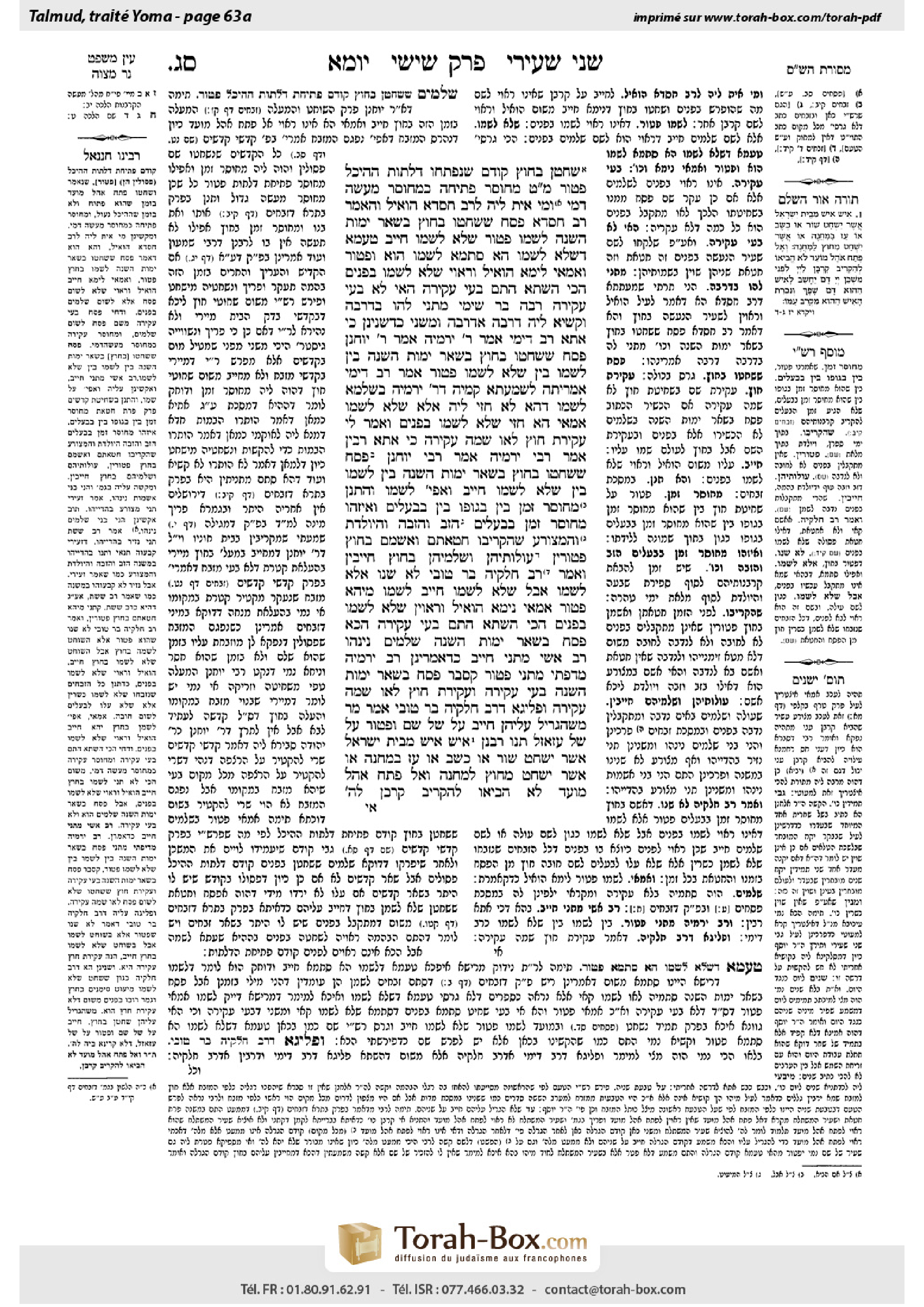
Yoma 63a: Talmud study for Daf Yomi
Daf Yomi is the daily study of one Talmud folio. Explore 37 tractates with scans, Hebrew text, Sefaria English and AI-generated French translations where annotated.
Passage selection and English or AI-generated French translation are available where the scan has annotations. Daf Study is independent of Torah-Box and Sefaria.
Browse Yoma · יומא · All tractatesYoma 63a text and translations
This page of Yoma includes the Aramaic text, an English translation and an AI-generated French translation, alongside the scan above.
יומא ס״ג א · Aramaic and Hebrew text
שְׁחָטָן בַּחוּץ קוֹדֶם שֶׁנִּפְתְּחוּ דַּלְתוֹת הַהֵיכָל — פָּטוּר. מַאי טַעְמָא: מְחוּסָּר פְּתִיחָה כִּמְחוּסָּר מַעֲשֶׂה דָּמֵי.
וּמִי אִית לֵיהּ לְרַב חִסְדָּא ״הוֹאִיל״?
וְהָאָמַר רַב חִסְדָּא: פֶּסַח שֶׁשְּׁחָטוֹ בַּחוּץ בִּשְׁאָר יְמוֹת הַשָּׁנָה, לִשְׁמוֹ — פָּטוּר, שֶׁלֹּא לִשְׁמוֹ — חַיָּיב.
טַעְמָא דְּשֶׁלֹּא לִשְׁמוֹ, הָא סְתָמָא, לִשְׁמוֹ הוּא וּפָטוּר. וְאַמַּאי? לֵימָא: הוֹאִיל וְרָאוּי שֶׁלֹּא לִשְׁמוֹ בִּפְנִים!
הָכִי הַשְׁתָּא?! הָתָם בָּעֵי עֲקִירָה, הַאי לָא בָּעֵי עֲקִירָה.
רַבָּה בַּר שִׁימִי מַתְנֵי לְהוּ בִּדְרַבָּה, וְקַשְׁיָא לֵיהּ דְּרַבָּה אַדְּרַבָּה. וּמְשַׁנֵּי כִּדְשַׁנִּינַן.
כִּי אֲתָא רַב דִּימִי, אָמַר רַבִּי יִרְמְיָה אָמַר רַבִּי יוֹחָנָן: פֶּסַח שֶׁשְּׁחָטוֹ בַּחוּץ בִּשְׁאָר יְמוֹת הַשָּׁנָה, בֵּין לִשְׁמוֹ בֵּין שֶׁלֹּא לִשְׁמוֹ — פָּטוּר.
אָמַר רַב דִּימִי: אַמְרִיתַהּ לִשְׁמַעְתָּא קַמֵּיהּ דְּרַבִּי יִרְמְיָה בִּשְׁלָמָא לִשְׁמוֹ, דְּהָא לָא חֲזֵי לֵיהּ. אֶלָּא שֶׁלֹּא לִשְׁמוֹ, אַמַּאי? הָא חֲזֵי שֶׁלֹּא לִשְׁמוֹ בִּפְנִים?
וַאֲמַר לִי: עֲקִירַת חוּץ לָאו שְׁמַהּ עֲקִירָה.
כִּי אֲתָא רָבִין, אָמַר רַבִּי יִרְמְיָה אָמַר רַבִּי יוֹחָנָן: פֶּסַח שֶׁשְּׁחָטוֹ בַּחוּץ בִּשְׁאָר יְמוֹת הַשָּׁנָה, בֵּין לִשְׁמוֹ בֵּין שֶׁלֹּא לִשְׁמוֹ — חַיָּיב.
וַאֲפִילּוּ לִשְׁמוֹ? וְהָתְנַן: מְחוּסַּר זְמַן — בֵּין בְּגוּפוֹ, בֵּין בִּבְעָלִים.
וְאֵיזֶהוּ מְחוּסַּר זְמַן בִּבְעָלִים — הַזָּב וְהַזָּבָה וְהַיּוֹלֶדֶת וְהַמְצוֹרָע
שֶׁהִקְרִיבוּ חַטָּאתָם וַאֲשָׁמָם בַּחוּץ — פְּטוּרִין. עוֹלוֹתֵיהֶן וְשַׁלְמֵיהֶן בַּחוּץ — חַיָּיבִין.
וַאֲמַר רַב חִלְקִיָּה בַּר טוֹבִי: לֹא שָׁנוּ אֶלָּא לִשְׁמוֹ, אֲבָל שֶׁלֹּא לִשְׁמוֹ — חַיָּיב.
לִשְׁמוֹ מִיהָא פָּטוּר, אַמַּאי? נֵימָא: הוֹאִיל וּרְאוּיִן שֶׁלֹּא לִשְׁמוֹ בִּפְנִים! הָכִי הַשְׁתָּא?! הָתָם בָּעֵי עֲקִירָה, הָכָא פֶּסַח בִּשְׁאָר יְמוֹת הַשָּׁנָה — שְׁלָמִים נִינְהוּ.
רַב אָשֵׁי מַתְנֵי: חַיָּיב, כִּדְאָמְרִינַן. רַב יִרְמְיָה מִדִּפְתִּי מַתְנֵי: פָּטוּר. קָסָבַר: פֶּסַח בִּשְׁאָר יְמוֹת הַשָּׁנָה בָּעֵי עֲקִירָה, וַעֲקִירַת חוּץ לָאו שְׁמָהּ עֲקִירָה. וּפְלִיגָא דְּרַב חִלְקִיָּה בַּר טוֹבִי.
אָמַר מָר: מִשֶּׁהִגְרִיל עֲלֵיהֶן חַיָּיב עַל שֶׁל שֵׁם, וּפָטוּר עַל שֶׁל עֲזָאזֵל.
תָּנוּ רַבָּנַן: ״אִישׁ אִישׁ מִבֵּית יִשְׂרָאֵל אֲשֶׁר יִשְׁחַט שׁוֹר אוֹ כֶשֶׂב אוֹ עֵז בַּמַּחֲנֶה אוֹ אֲשֶׁר יִשְׁחַט מִחוּץ לַמַּחֲנֶה. וְאֶל פֶּתַח אֹהֶל מוֹעֵד לֹא הֱבִיאוֹ לְהַקְרִיב קׇרְבָּן לַה׳״.
Yoma 63a · English translation
Based on Rav Ḥisda’s statement, if he slaughtered them outside the Temple before the doors of the Sanctuary were opened he is exempt. What is the reason? Lacking the opening of the doors is comparable to lacking an action. Therefore, the offering was not yet fit to be sacrificed in the Temple, and when he slaughtered it outside, despite doing so with the intention that it is a sacrificial offering, he is not considered to have violated the prohibition against sacrificing an offering outside the Temple.
Rav Ḥisda stated above that since the Yom Kippur goats could be used for the additional offerings, one is liable for slaughtering them outside the Temple. The Gemara asks: Does Rav Ḥisda accept the principle: Since a particular situation could come to be in the future, it is viewed as though it existed already in the present?
And didn’t Rav Ḥisda say: If one slaughtered a Paschal lamb outside the Temple during the rest of the days of the year other than Passover eve, if he slaughtered it for its own sake, i.e., as a Paschal lamb, he is exempt, since at that time it is not fit to be sacrificed as a Paschal lamb. If he sacrificed it not for its own sake but rather as a peace-offering, he is liable. A Paschal lamb that is slaughtered as a peace-offering on any day of the year other than Passover eve is considered a valid peace-offering. Therefore, it has the status of an offering that is fit to be sacrificed in the Temple, and he is liable for slaughtering it outside the Temple.
The Gemara comments: The reason he is liable is because he specifically slaughtered it not for its own sake. However, if he slaughtered it without specifying what offering he had in mind, it is considered to have been slaughtered for its own sake and he is exempt. But why is he exempt? Let us say: Since it is fit to be sacrificed within the Temple not for its own sake, i.e., as a peace-offering, it should be considered as though he slaughtered it as a peace-offering outside the Temple, and he should be liable.
The Gemara responds: How can these cases be compared? There, with regard to the Paschal lamb, it requires explicit uprooting from the status of a Paschal lamb in order to be considered a peace-offering. Therefore, if he did not specify his intent, it is still considered a Paschal lamb, which is not fit to be sacrificed. These Yom Kippur goats do not require uprooting from their previous status. The Yom Kippur goats have the status of a sin-offering and the goats sacrificed as part of the additional offerings of the day are also considered sin-offerings. Therefore, one who slaughters them outside the Temple is liable, as they are fit to be sacrificed at that time as sin-offerings, even without the principle: Since, etc.
Rabba bar Shimi taught these two halakhot, cited above in the name of Rav Ḥisda, in the name of Rabba, and he found a difficulty between one statement of Rabba and another statement of Rabba. And he resolved the apparent contradiction as we resolved it.
§ When Rav Dimi came from Eretz Yisrael to Babylonia, he said that Rabbi Yirmeya said that Rabbi Yoḥanan said: If one slaughtered a Paschal lamb outside the Temple during the rest of the days of the year, whether he slaughtered it for its own sake, as a Paschal lamb, or not for its own sake, as a peace-offering, he is exempt.
Rav Dimi said: I said this halakha before Rabbi Yirmeya and asked him: Granted, when he slaughters it outside the Temple for its own sake he is exempt, because it is not fit to be brought as a Paschal lamb at that time, and one is liable for slaughtering an offering outside the Temple only if it was fit to be sacrificed in the Temple. However, if he slaughters it not for its own sake, why is he exempt? Isn’t it fit to be sacrificed not for its own sake as a peace-offering inside the Temple?
And Rabbi Yirmeya said to me in response: Uprooting an offering’s designation outside the Temple is not called uprooting. Since he slaughtered it outside, the status of the offering does not change from that of a Paschal lamb to that of a peace-offering, despite his intention to this effect.
When Ravin came from Eretz Yisrael to Babylonia, he said a different version of the statement that Rabbi Yirmeya said that Rabbi Yoḥanan said: If one slaughtered a Paschal lamb outside the Temple during the rest of the days of the year, whether he slaughtered it for its own sake or not for its own sake, he is liable.
The Gemara expresses surprise: Is he liable even if he slaughtered it for its own sake? Didn’t we learn in a mishna in tractate Zevaḥim that one is exempt for sacrificing an offering that was not yet fit for sacrifice because it was lacking time? This is so whether it itself was lacking time, such as if it was less than eight days old, or it was lacking time due to its owners.
The Gemara explains: And what is an offering that is lacking time due to its owners? A zav, a zava, a woman after childbirth, and a leper, who sacrificed their offerings before the appropriate time. A zav, a zava, and a leper bring their offerings after counting seven days; a woman after childbirth brings hers when her purification period is complete.
Any of these people who sacrificed their sin-offering and, in the case of lepers, their guilt-offering outside the Temple are exempt. Since they would not fulfill their obligations to bring these offerings if they would sacrifice them in the Temple, and the offerings are unfit to be brought as voluntary offerings, because sin-offerings and guilt-offerings are not brought as voluntary offerings, one who slaughters them outside the Temple is not liable. However, if they sacrifice their burnt-offerings and peace-offerings outside the Temple, they are liable. This is because these offerings could be valid as voluntary offerings if they were sacrificed in the Temple.
And Rav Ḥilkiya bar Tovi said: They only taught that one is exempt for the guilt-offering when it is slaughtered for its own sake, but if it is slaughtered not for its own sake, he is liable, because a guilt-offering slaughtered in the Temple not for its own sake is valid.
The Gemara considers this: If he slaughtered it for its own sake, in any event he is exempt. Why? Let us say: Since they are fit to be sacrificed inside the Temple not for their own sake, he should be liable for sacrificing them outside. The Gemara responds: How can these cases be compared? There, the guilt-offering requires explicit uprooting of its designation in order to be valid. Here, a Paschal lamb during the rest of the days of the year is considered a peace-offering, even if its status is not explicitly uprooted.
The Gemara continues to discuss the case of a Paschal lamb that was slaughtered outside the Temple during the rest of the year, and not for its own sake. Rav Ashi taught: He is liable, as we stated. Rav Yirmeya of Difti taught: He is exempt. Rav Yirmeya held that a Paschal lamb during the rest of the days of the year requires uprooting of its previous designation, and uprooting an offering’s designation outside the Temple is not called uprooting. And this halakha disagrees with the statement of Rav Ḥilkiya bar Tovi, who held that uprooting an offering’s designation outside the Temple is considered an effective uprooting of that designation.
§ The Master said: If he slaughtered the two Yom Kippur goats outside the Temple after he drew lots to determine which of them is to be sacrificed to God and which is sent to Azazel, he is liable for slaughtering the one designated for God, and exempt for the one designated to be sent to Azazel.
The Sages taught in a baraita based upon the verses: “Any man of the house of Israel who shall slaughter a bull, or a lamb, or a goat in the camp, or who slaughters it outside the camp, and has not brought it to the entrance to the Tent of Meeting to present it as an offering to the Lord before the tabernacle of the Lord, blood shall be imputed to that man; he has shed blood; and that man shall be cut off from among his people” (Leviticus 17:3–4).
Yoma 63a · Traduction française (IA)
D’après la déclaration de Rav Ḥisda, s’il les a abattus hors du Temple avant l’ouverture des portes du Sanctuaire, il est exempt. Pourquoi ? L’absence d’ouverture des portes est comparable à l’absence d’un acte. Par conséquent, l’offrande n’était pas encore apte à être sacrifiée dans le Temple et, lorsqu’il l’a abattue à l’extérieur, même avec l’intention de l’offrir comme sacrifice, il n’est pas considéré comme ayant enfreint l’interdiction de sacrifier une offrande hors du Temple.
Rav Ḥisda a déclaré plus haut que, puisque les boucs de Yom Kippour pouvaient être utilisés pour les offrandes supplémentaires, on est passible pour les avoir abattus hors du Temple. La Guemara demande : Rav Ḥisda accepte-t-il le principe selon lequel une situation susceptible de se produire à l’avenir est considérée comme si elle existait déjà dans le présent ?
Rav Ḥisda n’a-t-il pas dit : si quelqu’un abat un agneau pascal hors du Temple pendant le reste de l’année, c’est-à-dire en dehors de la veille de Pessaḥ, s’il l’abat pour lui-même, c’est-à-dire comme agneau pascal, il est exempt, car à ce moment-là il n’est pas apte à être offert comme agneau pascal. S’il l’abat non pas pour lui-même, mais comme offrande de paix, il est passible. Un agneau pascal abattu comme offrande de paix n’importe quel jour de l’année autre que la veille de Pessaḥ est considéré comme une offrande de paix valide. Il a donc le statut d’une offrande apte à être sacrifiée dans le Temple, et l’on est passible pour l’avoir abattu hors du Temple.
La Guemara fait remarquer : il est passible parce qu’il l’a expressément abattu non pas pour lui-même. Cependant, s’il l’a abattu sans préciser quelle offrande il avait en tête, on considère qu’il l’a abattu pour lui-même et il est exempt. Mais pourquoi est-il exempt ? Puisqu’il est apte à être sacrifié dans le Temple non pas pour lui-même, c’est-à-dire comme offrande de paix, ne devrait-on pas considérer qu’il l’a abattu comme offrande de paix hors du Temple et qu’il est passible ?
La Guemara répond : comment peut-on comparer ces cas ? Dans le cas de l’agneau pascal, il faut renoncer explicitement à son statut d’agneau pascal pour qu’il soit considéré comme une offrande de paix. Par conséquent, s’il n’a pas précisé son intention, il reste considéré comme un agneau pascal, qui n’est pas apte à être sacrifié. Ces boucs de Yom Kippour n’exigent pas qu’on renonce à leur statut antérieur. Ils ont le statut de sacrifices expiatoires, et les boucs sacrifiés dans le cadre des offrandes supplémentaires du jour sont eux aussi considérés comme des sacrifices expiatoires. Par conséquent, celui qui les abat hors du Temple est passible, puisqu’ils sont alors aptes à être sacrifiés comme sacrifices expiatoires, même sans recourir au principe « puisque… », etc.
Rabba bar Shimi enseigna ces deux halakhot, citées plus haut au nom de Rav Ḥisda, au nom de Rabba, et releva une difficulté entre deux déclarations de Rabba. Il résolut cette contradiction apparente comme nous l’avons résolue.
§ Lorsque Rav Dimi vint d’Eretz Yisrael en Babylonie, il rapporta que Rabbi Yirmeya avait dit au nom de Rabbi Yoḥanan : si quelqu’un abat un agneau pascal hors du Temple pendant le reste de l’année, qu’il l’abatte pour lui-même, comme agneau pascal, ou non pour lui-même, comme offrande de paix, il est exempt.
Rav Dimi dit : j’ai énoncé cette halakha devant Rabbi Yirmeya et lui ai demandé : admettons que, lorsqu’il l’abat hors du Temple pour lui-même, il soit exempt, parce qu’à ce moment-là il n’est pas apte à être offert comme agneau pascal, et que l’on ne soit passible pour avoir abattu une offrande hors du Temple que si elle était apte à y être sacrifiée. Mais s’il l’abat non pas pour lui-même, pourquoi est-il exempt ? N’est-il pas apte à être sacrifié dans le Temple non pas pour lui-même, comme offrande de paix ?
Rabbi Yirmeya me répondit : renoncer à la désignation d’une offrande hors du Temple ne s’appelle pas un renoncement à cette désignation. Puisqu’il l’a abattue à l’extérieur, le statut de l’offrande ne passe pas de celui d’agneau pascal à celui d’offrande de paix, malgré son intention en ce sens.
Lorsque Ravin vint d’Eretz Yisrael en Babylonie, il rapporta une autre version de la déclaration de Rabbi Yirmeya au nom de Rabbi Yoḥanan : si quelqu’un abat un agneau pascal hors du Temple pendant le reste de l’année, qu’il l’abatte pour lui-même ou non pour lui-même, il est passible.
La Guemara exprime son étonnement : est-il passible même s’il l’a abattu pour lui-même ? N’avons-nous pas appris dans une Michna du traité Zevaḥim qu’on est exempt lorsqu’on sacrifie une offrande qui n’était pas encore apte à être sacrifiée parce que le moment n’était pas venu ? Cela vaut aussi bien si l’offrande elle-même n’était pas encore en âge d’être offerte, par exemple si elle avait moins de huit jours, que si le délai n’était pas écoulé en raison de ses propriétaires.
La Guemara explique : que désigne une offrande dont le délai n’est pas écoulé en raison de ses propriétaires ? Un zav, une zava, une femme après l’accouchement et un lépreux qui ont sacrifié leurs offrandes avant le moment approprié. Un zav, une zava et un lépreux apportent leurs offrandes après avoir compté sept jours ; une femme après l’accouchement apporte les siennes une fois achevée sa période de purification.
Toute personne dans l’un de ces cas qui sacrifie son sacrifice expiatoire et, dans le cas des lépreux, son sacrifice de culpabilité hors du Temple est exempt. En effet, elle ne s’acquitterait pas de son obligation d’apporter ces offrandes en les sacrifiant dans le Temple, et celles-ci ne peuvent pas être apportées à titre volontaire, car les sacrifices expiatoires et les sacrifices de culpabilité ne sont pas apportés volontairement. Par conséquent, celui qui les abat hors du Temple n’est pas passible. En revanche, si ces personnes sacrifient leurs holocaustes et leurs offrandes de paix hors du Temple, elles sont passibles. En effet, ces offrandes pourraient être valides à titre volontaire si elles étaient sacrifiées dans le Temple.
Rav Ḥilkiya bar Tovi dit : ils n’ont enseigné qu’on est exempt pour le sacrifice de culpabilité que lorsqu’il est abattu pour lui-même ; mais s’il est abattu non pas pour lui-même, on est passible, car un sacrifice de culpabilité abattu dans le Temple non pas pour lui-même est valide.
La Guemara examine la question : s’il l’a abattu pour lui-même, il est de toute façon exempt. Pourquoi ? Puisqu’ils sont aptes à être sacrifiés dans le Temple non pas pour eux-mêmes, ne devrait-il pas être passible pour les avoir sacrifiés à l’extérieur ? La Guemara répond : comment peut-on comparer ces cas ? Dans le premier cas, le sacrifice de culpabilité exige qu’on renonce explicitement à sa désignation pour être valide. Ici, un agneau pascal pendant le reste de l’année est considéré comme une offrande de paix, même si son statut n’a pas été explicitement modifié.
La Guemara poursuit l’examen du cas d’un agneau pascal abattu hors du Temple pendant le reste de l’année, non pas pour lui-même. Rav Ashi enseigna qu’on est passible, comme nous l’avons dit. Rav Yirmeya de Difti enseigna qu’on est exempt. Rav Yirmeya estimait qu’un agneau pascal, pendant le reste de l’année, exige qu’on renonce à sa désignation antérieure, et que renoncer à la désignation d’une offrande hors du Temple ne s’appelle pas un renoncement à cette désignation. Cette halakha est en désaccord avec la déclaration de Rav Ḥilkiya bar Tovi, qui estimait que renoncer à la désignation d’une offrande hors du Temple constitue un renoncement effectif à cette désignation.
§ Le Maître a dit : si quelqu’un abat les deux boucs de Yom Kippour hors du Temple après avoir tiré au sort pour déterminer lequel sera sacrifié pour Dieu et lequel sera envoyé à Azazel, il est passible pour avoir abattu celui qui a été désigné pour Dieu et exempt pour celui qui a été désigné pour être envoyé à Azazel.
Les Sages enseignèrent dans une baraïta, en s’appuyant sur les versets : « Tout homme de la maison d’Israël qui abat un taureau, un agneau ou une chèvre dans le camp, ou qui l’abat hors du camp, sans l’avoir amené à l’entrée de la Tente d’assignation pour le présenter comme offrande à l’Éternel devant la Demeure de l’Éternel, cet homme sera tenu pour coupable de sang ; il a versé le sang, et cet homme sera retranché du milieu de son peuple » (Lévitique 17:3–4).
Traduction française générée par IA à partir de l’édition anglaise de Sefaria. Vérifie toujours un passage avec le texte source.
Text from Sefaria: William Davidson Edition - Vocalized Aramaic (CC BY NC); William Davidson Edition - English (CC BY NC).