Yoma 63b: Talmud study for Daf Yomi
Daf Yomi is the daily study of one Talmud folio. Explore 37 tractates with scans, Hebrew text, Sefaria English and AI-generated French translations where annotated.
Passage selection and English or AI-generated French translation are available where the scan has annotations. Daf Study is independent of Torah-Box and Sefaria.
Browse Yoma · יומא · All tractatesYoma 63b text and translations
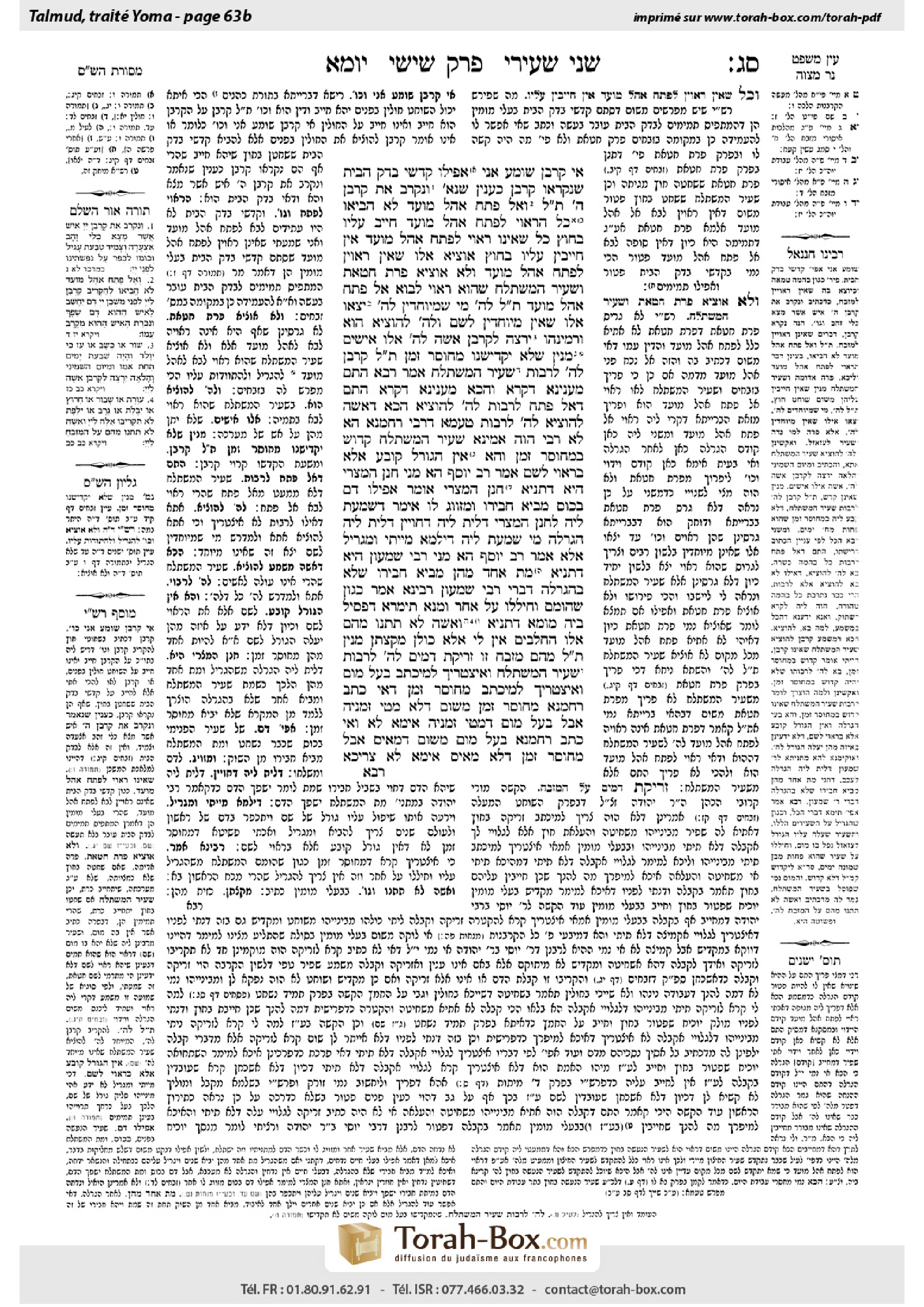
This page of Yoma includes the Aramaic text, an English translation and an AI-generated French translation, alongside the scan above.
יומא ס״ג ב · Aramaic and Hebrew text
אִי ״קׇרְבָּן״, שׁוֹמֵעַ אֲנִי אֲפִילּוּ קׇדְשֵׁי בֶּדֶק הַבַּיִת, שֶׁנִּקְרְאוּ קׇרְבָּן, כָּעִנְיָן שֶׁנֶּאֱמַר: ״וַנַּקְרֵב אֶת קׇרְבַּן ה׳״, תַּלְמוּד לוֹמַר: ״וְאֶל פֶּתַח אֹהֶל מוֹעֵד לֹא הֱבִיאוֹ״. כׇּל הָרָאוּי לְפֶתַח אֹהֶל מוֹעֵד — חַיָּיב עָלָיו בַּחוּץ, כֹּל שֶׁאֵינוֹ רָאוּי לְפֶתַח אֹהֶל מוֹעֵד — אֵין חַיָּיבִין עָלָיו בַּחוּץ.
אוֹצִיא אֵלּוּ שֶׁאֵין רְאוּיִן לְפֶתַח אֹהֶל מוֹעֵד, וְלֹא אוֹצִיא פָּרַת חַטָּאת וְשָׂעִיר הַמִּשְׁתַּלֵּחַ שֶׁהוּא רָאוּי לָבוֹא אֶל פֶּתַח אֹהֶל מוֹעֵד, תַּלְמוּד לוֹמַר: ״לַה׳״, מִי שֶׁמְּיוּחָדִין לַה׳, יָצְאוּ אֵלּוּ שֶׁאֵין מְיוּחָדִין לַשֵּׁם.
וְ״לַה׳״ לְהוֹצִיא הוּא? וּרְמִינְהוּ: ״יֵרָצֶה לְקׇרְבַּן אִשֶּׁה לַה׳״, אֵלּוּ אִישִּׁים,
מִנַּיִן שֶׁלֹּא יַקְדִּישֶׁנּוּ מְחוּסָּר זְמַן — תַּלְמוּד לוֹמַר: ״קׇרְבָּן״, ״לַה׳״ — לְרַבּוֹת שָׂעִיר הַמִּשְׁתַּלֵּחַ!
אָמַר רָבָא: הָתָם מֵעִנְיָנָא דִקְרָא וְהָכָא מֵעִנְיָנָא דִקְרָא. הָתָם דְּ״אֶל פֶּתַח״ לְרַבּוֹת — ״לַה׳״ לְהוֹצִיא. הָכָא דְּ״אִשֶּׁה״ לְהוֹצִיא — ״לַה׳״ לְרַבּוֹת.
טַעְמָא דְּרַבִּי רַחֲמָנָא, הָא לָא רַבִּי, הֲוָה אָמֵינָא: שָׂעִיר הַמִּשְׁתַּלֵּחַ קָדוֹשׁ בִּמְחוּסַּר זְמַן. וְהָא אֵין הַגּוֹרָל קוֹבֵעַ אֶלָּא בְּרָאוּי לַשֵּׁם!
אָמַר רַב יוֹסֵף: הָא מַנִּי, חָנָן הַמִּצְרִי הִיא, דְּתַנְיָא: חָנָן הַמִּצְרִי אוֹמֵר: אֲפִילּוּ דָּם בַּכּוֹס — מֵבִיא חֲבֵירוֹ וּמְזַוֵּוג לוֹ.
אֵימַר דְּשָׁמְעַתְּ לֵיהּ לְחָנָן הַמִּצְרִי דְּלֵית לֵיהּ דְּחוּיִין, דְּלֵית לֵיהּ הַגְרָלָה מִי שָׁמְעַתְּ לֵיהּ? דִּילְמָא מַיְיתֵי וּמַגְרִיל.
אֶלָּא אָמַר רַב יוֹסֵף: הָא מַנִּי, רַבִּי שִׁמְעוֹן הִיא. דְּתַנְיָא: מֵת אֶחָד מֵהֶן — מֵבִיא חֲבֵירוֹ שֶׁלֹּא בְּהַגְרָלָה, דִּבְרֵי רַבִּי שִׁמְעוֹן.
רָבִינָא אָמַר, כְּגוֹן שֶׁהוּמַם וְחִילְּלוֹ עַל אַחֵר.
וּמְנָא תֵּימְרָא דְּפָסֵיל בֵּיהּ מוּמָא! דְּתַנְיָא: ״וְאִשֶּׁה לֹא תִתְּנוּ מֵהֶם״, אֵלּוּ הַחֲלָבִים.
אֵין לִי אֶלָּא כּוּלָּן, מִקְצָתָן מִנַּיִן? תַּלְמוּד לוֹמַר: ״מֵהֶם״. ״מִזְבֵּחַ״, זוֹ זְרִיקַת דָּמִים. ״לַה׳״, לְרַבּוֹת שָׂעִיר הַמִּשְׁתַּלֵּחַ.
וְאִיצְטְרִיךְ לְמִיכְתַּב בַּעַל מוּם, וְאִיצְטְרִיךְ לְמִיכְתַּב מְחוּסַּר זְמַן. דְּאִי כְּתַב רַחֲמָנָא מְחוּסַּר זְמַן — מִשּׁוּם דְּלָא מָטֵי זִמְנֵיהּ, אֲבָל בַּעַל מוּם דְּמָטֵי זִמְנֵיהּ — אֵימָא לָא. וְאִי כְּתַב רַחֲמָנָא בַּעַל מוּם — מִשּׁוּם דִּמְאִיס, אֲבָל מְחוּסַּר זְמַן דְּלָא מְאִיס — אֵימָא לָא, צְרִיכָא.
Yoma 63b · English translation
If it would have mentioned just the word offering, I would derive that one is liable even for slaughtering animals consecrated for Temple maintenance outside the Temple, which are also called offering, as it is stated: “And we have brought the Lord’s offering, what every man has found: Articles of gold, armlets, and bracelets, rings, earrings, and pendants” (Numbers 31:50). Therefore, the verse states: “And has not brought it to the entrance to the Tent of Meeting” (Leviticus 17:4), to teach that with regard to any animal fit to be sacrificed within the entrance to the Tent of Meeting or the Temple, one is liable for slaughtering it outside the Temple. Conversely, with regard to any animal that is not fit to be sacrificed within the entrance to the Tent of Meeting, one is not liable for slaughtering it outside the Temple.
Furthermore: I might exclude these animals consecrated for Temple maintenance, which are not fit to be sacrificed within the entrance to the Tent of Meeting because they are blemished, and I will not exclude the heifer of a purification offering and the scapegoat, which are fit to come to the entrance to the Tent of Meeting. Therefore, the verse states “to the Lord” to indicate that one is liable only for those animals that are designated exclusively for God as offerings. These, the heifer of a purification offering and the scapegoat, are excluded, as they are not designated exclusively for God as sacrificial offerings but are used for some other purpose.
The Gemara asks about this halakhic midrash: Does the expression “to the Lord” come to exclude? The Gemara raises a contradiction based upon the verse: “When a bull, or a lamb, or a goat, is born it shall be seven days under its mother; but from the eighth day on it may be accepted as an offering by fire to the Lord” (Leviticus 22:27). An offering by fire to the Lord: These are offerings by fire, which are sacrificed on the altar and which may not be sacrificed before their proper time.
From where do we derive that he may not consecrate an animal when it is lacking time, i.e., before the eighth day? The verse states: An offering, which indicates that it should not be designated as an offering before the eighth day. The expression: To the Lord comes to include the scapegoat, which is also brought for the sake of God. In other words, the expression: To the Lord, not only does not exclude the scapegoat from the category of offerings, but specifically includes it in this category.
Rava said that this can be resolved as follows: There the expression is understood in the context of the verse and here it is understood in the context of the verse. There, with regard to consecrated animals slaughtered outside the Temple, where the phrase: To the entrance, in that same verse comes to include other offerings, the phrase: To the Lord necessarily comes to exclude. Conversely, here, with regard to consecrating animals before the proper time, where the phrase: Offering by fire comes to exclude, the phrase: To the Lord comes to include.
Once the contradiction has been reconciled, the Gemara challenges the reasoning of the argument. The reason the scapegoat may not be consecrated before it is eight days old is because the Merciful One specifically included it among the other offerings. But had it not included it I would have said: The scapegoat may be consecrated even when it is lacking time. However, this is difficult: Isn’t it true that the lottery establishes as the goat that is sacrificed to God, only one that is fit to be sacrificed to God? Since it is not known in advance which goat will be designated for this purpose, both goats must be eight days old and thereby fit to be sacrificed to God.
Rav Yosef said: In accordance with whose opinion is this baraita? It is the opinion of Ḥanan the Egyptian, as it was taught in a baraita that Ḥanan the Egyptian says: Even if the goat sacrificed to God has already been slaughtered and its blood has been collected in the cup, if the scapegoat dies, he brings another goat as a counterpart and pairs it with the goat that has already been slaughtered. Since in this case the priest need not draw new lots and the second goat is immediately designated to be sent to Azazel, it was necessary to teach that this goat must not be lacking time.
The Gemara presents a challenge with regard to this answer. Say that you heard Ḥanan the Egyptian say that he does not hold that if the scapegoat dies, the blood of the other goat is rejected. Did you also hear him say that he does not require a new lottery for the second goat? Perhaps he meant that one brings two new goats and draws lots, and whichever is designated to be sent to Azazel is the counterpart to the goat that was already slaughtered.
The Gemara presents another explanation of why it was necessary for the Torah to indicate that the scapegoat must not be lacking time. Rather, Rav Yosef said: In accordance with whose opinion is this? It is in accordance with the opinion of Rabbi Shimon, as it was taught in a baraita: If one of the goats dies, he brings another goat in its place without a lottery; this is the statement of Rabbi Shimon. Therefore, if the scapegoat would die, another goat would be designated as the scapegoat without a lottery, and it was necessary for the Torah to indicate that this goat had to be eight days old.
Ravina said that it is possible to answer according to all opinions. The derivation was necessary in a case where the scapegoat became blemished after the lottery and they redeemed it with another. In that situation, all agree that the new scapegoat does not need to be designated through a lottery, because the status of the original scapegoat was transferred to its replacement.
The Gemara asks: From where do you say that the scapegoat is disqualified by a blemish? A blemish disqualifies only a sacrificial offering, and the scapegoat is not a sacrificial offering. The Gemara answers: As it was taught in a baraita based upon the verse: “Blind, or broken, or maimed, or having a growth, or scurvy, or scabbed, you shall not offer these to the Lord, nor make an offering by fire of them upon the altar to the Lord” (Leviticus 22:22). The phrase: Nor make an offering by fire of them; these are the fats of blemished animals, which may not be sacrificed on the altar.
I have only derived that it is prohibited to sacrifice all the fats of a blemished animal; from where do I derive that it is prohibited to sacrifice some of them? The verse states “of them,” which indicates that the prohibition applies even to some of them. “The altar”; this is referring to the prohibition against sprinkling the blood of blemished animals. The phrase “to the Lord” comes to include the scapegoat, which is also disqualified by a blemish.
The Gemara comments: And it is necessary to write that a blemished scapegoat is disqualified and it is necessary to write that a scapegoat may not be lacking time. Since if the Merciful One had written only that a scapegoat is disqualified if it is lacking time, one might have said that this is because its time has not yet come and therefore it is unable to become consecrated. However, with regard to a blemished animal whose time has already arrived, say that it is not disqualified. And conversely, if the Merciful One had written only that a blemished scapegoat is disqualified, one might have said that this is because it is considered abhorrent to sacrifice a blemished animal as an offering. However, with regard to a goat that is lacking time, which is not abhorrent, say that it is not disqualified. It is therefore necessary for the Torah to include the scapegoat in both disqualifications.
Yoma 63b · Traduction française (IA)
S’il n’avait mentionné que le mot « offrande », j’en aurais déduit que l’on est passible même pour avoir abattu hors du Temple des animaux consacrés à son entretien, qui sont eux aussi appelés « offrande », comme il est dit : « Nous avons apporté l’offrande du Seigneur, ce que chacun a trouvé : des objets d’or, des bracelets, des joncs, des anneaux, des boucles d’oreilles et des pendentifs » (Nombres 31:50). Le verset précise donc : « et ne l’a pas amené à l’entrée de la Tente d’assignation » (Lévitique 17:4), pour enseigner que l’on est passible d’avoir abattu hors du Temple tout animal qui peut être offert à l’entrée de la Tente d’assignation ou dans le Temple. En revanche, on n’est pas passible d’avoir abattu hors du Temple un animal qui ne peut pas être offert à l’entrée de la Tente d’assignation.
En outre, je pourrais exclure ces animaux consacrés à l’entretien du Temple, qui ne peuvent pas être offerts à l’entrée de la Tente d’assignation parce qu’ils sont atteints d’un défaut, tout en n’excluant pas la génisse du sacrifice expiatoire et le bouc émissaire, qui peuvent être amenés à l’entrée de la Tente d’assignation. Le verset précise donc « au Seigneur », pour indiquer que l’on est passible uniquement pour les animaux exclusivement destinés à Dieu en tant qu’offrandes. La génisse du sacrifice expiatoire et le bouc émissaire sont exclus, car ils ne sont pas exclusivement destinés à Dieu comme offrandes sacrificielles, mais sont utilisés à une autre fin.
La Guemara interroge ce midrach halakhique : l’expression « au Seigneur » vient-elle exclure ? La Guemara soulève une contradiction à partir du verset : « Lorsqu’un taureau, un agneau ou un chevreau naît, il restera sept jours auprès de sa mère ; mais à partir du huitième jour, il pourra être accepté comme offrande consumée par le feu au Seigneur » (Lévitique 22:27). « Offrande consumée par le feu au Seigneur » : il s’agit des offrandes consumées par le feu, qui sont offertes sur l’autel et ne peuvent pas l’être avant le moment requis.
Comment déduit-on qu’on ne peut pas consacrer un animal avant que le délai requis ne soit écoulé, c’est-à-dire avant le huitième jour ? Le verset dit « une offrande », ce qui indique qu’on ne doit pas le désigner comme offrande avant le huitième jour. L’expression « au Seigneur » vient inclure le bouc émissaire, qui est lui aussi offert pour Dieu. Autrement dit, l’expression « au Seigneur » non seulement n’exclut pas le bouc émissaire de la catégorie des offrandes, mais l’y inclut expressément.
Rava dit que la contradiction peut être résolue ainsi : dans chaque cas, l’expression s’interprète selon le contexte du verset. Là, au sujet des animaux consacrés abattus hors du Temple, puisque l’expression « à l’entrée », dans ce même verset, vient inclure d’autres offrandes, l’expression « au Seigneur » doit nécessairement exclure. En revanche, ici, au sujet de la consécration d’animaux avant le moment requis, puisque l’expression « offrande consumée par le feu » vient exclure, l’expression « au Seigneur » vient inclure.
Une fois la contradiction résolue, la Guemara conteste le raisonnement. Si le bouc émissaire ne peut pas être consacré avant l’âge de huit jours, c’est parce que le Miséricordieux l’a expressément inclus parmi les autres offrandes. Mais s’il ne l’avait pas inclus, aurais-je dit que le bouc émissaire peut être consacré avant que le délai requis ne soit écoulé ? Cela pose toutefois une difficulté : n’est-il pas vrai que le tirage au sort ne désigne comme bouc offert à Dieu qu’un bouc apte à être offert à Dieu ? Puisqu’on ne sait pas à l’avance lequel des boucs sera désigné à cette fin, les deux boucs doivent avoir huit jours et être ainsi aptes à être offerts à Dieu.
Rav Yossef dit : De l’avis de qui est cette baraïta ? De celui de Ḥanan l’Égyptien, car il a été enseigné dans une baraïta que Ḥanan l’Égyptien dit : même si le bouc offert à Dieu a déjà été abattu et que son sang a été recueilli dans une coupe, si le bouc émissaire meurt, on apporte un autre bouc en remplacement et on l’associe au bouc déjà abattu. Dans ce cas, le prêtre n’a pas besoin de procéder à un nouveau tirage au sort, et le second bouc est immédiatement désigné pour être envoyé à Azazel ; il était donc nécessaire d’enseigner que ce bouc ne devait pas être âgé de moins de huit jours.
La Guemara soulève une difficulté à propos de cette réponse. Tu as entendu Ḥanan l’Égyptien dire qu’il ne considère pas que le sang de l’autre bouc soit rejeté si le bouc émissaire meurt. Mais l’as-tu aussi entendu dire qu’il n’exige pas un nouveau tirage au sort pour le second bouc ? Peut-être voulait-il dire qu’on apporte deux nouveaux boucs et qu’on tire au sort ; celui qui est désigné pour être envoyé à Azazel devient alors le remplaçant du bouc déjà abattu.
La Guemara présente une autre explication de la nécessité pour la Torah d’indiquer que le bouc émissaire ne doit pas être âgé de moins de huit jours. Rav Yossef dit plutôt : De l’avis de qui cela relève-t-il ? De celui de Rabbi Shimon, car il a été enseigné dans une baraïta : si l’un des boucs meurt, on apporte un autre bouc à sa place, sans tirage au sort ; telle est la déclaration de Rabbi Shimon. Par conséquent, si le bouc émissaire mourait, un autre bouc serait désigné comme bouc émissaire sans tirage au sort, et il était nécessaire que la Torah indique que ce bouc devait avoir huit jours.
Ravina dit qu’il est possible de répondre selon tous les avis. La déduction était nécessaire dans le cas où le bouc émissaire était devenu atteint d’un défaut après le tirage au sort et où on l’avait remplacé par un autre. Dans cette situation, tous s’accordent à dire que le nouveau bouc émissaire n’a pas besoin d’être désigné par tirage au sort, car le statut du bouc émissaire initial a été transféré à son remplaçant.
La Guemara demande : d’où déduis-tu que le bouc émissaire est invalidé par un défaut ? Seule une offrande sacrificielle est invalidée par un défaut, or le bouc émissaire n’est pas une offrande sacrificielle. La Guemara répond : comme il a été enseigné dans une baraïta à partir du verset : « Aveugle, ou brisé, ou mutilé, ou portant une excroissance, ou atteint de gale ou de teigne, vous ne les offrirez pas au Seigneur et n’en ferez pas une offrande consumée par le feu sur l’autel au Seigneur » (Lévitique 22:22). L’expression « et n’en ferez pas une offrande consumée par le feu » désigne les graisses des animaux atteints d’un défaut, qui ne peuvent pas être offertes sur l’autel.
J’ai seulement déduit qu’il est interdit d’offrir toutes les graisses d’un animal atteint d’un défaut ; d’où déduit-on qu’il est interdit d’en offrir une partie ? Le verset dit « d’eux », ce qui indique que l’interdiction s’applique même à une partie de ces graisses. « L’autel » : cela fait référence à l’interdiction d’asperger le sang des animaux atteints d’un défaut. L’expression « au Seigneur » vient inclure le bouc émissaire, qui est lui aussi invalidé par un défaut.
La Guemara fait remarquer qu’il est nécessaire d’enseigner qu’un bouc émissaire atteint d’un défaut est invalidé, et qu’il est nécessaire d’enseigner qu’un bouc émissaire ne doit pas être âgé de moins de huit jours. En effet, si le Miséricordieux avait seulement enseigné qu’un bouc émissaire est invalidé lorsque le délai requis n’est pas écoulé, on aurait pu dire que c’est parce que le moment n’est pas encore venu et qu’il ne peut donc pas être consacré. Cependant, à propos d’un animal atteint d’un défaut dont le moment requis est déjà venu, on aurait pu dire qu’il n’est pas invalidé. À l’inverse, si le Miséricordieux avait seulement enseigné qu’un bouc émissaire atteint d’un défaut est invalidé, on aurait pu dire que c’est parce qu’il est considéré comme répugnant d’offrir en sacrifice un animal atteint d’un défaut. Cependant, à propos d’un bouc qui n’a pas encore atteint l’âge requis et qui n’est pas répugnant, on aurait pu dire qu’il n’est pas invalidé. La Torah doit donc inclure le bouc émissaire dans ces deux motifs d’invalidation.
Traduction française générée par IA à partir de l’édition anglaise de Sefaria. Vérifie toujours un passage avec le texte source.
Text from Sefaria: William Davidson Edition - Vocalized Aramaic (CC BY NC); William Davidson Edition - English (CC BY NC).