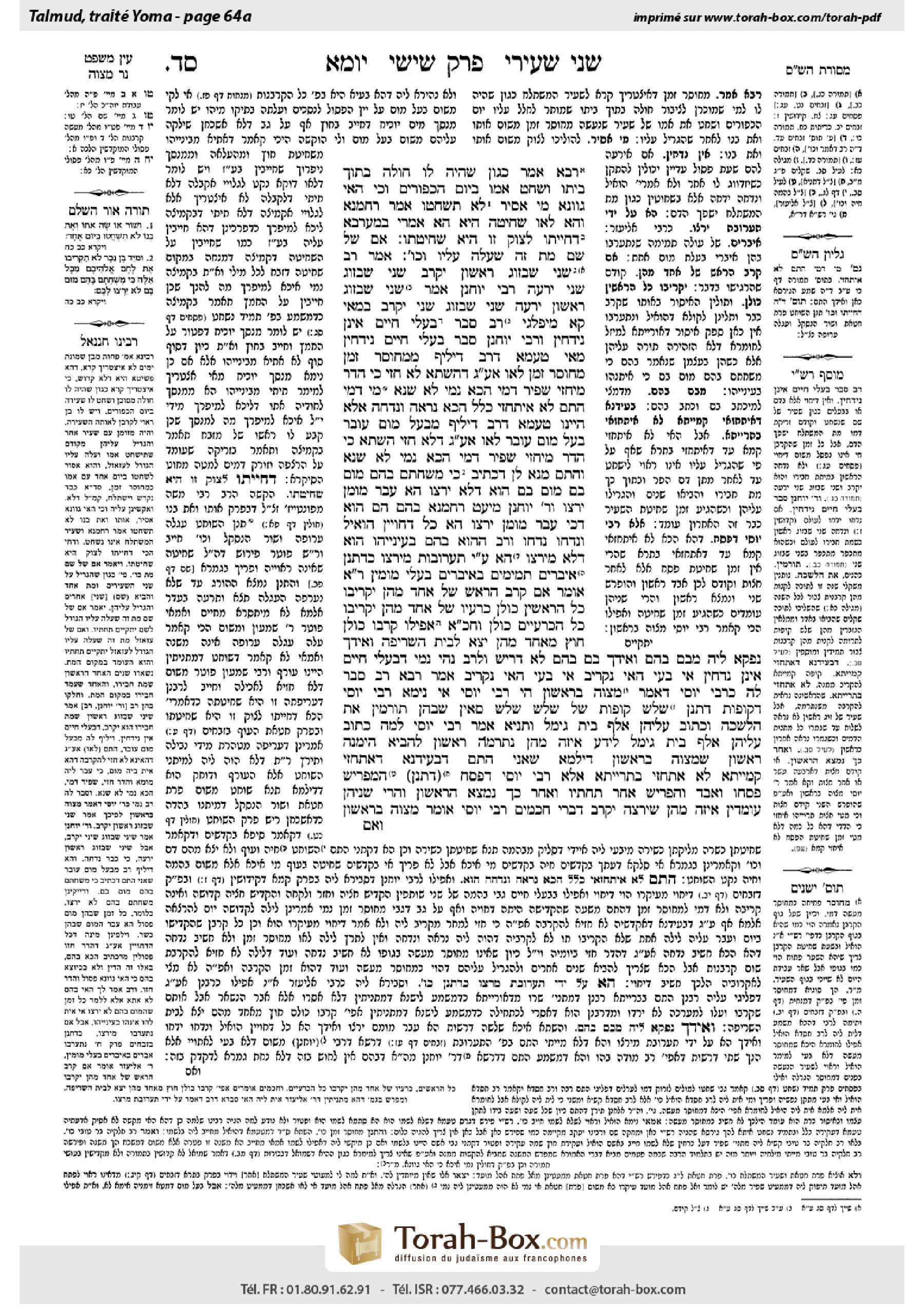
Yoma 64a: Talmud study for Daf Yomi
Daf Yomi is the daily study of one Talmud folio. Explore 37 tractates with scans, Hebrew text, Sefaria English and AI-generated French translations where annotated.
Passage selection and English or AI-generated French translation are available where the scan has annotations. Daf Study is independent of Torah-Box and Sefaria.
Browse Yoma · יומא · All tractatesYoma 64a text and translations
This page of Yoma includes the Aramaic text, an English translation and an AI-generated French translation, alongside the scan above.
יומא ס״ד א · Aramaic and Hebrew text
רָבָא אָמַר: כְּגוֹן שֶׁהָיָה לוֹ חוֹלֶה בְּתוֹךְ בֵּיתוֹ, וְשָׁחַט אִמּוֹ בְּיוֹם הַכִּפּוּרִים.
וְכִי הַאי גַּוְונָא מִי אֲסִיר? ״לֹא תִשְׁחֲטוּ״ אָמַר רַחֲמָנָא, וְהָא לָאו שְׁחִיטָה הִיא! הָא אָמְרִי בְּמַעְרְבָא דְּחִיָּיתוֹ לַצּוּק זוֹ הִיא שְׁחִיטָתוֹ.
אִם שֶׁל שֵׁם מֵת, זֶה שֶׁעָלָה עָלָיו וְכוּ׳.
אָמַר רַב: שֵׁנִי שֶׁבְּזוּג רִאשׁוֹן — יִקְרַב, שֵׁנִי שֶׁבְּזוּג שֵׁנִי — יִרְעֶה. רַבִּי יוֹחָנָן אָמַר: שֵׁנִי שֶׁבְּזוּג רִאשׁוֹן — יִרְעֶה, שֵׁנִי שֶׁבַּזּוּג שֵׁנִי — יִקְרַב.
בְּמַאי קָא מִיפַּלְגִי? רַב סָבַר: בַּעֲלֵי חַיִּים אֵינָן נִידְחִין, וְרַבִּי יוֹחָנָן סָבַר: בַּעֲלֵי חַיִּים נִידְחִין.
מַאי טַעְמָא דְּרַב? דְּיָלֵיף מִמְּחוּסַּר זְמַן. מְחוּסַּר זְמַן, לָאו אַף עַל גַּב דְּהַשְׁתָּא לָא חֲזֵי, כִּי הָדַר מִיחֲזֵי — שַׁפִּיר דָּמֵי, הָכָא נָמֵי לָא שְׁנָא. מִי דָּמֵי? הָתָם לָא אִיתְחֲזִי כְּלָל. הָכָא נִרְאָה וְנִדְחָה!
אֶלָּא: הַיְינוּ טַעְמָא דְּרַב, דְּיָלֵיף מִבַּעַל מוּם עוֹבֵר. בַּעַל מוּם עוֹבֵר, לָאו אַף עַל גַּב דְּלָא חֲזֵי הַשְׁתָּא, כִּי הָדַר מִיחֲזֵי — שַׁפִּיר דָּמֵי, הָכָא נָמֵי לָא שְׁנָא.
וְהָתָם מְנָא לַן? דִּכְתִיב: ״כִּי מׇשְׁחָתָם בָּהֶם מוּם בָּם״, מוּם בָּם — הוּא דְּלֹא יֵרָצוּ, הָא עָבַר מוּמָן — יֵרָצוּ.
וְרַבִּי יוֹחָנָן? מִיעֵט רַחֲמָנָא ״בָּהֶם״, הֵם הוּא דְּכִי עָבַר מוּמָן יֵרָצוּ, הָא כׇּל דְּחוּיִין, הוֹאִיל וְנִדְחוּ — נִדְחוּ.
וְרַב? הָהוּא ״בָּהֶם״ בְּעֵינַיְיהוּ הוּא דְּלָא מִירְצוּ, הָא עַל יְדֵי תַּעֲרוֹבוֹת — מִירְצוּ.
כְּדִתְנַן: אֵיבָרִים תְּמִימִים בְּאֵיבָרִים בַּעֲלֵי מוּמִין. רַבִּי אֱלִיעֶזֶר אוֹמֵר: אִם קָרַב הָרֹאשׁ שֶׁל אֶחָד מֵהֶן — יַקְרִיבוּ כׇּל הָרָאשִׁין כּוּלָּן, כְּרָעָיו שֶׁל אֶחָד מֵהֶן — יַקְרִיבוּ כָּל הַכְּרָעַיִים כּוּלָּן. וַחֲכָמִים אוֹמְרִים: אֲפִילּוּ קָרְבוּ כּוּלָּן חוּץ מֵאֶחָד מֵהֶן — יֵצֵא לְבֵית הַשְּׂרֵיפָה.
וְאִידַּךְ? נָפְקָא לֵיהּ מִ״בָּם״ ״בָּהֶם״. וְאִידַּךְ? ״בָּם״ ״בָּהֶם״ לָא דָּרֵישׁ.
וּלְרַב, נְהִי נָמֵי דְּבַעֲלֵי חַיִּים אֵינָן נִדְחִין, אִי בָּעֵי הַאי נַקְרֵיב אִי בָּעֵי הַאי נַקְרֵיב!
אָמַר רָבָא: רַב סָבַר לַהּ כְּרַבִּי יוֹסֵי, דְּאָמַר: מִצְוָה בָּרִאשׁוֹן. הֵי רַבִּי יוֹסֵי? אִי נֵימָא רַבִּי יוֹסֵי דְּקוּפּוֹת, דִּתְנַן: שָׁלֹשׁ קוּפּוֹת שֶׁל שָׁלֹשׁ שָׁלֹשׁ סְאִין, שֶׁבָּהֶן תּוֹרְמִין אֶת הַלִּשְׁכָּה, וְכָתוּב עֲלֵיהֶן: אָלֶף בֵּית גִּימֶל. וְתַנְיָא, אָמַר רַבִּי יוֹסֵי: לָמָּה כָּתוּב עֲלֵיהֶן אָלֶף בֵּית גִּימֶל — לֵידַע אֵיזֶה מֵהֶן נִתְרְמָה רִאשׁוֹן, לְהָבִיא הֵימֶנָּה רִאשׁוֹן, שֶׁמִּצְוָה בָּרִאשׁוֹן.
דִּילְמָא שָׁאנֵי הָתָם, דִּבְעִידָּנָא דְּאִתְחֲזַי קַמַּיְיתָא לָא אִתְחֲזַי בָּתְרָיְיתָא.
אֶלָּא רַבִּי יוֹסֵי דְּפֶסַח, (דִּתְנַן:) הַמַּפְרִישׁ פִּסְחוֹ וְאָבַד, וְהִפְרִישׁ אַחֵר תַּחְתָּיו, וְאַחַר כָּךְ נִמְצָא הָרִאשׁוֹן, וַהֲרֵי שְׁנֵיהֶן עוֹמְדִין — אֵיזֶה מֵהֶן שֶׁיִּרְצֶה יִקְרַב, דִּבְרֵי חֲכָמִים. רַבִּי יוֹסֵי אוֹמֵר: מִצְוָה בָּרִאשׁוֹן.
Yoma 64a · English translation
The Gemara presents another explanation as to why a verse is needed to indicate that the scapegoat may not be lacking time. Rava said: It is referring to a case where the one who sold the two goats had a critically ill person in his household, and he slaughtered the mother of the scapegoat in order to save the ill person’s life on Yom Kippur. Although the scapegoat is more than eight days old, it is considered lacking time because it is prohibited to slaughter a mother animal and its offspring on the same day.
The Gemara asks: Is it prohibited in a case like this? The Merciful One stated in the Torah: “And whether it be a cow or ewe, you shall not slaughter it and its young on one day” (Leviticus 22:28), and this act of pushing the scapegoat off the cliff is not a ritual slaughter. Consequently, the prohibition against slaughtering a mother animal and its offspring should not apply. The Gemara answers: They say in the West, i.e., Eretz Yisrael, that pushing it off the cliff, which is the manner in which the scapegoat is supposed to be killed, is considered its slaughter.
§ It was taught in the mishna that if one of the goats dies after the lottery, a second pair of goats is sought and new lots are drawn. After that lottery, the priest utters a stipulation: If the one to be sacrificed to God died, that goat upon which the lot for God was drawn shall stand in its stead; and if the one to be sent to Azazel died, that goat upon which the lot for Azazel was drawn shall stand in its stead. The second, superfluous goat should graze until it becomes blemished, at which point it will be sold and the money received in its sale will go to the purchase of a public gift-offering. The Gemara discusses which goat is set to pasture: The one that remains from the first lottery or the one that remains from the second lottery?
Rav said: If the goat to be sent to Azazel died, he should sacrifice the second goat of the first pair to God, and the second goat of the second pair should graze until it becomes unfit. Rabbi Yoḥanan said: The second goat of the first pair is the one that should graze, whereas he should sacrifice the second goat of the second pair.
The Gemara asks: With regard to what principle do they disagree? The Gemara explains: Rav holds that animals are not rejected. An animal that was consecrated as an offering but later became unfit for sacrifice is not considered disqualified forever. Therefore, although the remaining goat was not eligible to be sacrificed when its counterpart died, once another goat has been paired with it following a new lottery, it is no longer rejected and should be sacrificed. And Rabbi Yoḥanan holds that animals are rejected. Therefore, once the remaining goat from the first pair became disqualified, it remains disqualified forever.
The Gemara asks: What is the reason for the opinion of Rav? The Gemara answers: He derives it from the halakha applicable to an animal that is lacking time. In the case of an animal that is lacking time, is it not true that although it is unfit now, when it again becomes fit, it seems well, i.e., it may be sacrificed as an offering? Here, too, it is no different. The Gemara rejects this answer: Is it comparable? There, when the animal is lacking time, it was never fit to be sacrificed. Here, the animal was fit as an offering and later became unfit and was therefore rejected. Perhaps in this case it is permanently disqualified.
Rather, the Gemara retracts the first explanation and says that this is the reasoning of Rav: He derives it from the case of an animal with a temporary blemish. The animal is disqualified as an offering as long as the blemish remains, but is eligible for sacrifice once the blemish has healed. In the case of an animal with a temporary blemish, is it not true that although it is unfit now, when it again becomes fit, it seems well, i.e., it may be sacrificed as an offering? Here too, it is no different.
The Gemara asks: There, in the case of an animal with a temporary blemish, from where do we derive this halakha? As it is written: “Because their corruption is in them, there is a blemish in them; they shall not be accepted for you” (Leviticus 22:25), which teaches us: It is when the blemish is in them that they shall not be accepted; but if their blemish passes, they shall be accepted.
The Gemara asks: And what does Rabbi Yoḥanan respond to this proof? The Merciful One limited this halakha by using the term: In them, which indicates that it is they, animals with temporary blemishes, that are accepted when their blemishes pass, but with regard to all other animals that become disqualified, once they are rejected they remain rejected.
The Gemara asks: And how does Rav answer Rabbi Yoḥanan? That term: In them, should be understood as follows: It is on their own that they are not accepted; but in mixtures with animals that are fit to be sacrificed, animals that have a temporary blemish are accepted.
As we learned in a mishna: If limbs from unblemished burnt-offerings became mixed with limbs from blemished burnt-offerings, which are disqualified, Rabbi Eliezer says: If the head of one of them is sacrificed on the altar before they knew of the blemish, they should sacrifice all the heads, as it is assumed that the head of the disqualified animal was the one already sacrificed on the altar. Similarly, if the legs of one of them were sacrificed, they should sacrifice all the legs. And the Rabbis say: Even if all of them were sacrificed except for one, that one should be taken out to the place designated for burning disqualified offerings, as it is not assumed that the limbs of the disqualified animal have already been brought.
The Gemara asks: And how does the other Sage, Rabbi Yoḥanan, derive the halakha that the limbs are acceptable if they are in a mixture? The Gemara answers: He derives it from the Torah’s choice of terminology: It could have written: “In them,” as bam, but instead it used the term bahem, with the extra letter heh, and therefore an extra halakha can be derived from this word. The Gemara comments: And the other Sage, Rav, does not expound the difference in terminology between the words bam and bahem, as he does not consider the distinction significant enough to teach a halakha.
The Gemara asks: According to Rav, although living beings are not permanently rejected, that only explains why the remaining goat of the first pair is acceptable for sacrifice, but why must it be the one to be sacrificed? If he wants this one from the first pair he should sacrifice it, and if he wants that one from the second pair, he should sacrifice that.
Rava said: Rav holds in accordance with the opinion of Rabbi Yosei, who said: The mitzva should be fulfilled with the goat from the first pair. The Gemara asks: Which statement of Rabbi Yosei indicates that this is his opinion? If we say it is the statement of Rabbi Yosei with regard to the containers, as we learned in a mishna: There were three containers, each of which held three se’a, with which they collected coins from the chamber. And the letters alef, beit, and gimmel were written on them. And it was taught in a baraita that Rabbi Yosei said: Why were alef, beit, and gimmel written on them? In order to know which of them was collected from the chamber first, in order to bring an offering from it first, as the mitzva is performed with the first one.
That statement of Rabbi Yosei cannot serve as the source for Rav’s opinion. Perhaps it is different there, in the case of the containers, because at the time when the first container of coins was fit for use, the containers used later were not yet fit for use. Therefore, it cannot serve as a precedent with regard to a case in which both became fit for use at the same time. In the case of the Yom Kippur goats, none of the goats are actually fit for sacrifice until the point in the Temple service when they are supposed to be sacrificed. By that time, lots have already been drawn for the second pair of goats.
Rather, the source of Rav’s opinion is the statement of Rabbi Yosei with regard to the Paschal lamb. As we learned in a baraita: With regard to one who separated an animal as his Paschal lamb and it became lost, and he separated another in its stead, and afterward, but before midday on the eve of Passover, the first one is found, and they are both standing before him, the owner may bring whichever of them he wishes. This is the statement of the Rabbis. Rabbi Yosei says: The mitzva should be performed with the first one.
Yoma 64a · Traduction française (IA)
La Guemara présente une autre explication de la nécessité d’un verset indiquant que le bouc émissaire ne peut pas être trop jeune. Rava dit : Il s’agit du cas où le vendeur des deux boucs avait un malade en danger de mort dans sa maison et a égorgé la mère du bouc émissaire afin de sauver la vie du malade à Yom Kippour. Bien que le bouc émissaire ait plus de huit jours, il est considéré comme n’ayant pas encore l’âge requis, car il est interdit d’égorger un animal et son petit le même jour.
La Guemara demande : Est-ce interdit dans un cas comme celui-ci ? Le Miséricordieux a dit dans la Torah : « Qu’il s’agisse d’une vache ou d’une brebis, vous ne l’égorgerez pas avec son petit le même jour » (Lévitique 22:28), or précipiter le bouc du haut de la falaise ne constitue pas un égorgement rituel. Par conséquent, l’interdiction d’égorger un animal et son petit ne devrait pas s’appliquer. La Guemara répond : En Occident, c’est-à-dire en Erets Israël, on dit que le fait de le précipiter du haut de la falaise, qui est la manière dont le bouc émissaire doit être mis à mort, est considéré comme son égorgement.
§ Il a été enseigné dans la Michna que si l’un des boucs meurt après le tirage au sort, on se procure une seconde paire de boucs et on procède à un nouveau tirage au sort. Après ce tirage, le prêtre énonce une condition : si le bouc qui devait être offert à Dieu est mort, le bouc sur lequel est tombé le sort pour Dieu prendra sa place ; et si le bouc qui devait être envoyé à Azazel est mort, le bouc sur lequel est tombé le sort pour Azazel prendra sa place. Le second bouc, devenu superflu, doit paître jusqu’à ce qu’il soit atteint d’un défaut ; il sera alors vendu, et l’argent de sa vente servira à l’achat d’une offrande publique. La Guemara examine quel bouc est mis au pâturage : celui qui reste de la première paire ou celui qui reste de la seconde paire ?
Rav dit : si le bouc destiné à Azazel est mort, il faut offrir à Dieu le second bouc de la première paire, et le second bouc de la seconde paire doit paître jusqu’à ce qu’il devienne impropre au sacrifice. Rabbi Yoḥanan dit : c’est le second bouc de la première paire qui doit paître, tandis qu’il faut offrir le second bouc de la seconde paire.
La Guemara demande : Sur quel principe portent leurs divergences ? La Guemara explique : Rav estime que les animaux ne sont pas définitivement rejetés. Un animal consacré comme offrande, mais devenu par la suite impropre au sacrifice, n’est pas considéré comme disqualifié à jamais. Par conséquent, bien que le bouc restant n’ait pas été apte au sacrifice au moment où son compagnon est mort, dès qu’un autre bouc lui est associé à la suite d’un nouveau tirage au sort, il n’est plus rejeté et doit être offert. Rabbi Yoḥanan estime, quant à lui, que les animaux sont définitivement rejetés. Par conséquent, dès que le bouc restant de la première paire a été disqualifié, il le reste à jamais.
La Guemara demande : Quelle est la raison de l’opinion de Rav ? La Guemara répond : Il la déduit de la halakha applicable à un animal trop jeune. Dans le cas d’un animal trop jeune, n’est-il pas vrai que, bien qu’il soit impropre au sacrifice à présent, lorsqu’il devient apte, il peut être offert ? Ici aussi, il en va de même. La Guemara rejette cette réponse : La comparaison est-elle valable ? Dans le premier cas, l’animal trop jeune n’a jamais été apte au sacrifice. Ici, l’animal était apte comme offrande, puis il est devenu impropre et a donc été rejeté. Peut-être est-il définitivement disqualifié dans ce cas.
La Guemara revient plutôt sur sa première explication et expose ainsi le raisonnement de Rav : il le déduit du cas d’un animal atteint d’un défaut temporaire. L’animal est disqualifié comme offrande tant que le défaut subsiste, mais il peut être offert une fois le défaut guéri. Dans le cas d’un animal atteint d’un défaut temporaire, n’est-il pas vrai que, bien qu’il soit impropre au sacrifice à présent, lorsqu’il redevient apte, il peut être offert ? Ici aussi, il en va de même.
La Guemara demande : Dans le cas d’un animal atteint d’un défaut temporaire, d’où déduisons-nous cette halakha ? Car il est écrit : « Car leur corruption est en eux, il y a un défaut en eux ; ils ne seront pas agréés pour vous » (Lévitique 22:25). Cela nous enseigne que c’est lorsqu’ils ont un défaut qu’ils ne sont pas agréés ; mais si leur défaut disparaît, ils sont agréés.
La Guemara demande : Et que répond Rabbi Yoḥanan à cette preuve ? Le Miséricordieux a limité cette halakha en employant l’expression « en eux », ce qui indique que seuls ces animaux, ceux qui ont un défaut temporaire, sont agréés lorsque leur défaut disparaît ; quant à tous les autres animaux qui deviennent disqualifiés, une fois rejetés, ils le restent.
La Guemara demande : Et comment Rav répond-il à Rabbi Yoḥanan ? L’expression « en eux » doit être comprise ainsi : ils ne sont pas agréés lorsqu’ils sont seuls, mais les animaux atteints d’un défaut temporaire sont agréés lorsqu’ils sont mélangés à des animaux aptes au sacrifice.
Comme nous l’avons appris dans une Michna : si des membres d’holocaustes sans défaut se sont mélangés à des membres d’holocaustes atteints d’un défaut, qui sont disqualifiés, Rabbi Eliezer dit : si la tête de l’un d’eux est offerte sur l’autel avant que l’on ait connaissance du défaut, on doit offrir toutes les têtes, car on suppose que la tête de l’animal disqualifié est celle qui a déjà été offerte sur l’autel. De même, si les pattes de l’un d’eux ont été offertes, on doit offrir toutes les pattes. Les Sages disent : même si tous les membres sauf un ont été offerts, ce dernier doit être emporté à l’endroit destiné à brûler les offrandes disqualifiées, car on ne suppose pas que les membres de l’animal disqualifié ont déjà été apportés.
La Guemara demande : Et comment l’autre Sage, Rabbi Yoḥanan, déduit-il la halakha selon laquelle les membres sont agréés lorsqu’ils se trouvent dans un mélange ? La Guemara répond : Il la déduit du choix des termes de la Torah. Elle aurait pu écrire « en eux », bam, mais elle a plutôt employé le terme bahem, avec la lettre supplémentaire heh ; on peut donc déduire de ce mot une halakha supplémentaire. La Guemara fait remarquer : L’autre Sage, Rav, ne tire pas de déduction de la différence entre les termes bam et bahem, car il ne considère pas cette distinction comme suffisamment importante pour enseigner une halakha.
La Guemara demande : Selon Rav, même si les êtres vivants ne sont pas définitivement rejetés, cela explique seulement pourquoi le bouc restant de la première paire peut être offert ; mais pourquoi faut-il que ce soit lui qui soit offert ? S’il veut celui-ci, de la première paire, qu’il l’offre ; et s’il veut celui-là, de la seconde paire, qu’il l’offre.
Rava dit : Rav est conforme à l’opinion de Rabbi Yosei, qui a dit que la mitsva doit être accomplie avec le bouc de la première paire. La Guemara demande : Quelle déclaration de Rabbi Yosei indique qu’il est de cet avis ? Si nous disons qu’il s’agit de la déclaration de Rabbi Yosei au sujet des récipients, comme nous l’avons appris dans une Michna : il y avait trois récipients, contenant chacun trois séa, qui servaient à recueillir les pièces dans la chambre. Les lettres alef, beit et gimmel étaient inscrites sur eux. Et une baraïta enseigne que Rabbi Yosei a dit : Pourquoi les lettres alef, beit et gimmel étaient-elles inscrites sur eux ? Afin de savoir lequel avait été recueilli en premier dans la chambre, pour en apporter d’abord une offrande, car la mitsva s’accomplit avec le premier.
Cette déclaration de Rabbi Yosei ne peut pas servir de source à l’opinion de Rav. Peut-être le cas des récipients est-il différent, car au moment où le premier récipient de pièces était apte à être utilisé, ceux utilisés par la suite ne l’étaient pas encore. Ce cas ne peut donc pas servir de précédent pour une situation où les deux sont devenus aptes à être utilisés au même moment. Dans le cas des boucs de Yom Kippour, aucun des boucs n’est réellement apte au sacrifice avant le moment du service au Temple où il doit être offert. À ce moment-là, on a déjà tiré au sort la seconde paire de boucs.
La source de l’opinion de Rav est plutôt la déclaration de Rabbi Yosei au sujet de l’agneau pascal. Comme nous l’avons appris dans une baraïta : si quelqu’un a mis à part un animal comme agneau pascal, que celui-ci s’est perdu, puis en a mis un autre à sa place, et que par la suite, mais avant midi la veille de Pessaḥ, le premier est retrouvé, les deux se tenant alors devant lui, le propriétaire peut apporter celui qu’il veut. Telle est l’opinion des Sages. Rabbi Yosei dit : la mitsva doit être accomplie avec le premier.
Traduction française générée par IA à partir de l’édition anglaise de Sefaria. Vérifie toujours un passage avec le texte source.
Text from Sefaria: William Davidson Edition - Vocalized Aramaic (CC BY NC); William Davidson Edition - English (CC BY NC).