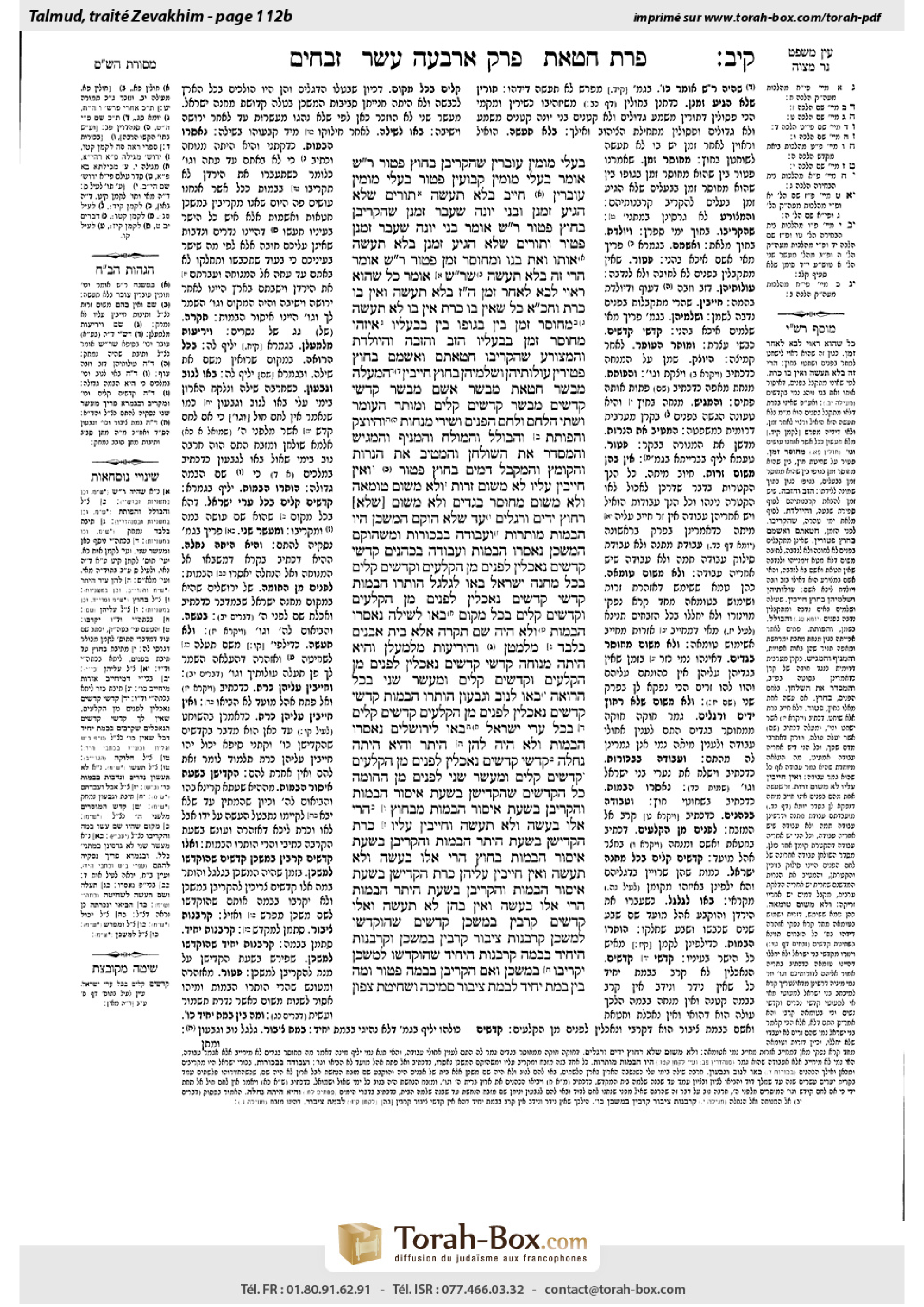
Zevachim 112b: Talmud study for Daf Yomi
Daf Yomi is the daily study of one Talmud folio. Explore 37 tractates with scans, Hebrew text, Sefaria English and AI-generated French translations where annotated.
Passage selection and English or AI-generated French translation are available where the scan has annotations. Daf Study is independent of Torah-Box and Sefaria.
Browse Zevachim · זבחים · All tractatesZevachim 112b text and translations
This page of Zevachim includes the Aramaic text, an English translation and an AI-generated French translation, alongside the scan above.
זבחים קי״ב ב · Aramaic and Hebrew text
בַּעֲלֵי מוּמִין עוֹבְרִין; שֶׁהִקְרִיבָן בַּחוּץ – פָּטוּר. רַבִּי שִׁמְעוֹן אוֹמֵר: בַּעֲלֵי מוּמִין קְבוּעִין – פָּטוּר, בַּעֲלֵי מוּמִין עוֹבְרִין – חַיָּיב בְּלֹא תַעֲשֶׂה.
תּוֹרִים שֶׁלֹּא הִגִּיעַ זְמַנָּן, וּבְנֵי יוֹנָה שֶׁעָבַר זְמַנָּן, שֶׁהִקְרִיבָן בַּחוּץ – פָּטוּר. רַבִּי שִׁמְעוֹן אוֹמֵר: בְּנֵי יוֹנָה שֶׁעָבַר זְמַנָּן – פָּטוּר, וְתוֹרִים שֶׁלֹּא הִגִּיעַ זְמַנָּן – בְּלֹא תַעֲשֶׂה.
אוֹתוֹ וְאֶת בְּנוֹ וּמְחוּסַּר זְמַן – פָּטוּר. רַבִּי שִׁמְעוֹן אוֹמֵר: הֲרֵי זֶה בְּלֹא תַעֲשֶׂה; שֶׁרַבִּי שִׁמְעוֹן אוֹמֵר: כׇּל שֶׁהוּא רָאוּי לָבֹא לְאַחַר זְמַן – הֲרֵי זֶה בְּלֹא תַּעֲשֶׂה וְאֵין בּוֹ כָּרֵת. וַחֲכָמִים אוֹמְרִים: כֹּל שֶׁאֵין בּוֹ כָּרֵת – אֵין בּוֹ לֹא תַעֲשֶׂה.
מְחוּסַּר זְמַן – בֵּין בְּגוּפוֹ, בֵּין בִּבְעָלָיו.
אֵיזֶהוּ מְחוּסַּר זְמַן בִּבְעָלָיו? הַזָּב וְהַזָּבָה וְהַיּוֹלֶדֶת וְהַמְּצוֹרָע, שֶׁהִקְרִיבוּ חַטָּאתָם וַאֲשָׁמָם בַּחוּץ – פְּטוּרִין. עוֹלוֹתֵיהֶן וְשַׁלְמֵיהֶן בַּחוּץ – חַיָּיבִין.
הַמַּעֲלֶה מִבְּשַׂר חַטָּאת, מִבְּשַׂר אָשָׁם, מִבְּשַׂר קׇדְשֵׁי קָדָשִׁים, מִבְּשַׂר קָדָשִׁים קַלִּים, וּמוֹתַר הָעוֹמֶר, וּשְׁתֵּי הַלֶּחֶם, וְלֶחֶם הַפָּנִים, וּשְׁיָרֵי מְנָחוֹת;
וְהַיּוֹצֵק, וְהַפּוֹתֵת, וְהַבּוֹלֵל, וְהַמּוֹלֵחַ, וְהַמֵּנִיף, וְהַמַּגִּישׁ; וְהַמְסַדֵּר אֶת הַשּׁוּלְחָן, וְהַמֵּטִיב אֶת הַנֵּרוֹת, וְהַקּוֹמֵץ, וְהַמְקַבֵּל דָּמִים בַּחוּץ – פָּטוּר.
וְאֵין חַיָּיבִין עָלָיו לֹא מִשּׁוּם זָרוּת, וְלֹא מִשּׁוּם טוּמְאָה, וְלֹא מִשּׁוּם מְחוּסַּר בְּגָדִים, וְלֹא מִשּׁוּם [שֶׁלֹּא] רְחוּץ יָדַיִם וְרַגְלַיִם.
עַד שֶׁלֹּא הוּקַם הַמִּשְׁכָּן – הָיוּ הַבָּמוֹת מוּתָּרוֹת, וַעֲבוֹדָה בִּבְכוֹרוֹת; וּמִשֶּׁהוּקַם הַמִּשְׁכָּן – נֶאֶסְרוּ הַבָּמוֹת, וַעֲבוֹדָה בַּכֹּהֲנִים. קׇדְשֵׁי קֳדָשִׁים נֶאֱכָלִין לִפְנִים מִן הַקְּלָעִים, וְקָדָשִׁים קַלִּים בְּכׇל מַחֲנֵה יִשְׂרָאֵל. בָּאוּ לַגִּלְגָּל – הוּתְּרוּ הַבָּמוֹת; קׇדְשֵׁי קֳדָשִׁים נֶאֱכָלִין לִפְנִים מִן הַקְּלָעִים, וְקָדָשִׁים קַלִּים בְּכׇל מָקוֹם.
בָּאוּ לְשִׁילֹה – נֶאֶסְרוּ הַבָּמוֹת. וְלֹא הָיָה שָׁם תִּקְרָה; אֶלָּא בֵּית אֲבָנִים בִּלְבָד מִלְּמַטָּן, וְהַיְּרִיעוֹת מִלְּמַעְלָן; וְהִיא הָיְתָה ״מְנוּחָה״. קׇדְשֵׁי קֳדָשִׁים נֶאֱכָלִין לִפְנִים מִן הַקְּלָעִים, וְקָדָשִׁים קַלִּים וּמַעֲשֵׂר שֵׁנִי בְּכׇל הָרוֹאֶה.
בָּאוּ לְנוֹב וְגִבְעוֹן – הוּתְּרוּ הַבָּמוֹת. קׇדְשֵׁי קֳדָשִׁים נֶאֱכָלִין לִפְנִים מִן הַקְּלָעִים, וְקָדָשִׁים קַלִּים בְּכׇל עָרֵי יִשְׂרָאֵל.
בָּאוּ לִירוּשָׁלַיִם – נֶאֶסְרוּ הַבָּמוֹת וְלֹא הָיָה לָהֶן הֶיתֵּר, וְהִיא הָיְתָה ״נַחֲלָה״. קׇדְשֵׁי קֳדָשִׁים נֶאֱכָלִין לִפְנִים מִן הַקְּלָעִים, קָדָשִׁים קַלִּים וּמַעֲשֵׂר שֵׁנִי לִפְנִים מִן הַחוֹמָה.
כׇּל הַקֳּדָשִׁים שֶׁהִקְדִּישָׁן בִּשְׁעַת אִיסּוּר הַבָּמוֹת, וְהִקְרִיבָן בִּשְׁעַת אִיסּוּר הַבָּמוֹת מִבַּחוּץ – הֲרֵי אֵלּוּ בַּעֲשֵׂה וְלֹא תַעֲשֶׂה, וְחַיָּיבִין עָלָיו כָּרֵת.
הִקְדִּישָׁן בִּשְׁעַת הֶיתֵּר הַבָּמוֹת, וְהִקְרִיבָן בִּשְׁעַת אִיסּוּר הַבָּמוֹת בַּחוּץ – הֲרֵי אֵלּוּ בַּעֲשֵׂה וְלֹא תַעֲשֶׂה, וְאֵין חַיָּיבִין עֲלֵיהֶן כָּרֵת. הִקְדִּישָׁן בִּשְׁעַת אִיסּוּר הַבָּמוֹת, וְהִקְרִיבָן בִּשְׁעַת הֶיתֵּר הַבָּמוֹת – הֲרֵי אֵלּוּ בַּעֲשֵׂה, וְאֵין בָּהֶן לֹא תַעֲשֶׂה.
וְאֵלּוּ קָדָשִׁים קְרֵבִין בַּמִּשְׁכָּן: קָדָשִׁים שֶׁהוּקְדְּשׁוּ לְמִשְׁכָּן, קׇרְבְּנוֹת צִיבּוּר קְרֵבִין בַּמִּשְׁכָּן, וְקׇרְבְּנוֹת הַיָּחִיד בְּבָמָה. קׇרְבְּנוֹת הַיָּחִיד שֶׁהוּקְדְּשׁוּ לַמִּשְׁכָּן – יַקְרִיבוּ בַּמִּשְׁכָּן, וְאִם הִקְרִיבָן בְּבָמָה – פָּטוּר.
וּמָה בֵּין בָּמַת יָחִיד לְבָמַת צִיבּוּר? סְמִיכָה, וּשְׁחִיטַת צָפוֹן,
Zevachim 112b · English translation
temporarily blemished, which one sacrificed outside the Temple courtyard, one is exempt. Rabbi Shimon says: For permanently blemished animals one is exempt; for temporarily blemished animals one is liable for violation of a prohibition, but it is not the type of prohibition for which he will receive karet, because ultimately the animal will be fit for sacrifice.
With regard to doves whose time of fitness for sacrifice has not arrived, as they are fit for sacrifice only when they are older, after their wings assume a golden hue; and pigeons whose time of fitness has passed, as they are fit only when they are young and their wings did not yet assume a yellowish tint, that one sacrificed outside the Temple courtyard, he is exempt. Rabbi Shimon says: For pigeons whose time of fitness has passed one is exempt, and for doves whose time of fitness has not yet arrived he is in violation of a prohibition.
With regard to an animal itself and its offspring that were slaughtered on the same day, where one violates a prohibition for slaughtering the second, and an animal whose time has not yet arrived, if one sacrificed it outside the Temple courtyard he is exempt. Rabbi Shimon says: For an animal whose time has not yet arrived, that person is in violation of a mere prohibition, as Rabbi Shimon says: With regard to any sacrificial animal that is fit to come and be sacrificed after the passage of time, if one sacrificed it outside the courtyard, that person is in violation of a prohibition but there is no liability for karet. And the Rabbis say: In any case in which there is no liability for karet there is no violation of a prohibition.
The mishna adds: An animal is defined as one whose time has not yet arrived, whether it is intrinsically premature, e.g., doves whose wings have not yet assumed a golden hue or an animal less than seven days old (see Leviticus 22:27), or whether it is premature for its owner.
Which is the animal whose time has not yet arrived because it is premature for its owner? It is the animal of a man who experiences a gonorrhea-like discharge [zav], and a woman who experiences a discharge of uterine blood after her menstrual period [zava], and a woman after childbirth, and a leper whose period of impurity is not yet complete, where these owners, who are ritually impure, sacrificed their sin offerings or guilt offerings outside the Temple courtyard. In this case they are exempt, as they are neither obligated nor permitted to bring those offerings. But if they sacrificed their burnt offerings or their peace offerings outside the courtyard they are liable, as those offerings may be brought as gift offerings even if their owner is ritually impure.
One who offers up outside the Temple courtyard a portion of the meat of a sin offering that is eaten; of the meat of a guilt offering; of the meat of other offerings of the most sacred order that are eaten, e.g., the sheep sacrificed on the festival of Shavuot, or of the meat of offerings of lesser sanctity, is exempt, as all these are eaten by the priests and not sacrificed on the altar. And for the same reason, one who sacrificed a portion of the surplus of the omer offering, a measure of barley brought as a communal offering on the sixteenth of the Hebrew month of Nisan, after the handful was removed; or the two loaves, i.e., the public offering on Shavuot of two loaves from the new wheat; or the shewbread arranged on the Table each Shabbat in the Sanctuary; or the remainder of meal offerings, is also exempt.
And likewise with regard to one who pours oil onto a meal offering; and one who breaks the loaves of a meal offering into pieces; and one who mixes oil into the flour of a meal offering; and one who salts a meal offering or other offerings; and one who waves a meal offering; and one who brings a meal offering to the corner of an altar, if he performs these actions outside the courtyard; and one who arranges shewbread on the table outside the Sanctuary; and one who removes the ashes from the lamps of the Candelabrum; and one who removes a handful from a meal offering; and one who collects the blood of an offering in a vessel, if he did so outside the Temple courtyard: In all of these cases he is exempt. This is because one is liable only if he performs an action similar to sacrifice that completes the sacrificial service, while all of these actions are ones that are normally followed by additional sacrificial rites.
And one is likewise not liable for any of these actions, neither due to the prohibition against a non-priest performing the Temple service, nor due to the prohibition against performing the Temple service in a state of ritual impurity, nor due to the prohibition against a priest lacking the requisite priestly vestments while performing the Temple service, nor due to the prohibition against performing the Temple service without washing one’s hands and feet.
Until the Tabernacle was established, private altars were permitted and the sacrificial service was performed by the firstborn. And from the time that the Tabernacle was established, private altars were prohibited and the sacrificial service was performed by the priests. Offerings of the most sacred order were then eaten within the curtains surrounding the courtyard of the Tabernacle in the wilderness and offerings of lesser sanctity were eaten throughout the camp of Israel. When the Jewish people arrived at Gilgal private altars were permitted, offerings of the most sacred order were then eaten within the curtains, and offerings of lesser sanctity were eaten anywhere.
When they arrived at Shiloh, private altars were prohibited. And there was no roof of wood or stone there, i.e., in the Tabernacle in Shiloh; rather there was only a building of stone below and the curtains of the roof of the Tabernacle were spread above it. And the period that the Tabernacle was in Shiloh was characterized in the Torah as “rest” in the verse: “For you have not as yet come to the rest and to the inheritance, which the Lord your God has given you” (Deuteronomy 12:9). Offerings of the most sacred order were then eaten within the curtains in the courtyard of the Tent of Meeting, and offerings of lesser sanctity and second tithe were eaten in any place that overlooks Shiloh.
When Shiloh was destroyed (see I Samuel 4:18), the Jewish people arrived with the Tabernacle at Nov, and later at Gibeon, and private altars were permitted. Offerings of the most sacred order were then eaten within the curtains in the courtyard of the Tent of Meeting, and offerings of lesser sanctity were eaten in all the cities of Eretz Yisrael.
When the Jewish people arrived at Jerusalem and built the Temple during the reign of Solomon, private altars were prohibited, and private altars did not have a subsequent period when they were permitted. And the Temple in Jerusalem was characterized as “inheritance” in the verse: “For you have not as yet come to the rest and to the inheritance, which the Lord your God has given you.” Offerings of the most sacred order were then eaten within the curtains, i.e., in the Temple courtyard, and offerings of lesser sanctity and second tithe were eaten within the walls of the city, whose legal status was that of the Israelite camp in the wilderness.
With regard to all offerings that one consecrated during a period of prohibition of private altars and sacrificed during a period of prohibition of private altars, if he sacrificed them outside their designated area, for these animals he is in violation of both the positive mitzva to sacrifice the offering in the place chosen by God and the prohibition against sacrificing them on a private altar, and he is liable to receive karet for doing it.
If one consecrated the animals during a period of permitting of private altars and sacrificed them during a period of prohibition of private altars, outside their designated area, for these animals he is in violation of a positive mitzva and a prohibition, but he is not liable to receive karet for sacrificing them. If he consecrated the animals during a period of prohibition of private altars and sacrificed them during a period of permitting of private altars, outside their designated area, for these animals he is in violation of a positive mitzva for failure to bring it to the Tabernacle, but these animals are not subject to a prohibition, as it is permitted to sacrifice on a private altar.
And these are the sacrificial items that are sacrificed only in the Tabernacle even when private altars are permitted: Sacrificial animals that were presumed to be consecrated for sacrifice in the Tabernacle. Therefore, communal offerings are sacrificed in the Tabernacle, but offerings of an individual may be sacrificed on a private altar. In addition, with regard to offerings of an individual that were consecrated expressly for sacrifice in the Tabernacle, one must sacrifice them in the Tabernacle. But if he sacrificed them on a private altar, he is exempt.
And what is the difference between the private altar of an individual and the public altar at the site of the Tabernacle when it was located in Gilgal, Nov, and Gibeon? It is that on a private altar there is no placing of hands on the head of an offering, no slaughter in the north,
Zevachim 112b · Traduction française (IA)
Pour un animal atteint d’un défaut temporaire, si on l’a sacrifié à l’extérieur du parvis du Temple, on est exempt. Rabbi Shimon dit : pour les animaux atteints d’un défaut permanent, on est exempt ; pour ceux qui sont atteints d’un défaut temporaire, on transgresse une interdiction, mais il ne s’agit pas d’une interdiction passible de karet, car l’animal sera finalement apte au sacrifice.
Pour les tourterelles dont le moment d’aptitude au sacrifice n’est pas encore arrivé, puisqu’elles ne sont aptes au sacrifice que lorsqu’elles sont plus âgées, après que leurs ailes ont pris une teinte dorée, et pour les pigeons dont la période d’aptitude est passée, puisqu’ils ne sont aptes que lorsqu’ils sont jeunes et que leurs ailes n’ont pas encore pris une teinte jaunâtre, si on les a sacrifiés à l’extérieur du parvis du Temple, on est exempt. Rabbi Shimon dit : pour les pigeons dont la période d’aptitude est passée, on est exempt, et pour les tourterelles dont le moment d’aptitude n’est pas encore arrivé, on transgresse une interdiction.
Pour un animal et son petit abattus le même jour — cas où l’on transgresse une interdiction en abattant le second — et pour un animal dont le moment d’aptitude n’est pas encore arrivé, si on l’a sacrifié à l’extérieur du parvis du Temple, on est exempt. Rabbi Shimon dit : dans le cas d’un animal dont le moment d’aptitude n’est pas encore arrivé, on transgresse une simple interdiction, car Rabbi Shimon dit : pour tout animal consacré qui sera apte à être apporté et sacrifié une fois le délai écoulé, si on l’a sacrifié à l’extérieur du parvis, on transgresse une interdiction, mais on n’encourt pas le karet. Les Sages disent : dans tous les cas où l’on n’encourt pas le karet, on ne transgresse aucune interdiction.
La Michna précise qu’est considéré comme un animal dont le moment d’aptitude n’est pas encore arrivé aussi bien celui qui est prématuré par nature — par exemple les tourterelles dont les ailes n’ont pas encore pris une teinte dorée ou un animal âgé de moins de sept jours (voir Lévitique 22,27) — que celui qui est prématuré du point de vue de son propriétaire.
Quel est l’animal dont le moment d’aptitude n’est pas encore arrivé parce qu’il est prématuré du point de vue de son propriétaire ? C’est l’animal appartenant à un homme qui souffre d’un écoulement semblable à la gonorrhée [zav], à une femme qui a des pertes de sang utérin après sa période menstruelle [zava], à une femme après un accouchement ou à un lépreux dont la période d’impureté n’est pas encore achevée, lorsque ces propriétaires, rituellement impurs, ont sacrifié leurs sacrifices expiatoires ou leurs sacrifices de culpabilité à l’extérieur du parvis du Temple. Dans ce cas, ils sont exempts, car ils ne sont ni tenus ni autorisés à apporter ces sacrifices. Mais s’ils ont sacrifié leurs holocaustes ou leurs sacrifices de paix à l’extérieur du parvis, ils sont passibles, car ces sacrifices peuvent être apportés comme offrandes volontaires, même lorsque leur propriétaire est rituellement impur.
Celui qui offre à l’extérieur du parvis du Temple une partie de la viande destinée à être consommée d’un sacrifice expiatoire, de la viande d’un sacrifice de culpabilité, de la viande d’autres sacrifices de sainteté suprême destinés à être consommés — par exemple les moutons sacrifiés lors de la fête de Chavouot — ou de la viande de sacrifices de moindre sainteté, est exempt, car tous ces sacrifices sont consommés par les prêtres et non brûlés sur l’autel. Pour la même raison, celui qui offre une partie du reste de l’offrande de l’omer — mesure d’orge apportée comme offrande communautaire le seize du mois hébraïque de Nissan, après qu’on en a prélevé la poignée —, ou les deux pains, c’est-à-dire l’offrande publique de Chavouot constituée de deux pains de blé nouveau, ou les pains de proposition disposés sur la Table chaque Chabbat dans le Sanctuaire, ou le reste des offrandes de farine, est également exempt.
De même, celui qui verse de l’huile sur une offrande de farine ; celui qui rompt les pains d’une offrande de farine en morceaux ; celui qui mélange de l’huile à la farine d’une offrande de farine ; celui qui sale une offrande de farine ou d’autres sacrifices ; celui qui balance une offrande de farine ; celui qui porte une offrande de farine à l’angle d’un autel, s’il accomplit ces actes à l’extérieur du parvis ; celui qui dispose les pains de proposition sur la Table à l’extérieur du Sanctuaire ; celui qui retire les cendres des lampes du Candélabre ; celui qui prélève une poignée d’une offrande de farine ; et celui qui recueille le sang d’un sacrifice dans un récipient, s’il le fait à l’extérieur du parvis du Temple : dans tous ces cas, il est exempt. En effet, on n’est passible que si l’on accomplit un acte comparable au sacrifice et qui achève le service sacrificiel, alors que chacun de ces actes est normalement suivi d’autres rites sacrificiels.
De même, on n’est passible pour aucun de ces actes, ni au titre de l’interdiction faite à un non-prêtre d’accomplir le service du Temple, ni au titre de l’interdiction d’accomplir ce service en état d’impureté rituelle, ni au titre de l’interdiction faite à un prêtre d’accomplir ce service sans les vêtements sacerdotaux requis, ni au titre de l’interdiction de l’accomplir sans s’être lavé les mains et les pieds.
Jusqu’à l’établissement du Tabernacle, les autels privés étaient autorisés et le service sacrificiel était accompli par les premiers-nés. À partir de l’établissement du Tabernacle, les autels privés furent interdits et le service sacrificiel fut accompli par les prêtres. Les sacrifices de sainteté suprême étaient alors consommés à l’intérieur des tentures entourant le parvis du Tabernacle dans le désert, et les sacrifices de moindre sainteté étaient consommés dans tout le camp d’Israël. Lorsque le peuple juif arriva à Guilgal, les autels privés furent autorisés ; les sacrifices de sainteté suprême étaient alors consommés à l’intérieur des tentures, et les sacrifices de moindre sainteté étaient consommés n’importe où.
Lorsqu’ils arrivèrent à Shilo, les autels privés furent interdits. Il n’y avait là aucun toit de bois ou de pierre, c’est-à-dire dans le Tabernacle de Shilo ; il n’y avait qu’un édifice de pierre dans sa partie inférieure, au-dessus duquel étaient tendues les tentures du toit du Tabernacle. Dans la Torah, la période où le Tabernacle se trouvait à Shilo est désignée comme un « repos », dans le verset : « Car vous n’êtes pas encore arrivés au repos et à l’héritage que l’Éternel, votre Dieu, vous a donnés » (Deutéronome 12,9). Les sacrifices de sainteté suprême étaient alors consommés à l’intérieur des tentures, dans le parvis de la Tente d’assignation, et les sacrifices de moindre sainteté ainsi que la seconde dîme étaient consommés en tout lieu d’où l’on pouvait voir Shilo.
Lorsque Shilo fut détruite (voir I Samuel 4,18), le peuple juif arriva avec le Tabernacle à Nov, puis à Gabaon, et les autels privés furent autorisés. Les sacrifices de sainteté suprême étaient alors consommés à l’intérieur des tentures, dans le parvis de la Tente d’assignation, et les sacrifices de moindre sainteté étaient consommés dans toutes les villes d’Eretz Israël.
Lorsque le peuple juif arriva à Jérusalem et y construisit le Temple sous le règne de Salomon, les autels privés furent interdits, et aucune période ultérieure ne les autorisa de nouveau. Dans le verset, le Temple de Jérusalem est désigné comme un « héritage » : « Car vous n’êtes pas encore arrivés au repos et à l’héritage que l’Éternel, votre Dieu, vous a donnés. » Les sacrifices de sainteté suprême étaient alors consommés à l’intérieur des tentures, c’est-à-dire dans le parvis du Temple, tandis que les sacrifices de moindre sainteté et la seconde dîme étaient consommés à l’intérieur des murs de la ville, dont le statut juridique correspondait à celui du camp israélite dans le désert.
Pour tous les sacrifices consacrés pendant une période où les autels privés étaient interdits et sacrifiés pendant une période où ils étaient interdits, si on les a sacrifiés en dehors de l’endroit qui leur était assigné, on transgresse, pour ces animaux, à la fois la mitsva positive de sacrifier l’offrande dans le lieu choisi par Dieu et l’interdiction de la sacrifier sur un autel privé, et l’on encourt le karet pour l’avoir fait.
Si l’on a consacré les animaux pendant une période où les autels privés étaient autorisés, puis qu’on les a sacrifiés pendant une période où ils étaient interdits, en dehors de l’endroit qui leur était assigné, on transgresse, pour ces animaux, une mitsva positive et une interdiction, mais on n’encourt pas le karet pour les avoir sacrifiés. Si l’on a consacré les animaux pendant une période où les autels privés étaient interdits, puis qu’on les a sacrifiés pendant une période où ils étaient autorisés, en dehors de l’endroit qui leur était assigné, on transgresse, pour ces animaux, une mitsva positive en ne les apportant pas au Tabernacle, mais ils ne sont soumis à aucune interdiction, puisqu’il est permis de sacrifier sur un autel privé.
Voici les objets sacrificiels qui ne peuvent être sacrifiés qu’au Tabernacle, même lorsque les autels privés sont autorisés : les animaux sacrificiels que l’on présume avoir été consacrés pour être sacrifiés au Tabernacle. Ainsi, les sacrifices communautaires sont sacrifiés au Tabernacle, tandis que les sacrifices d’un particulier peuvent être sacrifiés sur un autel privé. De plus, les sacrifices d’un particulier consacrés expressément pour être sacrifiés au Tabernacle doivent y être sacrifiés. Mais si on les a sacrifiés sur un autel privé, on est exempt.
Et quelle est la différence entre l’autel privé d’un particulier et l’autel public du lieu où se trouvait le Tabernacle, à Guilgal, à Nov et à Gabaon ? Sur un autel privé, il n’y a ni imposition des mains sur la tête d’un sacrifice ni abattage du côté nord,
Traduction française générée par IA à partir de l’édition anglaise de Sefaria. Vérifie toujours un passage avec le texte source.
Text from Sefaria: William Davidson Edition - Vocalized Aramaic (CC BY NC); William Davidson Edition - English (CC BY NC).