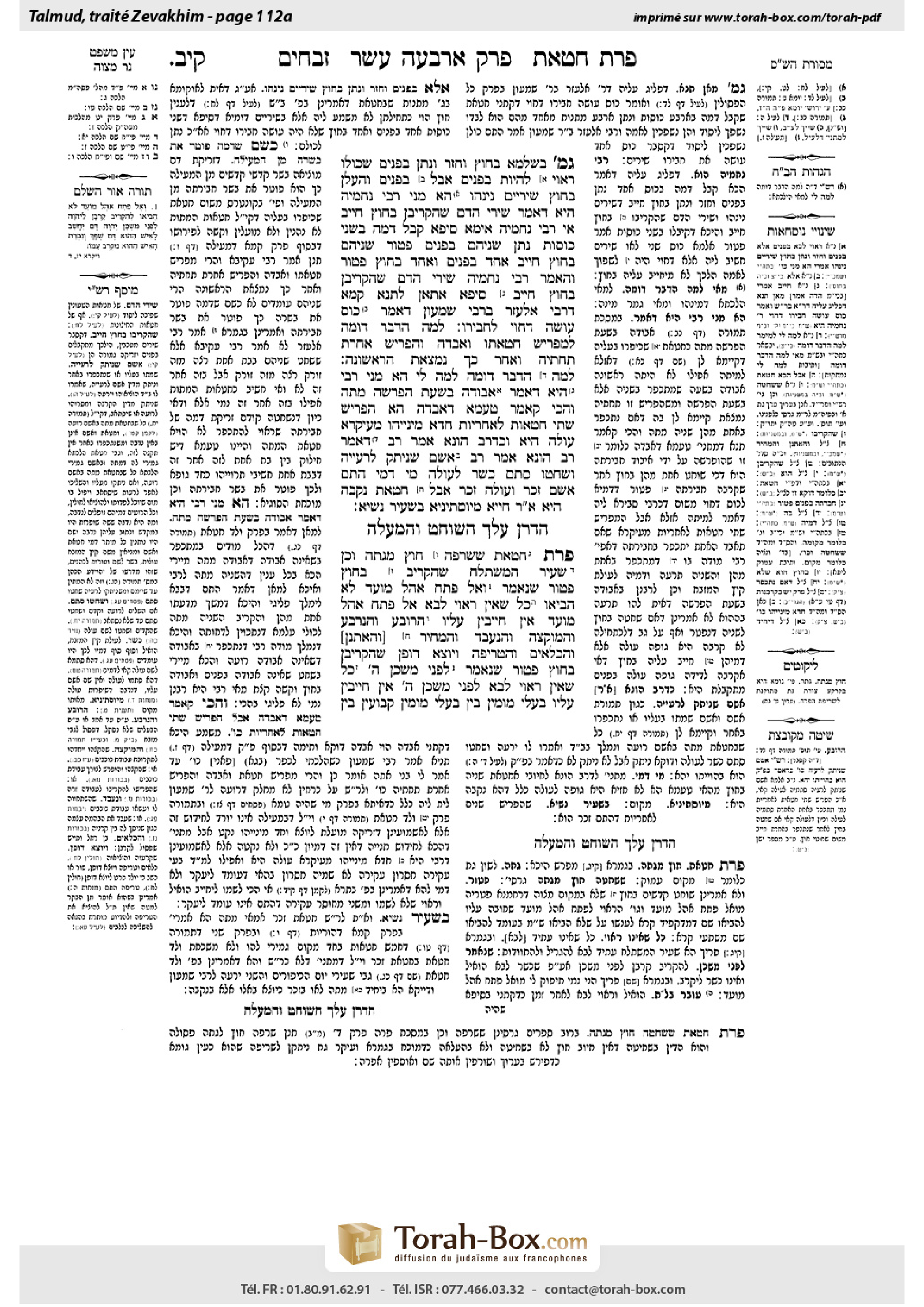
Zevachim 112a: Talmud study for Daf Yomi
Daf Yomi is the daily study of one Talmud folio. Explore 37 tractates with scans, Hebrew text, Sefaria English and AI-generated French translations where annotated.
Passage selection and English or AI-generated French translation are available where the scan has annotations. Daf Study is independent of Torah-Box and Sefaria.
Browse Zevachim · זבחים · All tractatesZevachim 112a text and translations
This page of Zevachim includes the Aramaic text, an English translation and an AI-generated French translation, alongside the scan above.
זבחים קי״ב א · Aramaic and Hebrew text
גְּמָ׳ בִּשְׁלָמָא בַּחוּץ וְחָזַר וְנָתַן בִּפְנִים – שֶׁכּוּלּוֹ רָאוּי לִהְיוֹת בִּפְנִים; אֲבָל בִּפְנִים וְהֶעֱלָן בַּחוּץ – שִׁירַיִים נִינְהוּ!
הָא מַנִּי – רַבִּי נְחֶמְיָה הִיא, דְּאָמַר: שְׁיָרֵי הַדָּם שֶׁהִקְרִיבָן בַּחוּץ – חַיָּיב.
אִי רַבִּי נְחֶמְיָה, אֵימָא סֵיפָא: קִבֵּל דָּמָהּ בִּשְׁנֵי כּוֹסוֹת; נָתַן שְׁנֵיהֶם בִּפְנִים – פָּטוּר. שְׁנֵיהֶם בַּחוּץ – חַיָּיב. אֶחָד בִּפְנִים וְאֶחָד בַּחוּץ – פָּטוּר. וְהָאָמַר רַבִּי נְחֶמְיָה: שְׁיָרֵי הַדָּם שֶׁהִקְרִיבָן בַּחוּץ – חַיָּיב!
סֵיפָא אֲתָאן לְתַנָּא קַמָּא דְּרַבִּי אֶלְעָזָר בְּרַבִּי שִׁמְעוֹן, דְּאָמַר: כּוֹס עוֹשֶׂה דָּחוּי לַחֲבֵירוֹ.
לְמָה הַדָּבָר דּוֹמֶה? לְמַפְרִישׁ חַטָּאתוֹ וְאָבְדָה, וְהִפְרִישׁ אַחֶרֶת תַּחְתֶּיהָ, וְאַחַר כָּךְ נִמְצֵאת הָרִאשׁוֹנָה.
״לְמָה הַדָּבָר דּוֹמֶה״ לְמָה לִי? הָא מַנִּי – רַבִּי הִיא; דְּאָמַר: אֲבוּדָה בִּשְׁעַת הַפְרָשָׁה – מֵתָה.
וְהָכִי קָאָמַר: טַעְמָא דְּאָבְדָה; הָא הִפְרִישׁ שְׁתֵּי חַטָּאוֹת לְאַחְרָיוּת – חֲדָא מִינַּיְיהוּ מֵעִיקָּרָא עוֹלָה הִיא.
וְכִדְרַב הוּנָא אָמַר רַב, דְּאָמַר רַב הוּנָא אָמַר רַב: אָשָׁם שֶׁנִּיתַּק לִרְעִיָּיה, וּשְׁחָטוֹ סְתָם – כָּשֵׁר לְעוֹלָה.
מִי דָּמֵי?! הָתָם אָשָׁם זָכָר, וְעוֹלָה זָכָר; אֲבָל חַטָּאת – נְקֵבָה הִיא! אָמַר רַב חִיָּיא מִיּוֹסְתִּינְיָא: בִּשְׂעִיר נָשִׂיא.
הֲדַרַן עֲלָךְ הַשּׁוֹחֵט וְהַמַּעֲלֶה
מַתְנִי׳ פָּרַת חַטָּאת שֶׁשְּׂרָפָהּ חוּץ מִגִּתָּהּ, וְכֵן שָׂעִיר הַמִּשְׁתַּלֵּחַ שֶׁהִקְרִיב בַּחוּץ – פָּטוּר.
שֶׁנֶּאֱמַר: ״וְאֶל פֶּתַח אֹהֶל מוֹעֵד לֹא הֱבִיאוֹ״ – כֹּל שֶׁאֵין רָאוּי לָבֹא אֶל פֶּתַח אֹהֶל מוֹעֵד, אֵין חַיָּיבִין עָלָיו.
הָרוֹבֵעַ, וְהַנִּרְבָּע, וְהַמּוּקְצֶה, וְהַנֶּעֱבָד, וְהַמְּחִיר, [וְהָאֶתְנַן], וְהַכִּלְאַיִם, וְהַטְּרֵיפָה, וְיוֹצֵא דּוֹפֶן; שֶׁהִקְרִיבָן בַּחוּץ – פָּטוּר.
שֶׁנֶּאֱמַר: ״לִפְנֵי מִשְׁכַּן ה׳״ – כֹּל שֶׁאֵין רָאוּי לָבֹא לִפְנֵי מִשְׁכַּן ה׳, אֵין חַיָּיבִין עָלָיו.
בַּעֲלֵי מוּמִין – בֵּין בַּעֲלֵי מוּמִין קְבוּעִין, בֵּין
Zevachim 112a · English translation
GEMARA: The Gemara discusses the first clause of the mishna: Granted that one is liable in a case where he first placed the blood on an altar outside the courtyard and then placed the remaining blood on the altar inside the courtyard; that is because, as the mishna explains: As the blood in its entirety is fit to be placed inside the courtyard. But in a case where he first placed its blood on the altar inside the courtyard and then offered up the remaining blood on an altar outside the courtyard, why he is liable? That blood is merely a remainder, and one should not be liable for offering it up outside.
The Gemara explains: In accordance with whose opinion is this mishna? It is in accordance with the opinion of Rabbi Neḥemya, who says: For the remainder of the blood of an offering that was supposed to be poured at the base of the altar and that instead one sacrificed outside the courtyard, one is liable.
The Gemara asks: If the mishna is in accordance with the opinion of Rabbi Neḥemya, then say the latter clause: If one collected its blood in two cups and placed the blood from both of them on the altar inside the courtyard, he is exempt. If he placed the blood from both of them on an altar outside the courtyard, he is liable. If he first placed the blood from one cup inside and then placed the blood from the other one outside, he is exempt. By using the blood of the first cup to perform the mitzva of placing the blood on the altar, he thereby rendered the blood in the second cup a mere remainder. The Gemara asks: How can this clause be attributed to Rabbi Neḥemya? But doesn’t Rabbi Neḥemya say: For the remainder of the blood of an offering that one offered outside the courtyard, he is liable?
The Gemara answers: In the latter clause we arrive at the opinion of the first tanna, who disagrees with Rabbi Elazar, son of Rabbi Shimon. As that tanna says: The placement of the blood from one cup renders the blood of the other cup as disqualified. Since it is actually disqualified and not merely a remainder, one is not liable for offering it up outside.
§ The mishna presents an analogy for its ruling: To what is this matter comparable? It is comparable to a case where one separated an animal for his sin offering and it was lost, and he separated another animal in its place, and thereafter, the first animal was found.
The Gemara asks: Why do I need to ask: To what is this matter comparable, and provide an analogy to the mishna’s rulings? What does the analogy add? The Gemara explains: In accordance with whose opinion is this mishna? It is in accordance with the opinion of Rabbi Yehuda HaNasi, who says (see Temura 22b): A sin offering that was lost during the time of the separation of a substitute, if it is later found and one of them is slaughtered as the person’s sin offering, the other one is put to death. Accordingly, it is actually disqualified from being used as an offering, and one is therefore not liable for offering it up outside.
And this is what the mishna is saying by presenting its analogy: The reason that one is exempt from liability for offering up the unused sin offering outside is that it was lost at the time its substitute was separated and therefore it is considered disqualified. But if one separated two sin offerings from the outset as a guarantee, so that even if one is lost he can use the other, then if neither is lost and he sacrifices one of them, the other one is not put to death. Rather, it is left to graze until it becomes blemished, at which point it is sold and the proceeds used to purchase a voluntary burnt offering. It emerges that from the outset, one of these two animals, i.e., the one that was not ultimately sacrificed as his sin offering, is a burnt offering, and therefore if one offers it up outside the courtyard he is liable. The analogy teaches that with regard to blood collected in two cups, if one offers up blood from the unused cup outside, he is exempt only because the blood in that cup is considered disqualified, but he would not be exempt if it was considered a remainder.
And this is in accordance with the statement that Rav Huna says that Rav says, as Rav Huna says that Rav says: A guilt offering that was consigned to grazing per the halakha to leave it to graze if its owner dies or achieves atonement through another guilt offering, and then instead of being left to develop a blemish, at which point it could be sold and the proceeds used to purchase a voluntary burnt offering, one slaughtered it, even with unspecified intent, the animal itself is fit to be sacrificed as a burnt offering. Similarly, the mishna assumes that in any case where an animal is consigned to grazing it is considered fit, and one would be liable for slaughtering it outside the courtyard.
The Gemara asks: Are these cases comparable? There, in Rav’s ruling, it is logical that the animal is considered fit, as a guilt offering is a male animal and a burnt offering is a male animal, so it is possible to bring an animal as the latter even if it had been designated as the former. Therefore, a guilt offering left to graze is still considered fit. But in the mishna’s case, just because the animal is left to graze does not necessarily indicate that it itself is fit to be brought, as a sin offering is a female animal, which can never be brought as a burnt offering. Therefore, it should be considered unfit. Rav Ḥiyya from Yostiniyya said: The ruling of the mishna is with regard to the goat of the Nasi, which is a male sin offering. Therefore, in a case where it is left to graze it is still considered fit, as it can be brought as a burnt offering.
This chapter discussed two distinct prohibitions: That of slaughtering an offering outside the Temple courtyard and that of offering up an offering by placing it upon an altar outside the Temple courtyard. Since they are considered two distinct prohibitions, one is liable even if he performs only one of them, and he is liable twice if he performs both.
MISHNA: With regard to the red heifer of purification that one burned outside its pit, the pit being an excavation on the Mount of Olives opposite the entrance to the Sanctuary designated for its slaughter and its burning, and likewise the scapegoat that one sacrificed outside the Temple courtyard rather than casting it off a cliff as prescribed, he is exempt from punishment for violating the transgression of slaughtering and sacrificing outside the Temple courtyard.
The source for this is as it is stated with regard to slaughter of sacrificial animals outside the courtyard: “Whatever man…that slaughters outside the camp, and to the entrance of the Tent of Meeting he did not bring it, to present it as an offering to the Lord before the Tabernacle of the Lord” (Leviticus 17:3–4). From that verse it is derived: For any offering that is not fit to come to the entrance of the Tent of Meeting for sacrifice on the altar, e.g., the red heifer and the scapegoat, one is not liable for its slaughter and sacrifice outside its place.
With regard to an animal that actively copulated with a person, or an animal that was the object of bestiality, or an animal that was set aside for idol worship, or an animal that was worshipped as a deity, or an animal given as the price of a dog that was purchased, or an animal that was given as payment to a prostitute, or an animal born of a mixture of diverse kinds, or an animal with a wound that will cause it to die within twelve months [tereifa], or an animal born by caesarean section, any of which one sacrificed outside the Temple courtyard, he is exempt.
The source for this is as it is stated: “And to the entrance of the Tent of Meeting he did not bring it to present it as an offering to the Lord before the Tabernacle of the Lord.” From this verse, it is derived: For any animal that is not fit to come to the entrance of the Tent of Meeting for sacrifice on the altar, one is not liable for its slaughter and sacrifice outside the courtyard.
For blemished animals, whether they are permanently blemished or whether they are
Zevachim 112a · Traduction française (IA)
GUEMARA : La Guemara examine la première partie de la Michna : il est compréhensible que l’on soit passible si l’on a d’abord placé le sang sur un autel à l’extérieur du parvis, puis placé le reste du sang sur l’autel à l’intérieur du parvis, car, comme l’explique la Michna, la totalité du sang peut être placée à l’intérieur du parvis. Mais si l’on a d’abord placé le sang sur l’autel à l’intérieur du parvis, puis offert le sang restant sur un autel à l’extérieur du parvis, pourquoi est-on passible ? Ce sang n’est qu’un reste, et l’on ne devrait pas être passible pour l’avoir offert à l’extérieur.
La Guemara explique : De l’avis de qui est cette Michna ? Elle est conforme à l’avis de Rabbi Neḥemya, qui dit : Pour le reste du sang d’une offrande, qui aurait dû être versé à la base de l’autel mais qu’on a offert à l’extérieur du parvis, on est passible.
La Guemara demande : Si la Michna est conforme à l’avis de Rabbi Neḥemya, examinons alors sa dernière partie : si l’on a recueilli le sang de l’offrande dans deux coupes et placé le sang des deux coupes sur l’autel, à l’intérieur du parvis, on est quitte. Si l’on a placé le sang des deux coupes sur un autel à l’extérieur du parvis, on est passible. Si l’on a d’abord placé à l’intérieur le sang d’une coupe, puis à l’extérieur celui de l’autre, on est quitte. En utilisant le sang de la première coupe pour accomplir la mitsva de placer le sang sur l’autel, on a ainsi rendu le sang de la seconde coupe simple reste. La Guemara demande : Comment cette partie peut-elle être attribuée à Rabbi Neḥemya ? Rabbi Neḥemya ne dit-il pas que, pour le reste du sang d’une offrande qu’on a offert à l’extérieur du parvis, on est passible ?
La Guemara répond : Dans la dernière partie, nous en venons à l’avis du premier tanna, qui est en désaccord avec Rabbi Elazar, fils de Rabbi Shimon. Ce tanna dit que le fait de placer le sang d’une coupe rend le sang de l’autre coupe impropre. Puisqu’il est effectivement impropre et non simplement un reste, on n’est pas passible pour l’avoir offert à l’extérieur.
§ La Michna propose une analogie à l’appui de sa décision : À quoi cela ressemble-t-il ? À quelqu’un qui a mis à part un animal pour son sacrifice expiatoire, l’a perdu, puis a mis à part un autre animal à sa place ; par la suite, le premier animal a été retrouvé.
La Guemara demande : Pourquoi faut-il demander : « À quoi cela ressemble-t-il ? » et proposer une analogie avec les décisions de la Michna ? Qu’ajoute cette analogie ? La Guemara explique : De l’avis de qui est cette Michna ? Elle est conforme à l’avis de Rabbi Yehouda HaNassi, qui dit (voir Temoura 22b) : Si un sacrifice expiatoire a été perdu au moment où un substitut a été mis à part, puis qu’on le retrouve et que l’un des deux est abattu comme sacrifice expiatoire de la personne, l’autre doit être mis à mort. Il est donc effectivement impropre à être offert, et l’on n’est par conséquent pas passible pour l’avoir offert à l’extérieur.
Voici ce que la Michna veut dire en proposant son analogie : si l’on n’est pas passible pour avoir offert à l’extérieur le sacrifice expiatoire inutilisé, c’est parce qu’il avait été perdu au moment où son substitut avait été mis à part et qu’il est donc considéré comme impropre. Mais si l’on a mis à part dès le départ deux sacrifices expiatoires à titre de garantie, afin de pouvoir utiliser l’autre si l’un est perdu, alors, si aucun des deux n’est perdu et qu’on en sacrifie un, l’autre n’est pas mis à mort. Il est plutôt laissé à paître jusqu’à ce qu’il devienne porteur d’un défaut ; il est alors vendu et le produit de la vente sert à acheter un holocauste volontaire. Il s’ensuit que, dès le départ, l’un de ces deux animaux, c’est-à-dire celui qui n’a finalement pas été sacrifié comme sacrifice expiatoire de la personne, est destiné à être un holocauste ; par conséquent, si on l’offre à l’extérieur du parvis, on est passible. L’analogie enseigne qu’en ce qui concerne le sang recueilli dans deux coupes, si l’on offre à l’extérieur le sang de la coupe inutilisée, on n’est quitte que parce que le sang de cette coupe est considéré comme impropre ; mais on ne serait pas quitte s’il était considéré comme un reste.
Cela concorde avec l’enseignement que Rav Houna rapporte au nom de Rav, car Rav Houna rapporte au nom de Rav : Un sacrifice de culpabilité destiné à paître conformément à la halakha — c’est-à-dire qu’il doit être laissé à paître si son propriétaire meurt ou obtient l’expiation grâce à un autre sacrifice de culpabilité —, si, au lieu d’être laissé à paître jusqu’à ce qu’il présente un défaut, moment où il pourrait être vendu et le produit de la vente servir à acheter un holocauste volontaire, on l’abat, même sans intention particulière, l’animal lui-même peut être offert comme holocauste. De même, la Michna part du principe que, dans tout cas où un animal est destiné à paître, il est considéré comme apte ; on serait donc passible si on l’abattait à l’extérieur du parvis.
La Guemara demande : Ces cas sont-ils comparables ? Dans le cas de l’enseignement de Rav, il est logique que l’animal soit considéré comme apte, car un sacrifice de culpabilité est un animal mâle, tout comme un holocauste ; il est donc possible d’offrir comme holocauste un animal qui avait été désigné comme sacrifice de culpabilité. Ainsi, un sacrifice de culpabilité laissé à paître est toujours considéré comme apte. Mais dans le cas de la Michna, le fait que l’animal soit laissé à paître n’indique pas nécessairement qu’il soit lui-même apte à être offert, car un sacrifice expiatoire est un animal femelle, qui ne peut jamais être offert comme holocauste. Il devrait donc être considéré comme impropre. Rav Ḥiyya de Yostiniyya a dit : La décision de la Michna concerne le bouc du nasi, qui est un sacrifice expiatoire mâle. Par conséquent, lorsqu’il est laissé à paître, il est toujours considéré comme apte, puisqu’il peut être offert comme holocauste. Ce chapitre a traité de deux interdictions distinctes : celle d’abattre une offrande à l’extérieur du parvis du Temple et celle d’offrir une offrande en la plaçant sur un autel à l’extérieur du parvis du Temple. Puisqu’il s’agit de deux interdictions distinctes, on est passible même si l’on n’en enfreint qu’une seule, et l’on est passible deux fois si l’on enfreint les deux.
MICHNA : Si l’on brûle la vache rousse de purification à l’extérieur de sa fosse — excavation creusée sur le mont des Oliviers, en face de l’entrée du Sanctuaire, et destinée à son abattage et à sa combustion —, et si l’on sacrifie le bouc émissaire à l’extérieur du parvis du Temple au lieu de le précipiter du haut d’une falaise comme prescrit, on n’est pas passible pour avoir enfreint l’interdiction d’abattre et de sacrifier à l’extérieur du parvis du Temple.
La source en est le verset concernant l’abattage des animaux consacrés à l’extérieur du parvis : « Quelque homme […] qui abattra à l’extérieur du camp et ne l’aura pas amené à l’entrée de la Tente d’assignation pour le présenter comme offrande à l’Éternel, devant le Tabernacle de l’Éternel » (Lévitique 17:3–4). On déduit de ce verset que, pour toute offrande qui ne peut pas être amenée à l’entrée de la Tente d’assignation afin d’être sacrifiée sur l’autel — par exemple la vache rousse et le bouc émissaire —, on n’est pas passible pour l’avoir abattue ou sacrifiée hors de son lieu prescrit.
Si l’on sacrifie à l’extérieur du parvis du Temple un animal qui a copulé avec une personne, un animal qui a été l’objet d’une relation sexuelle avec une personne, un animal mis à part pour le culte idolâtre, un animal adoré comme une divinité, un animal donné comme prix d’un chien acheté, un animal donné en paiement à une prostituée, un animal issu d’un croisement d’espèces différentes, un animal atteint d’une blessure qui entraînera sa mort dans les douze mois [tereifa], ou un animal né par césarienne, on est quitte.
La source en est le verset : « Et ne l’aura pas amené à l’entrée de la Tente d’assignation pour le présenter comme offrande à l’Éternel, devant le Tabernacle de l’Éternel. » On déduit de ce verset que, pour tout animal qui ne peut pas être amené à l’entrée de la Tente d’assignation afin d’être sacrifié sur l’autel, on n’est pas passible pour l’avoir abattu ou sacrifié à l’extérieur du parvis.
Pour les animaux présentant un défaut, qu’il s’agisse de défauts permanents ou de
Traduction française générée par IA à partir de l’édition anglaise de Sefaria. Vérifie toujours un passage avec le texte source.
Text from Sefaria: William Davidson Edition - Vocalized Aramaic (CC BY NC); William Davidson Edition - English (CC BY NC).