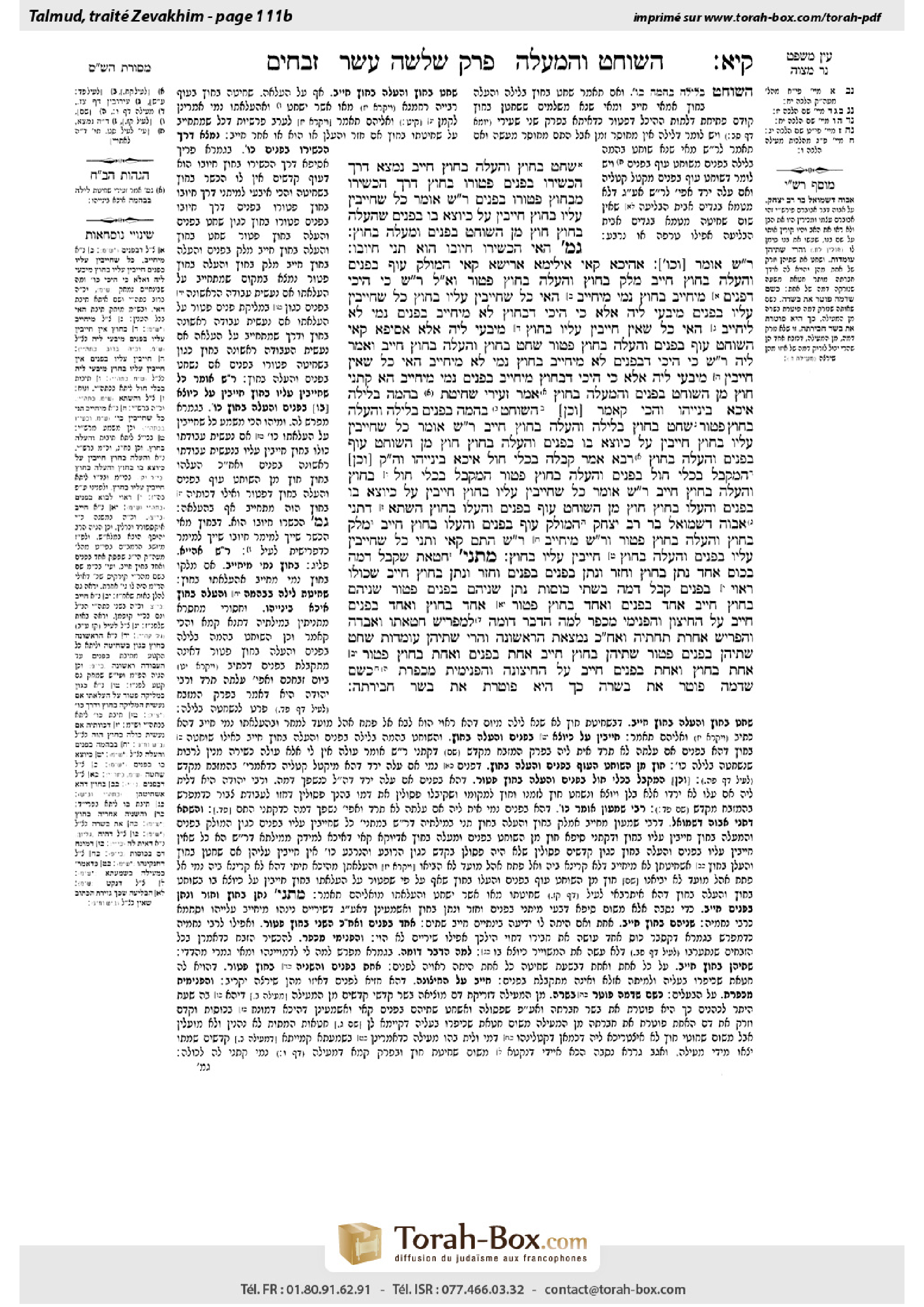
Zevachim 111b: Talmud study for Daf Yomi
Daf Yomi is the daily study of one Talmud folio. Explore 37 tractates with scans, Hebrew text, Sefaria English and AI-generated French translations where annotated.
Passage selection and English or AI-generated French translation are available where the scan has annotations. Daf Study is independent of Torah-Box and Sefaria.
Browse Zevachim · זבחים · All tractatesZevachim 111b text and translations
This page of Zevachim includes the Aramaic text, an English translation and an AI-generated French translation, alongside the scan above.
זבחים קי״א ב · Aramaic and Hebrew text
שָׁחַט בַּחוּץ וְהֶעֱלָה בַּחוּץ – חַיָּיב.
נִמְצָא דֶּרֶךְ הֶכְשֵׁירוֹ בִּפְנִים – פְּטוּרוֹ בַּחוּץ, דֶּרֶךְ הֶכְשֵׁירוֹ מִבַּחוּץ – פְּטוּרוֹ בִּפְנִים.
רַבִּי שִׁמְעוֹן אוֹמֵר: כֹּל שֶׁחַיָּיבִין עָלָיו בַּחוּץ – חַיָּיבִין עַל כַּיּוֹצֵא בּוֹ בִּפְנִים שֶׁהֶעֱלָה בַּחוּץ; חוּץ מִן הַשּׁוֹחֵט בִּפְנִים וּמַעֲלֶה בַּחוּץ.
גְּמָ׳ הַאי ״הֶכְשֵׁירוֹ״?! חִיּוּבוֹ הוּא! תְּנִי ״חִיּוּבוֹ״.
רַבִּי שִׁמְעוֹן אוֹמֵר [וְכוּ׳]. אַהֵיכָא קָאֵי?
אִילֵּימָא אַרֵישָׁא קָאֵי: הַמּוֹלֵק עוֹף בִּפְנִים וְהֶעֱלָה בַּחוּץ – חַיָּיב, מָלַק בַּחוּץ וְהֶעֱלָה בַּחוּץ – פָּטוּר. וַאֲמַר לֵיהּ רַבִּי שִׁמְעוֹן: כִּי הֵיכִי דִּפְנִים מִיחַיַּיב, בַּחוּץ נָמֵי מִיחַיַּיב. הַאי ״כֹּל שֶׁחַיָּיבִין עָלָיו בַּחוּץ״?! ״כֹּל שֶׁחַיָּיבִין עָלָיו בִּפְנִים״ מִיבְּעֵי לֵיהּ!
אֶלָּא כִּי הֵיכִי דִּבְחוּץ לָא מִיחַיַּיב, בִּפְנִים נָמֵי לָא לִיחַיַּיב? הַאי ״כֹּל שֶׁאֵין חַיָּיבִין עָלָיו בַּחוּץ״ מִיבְּעֵי לֵיהּ!
אֶלָּא אַסֵּיפָא קָאֵי: הַשּׁוֹחֵט עוֹף בִּפְנִים וְהֶעֱלָה בַּחוּץ – פָּטוּר. שָׁחַט בַּחוּץ וְהֶעֱלָה בַּחוּץ – חַיָּיב. וַאֲמַר לֵיהּ רַבִּי שִׁמְעוֹן: כִּי הֵיכִי דְּבִפְנִים לָא מִיחַיַּיב, בַּחוּץ נָמֵי לָא מִיחַיַּיב. הַאי ״כֹּל שֶׁאֵין חַיָּיבִין״ מִיבְּעֵי לֵיהּ!
אֶלָּא כִּי הֵיכִי דְּבַחוּץ מִיחַיַּיב, בִּפְנִים נָמֵי מִיחַיַּיב? הָא קָתָנֵי: חוּץ מִן הַשּׁוֹחֵט בִּפְנִים וְהַמַּעֲלֶה בַּחוּץ!
אָמַר זְעֵירִי: שְׁחִיטַת בְּהֵמָה בַּלַּיְלָה אִיכָּא בֵּינַיְיהוּ. וְהָכִי קָאָמַר: [וְכֵן] הַשּׁוֹחֵט בְּהֵמָה בִּפְנִים בַּלַּיְלָה וְהֶעֱלָה בַּחוּץ – פָּטוּר. שָׁחַט בַּחוּץ בַּלַּיְלָה וְהֶעֱלָה בַּחוּץ – חַיָּיב.
רַבִּי שִׁמְעוֹן אוֹמֵר: כֹּל שֶׁחַיָּיבִין עָלָיו בַּחוּץ – חַיָּיבִין עַל כְּיוֹצֵא בּוֹ בִּפְנִים וְהֶעֱלָה בַּחוּץ, חוּץ מִן הַשּׁוֹחֵט עוֹף בִּפְנִים וְהֶעֱלָה בַּחוּץ.
רָבָא אָמַר: קַבָּלָה בִּכְלִי חוֹל אִיכָּא בֵּינַיְיהוּ. וְהָכִי קָאָמַר: [וְכֵן] הַמְקַבֵּל בִּכְלִי חוֹל בִּפְנִים וְהֶעֱלָה בַּחוּץ – פָּטוּר. הַמְקַבֵּל בִּכְלִי חוֹל בַּחוּץ וְהֶעֱלָה בַּחוּץ – חַיָּיב.
רַבִּי שִׁמְעוֹן אוֹמֵר: כֹּל שֶׁחַיָּיבִין עָלָיו בַּחוּץ, חַיָּיבִין עַל כַּיּוֹצֵא בּוֹ בִּפְנִים וְהֶעֱלוֹ בַּחוּץ, חוּץ מִן הַשּׁוֹחֵט עוֹף בִּפְנִים וְהֶעֱלוֹ בַּחוּץ.
הַשְׁתָּא דְּתָנֵי אֲבוּהּ דִּשְׁמוּאֵל בַּר רַב יִצְחָק: הַמּוֹלֵק עוֹף בִּפְנִים וְהֶעֱלוֹ בַּחוּץ – חַיָּיב, מָלַק בַּחוּץ וְהֶעֱלָה בַּחוּץ – פָּטוּר, וְרַבִּי שִׁמְעוֹן מִיחַיַּיב; רַבִּי שִׁמְעוֹן הָתָם קָאֵי – וְתָנֵי: כֹּל שֶׁחַיָּיבִין עָלָיו בִּפְנִים וְהֶעֱלָה בַּחוּץ – חַיָּיבִין עָלָיו בַּחוּץ.
מַתְנִי׳ חַטָּאת שֶׁקִּבֵּל דָּמָהּ בְּכוֹס אֶחָד; נָתַן בַּחוּץ וְחָזַר וְנָתַן בִּפְנִים, בִּפְנִים וְחָזַר וְנָתַן בַּחוּץ – חַיָּיב, שֶׁכּוּלּוֹ רָאוּי בִּפְנִים.
קִבֵּל דָּמָהּ בִּשְׁתֵּי כּוֹסוֹת; נָתַן שְׁנֵיהֶם בִּפְנִים – פָּטוּר. שְׁנֵיהֶם בַּחוּץ – חַיָּיב. אֶחָד בִּפְנִים וְאֶחָד בַּחוּץ – פָּטוּר. אֶחָד בַּחוּץ וְאֶחָד בִּפְנִים – חַיָּיב עַל הַחִיצוֹן, וְהַפְּנִימִי מְכַפֵּר.
לְמָה הַדָּבָר דּוֹמֶה? לְמַפְרִישׁ חַטָּאתוֹ וְאָבְדָה וְהִפְרִישׁ אַחֶרֶת תַּחְתֶּיהָ, וְאַחַר כָּךְ נִמְצֵאת הָרִאשׁוֹנָה, וַהֲרֵי שְׁתֵּיהֶן עוֹמְדוֹת. שָׁחַט שְׁתֵּיהֶן בִּפְנִים – פָּטוּר. שְׁתֵּיהֶן בַּחוּץ – חַיָּיב. אַחַת בִּפְנִים וְאַחַת בַּחוּץ – פָּטוּר. אַחַת בַּחוּץ וְאַחַת בִּפְנִים – חַיָּיב עַל הַחִיצוֹנָה, וְהַפְּנִימִית מְכַפֶּרֶת.
כְּשֵׁם שֶׁדָּמָהּ פּוֹטֵר אֶת בְּשָׂרָהּ, כָּךְ הִיא פּוֹטֶרֶת אֶת בְּשַׂר חֲבֶירְתָּהּ.
Zevachim 111b · English translation
But if one slaughtered a bird offering outside the courtyard and then offered it up outside, he is liable.
Evidently, the manner of its preparation inside the courtyard, i.e., pinching, effects its exemption outside the courtyard, and the manner of its preparation outside the courtyard, i.e., slaughter, effects its exemption inside the courtyard.
Rabbi Shimon says: With regard to any act of killing an animal concerning which, when it was performed outside the courtyard, one is liable for subsequently offering it up outside the courtyard, one is also liable for having offered the animal up outside the courtyard after performing a similar act of killing inside the courtyard. This is the halakha except with regard to one who slaughters a bird inside the courtyard and offers it up outside the courtyard; he is exempt.
GEMARA: In summarizing its rulings the mishna states: The manner of its preparation outside the courtyard effects its exemption inside the courtyard. The Gemara comments: This term: The manner of its preparation, is inappropriate when referring to the slaughter of a bird offering, as a bird offering is not prepared by slaughtering; on the contrary, it is disqualified if slaughtered. The slaughter of a bird offering outside the courtyard is the reason for its liability. The Gemara concedes: Emend the mishna and teach: Its liability.
§ The mishna cites the ruling of Rabbi Shimon: Rabbi Shimon says: With regard to any act of killing an animal concerning which, when it was performed outside the courtyard, one is liable for subsequently offering it up outside the courtyard, one is also liable for having offered the animal up outside the courtyard after performing a similar act of killing inside the courtyard. This is the halakha except with regard to one who slaughters a bird inside the courtyard and offers it up outside the courtyard; he is exempt. The Gemara asks: To what does he refer?
If we say that he is referring to the first clause of the mishna, which states: One who pinches the nape of the bird offering inside and then offers it up outside is liable, but if one pinched its nape outside and then offered it up outside, he is exempt; and it is with the second part of this clause that Rabbi Shimon disagrees and says to the first tanna: Just as one who pinches the nape of a bird offering inside and then offers it up outside is liable, so too one who pinches its nape outside and then offers it up outside is liable, this is difficult. If that is what Rabbi Shimon intended, then instead of saying in the mishna: With regard to any act of killing an animal concerning which, when it was performed outside the courtyard, one is liable for subsequently offering it up outside the courtyard, he should have said: With regard to any act of killing an animal concerning which, when it was performed inside the courtyard, one is liable for subsequently offering it up outside the courtyard, one is also liable for a similar act of killing done outside the courtyard. Evidently, Rabbi Shimon does not disagree with the first tanna on this issue.
Rather, perhaps Rabbi Shimon disagrees with the first part of the first clause and says to the first tanna: Just as one who pinches the nape of a bird offering outside and then offers it up outside is not liable, so too one who pinches its nape inside and then offers it up outside is not liable. The Gemara rejects this: If that is what Rabbi Shimon intended, then he should have said: With regard to any act of killing an animal concerning which, when it was performed outside the courtyard, one is not liable for subsequently offering it up outside the courtyard, one is also not liable for having offered the animal up outside the courtyard after performing a similar act of killing inside the courtyard. Evidently, Rabbi Shimon does not disagree with the first tanna on this issue either.
Rather, he is referring to the latter clause of the mishna: One who slaughters a bird offering inside and offers it up outside is exempt, but if one slaughtered a bird offering outside and then offered it up outside, he is liable. And it is with the second part of this clause that Rabbi Shimon disagrees and says to the first tanna: Just as one who slaughters a bird offering inside and then offers it up outside is not liable, so too one who slaughters it outside and then offers it up outside is not liable. The Gemara rejects this: If that is what Rabbi Shimon intended, then he should have said: With regard to any act of killing an animal concerning which, when it was performed inside the courtyard, one is not liable for subsequently offering it up outside the courtyard, one is also not liable for having offered the animal up outside the courtyard after performing a similar act of killing outside the courtyard. Evidently, Rabbi Shimon does not disagree with the first tanna on this issue.
Rather, perhaps Rabbi Shimon disagrees with the first part of the latter clause and says to the first tanna: Just as one who slaughters a bird offering outside and then offers it up outside is liable, so too one who slaughters it inside and then offers it up outside is liable. The Gemara rejects this: Rabbi Shimon clearly does not hold this, as the mishna teaches that he concludes: This is the halakha except with regard to one who slaughters a bird inside the courtyard and offers it up outside the courtyard; he is exempt.
If Rabbi Shimon is not referring to any of the rulings mentioned in the mishna, he must be disagreeing with the first tanna with regard to another issue. Ze’eiri said: The difference between the first tanna and Rabbi Shimon is with regard to the slaughter of an animal offering at night inside the courtyard, and this is what the mishna is saying: The first tanna said: And so too, one who slaughters an animal offering inside the courtyard at night and then offers it up outside is exempt, as by slaughtering the animal at night he caused it to become disqualified. But one who slaughtered an animal outside the courtyard at night and then offered it up outside is liable.
It is with this ruling that Rabbi Shimon disagrees and says: With regard to any act of killing an animal concerning which, when it was performed outside the courtyard, one is liable for subsequently offering it up outside the courtyard, one is also liable for having offered the animal up outside the courtyard after performing a similar act of killing inside the courtyard. This is the halakha except with regard to one who slaughters a bird inside the courtyard and offers it up outside the courtyard; he is exempt.
The Gemara provides another suggestion: Rava said that the difference between the first tanna and Rabbi Shimon is with regard to the collection of the blood of an offering in a non-sacred vessel, and this is what the mishna is saying: The first tanna said: And so too, one who collects the blood of an offering in a non-sacred vessel inside the courtyard and then offers up that offering outside is exempt, as receiving blood in a non-sacred vessel disqualifies the offering. But one who collects the blood of an offering in a non-sacred vessel outside the courtyard and then offers up that offering outside is liable.
It is with this ruling that Rabbi Shimon disagrees and says: With regard to any act done with an animal, i.e., the collecting of its blood, concerning which, when it was performed outside the courtyard, one is liable for subsequently offering it up outside the courtyard, one is also liable for having offered the animal up outside the courtyard after performing a similar act inside the courtyard. This is the halakha except with regard to one who slaughters a bird inside the courtyard and offers it up outside the courtyard; he is exempt.
The Gemara comments: Now that Shmuel’s father, son of Rav Yitzḥak, has taught a baraita, another explanation can be provided. The baraita teaches: One who pinches the nape of a bird inside the courtyard and then offers it up outside is liable, but one who pinched the nape of a bird outside and then offered it up outside is exempt. And Rabbi Shimon says that he is liable. It is apparent then that Rabbi Shimon in the mishna is referring to there, i.e., to the first clause of the mishna, and disagreeing with it. Therefore, one should emend the mishna and teach: With regard to any act of killing an animal concerning which, when it was performed inside the courtyard, one is liable for subsequently offering it up outside the courtyard, one is also liable for having offered the animal up outside the courtyard after performing a similar act of killing outside the courtyard.
MISHNA: With regard to a sin offering where one collected its blood in one cup, if he first placed its blood on an altar outside the courtyard and then placed the remaining blood on the altar inside the courtyard, or if he first placed its blood on the altar inside the courtyard and then placed the remaining blood on an altar outside the courtyard, in both cases he is liable for placing the blood outside the courtyard, as the blood in its entirety is fit to be placed on the altar inside the courtyard.
If one collected its blood in two cups and placed the blood from both of them on the altar inside the courtyard he is exempt as he acted appropriately. If he placed the blood from both of them on an altar outside the courtyard, he is liable, as both are fit to be placed inside. If he first placed the blood from one cup inside and then placed the blood from the other one outside, he is exempt. By using the blood of the first cup to perform the mitzva of placing the blood on the altar, he thereby rendered the blood in the second cup unfit to be placed on the altar; therefore, there is no liability for placing it on an altar outside. If he first placed the blood from one cup outside and then placed the blood from the other one inside, he is liable for the external placement as that blood was fit to be placed inside, and the internal placement atones for the transgression for which the sin offering was brought.
To what is this matter comparable? It is comparable to a case where one separated an animal for his sin offering and it was lost, and he separated another animal in its place, and thereafter, the first animal was found. In that case, both of them stand before him and he must sacrifice one as his sin offering. If he slaughtered both of them inside the courtyard, he is exempt. If he slaughtered both of them outside the courtyard, he is liable, as each was fit to be slaughtered in the courtyard. If he first slaughtered one inside and then slaughtered the other one outside he is exempt from liability for slaughtering the second, as he has already fulfilled his obligation with the first, thereby rendering the second one unfit for sacrifice. If he first slaughtered one outside and then slaughtered the other one inside he is liable for slaughtering the external animal outside the courtyard, as it was fit to be slaughtered inside, and the internal animal atones for the transgression for which the sin offering was brought.
The mishna adds: In a case where one slaughtered both inside the courtyard, just as placing the blood of the first animal exempts one who consumes its meat from liability for misuse of consecrated property, so too, it exempts one who consumes the meat of its counterpart, the second animal, from liability.
Zevachim 111b · Traduction française (IA)
Mais si quelqu’un égorge un oiseau destiné à une offrande à l’extérieur de la cour, puis le fait monter sur l’autel à l’extérieur, il est passible.
Il apparaît donc que le mode de préparation à l’intérieur de la cour, c’est-à-dire la mélika, le rend quitte à l’extérieur de la cour, et que le mode de préparation à l’extérieur de la cour, c’est-à-dire l’égorgement, le rend quitte à l’intérieur de la cour.
Rabbi Shimon dit : Pour tout acte consistant à tuer un animal pour lequel, lorsqu’il est accompli à l’extérieur de la cour, on est passible si l’on fait ensuite monter l’animal sur l’autel à l’extérieur de la cour, on est également passible si l’on fait monter l’animal sur l’autel à l’extérieur de la cour après avoir accompli à l’intérieur de la cour un acte similaire consistant à le tuer. Telle est la halakha, sauf dans le cas de celui qui égorge un oiseau à l’intérieur de la cour et le fait monter sur l’autel à l’extérieur de la cour : il est quitte.
GUEMARA : En résumant ses décisions, la Michna énonce : « Le mode de préparation à l’extérieur de la cour le rend quitte à l’intérieur de la cour. » La Guemara fait remarquer que le terme « mode de préparation » ne convient pas lorsqu’il s’agit de l’égorgement d’un oiseau destiné à une offrande, car celui-ci n’est pas préparé par égorgement ; au contraire, il est rendu impropre par l’égorgement. C’est l’égorgement d’un oiseau destiné à une offrande à l’extérieur de la cour qui entraîne la responsabilité. La Guemara concède : Corrige la Michna et enseigne : « Sa responsabilité ».
§ La Michna cite la décision de Rabbi Shimon : Rabbi Shimon dit : Pour tout acte consistant à tuer un animal pour lequel, lorsqu’il est accompli à l’extérieur de la cour, on est passible si l’on fait ensuite monter l’animal sur l’autel à l’extérieur de la cour, on est également passible si l’on fait monter l’animal sur l’autel à l’extérieur de la cour après avoir accompli à l’intérieur de la cour un acte similaire consistant à le tuer. Telle est la halakha, sauf dans le cas de celui qui égorge un oiseau à l’intérieur de la cour et le fait monter sur l’autel à l’extérieur de la cour : il est quitte. La Guemara demande : À quoi fait-il référence ?
Si l’on dit qu’il fait référence à la première clause de la Michna, qui énonce : Celui qui pratique la mélika sur un oiseau destiné à une offrande à l’intérieur, puis le fait monter sur l’autel à l’extérieur, est passible ; mais si quelqu’un pratique la mélika à l’extérieur, puis le fait monter sur l’autel à l’extérieur, il est quitte ; et que Rabbi Shimon conteste la seconde partie de cette clause en disant au premier tanna : De même que celui qui pratique la mélika sur un oiseau destiné à une offrande à l’intérieur, puis le fait monter sur l’autel à l’extérieur, est passible, de même celui qui pratique la mélika à l’extérieur, puis le fait monter sur l’autel à l’extérieur, est passible, cela pose une difficulté. Si telle était l’intention de Rabbi Shimon, au lieu de dire dans la Michna : « Pour tout acte consistant à tuer un animal pour lequel, lorsqu’il est accompli à l’extérieur de la cour, on est passible si l’on fait ensuite monter l’animal sur l’autel à l’extérieur de la cour », il aurait dû dire : « Pour tout acte consistant à tuer un animal pour lequel, lorsqu’il est accompli à l’intérieur de la cour, on est passible si l’on fait ensuite monter l’animal sur l’autel à l’extérieur de la cour, on est également passible si l’on a fait monter l’animal sur l’autel à l’extérieur de la cour après avoir accompli à l’extérieur de la cour un acte similaire consistant à le tuer. » Il apparaît donc que Rabbi Shimon ne conteste pas le premier tanna sur ce point.
Mais peut-être Rabbi Shimon conteste-t-il la première partie de la première clause et dit-il au premier tanna : De même que celui qui pratique la mélika sur un oiseau destiné à une offrande à l’extérieur, puis le fait monter sur l’autel à l’extérieur, n’est pas passible, de même celui qui pratique la mélika à l’intérieur, puis le fait monter sur l’autel à l’extérieur, n’est pas passible. La Guemara rejette cette possibilité : si telle était l’intention de Rabbi Shimon, il aurait dû dire : « Pour tout acte consistant à tuer un animal pour lequel, lorsqu’il est accompli à l’extérieur de la cour, on n’est pas passible si l’on fait ensuite monter l’animal sur l’autel à l’extérieur de la cour, on n’est pas non plus passible si l’on a fait monter l’animal sur l’autel à l’extérieur de la cour après avoir accompli à l’intérieur de la cour un acte similaire consistant à le tuer. » Il apparaît donc que Rabbi Shimon ne conteste pas non plus le premier tanna sur ce point.
Il fait plutôt référence à la dernière clause de la Michna : Celui qui égorge un oiseau destiné à une offrande à l’intérieur et le fait monter sur l’autel à l’extérieur est quitte ; mais si quelqu’un égorge un oiseau destiné à une offrande à l’extérieur, puis le fait monter sur l’autel à l’extérieur, il est passible. Et si Rabbi Shimon conteste la seconde partie de cette clause en disant au premier tanna : De même que celui qui égorge un oiseau destiné à une offrande à l’intérieur, puis le fait monter sur l’autel à l’extérieur, n’est pas passible, de même celui qui l’égorge à l’extérieur, puis le fait monter sur l’autel à l’extérieur, n’est pas passible, cela pose une difficulté. Si telle était l’intention de Rabbi Shimon, il aurait dû dire : « Pour tout acte consistant à tuer un animal pour lequel, lorsqu’il est accompli à l’intérieur de la cour, on n’est pas passible si l’on fait ensuite monter l’animal sur l’autel à l’extérieur de la cour, on n’est pas non plus passible si l’on a fait monter l’animal sur l’autel à l’extérieur de la cour après avoir accompli à l’extérieur de la cour un acte similaire consistant à le tuer. » Il apparaît donc que Rabbi Shimon ne conteste pas le premier tanna sur ce point.
Mais peut-être Rabbi Shimon conteste-t-il la première partie de la dernière clause et dit-il au premier tanna : De même que celui qui égorge un oiseau destiné à une offrande à l’extérieur, puis le fait monter sur l’autel à l’extérieur, est passible, de même celui qui l’égorge à l’intérieur, puis le fait monter sur l’autel à l’extérieur, est passible. La Guemara rejette cette possibilité : il est clair que Rabbi Shimon ne soutient pas cette opinion, car la Michna enseigne qu’il conclut : « Telle est la halakha, sauf dans le cas de celui qui égorge un oiseau à l’intérieur de la cour et le fait monter sur l’autel à l’extérieur de la cour : il est quitte. »
Si Rabbi Shimon ne fait référence à aucune des décisions mentionnées dans la Michna, il doit contester le premier tanna sur une autre question. Ze’eiri dit : La différence entre le premier tanna et Rabbi Shimon concerne l’égorgement d’un animal destiné à une offrande pendant la nuit, à l’intérieur de la cour. Voici ce que dit la Michna : le premier tanna a dit : De même, celui qui égorge un animal destiné à une offrande à l’intérieur de la cour pendant la nuit, puis le fait monter sur l’autel à l’extérieur, est quitte, car en égorgeant l’animal pendant la nuit, il l’a rendu impropre. Mais celui qui égorge un animal à l’extérieur de la cour pendant la nuit, puis le fait monter sur l’autel à l’extérieur, est passible.
C’est sur cette décision que Rabbi Shimon conteste et dit : Pour tout acte consistant à tuer un animal pour lequel, lorsqu’il est accompli à l’extérieur de la cour, on est passible si l’on fait ensuite monter l’animal sur l’autel à l’extérieur de la cour, on est également passible si l’on fait monter l’animal sur l’autel à l’extérieur de la cour après avoir accompli à l’intérieur de la cour un acte similaire consistant à le tuer. Telle est la halakha, sauf dans le cas de celui qui égorge un oiseau à l’intérieur de la cour et le fait monter sur l’autel à l’extérieur de la cour : il est quitte.
La Guemara propose une autre explication : Rava dit que la différence entre le premier tanna et Rabbi Shimon concerne la réception du sang d’une offrande dans un récipient non consacré. Voici ce que dit la Michna : le premier tanna a dit : De même, celui qui reçoit le sang d’une offrande dans un récipient non consacré à l’intérieur de la cour, puis fait monter cette offrande sur l’autel à l’extérieur, est quitte, car recevoir le sang dans un récipient non consacré rend l’offrande impropre. Mais celui qui reçoit le sang d’une offrande dans un récipient non consacré à l’extérieur de la cour, puis fait monter cette offrande sur l’autel à l’extérieur, est passible.
C’est sur cette décision que Rabbi Shimon conteste et dit : Pour tout acte accompli avec un animal, c’est-à-dire la réception de son sang, pour lequel, lorsqu’il est accompli à l’extérieur de la cour, on est passible si l’on fait ensuite monter l’animal sur l’autel à l’extérieur de la cour, on est également passible si l’on fait monter l’animal sur l’autel à l’extérieur de la cour après avoir accompli à l’intérieur de la cour un acte similaire. Telle est la halakha, sauf dans le cas de celui qui égorge un oiseau à l’intérieur de la cour et le fait monter sur l’autel à l’extérieur de la cour : il est quitte.
La Guemara fait remarquer : À présent que le père de Shmuel, fils de Rav Yitzḥak, a enseigné une baraïta, une autre explication peut être proposée. La baraïta enseigne : Celui qui pratique la mélika sur un oiseau à l’intérieur de la cour, puis le fait monter sur l’autel à l’extérieur, est passible ; mais celui qui pratique la mélika sur un oiseau à l’extérieur, puis le fait monter sur l’autel à l’extérieur, est quitte. Rabbi Shimon dit qu’il est passible. Il apparaît donc que, dans la Michna, Rabbi Shimon fait référence à ce cas, c’est-à-dire à la première clause de la Michna, et la conteste. Il faut donc corriger la Michna et enseigner : « Pour tout acte consistant à tuer un animal pour lequel, lorsqu’il est accompli à l’intérieur de la cour, on est passible si l’on fait ensuite monter l’animal sur l’autel à l’extérieur de la cour, on est également passible si l’on a fait monter l’animal sur l’autel à l’extérieur de la cour après avoir accompli à l’extérieur de la cour un acte similaire consistant à le tuer. »
MICHNA : À propos d’un sacrifice expiatoire dont le sang a été recueilli dans une seule coupe, si l’on a d’abord appliqué son sang sur un autel à l’extérieur de la cour, puis appliqué le sang restant sur l’autel à l’intérieur de la cour, ou si l’on a d’abord appliqué son sang sur l’autel à l’intérieur de la cour, puis appliqué le sang restant sur un autel à l’extérieur de la cour, dans les deux cas, on est passible pour avoir appliqué le sang à l’extérieur de la cour, car tout le sang peut être appliqué sur l’autel à l’intérieur de la cour.
Si l’on a recueilli son sang dans deux coupes et appliqué le sang des deux sur l’autel à l’intérieur de la cour, on est quitte, car on a agi comme il convient. Si l’on a appliqué le sang des deux sur un autel à l’extérieur de la cour, on est passible, car le sang des deux coupes peut être appliqué à l’intérieur. Si l’on a d’abord appliqué à l’intérieur le sang d’une coupe, puis appliqué à l’extérieur celui de l’autre coupe, on est quitte. En utilisant le sang de la première coupe pour accomplir la mitsva de l’application du sang sur l’autel, on a rendu le sang de la seconde coupe impropre à être appliqué sur l’autel ; on n’est donc pas passible pour l’avoir appliqué sur un autel à l’extérieur. Si l’on a d’abord appliqué à l’extérieur le sang d’une coupe, puis appliqué à l’intérieur celui de l’autre coupe, on est passible pour l’application à l’extérieur, car ce sang pouvait être appliqué à l’intérieur, et l’application à l’intérieur expie la transgression pour laquelle le sacrifice expiatoire a été apporté.
À quoi cette situation est-elle comparable ? À un cas où quelqu’un avait mis de côté un animal pour son sacrifice expiatoire, que celui-ci fut perdu, qu’il en mit un autre de côté à sa place, puis que le premier animal fut retrouvé. Dans ce cas, les deux animaux se trouvent devant lui et il doit en offrir un comme sacrifice expiatoire. S’il les a tous deux égorgés à l’intérieur de la cour, il est quitte. S’il les a tous deux égorgés à l’extérieur de la cour, il est passible, car chacun pouvait être égorgé dans la cour. S’il a d’abord égorgé l’un à l’intérieur, puis l’autre à l’extérieur, il est quitte pour l’égorgement du second, car il a déjà accompli son obligation avec le premier, rendant ainsi le second impropre au sacrifice. S’il a d’abord égorgé l’un à l’extérieur, puis l’autre à l’intérieur, il est passible pour avoir égorgé à l’extérieur de la cour l’animal égorgé à l’extérieur, car celui-ci pouvait être égorgé à l’intérieur ; et l’animal égorgé à l’intérieur expie la transgression pour laquelle le sacrifice expiatoire a été apporté.
La Michna ajoute : Dans le cas où l’on a égorgé les deux animaux à l’intérieur de la cour, de même que l’application du sang du premier animal exonère celui qui consomme sa viande de toute responsabilité pour utilisation illicite de biens consacrés, elle exonère également de cette responsabilité celui qui consomme la viande de son équivalent, le second animal.
Traduction française générée par IA à partir de l’édition anglaise de Sefaria. Vérifie toujours un passage avec le texte source.
Text from Sefaria: William Davidson Edition - Vocalized Aramaic (CC BY NC); William Davidson Edition - English (CC BY NC).