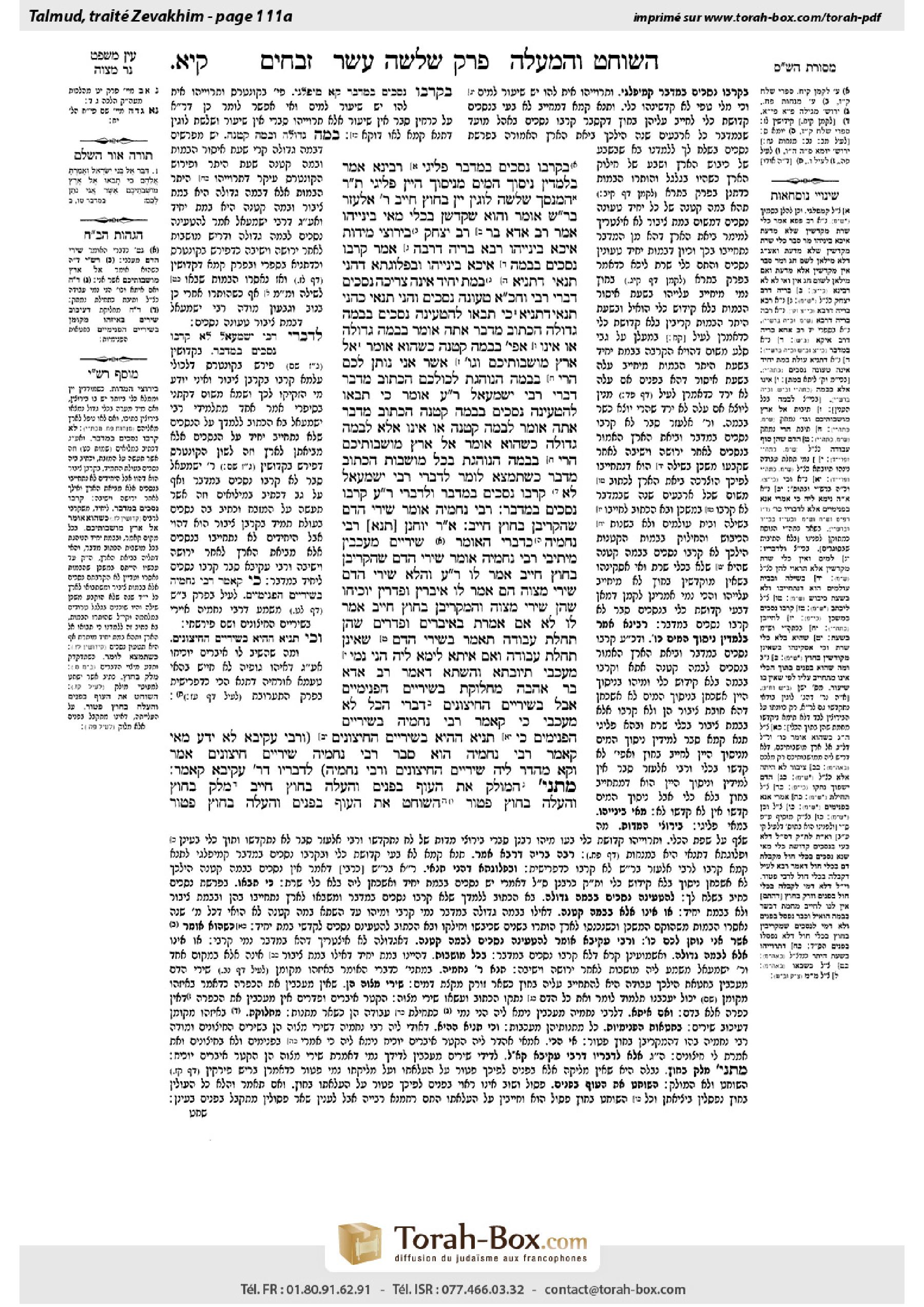
Zevachim 111a: Talmud study for Daf Yomi
Daf Yomi is the daily study of one Talmud folio. Explore 37 tractates with scans, Hebrew text, Sefaria English and AI-generated French translations where annotated.
Passage selection and English or AI-generated French translation are available where the scan has annotations. Daf Study is independent of Torah-Box and Sefaria.
Browse Zevachim · זבחים · All tractatesZevachim 111a text and translations
This page of Zevachim includes the Aramaic text, an English translation and an AI-generated French translation, alongside the scan above.
זבחים קי״א א · Aramaic and Hebrew text
בְּקָרְבוּ נְסָכִים בַּמִּדְבָּר פְּלִיגִי.
רָבִינָא אָמַר: בִּלְמֵדִין נִיסּוּךְ הַמַּיִם מִנִּיסּוּךְ הַיַּיִן פְּלִיגִי.
תָּנוּ רַבָּנַן: הַמְנַסֵּךְ שְׁלֹשָׁה לוּגִּין יַיִן בַּחוּץ – חַיָּיב. רַבִּי אֶלְעָזָר בְּרַבִּי שִׁמְעוֹן אוֹמֵר: וְהוּא שֶׁקִּדְּשָׁן בִּכְלִי.
מַאי בֵּינַיְיהוּ? אָמַר רַב אַדָּא בַּר רַב יִצְחָק: בֵּירוּצֵי מִידּוֹת אִיכָּא בֵּינַיְיהוּ.
רָבָא בְּרֵיהּ דְּרַבָּה אָמַר: קָרְבוּ נְסָכִים בְּבָמָה אִיכָּא בֵּינַיְיהוּ.
וּבִפְלוּגְתָּא דְּהָנֵי תַּנָּאֵי – דְּתַנְיָא: בָּמַת יָחִיד אֵינָהּ צְרִיכָה נְסָכִים. דִּבְרֵי רַבִּי. וַחֲכָמִים אוֹמְרִים: טְעוּנָה נְסָכִים.
וְהָנֵי תַּנָּאֵי כְּהָנֵי תַּנָּאֵי – דְּתַנְיָא: ״כִּי תָבֹאוּ״ – לְהַטְעִינָהּ נְסָכִים לְבָמָה גְּדוֹלָה הַכָּתוּב מְדַבֵּר.
אַתָּה אוֹמֵר לְבָמָה גְּדוֹלָה; אוֹ אֵינוֹ אֲפִילּוּ בָּמָה קְטַנָּה? כְּשֶׁהוּא אוֹמֵר: ״אֶל אֶרֶץ מוֹשְׁבֹתֵיכֶם אֲשֶׁר אֲנִי נֹתֵן לָכֶם״ – הֲרֵי בְּבָמָה הַנּוֹהֶגֶת לְכוּלְּכֶם הַכָּתוּב מְדַבֵּר. דִּבְרֵי רַבִּי יִשְׁמָעֵאל.
רַבִּי עֲקִיבָא אוֹמֵר: ״כִּי תָבֹאוּ״ – לְהַטְעִינָהּ נְסָכִים (בְּבָמָה) [לְבָמָה] קְטַנָּה הַכָּתוּב מְדַבֵּר.
אַתָּה אוֹמֵר לְבָמָה קְטַנָּה; אוֹ אֵינוֹ אֶלָּא לְבָמָה גְּדוֹלָה? כְּשֶׁהוּא אוֹמֵר: ״אֶל אֶרֶץ מוֹשְׁבֹתֵיכֶם״ – הֲרֵי בְּבָמָה הַנּוֹהֶגֶת בְּכׇל מוֹשָׁבוֹת הַכָּתוּב מְדַבֵּר.
כְּשֶׁתִּמְצָא לוֹמַר; לְדִבְרֵי רַבִּי יִשְׁמָעֵאל – לֹא קָרְבוּ נְסָכִים בַּמִּדְבָּר, וּלְדִבְרֵי רַבִּי עֲקִיבָא – קָרְבוּ נְסָכִים בַּמִּדְבָּר.
רַבִּי נְחֶמְיָה אוֹמֵר: שְׁיָרֵי הַדָּם שֶׁהִקְרִיבָן בַּחוּץ – חַיָּיב.
אָמַר רַבִּי יוֹחָנָן: [תַּנָּא] רַבִּי נְחֶמְיָה כְּדִבְרֵי הָאוֹמֵר שִׁירַיִים מְעַכְּבִין.
מֵיתִיבִי: רַבִּי נְחֶמְיָה אוֹמֵר: שְׁיָרֵי הַדָּם שֶׁהִקְרִיבָן בַּחוּץ – חַיָּיב. אָמַר לוֹ רַבִּי עֲקִיבָא: וַהֲלֹא שְׁיָרֵי הַדָּם שְׁיָרֵי מִצְוָה הֵם! אָמַר לוֹ: אֵיבָרִין וּפְדָרִין יוֹכִיחוּ – שֶׁהֵן שְׁיָרֵי מִצְוָה, וְהַמַּקְרִיבָן בַּחוּץ חַיָּיב! אָמַר לוֹ: לֹא; אִם אָמַרְתָּ בְּאֵיבָרִים וּפְדָרִים – שֶׁהֵן תְּחִלַּת עֲבוֹדָה, תֹּאמַר בִּשְׁיָרֵי הַדָּם שֶׁאֵינָן תְּחִלַּת עֲבוֹדָה?!
וְאִם אִיתָא, לֵימָא לֵיהּ: הָנֵי נָמֵי מְעַכְּבִי! תְּיוּבְתָּא.
וְהַשְׁתָּא דְּאָמַר רַב אַדָּא בַּר אַהֲבָה: מַחְלוֹקֶת בְּשִׁירַיִים הַפְּנִימִיִּים, אֲבָל בְּשִׁירַיִים הַחִיצוֹנִים – דִּבְרֵי הַכֹּל לָא מְעַכְּבִי; כִּי קָאָמַר רַבִּי נְחֶמְיָה – בְּשִׁירַיִים הַפְּנִימִים, כִּי תַּנְיָא הָהִיא – בְּשִׁירַיִים הַחִיצוֹנִים.
וְרַבִּי עֲקִיבָא לָא יָדַע מַאי קָאָמַר רַבִּי נְחֶמְיָה; הוּא סָבַר: רַבִּי נְחֶמְיָה שִׁירַיִים חִיצוֹנִים אָמַר, וְקָא מַהְדַּר לֵיהּ שִׁירַיִים הַחִיצוֹנִים. וְרַבִּי נְחֶמְיָה – לִדְבָרָיו דְּרַבִּי עֲקִיבָא קָאָמַר.
מַתְנִי׳ הַמּוֹלֵק אֶת הָעוֹף בִּפְנִים וְהֶעֱלָה בַּחוּץ – חַיָּיב. מָלַק בַּחוּץ וְהֶעֱלָה בַּחוּץ – פָּטוּר. הַשּׁוֹחֵט אֶת הָעוֹף בִּפְנִים וְהֶעֱלָה בַּחוּץ – פָּטוּר.
Zevachim 111a · English translation
They disagree with regard to whether one is liable for pouring a libation outside the courtyard that was not first consecrated in a service vessel. This dispute is based on a disagreement with regard to whether wine libations were offered in the Tabernacle in the wilderness before the Jewish people entered Eretz Yisrael. The Gemara will soon explain the logical connection between the two issues.
Ravina said: Everyone agrees that wine libations are valid even if they are not first consecrated in a sacred service vessel. Therefore, one who pours a wine libation outside the courtyard is liable even if it was not first consecrated in a service vessel. They disagree with regard to whether the liability for pouring a water libation can be derived from that of a wine libation. The first tanna holds that it can; Rabbi Elazar, son of Rabbi Shimon, holds that it cannot.
§ The Sages taught in a baraita: One who pours as a libation three log of wine outside the courtyard is liable. Rabbi Elazar, son of Rabbi Shimon, says: And that is in a case where he first consecrated the wine in a sacred service vessel.
What is the difference between them? Rav Adda bar Rav Yitzḥak said: The difference between them is with regard to whether the overfill of measuring vessels is also consecrated. Both agree that one is liable for pouring a libation outside the courtyard only if it was first consecrated in a service vessel. The first tanna holds that the liquid that rises above the rim of a vessel is also consecrated, and if one collects three log of that liquid and pours it as a libation outside the courtyard he is liable. Rabbi Elazar, son of Rabbi Shimon, holds that only the wine within the walls of the vessel itself is consecrated.
Rava, son of Rabba, said: The difference between them is with regard to whether one is liable for pouring a libation outside the courtyard that was not first consecrated in a service vessel. This dispute is based on a disagreement as to whether wine libations were offered on private altars.
He explains: And they disagree with regard to the issue that is the subject of the dispute between these tanna’im, as it is taught in a baraita: An offering sacrificed on a private altar does not need to be accompanied by wine libations; this is the statement of Rabbi Yehuda HaNasi. And the Rabbis say: It does require wine libations. Service vessels are not used in the context of private altars. Therefore, if libations are brought on private altars then it is apparent that libations can be valid even if they were not first consecrated in a service vessel. Accordingly, one would be liable for pouring a libation outside the Temple even if it had not first been consecrated in a service vessel. If libations are not brought on private altars, then there is no precedent of a libation that was not first consecrated in a service vessel, and one would not be liable for pouring a non-consecrated libation outside the Temple.
And the opinion of these tanna’im is like the opinion of those tanna’im, as it is taught in a baraita: In introducing the mitzva to bring wine libations together with animal offerings, the verse states: “When you come into the land of your dwellings, which I give to you” (Numbers 15:2), which indicates that the mitzva to bring libations began only once the Jewish people entered Eretz Yisrael. The verse speaks in order to require that libations be brought with animal offerings that are brought upon a great public altar. This assumes libations were not brought on a public altar in the wilderness. Therefore, it is necessary to teach that upon entering Eretz Yisrael they are required.
Do you say that the verse is referring to offerings brought on a great public altar, or is it even referring to offerings brought on a small private altar? Perhaps libations were brought on the public altar in the wilderness, and it is therefore unnecessary to state that after entering Eretz Yisrael libations should continue to be brought on a public altar. Accordingly, the verse must be teaching that after the Jewish people have entered Eretz Yisrael, libations are required even on private altars. This suggestion is rejected: When the verse states: “Into the land of your dwellings, which I give to you [lakhem],” using the plural form of the word “you,” it is apparent that the verse is speaking of a public altar that is used by everyone; this is the statement of Rabbi Yishmael.
Rabbi Akiva says: Through its introductory clause: “When you come,” the verse speaks in order to require that libations be brought with animal offerings that are brought upon a small private altar. This assumes libations were already brought in the wilderness, and the verse must be teaching that libations are required even on private altars.
Do you say that the verse is speaking of a small private altar outside the Temple? Or is it only referring to a great public altar? Perhaps libations were not brought on the public altar in the wilderness and the verse is necessary in order to teach that upon entering Eretz Yisrael they are required. When the verse states: “Into the land of your dwellings,” it is apparent that the verse is speaking of an altar that is used in all your dwellings, which certainly must be referring to private altars, as there was only one central public altar.
The Gemara explains: When you analyze the matter you will find that you can say that according to the statement of Rabbi Yishmael, libations were not offered in the wilderness. Therefore, it is necessary to teach that upon entering Eretz Yisrael they are required. And according to the statement of Rabbi Akiva libations were offered in the wilderness. Therefore, the verse must be teaching that libations are required even on private altars.
§ The mishna teaches: Rabbi Neḥemya says: For the remainder of the blood of an offering that was supposed to be poured at the base of the altar and that instead one sacrificed outside the courtyard, one is liable.
Rabbi Yoḥanan said: Rabbi Neḥemya taught this halakha in accordance with the statement of the one who says that failure to pour the remainder of the blood at the base of the altar disqualifies the offering.
The Gemara raises an objection from a baraita: Rabbi Neḥemya says that for the remainder of the blood of an offering that one sacrificed outside the courtyard, one is liable. Rabbi Akiva said to him: Isn’t pouring the remainder of the blood considered a non-essential mitzva, which is not indispensable to the validity of the offering? Accordingly, one should not be liable for sacrificing the blood outside the Temple courtyard. Rabbi Neḥemya said to him: Sacrificial limbs and fats of a burnt offering will prove the matter, as they are considered a non-essential mitzva, and yet one who sacrifices them outside the courtyard is liable. Rabbi Akiva said to him: No, if you said that one is liable with regard to the burning of the limbs and fats, which is the start of a sacrificial rite, i.e., burning them is a sacrificial rite in and of itself, shall you also say that this is the halakha with regard to the pouring of the remainder of the blood, which is not the start of a sacrificial rite, but is just the conclusion of the sprinkling of the blood?
The Gemara explains the challenge from the baraita: And if it is so that Rabbi Neḥemya holds that that failure to pour the remainder of the blood at the base of the altar disqualifies the offering, let Rabbi Neḥemya say in response to Rabbi Akiva: These too, i.e., the pouring of the remainder of the blood, are considered to be a sacrificial rite in and of themselves because failure to pour out the remainder disqualifies the offering. The Gemara concludes: Indeed, this is a conclusive refutation.
The Gemara qualifies its rejection: And now that Rav Adda bar Ahava says: The dispute between the tanna’im with regard to whether failure to pour the remainder of the blood disqualifies the offering is only with regard to the remainder of blood that was presented on the inner altar, but with regard to the remainder of blood that was presented on the external altar everyone agrees that failure to pour it does not disqualify the offering; the apparent contradiction between Rabbi Yoḥanan’s statement and the baraita can therefore be resolved. When Rabbi Neḥemya says in the mishna that one is liable for sacrificing the remainder of the blood outside the courtyard, he is referring to the remainder of blood that was presented on the inner altar. The pouring of that blood is considered a rite in and of itself, and one is liable for sacrificing it outside the Temple. When that statement of Rabbi Neḥemya is taught in the baraita, it is referring to the remainder of blood that was presented on the external altar. Concerning such blood, Rabbi Neḥemya concedes that the pouring is not considered a rite in and of itself.
In light of this, the Gemara explains the discussion between Rabbi Akiva and Rabbi Neḥemya: And Rabbi Akiva did not know what Rabbi Neḥemya was saying. Rabbi Akiva thought that Rabbi Neḥemya was stating a ruling about the pouring of the remainder of blood that was presented on the external altar. Therefore, Rabbi Akiva responded to him with a claim relating to the remainder of blood that was presented on the external altar and said that it is a non-essential mitzva. And then Rabbi Neḥemya answered him by saying a defense of his opinion in accordance with the misconception underlying the statement of Rabbi Akiva.
MISHNA: One who pinches the nape of a bird offering inside the Temple courtyard and then offers it up outside the courtyard is liable. But if one pinched its nape outside the courtyard and then offered it up outside the courtyard he is exempt, as pinching the nape of a bird outside the courtyard is not considered valid pinching. One who slaughters, with a knife, a bird offering inside the courtyard and offers it up outside the courtyard is exempt, as slaughtering a bird offering in the Temple courtyard disqualifies it as an offering.
Zevachim 111a · Traduction française (IA)
Ils sont en désaccord sur la question de savoir si l’on est passible pour avoir versé une libation à l’extérieur de la cour lorsque le vin n’a pas été préalablement consacré dans un ustensile de service. Ce désaccord repose sur une divergence quant à savoir si des libations de vin étaient offertes dans le Tabernacle, dans le désert, avant que le peuple juif n’entre en Eretz Israël. La Guemara expliquera bientôt le lien logique entre ces deux questions.
Ravina a dit : Tous conviennent que les libations de vin sont valides même si le vin n’a pas été préalablement consacré dans un ustensile de service sacré. Par conséquent, celui qui verse une libation de vin à l’extérieur de la cour est passible, même si le vin n’a pas été préalablement consacré dans un ustensile de service. Ils sont en désaccord sur la question de savoir si l’on peut déduire de la libation de vin la responsabilité encourue pour avoir versé une libation d’eau. Le premier tanna estime que oui ; Rabbi Elazar, fils de Rabbi Shimon, estime que non.
§ Les Sages ont enseigné dans une baraïta : Celui qui verse en libation trois log de vin à l’extérieur de la cour est passible. Rabbi Elazar, fils de Rabbi Shimon, dit : Cela vaut dans le cas où il a d’abord consacré le vin dans un ustensile de service sacré.
Quelle est la différence entre eux ? Rav Adda bar Rav Yitzḥak a dit : La différence porte sur la question de savoir si le liquide qui déborde des récipients de mesure est lui aussi consacré. Tous deux conviennent que l’on n’est passible pour avoir versé une libation à l’extérieur de la cour que si le vin a d’abord été consacré dans un ustensile de service. Le premier tanna estime que le liquide qui dépasse le bord du récipient est lui aussi consacré ; si quelqu’un recueille trois log de ce liquide et le verse en libation à l’extérieur de la cour, il est passible. Rabbi Elazar, fils de Rabbi Shimon, estime que seul le vin contenu entre les parois du récipient est consacré.
Rava, fils de Rabba, a dit : La différence porte sur la question de savoir si l’on est passible pour avoir versé une libation à l’extérieur de la cour lorsque le vin n’a pas été préalablement consacré dans un ustensile de service. Ce désaccord repose sur une divergence quant à savoir si des libations de vin étaient offertes sur des autels privés.
Il explique : Ils sont en désaccord sur la question qui fait l’objet de la controverse entre ces tannaïm, comme il est enseigné dans une baraïta : Une offrande sacrifiée sur un autel privé n’a pas besoin d’être accompagnée de libations de vin ; telle est l’opinion de Rabbi Yehouda HaNassi. Les Sages disent : Elle doit être accompagnée de libations de vin. On n’utilise pas d’ustensiles de service sur les autels privés. Par conséquent, si des libations sont offertes sur des autels privés, il est évident qu’elles peuvent être valides même si elles n’ont pas été préalablement consacrées dans un ustensile de service. Ainsi, on serait passible pour avoir versé une libation à l’extérieur du Temple même si elle n’avait pas été préalablement consacrée dans un ustensile de service. Si aucune libation n’est offerte sur les autels privés, il n’existe alors aucun précédent de libation qui n’ait pas d’abord été consacrée dans un ustensile de service, et l’on ne serait pas passible pour avoir versé à l’extérieur du Temple une libation non consacrée.
L’opinion de ces tannaïm correspond à celle de ces autres tannaïm, comme il est enseigné dans une baraïta : Pour introduire la mitsva d’apporter des libations de vin avec les offrandes animales, le verset dit : « Lorsque vous entrerez dans le pays où vous établirez vos demeures, que je vous donne » (Nombres 15:2), ce qui indique que la mitsva d’apporter des libations n’a commencé qu’après l’entrée du peuple juif en Eretz Israël. Le verset parle des offrandes animales apportées sur un grand autel public, afin d’exiger qu’elles soient accompagnées de libations. Cela suppose que des libations n’étaient pas offertes sur un autel public dans le désert. Il faut donc enseigner qu’après leur entrée en Eretz Israël, elles sont requises.
Peut-on dire que le verset parle des offrandes apportées sur un grand autel public, ou bien parle-t-il aussi des offrandes apportées sur un petit autel privé ? Peut-être des libations étaient-elles offertes sur l’autel public dans le désert ; il n’est donc pas nécessaire de préciser qu’après l’entrée en Eretz Israël, les libations doivent continuer à être offertes sur un autel public. Le verset doit donc enseigner qu’après l’entrée du peuple juif en Eretz Israël, les libations sont requises même sur les autels privés. Cette proposition est rejetée : lorsque le verset dit « dans le pays où vous établirez vos demeures, que je vous donne [lakhem] », en employant la forme plurielle de « vous », il apparaît qu’il parle d’un autel public utilisé par tous ; telle est l’opinion de Rabbi Yishmael.
Rabbi Akiva dit : Par sa proposition introductive, « Lorsque vous entrerez », le verset parle des offrandes animales apportées sur un petit autel privé, afin d’exiger qu’elles soient accompagnées de libations. Cela suppose que des libations étaient déjà offertes dans le désert ; le verset doit donc enseigner que les libations sont requises même sur les autels privés.
Peut-on dire que le verset parle d’un petit autel privé situé hors du Temple ? Ou bien ne parle-t-il que d’un grand autel public ? Peut-être aucune libation n’était-elle offerte sur l’autel public dans le désert, et le verset est alors nécessaire pour enseigner qu’elles sont requises après l’entrée en Eretz Israël. Lorsque le verset dit « dans le pays où vous établirez vos demeures », il apparaît qu’il parle d’un autel utilisé dans toutes vos demeures, ce qui doit certainement désigner les autels privés, puisqu’il n’y avait qu’un seul autel public central.
La Guemara explique : À l’examen, on peut dire que, selon Rabbi Yishmael, aucune libation n’était offerte dans le désert. Il faut donc enseigner qu’après l’entrée en Eretz Israël, elles sont requises. Selon Rabbi Akiva, des libations étaient offertes dans le désert. Le verset doit donc enseigner que les libations sont requises même sur les autels privés.
§ La Michna enseigne : Rabbi Neḥemya dit : Celui qui sacrifie à l’extérieur de la cour le reste du sang d’une offrande, qui aurait dû être versé au pied de l’autel, est passible.
Rabbi Yoḥanan a dit : Rabbi Neḥemya a enseigné cette halakha conformément à l’opinion de celui qui dit que le fait de ne pas verser le reste du sang au pied de l’autel invalide l’offrande.
La Guemara soulève une objection tirée d’une baraïta : Rabbi Neḥemya dit que celui qui sacrifie à l’extérieur de la cour le reste du sang d’une offrande est passible. Rabbi Akiva lui dit : Le versement du reste du sang n’est-il pas une mitsva non indispensable, dont l’absence n’empêche pas la validité de l’offrande ? Par conséquent, on ne devrait pas être passible pour avoir sacrifié le sang à l’extérieur de la cour du Temple. Rabbi Neḥemya lui dit : Les membres et les graisses d’un holocauste le prouvent : ils relèvent d’une mitsva non indispensable, et pourtant celui qui les sacrifie à l’extérieur de la cour est passible. Rabbi Akiva lui dit : Non. Si tu as dit qu’on est passible pour la combustion des membres et des graisses, qui constitue le commencement d’un rite sacrificiel — c’est-à-dire que leur combustion est en elle-même un rite sacrificiel —, diras-tu aussi que telle est la halakha pour le versement du reste du sang, qui ne constitue pas le commencement d’un rite sacrificiel, mais seulement l’achèvement de l’aspersion du sang ?
La Guemara expose l’objection tirée de la baraïta : Si Rabbi Neḥemya estimait que le fait de ne pas verser le reste du sang au pied de l’autel invalide l’offrande, qu’il réponde donc à Rabbi Akiva : « Le versement du reste du sang est lui aussi considéré comme un rite sacrificiel à part entière, puisque le fait de ne pas verser ce reste invalide l’offrande. » La Guemara conclut : En effet, il s’agit là d’une réfutation définitive.
La Guemara nuance sa réfutation : Or, puisque Rav Adda bar Ahava dit que le désaccord entre les tannaïm sur la question de savoir si le fait de ne pas verser le reste du sang invalide l’offrande ne porte que sur le reste du sang présenté sur l’autel intérieur, tandis que, pour le reste du sang présenté sur l’autel extérieur, tous conviennent que le fait de ne pas le verser n’invalide pas l’offrande, la contradiction apparente entre la déclaration de Rabbi Yoḥanan et la baraïta peut être résolue. Lorsque Rabbi Neḥemya dit dans la Michna que l’on est passible pour avoir sacrifié le reste du sang à l’extérieur de la cour, il parle du reste du sang présenté sur l’autel intérieur. Le versement de ce sang est considéré comme un rite à part entière, et l’on est passible pour l’avoir sacrifié à l’extérieur du Temple. Lorsque cette déclaration de Rabbi Neḥemya est enseignée dans la baraïta, elle porte sur le reste du sang présenté sur l’autel extérieur. Concernant un tel sang, Rabbi Neḥemya reconnaît que son versement n’est pas considéré comme un rite à part entière.
À la lumière de cela, la Guemara explique l’échange entre Rabbi Akiva et Rabbi Neḥemya : Rabbi Akiva ne savait pas ce que Rabbi Neḥemya voulait dire. Il pensait que Rabbi Neḥemya énonçait une décision au sujet du versement du reste du sang présenté sur l’autel extérieur. Rabbi Akiva lui répondit donc par un argument concernant le reste du sang présenté sur l’autel extérieur, disant qu’il s’agissait d’une mitsva non indispensable. Rabbi Neḥemya lui répondit alors en défendant son opinion conformément à la méprise qui sous-tendait la déclaration de Rabbi Akiva.
MICHNA : Celui qui pince la nuque d’une offrande d’oiseau à l’intérieur de la cour du Temple, puis la fait brûler à l’extérieur de la cour, est passible. Mais s’il lui a pincé la nuque à l’extérieur de la cour, puis l’a fait brûler à l’extérieur de la cour, il est exempt, car le pincement de la nuque d’un oiseau à l’extérieur de la cour n’est pas considéré comme un pincement valide. Celui qui égorge au couteau une offrande d’oiseau à l’intérieur de la cour, puis la fait brûler à l’extérieur de la cour, est exempt, car l’égorgement d’une offrande d’oiseau dans la cour du Temple l’invalide.
Traduction française générée par IA à partir de l’édition anglaise de Sefaria. Vérifie toujours un passage avec le texte source.
Text from Sefaria: William Davidson Edition - Vocalized Aramaic (CC BY NC); William Davidson Edition - English (CC BY NC).