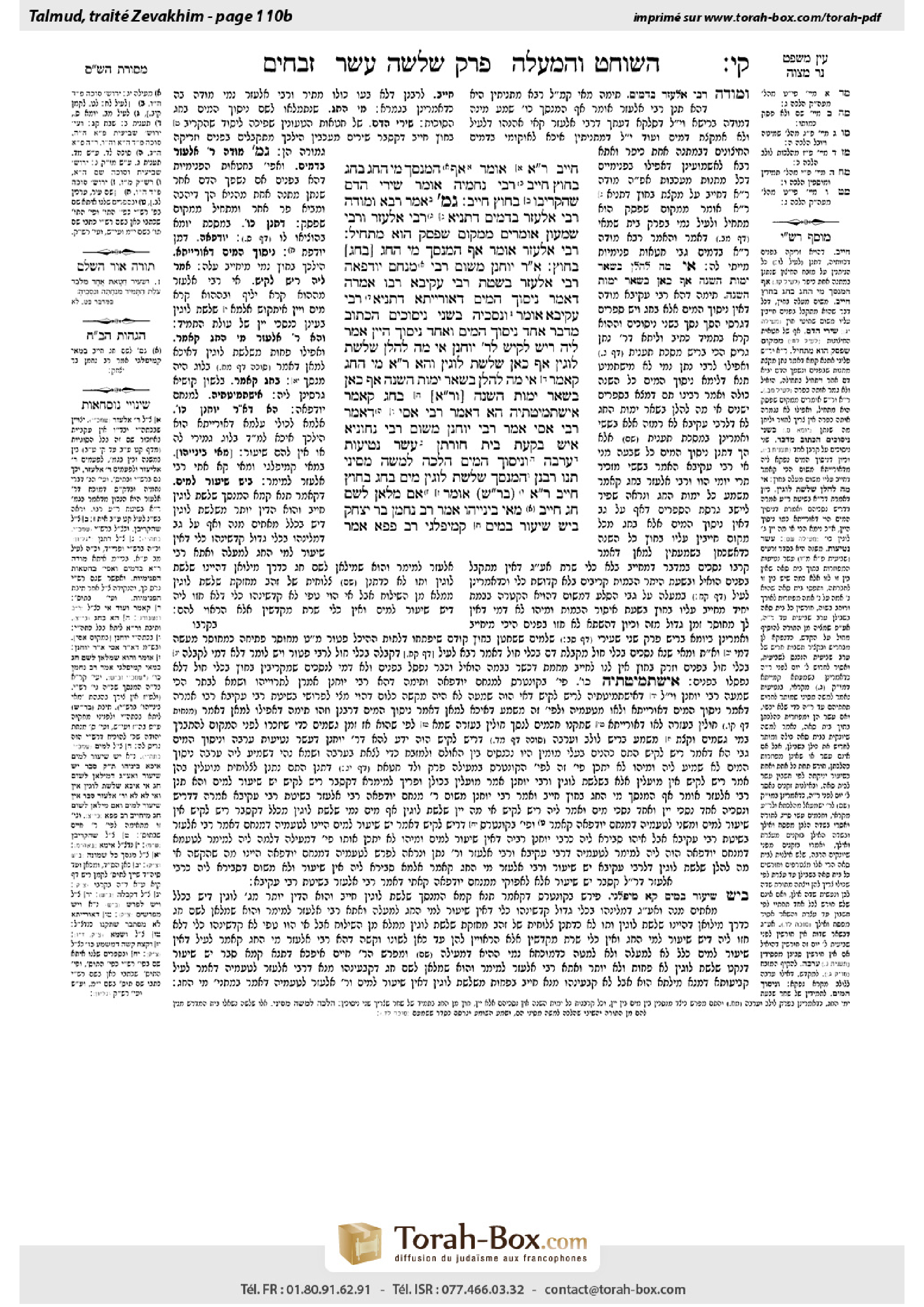
Zevachim 110b: Talmud study for Daf Yomi
Daf Yomi is the daily study of one Talmud folio. Explore 37 tractates with scans, Hebrew text, Sefaria English and AI-generated French translations where annotated.
Passage selection and English or AI-generated French translation are available where the scan has annotations. Daf Study is independent of Torah-Box and Sefaria.
Browse Zevachim · זבחים · All tractatesZevachim 110b text and translations
This page of Zevachim includes the Aramaic text, an English translation and an AI-generated French translation, alongside the scan above.
זבחים ק״י ב · Aramaic and Hebrew text
חַיָּיב. רַבִּי אֶלְעָזָר אוֹמֵר: אַף הַמְנַסֵּךְ מֵי הֶחָג בֶּחָג בַּחוּץ – חַיָּיב. רַבִּי נְחֶמְיָה אוֹמֵר: שְׁיָרֵי הַדָּם (שֶׁהִקְרִיבוּ) [שֶׁהִקְרִיבָן] בַּחוּץ – חַיָּיב.
גְּמָ׳ אָמַר רָבָא: וּמוֹדֶה רַבִּי אֶלְעָזָר בְּדָמִים.
דְּתַנְיָא, רַבִּי אֶלְעָזָר וְרַבִּי שִׁמְעוֹן אוֹמְרִים: מִמָּקוֹם שֶׁפָּסַק הוּא מַתְחִיל.
רַבִּי אֶלְעָזָר אוֹמֵר: אַף הַמְנַסֵּךְ מֵי הֶחָג [בֶּחָג] בַּחוּץ. אָמַר רַבִּי יוֹחָנָן מִשּׁוּם רַבִּי מְנַחֵם יוֹדְפָאָה: רַבִּי אֶלְעָזָר – בְּשִׁטַּת רַבִּי עֲקִיבָא רַבּוֹ אֲמָרָהּ, דְּאָמַר: נִיסּוּךְ הַמַּיִם דְּאוֹרָיְיתָא. דְּתַנְיָא, רַבִּי עֲקִיבָא אוֹמֵר: ״וּנְסָכֶיהָ״ – בִּשְׁנֵי נִיסּוּכִים הַכָּתוּב מְדַבֵּר, אֶחָד נִיסּוּךְ הַמַּיִם וְאֶחָד נִיסּוּךְ הַיַּיִן.
אֲמַר לֵיהּ רֵישׁ לָקִישׁ לְרַבִּי יוֹחָנָן: אִי – מָה לְהַלָּן שְׁלֹשֶׁת לוּגִּין, אַף כָּאן שְׁלֹשֶׁת לוּגִּין?! וְהָא רַבִּי אֶלְעָזָר ״מֵי הֶחָג״ קָאָמַר! אִי – מָה לְהַלָּן בִּשְׁאָר יְמוֹת הַשָּׁנָה, אַף כָּאן בִּשְׁאָר יְמוֹת הַשָּׁנָה?! [וְרַבִּי אֶלְעָזָר] ״בֶּחָג״ קָאָמַר!
אִישְׁתְּמִיטְתֵּיהּ הָא דְּאָמַר רַבִּי אַסִּי; דְּאָמַר רַבִּי אַסִּי אָמַר רַבִּי יוֹחָנָן מִשּׁוּם רַבִּי נְחוּנְיָא אִישׁ בִּקְעַת בֵּית חוֹרְתָן: עֶשֶׂר נְטִיעוֹת, עֲרָבָה וְנִיסּוּךְ הַמַּיִם – הֲלָכָה לְמֹשֶׁה מִסִּינַי.
תָּנוּ רַבָּנַן: הַמְנַסֵּךְ שְׁלֹשֶׁת לוּגִּין מַיִם בֶּחָג בַּחוּץ – חַיָּיב. רַבִּי אֶלְעָזָר (בְּרַבִּי שִׁמְעוֹן) אוֹמֵר: אִם מִלְּאָן לְשֵׁם חַג – חַיָּיב.
מַאי בֵּינַיְיהוּ? אָמַר רַב נַחְמָן בַּר יִצְחָק: בְּיֵשׁ שִׁיעוּר בְּמַיִם קָמִיפַּלְגִי.
רַב פָּפָּא אָמַר:
Zevachim 110b · English translation
is liable. Rabbi Elazar says: So too, one who pours as a libation water consecrated for the libation of the festival of Sukkot, during the Festival, outside the courtyard, is liable. Rabbi Neḥemya says: For the remainder of the blood of an offering that was supposed to be poured at the base of the altar and that instead one sacrificed outside the courtyard, one is liable.
GEMARA: Rava says: Rabbi Elazar generally holds that one is liable for sacrificing outside only when he sacrifices a complete offering, but Rabbi Elazar concedes with regard to the sprinkling of the blood of an offering, that one is liable for sprinkling outside even part of the blood, e.g., one sprinkling instead of four. This is clearly the halakha with regard to offerings whose blood is sprinkled on the external altar, as a single sprinkling renders such an offering valid (see 36b), and it can be regarded as a complete offering. Rabbi Elazar concedes that this is the halakha even with regard to offerings whose blood is sprinkled on the inner altar, despite the fact that such offerings are valid only once all the sprinklings have been completed.
The fact that Rabbi Elazar concedes this point is apparent from that which is taught in a mishna (Yoma 60a) with regard to the numerous sprinklings of blood performed in the Holy of Holies, upon the Curtain, and on the inner altar, as part of the Yom Kippur Temple service: If during the sprinklings the blood spills and it is necessary to bring the blood of a second animal in order to complete them, Rabbi Elazar and Rabbi Shimon say: From the place that the High Priest stopped sprinkling the blood of the first animal, there he begins to sprinkle the blood of the second animal; it is unnecessary to repeat any of the sprinklings that have already been performed. From this ruling it is apparent that each sprinkling is considered an independent and complete act of service, and one will be liable for even a single act of sprinkling done outside the Temple.
§ The mishna teaches: Rabbi Elazar says: So too, one who pours as a libation water consecrated for the libation of the festival of Sukkot, during the Festival, outside the courtyard, is liable. Rabbi Yoḥanan said in the name of Rabbi Menaḥem Yodfa’a: Rabbi Elazar said that halakha in accordance with the opinion of Rabbi Akiva, his teacher, who says: The water libation on Sukkot is a mitzva by Torah law. As it is taught in a baraita that Rabbi Akiva says concerning the verse: “Beside the daily burnt offering, its meal offering, and its libations” (Numbers 29:31), the fact that the Torah makes reference to “libations” in the plural indicates that the verse is speaking of two types of libations. One is the water libation, which is unique to the festival of Sukkot; and the other one is the wine libation, which always accompanies the daily offering. If the water libation was not a mitzva by Torah law, one would not be liable for pouring it as a libation outside the Temple courtyard.
Reish Lakish said to Rabbi Yoḥanan: If Rabbi Elazar derives the mitzva of the water libation through the derivation taught by Rabbi Akiva, according to which both the wine libation and water libation are derived from the same word, then he should hold that just as there, with regard to wine, one is liable only if he pours three log, so too here, with regard to water, one should be liable only if he pours three log. But in the mishna, Rabbi Elazar says simply: Water of the festival of Sukkot, which seems to include any amount. Furthermore, he should hold that just as with regard to pouring a libation of wine outside the Temple, one is liable for pouring a libation during the rest of the days of the year and not only on Sukkot, so too, with regard to pouring a libation of water, one should be liable for pouring a libation during the rest of the days of the year. But in the mishna Rabbi Elazar says that one is liable only if he pours the water libation during the Festival. It is apparent that Rabbi Elazar derived the mitzva of the water libation from a different source.
That which Rabbi Asi says escaped him, as Rabbi Asi says that Rabbi Yoḥanan says in the name of Rabbi Neḥunya, a man of the valley of Beit Ḥortan: The halakha of ten saplings, the practice of taking a willow in the Temple during Sukkot, and the obligation to perform the water libation during Sukkot, each of these is a halakha transmitted to Moses from Sinai. According to Rabbi Asi, the mitzva of the water libation is not derived from the same source as the wine libation, and it is possible that there will be differences in the halakhot that apply to them.
§ The Sages taught in a baraita: One who pours as a libation three log of water during the festival of Sukkot outside the courtyard is liable. Rabbi Elazar, son of Rabbi Shimon, says: If he filled a service vessel with the three log in order to consecrate them for the sake of the Festival, he is liable.
The Gemara asks: What is the difference between these two opinions? Rav Naḥman bar Yitzḥak said: They disagree with regard to whether there is a precise measure of water that can be consecrated as a libation. The first tanna holds that even if one fills a service vessel with more than three log, the water is thereby consecrated. Therefore, if one then pours at least three log of that water outside the courtyard, he is liable. Rabbi Elazar holds that if one attempts to consecrate more than three log, the consecration of the water is ineffective. Therefore, if one then pours three log of that water as a libation outside the courtyard, he is not liable.
Rav Pappa said:
Zevachim 110b · Traduction française (IA)
est passible. Rabbi Elazar dit : De même, celui qui verse en libation, hors de la cour, pendant la fête de Soukkot, de l’eau consacrée pour la libation de la fête est passible. Rabbi Neḥemya dit : Celui qui sacrifie hors de la cour le reste du sang d’une offrande, qui aurait dû être versé à la base de l’autel, est passible.
GUEMARA : Rava dit : Rabbi Elazar soutient généralement qu’on n’est passible d’avoir offert un sacrifice à l’extérieur que lorsqu’on y offre une offrande entière. Toutefois, Rabbi Elazar admet que, pour l’aspersion du sang d’une offrande, on est passible même si l’on n’asperge à l’extérieur qu’une partie du sang, par exemple une aspersion au lieu de quatre. Cela est clairement la halakha pour les offrandes dont le sang est aspergé sur l’autel extérieur, car une seule aspersion suffit à rendre l’offrande valide (voir 36b), et peut donc être considérée comme une offrande complète. Rabbi Elazar admet que telle est aussi la halakha pour les offrandes dont le sang est aspergé sur l’autel intérieur, bien que ces offrandes ne soient valides qu’une fois toutes les aspersions achevées.
Le fait que Rabbi Elazar admette ce point ressort de ce qui est enseigné dans une Michna (Yoma 60a) au sujet des nombreuses aspersions de sang effectuées dans le Saint des saints, sur le rideau et sur l’autel intérieur, dans le cadre du service du Temple de Yom Kippour : si, au cours des aspersions, le sang se répand et qu’il faille apporter le sang d’un second animal pour les achever, Rabbi Elazar et Rabbi Shimon disent : Là où le grand prêtre s’est arrêté en aspergeant le sang du premier animal, il commence à asperger celui du second ; il n’est pas nécessaire de répéter les aspersions déjà effectuées. Cette décision montre que chaque aspersion est considérée comme un acte de service indépendant et complet, et qu’on est passible même pour un seul acte d’aspersion accompli à l’extérieur du Temple.
§ La Michna enseigne : Rabbi Elazar dit : De même, celui qui verse en libation, hors de la cour, pendant la fête de Soukkot, de l’eau consacrée pour la libation de la fête est passible. Rabbi Yoḥanan a dit au nom de Rabbi Menaḥem Yodfa’a : Rabbi Elazar a statué conformément à l’opinion de Rabbi Akiva, son maître, qui dit que la libation d’eau à Soukkot est une mitsva prescrite par la Torah. En effet, il est enseigné dans une baraïta que Rabbi Akiva dit au sujet du verset : « À côté de l’holocauste quotidien, de son offrande de farine et de ses libations » (Nombres 29,31) : le fait que la Torah mentionne les « libations » au pluriel indique que le verset parle de deux types de libations. L’une est la libation d’eau, propre à la fête de Soukkot ; l’autre est la libation de vin, qui accompagne toujours l’offrande quotidienne. Si la libation d’eau n’était pas une mitsva prescrite par la Torah, on ne serait pas passible d’en verser en libation hors de la cour du Temple.
Reish Lakish dit à Rabbi Yoḥanan : Si Rabbi Elazar déduit la mitsva de la libation d’eau au moyen du raisonnement enseigné par Rabbi Akiva, selon lequel la libation de vin et celle d’eau sont toutes deux déduites du même mot, il devrait alors soutenir que, de même que pour le vin on n’est passible que si l’on verse trois log, de même, pour l’eau, on ne devrait être passible que si l’on en verse trois log. Or, dans la Michna, Rabbi Elazar dit simplement : « l’eau de la fête de Soukkot », ce qui semble inclure toute quantité. En outre, il devrait soutenir que, de même que pour le versement d’une libation de vin à l’extérieur du Temple, on est passible si on la verse les autres jours de l’année, et pas seulement à Soukkot, de même, pour la libation d’eau, on devrait être passible si on la verse les autres jours de l’année. Or, dans la Michna, Rabbi Elazar dit qu’on n’est passible que si l’on verse la libation d’eau pendant la fête. Il apparaît donc que Rabbi Elazar a déduit la mitsva de la libation d’eau d’une autre source.
Ce que Rabbi Asi ignorait, c’est que Rabbi Asi rapporte au nom de Rabbi Yoḥanan, qui le tient de Rabbi Neḥunya, un homme de la vallée de Beit Ḥortan : la halakha des dix jeunes arbres, la pratique consistant à prendre un saule dans le Temple pendant Soukkot et l’obligation d’accomplir la libation d’eau pendant Soukkot sont chacune des halakhot transmises à Moïse au Sinaï. Selon Rabbi Asi, la mitsva de la libation d’eau n’est pas déduite de la même source que la libation de vin ; il est donc possible que les halakhot qui leur sont applicables diffèrent.
Les Sages ont enseigné dans une baraïta : Celui qui verse en libation trois log d’eau hors de la cour pendant la fête de Soukkot est passible. Rabbi Elazar, fils de Rabbi Shimon, dit : S’il a rempli un ustensile de service de trois log afin de les consacrer pour la fête, il est passible.
La Guemara demande : Quelle est la différence entre ces deux opinions ? Rav Naḥman bar Yitzḥak dit : Ils sont en désaccord sur la question de savoir s’il existe une mesure précise d’eau pouvant être consacrée comme libation. Le premier tanna soutient que même si l’on remplit un ustensile de service avec plus de trois log, l’eau est ainsi consacrée. Par conséquent, si l’on verse ensuite à l’extérieur de la cour au moins trois log de cette eau, on est passible. Rabbi Elazar soutient que si l’on tente de consacrer plus de trois log, la consécration de l’eau est sans effet. Par conséquent, si l’on verse ensuite en libation trois log de cette eau à l’extérieur de la cour, on n’est pas passible.
Rav Pappa dit :
Traduction française générée par IA à partir de l’édition anglaise de Sefaria. Vérifie toujours un passage avec le texte source.
Text from Sefaria: William Davidson Edition - Vocalized Aramaic (CC BY NC); William Davidson Edition - English (CC BY NC).