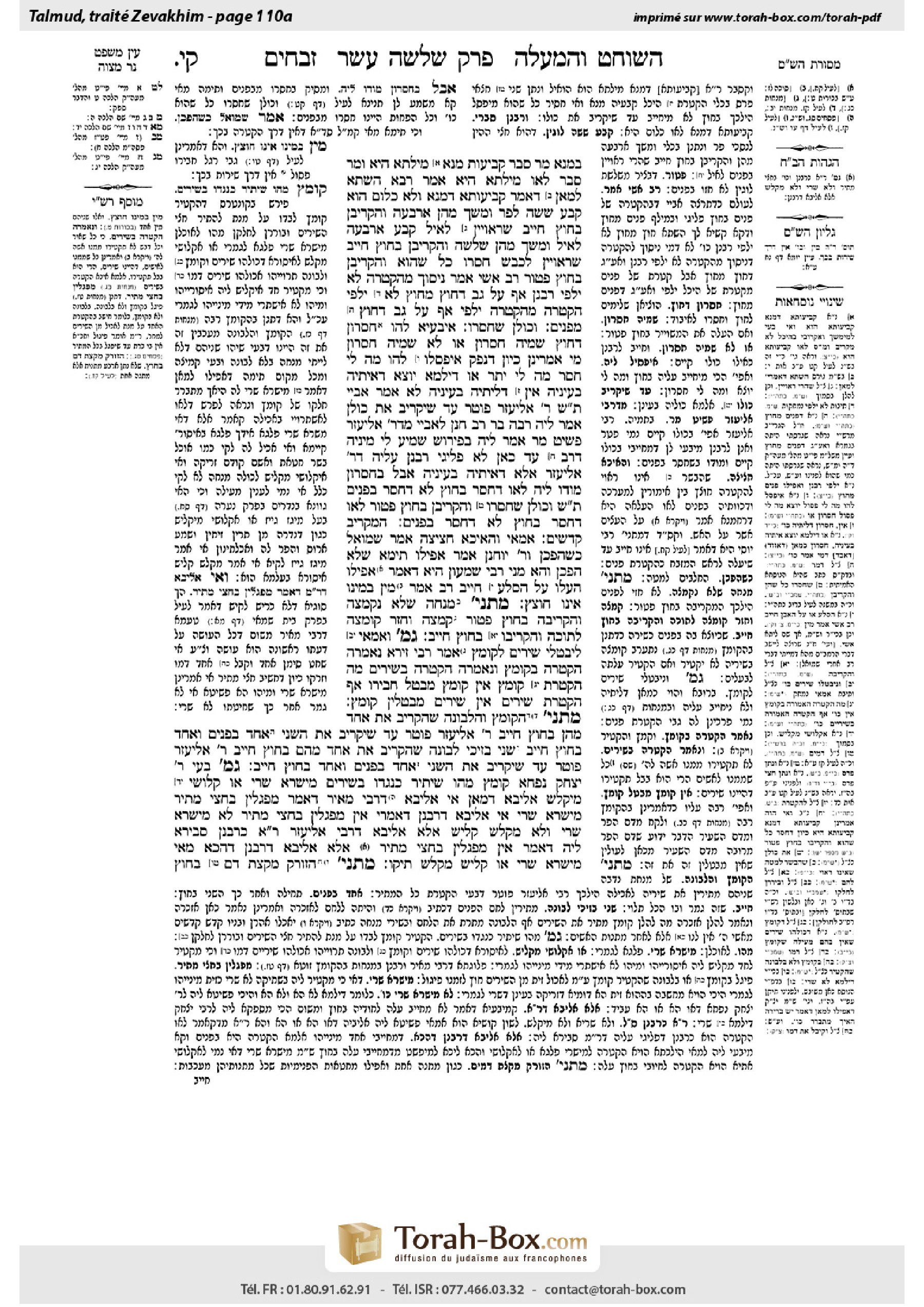
Zevachim 110a: Talmud study for Daf Yomi
Daf Yomi is the daily study of one Talmud folio. Explore 37 tractates with scans, Hebrew text, Sefaria English and AI-generated French translations where annotated.
Passage selection and English or AI-generated French translation are available where the scan has annotations. Daf Study is independent of Torah-Box and Sefaria.
Browse Zevachim · זבחים · All tractatesZevachim 110a text and translations
This page of Zevachim includes the Aramaic text, an English translation and an AI-generated French translation, alongside the scan above.
זבחים ק״י א · Aramaic and Hebrew text
בְּמָנָא. מָר סָבַר: קְבִיעוּת מָנָא מִילְּתָא הִיא, וּמָר סָבַר: לָאו מִילְּתָא הִיא.
אָמַר רָבָא: הַשְׁתָּא לְמַאן דְּאָמַר קְבִיעוּתָא דְּמָנָא וְלָא כְּלוּם הוּא – קָבַע שִׁשָּׁה לְפַר, וּמָשַׁךְ מֵהֶן אַרְבָּעָה וְהִקְרִיבָן בַּחוּץ – חַיָּיב; שֶׁרְאוּיִין לְאַיִל.
קָבַע אַרְבָּעָה לְאַיִל, וּמָשַׁךְ מֵהֶן שְׁלֹשָׁה וְהִקְרִיבָן בַּחוּץ – חַיָּיב, שֶׁרְאוּיִין לְכֶבֶשׂ.
חָסְרוּ כׇּל שֶׁהוּא, וְהִקְרִיבָן בַּחוּץ – פָּטוּר.
רַב אָשֵׁי אָמַר: נִיסּוּךְ מֵהַקְטָרָה לָא יָלְפִי רַבָּנַן.
אַף עַל גַּב דְּחוּץ מֵחוּץ, לָא יָלְפִי. הַקְטָרָה מֵהַקְטָרָה יָלְפִי, אַף עַל גַּב דְּחוּץ מִפְּנִים.
וְכוּלָּן שֶׁחָסְרוּ. אִיבַּעְיָא לְהוּ: חֶסְרוֹן דְּחוּץ, שְׁמֵיהּ חֶסְרוֹן אוֹ לָא שְׁמֵיהּ חֶסְרוֹן?
מִי אָמְרִינַן: כֵּיוָן דִּנְפַק – אִיפַּסְלוּ לְהוּ, מָה לִי חָסֵר מָה לִי יָתֵר; אוֹ דִילְמָא, יוֹצֵא דְּאִיתֵיהּ בְּעֵינֵיהּ – אִין, דְּלֵיתֵיהּ בְּעֵינֵיהּ – לָא?
אָמַר אַבָּיֵי, תָּא שְׁמַע: רַבִּי אֱלִיעֶזֶר פּוֹטֵר עַד שֶׁיַּקְרִיב אֶת כּוּלָּן.
אֲמַר לֵיהּ רַבָּה בַּר רַב חָנָן לְאַבָּיֵי: מִדְּרַבִּי אֱלִיעֶזֶר פָּשֵׁיט מָר?!
אֲמַר לֵיהּ, בְּפֵירוּשׁ שְׁמִיעַ לִי מִינֵּיהּ דְּרַב: עַד כָּאן לָא פְּלִיגִי רַבָּנַן עֲלֵיהּ דְּרַבִּי אֱלִיעֶזֶר– אֶלָּא דְּאִיתֵיהּ בְּעֵינֵיהּ; אֲבָל בְּחֶסְרוֹן – מוֹדוּ לֵיהּ. לָאו דַּחֲסַר בַּחוּץ? לָא, דַּחֲסַר בִּפְנִים.
תָּא שְׁמַע: וְכוּלָּן שֶׁחָסְרוּ וְהִקְרִיבָן בַּחוּץ – פָּטוּר. לָאו דַּחֲסַר בַּחוּץ? לָא, דַּחֲסַר בִּפְנִים.
הַמַּקְרִיב קָדָשִׁים. אַמַּאי? וְהָאִיכָּא חֲצִיצָה!
אָמַר שְׁמוּאֵל: כְּשֶׁהֲפָכָן.
וְרַבִּי יוֹחָנָן אָמַר: אֲפִילּוּ תֵּימָא שֶׁלֹּא הֲפָכָן; וְהָא מַנִּי – רַבִּי שִׁמְעוֹן הִיא, דְּאָמַר: אֲפִילּוּ הֶעֱלָה עַל הַסֶּלַע – חַיָּיב.
רַב אָמַר: מִין בְּמִינוֹ אֵינוֹ חוֹצֵץ.
מַתְנִי׳ מִנְחָה שֶׁלֹּא נִקְמְצָה, וְהִקְרִיבָהּ בַּחוּץ – פָּטוּר. קְמָצָהּ, וְחָזַר קוּמְצָהּ לְתוֹכָהּ, וְהִקְרִיבוֹ בַּחוּץ – חַיָּיב.
גְּמָ׳ וְאַמַּאי? (לִיבַטְּלִי) [לִיבַטְּלוּ] שִׁירַיִם לְקוֹמֶץ!
אָמַר רַבִּי זֵירָא: נֶאֶמְרָה הַקְטָרָה בַּקּוֹמֶץ, וְנֶאֶמְרָה הַקְטָרָה בַּשִּׁירַיִם; מָה הַקְטָרַת קוֹמֶץ – אֵין קוֹמֶץ מְבַטֵּל חֲבֵירוֹ, אַף הַקְטָרַת שִׁירַיִם – אֵין שִׁירַיִם מְבַטְּלִין קוֹמֶץ.
מַתְנִי׳ הַקּוֹמֶץ וְהַלְּבוֹנָה, שֶׁהִקְרִיב אֶת אֶחָד מֵהֶן בַּחוּץ – חַיָּיב. רַבִּי אֱלִיעֶזֶר פּוֹטֵר עַד שֶׁיַּקְרִיב אֶת הַשֵּׁנִי. אֶחָד בִּפְנִים וְאֶחָד בַּחוּץ – חַיָּיב.
שְׁנֵי בְּזִיכֵי לְבוֹנָה, שֶׁהִקְרִיב אֶת אֶחָד מֵהֶם בַּחוּץ – חַיָּיב. רַבִּי אֱלִיעֶזֶר פּוֹטֵר, עַד שֶׁיַּקְרִיב אֶת הַשֵּׁנִי. אֶחָד בִּפְנִים וְאֶחָד בַּחוּץ – חַיָּיב.
גְּמָ׳ בָּעֵי רַבִּי יִצְחָק נַפָּחָא: קוֹמֶץ, מַהוּ שֶׁיַּתִּיר כְּנֶגְדּוֹ בַּשִּׁירַיִם? מִישְׁרָא שָׁרֵי, אוֹ (קלושי) [אִקְּלוֹשֵׁי] מִיקְּלֵשׁ?
אַלִּיבָּא דְּמַאן? אִי אַלִּיבָּא דְּרַבִּי מֵאִיר, דְּאָמַר: מְפַגְּלִין בַּחֲצִי מַתִּיר – מִישְׁרֵא שָׁרֵי!
אִי אַלִּיבָּא דְּרַבָּנַן, דְּאָמְרִי: אֵין מְפַגְּלִין בַּחֲצִי מַתִּיר – לָא מִישְׁרָא שָׁרֵי, וְלָא [אִקְּלוֹשֵׁי] מִקְּלֵשׁ (קָלֵישׁ)!
אֶלָּא אַלִּיבָּא דְּרַבִּי אֱלִיעֶזֶר? רַבִּי אֱלִיעֶזֶר כְּרַבָּנַן סְבִירָא לֵיהּ, דְּאָמַר: אֵין מְפַגְּלִין בַּחֲצִי מַתִּיר!
אֶלָּא אַלִּיבָּא דְּרַבָּנַן דְּהָכָא. מַאי? מִישְׁרָא שָׁרֵי, אוֹ (קָלֵישׁ) [אִקְּלוֹשֵׁי] מִקְּלֵשׁ?
תֵּיקוּ.
מַתְנִי׳ הַזּוֹרֵק מִקְצָת דָּם בַּחוּץ –
Zevachim 110a · English translation
by placing them in a vessel. One Sage, Rabbi Eliezer, holds that the designation of a measure of incense larger than an olive-bulk by placing it in a vessel is a significant matter that renders one obligated to burn all the incense that was placed there. Therefore, one who then burned only an olive-bulk of that incense outside the courtyard is exempt. And one Sage, the Rabbis, holds that it is nothing and does not render one obligated to burn all the incense that was placed in the vessel. Therefore, one who then burned an olive-bulk of that incense outside the courtyard is liable.
Rava said: Now, according to the one who says that designation by placing in a vessel is nothing, if one designated in a vessel six log of wine as a libation to accompany the sacrificing of a bull, which is the required amount, and then removed four log from it and brought those four log as a libation outside the courtyard, he would be liable, as a libation of four log of wine is fit for the sacrificing of a ram (see Numbers 28:14).
Similarly, if one designated by placing in a vessel four log of wine for a libation to accompany the sacrificing of a ram and then removed three log of wine from it and brought those three log as a libation outside the courtyard, he would be liable, as three log of wine is a fit libation for the sacrificing of a lamb (see Numbers 28:14).
But if those three log were lacking any amount, and one brought them as a libation outside the courtyard, he would be exempt because less than three log of wine is never a fit libation.
Rava inferred from the baraita that the Rabbis do not derive the measure for liability for a rite performed in the outer sanctum, i.e., the pouring of a libation, from one performed in the outer sanctum, i.e., the burning of incense. From that he concluded that the Rabbis would certainly not derive the measure for liability for a rite performed in the inner sanctum from a rite performed in the outer sanctum. This refuted Abaye’s claim that the Rabbis derive the measure for liability for burning outside the incense of the inner sanctum from the measure for liability for burning outside the incense of the outer sanctum. Rav Ashi said in defense of Abaye’s opinion: Indeed, as is indicated by the baraita, the Rabbis do not derive the measure for liability for pouring a libation outside the courtyard from the measure for liability for burning incense, which are two different rites performed in the outer sanctum.
Rav Ashi continues: Even though the Rabbis do not derive the halakhot of a rite performed in the outer sanctum from a different rite performed in the outer sanctum, they do derive the measure for liability for burning the incense of the outer sanctum from the identical rite of burning of the incense of the inner sanctum, even though it involves deriving the halakhot of a rite performed in the outer sanctum from one performed in the inner sanctum.
§ After enumerating various items that are burned entirely on the altar, the mishna states: And with regard to any of these offerings that were lacking any amount, if one sacrifices it outside the courtyard, he is exempt. Concerning this ruling, a dilemma was raised before the Sages: Is a lack that occurs to an offering outside the courtyard considered a lack in order to exempt one who sacrifices the remainder outside the courtyard? Or is it not considered a lack?
Do we say that once an offering emerges from the courtyard it is in any event disqualified, and yet the Torah deems one liable for offering it there, so what difference is there to me if there is an additional disqualification of being lacking and what difference is there to me if it is still complete? Or perhaps it is only with regard to emerging from the courtyard, where it is still in its original state, that yes, one is liable despite the fact that it was disqualified by emerging from the courtyard, but where it is not in its original state, one would not be liable.
Abaye said: Come and hear a resolution from the mishna: Rabbi Eliezer deems him exempt unless he sacrifices the whole of any one of these items outside the Temple. It is apparent then that the offering must remain complete.
Rabba bar Rav Ḥanan said to Abaye: Can the Master resolve the dilemma from the opinion of Rabbi Eliezer? The Rabbis disagree with Rabbi Eliezer, and hold that one is liable for sacrificing even an olive-bulk, and the dilemma was raised according to their opinion.
Abaye said to him: I heard explicitly from Rav that the Rabbis disagree with Rabbi Eliezer only where the offering is still in its original form, i.e., complete. But where it is lacking, they concede to him that one is not liable. The Gemara attempts to bring a proof from here: Was Rav not referring to a case where it became lacking outside the courtyard? If so, it is evident that even according to the Rabbis a lack that occurs outside is considered a lack. The Gemara rejects this: No, he was referring to a case where it became lacking inside the courtyard. Accordingly, this mishna cannot serve as a proof.
The Gemara suggests: Come and hear a resolution from the continuation of the mishna: And with regard to any of these offerings that were lacking any amount, if one sacrifices them outside the courtyard, he is exempt. The Gemara attempts to bring a proof from here: Is the mishna not referring to a case where it became lacking outside the courtyard? If so, it is evident that even a lack that occurs outside is considered a lack. The Gemara rejects this: No, it is referring to a case where it became lacking inside the courtyard. Accordingly, this cannot serve as a proof.
§ The mishna teaches: One who sacrifices sacrificial meat, which is eaten, and sacrificial portions, i.e., those that are to be burned on the altar, outside the courtyard, is liable for the sacrifice of the sacrificial portions, but not for the meat. The Gemara asks: Why is he liable? If the meat is placed directly on the altar’s fire and then the sacrificial portions are placed upon the meat, isn’t there an interposition between the altar and the sacrificial portions? Since if they were offered in the Temple in that manner, one would not have fulfilled the obligation, one should not be liable if he offers them up in this manner outside the Temple.
Shmuel said: The mishna is referring to a case where he turned them over and the sacrificial portions lay directly on the altar’s fire.
Rabbi Yoḥanan said there is another explanation: You may even say that the mishna is referring to a case where they did not turn them over. And in accordance with whose opinion is this mishna? It is in accordance with the opinion of Rabbi Shimon, who says (108a) that even if one offered it up on a rock he is liable. According to him, it is clear that in order for one to be liable, the mode of offering up performed outside the Temple does not need to entirely parallel the mode of offering up in the Temple.
Rav said there is another explanation: Even in the Temple, burning the sacrificial meat and sacrificial portions in this manner would be valid as both items are from the same animal, and a substance in contact with the same type of substance does not interpose.
MISHNA: If there is a meal offering from which a handful was not removed, and one sacrificed it outside the Temple courtyard, he is exempt from liability, because until the handful is actually removed it is not fit to be burned on the altar inside the Temple. But if a priest took a handful from it and then returned its handful into the remainder of the meal offering, and one sacrificed the entire mixture outside the courtyard, he is liable, as once the handful has been removed it is fit to be burned on the altar inside the Temple, and one is liable for offering it up outside even though it is mixed into the remainder.
GEMARA: The Gemara asks about the final clause: But why is he liable? Let the remainder of the meal offering, which is certainly the majority of the mixture, nullify the handful.
Rabbi Zeira said: A term of burning is stated with regard to the handful removed from the meal offering, and a term of burning is stated with regard to the remainder of the meal offering. With regard to the handful, referred to by the Torah as “the memorial part,” it is written: “And the priest shall burn the memorial part upon the altar” (Leviticus 2:2), and with regard to the remainder of the meal offering it is written: “Do not burn it as a fire to the Lord” (Leviticus 2:11). This provides a verbal analogy that teaches that just as with regard to the burning of the handful, if two handfuls are mixed together one handful does not nullify another, so too, with regard to the burning of the remainder, if the remainder and the handful are mixed together, the remainder does not nullify the handful.
MISHNA: The burning of both the handful and the frankincense permits the consumption of the remainder of the meal offering by the priests. With regard to the handful and the frankincense, in a case where one sacrificed only one of them outside the Temple courtyard, he is liable. Rabbi Eliezer exempts from liability one who burns only one of them until he also sacrifices the second. Since the remainder of the meal offering becomes permitted only once both have been burned, he considers each one alone to be an incomplete offering, and he holds one is not liable for sacrificing only one of them. Rabbi Eliezer concedes that if one sacrificed one inside the courtyard and one outside the courtyard, he is liable.
The burning of two bowls of frankincense permits the consumption of the shewbread. With regard to the two bowls of frankincense, in a case where one sacrificed only one of them outside the courtyard, he is liable. Rabbi Eliezer exempts from liability one who burns only one of them until he also sacrifices the second, since the shewbread becomes permitted only once both bowls of frankincense are burned. Rabbi Eliezer concedes that if one sacrificed one inside the courtyard and one outside the courtyard, he is liable.
GEMARA: The mishna is based on the fact that it is permitted for the priests to consume the remainder of the meal offering only once both the handful and the frankincense have been burned. With regard to this, Rabbi Yitzḥak Nappaḥa raises a dilemma: If one burned the handful but not the frankincense, what is the halakha with regard to whether this will permit the consumption of the corresponding half of the remainder? Since the burning of both the handful and the frankincense permits the entire remainder, it seems that each one of them affects half of the remainder. Accordingly, it is unclear whether burning one of them will entirely permit half of the remainder, or whether it will merely weaken the prohibition concerning the remainder, and it will still be prohibited to eat any of it.
The Gemara asks: In accordance with whose opinion did Rabbi Yitzḥak Nappaḥa raise this dilemma? If it is in accordance with the opinion of Rabbi Meir, who says: One can render an offering piggul by having piggul intention during half of two acts that together permit the offering for consumption, i.e., during either one of them, then it should be obvious that the offering of the handful alone should entirely permit half of the remainder. The fact that Rabbi Meir holds that intention during just one of the acts can render the offering piggul demonstrates that he holds that each act alone has the power to permit part of the offering. It is apparent, then, the dilemma was not raised according to Rabbi Meir’s opinion.
If it is in accordance with the opinion of the Rabbis, who say: One cannot render an offering piggul by having piggul intention during half of two acts that together permit the offering for consumption; rather, one must have piggul intention during both acts, then it is evident that neither act alone has the power to affect the offering, and so the burning of the handful alone should neither permit any of the remainder nor weaken the prohibition that applies to it. It is apparent, then, the dilemma was not raised according to the Rabbis’ opinion.
Rather, the dilemma was raised in accordance with the opinion of Rabbi Eliezer as taught in the mishna. Rabbi Eliezer rules that one who sacrifices outside only the handful or the frankincense is not liable. Evidently, he holds that neither of these alone can permit the consumption of the meal offering. The Gemara rejects this suggestion as well: Rabbi Eliezer holds in accordance with the opinion of the Rabbis, who say: One cannot render an offering piggul by having piggul intention during half of two acts that together permit the offering for consumption. Accordingly, he would hold that the offering of only the handful neither permits any of the remainder, nor weakens the prohibition concerning it, and it would not make sense to raise the dilemma according to him.
Rather, it must be that the dilemma was raised in accordance with the opinion of the Rabbis that is taught here in the mishna. They hold that one is liable even for sacrificing outside only the handful or only the frankincense. Evidently, they hold that each one alone has the power to affect the status of the remainder. Accordingly, Rabbi Yitzḥak Nappaḥa asked concerning a case where one of them is burned on the altar in the Temple, what is the halakha? Does it entirely permit half of the remainder, or does it weaken the prohibition concerning the entire remainder?
The Gemara concludes: The dilemma shall stand unresolved.
MISHNA: One who sprinkles part of the blood of an offering, e.g., one sprinkling instead of four, outside the Temple courtyard
Zevachim 110a · Traduction française (IA)
en les plaçant dans un récipient. Un Sage, Rabbi Eliezer, considère que le fait de désigner, en la plaçant dans un récipient, une quantité d’encens supérieure à une olive est significatif et oblige à brûler tout l’encens qui y a été placé. Par conséquent, celui qui ne brûle ensuite qu’une olive de cet encens à l’extérieur de la cour est exempt. Un autre Sage, les Rabbins, considère que cela n’a aucune importance et n’oblige pas à brûler tout l’encens placé dans le récipient. Par conséquent, celui qui brûle ensuite une olive de cet encens à l’extérieur de la cour est passible.
Rava dit : À présent, selon celui qui affirme que la désignation par placement dans un récipient n’a aucune importance, si quelqu’un désigne dans un récipient six log de vin comme libation accompagnant le sacrifice d’un taureau, quantité requise, puis en retire quatre log et apporte ces quatre log comme libation à l’extérieur de la cour, il est passible, car une libation de quatre log de vin convient au sacrifice d’un bélier (voir Nombres 28:14).
De même, si quelqu’un désigne dans un récipient quatre log de vin comme libation accompagnant le sacrifice d’un bélier, puis en retire trois log et apporte ces trois log comme libation à l’extérieur de la cour, il est passible, car trois log de vin constituent une libation valable pour le sacrifice d’un agneau (voir Nombres 28:14).
Mais s’il manque ne serait-ce qu’une infime quantité de ces trois log et que quelqu’un les apporte comme libation à l’extérieur de la cour, il est exempt, car une quantité de vin inférieure à trois log ne constitue jamais une libation valable.
Rava déduit de la baraïta que les Rabbins ne déduisent pas la mesure requise pour engager la responsabilité au titre d’un rite accompli dans le sanctuaire extérieur, à savoir le versement d’une libation, de celle d’un autre rite accompli dans le sanctuaire extérieur, à savoir la combustion de l’encens. Il en conclut que les Rabbins ne déduiraient certainement pas la mesure requise pour engager la responsabilité au titre d’un rite accompli dans le sanctuaire intérieur de celle d’un rite accompli dans le sanctuaire extérieur. Cela réfute l’affirmation d’Abayé selon laquelle les Rabbins déduisent la mesure requise pour engager la responsabilité lorsqu’on brûle à l’extérieur l’encens du sanctuaire intérieur de celle requise lorsqu’on brûle à l’extérieur l’encens du sanctuaire extérieur. Rav Ashi défend l’opinion d’Abayé : en effet, comme l’indique la baraïta, les Rabbins ne déduisent pas la mesure requise pour engager la responsabilité lorsqu’on verse une libation à l’extérieur de la cour de celle requise lorsqu’on brûle de l’encens, car il s’agit de deux rites différents accomplis dans le sanctuaire extérieur.
Rav Ashi poursuit : même si les Rabbins ne déduisent pas les halakhot d’un rite accompli dans le sanctuaire extérieur de celles d’un autre rite accompli dans le sanctuaire extérieur, ils déduisent la mesure requise pour engager la responsabilité lorsqu’on brûle l’encens du sanctuaire extérieur du rite identique consistant à brûler l’encens du sanctuaire intérieur, bien que cela revienne à déduire les halakhot d’un rite accompli dans le sanctuaire extérieur de celles d’un rite accompli dans le sanctuaire intérieur.
§ Après avoir énuméré divers éléments entièrement brûlés sur l’autel, la Michna enseigne : « Et pour chacune de ces offrandes, s’il manque ne serait-ce qu’une infime quantité, celui qui la sacrifie à l’extérieur de la cour est exempt. » À propos de cette règle, les Sages soulevèrent un dilemme : si une offrande diminue à l’extérieur de la cour, cette diminution est-elle prise en compte et permet-elle d’exempter celui qui sacrifie le reste à l’extérieur de la cour ? Ou bien n’est-elle pas prise en compte ?
Faut-il dire qu’une fois qu’une offrande est sortie de la cour, elle est de toute façon disqualifiée, et que pourtant la Torah rend passible celui qui la présente en offrande à cet endroit ? Dès lors, quelle différence cela fait-il qu’elle soit également disqualifiée parce qu’il en manque une partie, ou qu’elle soit encore complète ? Ou peut-être que, dans le cas où elle est sortie de la cour tout en conservant son état d’origine, on est passible malgré le fait qu’elle ait été disqualifiée par sa sortie de la cour ; mais si elle ne conserve pas son état d’origine, on n’est pas passible.
Abayé dit : Venez et écoutez une résolution tirée de la Michna : Rabbi Eliezer l’exempte, à moins qu’il ne sacrifie à l’extérieur du Temple la totalité de l’un de ces éléments. Il semble donc que l’offrande doit rester complète.
Rabba bar Rav Ḥanan dit à Abayé : Le Maître peut-il résoudre le dilemme à partir de l’opinion de Rabbi Eliezer ? Les Rabbins sont en désaccord avec Rabbi Eliezer et considèrent qu’on est passible même pour le sacrifice d’une olive ; or, le dilemme a été soulevé selon leur opinion.
Abayé lui dit : J’ai entendu explicitement de Rav que les Rabbins ne sont en désaccord avec Rabbi Eliezer que lorsque l’offrande conserve sa forme d’origine, c’est-à-dire qu’elle est complète. Mais lorsqu’il en manque une partie, ils reconnaissent qu’on n’est pas passible. La Guemara tente d’en tirer une preuve : Rav ne parlait-il pas d’un cas où elle avait diminué à l’extérieur de la cour ? Si oui, il est évident que, même selon les Rabbins, une diminution survenue à l’extérieur est prise en compte. La Guemara rejette cette interprétation : non, il parlait d’un cas où elle avait diminué à l’intérieur de la cour. Par conséquent, cette Michna ne peut servir de preuve.
La Guemara propose : Venez et écoutez une résolution tirée de la suite de la Michna : « Et pour chacune de ces offrandes, s’il manque ne serait-ce qu’une infime quantité, celui qui la sacrifie à l’extérieur de la cour est exempt. » La Guemara tente d’en tirer une preuve : la Michna ne parle-t-elle pas d’un cas où elle a diminué à l’extérieur de la cour ? Si oui, il est évident qu’une diminution survenue à l’extérieur est également prise en compte. La Guemara rejette cette interprétation : non, il s’agit d’un cas où elle a diminué à l’intérieur de la cour. Par conséquent, cela ne peut servir de preuve.
§ La Michna enseigne : celui qui sacrifie à l’extérieur de la cour de la viande sacrificielle, destinée à être consommée, et des portions sacrificielles, c’est-à-dire celles qui doivent être brûlées sur l’autel, est passible pour le sacrifice des portions sacrificielles, mais non pour celui de la viande. La Guemara demande : pourquoi est-il passible ? Si la viande est placée directement sur le feu de l’autel, puis que les portions sacrificielles sont posées sur la viande, n’y a-t-il pas interposition entre l’autel et les portions sacrificielles ? Puisque, si elles étaient offertes dans le Temple de cette manière, on ne se serait pas acquitté de l’obligation, on ne devrait pas être passible si on les offre ainsi à l’extérieur du Temple.
Chmouel dit : la Michna parle d’un cas où il les a retournées, de sorte que les portions sacrificielles reposaient directement sur le feu de l’autel.
Rabbi Yoḥanan donne une autre explication : on peut même dire que la Michna parle d’un cas où il ne les a pas retournées. Et selon l’opinion de qui cette Michna est-elle ? Elle est conforme à l’opinion de Rabbi Chimon, qui dit (108a) que même si quelqu’un l’offre sur un rocher, il est passible. Selon lui, il est clair que, pour être passible, la manière de l’offrir à l’extérieur du Temple n’a pas besoin de correspondre entièrement à la manière de l’offrir dans le Temple.
Rav donne une autre explication : même dans le Temple, brûler ainsi la viande sacrificielle et les portions sacrificielles serait valable, puisque les deux éléments proviennent du même animal et qu’une substance en contact avec une substance de même nature ne constitue pas une interposition.
MICHNA : Si une offrande végétale n’a pas été prélevée d’une poignée et que quelqu’un la sacrifie à l’extérieur de la cour du Temple, il est exempt de responsabilité, car tant que la poignée n’a pas été effectivement prélevée, elle n’est pas propre à être brûlée sur l’autel à l’intérieur du Temple. Mais si un prêtre en a prélevé une poignée, puis l’a remise dans le reste de l’offrande végétale, et que quelqu’un sacrifie le mélange entier à l’extérieur de la cour, il est passible, car, une fois la poignée prélevée, elle est propre à être brûlée sur l’autel à l’intérieur du Temple, et l’on est passible de l’offrir à l’extérieur même si elle est mélangée au reste.
GUEMARA : La Guemara interroge sur la dernière clause : mais pourquoi est-il passible ? Que le reste de l’offrande végétale, qui constitue certainement la majeure partie du mélange, annule la poignée.
Rabbi Zeira dit : un terme désignant la combustion est employé à propos de la poignée prélevée de l’offrande végétale, et un terme désignant la combustion est employé à propos du reste de l’offrande végétale. Au sujet de la poignée, que la Torah appelle « la part commémorative », il est écrit : « Le prêtre brûlera la part commémorative sur l’autel » (Lévitique 2:2), et au sujet du reste de l’offrande végétale, il est écrit : « Tu ne la brûleras pas comme un feu pour le Seigneur » (Lévitique 2:11). Cette analogie verbale enseigne que, de même que, pour la combustion de la poignée, si deux poignées sont mélangées, l’une n’annule pas l’autre, de même, pour la combustion du reste, si le reste et la poignée sont mélangés, le reste n’annule pas la poignée.
MICHNA : La combustion de la poignée et de l’encens permet aux prêtres de consommer le reste de l’offrande végétale. Si quelqu’un ne sacrifie à l’extérieur de la cour du Temple que l’un des deux, la poignée ou l’encens, il est passible. Rabbi Eliezer exempte celui qui n’en brûle qu’un seul jusqu’à ce qu’il sacrifie également le second. Puisque le reste de l’offrande végétale n’est permis qu’une fois les deux brûlés, il considère que chacun, pris séparément, constitue une offrande incomplète, et estime qu’on n’est pas passible pour le sacrifice d’un seul des deux. Rabbi Eliezer reconnaît que si quelqu’un en a sacrifié un à l’intérieur de la cour et l’autre à l’extérieur de la cour, il est passible.
La combustion des deux coupes d’encens permet la consommation des pains de proposition. Si quelqu’un ne sacrifie à l’extérieur de la cour que l’une des deux coupes d’encens, il est passible. Rabbi Eliezer exempte celui qui n’en brûle qu’une seule jusqu’à ce qu’il sacrifie également la seconde, puisque les pains de proposition ne deviennent permis qu’une fois les deux coupes d’encens brûlées. Rabbi Eliezer reconnaît que si quelqu’un en a sacrifié une à l’intérieur de la cour et l’autre à l’extérieur de la cour, il est passible.
GUEMARA : La Michna repose sur le fait que les prêtres ne sont autorisés à consommer le reste de l’offrande végétale qu’une fois la poignée et l’encens brûlés tous deux. À ce sujet, Rabbi Yitsḥak Nappaḥa soulève un dilemme : si quelqu’un a brûlé la poignée, mais pas l’encens, quelle est la halakha quant à savoir si cela permet la consommation de la moitié correspondante du reste ? Puisque la combustion de la poignée et de l’encens permet la consommation de la totalité du reste, il semble que chacun des deux ait un effet sur la moitié du reste. Il n’est donc pas clair si la combustion de l’un d’eux permet entièrement la moitié du reste, ou si elle ne fait qu’atténuer l’interdit qui pèse sur le reste, celui-ci demeurant interdit à la consommation dans son intégralité.
La Guemara demande : selon l’opinion de qui Rabbi Yitsḥak Nappaḥa a-t-il soulevé ce dilemme ? Si c’est selon l’opinion de Rabbi Meïr, qui dit qu’on peut rendre une offrande piggoul par une intention de piggoul pendant la moitié de deux actes qui, ensemble, rendent l’offrande propre à être consommée, c’est-à-dire pendant l’un ou l’autre de ces actes, alors il devrait être évident que la seule offrande de la poignée permet entièrement la moitié du reste. Le fait que Rabbi Meïr considère qu’une intention durant un seul des actes suffit à rendre l’offrande piggoul montre qu’il estime que chaque acte, à lui seul, peut rendre une partie de l’offrande permise. Il est donc manifeste que le dilemme n’a pas été soulevé selon l’opinion de Rabbi Meïr.
Si c’est selon l’opinion des Rabbins, qui disent qu’on ne peut pas rendre une offrande piggoul par une intention de piggoul pendant la moitié de deux actes qui, ensemble, rendent l’offrande propre à être consommée, mais qu’il faut avoir une intention de piggoul pendant les deux actes, alors il est évident qu’aucun des deux actes, à lui seul, ne peut avoir d’effet sur l’offrande. La seule combustion de la poignée ne devrait donc ni permettre une partie du reste ni atténuer l’interdit qui s’y applique. Il est donc manifeste que le dilemme n’a pas été soulevé selon l’opinion des Rabbins.
Le dilemme a plutôt été soulevé selon l’opinion de Rabbi Eliezer, telle qu’enseignée dans la Michna. Rabbi Eliezer statue que celui qui ne sacrifie à l’extérieur que la poignée ou l’encens n’est pas passible. Il semble donc qu’il estime qu’aucun de ces éléments, à lui seul, ne peut permettre la consommation de l’offrande végétale. La Guemara rejette également cette hypothèse : Rabbi Eliezer est conforme à l’opinion des Rabbins, qui disent qu’on ne peut pas rendre une offrande piggoul par une intention de piggoul pendant la moitié de deux actes qui, ensemble, rendent l’offrande propre à être consommée. Il est donc d’avis que la seule offrande de la poignée ne permet aucune partie du reste et n’atténue pas non plus l’interdit qui s’y applique ; il n’aurait donc pas été logique de soulever le dilemme selon son opinion.
Il faut plutôt dire que le dilemme a été soulevé selon l’opinion des Rabbins enseignée ici dans la Michna. Ils estiment qu’on est passible même si l’on ne sacrifie à l’extérieur que la poignée ou que l’encens. Il semble donc qu’ils considèrent que chacun de ces éléments, à lui seul, peut modifier le statut du reste. Rabbi Yitsḥak Nappaḥa demande donc ce qu’il en est dans le cas où l’un des deux est brûlé sur l’autel dans le Temple : quelle est la halakha ? Cela permet-il entièrement la moitié du reste, ou bien atténue-t-il l’interdit pesant sur la totalité du reste ?
La Guemara conclut : le dilemme restera sans réponse.
MICHNA : Celui qui asperge une partie du sang d’une offrande, par exemple une fois au lieu de quatre, à l’extérieur de la cour du Temple
Traduction française générée par IA à partir de l’édition anglaise de Sefaria. Vérifie toujours un passage avec le texte source.
Text from Sefaria: William Davidson Edition - Vocalized Aramaic (CC BY NC); William Davidson Edition - English (CC BY NC).