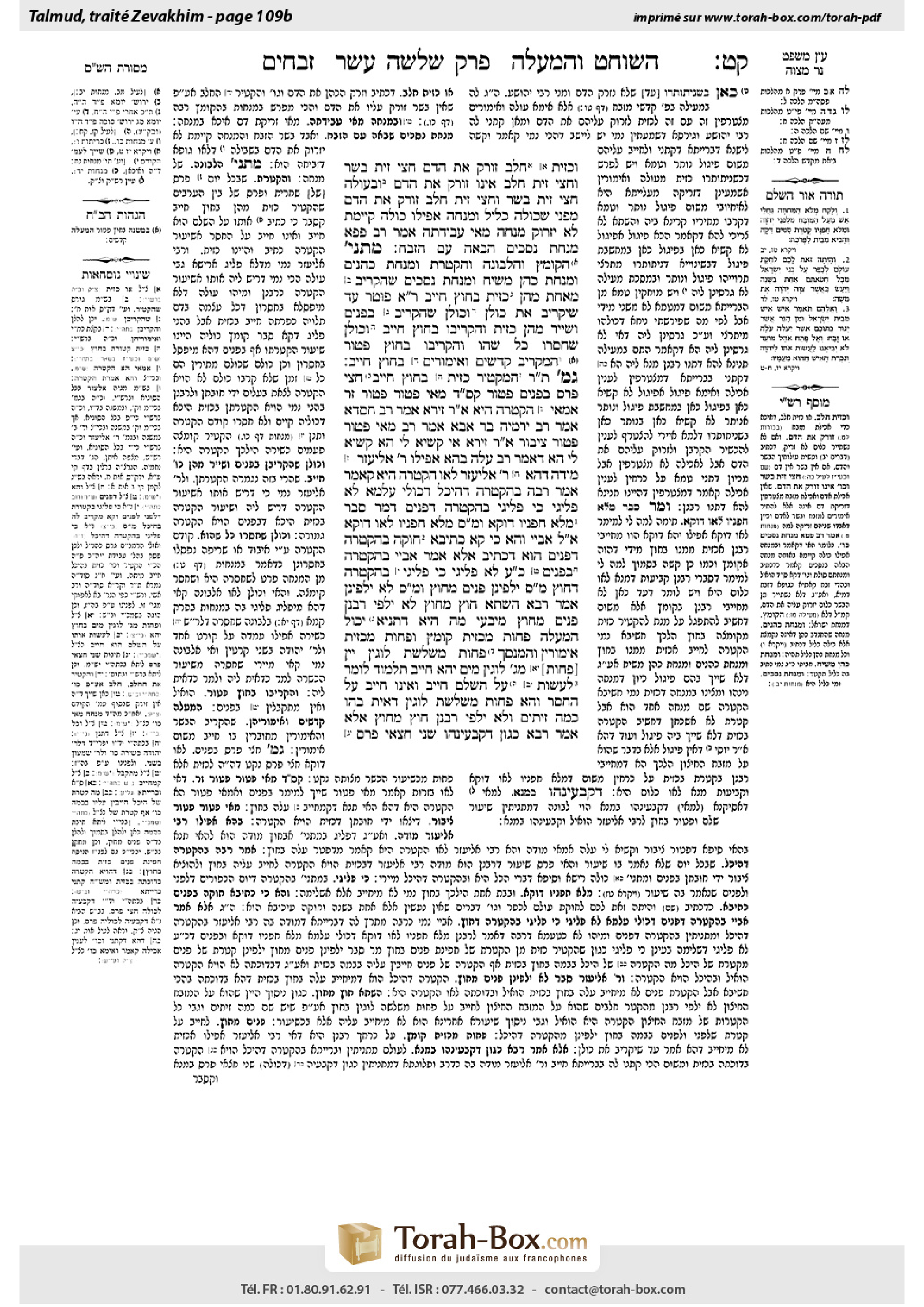
Zevachim 109b: Talmud study for Daf Yomi
Daf Yomi is the daily study of one Talmud folio. Explore 37 tractates with scans, Hebrew text, Sefaria English and AI-generated French translations where annotated.
Passage selection and English or AI-generated French translation are available where the scan has annotations. Daf Study is independent of Torah-Box and Sefaria.
Browse Zevachim · זבחים · All tractatesZevachim 109b text and translations
This page of Zevachim includes the Aramaic text, an English translation and an AI-generated French translation, alongside the scan above.
זבחים ק״ט ב · Aramaic and Hebrew text
וּכְזַיִת חֵלֶב – זוֹרֵק אֶת הַדָּם.
חֲצִי זַיִת בָּשָׂר וַחֲצִי זַיִת חֵלֶב – אֵינוֹ זוֹרֵק אֶת הַדָּם. וּבְעוֹלָה, חֲצִי זַיִת בָּשָׂר וַחֲצִי זַיִת חֵלֶב – זוֹרֵק אֶת הַדָּם, מִפְּנֵי שֶׁכּוּלָּהּ כָּלִיל. וּמִנְחָה, אֲפִילּוּ כּוּלָּהּ קַיֶּימֶת – לֹא יִזְרוֹק.
מִנְחָה מַאי עֲבִידְתַּהּ? אָמַר רַב פָּפָּא: מִנְחַת נְסָכִים הַבָּאָה עִם הַזֶּבַח.
מַתְנִי׳ הַקּוֹמֶץ, וְהַלְּבוֹנָה, וְהַקְּטֹרֶת, וּמִנְחַת כֹּהֲנִים, וּמִנְחַת כֹּהֵן מָשִׁיחַ, וּמִנְחַת נְסָכִים, שֶׁהִקְרִיב מֵאַחַת מֵהֶן כְּזַיִת בַּחוּץ – חַיָּיב. רַבִּי אֱלִיעֶזֶר פּוֹטֵר, עַד שֶׁיַּקְרִיב אֶת כּוּלָּן. וְכוּלָּן שֶׁהִקְרִיב בִּפְנִים וְשִׁיֵּיר מֵהֶן כְּזַיִת, וְהִקְרִיבוֹ בַּחוּץ – חַיָּיב.
וְכוּלָּן שֶׁחָסְרוּ כׇּל שֶׁהוּ, וְהִקְרִיבוֹ בַּחוּץ – פָּטוּר.
הַמַּקְרִיב קָדָשִׁים וְאֵימוּרִים בַּחוּץ – חַיָּיב.
גְּמָ׳ תָּנוּ רַבָּנַן: הַמַּקְטִיר כְּזַיִת בַּחוּץ – חַיָּיב. חֲצִי פְרָס בִּפְנִים – פָּטוּר.
קָא סָלְקָא דַּעְתִּין: מַאי פָּטוּר – פָּטוּר זָר; אַמַּאי? הַקְטָרָה הִיא!
אָמַר רַבִּי זֵירָא אָמַר רַב חִסְדָּא אָמַר רַב יִרְמְיָה בַּר אַבָּא אָמַר רַב: מַאי פָּטוּר – פָּטוּר צִיבּוּר.
אָמַר רַבִּי זֵירָא, אִי קַשְׁיָא לִי – הָא קַשְׁיָא לִי: הָא דְּאָמַר רַב עֲלַהּ, בְּהָא – אֲפִילּוּ רַבִּי אֱלִיעֶזֶר מוֹדֶה; דְּהָא רַבִּי אֱלִיעֶזֶר לָאו הַקְטָרָה הִיא קָאָמַר!
אָמַר רַבָּה: בְּהַקְטָרָה דְּהֵיכָל – דְּכוּלֵּי עָלְמָא לָא פְּלִיגִי.
כִּי פְּלִיגִי – בְּהַקְטָרָה דִּפְנִים; דְּמָר סָבַר: ״מְלֹא חׇפְנָיו״ דַּוְקָא, וּמָר סָבַר: ״מְלֹא חׇפְנָיו״ לָאו דַּוְקָא.
אֲמַר לֵיהּ אַבָּיֵי: וְהָא כִּי קָא כְתִיבָא ״חֻקָּה״ – בְּהַקְטָרָה דִּפְנִים הוּא דִּכְתִיב!
אֶלָּא אָמַר אַבָּיֵי: בְּהַקְטָרָה בִּפְנִים – כּוּלֵּי עָלְמָא לָא פְּלִיגִי.
כִּי פְּלִיגִי – בְּהַקְטָרָה דְּחוּץ; מָר סָבַר: יָלְפִינַן פְּנִים מִחוּץ, וּמָר סָבַר: לָא יָלְפִינַן.
אָמַר רָבָא: הַשְׁתָּא חוּץ מֵחוּץ לָא יָלְפִי רַבָּנַן, פְּנִים מֵחוּץ מִיבְּעֵי?!
מָה הִיא? דְּתַנְיָא: יָכוֹל הַמַּעֲלֶה פָּחוֹת מִכְּזַיִת קוֹמֶץ וּפָחוֹת מִכְּזַיִת אֵימוּרִין, וְהַמְנַסֵּךְ פָּחוֹת מִשְּׁלֹשֶׁת לוּגִּין יַיִן [פָּחוֹת] מִשְּׁלֹשָׁה לוּגִּין מַיִם – יְהֵא חַיָּיב? תַּלְמוּד לוֹמַר: ״לַעֲשׂוֹת״ – עַל הַשָּׁלֵם חַיָּיב, וְאֵינוֹ חַיָּיב עַל הֶחָסֵר.
וְהָא פָּחוֹת מִשְּׁלֹשֶׁת לוּגִּין, דְּאִית בְּהוּ כַּמָּה זֵיתִים – וְלָא יָלְפִי רַבָּנַן חוּץ מִחוּץ!
אֶלָּא אָמַר רָבָא: כְּגוֹן דְּקַבְעִינְהוּ שְׁנֵי חֲצָאֵי פְּרָס
Zevachim 109b · English translation
or from which there remains only an olive-bulk of sacrificial portions, e.g., fat to be burned on the altar, one still sprinkles the blood of the offering on the altar and one thereby fulfills his obligation.
But if all that remains is half an olive-bulk of meat and half an olive-bulk of fat, one may not sprinkle the blood, as since the meat and the sacrificial portions are used differently, the former being eaten and the latter being burned on the altar, they cannot combine to form the minimum requirement of an olive-bulk. This applies only to offerings whose meat is eaten. But for a burnt offering, even if all that remains is half an olive-bulk of flesh and half an olive-bulk of fat, one sprinkles the blood, because since the offering is consumed upon the altar in its entirety, all of its parts combine together. And with regard to a meal offering, even if all of it still exists, one does not sprinkle the blood. It is apparent that Rabbi Yehoshua’s opinion in this baraita is the one expressed in the baraita.
The Gemara clarifies the final clause of the baraita: What is the relevance of a meal offering to the sprinkling of blood? In a meal offering there is no blood at all. Rav Pappa said: The baraita is referring to a meal offering brought with the libations that accompany an animal offering. If the entire body of the offering was destroyed but the meal offering that accompanied it remains, one might have thought that it would be sufficient to allow for the sprinkling of the blood. The baraita teaches that this is incorrect.
MISHNA: With regard to the handful of a meal offering, the frankincense, the incense, the meal offering of priests, the meal offering of the anointed priest, and the meal offering brought with the libations that accompany animal offerings, in a case where one sacrificed even an olive-bulk from any one of these, which should be sacrificed on the altar, outside the Temple, he is liable, as the burning of an olive-bulk is considered a proper burning. Rabbi Eliezer deems him exempt unless he sacrifices the whole of any one of these items outside the Temple. But Rabbi Eliezer concedes that with regard to any of them that one sacrificed inside the courtyard but left over an olive-bulk from them and then sacrificed that olive-bulk outside the courtyard, he is liable.
And with regard to any of these offerings that were lacking any amount, if one sacrifices it outside the courtyard, he is exempt.
One who sacrifices sacrificial meat, which is eaten, and sacrificial portions, i.e., those that are to be burned on the altar, outside the courtyard, is liable for the sacrifice of the sacrificial portions. But he is not liable for sacrificing the meat.
GEMARA: The Sages taught in a baraita: Each morning and afternoon, a peras, i.e., half a maneh, of incense must be burned in the Sanctuary. Nevertheless, one who burns only an olive-bulk of incense outside the courtyard is liable. If one burns half a peras inside the Temple, he is exempt.
The Gemara addresses the latter clause of the baraita: It enters our mind to explain: What is meant by: He is exempt? It means that a non-priest, for whom it is prohibited to perform the sacrificial rites in the Temple, is exempt if he burns incense inside the Temple. The Gemara rejects this: Why should he be exempt; this is an act of sacrificial burning? Even though he burned less than a peras, it is apparent from the first clause of the baraita that burning even an olive-bulk is considered an act of sacrificial burning.
Rabbi Zeira said that Rav Ḥisda said that Rav Yirmeya, son of Abba, said that Rav said: What is meant by: He is exempt? It means that if a priest burns half a peras inside the Temple, the community is thereby exempt from its obligation to burn incense despite the fact that less than the required amount was burned.
Rabbi Zeira said: If there is something difficult for me with regard to this baraita, this is difficult for me: That which Rav said concerning this baraita: With regard to this halakha, that if a priest burns less than a peras of incense the community fulfills its obligation, even Rabbi Eliezer concedes. Rabbi Zeira explains: This is difficult for me as Rabbi Eliezer rules in the mishna that one who burns an olive-bulk of incense outside is exempt. Effectively, he is saying that burning less than the required amount is not an act of sacrificial burning. How then can he hold that the community fulfills its obligation by the burning of less than a peras?
Rabba said: With regard to the burning of incense designated to be burned in the Sanctuary upon the golden altar, everyone, i.e., the Rabbis and Rabbi Eliezer, agrees that the Torah does not specify the amount to be burned; the requirement to burn a peras is rabbinic. Accordingly, the obligation is fulfilled even if only an olive-bulk of incense is burned there, as the baraita states, and one who burns an olive-bulk of that incense outside the Temple is liable.
When they disagree in the mishna, it is with regard to the burning of incense in the inner sanctum, i.e., in the Holy of Holies, on Yom Kippur. Concerning that obligation, the verse states: “And he shall take…his handful of sweet incense, beaten small, and bring it within the Curtain” (Leviticus 16:12). As one Sage, Rabbi Eliezer, holds that “his handful” indicates that specifically that measure must be burned in order to fulfill the obligation. Accordingly, he also holds that one who burns only an olive-bulk of that incense outside the courtyard is exempt. And the other Sage, the Rabbis who disagree with Rabbi Eliezer, holds that “his handful” does not indicate that specifically that measure must be burned, and the obligation can be fulfilled even with a lesser amount. Accordingly, they also hold that one who burns even an olive-bulk of that incense outside the courtyard is liable.
Abaye said to Rabba: But when the term “statute” is written with regard to the Yom Kippur Temple service (see Leviticus 16:29), it is also written with regard to the burning of incense in the inner sanctum. The term “statute” stated with regard to a rite indicates that it is valid only if performed precisely in accordance with all the details mentioned in the Torah concerning it. Accordingly, the term “his handful” must be specific.
Rather, Abaye said: With regard to the burning of incense in the inner sanctum, i.e., in the Holy of Holies, on Yom Kippur, everyone agrees that the obligation is only fulfilled if a handful of incense is burned. Also, everyone agrees with regard to burning incense in the Sanctuary that the obligation is fulfilled even with an olive-bulk, as the baraita states, and one who burns an olive-bulk of incense outside the Temple is liable.
When they disagree in the mishna, it is with regard to the burning of incense of the Holy of Holies outside the Temple courtyard. One Sage, the Rabbis, holds that we derive the measure for liability for incense of the inner sanctum from incense of the outer sanctum, i.e., the Sanctuary. Just as for the latter one is liable for an olive-bulk, so too, for the former one is liable for an olive-bulk. And the other Sage, Rabbi Eliezer, holds that we do not derive one from the other. Rather, since the obligation inside the Holy of Holies is fulfilled only with a handful of incense, one is liable for burning that incense outside the Temple only if he burns that amount.
Rava said in rejection of Abaye’s understanding: Now, if the Rabbis do not derive the measure for liability for offering up outside the Temple courtyard, with regard to other rites performed in the outer sanctum, from incense of the outer sanctum, is it necessary to question whether they would derive the measure for liability for incense of the inner sanctum from incense of the outer sanctum? Certainly, they would not.
The Gemara asks: What is the rite that Rava is referring to in his response to Abaye? It is as it is taught in a baraita: One might have thought that one who offers up outside the courtyard less than an olive-bulk of the handful taken from a meal offering or less than an olive-bulk of the sacrificial portions, or who pours as a libation outside the courtyard less than three log of wine or who pours as a libation on Sukkot less than three log of water, that he would be liable. To counter this, the verse states: “And he will not bring it to the entrance of the Tent of Meeting, to sacrifice it” (Leviticus 17:9). The term “to sacrifice it” indicates that one is liable for the sacrifice of a complete offering outside the courtyard but one is not liable for the sacrifice of an incomplete offering outside.
The Gemara explains Rava’s inference: But the baraita states that for a libation of less than three log outside the courtyard one is exempt despite the fact that the libation still contains a few olive-bulks. And it is apparent then, that the Rabbis do not derive the measure for liability for the rite of libation that should be performed in the outer sanctum from incense that should be burned in the outer sanctum. Certainly then, they would not derive the measure for liability for incense of the inner sanctum from incense of the outer sanctum.
Rather, Rava said to resolve Rabbi Zeira’s difficulty: Rabbi Eliezer and the Rabbis agree with regard to the incense of the Sanctuary, that the Torah does not specify an amount to be burned, and the community fulfills its obligation even if only an olive-bulk is burned, as is taught in the baraita. When they disagree in the mishna, it is in a case where, for example, one designated two half-peras portions of incense, in accordance with the rabbinic requirement to burn one peras,
Zevachim 109b · Traduction française (IA)
ou s’il ne reste qu’un volume d’olive de parties sacrificielles, par exemple de la graisse destinée à être brûlée sur l’autel, on asperge néanmoins l’autel du sang de l’offrande et l’on s’acquitte ainsi de son obligation.
Mais s’il ne reste qu’un demi-volume d’olive de viande et un demi-volume d’olive de graisse, on ne peut pas asperger le sang, car la viande et les parties sacrificielles ont des usages différents : la première est consommée, tandis que les secondes sont brûlées sur l’autel ; elles ne peuvent donc pas se combiner pour atteindre le minimum d’un volume d’olive. Cela ne s’applique qu’aux offrandes dont la viande est consommée. Mais, pour un holocauste, même s’il ne reste qu’un demi-volume d’olive de chair et un demi-volume d’olive de graisse, on asperge le sang, car l’offrande étant entièrement consumée sur l’autel, toutes ses parties se combinent. Quant à une offrande végétale, même si elle subsiste entièrement, on n’asperge pas le sang. Il ressort que l’opinion de Rabbi Yehoshua dans cette baraïta est celle exprimée dans la baraïta.
La Guemara précise la dernière clause de la baraïta : quel rapport une offrande végétale a-t-elle avec l’aspersion du sang ? Une offrande végétale ne comporte aucun sang. Rav Pappa dit : la baraïta parle d’une offrande végétale apportée avec les libations qui accompagnent une offrande animale. Si toute la matière de l’offrande a été détruite, mais que l’offrande végétale qui l’accompagnait subsiste, on aurait pu penser que cela suffisait pour permettre l’aspersion du sang. La baraïta enseigne que ce n’est pas le cas.
MICHNA : En ce qui concerne la poignée d’une offrande végétale, l’encens, l’offrande végétale des prêtres, l’offrande végétale du prêtre oint et l’offrande végétale apportée avec les libations qui accompagnent les offrandes animales, si quelqu’un en sacrifie à l’extérieur du Temple ne serait-ce qu’un volume d’olive — alors que ces éléments doivent être sacrifiés sur l’autel —, il est passible, car brûler un volume d’olive est considéré comme une combustion conforme. Rabbi Eliezer le déclare quitte, à moins qu’il ne sacrifie à l’extérieur du Temple la totalité de l’un de ces éléments. Mais Rabbi Eliezer reconnaît que, pour l’un quelconque de ces éléments sacrifié dans la cour, puis dont on a laissé un volume d’olive et que l’on sacrifie ensuite à l’extérieur de la cour, on est passible.
Et si l’un de ces éléments est incomplet, quelle que soit la quantité manquante, celui qui le sacrifie à l’extérieur de la cour est quitte.
Celui qui sacrifie à l’extérieur de la cour de la viande sacrificielle destinée à être consommée et des parties sacrificielles destinées à être brûlées sur l’autel est passible pour le sacrifice des parties sacrificielles. Mais il n’est pas passible pour le sacrifice de la viande.
GUEMARA : Les Sages ont enseigné dans une baraïta : chaque matin et chaque après-midi, un péras, c’est-à-dire un demi-mané, d’encens doit être brûlé dans le Sanctuaire. Néanmoins, celui qui brûle à l’extérieur de la cour ne serait-ce qu’un volume d’olive d’encens est passible. Si quelqu’un brûle un demi-péras à l’intérieur du Temple, il est quitte.
La Guemara examine la dernière clause de la baraïta. On pourrait comprendre ainsi : que signifie « il est quitte » ? Cela signifie qu’un non-prêtre, à qui il est interdit d’accomplir les rites sacrificiels dans le Temple, est quitte s’il y brûle de l’encens. La Guemara rejette cette interprétation : pourquoi serait-il quitte ? Il s’agit bien d’un acte de combustion sacrificielle ! Bien qu’il ait brûlé moins d’un péras, la première clause de la baraïta montre que brûler ne serait-ce qu’un volume d’olive est considéré comme un acte de combustion sacrificielle.
Rabbi Zeira a dit au nom de Rav Ḥisda, qui l’a dit au nom de Rav Yirmeya, fils d’Abba, qui l’a dit au nom de Rav : que signifie « il est quitte » ? Cela signifie que si un prêtre brûle un demi-péras à l’intérieur du Temple, la communauté s’acquitte ainsi de son obligation de brûler de l’encens, bien qu’une quantité inférieure à celle requise ait été brûlée.
Rabbi Zeira dit : s’il y a une difficulté que me pose cette baraïta, c’est celle-ci : Rav a dit à propos de cette baraïta que, selon cette halakha — si un prêtre brûle moins d’un péras d’encens, la communauté s’acquitte de son obligation —, même Rabbi Eliezer est d’accord. Rabbi Zeira explique : cela me pose difficulté, car Rabbi Eliezer statue dans la Michna que celui qui brûle à l’extérieur un volume d’olive d’encens est quitte. En pratique, il affirme que brûler une quantité inférieure à celle requise ne constitue pas un acte de combustion sacrificielle. Comment peut-il alors soutenir que la communauté s’acquitte de son obligation en brûlant moins d’un péras ?
Rabba dit : concernant l’encens destiné à être brûlé dans le Sanctuaire sur l’autel d’or, tous — les Sages et Rabbi Eliezer — conviennent que la Torah ne précise pas la quantité à brûler ; l’obligation de brûler un péras est d’ordre rabbinique. Par conséquent, l’obligation est remplie même si l’on n’y brûle qu’un volume d’olive d’encens, comme l’enseigne la baraïta, et celui qui brûle à l’extérieur du Temple un volume d’olive de cet encens est passible.
Le désaccord de la Michna porte sur la combustion de l’encens dans le sanctuaire intérieur, c’est-à-dire dans le Saint des saints, à Yom Kippour. À propos de cette obligation, le verset dit : « Il prendra… sa poignée d’encens odoriférant, finement broyé, et le portera au-delà du voile » (Lévitique 16, 12). Rabbi Eliezer, l’un des Sages, considère que les mots « sa poignée » indiquent qu’il faut précisément cette quantité pour s’acquitter de l’obligation. Par conséquent, il considère aussi que celui qui brûle à l’extérieur de la cour seulement un volume d’olive de cet encens est quitte. L’autre Sage, les Sages qui contestent Rabbi Eliezer, considère que les mots « sa poignée » n’indiquent pas qu’il faille précisément cette quantité et que l’obligation peut être remplie avec une quantité moindre. Par conséquent, ils considèrent aussi que celui qui brûle à l’extérieur de la cour ne serait-ce qu’un volume d’olive de cet encens est passible.
Abaye dit à Rabba : mais le terme « statut » figure à propos du service du Temple à Yom Kippour (voir Lévitique 16, 29), et il figure aussi à propos de la combustion de l’encens dans le sanctuaire intérieur. Le terme « statut », lorsqu’il est employé à propos d’un rite, indique que celui-ci n’est valide que s’il est accompli exactement selon tous les détails que la Torah énonce à son sujet. Par conséquent, les mots « sa poignée » doivent désigner une mesure précise.
Abaye dit plutôt : concernant la combustion de l’encens dans le sanctuaire intérieur, c’est-à-dire dans le Saint des saints, à Yom Kippour, tous conviennent que l’obligation n’est remplie que si l’on brûle une poignée d’encens. Tous conviennent également que, pour l’encens brûlé dans le Sanctuaire, l’obligation est remplie même avec un volume d’olive, comme l’enseigne la baraïta, et que celui qui brûle à l’extérieur du Temple un volume d’olive d’encens est passible.
Le désaccord de la Michna porte sur la combustion de l’encens du Saint des saints à l’extérieur de la cour du Temple. Les Sages considèrent que l’on déduit la mesure entraînant la responsabilité pour l’encens du sanctuaire intérieur de celle de l’encens du sanctuaire extérieur, c’est-à-dire le Sanctuaire. De même que, pour ce dernier, on est passible à partir d’un volume d’olive, de même, pour le premier, on est passible à partir d’un volume d’olive. Rabbi Eliezer, l’autre Sage, considère que l’on ne déduit pas l’un de l’autre. Au contraire, puisque l’obligation à l’intérieur du Saint des saints n’est remplie qu’avec une poignée d’encens, on n’est passible d’avoir brûlé cet encens à l’extérieur du Temple que si l’on en brûle cette quantité.
Rava rejette l’interprétation d’Abaye en disant : si les Sages ne déduisent pas de l’encens du sanctuaire extérieur la mesure entraînant la responsabilité pour les autres rites accomplis dans ce sanctuaire lorsqu’ils sont exécutés à l’extérieur de la cour du Temple, faut-il se demander s’ils déduiraient de l’encens du sanctuaire extérieur la mesure entraînant la responsabilité pour l’encens du sanctuaire intérieur ? Certainement pas.
La Guemara demande : à quel rite Rava fait-il référence dans sa réponse à Abaye ? Au rite enseigné dans une baraïta : on aurait pu penser que celui qui offre à l’extérieur de la cour moins d’un volume d’olive de la poignée prélevée sur une offrande végétale ou moins d’un volume d’olive de parties sacrificielles, ou qui verse en libation à l’extérieur de la cour moins de trois log de vin, ou qui verse en libation moins de trois log d’eau à Souccot, serait passible. Pour écarter cette idée, le verset dit : « Il ne l’aura pas apportée à l’entrée de la Tente d’assignation pour la sacrifier » (Lévitique 17, 9). Les mots « pour la sacrifier » indiquent qu’on est passible d’avoir sacrifié une offrande complète à l’extérieur de la cour, mais qu’on n’est pas passible d’y avoir sacrifié une offrande incomplète.
La Guemara explique le raisonnement de Rava : la baraïta enseigne que l’on est quitte pour une libation de moins de trois log faite à l’extérieur de la cour, bien que le liquide contienne encore quelques volumes d’olive. Il apparaît donc que les Sages ne déduisent pas, pour le rite de libation qui doit être accompli dans le sanctuaire extérieur, la mesure entraînant la responsabilité de celle de l’encens qui doit y être brûlé. À plus forte raison, ils ne déduiraient pas de l’encens du sanctuaire extérieur la mesure entraînant la responsabilité pour l’encens du sanctuaire intérieur.
Rava dit plutôt, pour résoudre la difficulté de Rabbi Zeira : Rabbi Eliezer et les Sages conviennent que, pour l’encens du Sanctuaire, la Torah ne précise pas la quantité à brûler et que la communauté s’acquitte de son obligation même si l’on ne brûle qu’un volume d’olive, comme l’enseigne la baraïta. Leur désaccord dans la Michna porte sur un cas où, par exemple, quelqu’un a désigné deux portions d’un demi-péras d’encens, conformément à l’exigence rabbinique de brûler un péras,
Traduction française générée par IA à partir de l’édition anglaise de Sefaria. Vérifie toujours un passage avec le texte source.
Text from Sefaria: William Davidson Edition - Vocalized Aramaic (CC BY NC); William Davidson Edition - English (CC BY NC).