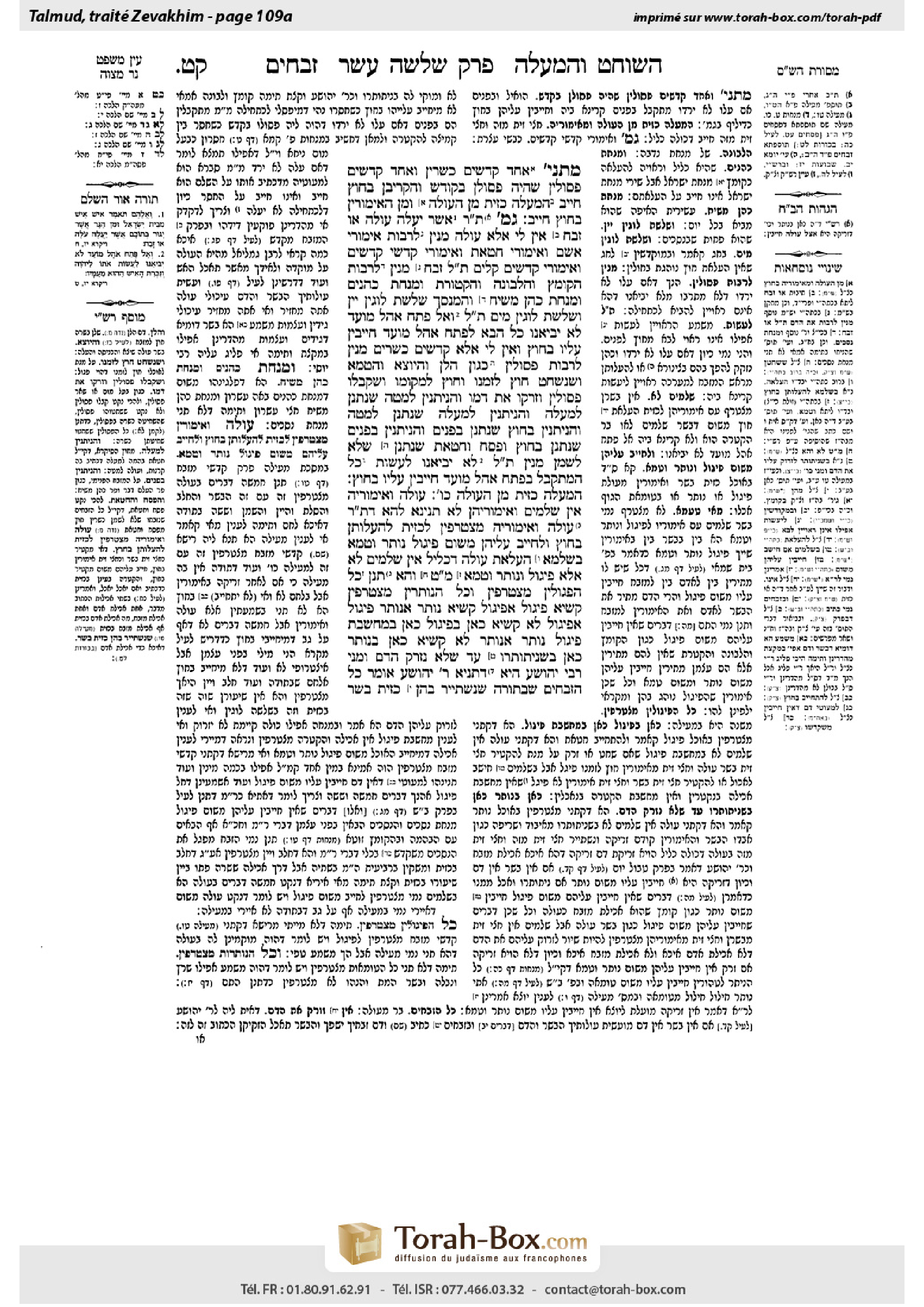
Zevachim 109a: Talmud study for Daf Yomi
Daf Yomi is the daily study of one Talmud folio. Explore 37 tractates with scans, Hebrew text, Sefaria English and AI-generated French translations where annotated.
Passage selection and English or AI-generated French translation are available where the scan has annotations. Daf Study is independent of Torah-Box and Sefaria.
Browse Zevachim · זבחים · All tractatesZevachim 109a text and translations
This page of Zevachim includes the Aramaic text, an English translation and an AI-generated French translation, alongside the scan above.
זבחים ק״ט א · Aramaic and Hebrew text
מַתְנִי׳ אֶחָד קֳדָשִׁים כְּשֵׁרִין וְאֶחָד קָדָשִׁים פְּסוּלִין, שֶׁהָיָה פְּסוּלָן בַּקּוֹדֶשׁ וְהִקְרִיבָן בַּחוּץ – חַיָּיב.
הַמַּעֲלֶה כְּזַיִת מִן הָעוֹלָה וּמִן הָאֵימוּרִין בַּחוּץ – חַיָּיב.
גְּמָ׳ תָּנוּ רַבָּנַן: ״אֲשֶׁר יַעֲלֶה עֹלָה אוֹ זָבַח״ – אֵין לִי אֶלָּא עוֹלָה; מִנַּיִן לְרַבּוֹת אֵימוּרֵי אָשָׁם, וְאֵימוּרֵי חַטָּאת, וְאֵימוּרֵי קׇדְשֵׁי קָדָשִׁים, וְאֵימוּרֵי קָדָשִׁים קַלִּים? תַּלְמוּד לוֹמַר: ״זֶבַח״.
מִנַּיִן לְרַבּוֹת הַקּוֹמֶץ, וְהַלְּבוֹנָה, וְהַקְּטוֹרֶת, וּמִנְחַת כֹּהֲנִים, וּמִנְחַת כֹּהֵן מָשִׁיחַ, וְהַמְנַסֵּךְ שְׁלֹשֶׁת לוּגִּין יַיִן, וּשְׁלֹשֶׁת לוּגִּין מַיִם? תַּלְמוּד לוֹמַר: ״וְאֶל פֶּתַח אֹהֶל מוֹעֵד לֹא יְבִיאֶנּוּ״ – כׇּל הַבָּא לְפֶתַח אֹהֶל מוֹעֵד, חַיָּיבִין עָלָיו בַּחוּץ.
וְאֵין לִי אֶלָּא קֳדָשִׁים כְּשֵׁרִים; מִנַּיִן לְרַבּוֹת פְּסוּלִין?
כְּגוֹן הַלָּן, וְהַיּוֹצֵא, וְהַטָּמֵא, וְשֶׁנִּשְׁחַט חוּץ לִזְמַנּוֹ וְחוּץ לִמְקוֹמוֹ, וְשֶׁקִּבְּלוּ פְּסוּלִין וְזָרְקוּ אֶת דָּמוֹ, וְהַנִּיתָּנִין לְמַטָּה שֶׁנְּתָנָן לְמַעְלָה, וְהַנִּיתָּנִין לְמַעְלָה שֶׁנְּתָנָן לְמַטָּה, וְהַנִּיתָּנִין בַּחוּץ שֶׁנְּתָנָן בִּפְנִים, וְהַנִּיתָּנִין בִּפְנִים שֶׁנְּתָנָן בַּחוּץ, וּפֶסַח וְחַטָּאת שֶׁנְּתָנָן שֶׁלֹּא לִשְׁמָן –
מִנַּיִן? תַּלְמוּד לוֹמַר: ״לֹא יְבִיאֶנּוּ לַעֲשׂוֹת״ – כׇּל הַמִּתְקַבֵּל בְּפֶתַח אֹהֶל מוֹעֵד, חַיָּיבִין עָלָיו בַּחוּץ.
הַמַּעֲלֶה כְּזַיִת מִן הָעוֹלָה כּוּ׳. עוֹלָה וְאֵימוּרֶיהָ – אִין, שְׁלָמִים וְאֵימוּרֵיהֶן – לָא;
תְּנֵינָא לְהָא דְּתָנוּ רַבָּנַן: עוֹלָה וְאֵימוּרֶיהָ מִצְטָרְפִין לִכְזַיִת – לְהַעֲלוֹתָן בַּחוּץ, וּלְחַיֵּיב עֲלֵיהֶן מִשּׁוּם פִּיגּוּל נוֹתָר וְטָמֵא.
בִּשְׁלָמָא הַעֲלָאַת עוֹלָה – דְּכָלִיל אִין, שְׁלָמִים לָא; אֶלָּא פִּיגּוּל וְנוֹתָר וְטָמֵא – מַאי טַעְמָא?
וְהָא תְּנַן: כׇּל הַפִּגּוּלִין מִצְטָרְפִין, וְכׇל הַנּוֹתָרִין מִצְטָרְפִין; קַשְׁיָא פִּיגּוּל אַפִּיגּוּל, קַשְׁיָא נוֹתָר אַנּוֹתָר!
פִּיגּוּל אַפִּיגּוּל לָא קַשְׁיָא – כָּאן בְּפִיגּוּל, כָּאן בְּמַחְשֶׁבֶת פִּיגּוּל.
נוֹתָר אַנּוֹתָר לָא קַשְׁיָא – כָּאן בְּנוֹתָר, כָּאן בְּשֶׁנִּיתּוֹתְרוּ עַד שֶׁלֹּא נִזְרַק הַדָּם.
וּמַנִּי? רַבִּי יְהוֹשֻׁעַ הִיא; דְּתַנְיָא, רַבִּי יְהוֹשֻׁעַ אוֹמֵר: כׇּל הַזְּבָחִים שֶׁבַּתּוֹרָה שֶׁנִּשְׁתַּיֵּיר בָּהֶן כְּזַיִת בָּשָׂר
Zevachim 109a · English translation
MISHNA: With regard to both fit sacrificial animals, and unfit sacrificial animals whose disqualification occurred in sanctity, i.e., in the course of the Temple service, and one sacrificed them outside the Temple courtyard, he is liable.
One who offers up outside the courtyard an olive-bulk made up of the flesh of a burnt offering and of its sacrificial portions is liable.
GEMARA: The Sages taught in a baraita: The verse states with regard to offering up outside the courtyard: “That offers up a burnt offering or sacrifice, and he will not bring it to the entrance of the Tent of Meeting, to sacrifice it to the Lord” (Leviticus 17:8–9). From the term “burnt offering” I have derived only that one is liable for offering up a burnt offering, which is burned entirely on the altar. From where do I derive to include that one is liable for offering up outside the courtyard the sacrificial portions of a guilt offering, the sacrificial portions of a sin offering, the sacrificial portions of offerings of the most sacred order, or the sacrificial portions of offerings of lesser sanctity? The verse states: “Sacrifice,” which includes the sacrificial portions of all other offerings that are to be burned on the altar.
From where is it derived to include that one is liable for offering up outside the courtyard the handful taken from a meal offering; the frankincense that was to be offered with it; the incense, which was offered each day in the Sanctuary; the meal offering of priests; the meal offering of the anointed priest, i.e., the High Priest, which he offered daily; and to include as liable one who pours as a libation three log of wine, which is the volume of the smallest wine libation used in the Temple; or one who pours as a libation three log of water that was consecrated to be used as a libation during the festival of Sukkot? The verse states: “And he will not bring it to the entrance of the Tent of Meeting” (Leviticus 17:9), which indicates that with regard to any offering that is fit to be brought to the entrance of the Tent of Meeting to be offered there upon the altar, one is liable for offering it up outside the courtyard.
I have derived only that one is liable for offering up fit offerings; from where do I derive to also include liability for unfit offerings whose disqualification occurred in sanctity?
For example: Sacrificial meat that was left overnight, or an offering that went outside the courtyard, or an offering that is impure, or an offering that was slaughtered with intent to consume it beyond its designated time or outside its designated area, or an offering that an unfit person collected and sprinkled its blood, or if one placed the blood that is to be placed above the red line encircling the altar below it, or if one placed the blood that is to be placed below the red line above it, or if one placed the blood that is to be placed inside the Sanctuary outside on the external altar, or if one placed the blood that is to be placed outside the Sanctuary inside it, or a Paschal offering or sin offering whose blood was placed not for their sake?
Since the disqualification of these offerings occurred in sanctity, if they were to be, albeit unlawfully, placed upon the altar, the altar would render them acceptable such that they should not be removed from upon it. From where is it derived to also include liability for these unfit offerings? The verse states: “And he will not bring it to the entrance of the Tent of Meeting, to sacrifice it to the Lord,” which indicates that with regard to any item that is rendered acceptable upon the altar at the entrance of the Tent of Meeting, even if it should not have been brought there ab initio, one is liable for offering it up outside the courtyard.
§ The mishna teaches: One who offers up outside the courtyard an olive-bulk made up of the flesh of a burnt offering and of its sacrificial portions is liable. The Gemara infers: The mishna states that for an olive-bulk combined of the flesh of a burnt offering and of its sacrificial portions, yes, one is liable. By inference, for an olive-bulk combined of the meat of a peace offering and of its sacrificial portions, one is not liable, because its meat is eaten, not burned on the altar.
We learn in the mishna that which the Sages taught explicitly in a baraita (Tosefta, Me’ila 1:28): The flesh of a burnt offering and its sacrificial portions combine to form the minimum measure of an olive-bulk to render one liable for offering them up outside the courtyard, and to render one liable for eating them due to piggul, i.e., if the sacrificial rites were performed with the intent of sacrificing the offering after its designated time; notar, i.e., if its flesh remained after the period in which it was permitted to sacrifice it; or for eating them while he was ritually impure. This baraita, too, states that only the flesh and sacrificial portions of a burnt offering combine. This indicates that the meat and sacrificial portions of a peace offering do not combine.
The Gemara asks: Granted, with regard to offering up outside the courtyard, it is logical that for a burnt offering, which is entirely consumed upon the altar, that yes, everything will combine, and that for peace offerings, whose meat is not burned on the altar, the meat and sacrificial portions will not combine. But with regard to liability for piggul, notar, and eating while ritually impure, what is the reason that the baraita differentiates between a burnt offering and a peace offering?
The Gemara compounds its questions: And didn’t we learn in a mishna (Me’ila 15a): Anything that is piggul combines together, and anything that is notar combines together, to form the measure of an olive-bulk to render one liable? The mishna indicates that this halakha applies to all types of offerings. Accordingly, the Gemara notes: The ruling about piggul in the baraita is difficult, as it is contradicted by the ruling about piggul in the mishna, and the ruling about notar in the baraita is difficult, as it is contradicted by the ruling about notar in the mishna.
The Gemara resolves the difficulties: That the ruling about piggul in the baraita is contradicted by the ruling about piggul in the mishna is not difficult. Here, in the mishna, the ruling that they combine concerns liability for eating piggul, whereas there, in the baraita, the ruling that only the parts of a burnt offering combine concerns piggul intention. An offering is rendered piggul only if one intends to eat an olive-bulk of it after the designated time for eating it or to sacrifice an olive-bulk of it after the designated time for sacrificing it. The baraita rules that for a burnt offering, if one has such intention for both half an olive-bulk of its meat and half an olive-bulk of its sacrificial portions, that is sufficient for the entire offering to be rendered piggul. For a peace offering, the offering is rendered piggul only if one has such intention about an olive-bulk comprised only of meat or only of sacrificial portions.
The Gemara resolves the second difficulty: That the ruling about notar in the baraita is contradicted by the ruling about notar in the mishna is not difficult. Here, in the mishna, the ruling that they combine concerns liability for eating notar, whereas there, in the baraita, the ruling that only the parts of a burnt offering combine concerns a case in which only an olive-bulk combined of both the flesh and the sacrificial portions remained from the offering, the rest having been destroyed, before its blood was sprinkled. Blood may not be sprinkled unless an olive-bulk of the offering remains. And if the blood is not sprinkled, the offering will never be rendered notar. The baraita rules that in the case of a burnt offering, the different parts of it combine to form an olive-bulk to permit the sprinkling of the blood. This does not apply to a peace offering, for which an olive-bulk of only meat or of only sacrificial portions must remain in order to permit the sprinkling of the blood.
The Gemara asks: And whose opinion is expressed by the baraita? It is the opinion of Rabbi Yehoshua, as it is taught in a baraita: Rabbi Yehoshua says: With regard to all the offerings that are mentioned in the Torah from which there remains only an olive-bulk of meat, the rest having been destroyed or rendered impure,
Zevachim 109a · Traduction française (IA)
MICHNA : Qu’il s’agisse d’animaux consacrés aptes ou d’animaux consacrés inaptes dont l’invalidation est survenue alors qu’ils étaient consacrés, c’est-à-dire au cours du service du Temple, celui qui les offre à l’extérieur du parvis est passible.
Celui qui offre à l’extérieur du parvis un volume équivalent à une olive, composé de la chair d’un holocauste et de ses parties sacrificielles, est passible.
GUEMARA : Les Sages ont enseigné dans une baraïta : À propos de l’offrande à l’extérieur du parvis, le verset dit : « Celui qui offre un holocauste ou un sacrifice et ne l’apporte pas à l’entrée de la Tente d’assignation pour le sacrifier au Seigneur » (Lévitique 17, 8-9). Du terme « holocauste », je n’ai déduit que l’on est passible lorsqu’on offre un holocauste, qui est entièrement consumé sur l’autel. D’où déduire que l’on est également passible lorsqu’on offre à l’extérieur du parvis les parties sacrificielles d’un sacrifice de culpabilité, celles d’un sacrifice expiatoire, celles d’offrandes de très haute sainteté ou celles d’offrandes de sainteté moindre ? Le verset dit : « Sacrifice », terme qui inclut les parties sacrificielles de toutes les autres offrandes destinées à être consumées sur l’autel.
D’où déduire que l’on est également passible lorsqu’on offre à l’extérieur du parvis la poignée prélevée d’une offrande végétale, l’encens qui devait être offert avec elle, l’encens offert chaque jour dans le Sanctuaire, l’offrande végétale des prêtres, l’offrande végétale du prêtre oint, c’est-à-dire du Grand Prêtre, qu’il offrait chaque jour ; et que l’on est passible lorsqu’on verse en libation trois log de vin, volume de la plus petite libation de vin utilisée dans le Temple, ou trois log d’eau consacrée pour être offerte en libation pendant la fête de Souccot ? Le verset dit : « Et ne l’apporte pas à l’entrée de la Tente d’assignation » (Lévitique 17, 9), ce qui indique que, pour toute offrande pouvant être apportée à l’entrée de la Tente d’assignation afin d’y être offerte sur l’autel, on est passible si on l’offre à l’extérieur du parvis.
Je n’ai déduit que l’on est passible lorsqu’on offre des offrandes aptes ; d’où déduire que l’on est également passible pour des offrandes inaptes dont l’invalidation est survenue alors qu’elles étaient consacrées ?
Par exemple : de la viande sacrificielle laissée toute la nuit, une offrande sortie du parvis, une offrande impure, une offrande égorgée avec l’intention de la consommer après le délai qui lui est imparti ou en dehors de l’endroit qui lui est imparti, une offrande dont une personne inapte a recueilli le sang et fait l’aspersion ; si l’on a aspergé sous la ligne rouge qui entoure l’autel le sang qui devait être aspergé au-dessus de cette ligne ; si l’on a aspergé au-dessus de cette ligne le sang qui devait être aspergé en dessous ; si l’on a placé sur l’autel extérieur le sang qui devait être placé à l’intérieur du Sanctuaire ; si l’on a placé à l’intérieur du Sanctuaire le sang qui devait être placé à l’extérieur ; ou encore une offrande pascale ou un sacrifice expiatoire dont le sang a été aspergé sans que l’on agisse pour leur sake ?
Puisque l’invalidation de ces offrandes est survenue alors qu’elles étaient consacrées, si elles étaient placées, même illicitement, sur l’autel, celui-ci les rendrait recevables, de sorte qu’il ne faudrait pas les en retirer. D’où déduire que l’on est également passible pour ces offrandes inaptes ? Le verset dit : « Et ne l’apporte pas à l’entrée de la Tente d’assignation pour le sacrifier au Seigneur », ce qui indique que, pour tout élément rendu recevable sur l’autel à l’entrée de la Tente d’assignation, même s’il n’aurait pas dû y être apporté a priori, on est passible si on l’offre à l’extérieur du parvis.
§ La Michna enseigne : Celui qui offre à l’extérieur du parvis un volume équivalent à une olive, composé de la chair d’un holocauste et de ses parties sacrificielles, est passible. La Guemara en déduit : La Michna dit que l’on est passible pour un volume équivalent à une olive composé de la chair d’un holocauste et de ses parties sacrificielles ; par déduction, on n’est pas passible pour un volume équivalent à une olive composé de la viande d’un sacrifice de paix et de ses parties sacrificielles, car sa viande est consommée et non brûlée sur l’autel.
Nous apprenons dans la Michna ce que les Sages ont enseigné explicitement dans une baraïta (Tossefta, Meïla 1, 28) : la chair d’un holocauste et ses parties sacrificielles s’associent pour constituer la mesure minimale d’un volume équivalent à une olive, et rendent ainsi passible celui qui les offre à l’extérieur du parvis ; elles rendent aussi passible celui qui les consomme en raison du piggoul, c’est-à-dire si les rites sacrificiels ont été accomplis avec l’intention d’offrir le sacrifice après le délai qui lui est imparti ; du notar, c’est-à-dire si sa chair est restée après la période pendant laquelle il était permis de l’offrir ; ou de leur consommation en état d’impureté rituelle. Cette baraïta aussi affirme que seuls la chair et les parties sacrificielles d’un holocauste s’associent. Cela indique que la viande et les parties sacrificielles d’un sacrifice de paix ne s’associent pas.
La Guemara demande : Certes, en ce qui concerne l’offrande à l’extérieur du parvis, il est logique que, pour un holocauste, entièrement consumé sur l’autel, tout s’associe, tandis que, pour les sacrifices de paix, dont la viande n’est pas brûlée sur l’autel, la viande et les parties sacrificielles ne s’associent pas. Mais, en ce qui concerne la responsabilité pour le piggoul, le notar et la consommation en état d’impureté rituelle, pourquoi la baraïta établit-elle une distinction entre un holocauste et un sacrifice de paix ?
La Guemara ajoute à ses questions : N’avons-nous pas appris dans une Michna (Meïla 15a) que tout ce qui est piggoul s’associe, et que tout ce qui est notar s’associe, pour constituer la mesure d’un volume équivalent à une olive et rendre passible ? La Michna indique que cette halakha s’applique à tous les types d’offrandes. La Guemara note donc : la règle de la baraïta sur le piggoul est difficile, car elle est contredite par la règle de la Michna sur le piggoul ; et la règle de la baraïta sur le notar est difficile, car elle est contredite par la règle de la Michna sur le notar.
La Guemara résout les difficultés : la contradiction entre la règle de la baraïta sur le piggoul et celle de la Michna ne pose pas de difficulté. Ici, dans la Michna, la règle selon laquelle les éléments s’associent concerne la responsabilité pour la consommation de piggoul ; là, dans la baraïta, la règle selon laquelle seuls les éléments d’un holocauste s’associent concerne l’intention de piggoul. Une offrande ne devient piggoul que si l’on a l’intention d’en consommer un volume équivalent à une olive après le délai imparti à sa consommation, ou d’en offrir un volume équivalent à une olive après le délai imparti à son offrande. La baraïta statue que, pour un holocauste, si l’on a cette intention pour une demi-mesure d’olive de sa viande et une demi-mesure d’olive de ses parties sacrificielles, cela suffit pour que toute l’offrande devienne piggoul. Pour un sacrifice de paix, l’offrande ne devient piggoul que si l’on a cette intention à propos d’un volume équivalent à une olive composé uniquement de viande ou uniquement de parties sacrificielles.
La Guemara résout la seconde difficulté : la contradiction entre la règle de la baraïta sur le notar et celle de la Michna ne pose pas de difficulté. Ici, dans la Michna, la règle selon laquelle les éléments s’associent concerne la responsabilité pour la consommation de notar ; là, dans la baraïta, la règle selon laquelle seuls les éléments d’un holocauste s’associent concerne un cas où il ne restait de l’offrande qu’un volume équivalent à une olive, composé à la fois de chair et de parties sacrificielles, le reste ayant été détruit avant l’aspersion de son sang. Le sang ne peut être aspergé que s’il reste de l’offrande un volume équivalent à une olive. Et si le sang n’est pas aspergé, l’offrande ne pourra jamais devenir notar. La baraïta statue que, dans le cas d’un holocauste, ses différentes parties s’associent pour constituer un volume équivalent à une olive permettant l’aspersion du sang. Cela ne s’applique pas à un sacrifice de paix, pour lequel il doit rester un volume équivalent à une olive composé uniquement de viande ou uniquement de parties sacrificielles afin de permettre l’aspersion du sang.
La Guemara demande : De qui la baraïta exprime-t-elle l’opinion ? De Rabbi Yehoshoua, comme on l’enseigne dans une baraïta : Rabbi Yehoshoua dit : parmi toutes les offrandes mentionnées dans la Torah, lorsqu’il ne reste qu’un volume équivalent à une olive de viande, le reste ayant été détruit ou rendu impur,
Traduction française générée par IA à partir de l’édition anglaise de Sefaria. Vérifie toujours un passage avec le texte source.
Text from Sefaria: William Davidson Edition - Vocalized Aramaic (CC BY NC); William Davidson Edition - English (CC BY NC).