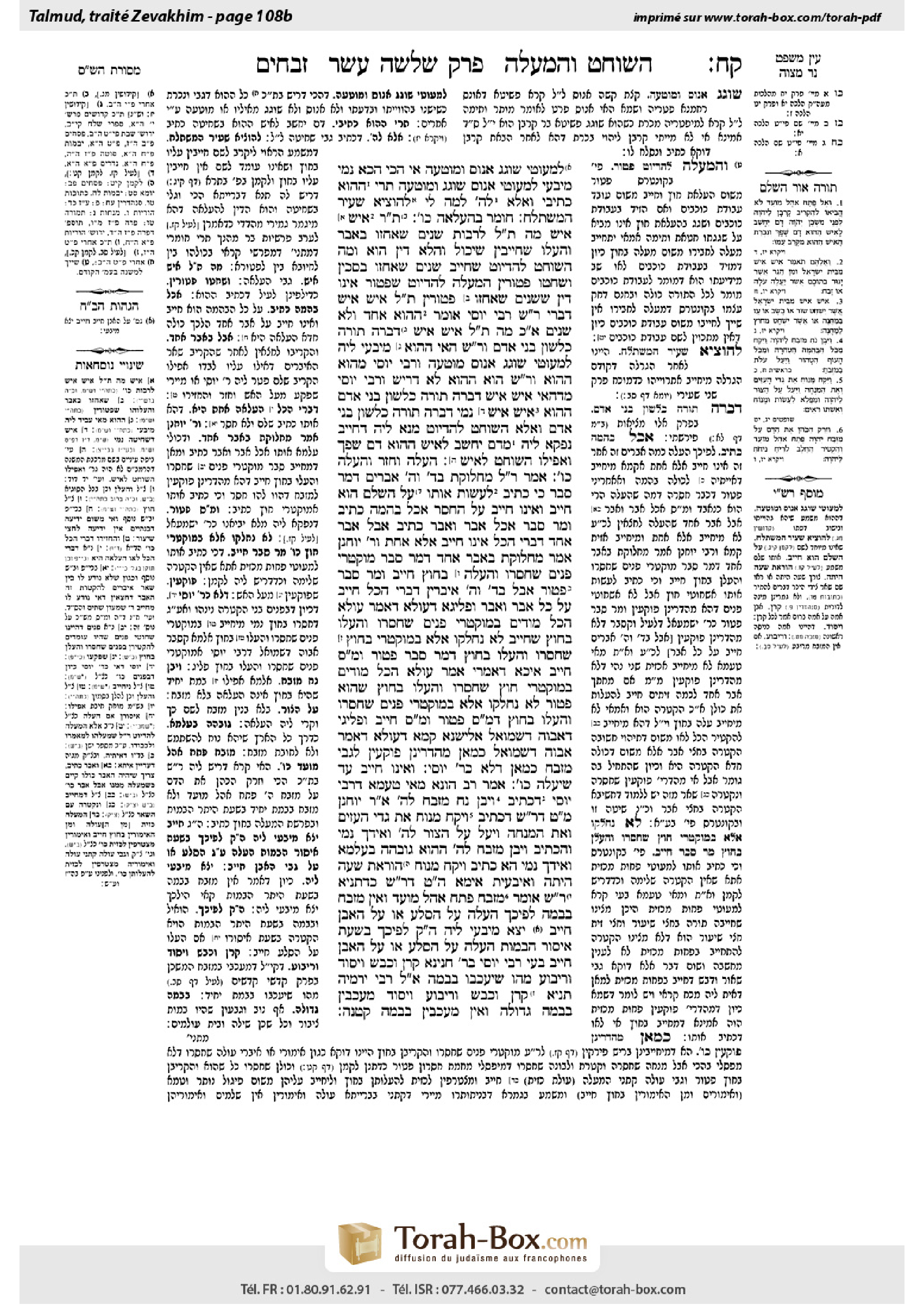
Zevachim 108b: Talmud study for Daf Yomi
Daf Yomi is the daily study of one Talmud folio. Explore 37 tractates with scans, Hebrew text, Sefaria English and AI-generated French translations where annotated.
Passage selection and English or AI-generated French translation are available where the scan has annotations. Daf Study is independent of Torah-Box and Sefaria.
Browse Zevachim · זבחים · All tractatesZevachim 108b text and translations
This page of Zevachim includes the Aramaic text, an English translation and an AI-generated French translation, alongside the scan above.
זבחים ק״ח ב · Aramaic and Hebrew text
מִיבְּעֵי לֵיהּ לְמַעוֹטֵי שׁוֹגֵג, אָנוּס וּמוּטְעֶה. אִי הָכִי, הָכָא נָמֵי מִיבְּעֵי לְמַעוֹטֵי אָנוּס, שׁוֹגֵג וּמוּטְעֶה!
תְּרֵי ״הָהוּא״ כְּתִיבִי.
וְאֶלָּא ״לַה׳״ לְמָה לִי? לְהוֹצִיא שָׂעִיר הַמִּשְׁתַּלֵּחַ.
חוֹמֶר בְּהַעֲלָאָה כּוּ׳.
תָּנוּ רַבָּנַן: ״אִישׁ אִישׁ״ – מָה תַּלְמוּד לוֹמַר? שְׁנַיִם שֶׁאָחֲזוּ בְּאֵבֶר וְהֶעֱלוּ, שֶׁחַיָּיבִין. שֶׁיָּכוֹל וַהֲלֹא דִּין הוּא: וּמָה הַשּׁוֹחֵט לְהֶדְיוֹט, שֶׁחַיָּיב – שְׁנַיִם שֶׁאָחֲזוּ בְּסַכִּין וְשָׁחֲטוּ, פְּטוּרִין; הַמַּעֲלֶה לְהֶדְיוֹט, שֶׁפָּטוּר – אֵינוֹ דִּין שֶׁשְּׁנַיִם שֶׁאָחֲזוּ, פְּטוּרִין? תַּלְמוּד לוֹמַר: ״אִישׁ אִישׁ״. דִּבְרֵי רַבִּי שִׁמְעוֹן.
רַבִּי יוֹסֵי אוֹמֵר: ״הַהוּא״ – אֶחָד וְלֹא שְׁנַיִם. אִם כֵּן, מָה תַּלְמוּד לוֹמַר: ״אִישׁ אִישׁ״? דִּבְּרָה תּוֹרָה כִּלְשׁוֹן בְּנֵי אָדָם.
וְרַבִּי שִׁמְעוֹן – הַאי ״הַהוּא״ מִיבְּעֵי לֵיהּ לְמַעוֹטֵי שׁוֹגֵג, אָנוּס, מוּטְעֶה. וְרַבִּי יוֹסֵי – מֵ״הוּא״–״הַהוּא״. וְרַבִּי שִׁמְעוֹן – ״הוּא״–״הַהוּא״ לָא דָּרֵישׁ.
וְרַבִּי יוֹסֵי – מִדְּהַאי ״אִישׁ אִישׁ״ דִּבְּרָה תּוֹרָה כִלְשׁוֹן בְּנֵי אָדָם, הָהוּא ״אִישׁ אִישׁ״ נָמֵי דִּבְּרָה תּוֹרָה כִלְשׁוֹן בְּנֵי אָדָם. וְאֶלָּא הַשּׁוֹחֵט לְהֶדְיוֹט מְנָא לֵיהּ דְּחַיָּיב? נָפְקָא לֵיהּ מִ״דָּם יֵחָשֵׁב לָאִישׁ הַהוּא דָּם שָׁפָךְ״ – וַאֲפִילּוּ הַשּׁוֹחֵט לָאִישׁ.
הֶעֱלָה וְחָזַר וְהֶעֱלָה כּוּ׳.
אָמַר רֵישׁ לָקִישׁ: מַחְלוֹקֶת בְּאַרְבָּעָה וַחֲמִשָּׁה אֵבָרִים; דְּמָר סָבַר: כִּי כְּתִיב ״לַעֲשׂוֹת אֹתוֹ״ – עַל הַשָּׁלֵם הוּא חַיָּיב וְאֵינוֹ חַיָּיב עַל הֶחָסֵר, אַכֹּל בְּהֵמָה כְּתִיב; וּמָר סָבַר: אַכֹּל אֵבֶר וְאֵבֶר כְּתִיב. אֲבָל אֵבֶר אֶחָד – דִּבְרֵי הַכֹּל אֵינוֹ חַיָּיב אֶלָּא אַחַת.
וְרַבִּי יוֹחָנָן אָמַר: מַחְלוֹקֶת בְּאֵבֶר אֶחָד – דְּמָר סָבַר: מוּקְטְרֵי פְּנִים שֶׁחָסְרוּ (והעלו) [וְהֶעֱלָן] בַּחוּץ – חַיָּיב, וּמָר סָבַר – פָּטוּר; אֲבָל בְּאַרְבָּעָה וַחֲמִשָּׁה אֵיבָרִין – דִּבְרֵי הַכֹּל חַיָּיב עַל כׇּל אֵבֶר וְאֵבֶר.
וּפְלִיגָא דְּעוּלָּא, דְּאָמַר עוּלָּא: הַכֹּל מוֹדִים בְּמוּקְטְרֵי פְּנִים שֶׁחָסְרוּ (וְהֶעֱלוֹ) [וְהֶעֱלָן] בַּחוּץ – שֶׁחַיָּיב. לֹא נֶחְלְקוּ אֶלָּא בְּמוּקְטְרֵי בַּחוּץ שֶׁחָסְרוּ (וְהֶעֱלוֹ) [וְהֶעֱלָן] בַּחוּץ – דְּמָר סָבַר פָּטוּר, וּמַר סָבַר חַיָּיב.
אִיכָּא דְּאָמְרִי, אָמַר עוּלָּא: הַכֹּל מוֹדִים בְּמוּקְטְרֵי חוּץ שֶׁחָסְרוּ (וְהֶעֱלוֹ) [וְהֶעֱלָן] בַּחוּץ שֶׁהוּא פָּטוּר, לֹא נֶחְלְקוּ אֶלָּא בְּמוּקְטְרֵי פְּנִים שֶׁחָסְרוּ (וְהֶעֱלוֹ) [וְהֶעֱלָן] בַּחוּץ, דְּמָר סָבַר פָּטוּר, וּמַר סָבַר חַיָּיב.
(וּפְלִיגִי) [וּפְלִיגָא] דַּאֲבוּהּ דִּשְׁמוּאֵל אַלִּישָּׁנָא קַמָּא דְּעוּלָּא; דְּאָמַר אֲבוּהּ דִּשְׁמוּאֵל: כְּמַאן מַהְדְּרִינַן פּוֹקְעִין לְגַבֵּי מִזְבֵּחַ? כְּמַאן – דְּלָא כְּרַבִּי יוֹסֵי.
וְאֵינוֹ חַיָּיב עַד שֶׁיַּעֲלֶה כּוּ׳. אָמַר רַב הוּנָא: מַאי טַעְמָא דְּרַבִּי יוֹסֵי? דִּכְתִיב: ״וַיִּבֶן נֹחַ מִזְבֵּחַ לַה׳״.
אָמַר רַבִּי יוֹחָנָן: מַאי טַעְמָא דְּרַבִּי שִׁמְעוֹן? דִּכְתִיב: ״וַיִּקַּח מָנוֹחַ אֶת גְּדִי הָעִזִּים וְאֶת הַמִּנְחָה וַיַּעַל עַל הַצּוּר לַה׳״.
וְאִידַּךְ נָמֵי, וְהָכְתִיב: ״וַיִּבֶן מִזְבֵּחַ לַה׳״! הַהוּא גּוּבְהָה בְּעָלְמָא. וְאִידַּךְ נָמֵי, הָא כְּתִיב: ״וַיִּקַּח מָנוֹחַ״! הוֹרָאַת שָׁעָה הָיְתָה.
וְאִיבָּעֵית אֵימָא: הַיְינוּ טַעְמָא דְּרַבִּי שִׁמְעוֹן – כִּדְתַנְיָא, רַבִּי שִׁמְעוֹן אוֹמֵר: ״מִזְבֵּחַ פֶּתַח אֹהֶל מוֹעֵד״; וְאֵין מִזְבֵּחַ בְּבָמָה; לְפִיכָךְ הֶעֱלָה עַל הַסֶּלַע אוֹ עַל הָאֶבֶן – חַיָּיב.
יָצָא מִיבְּעֵי לֵיהּ! הָכִי קָאָמַר: לְפִיכָךְ בִּשְׁעַת אִיסּוּר הַבָּמוֹת – הֶעֱלָה עַל הַסֶּלַע אוֹ עַל הָאֶבֶן, חַיָּיב.
בָּעֵי רַבִּי יוֹסֵי בְּרַבִּי חֲנִינָא: קֶרֶן וְכֶבֶשׁ וִיסוֹד וְרִיבּוּעַ – מַהוּ שֶׁיְּעַכְּבוּ בְּבָמָה?
אֲמַר לֵיהּ רַבִּי יִרְמְיָה, תַּנְיָא: קֶרֶן וְכֶבֶשׁ וְרִיבּוּעַ וִיסוֹד – מְעַכְּבִין בְּבָמָה גְּדוֹלָה, וְאֵין מְעַכְּבִין בְּבָמָה קְטַנָּה.
Zevachim 108b · English translation
to exclude from the liability for karet one whose violation was unwitting, or who was compelled to act, or who was mistaken. The term “that man” teaches that only one who offered up with intent is liable to receive karet. The Gemara challenges: If so, here too, with regard to slaughtering outside, the term is necessary to exclude one whose violation was unwitting, or who was compelled to act, or who was mistaken. How can the term be used to teach that only one who acts alone is liable?
The Gemara explains: With regard to slaughtering outside, two instances of the term “that man” are written: “Blood shall be imputed to that man, he has shed blood, and that man shall be cut off from among his people” (Leviticus 17:4). One instance teaches that only one who acts with intent is liable to receive karet, and the other teaches that only one who acts alone is liable.
The Gemara has now justified its claim that the liability of one who slaughters an offering outside for the sake of an ordinary purpose is derived from the phrase “ish ish.” Accordingly, the Gemara asks: But why do I need the term “to the Lord”? The Gemara explains: It is written to exclude from liability one who slaughters the Yom Kippur scapegoat outside the courtyard.
§ The mishna teaches: The greater stringency with regard to offering up outside is that two people who grasped a knife and together slaughtered an offering outside the courtyard are exempt. But if two grasped a limb from an offering and together offered it up outside, they are liable.
The Sages taught in a baraita: What halakha is alluded to when the verse states: “Any man [ish ish]…that offers up a burnt offering or sacrifice” (Leviticus 17:8)? The verse teaches that two people who grasped a limb of an offering and offered it up together outside the courtyard are liable. It is necessary for the verse to teach this, as one might have thought to say: Could this not be derived through an a fortiori inference: If with regard to slaughtering outside the courtyard, one who slaughters for the sake of an ordinary purpose is liable, and nevertheless, two who grasped a knife and together slaughtered an offering are exempt, then with regard to offering up outside the courtyard, where one who offers up for the sake of an ordinary purpose is exempt, is it not logical that two who grasped a limb and offered it up will also be exempt? To counter this, the verse states “ish ish” to teach that they are liable for offering up together; this is the statement of Rabbi Shimon.
Rabbi Yosei says that the halakha concerning this case is derived from a different verse. The term “that [hahu] man” (Leviticus 17:9), which is in the singular, indicates that only one who acts alone is liable, but not two who act together. The baraita asks: If so, what halakha is alluded to when the verse states “ish ish”? The baraita explains: Rabbi Yosei holds that the reason the Torah uses the doubled term “ish ish” is that the Torah spoke in the language of people, and no halakhot are to be derived from it.
The Gemara asks: And Rabbi Shimon, what does he derive from the term “that man”? The Gemara explains: This term: “That man,” is necessary to exclude from liability one whose violation was unwitting, or who was compelled to act, or who was mistaken. The Gemara notes: And Rabbi Yosei derives that halakha from the fact that the verse could have stated hu and instead stated “hahu.” The Hebrew word for: That, hahu, is formed of the definite article ha and the pronoun hu. And Rabbi Shimon does not expound any halakhot from the fact that the verse could have stated hu and instead stated “hahu.” He holds that the expanded form is used because the Torah spoke in the language of people.
The Gemara asks: And as for Rabbi Yosei, from the fact that he holds that nothing is to be derived from the phrase “ish ish” written with regard to offering up, as he holds that the Torah spoke in the language of people, then also with regard to that phrase: “Any man [ish ish]” (Leviticus 17:3), written with regard to slaughtering, since he holds that the Torah spoke in the language of people, he should not derive any halakhot from it. But if so, from where does he derive that one who slaughters outside for the sake of an ordinary purpose is liable? The Gemara answers: He derives it from the verse: “Blood shall be imputed to that man; he has shed blood” (Leviticus 17:4), which teaches that even one who slaughters for the sake of an ordinary man is liable.
§ The mishna teaches: If one unwittingly offered up part of an offering outside the courtyard and then in a different lapse of awareness offered up other parts of that offering and then again, in another lapse of awareness, offered up yet other parts, he is liable to bring a sin offering for each act of offering up; this is the statement of Rabbi Shimon. Rabbi Yosei says: He is liable to bring only one sin offering.
The Gemara cites two opinions concerning the case under dispute. Reish Lakish says: The dispute in the mishna concerns four or five limbs that were offered up in different lapses of awareness. As one Sage, Rabbi Yosei, holds: When it is written: “To sacrifice it” (Leviticus 17:9), which teaches the halakha that for offering up a complete item one is liable but that one is not liable for offering up an incomplete item, it is written with regard to a whole animal. Accordingly, liability to bring a sin offering is incurred only once one offers up the entire animal, even if that was done limb by limb. And the other Sage, Rabbi Shimon, holds that that verse is written with regard to each and every limb of an animal. Accordingly, one is liable for each limb he offered up. But with regard to the offering up of one limb in parts, everyone agrees that a person is liable to bring only one sin offering. According to Rabbi Shimon this would apply even if that were the only limb that was offered up; according to Rabbi Yosei this would apply only if the rest of the animal had already been offered up.
And Rabbi Yoḥanan says: Everyone agrees that one is liable even for offering up a single limb. Furthermore, if an offering is slaughtered outside the courtyard, everyone agrees that one is liable only once an entire limb has been offered up. The dispute in the mishna concerns one limb from an offering that was slaughtered inside the courtyard that was then taken outside and offered up in parts, during different lapses of awareness. As one Sage, Rabbi Shimon, holds that for offerings that are fit to be burned inside the Temple, that became incomplete and were instead offered up outside the Temple, one is liable. Accordingly, one is liable for each part of the limb. And the other Sage, Rabbi Yosei, holds that one is exempt for offering up part of a limb outside the courtyard. Accordingly, liability is incurred only once all the parts of the limb have been offered up. But with regard to offering up four or five limbs, everyone agrees that one is liable for each and every limb, as they understand that the phrase “to sacrifice it” is written with regard to each and every limb.
And Rabbi Yoḥanan disagrees with the opinion of Ulla, as Ulla says: Everyone in the mishna concedes with regard to offerings that are fit to be burned inside the Temple courtyard that became incomplete and were instead offered up outside the courtyard, that one is liable. They disagree only with regard to offerings that, having been slaughtered outside are unfit and so will be burned outside, that became incomplete and were offered up outside. As one Sage, Rabbi Yosei, holds that one is exempt, and the other Sage, Rabbi Shimon, holds that one is liable.
There are those who say there is a different version of Ulla’s statement, according to which he agrees with his teacher, Rabbi Yoḥanan. Ulla says: Everyone in the mishna concedes with regard to offerings that, having been slaughtered outside the Temple are unfit and so will be burned outside, that became incomplete and were offered up outside, that one is exempt. They disagree only with regard to offerings that are fit to be burned inside that became incomplete and were instead offered up outside. As one Sage, Rabbi Yosei, holds that one is exempt, and the other Sage, Rabbi Shimon, holds that one is liable.
And the statement of Shmuel’s father disagrees with the first version of Ulla’s statement, as Shmuel’s father says: In accordance with whose opinion do we restore limbs that were dislodged from upon the altar to the altar? In accordance with whose opinion? It is not in accordance with the opinion of Rabbi Yosei recorded in the mishna. Shmuel’s father assumes that Rabbi Yosei holds that incomplete limbs are never offered up on the altar, even if they were dislodged from the altar. Accordingly, he holds that one is not liable for offering them up outside the Temple courtyard. This is contrary to the first version of Ulla’s opinion, according to which one is liable for offering up incomplete offerings that were slaughtered inside the courtyard. Evidently, Ulla holds that an incomplete limb that was dislodged from the altar is to be restored to the altar.
§ The mishna teaches: Rabbi Yosei says: And one is liable for offering up an offering outside the courtyard only once he offers it up upon the top of an altar that was erected there. Rabbi Shimon says: Even if he offered it up on a rock or on a stone, not an altar, he is liable. Rav Huna says: What is the reason of Rabbi Yosei? As it is written: “And Noah built an altar to the Lord, and took of every pure animal, and of every pure bird, and offered up burnt offerings on the altar” (Genesis 8:20). Noah was particular to use an altar rather than one of the available rocks. Apparently, this was because placing an item upon an altar is the only act that can be considered offering up.
Rabbi Yoḥanan said: What is the reason of Rabbi Shimon? As it is written: “And Manoah took the kid with the meal offering, and offered it up upon the rock, to the Lord” (Judges 13:19). Evidently, even placing an offering upon a rock is considered an act of offering up.
The Gemara explains how each tanna interprets the verse that supports the other. But also according to the other opinion, Rabbi Shimon’s, isn’t it written: “And Noah built an altar to the Lord”? How does he explain that verse? The Gemara answers: That verse is referring merely to an elevated place and not specifically to an altar. But also according to the other opinion, Rabbi Yosei’s, isn’t it written: “And Manoah took…and offered it up upon the rock”? How does he explain that verse? The Gemara answers: The use of a rock in that case was a provisional edict issued in exigent circumstances, by the angel who visited Manoah, and so one cannot derive normative halakha from it.
And if you wish, say instead that the reason of Rabbi Shimon is as it is taught in a baraita: Rabbi Shimon says that the verse states: “And the priest shall sprinkle the blood upon the altar of the Lord at the entrance of the Tent of Meeting” (Leviticus 17:6). From here it is apparent that only in the Sanctuary is there a requirement for an altar, but a specifically erected altar is not required in order to offer up on a private altar during periods when it is permitted to do so. Therefore, one who offered up outside the courtyard on a rock or on a stone is liable.
The Gemara questions the formulation of the baraita: If the baraita was referring to offering up during a period when the use of private altars is permitted, it should have concluded: One who offered up outside on a rock or on a stone has fulfilled his obligation. Why does it state instead that he is liable? The Gemara explains: This is what the baraita is saying: Since there is no requirement for a specifically erected altar during a period when private altars are permitted, therefore, during a period when the use of private altars is prohibited, one who offers up outside on a rock or on a stone is liable.
Rabbi Yosei, son of Rabbi Ḥanina, raises a dilemma: Features that are indispensable with regard to the altar in the Temple are the corner, the ramp leading to the altar, the base of the altar, and the square shape. What is the halakha with regard to whether they are also indispensable for the validity of a private altar during a period when it is permitted to use private altars?
Rabbi Yirmeya said to him: It is taught in a baraita: The corner, the ramp, the base, and the square shape are all indispensable for the validity of a great public altar, but they are not indispensable for the validity of a small private altar.
Zevachim 108b · Traduction française (IA)
afin d’exclure de la responsabilité passible de karet celui dont la transgression a été involontaire, qui a été contraint d’agir ou qui s’est trompé. L’expression « cet homme » enseigne que seul celui qui a offert avec intention est passible de karet. La Guemara objecte : si tel est le cas, ici aussi, concernant l’abattage à l’extérieur, l’expression est nécessaire pour exclure celui dont la transgression a été involontaire, qui a été contraint d’agir ou qui s’est trompé. Comment peut-on utiliser cette expression pour enseigner que seul celui qui agit seul est passible ?
La Guemara explique : concernant l’abattage à l’extérieur, l’expression « cet homme » apparaît deux fois : « Le sang sera imputé à cet homme ; il a versé le sang, et cet homme sera retranché du sein de son peuple » (Lévitique 17, 4). Une occurrence enseigne que seul celui qui agit intentionnellement est passible de karet, et l’autre enseigne que seul celui qui agit seul est passible.
La Guemara a maintenant justifié son affirmation selon laquelle la responsabilité de celui qui abat un sacrifice à l’extérieur dans un but profane est déduite de l’expression « ish ish ». La Guemara demande donc : Mais pourquoi l’expression « pour le Seigneur » est-elle nécessaire ? La Guemara explique : Elle est écrite pour exonérer celui qui abat à l’extérieur le bouc émissaire de Yom Kippour.
§ La Michna enseigne : La plus grande rigueur concernant l’offrande à l’extérieur est que deux personnes qui tiennent ensemble un couteau et abattent un sacrifice à l’extérieur sont exonérées. En revanche, si deux personnes tiennent ensemble un membre d’un sacrifice et l’offrent à l’extérieur, elles sont passibles.
Les Sages ont enseigné dans une baraïta : Quelle halakha est suggérée par le verset : « Tout homme [ish ish]… qui offre un holocauste ou un sacrifice » (Lévitique 17, 8) ? Le verset enseigne que deux personnes qui tiennent ensemble un membre d’un sacrifice et l’offrent à l’extérieur sont passibles. Il est nécessaire que le verset l’enseigne, car on aurait pu raisonner ainsi : ne peut-on pas le déduire par un raisonnement a fortiori ? En effet, concernant l’abattage à l’extérieur, celui qui abat dans un but profane est passible et, pourtant, deux personnes qui tiennent ensemble un couteau et abattent un sacrifice sont exonérées. Alors, concernant l’offrande à l’extérieur, où celui qui offre dans un but profane est exonéré, n’est-il pas logique que deux personnes qui tiennent ensemble un membre et l’offrent soient elles aussi exonérées ? Pour réfuter cette déduction, le verset dit « ish ish », enseignant qu’elles sont passibles lorsqu’elles offrent ensemble. Telle est l’opinion de Rabbi Shimon.
Rabbi Yosei dit que la halakha concernant ce cas se déduit d’un autre verset. L’expression « cet [hahu] homme » (Lévitique 17, 9), au singulier, indique que seul celui qui agit seul est passible, mais pas deux personnes qui agissent ensemble. La baraïta demande : Si tel est le cas, quelle halakha est suggérée par le verset qui dit « ish ish » ? La baraïta explique : Rabbi Yosei estime que la Torah emploie l’expression redoublée « ish ish » parce qu’elle s’exprime dans le langage courant ; on ne doit donc en déduire aucune halakha.
La Guemara demande : Et Rabbi Shimon, que déduit-il de l’expression « cet homme » ? La Guemara explique : Cette expression est nécessaire pour exonérer celui dont la transgression a été involontaire, qui a été contraint d’agir ou qui s’est trompé. La Guemara précise : Rabbi Yosei, lui, déduit cette halakha du fait que le verset aurait pu dire hu, mais dit à la place « hahu ». Le mot hébreu hahu, qui signifie « celui-là », est formé de l’article défini ha et du pronom hu. Rabbi Shimon, lui, ne tire aucune halakha du fait que le verset aurait pu dire hu, mais dit à la place « hahu ». Selon lui, cette forme développée est employée parce que la Torah s’exprime dans le langage courant.
La Guemara demande : Quant à Rabbi Yosei, puisqu’il estime qu’on ne doit rien déduire de l’expression « ish ish » écrite à propos de l’offrande, car la Torah s’exprime dans le langage courant, ne devrait-il pas également ne rien déduire de l’expression « tout homme [ish ish] » (Lévitique 17, 3), écrite à propos de l’abattage ? Mais alors, d’où déduit-il que celui qui abat à l’extérieur dans un but profane est passible ? La Guemara répond : Il le déduit du verset : « Le sang sera imputé à cet homme ; il a versé le sang » (Lévitique 17, 4), qui enseigne que même celui qui abat pour qu’un homme ordinaire en bénéficie est passible.
§ La Michna enseigne : Si quelqu’un offre involontairement à l’extérieur une partie d’un sacrifice, puis en offre d’autres parties à la suite d’une nouvelle perte de conscience, et encore d’autres à la suite d’une autre perte de conscience, il doit apporter un sacrifice expiatoire pour chaque acte d’offrande ; telle est l’opinion de Rabbi Shimon. Rabbi Yosei dit : Il ne doit apporter qu’un seul sacrifice expiatoire.
La Guemara rapporte deux opinions au sujet du cas faisant l’objet du désaccord. Reish Lakish dit : Le désaccord dans la Michna concerne quatre ou cinq membres offerts à la suite de différentes pertes de conscience. En effet, l’un des Sages, Rabbi Yosei, estime que les mots « pour l’offrir » (Lévitique 17, 9), qui enseignent qu’on est passible pour l’offrande d’un élément entier, mais non pour celle d’un élément incomplet, se rapportent à un animal entier. Par conséquent, on n’est tenu d’apporter un sacrifice expiatoire qu’après avoir offert l’animal entier, même si on l’a fait membre après membre. L’autre Sage, Rabbi Shimon, estime que ce verset se rapporte à chacun des membres d’un animal. Par conséquent, on est passible pour chaque membre offert. Mais, si l’on offre les différentes parties d’un seul membre, tous conviennent qu’on ne doit apporter qu’un seul sacrifice expiatoire. Selon Rabbi Shimon, cela s’appliquerait même si ce membre était le seul à avoir été offert ; selon Rabbi Yosei, cela ne s’appliquerait que si le reste de l’animal avait déjà été offert.
Et Rabbi Yoḥanan dit : Tous conviennent qu’on est passible même pour l’offrande d’un seul membre. De plus, si un sacrifice est abattu à l’extérieur, tous conviennent qu’on n’est passible qu’une fois qu’un membre entier a été offert. Le désaccord dans la Michna concerne un membre d’un sacrifice abattu à l’intérieur, puis emporté à l’extérieur et offert en plusieurs parties, à la suite de différentes pertes de conscience. L’un des Sages, Rabbi Shimon, estime que, pour les sacrifices qui peuvent être brûlés à l’intérieur du Temple, mais qui sont devenus incomplets et ont été offerts à l’extérieur à la place, on est passible. Par conséquent, on est passible pour chaque partie du membre. L’autre Sage, Rabbi Yosei, estime qu’on est exonéré pour l’offrande d’une partie d’un membre à l’extérieur. Par conséquent, on n’est passible qu’une fois que toutes les parties du membre ont été offertes. Mais, concernant l’offrande de quatre ou cinq membres, tous conviennent qu’on est passible pour chacun des membres, car ils comprennent que l’expression « pour l’offrir » se rapporte à chacun des membres.
Et Rabbi Yoḥanan conteste l’opinion d’Ulla, car Ulla dit : Dans la Michna, tous reconnaissent que, pour les sacrifices qui peuvent être brûlés à l’intérieur de la cour du Temple, mais qui sont devenus incomplets et ont été offerts à l’extérieur à la place, on est passible. Ils ne sont en désaccord qu’au sujet des sacrifices qui, ayant été abattus à l’extérieur, sont impropres et doivent donc être brûlés à l’extérieur, mais qui sont devenus incomplets et ont été offerts à l’extérieur. L’un des Sages, Rabbi Yosei, estime qu’on est exonéré, tandis que l’autre, Rabbi Shimon, estime qu’on est passible.
Certains rapportent une autre version de l’enseignement d’Ulla, selon laquelle il est d’accord avec son maître, Rabbi Yoḥanan. Ulla dit : Dans la Michna, tous reconnaissent que, pour les sacrifices qui, ayant été abattus à l’extérieur du Temple, sont impropres et doivent donc être brûlés à l’extérieur, mais qui sont devenus incomplets et ont été offerts à l’extérieur, on est exonéré. Ils ne sont en désaccord qu’au sujet des sacrifices qui peuvent être brûlés à l’intérieur, mais qui sont devenus incomplets et ont été offerts à l’extérieur à la place. L’un des Sages, Rabbi Yosei, estime qu’on est exonéré, tandis que l’autre, Rabbi Shimon, estime qu’on est passible.
L’opinion du père de Shmuel contredit la première version de l’enseignement d’Ulla, car le père de Shmuel dit : Selon l’opinion de qui remet-on sur l’autel les membres qui en sont tombés ? Selon l’opinion de qui ? Ce n’est pas celle de Rabbi Yosei, rapportée dans la Michna. Le père de Shmuel suppose que Rabbi Yosei estime que les membres incomplets ne sont jamais offerts sur l’autel, même s’ils en sont tombés. Par conséquent, il estime qu’on n’est pas passible de les offrir à l’extérieur de la cour du Temple. Cela contredit la première version de l’opinion d’Ulla, selon laquelle on est passible lorsqu’on offre à l’extérieur des sacrifices incomplets qui ont été abattus à l’intérieur de la cour. Il apparaît donc qu’Ulla estime qu’un membre incomplet tombé de l’autel doit y être remis.
§ La Michna enseigne : Rabbi Yosei dit : On n’est passible pour l’offrande d’un sacrifice à l’extérieur qu’une fois qu’on l’a offert sur le sommet d’un autel érigé là. Rabbi Shimon dit : Même si on l’a offert sur un rocher ou une pierre, et non sur un autel, on est passible. Rav Huna dit : Quelle est la raison de Rabbi Yosei ? Il est écrit : « Noé bâtit un autel pour le Seigneur ; il prit de tout animal pur et de tout oiseau pur, et offrit des holocaustes sur l’autel » (Genèse 8, 20). Noé prit soin d’utiliser un autel plutôt que l’un des rochers disponibles. Apparemment, c’est parce que placer un élément sur un autel est le seul acte qui puisse être considéré comme une offrande.
Rabbi Yoḥanan dit : Quelle est la raison de Rabbi Shimon ? Il est écrit : « Manoah prit le chevreau avec l’oblation et l’offrit sur le rocher, au Seigneur » (Juges 13, 19). Cela montre que placer un sacrifice sur un rocher est également considéré comme un acte d’offrande.
La Guemara explique comment chaque tanna interprète le verset qui appuie l’opinion de l’autre. Mais, selon l’autre opinion, celle de Rabbi Shimon, n’est-il pas écrit : « Noé bâtit un autel pour le Seigneur » ? Comment interprète-t-il ce verset ? La Guemara répond : Ce verset fait simplement référence à un lieu élevé, et non spécifiquement à un autel. Mais, selon l’autre opinion, celle de Rabbi Yosei, n’est-il pas écrit : « Manoah prit… et l’offrit sur le rocher » ? Comment interprète-t-il ce verset ? La Guemara répond : L’utilisation d’un rocher dans ce cas relevait d’un décret provisoire, pris dans une situation d’urgence par l’ange qui rendit visite à Manoah ; on ne peut donc pas en déduire une halakha normative.
Et, si l’on préfère, on peut dire que la raison de Rabbi Shimon est celle qui est enseignée dans une baraïta : Rabbi Shimon dit que le verset énonce : « Le prêtre aspergera le sang sur l’autel du Seigneur, à l’entrée de la Tente d’assignation » (Lévitique 17, 6). Il en ressort que l’exigence d’un autel ne vaut qu’au Sanctuaire ; en revanche, un autel spécialement érigé n’est pas nécessaire pour offrir sur un autel privé durant les périodes où cela est permis. Par conséquent, celui qui offre à l’extérieur sur un rocher ou une pierre est passible.
La Guemara remet en question la formulation de la baraïta : si celle-ci faisait référence à une offrande durant une période où l’utilisation des autels privés est permise, elle aurait dû conclure : Celui qui a offert à l’extérieur sur un rocher ou une pierre a accompli son obligation. Pourquoi dit-elle plutôt qu’il est passible ? La Guemara explique : Voici ce que dit la baraïta : puisqu’un autel spécialement érigé n’est pas nécessaire durant une période où les autels privés sont permis, celui qui offre à l’extérieur sur un rocher ou une pierre durant une période où l’utilisation des autels privés est interdite est donc passible.
Rabbi Yosei, fils de Rabbi Ḥanina, pose une question : Les éléments dont la présence est indispensable pour l’autel du Temple sont la corne, la rampe qui mène à l’autel, la base de l’autel et sa forme carrée. Quelle est la halakha : ces éléments sont-ils également indispensables à la validité d’un autel privé durant une période où l’utilisation des autels privés est permise ?
Rabbi Yirmeya lui dit : Il est enseigné dans une baraïta : la corne, la rampe, la base et la forme carrée sont tous indispensables à la validité d’un grand autel public, mais ils ne sont pas indispensables à la validité d’un petit autel privé.
Traduction française générée par IA à partir de l’édition anglaise de Sefaria. Vérifie toujours un passage avec le texte source.
Text from Sefaria: William Davidson Edition - Vocalized Aramaic (CC BY NC); William Davidson Edition - English (CC BY NC).