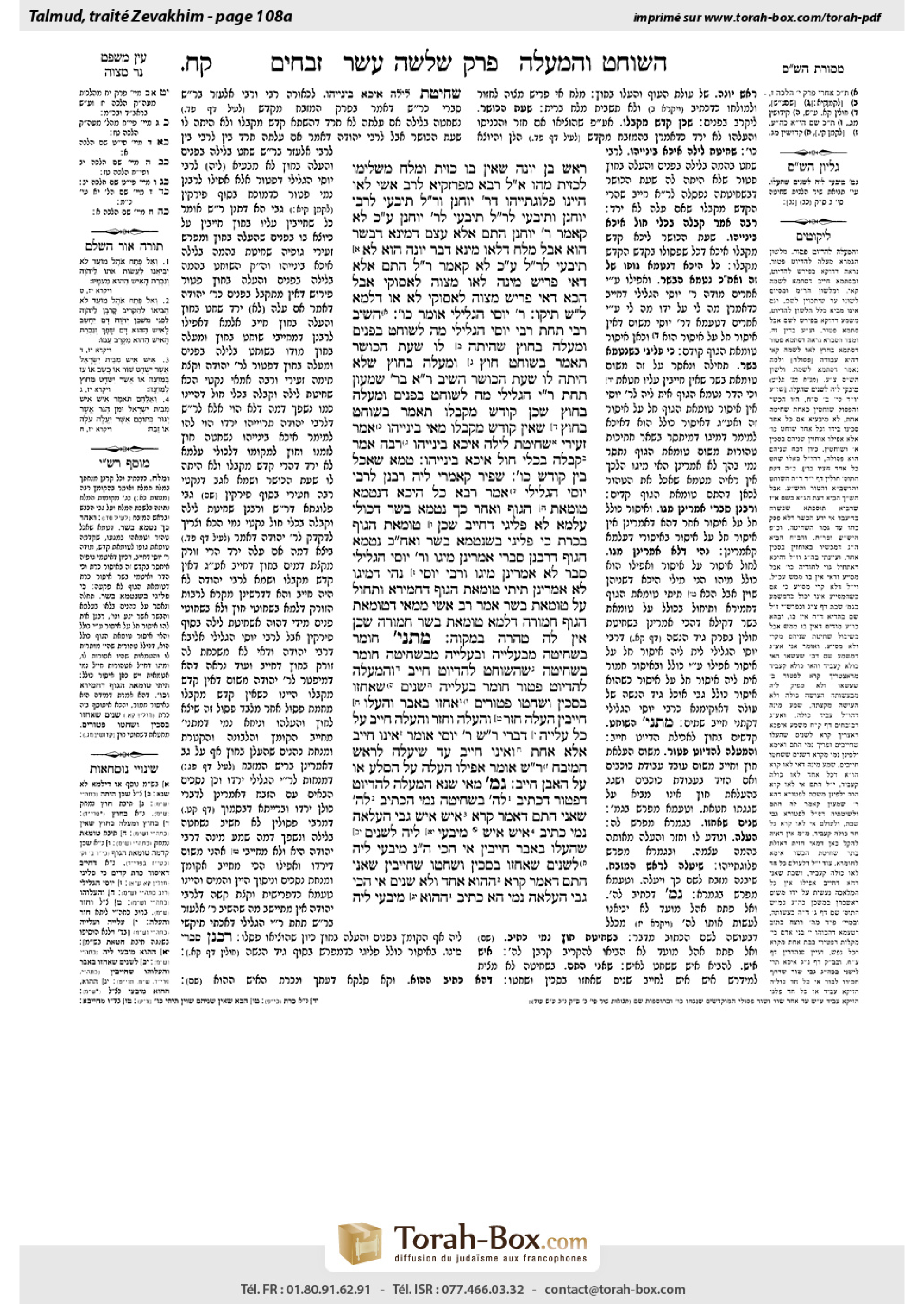
Zevachim 108a: Talmud study for Daf Yomi
Daf Yomi is the daily study of one Talmud folio. Explore 37 tractates with scans, Hebrew text, Sefaria English and AI-generated French translations where annotated.
Passage selection and English or AI-generated French translation are available where the scan has annotations. Daf Study is independent of Torah-Box and Sefaria.
Browse Zevachim · זבחים · All tractatesZevachim 108a text and translations
This page of Zevachim includes the Aramaic text, an English translation and an AI-generated French translation, alongside the scan above.
זבחים ק״ח א · Aramaic and Hebrew text
רֹאשׁ בֶּן יוֹנָה שֶׁאֵין בּוֹ כְּזַיִת, וּמֶלַח מַשְׁלִימוֹ לִכְזַיִת; מַהוּ?
אֲמַר לֵיהּ רָבָא מִפַּרְזִקְיָא לְרַב אָשֵׁי: לָאו הַיְינוּ פְּלוּגְתַּיְיהוּ דְּרַבִּי יוֹחָנָן וְרֵישׁ לָקִישׁ? תִּיבְּעֵי לְרַבִּי יוֹחָנָן, וְתִיבְּעֵי לְרֵישׁ לָקִישׁ;
תִּיבְּעֵי לְרַבִּי יוֹחָנָן – עַד כָּאן לָא קָאָמַר רַבִּי יוֹחָנָן הָתָם, אֶלָּא עֶצֶם – דְּמִינָא דְּבָשָׂר הוּא; אֲבָל מֶלַח, דְּלָאו מִינָא דְּבַר יוֹנָה הוּא – לָא. תִּיבְּעֵי לְרֵישׁ לָקִישׁ – עַד כָּאן לָא קָאָמַר רֵישׁ לָקִישׁ הָתָם, אֶלָּא דְּאִי פָּרֵישׁ מִינֵּהּ לָאו מִצְוָה לְאַסּוֹקֵי; אֲבָל הָכָא, דְּאִי פָּרֵישׁ מִצְוָה לְאַסּוֹקֵי – לָא. אוֹ דִלְמָא לָא שְׁנָא?
תֵּיקוּ.
רַבִּי יוֹסֵי הַגְּלִילִי אוֹמֵר כּוּ׳.
הֵשִׁיב רַבִּי תַּחַת רַבִּי יוֹסֵי הַגְּלִילִי: מָה לְשׁוֹחֵט בִּפְנִים וּמַעֲלֶה בַּחוּץ – שֶׁהָיְתָה לוֹ שְׁעַת הַכּוֹשֶׁר; תֹּאמַר בְּשׁוֹחֵט חוּץ וּמַעֲלֶה בַּחוּץ – שֶׁלֹּא הָיְתָה לוֹ שְׁעַת הַכּוֹשֶׁר?!
הֵשִׁיב רַבִּי אֶלְעָזָר בְּרַבִּי שִׁמְעוֹן תַּחַת רַבִּי יוֹסֵי הַגְּלִילִי: מָה לְשׁוֹחֵט בִּפְנִים וּמַעֲלֶה בַּחוּץ – שֶׁכֵּן קוֹדֶשׁ מְקַבְּלוֹ; תֹּאמַר בְּשׁוֹחֵט בַּחוּץ – שֶׁאֵין קוֹדֶשׁ מְקַבְּלוֹ?!
מַאי בֵּינַיְיהוּ? אָמַר זְעֵירִי: שְׁחִיטַת לַיְלָה אִיכָּא בֵּינַיְיהוּ.
רַבָּה אָמַר: קַבָּלָה בִּכְלִי חוֹל אִיכָּא בֵּינַיְיהוּ.
טָמֵא שֶׁאָכַל בֵּין קוֹדֶשׁ כּוּ׳.
שַׁפִּיר קָאָמְרִי לֵיהּ רַבָּנַן לְרַבִּי יוֹסֵי הַגְּלִילִי!
אָמַר רָבָא: כֹּל הֵיכָא דְּנִטְמָא טוּמְאַת הַגּוּף וְאַחַר כָּךְ נִטְמָא בָּשָׂר – דְּכוּלֵּי עָלְמָא לָא פְּלִיגִי דְּחַיָּיב, שֶׁכֵּן טוּמְאַת הַגּוּף בְּכָרֵת.
כִּי פְּלִיגִי – כְּשֶׁנִּטְמָא בָּשָׂר וְאַחַר כָּךְ נִטְמָא הַגּוּף.
דְּרַבָּנַן סָבְרִי אָמְרִינַן מִיגּוֹ, וְרַבִּי יוֹסֵי הַגְּלִילִי סָבַר לָא אָמְרִינַן מִיגּוֹ.
וְרַבִּי יוֹסֵי – נְהִי דְּמִיגּוֹ לָא אָמְרִינַן; תֵּיתֵי טוּמְאַת הַגּוּף דַּחֲמִירָא, וְתָחוּל עַל טוּמְאַת בָּשָׂר!
אָמַר רַב אָשֵׁי: מִמַּאי דְּטוּמְאַת הַגּוּף חֲמוּרָה? דִּלְמָא טוּמְאַת בָּשָׂר חֲמוּרָה, שֶׁכֵּן אֵין לָהּ טׇהֳרָה בַּמִּקְוֶה!
מַתְנִי׳ חוֹמֶר בַּשְּׁחִיטָה מִבָּעֲלִיָּיה, וּבָעֲלִיָּיה מִבַּשְּׁחִיטָה.
חוֹמֶר בַּשְּׁחִיטָה – שֶׁהַשּׁוֹחֵט לַהֶדְיוֹט חַיָּיב, וְהַמַּעֲלֶה לַהֶדְיוֹט פָּטוּר. חוֹמֶר בָּעֲלִיָּיה – שְׁנַיִם שֶׁאָחֲזוּ בְּסַכִּין וְשָׁחֲטוּ, פְּטוּרִים; אָחֲזוּ בְּאֵבֶר וְהֶעֱלוּ, חַיָּיבִין.
הֶעֱלָה חָזַר וְהֶעֱלָה וְחָזַר וְהֶעֱלָה – חַיָּיב עַל כׇּל עֲלִיָּיה. דִּבְרֵי רַבִּי שִׁמְעוֹן. רַבִּי יוֹסֵי אוֹמֵר: אֵינוֹ חַיָּיב אֶלָּא אַחַת.
וְאֵינוֹ חַיָּיב עַד שֶׁיַּעֲלֶה לְרֹאשׁ הַמִּזְבֵּחַ. רַבִּי שִׁמְעוֹן אוֹמֵר: אֲפִילּוּ הֶעֱלָה עַל הַסֶּלַע אוֹ עַל הָאֶבֶן – חַיָּיב.
גְּמָ׳ מַאי שְׁנָא הַמַּעֲלֶה לְהֶדְיוֹט דְּפָטוּר – דִּכְתִיב ״לַה׳״, בַּשְּׁחִיטָה נָמֵי הָכְתִיב ״לַה׳״!
שָׁאנֵי הָתָם, דְּאָמַר קְרָא: ״אִישׁ אִישׁ״. גַּבֵּי הַעֲלָאָה נָמֵי כְּתִיב: ״אִישׁ אִישׁ״! מִיבְּעֵי לֵיהּ לִשְׁנַיִם שֶׁהֶעֱלוּ בְּאֵבֶר – חַיָּיבִין.
אִי הָכִי, הָכָא נָמֵי מִיבְּעֵי לֵיהּ לִשְׁנַיִם שֶׁאָחֲזוּ בְּסַכִּין וְשָׁחֲטוּ – שֶׁחַיָּיבִין! שָׁאנֵי הָתָם, דְּאָמַר קְרָא: ״הָהוּא״ – אֶחָד וְלֹא שְׁנַיִם.
אִי הָכִי, גַּבֵּי הַעֲלָאָה נָמֵי – הָא כְּתִיב ״הָהוּא״!
Zevachim 108a · English translation
the head of a pigeon burnt offering that does not have on it an olive-bulk of flesh, but the salt that adheres to it, after it was salted in accordance with the requirement to salt it (see Leviticus 2:13), completes the measure to make an olive-bulk, what is the halakha? Is one liable for offering it up outside?
Rava from Parzakya said to Rav Ashi: Is this not identical to the dispute between Rabbi Yoḥanan and Reish Lakish with regard to a bone attached to sacrificial flesh? Rav Ashi responded: No. The dilemma can be raised according to Rabbi Yoḥanan and the dilemma can be raised according to Reish Lakish.
The Gemara elaborates: The dilemma can be raised according to Rabbi Yoḥanan: Perhaps Rabbi Yoḥanan states his opinion only there, with regard to a bone, claiming that it contributes to the measure of an olive-bulk as it is of the same kind that flesh is, i.e., they are both animal parts. But in the case of salt, which is not of the same kind as a pigeon, perhaps it would not contribute to the measure. And the dilemma can also be raised according to Reish Lakish: Perhaps Reish Lakish states his opinion only there, with regard to a bone, claiming that it does not contribute to the measure of an olive-bulk, as if the bone separates from the flesh, there is no mitzva to offer the bone up on the altar. But here, with regard to salt, concerning which if it separates from the pigeon there is a mitzva to offer it up, he would not rule as he does concerning a bone attached to flesh. Or perhaps there is no difference between the cases.
The Gemara concludes: The dilemma shall stand unresolved.
§ The mishna teaches: Rabbi Yosei HaGelili says: If he slaughtered an offering inside the courtyard and then offered it up outside the courtyard, he is liable. But if he slaughtered it outside, thereby rendering it unfit, and then he offered it up outside, he is exempt for the offering up, as he offered up only an item that is unfit, and one is liable only for offering up an item that is fit to be offered up inside the Temple. The Rabbis said to him: According to your reasoning, even in a case where he slaughters it inside and offers it up outside, he should be exempt, since he rendered it unfit the moment that he took it outside the courtyard. Yet, in such a case, he is certainly liable for offering it up. So too, one who slaughters an offering outside and then offers it up outside is liable.
While a defense of Rabbi Yosei HaGelili’s opinion is not presented in the mishna, various possibilities are recorded in a baraita: Rabbi Yehuda HaNasi responded to this challenge on behalf of Rabbi Yosei HaGelili: What is notable about slaughtering an offering inside the courtyard and then offering it up outside? It is notable in that the offering had a period of fitness. Can you say the same about slaughtering an offering outside and then offering it up outside, where the offering never had a period of fitness? It was disqualified as soon as it was slaughtered and so it is reasonable that one is not liable for offering it up.
Rabbi Elazar, son of Rabbi Shimon, responded to this challenge on behalf of Rabbi Yosei HaGelili: What is notable about slaughtering an offering inside the courtyard and then offering it up outside? It is notable in that even though the offering was taken outside the courtyard and thereby disqualified, if it is, albeit unlawfully, placed on the altar, the sanctity of the altar renders the offering acceptable and it should not be removed from the altar because the disqualification occurred in sanctity, i.e., during the course of the Temple service (see 84a). Can you say the same about slaughtering an offering outside and then offering it up outside, where the disqualification did not occur in sanctity and so the sanctity of the altar does not render the offering acceptable? Therefore, even if it were placed there, it must be removed.
The Gemara asks: What is the practical difference between these two responses? Ze’eiri said: The practical difference between them is a case of slaughtering an offering at night inside the courtyard and then offering it up outside. According to Rabbi Yehuda HaNasi’s response, one would be exempt, as slaughtering at night disqualifies the offering from its very outset; whereas according to the response of Rabbi Elazar, one would be liable as this is a disqualification that occurs in sanctity.
Rabba said: The practical difference between them is a case in which, after slaughtering the offering in the courtyard, the collection of the blood was done there in a non-sacred vessel and then the animal was offered up outside the courtyard. According to Rabbi Yehuda HaNasi’s defense, one would be exempt, as collecting the blood in a non-sacred vessel disqualifies the offering from its very outset; whereas according to the response of Rabbi Elazar, one would be liable as this is a disqualification that occurs in sanctity.
§ The mishna teaches: One who is ritually impure who ate sacrificial food, whether it was ritually impure sacrificial food or ritually pure sacrificial food, is liable to receive karet if he did so intentionally, and to bring a sliding-scale offering if he did so unwittingly. Rabbi Yosei HaGelili says: An impure person who ate pure sacrificial food is liable. But an impure person who ate impure sacrificial food is exempt, as he merely ate an impure item, and the prohibition against eating sacrificial food while one is impure applies only to pure sacrificial food. The Rabbis said to him: According to your logic, even in a case of an impure person who ate what had been pure sacrificial food, once he has touched it, he has thereby rendered it ritually impure. Yet, in such a case, he is certainly liable for eating it. So too, an impure person who ate impure sacrificial food is liable.
The Gemara notes: The Rabbis are saying well to Rabbi Yosei HaGelili; why does Rabbi Yosei HaGelili disagree?
Rava said in elaboration of the dispute: Wherever one is first rendered impure with impurity of the body and then afterward the sacrificial meat is rendered impure, everyone agrees that he is liable if he eats the meat. This is because the prohibition due to the impurity of one’s body, which carries the punishment of karet, took effect while the meat was still ritually pure, and so this prohibition is not abrogated even when the meat is later rendered impure.
When they disagree is in a case where first the meat is rendered impure and then afterward the person’s body is rendered impure. In general, once an item has become subject to a prohibition, it cannot then become subject to an additional prohibition. In this case, once the meat is rendered impure, it is prohibited for anyone to eat it, even if that person is ritually pure. If that person is later rendered impure, the meat should not become subject to the additional prohibition against a ritually impure person eating sacrificial meat.
Rava explains that Rabbi Yosei HaGelili and the Rabbis disagree as to whether this case is an exception to that principle, as the Rabbis hold that we say that since the prohibition due to the ritual impurity of one’s body is a more inclusive prohibition, as it prohibits that person from eating all sacrificial meat, both pure and impure, it therefore takes effect also with regard to this meat, even though it was already rendered impure before the person was. And Rabbi Yosei HaGelili says that we do not say that since it is a more inclusive prohibition, it takes effect.
The Gemara asks: But even according to Rabbi Yosei HaGelili, granted that we do not say that since it is a more inclusive prohibition it will take effect. But still, the prohibition due to the impurity of a person’s body, which is a more stringent prohibition as it carries the punishment of karet, should come and take effect upon the prohibition due to the ritual impurity of the meat itself, as that prohibition is less stringent as it carries only the punishment of lashes. One exception to the principle that a second prohibition does not take effect is that even if an item or person is already subject to a prohibition, a more stringent prohibition will still take effect with regard to it.
Rav Ashi said: From where is it apparent that the prohibition due to the impurity of the person’s body is more stringent? Perhaps the prohibition due to the impurity of the meat is more stringent, as impure meat does not have the possibility of purification in a ritual bath, whereas a ritually impure person does. Since the prohibition due to the person’s impurity is not more stringent in every regard, it cannot take effect upon meat that is already prohibited due to its own impurity.
MISHNA: There is a greater stringency with regard to slaughtering outside the Temple courtyard than with regard to offering up outside, and there is a greater stringency with regard to offering up outside than with regard to slaughtering outside.
The mishna elaborates: The greater stringency with regard to slaughtering outside is that one who slaughters an offering outside the Temple courtyard even for the sake of an ordinary purpose, not for the sake of God, is liable. But one who offers up an offering outside the courtyard for the sake of an ordinary purpose is exempt. The greater stringency with regard to offering up outside is that two people who grasped a knife and together slaughtered an offering outside the courtyard are exempt. But if two grasped a limb from an offering and together offered it up outside, they are liable.
If one unwittingly offered up part of an offering outside the courtyard and then in a different lapse of awareness offered up other parts of that offering and then again, in another lapse of awareness, offered up yet other parts, he is liable to bring a sin offering for each act of offering up; this is the statement of Rabbi Shimon. Rabbi Yosei says: He is liable to bring only one sin offering.
Rabbi Yosei adds: And one is liable for offering up an offering outside the courtyard only once he offers it up at the top of an altar that was erected there. Rabbi Shimon says: Even if he offered it up on a rock or on a stone, not an altar, he is liable.
GEMARA: The Gemara analyzes the first halakha of the mishna: What is different about one who offers up outside for the sake of an ordinary purpose, that he is exempt? As it is written: “And he will not bring it to the entrance of the Tent of Meeting, to sacrifice it to the Lord” (Leviticus 17:9), which indicates that the liability applies only to offering up for the sake of the Lord. The Gemara questions this: But with regard to slaughtering, isn’t it also written: “Or that slaughters it outside the camp, and he did not bring it to the entrance of the Tent of Meeting to sacrifice an offering to the Lord” (Leviticus 17:3–4)?
The Gemara explains: It is different there, with regard to slaughtering, as the verse states: “Any man [ish ish] of the house of Israel…that slaughters it outside the camp” (Leviticus 17:3). The amplification indicated by the phrase “ish ish” teaches that one is liable even for slaughtering for the sake of an ordinary purpose. The Gemara challenges: But also with regard to offering up it is written: “Any man [ish ish] of the house of Israel…that offers up a burnt offering” (Leviticus 17:8). The Gemara explains: That amplification is necessary to teach that two people who offered up a limb of an offering together outside the courtyard are liable.
The Gemara asks: If so, here too, with regard to slaughtering, the phrase “ish ish” should be used to teach that two people who grasped a knife and together slaughtered an offering outside the courtyard are liable, contrary to the ruling of the mishna. Why are the two parallel phrases expounded in different ways? The Gemara explains: It is different there, with regard to slaughtering, as the verse states: “And that man shall be cut off from among his people” (Leviticus 17:4). The term “that man,” which is in the singular, indicates that only one who acts alone is liable, but not two who act together.
The Gemara challenges: But if so, also with regard to offering up, isn’t it written: “That man shall be cut off from his people” (Leviticus 17:9)? Why isn’t that term also expounded to teach that only one who acts alone is liable? The Gemara explains: That term is necessary
Zevachim 108a · Traduction française (IA)
La tête d’une colombe offerte en holocauste ne contient pas le volume d’une olive de chair, mais le sel qui y adhère après qu’elle a été salée conformément à l’obligation de la saler (voir Lévitique 2,13) complète cette mesure. Quelle est la halakha ? Est-on passible pour l’avoir offerte à l’extérieur ?
Rava de Parzakya dit à Rav Ashi : N’est-ce pas identique à la controverse entre Rabbi Yoḥanan et Reish Lakish au sujet d’un os attaché à la chair d’un sacrifice ? Rav Ashi répondit : Non. On peut soulever le dilemme aussi bien selon Rabbi Yoḥanan que selon Reish Lakish.
La Guemara développe : On peut soulever le dilemme selon Rabbi Yoḥanan : peut-être Rabbi Yoḥanan ne soutient-il son opinion que dans ce cas, au sujet d’un os, affirmant qu’il contribue à atteindre le volume d’une olive parce qu’il est de même nature que la chair, c’est-à-dire que tous deux sont des parties de l’animal. Mais, dans le cas du sel, qui n’est pas de même nature qu’une colombe, peut-être ne contribuerait-il pas à atteindre cette mesure. On peut également soulever le dilemme selon Reish Lakish : peut-être Reish Lakish ne soutient-il son opinion que dans ce cas, au sujet d’un os, affirmant qu’il ne contribue pas à atteindre le volume d’une olive, car si l’os se détache de la chair, il n’y a pas de mitsva de l’offrir sur l’autel. Mais ici, au sujet du sel, qu’il y a une mitsva d’offrir s’il se détache de la colombe, il ne statuerait pas comme il le fait au sujet d’un os attaché à la chair. Ou peut-être n’y a-t-il aucune différence entre les cas.
La Guemara conclut : Le dilemme reste sans solution.
§ La Michna enseigne : Rabbi Yosei HaGelili dit : Si quelqu’un a abattu un sacrifice à l’intérieur du parvis, puis l’a offert à l’extérieur du parvis, il est passible. Mais s’il l’a abattu à l’extérieur, le rendant ainsi impropre, puis l’a offert à l’extérieur, il n’est pas passible pour l’offrande, car il n’a offert qu’un élément impropre, et l’on n’est passible que pour avoir offert un élément propre à être offert à l’intérieur du Temple. Les Sages lui dirent : Selon ton raisonnement, même si quelqu’un abat un sacrifice à l’intérieur puis l’offre à l’extérieur, il devrait être exempt, puisqu’il l’a rendu impropre dès qu’il l’a sorti du parvis. Pourtant, dans un tel cas, il est certainement passible pour l’avoir offert. De même, celui qui abat un sacrifice à l’extérieur puis l’offre à l’extérieur est passible.
La Michna ne présente pas de défense de l’opinion de Rabbi Yosei HaGelili, mais une baraïta rapporte diverses réponses : Rabbi Yehuda HaNasi répondit à cette objection au nom de Rabbi Yosei HaGelili : Qu’y a-t-il de particulier dans le fait d’abattre un sacrifice à l’intérieur du parvis puis de l’offrir à l’extérieur ? C’est que le sacrifice a connu une période où il était apte. Peut-on en dire autant d’un sacrifice abattu à l’extérieur puis offert à l’extérieur, alors qu’il n’a jamais connu de période où il était apte ? Il a été disqualifié dès son abattage ; il est donc raisonnable de ne pas être passible pour l’avoir offert.
Rabbi Elazar, fils de Rabbi Shimon, répondit à cette objection au nom de Rabbi Yosei HaGelili : Qu’y a-t-il de particulier dans le fait d’abattre un sacrifice à l’intérieur du parvis puis de l’offrir à l’extérieur ? C’est que, même si le sacrifice a été emporté hors du parvis et ainsi disqualifié, s’il est placé sur l’autel — quoique de manière illicite —, la sainteté de l’autel le rend acceptable et il ne doit pas être retiré de l’autel, car la disqualification est survenue dans un contexte de sainteté, c’est-à-dire au cours du service du Temple (voir 84a). Peut-on en dire autant d’un sacrifice abattu à l’extérieur puis offert à l’extérieur, alors que la disqualification n’est pas survenue dans un contexte de sainteté et que la sainteté de l’autel ne rend donc pas le sacrifice acceptable ? Par conséquent, même s’il y était placé, il devrait être retiré.
La Guemara demande : Quelle est la différence pratique entre ces deux réponses ? Ze’eiri dit : La différence pratique concerne le cas où l’on abat un sacrifice à l’intérieur du parvis pendant la nuit, puis où on l’offre à l’extérieur. Selon la réponse de Rabbi Yehuda HaNasi, on serait exempt, car l’abattage nocturne disqualifie le sacrifice dès le départ ; tandis que selon la réponse de Rabbi Elazar, on serait passible, car il s’agit d’une disqualification survenue dans un contexte de sainteté.
Rabba dit : La différence pratique concerne le cas où, après avoir abattu le sacrifice dans le parvis, on y a recueilli le sang dans un récipient profane, puis offert l’animal à l’extérieur du parvis. Selon la défense de Rabbi Yehuda HaNasi, on serait exempt, car le recueil du sang dans un récipient profane disqualifie le sacrifice dès le départ ; tandis que selon la réponse de Rabbi Elazar, on serait passible, car il s’agit d’une disqualification survenue dans un contexte de sainteté.
§ La Michna enseigne : Une personne en état d’impureté rituelle qui a mangé des aliments sacrés, qu’ils soient rituellement impurs ou rituellement purs, est passible de retranchement si elle l’a fait intentionnellement et doit apporter une offrande à valeur graduée si elle l’a fait involontairement. Rabbi Yosei HaGelili dit : Une personne impure qui a mangé des aliments sacrés purs est passible. Mais une personne impure qui a mangé des aliments sacrés impurs est exemptée, car elle n’a fait que manger un élément impur, et l’interdiction de manger des aliments sacrés en état d’impureté ne s’applique qu’aux aliments sacrés purs. Les Sages lui dirent : Selon ton raisonnement, même dans le cas d’une personne impure qui a mangé des aliments sacrés qui étaient purs, dès qu’elle les a touchés, elle les a rendus rituellement impurs. Pourtant, dans un tel cas, elle est certainement passible pour les avoir mangés. De même, une personne impure qui a mangé des aliments sacrés impurs est passible.
La Guemara relève : Les Sages répondent bien à Rabbi Yosei HaGelili ; pourquoi celui-ci est-il en désaccord ?
Rava explique la controverse : Chaque fois qu’une personne est d’abord rendue impure par une impureté corporelle, puis que la viande du sacrifice est rendue impure, tous conviennent qu’elle est passible si elle mange cette viande. En effet, l’interdiction due à l’impureté de son corps, qui entraîne la peine de retranchement, a pris effet alors que la viande était encore rituellement pure ; cette interdiction n’est donc pas abrogée lorsque la viande devient ensuite impure.
Le désaccord porte sur le cas où la viande est d’abord rendue impure, puis où le corps de la personne est rendu impur. En règle générale, une fois qu’un élément est soumis à une interdiction, il ne peut ensuite être soumis à une interdiction supplémentaire. Dans ce cas, dès que la viande est rendue impure, il est interdit à quiconque de la manger, même si cette personne est rituellement pure. Si cette personne est ensuite rendue impure, la viande ne devrait pas être soumise à l’interdiction supplémentaire faite à une personne rituellement impure de manger de la viande sacrificielle.
Rava explique que Rabbi Yosei HaGelili et les Sages sont en désaccord sur la question de savoir si ce cas fait exception à ce principe. Les Sages estiment que, puisque l’interdiction due à l’impureté rituelle du corps est plus inclusive — car elle interdit à cette personne de manger toute viande sacrificielle, pure ou impure —, elle prend également effet à l’égard de cette viande, bien que celle-ci ait été rendue impure avant que la personne ne le soit. Rabbi Yosei HaGelili, quant à lui, considère que cette interdiction ne prend pas effet au motif qu’elle est plus inclusive.
La Guemara demande : Pourtant, même selon Rabbi Yosei HaGelili, admettons qu’on ne considère pas que l’interdiction prenne effet parce qu’elle est plus inclusive. Mais l’interdiction due à l’impureté du corps d’une personne, qui est plus rigoureuse puisqu’elle entraîne la peine de retranchement, ne devrait-elle pas prendre effet en plus de l’interdiction due à l’impureté rituelle de la viande elle-même, laquelle est moins rigoureuse puisqu’elle n’entraîne que la peine de flagellation ? Une exception au principe selon lequel une seconde interdiction ne prend pas effet est qu’une interdiction plus rigoureuse prend malgré tout effet à l’égard d’un élément ou d’une personne déjà soumis à une interdiction.
Rav Ashi dit : D’où sait-on que l’interdiction due à l’impureté du corps de la personne est plus rigoureuse ? Peut-être l’interdiction due à l’impureté de la viande est-elle plus rigoureuse, car une viande impure ne peut pas être purifiée dans un bain rituel, alors qu’une personne rituellement impure peut l’être. Puisque l’interdiction due à l’impureté de la personne n’est pas plus rigoureuse à tous égards, elle ne peut pas prendre effet à l’égard d’une viande déjà interdite en raison de sa propre impureté.
MICHNA : L’abattage à l’extérieur du parvis du Temple est plus sévèrement sanctionné que l’offrande à l’extérieur, et l’offrande à l’extérieur est plus sévèrement sanctionnée que l’abattage à l’extérieur.
La Michna développe : La plus grande rigueur de l’abattage à l’extérieur tient au fait que celui qui abat un sacrifice à l’extérieur du parvis du Temple, même dans un but profane et non pour Dieu, est passible. Mais celui qui offre un sacrifice à l’extérieur du parvis dans un but profane est exempt. La plus grande rigueur de l’offrande à l’extérieur tient au fait que deux personnes qui ont saisi ensemble un couteau et abattu un sacrifice à l’extérieur du parvis sont exemptes. Mais si deux personnes ont saisi ensemble un membre d’un sacrifice et l’ont offert à l’extérieur, elles sont passibles.
Si quelqu’un a offert involontairement une partie d’un sacrifice à l’extérieur du parvis, puis, lors d’un autre accès de distraction, en a offert d’autres parties, puis encore, lors d’un autre accès de distraction, en a offert d’autres, il doit apporter un sacrifice expiatoire pour chaque acte d’offrande ; telle est l’opinion de Rabbi Shimon. Rabbi Yosei dit : Il ne doit apporter qu’un seul sacrifice expiatoire.
Rabbi Yosei ajoute : On n’est passible pour avoir offert un sacrifice à l’extérieur du parvis qu’à partir du moment où on l’offre au sommet d’un autel érigé là. Rabbi Shimon dit : Même si on l’a offert sur un rocher ou une pierre, et non sur un autel, on est passible.
GUEMARA : La Guemara analyse la première halakha de la Michna : Pourquoi celui qui offre un sacrifice à l’extérieur dans un but profane est-il exempt ? C’est qu’il est écrit : « Et il ne l’apportera pas à l’entrée de la Tente d’assignation pour le sacrifier au Seigneur » (Lévitique 17,9), ce qui indique qu’on n’est passible que si l’on offre pour le Seigneur. La Guemara objecte : Mais, au sujet de l’abattage, n’est-il pas également écrit : « Ou qui l’abat hors du camp, et ne l’a pas apporté à l’entrée de la Tente d’assignation pour offrir un sacrifice au Seigneur » (Lévitique 17,3-4) ?
La Guemara explique : Le cas de l’abattage est différent, car le verset dit : « Tout homme [ish ish] de la maison d’Israël… qui l’abat hors du camp » (Lévitique 17,3). L’expression amplificatrice « ish ish » enseigne qu’on est passible même si l’on abat dans un but profane. La Guemara objecte : Mais, au sujet de l’offrande, il est également écrit : « Tout homme [ish ish] de la maison d’Israël… qui offre un holocauste » (Lévitique 17,8). La Guemara explique : Cette amplification est nécessaire pour enseigner que deux personnes qui offrent ensemble à l’extérieur du parvis un membre d’un sacrifice sont passibles.
La Guemara demande : Si tel est le cas, ici aussi, au sujet de l’abattage, l’expression « ish ish » devrait enseigner que deux personnes qui ont saisi ensemble un couteau et abattu un sacrifice à l’extérieur du parvis sont passibles, contrairement à la décision de la Michna. Pourquoi les deux expressions parallèles sont-elles interprétées de façons différentes ? La Guemara explique : Le cas de l’abattage est différent, car le verset dit : « Cet homme sera retranché du milieu de son peuple » (Lévitique 17,4). Le terme « cet homme », au singulier, indique que seul celui qui agit seul est passible, et non deux personnes agissant ensemble.
La Guemara objecte : Mais si tel est le cas, au sujet de l’offrande également, n’est-il pas écrit : « Cet homme sera retranché de son peuple » (Lévitique 17,9) ? Pourquoi ce terme n’est-il pas lui aussi interprété comme enseignant que seul celui qui agit seul est passible ? La Guemara explique : Ce terme est nécessaire
Traduction française générée par IA à partir de l’édition anglaise de Sefaria. Vérifie toujours un passage avec le texte source.
Text from Sefaria: William Davidson Edition - Vocalized Aramaic (CC BY NC); William Davidson Edition - English (CC BY NC).