Zevachim 107b: Talmud study for Daf Yomi
Daf Yomi is the daily study of one Talmud folio. Explore 37 tractates with scans, Hebrew text, Sefaria English and AI-generated French translations where annotated.
Passage selection and English or AI-generated French translation are available where the scan has annotations. Daf Study is independent of Torah-Box and Sefaria.
Browse Zevachim · זבחים · All tractatesZevachim 107b text and translations
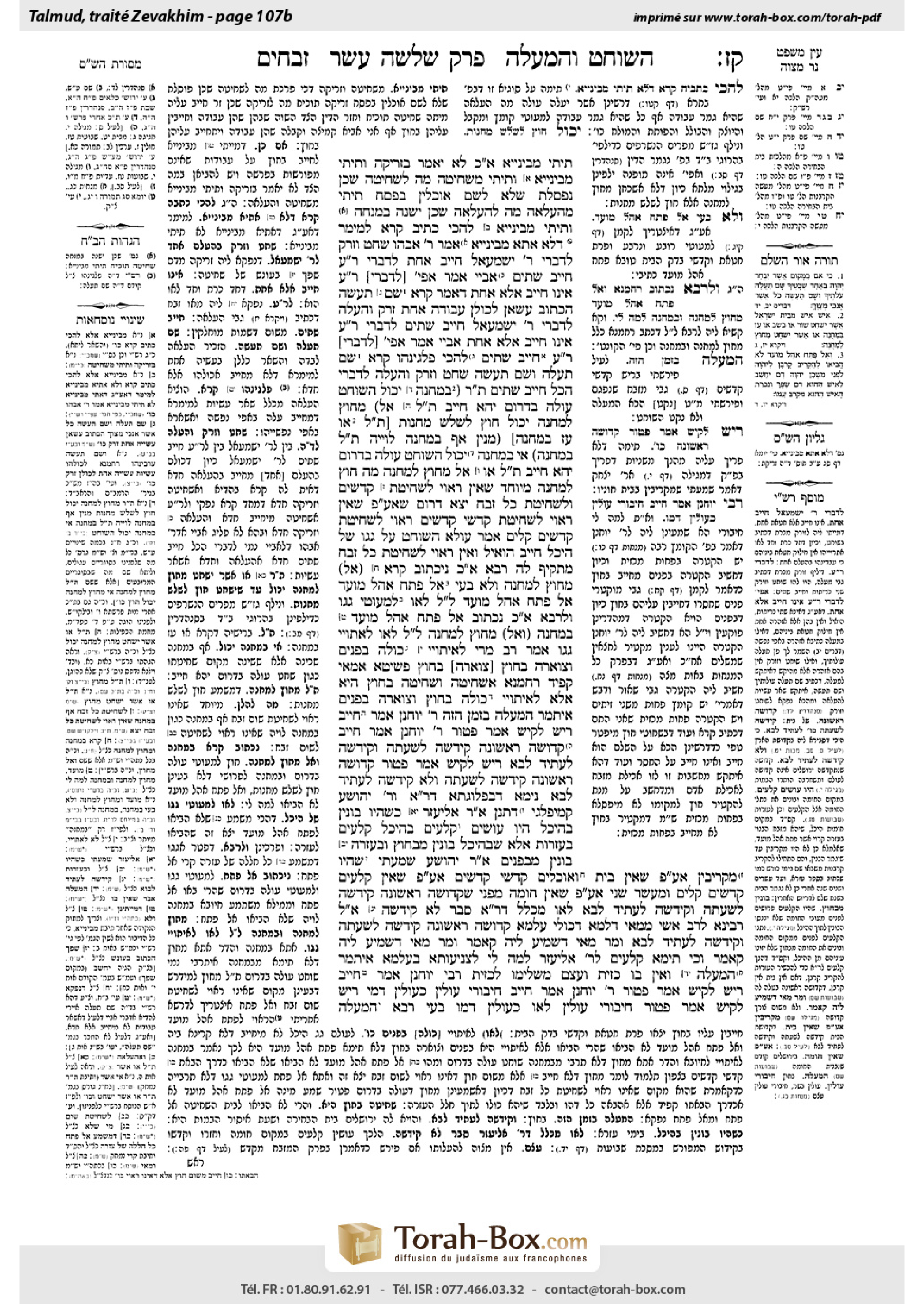
This page of Zevachim includes the Aramaic text, an English translation and an AI-generated French translation, alongside the scan above.
זבחים ק״ז ב · Aramaic and Hebrew text
תֵּיתֵי מִבֵּינַיָּיא.
אִם כֵּן, לֹא יֵאָמֵר בִּזְרִיקָה, וְתֵיתֵי מִבֵּינַיָּיא!
וְתֵיתֵי מִשְּׁחִיטָה – מָה לִשְׁחִיטָה, שֶׁכֵּן נִפְסֶלֶת שֶׁלֹּא לְשֵׁם אוֹכְלִין בַּפֶּסַח; תֵּיתֵי מֵהַעֲלָאָה – מָה לְהַעֲלָאָה, שֶׁכֵּן יֶשְׁנָהּ בַּמִּנְחָה; וְתֵיתֵי מִבֵּינַיָּיא;
לְהָכִי כְּתִיב קְרָא, לְמֵימַר דְּלָא אֲתָא מִבֵּינַיָּיא.
אָמַר רַבִּי אֲבָהוּ: שָׁחַט וְזָרַק – לְדִבְרֵי רַבִּי יִשְׁמָעֵאל חַיָּיב אַחַת, לְדִבְרֵי רַבִּי עֲקִיבָא חַיָּיב שְׁתַּיִם.
אַבָּיֵי אָמַר: אֲפִילּוּ [לְדִבְרֵי] רַבִּי עֲקִיבָא אֵינוֹ חַיָּיב אֶלָּא אַחַת, דְּאָמַר קְרָא: ״שָׁם תַּעֲשֶׂה״ – הַכָּתוּב עֲשָׂאָן לְכוּלָּן עֲבוֹדָה אַחַת.
זָרַק וְהֶעֱלָה – לְדִבְרֵי רַבִּי יִשְׁמָעֵאל חַיָּיב שְׁתַּיִם, לְדִבְרֵי רַבִּי עֲקִיבָא אֵינוֹ חַיָּיב אֶלָּא אַחַת.
אַבָּיֵי אָמַר: אֲפִילּוּ [לְדִבְרֵי] רַבִּי עֲקִיבָא חַיָּיב שְׁתַּיִם; לְהָכִי פַּלְגִינְהוּ קְרָא: ״שָׁם תַּעֲלֶה״ וְ״שָׁם תַּעֲשֶׂה״.
שָׁחַט וְזָרַק וְהֶעֱלָה – לְדִבְרֵי הַכֹּל חַיָּיב שְׁתַּיִם.
תָּנוּ רַבָּנַן: ״בַּמַּחֲנֶה״ – יָכוֹל הַשּׁוֹחֵט עוֹלָה בַּדָּרוֹם יְהֵא חַיָּיב? תַּלְמוּד לוֹמַר: ״אֶל מִחוּץ לַמַּחֲנֶה״.
יָכוֹל חוּץ לְשָׁלֹשׁ מַחֲנוֹת? (תַּלְמוּד לוֹמַר ״אוֹ עֵז בַּמַּחֲנֶה״.) מִנַּיִן אַף בְּמַחֲנֵה לְוִיָּיה? תַּלְמוּד לוֹמַר: ״בַּמַּחֲנֶה״.
אִי בַּמַּחֲנֶה, יָכוֹל הַשּׁוֹחֵט עוֹלָה בַּדָּרוֹם יְהֵא חַיָּיב? תַּלְמוּד לוֹמַר: ״אוֹ אֶל מִחוּץ לַמַּחֲנֶה״.
מָה חוּץ לַמַּחֲנֶה מְיוּחָד – שֶׁאֵין רָאוּי לִשְׁחִיטַת קָדָשִׁים וְלִשְׁחִיטַת כׇּל זֶבַח; יָצָא דָּרוֹם – שֶׁאַף עַל פִּי שֶׁאֵין רָאוּי לִשְׁחִיטַת קׇדְשֵׁי קָדָשִׁים, רָאוּי לִשְׁחִיטַת קָדָשִׁים קַלִּים.
אָמַר עוּלָּא: הַשּׁוֹחֵט עַל גַּגּוֹ שֶׁל הֵיכָל – חַיָּיב, הוֹאִיל וְאֵין רָאוּי לִשְׁחִיטַת כׇּל זֶבַח. מַתְקֵיף לַהּ רָבָא: אִם כֵּן, נִיכְתּוֹב קְרָא ״(אֶל) מִחוּץ לַמַּחֲנֶה״, וְלָא בָּעֵי ״אֶל פֶּתַח אֹהֶל מוֹעֵד״; ״אֶל פֶּתַח אֹהֶל מוֹעֵד״ לְמָה לִי? לָאו לְמַעוֹטֵי גַּגּוֹ?
וּלְרָבָא – אִם כֵּן נִכְתּוֹב: ״אֶל פֶּתַח אֹהֶל מוֹעֵד״; ״בַּמַּחֲנֶה״ ״(וְאֶל) מִחוּץ לַמַּחֲנֶה״ לְמָה לִי? לָאו לְאֵתוֹיֵי גַּגּוֹ?
אָמַר רַב מָרִי: לְאֵיתוֹיֵי כּוּלָּהּ בִּפְנִים וְצַוָּארָהּ בַּחוּץ.
[צַוָּארָהּ] בַּחוּץ – פְּשִׁיטָא! אַמַּאי קָפֵיד רַחֲמָנָא – אַשְּׁחִיטָה; וּשְׁחִיטָה בַּחוּץ הִיא! אֶלָּא לְאֵיתוֹיֵי כּוּלָּהּ בַּחוּץ וְצַוָּארָהּ בִּפְנִים.
אִיתְּמַר: הַמַּעֲלֶה בִּזְמַן הַזֶּה – רַבִּי יוֹחָנָן אָמַר: חַיָּיב, רֵישׁ לָקִישׁ אָמַר: פָּטוּר.
רַבִּי יוֹחָנָן אָמַר חַיָּיב – קְדוּשָּׁה רִאשׁוֹנָה קִידְּשָׁה לִשְׁעָתָהּ וְקִידְּשָׁה לֶעָתִיד לָבֹא. רֵישׁ לָקִישׁ אָמַר פָּטוּר – קְדוּשָּׁה רִאשׁוֹנָה קִידְּשָׁה לִשְׁעָתָהּ וְלֹא קִידְּשָׁה לֶעָתִיד לָבֹא.
נֵימָא דְּבִפְלוּגְתָּא דְּרַבִּי אֱלִיעֶזֶר וְרַבִּי יְהוֹשֻׁעַ קָמִיפַּלְגִי? דִּתְנַן, אָמַר רַבִּי אֱלִיעֶזֶר: כְּשֶׁהָיוּ בּוֹנִין בַּהֵיכָל – הָיוּ עוֹשִׂים קְלָעִים בַּהֵיכָל, קְלָעִים בָּעֲזָרוֹת; אֶלָּא שֶׁבַּהֵיכָל בּוֹנִין מִבַּחוּץ, וּבָעֲזָרָה בּוֹנִין מִבִּפְנִים.
אָמַר רַבִּי יְהוֹשֻׁעַ: שָׁמַעְתִּי שֶׁהָיוּ מַקְרִיבִין אַף עַל פִּי שֶׁאֵין בַּיִת, וְאוֹכְלִים קׇדְשֵׁי קָדָשִׁים אַף עַל פִּי שֶׁאֵין קְלָעִים, קָדָשִׁים קַלִּים וּמַעֲשֵׂר שֵׁנִי אַף עַל פִּי שֶׁאֵין חוֹמָה; מִפְּנֵי שֶׁקְּדוּשָּׁה רִאשׁוֹנָה קִידְּשָׁה לִשְׁעָתָהּ וְקִידְּשָׁה לֶעָתִיד לָבֹא.
לָאו מִכְּלָל דְּרַבִּי אֱלִיעֶזֶר סָבַר לֹא קִידְּשָׁה?
אֲמַר לֵיהּ רָבִינָא לְרַב אָשֵׁי: מִמַּאי? דִּלְמָא דְּכוּלֵּי עָלְמָא – קְדוּשָּׁה רִאשׁוֹנָה קִידְּשָׁה לִשְׁעָתָהּ וְקִידְּשָׁה לֶעָתִיד לָבֹא; וּמָר מַאי דִּשְׁמִיעַ לֵיהּ קָאָמַר, וּמָר מַאי דִּשְׁמִיעַ לֵיהּ קָאָמַר! וְכִי תֵּימָא: קְלָעִים לְרַבִּי אֱלִיעֶזֶר לְמָה לִי? לִצְנִיעוּתָא בְּעָלְמָא.
אִיתְּמַר: הַמַּעֲלֶה וְאֵין בּוֹ כְּזַיִת, וְעֶצֶם מַשְׁלִימוֹ לִכְזַיִת – רַבִּי יוֹחָנָן אָמַר: חַיָּיב, רֵישׁ לָקִישׁ אָמַר: פָּטוּר.
רַבִּי יוֹחָנָן אָמַר חַיָּיב – חִיבּוּרֵי עוֹלִין כְּעוֹלִין דָּמֵי. רֵישׁ לָקִישׁ אָמַר פָּטוּר – חִיבּוּרֵי עוֹלִין לָאו כְּעוֹלִין דָּמוּ.
בָּעֵי רָבָא: הַמַּעֲלֶה
Zevachim 107b · English translation
Given that each suggestion has a different refutation, the Gemara suggests: Derive it through a comparison to the common element shared by these two cases. Slaughtering and sprinkling are each just one of the sacrificial rites that are performed with an offering, and yet one is liable for performing them outside the Temple. Since the derivation is based on a comparison to both cases, the refutations offered for each individual case are no longer relevant.
The Gemara rejects this: If that were so, and one can derive liability for one rite through a comparison to the common element shared by two other rites, then let the Torah not state that one is liable for sprinkling blood outside the Temple, and instead derive it from the common element shared by slaughtering and offering up outside the Temple.
The derivation would be as follows: And if you suggest deriving liability for sprinkling from the liability for slaughtering, that could be refuted. What is notable about slaughtering? It is notable in that, with regard to a Paschal offering, if one slaughters it with the intent that it be for the sake of those who cannot eat, it is thereby disqualified. Sprinkling does not share this stringency. And if you suggest deriving liability for sprinkling from the liability for offering up, that could also be refuted. What is notable about offering up? It is notable in that liability for offering up also exists with regard to a meal offering. Sprinkling does not share this stringency. But it should still be possible to derive liability for sprinkling from the common element shared by the two cases. Since the derivation is based on a comparison to both cases, the refutations offered above for each individual case are no longer relevant.
The Gemara explains: It is for this very reason that a verse is written to teach the liability for sprinkling outside the Temple, to say to you that liability for performing sacrificial rites outside the Temple cannot be derived from the common element shared by two other cases; rather, it must be directly derived from a verse. Accordingly, the Gemara has demonstrated that there is no basis to have assumed that one who takes a handful from a meal offering, or collects blood, outside the Temple is liable.
§ The Gemara cited a dispute concerning the source for the liability for sprinkling part of the blood of an offering outside the Temple courtyard. According to Rabbi Yishmael, it is derived from the verse in the passage about slaughtering outside the Temple: “Blood shall be imputed to that man” (Leviticus 17:4). According to Rabbi Akiva, it is derived from the verse in the passage about offering up outside the Temple: “Any man…that offers up a burnt offering or sacrifice” (Leviticus 17:8). Rabbi Abbahu says: One who slaughtered an offering and sprinkled its blood outside the Temple in a single lapse of awareness, according to the statement of Rabbi Yishmael, is liable to bring one sin offering, as liability for each transgression is derived from the same passage and they are subcategories of the same prohibition. According to the statement of Rabbi Akiva, one is liable to bring two sin offerings, as the liability for each transgression is derived from a different passage and they are considered independent prohibitions.
Abaye said: Even according to the statement of Rabbi Akiva, he is liable to bring only one sin offering, as the verse states with regard to performing sacrificial rites outside the Temple courtyard: “But in the place that the Lord will choose in one of your tribes, there you shall offer up your burnt offerings, and there you shall do all that I command you” (Deuteronomy 12:14). Since the first part of the verse makes reference to offering up, by inference, the term “you shall do” in the second part must be referring to all the other sacrificial rites. Therefore, the verse has regarded all of the sacrificial rites apart from offering up as one rite with regard to the prohibition against performing them outside the Temple courtyard.
Rabbi Abbahu also said: One who sprinkled the blood of an offering and offered it up outside, in a single lapse of awareness, according to the statement of Rabbi Yishmael is liable to bring two sin offerings. According to the statement of Rabbi Akiva, he is liable to bring only one sin offering.
Abaye said: Even according to the statement of Rabbi Akiva he is liable to bring two sin offerings, as it is for this reason that the verse differentiated between the offering up and the slaughtering, as it states: “There you shall offer up your burnt offerings, and there you shall do,” in order to teach that one who performs both is liable for each one.
Finally, Rabbi Abbahu adds the logical conclusion that with regard to one who slaughtered an offering and sprinkled its blood and offered it up outside, in a single lapse of awareness, all agree that he is liable to bring two sin offerings.
§ The Sages taught in a baraita: The verse states: “Any man of the house of Israel that slaughters an ox, or lamb, or goat, in the camp, or that slaughters it outside the camp” (Leviticus 17:3). Based on the first part of the verse: “That slaughters…in the camp,” one might have thought that one who slaughters a burnt offering in the south of the courtyard, instead of in the north, where it should be slaughtered, will be liable, as he has slaughtered it outside the area in which it should be slaughtered. To counter this, the next part of the verse states: “That slaughters it outside the camp,” indicating that liability is incurred only for slaughtering an offering outside the Temple courtyard.
The baraita continues: Three concentric areas, so-called camps, arranged according to decreasing level of sanctity, encompassed the Tabernacle and Temple: The camp of the Divine Presence comprised the courtyard of the Tabernacle, and later on, of the Temple. Surrounding that was the Levite camp and then the Israelite camp. If the verse had stated only: “That slaughters it outside the camp,” one might have thought that a person would be liable only for slaughtering an offering outside all three of the camps. To dispel this notion, the first part of the verse states: “That slaughters an ox, or lamb, or goat, in the camp,” which indicates that liability is incurred even for slaughtering inside these camps. From where is it derived that one is liable even if he slaughters inside the Levite camp? The verse states: “That slaughters…in the camp,” which indicates that liability is incurred even for slaughtering inside the three camps.
If the verse stated only the term “in the camp,” which indicates that one is liable even for slaughtering inside the three camps, one might have thought that one who slaughters a burnt offering in the south of the courtyard, which is regarded as being outside of the holier northern section of the courtyard, where such an offering should be slaughtered, will also be liable. To counter this, the verse states: “Or that slaughters it outside the camp.”
This indicates that just as the phrase “outside the camp” is distinctive in that it is referring to an area that is not fit for slaughtering offerings of the most sacred order or for slaughtering any other type of offering, so too, the term “in the camp” is referring to an area unfit for the slaughter of any offering. This excludes the south of the courtyard, as even though it is an area that is not fit for slaughtering offerings of the most sacred order, it is fit for slaughtering offerings of lesser sanctity. Therefore, no liability is incurred for slaughtering an offering in the south of the courtyard, even if it should have been slaughtered in the north.
Based on this baraita, Ulla says: One who slaughters an offering on the roof of the Sanctuary is liable for slaughtering outside the Temple courtyard, since the roof is an area that is not fit for the slaughter of any offering. Rava objects to this: If so, let the verse write only: “Or that slaughters it outside the camp,” and it would not be necessary to write: “And he did not bring it to the entrance of the Tent of Meeting” (Leviticus 17:4). Why do I need the verse to also write: “And he did not bring it to the entrance of the Tent of Meeting”? Is it not to exclude the roof of the Sanctuary, as in the Temple the Sanctuary corresponded to the Tent of Meeting? Although the roof is an area that is not fit for slaughtering any offering, one should not be liable for slaughtering there since the offering was nevertheless brought to the Tent of Meeting.
The Gemara questions Rava’s claim: But according to Rava, if that is so and one is exempt if he slaughtered on the roof of the Sanctuary as ultimately the offering was brought to the Tent of Meeting, then let the verse write only: “And he did not bring it to the entrance of the Tent of Meeting.” Why do I need the verse to also write “in the camp” and “outside the camp”? Is it not that the term “in the camp” indicates that there is a case where one is liable even when slaughtering inside the courtyard, which serves to include liability for slaughtering on the roof of the Sanctuary? According to this, the term “outside the camp” would then be necessary to exclude liability for slaughtering a burnt offering in the south of the courtyard.
Rav Mari said in defense of Rava: No, the term “in the camp” is written to include liability for slaughtering an offering in a case where its body is entirely inside the courtyard but its neck is outside the courtyard.
The Gemara modifies Rav Mari’s statement: If its neck is outside the courtyard, it is obvious that one is liable, as about what is the Merciful One particular? The Merciful One is particular about the slaughter. And in this case, the slaughter is done outside the courtyard. Rather, say instead that the term “in the camp” is written to include liability for slaughtering an offering where its body is entirely outside the courtyard but its neck is inside the courtyard.
§ An amoraic dispute was stated with regard to one who offers up an offering outside the courtyard today, when there is no Temple: Rabbi Yoḥanan says: He is liable. Reish Lakish says: He is exempt.
The Gemara elaborates: Rabbi Yoḥanan says that he is liable, as he holds that the initial consecration of the Temple sanctified it for its time and sanctified it forever, and the location of the Temple remains sacred even after the Temple was destroyed. Accordingly, it is still possible now to build an altar there and bring offerings upon it; therefore, one is liable if he instead offers up an offering outside the Temple courtyard area. Reish Lakish says that he is exempt, as he holds that the initial consecration of the Temple sanctified it for its time but did not sanctify it forever. Accordingly, one can no longer bring offerings there; therefore, one is not liable for offering up outside that area.
The Gemara suggests: Let us say that Rabbi Yoḥanan and Reish Lakish disagree with regard to the issue that is the subject of the dispute between Rabbi Eliezer and Rabbi Yehoshua, as we learned in a mishna (Eduyyot 8:6): Rabbi Eliezer said: I heard that when they were building the Sanctuary in the Second Temple, they would fashion temporary curtains for the Sanctuary and temporary curtains for the courtyards to serve as partitions until the construction of the stone walls was completed. The difference was only that in the Sanctuary, the workers built the walls outside the curtains, without entering, and in the courtyards, the workers built the walls within the curtains.
The mishna continues: Rabbi Yehoshua said: I heard that one sacrifices offerings on the altar even if there is no Temple, and one partakes of offerings of the most sacred order in the Temple courtyard even if there are no curtains, and one partakes of offerings of lesser sanctity and second-tithe produce in Jerusalem even if there is no wall surrounding the city. This is due to the fact that the initial consecration sanctified the Temple and Jerusalem for their time and also sanctified them forever.
The Gemara concludes: From the fact that Rabbi Yehoshua based his opinion on the principle that the initial consecration sanctified the Temple and Jerusalem forever, can one not learn by inference that Rabbi Eliezer maintains that it did not sanctify them forever? The dispute between Rabbi Yoḥanan and Reish Lakish would then directly parallel the dispute between Rabbi Yehoshua and Rabbi Eliezer.
Ravina said to Rav Ashi: From where do you draw this inference? Perhaps everyone maintains that the initial consecration sanctified the Temple and Jerusalem for their time and also sanctified them forever. And one Sage, Rabbi Eliezer, stated that tradition, which he heard from his teachers, and one Sage, Rabbi Yehoshua, stated that tradition, which he heard from his teachers, and there is no dispute between them. And if you would say: Why do I need curtains at all according to Rabbi Eliezer? The original sanctity remained when Jerusalem was not surrounded by walls, and similarly, the presence or absence of curtains is irrelevant to the sanctity of the Temple area as well. The Gemara answers: The curtains were established merely for seclusion, as it would have been unbecoming for the activity in this most sacred venue to have been visible to all.
§ An amoraic dispute was stated with regard to one who offers up outside the Temple a limb of an offering and it does not have on it an olive-bulk of flesh, but the bone completes the measure to make an olive-bulk. Rabbi Yoḥanan says: He is liable. Reish Lakish says: He is exempt.
The Gemara elaborates: Rabbi Yoḥanan says that he is liable, as he holds that an item attached to flesh that must be offered up on the altar, e.g., a bone attached to sacrificial flesh, is also regarded as an item that must be offered up on the altar. Even though if it were to become detached, there would be no requirement to offer it up, nevertheless, as long as it is attached it is considered part of the flesh and it contributes to the required measure of an olive-bulk. Reish Lakish says that he is exempt, as he holds that an item attached to flesh that must be offered up on the altar is not regarded as an item that must be offered up on the altar.
Rava raises a dilemma: With regard to one who offers up outside the Temple courtyard
Zevachim 107b · Traduction française (IA)
Puisque chaque proposition fait l’objet d’une réfutation différente, la Guemara suggère : déduisons-le par comparaison avec l’élément commun à ces deux cas. L’abattage et l’aspersion sont chacun un rite sacrificiel accompli sur une offrande, et pourtant, celui qui les accomplit à l’extérieur du Temple est passible. Puisque la déduction repose sur une comparaison avec les deux cas, les réfutations avancées pour chacun des cas pris séparément ne sont plus pertinentes.
La Guemara rejette cette proposition : s’il en était ainsi, et si l’on pouvait déduire la responsabilité pour un rite par comparaison avec l’élément commun à deux autres rites, alors la Torah n’aurait pas eu à dire que celui qui asperge le sang à l’extérieur du Temple est passible ; on aurait pu plutôt déduire cette responsabilité de l’élément commun à l’abattage et à la présentation sur l’autel à l’extérieur du Temple.
La déduction serait la suivante : si tu proposes de déduire la responsabilité pour l’aspersion de celle qui découle de l’abattage, on pourrait réfuter cette déduction. Qu’a de particulier l’abattage ? Dans le cas d’un sacrifice pascal, si on l’abat avec l’intention qu’il soit destiné à ceux qui ne peuvent pas en manger, il est alors invalidé. L’aspersion ne présente pas cette rigueur. Et si tu proposes de déduire la responsabilité pour l’aspersion de celle qui découle de la présentation sur l’autel, on pourrait également réfuter cette déduction. Qu’a de particulier la présentation sur l’autel ? La responsabilité pour l’avoir accomplie existe également dans le cas d’une offrande végétale. L’aspersion ne présente pas cette rigueur. Mais il devrait malgré tout être possible de déduire la responsabilité pour l’aspersion de l’élément commun aux deux cas. Puisque la déduction repose sur une comparaison avec les deux cas, les réfutations avancées plus haut pour chacun des cas pris séparément ne sont plus pertinentes.
La Guemara explique : c’est précisément pour cette raison qu’un verset est écrit afin d’enseigner la responsabilité pour l’aspersion à l’extérieur du Temple : il vient t’apprendre que la responsabilité pour l’accomplissement de rites sacrificiels à l’extérieur du Temple ne peut pas être déduite de l’élément commun à deux autres cas ; elle doit plutôt être directement déduite d’un verset. Ainsi, la Guemara a montré qu’il n’y a aucun fondement à supposer que celui qui prélève une poignée d’une offrande végétale ou recueille du sang à l’extérieur du Temple est passible.
§ La Guemara a cité une controverse concernant la source de la responsabilité pour l’aspersion d’une partie du sang d’une offrande à l’extérieur de la cour du Temple. Selon Rabbi Yishmael, elle se déduit du verset du passage sur l’abattage à l’extérieur du Temple : « Le sang sera imputé à cet homme » (Lévitique 17:4). Selon Rabbi Akiva, elle se déduit du verset du passage sur la présentation sur l’autel à l’extérieur du Temple : « Tout homme… qui présente un holocauste ou un sacrifice » (Lévitique 17:8). Rabbi Abbahou dit : celui qui a abattu une offrande et en a aspergé le sang à l’extérieur du Temple au cours d’un seul manquement involontaire doit apporter un sacrifice expiatoire, selon l’opinion de Rabbi Yishmael, car la responsabilité pour chacune de ces transgressions se déduit du même passage et elles relèvent de sous-catégories d’une même interdiction. Selon l’opinion de Rabbi Akiva, il doit apporter deux sacrifices expiatoires, car la responsabilité pour chaque transgression se déduit d’un passage différent et elles sont considérées comme des interdictions indépendantes.
Abayé dit : même selon l’opinion de Rabbi Akiva, il n’est passible que d’un seul sacrifice expiatoire, car le verset dit au sujet de l’accomplissement des rites sacrificiels à l’extérieur de la cour du Temple : « Mais au lieu que le Seigneur choisira dans l’une de tes tribus, là tu présenteras tes holocaustes et là tu feras tout ce que je t’ordonne » (Deutéronome 12:14). Puisque la première partie du verset fait référence à la présentation sur l’autel, on déduit que l’expression « tu feras », dans la seconde partie, désigne tous les autres rites sacrificiels. Le verset considère donc tous les rites sacrificiels, à l’exception de la présentation sur l’autel, comme un seul rite au regard de l’interdiction de les accomplir à l’extérieur de la cour du Temple.
Rabbi Abbahou dit également : celui qui a aspergé le sang d’une offrande et l’a présentée sur l’autel à l’extérieur au cours d’un seul manquement involontaire doit apporter deux sacrifices expiatoires, selon l’opinion de Rabbi Yishmael. Selon l’opinion de Rabbi Akiva, il n’est passible que d’un seul sacrifice expiatoire.
Abayé dit : même selon l’opinion de Rabbi Akiva, il est passible de deux sacrifices expiatoires, car c’est pour cette raison que le verset distingue la présentation sur l’autel de l’abattage, lorsqu’il dit : « Là tu présenteras tes holocaustes et là tu feras », afin d’enseigner que celui qui accomplit les deux est passible pour chacun d’eux.
Enfin, Rabbi Abbahou ajoute la conclusion logique suivante : celui qui a abattu une offrande, en a aspergé le sang et l’a présentée sur l’autel à l’extérieur au cours d’un seul manquement involontaire doit, de l’avis de tous, apporter deux sacrifices expiatoires.
§ Les Sages ont enseigné dans une baraïta : le verset dit : « Tout homme de la maison d’Israël qui abat un taureau, un agneau ou une chèvre dans le camp, ou qui l’abat hors du camp » (Lévitique 17:3). À partir de la première partie du verset, « qui abat… dans le camp », on aurait pu penser que celui qui abat un holocauste au sud de la cour, au lieu de l’abattre au nord, où il doit l’être, est passible, puisqu’il l’a abattu en dehors de la zone où il aurait dû l’être. Pour écarter cette possibilité, la suite du verset dit : « qui l’abat hors du camp », ce qui indique que l’on n’encourt la responsabilité que si l’on abat une offrande à l’extérieur de la cour du Temple.
La baraïta poursuit : trois zones concentriques, appelées camps et disposées par ordre décroissant de sainteté, entouraient le Tabernacle et le Temple. Le camp de la Présence divine comprenait la cour du Tabernacle, puis, plus tard, celle du Temple. Autour se trouvaient le camp des Lévites, puis le camp des Israélites. Si le verset avait seulement dit : « qui l’abat hors du camp », on aurait pu penser qu’une personne n’est passible que si elle abat une offrande à l’extérieur des trois camps. Pour écarter cette idée, la première partie du verset dit : « qui abat un taureau, un agneau ou une chèvre dans le camp », ce qui indique que la responsabilité est encourue même pour un abattage à l’intérieur de ces camps. D’où déduit-on qu’on est passible même si l’on abat à l’intérieur du camp des Lévites ? Le verset dit : « qui abat… dans le camp », ce qui indique que la responsabilité est encourue même si l’on abat à l’intérieur des trois camps.
Si le verset avait seulement énoncé l’expression « dans le camp », qui indique que la responsabilité est encourue même pour un abattage à l’intérieur des trois camps, on aurait pu penser que celui qui abat un holocauste au sud de la cour, considéré comme situé en dehors de la section nord, plus sainte, de la cour où un tel sacrifice doit être abattu, serait lui aussi passible. Pour écarter cette possibilité, le verset dit : « ou qui l’abat hors du camp ».
Cela indique que, de même que l’expression « hors du camp » désigne une zone où il n’est permis d’abattre ni les offrandes de sainteté supérieure ni aucun autre type d’offrande, de même, l’expression « dans le camp » désigne une zone où il n’est permis d’abattre aucune offrande. Cela exclut le sud de la cour : bien qu’on n’y puisse pas abattre des offrandes de sainteté supérieure, on peut y abattre des offrandes de moindre sainteté. On n’encourt donc aucune responsabilité pour avoir abattu une offrande au sud de la cour, même si elle aurait dû être abattue au nord.
Sur la base de cette baraïta, Oulla dit : celui qui abat une offrande sur le toit du Sanctuaire est passible pour l’avoir abattue à l’extérieur de la cour du Temple, puisque le toit est une zone où il n’est permis d’abattre aucune offrande. Rava objecte : dans ce cas, que le verset dise seulement : « ou qui l’abat hors du camp », et il ne serait pas nécessaire d’écrire : « et ne l’a pas apporté à l’entrée de la Tente d’assignation » (Lévitique 17:4). Pourquoi le verset doit-il également dire : « et ne l’a pas apporté à l’entrée de la Tente d’assignation » ? N’est-ce pas pour exclure le toit du Sanctuaire, puisque, dans le Temple, le Sanctuaire correspondait à la Tente d’assignation ? Bien que le toit soit une zone où il n’est permis d’abattre aucune offrande, on ne devrait pas être passible pour y avoir abattu une offrande, puisque celle-ci a néanmoins été apportée à la Tente d’assignation.
La Guemara conteste l’affirmation de Rava : mais, selon Rava, si l’on est exempt lorsqu’on a abattu sur le toit du Sanctuaire, puisque l’offrande a finalement été apportée à la Tente d’assignation, que le verset dise seulement : « et ne l’a pas apporté à l’entrée de la Tente d’assignation ». Pourquoi le verset doit-il aussi dire « dans le camp » et « hors du camp » ? N’est-ce pas que l’expression « dans le camp » indique qu’il existe un cas où l’on est passible même en abattant à l’intérieur de la cour, et qu’elle vient inclure la responsabilité pour l’abattage sur le toit du Sanctuaire ? Selon cette interprétation, l’expression « hors du camp » serait alors nécessaire pour exclure la responsabilité lorsqu’on abat un holocauste au sud de la cour.
Rav Mari défend Rava : non, l’expression « dans le camp » est écrite pour inclure la responsabilité lorsqu’on abat une offrande dont le corps se trouve entièrement à l’intérieur de la cour, mais dont le cou est à l’extérieur de la cour.
La Guemara rectifie la déclaration de Rav Mari : si le cou se trouve à l’extérieur de la cour, il est évident que l’on est passible. Sur quoi le Miséricordieux insiste-t-il ? Sur l’abattage. Or, dans ce cas, l’abattage est effectué à l’extérieur de la cour. Il faut plutôt dire que l’expression « dans le camp » est écrite pour inclure la responsabilité lorsqu’on abat une offrande dont le corps se trouve entièrement à l’extérieur de la cour, mais dont le cou est à l’intérieur de la cour.
§ Une controverse amoraïque est rapportée au sujet de celui qui présente une offrande sur l’autel à l’extérieur de la cour de nos jours, alors qu’il n’y a pas de Temple : Rabbi Yoḥanan dit qu’il est passible. Reish Lakish dit qu’il est exempt.
La Guemara explique : Rabbi Yoḥanan dit qu’il est passible, car il considère que la consécration initiale du Temple l’a sanctifié pour son époque et pour toujours ; l’emplacement du Temple demeure donc sacré même après sa destruction. Par conséquent, il est encore possible aujourd’hui d’y construire un autel et d’y apporter des offrandes ; celui qui présente plutôt une offrande sur l’autel à l’extérieur de la zone de la cour du Temple est donc passible. Reish Lakish dit qu’il est exempt, car il considère que la consécration initiale du Temple l’a sanctifié pour son époque, mais pas pour toujours. Par conséquent, on ne peut plus y apporter d’offrandes ; celui qui en présente sur l’autel à l’extérieur de cette zone n’est donc pas passible.
La Guemara suggère : Rabbi Yoḥanan et Reish Lakish sont-ils en désaccord sur la question qui fait l’objet de la controverse entre Rabbi Eliezer et Rabbi Yehoshua ? En effet, nous avons appris dans une Michna (Eduyyot 8:6) que Rabbi Eliezer a dit : « J’ai entendu dire que, lorsqu’ils construisaient le Sanctuaire du Second Temple, ils confectionnaient des rideaux provisoires pour le Sanctuaire et des rideaux provisoires pour les cours, afin de servir de cloisons jusqu’à l’achèvement des murs de pierre. La seule différence était que, dans le Sanctuaire, les ouvriers construisaient les murs à l’extérieur des rideaux, sans y entrer, tandis que, dans les cours, ils construisaient les murs à l’intérieur des rideaux. »
La Michna poursuit : Rabbi Yehoshua a dit : « J’ai entendu dire qu’on offre des sacrifices sur l’autel même en l’absence de Temple, qu’on consomme les offrandes de sainteté supérieure dans la cour du Temple même en l’absence de rideaux, et qu’on consomme les offrandes de moindre sainteté et les produits de la seconde dîme à Jérusalem même en l’absence de mur d’enceinte. » Cela tient au fait que la consécration initiale a sanctifié le Temple et Jérusalem pour leur époque et aussi pour toujours.
La Guemara conclut : puisque Rabbi Yehoshua fonde son opinion sur le principe selon lequel la consécration initiale a sanctifié le Temple et Jérusalem pour toujours, ne peut-on pas en déduire que Rabbi Eliezer estime qu’elle ne les a pas sanctifiés pour toujours ? La controverse entre Rabbi Yoḥanan et Reish Lakish correspondrait alors directement à celle entre Rabbi Yehoshua et Rabbi Eliezer.
Ravina dit à Rav Ashi : d’où tires-tu cette déduction ? Peut-être tous considèrent-ils que la consécration initiale a sanctifié le Temple et Jérusalem pour leur époque et aussi pour toujours. Un Sage, Rabbi Eliezer, a rapporté la tradition qu’il avait entendue de ses maîtres, et un autre Sage, Rabbi Yehoshua, a rapporté la tradition qu’il avait entendue de ses maîtres ; il n’y a donc pas de controverse entre eux. Et si tu dis : selon Rabbi Eliezer, pourquoi faut-il des rideaux ? La sainteté originelle subsistait lorsque Jérusalem n’était pas entourée de murs ; de même, la présence ou l’absence de rideaux est sans incidence sur la sainteté de l’espace du Temple. La Guemara répond : les rideaux n’ont été installés que pour préserver l’intimité, car il aurait été inconvenant que les activités se déroulant dans ce lieu le plus sacré soient visibles de tous.
§ Une controverse amoraïque est rapportée au sujet de celui qui présente sur l’autel, à l’extérieur du Temple, un membre d’une offrande qui ne contient pas un volume d’olive de chair, mais dont l’os complète la mesure pour atteindre un volume d’olive. Rabbi Yoḥanan dit qu’il est passible. Reish Lakish dit qu’il est exempt.
La Guemara explique : Rabbi Yoḥanan dit qu’il est passible, car il considère qu’un élément attaché à de la chair qui doit être présenté sur l’autel, par exemple un os attaché à la chair d’un sacrifice, est lui aussi considéré comme un élément qui doit être présenté sur l’autel. Même s’il n’y aurait aucune obligation de le présenter s’il se détachait, tant qu’il reste attaché, il est considéré comme faisant partie de la chair et contribue à atteindre la mesure requise d’un volume d’olive. Reish Lakish dit qu’il est exempt, car il considère qu’un élément attaché à de la chair qui doit être présentée sur l’autel n’est pas lui-même considéré comme un élément qui doit être présenté sur l’autel.
Rava soulève une question : concernant celui qui présente sur l’autel, à l’extérieur de la cour du Temple
Traduction française générée par IA à partir de l’édition anglaise de Sefaria. Vérifie toujours un passage avec le texte source.
Text from Sefaria: William Davidson Edition - Vocalized Aramaic (CC BY NC); William Davidson Edition - English (CC BY NC).