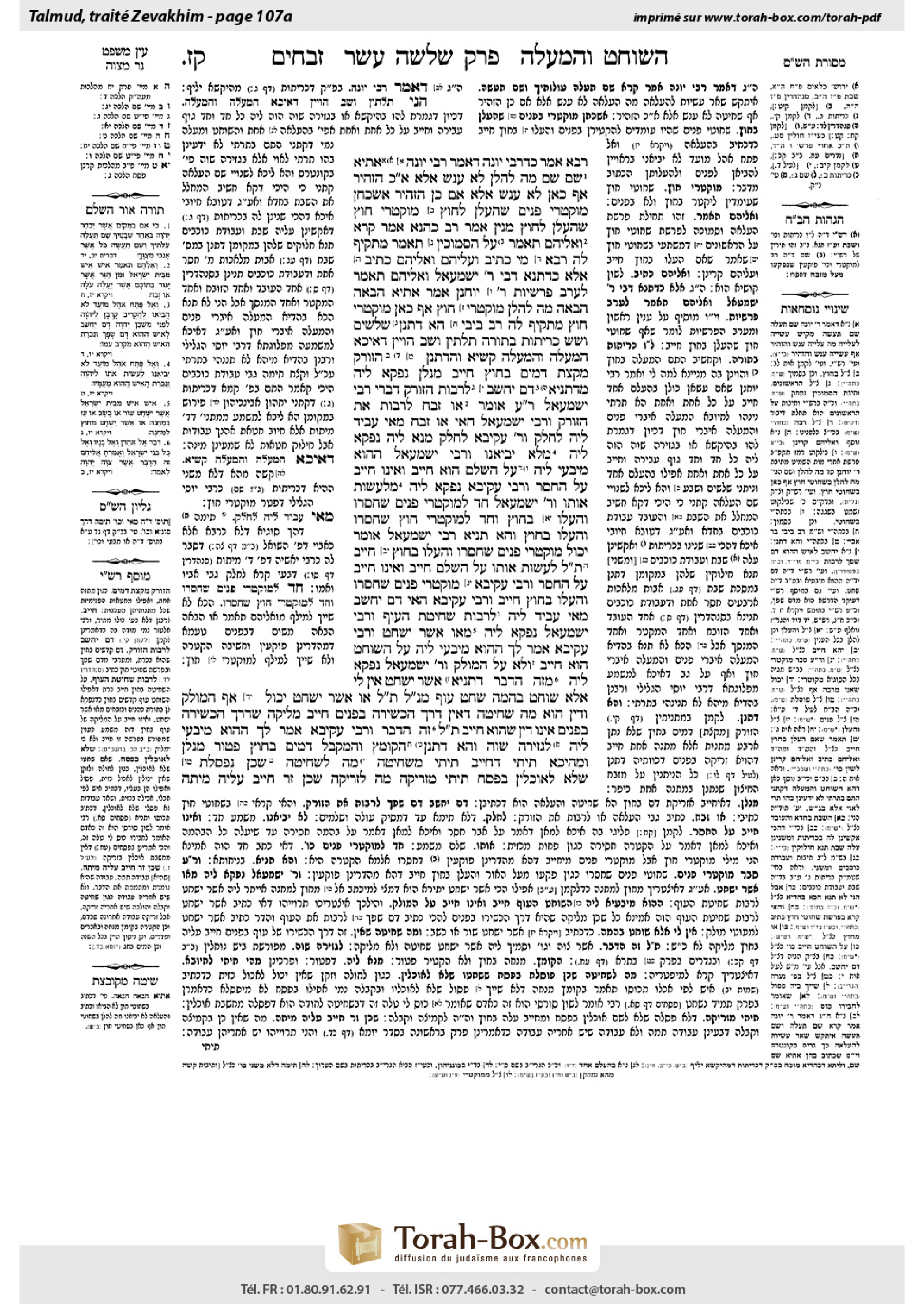
Zevachim 107a: Talmud study for Daf Yomi
Daf Yomi is the daily study of one Talmud folio. Explore 37 tractates with scans, Hebrew text, Sefaria English and AI-generated French translations where annotated.
Passage selection and English or AI-generated French translation are available where the scan has annotations. Daf Study is independent of Torah-Box and Sefaria.
Browse Zevachim · זבחים · All tractatesZevachim 107a text and translations
This page of Zevachim includes the Aramaic text, an English translation and an AI-generated French translation, alongside the scan above.
זבחים ק״ז א · Aramaic and Hebrew text
רָבָא אָמַר: כִּדְרַבִּי יוֹנָה, דְּאָמַר רַבִּי יוֹנָה: אָתְיָא ״שָׁם״–״שָׁם״; מָה לְהַלָּן לֹא עָנַשׁ אֶלָּא אִם כֵּן הִזְהִיר, אַף כָּאן לֹא עָנַשׁ אֶלָּא אִם כֵּן הִזְהִיר.
אַשְׁכְּחַן מוּקְטְרֵי פְּנִים שֶׁהֶעֱלָן לַחוּץ; מוּקְטְרֵי חוּץ שֶׁהֶעֱלָן לַחוּץ מִנַּיִן?
אָמַר רַב כָּהֲנָא, אָמַר קְרָא: ״וַאֲלֵהֶם תֹּאמַר״ – עַל הַסְּמוּכִין תֹּאמַר.
מַתְקֵיף לַהּ רָבָא: מִי כְּתִיב ״וַעֲלֵיהֶם״?! ״וַאֲלֵיהֶם״ כְּתִיב! אֶלָּא כִּדְתָנָא דְּבֵי רַבִּי יִשְׁמָעֵאל: ״וַאֲלֵהֶם תֹּאמַר״ – לְעָרֵב פָּרָשִׁיּוֹת.
רַבִּי יוֹחָנָן אָמַר: אָתְיָא הֲבָאָה–הֲבָאָה; מָה לְהַלָּן מוּקְטְרֵי חוּץ, אַף כָּאן מוּקְטְרֵי חוּץ.
מַתְקֵיף לַהּ רַב בִּיבִי, הָא דִּתְנַן: שְׁלֹשִׁים וְשֵׁשׁ כָּרֵיתוֹת בְּתוֹרָה – תְּלָתִין וְשַׁב הָוְיָין, דְּאִיכָּא הַמַּעֲלֶה וְהַמַּעֲלֶה! קַשְׁיָא.
וְהָדִתְנַן: הַזּוֹרֵק מִקְצָת דָּמִים בַּחוּץ – חַיָּיב, מְנָלַן? נָפְקָא לֵיהּ מִדְּתַנְיָא: ״דָּם יֵחָשֵׁב״ – לְרַבּוֹת הַזּוֹרֵק. דִּבְרֵי רַבִּי יִשְׁמָעֵאל. רַבִּי עֲקִיבָא אוֹמֵר: ״אוֹ זָבַח״ – לְרַבּוֹת אֶת הַזּוֹרֵק.
וְרַבִּי יִשְׁמָעֵאל, הַאי ״אוֹ זָבַח״ מַאי עָבֵיד לֵיהּ? לְחַלֵּק.
וְרַבִּי עֲקִיבָא, לְחַלֵּק מְנָא לֵיהּ? נָפְקָא לֵיהּ מִ״לֹּא יְבִיאֶנּוּ״.
וְרַבִּי יִשְׁמָעֵאל – הָהוּא מִיבְּעֵי לֵיהּ: עַל הַשָּׁלֵם הוּא חַיָּיב, וְאֵינוֹ חַיָּיב עַל הֶחָסֵר. וְרַבִּי עֲקִיבָא – נָפְקָא לֵיהּ מִ״לַּעֲשׂוֹת אוֹתוֹ״.
וְרַבִּי יִשְׁמָעֵאל – חַד לְמוּקְטְרֵי פְּנִים שֶׁחָסְרוּ וְהֶעֱלָן בַּחוּץ, וְחַד לְמוּקְטְרֵי חוּץ שֶׁחָסְרוּ (וְהֶעֱלוּ) [וְהֶעֱלָן] בַּחוּץ. וְהָא תַּנְיָא, רַבִּי יִשְׁמָעֵאל אוֹמֵר: יָכוֹל מוּקְטְרֵי פָּנִים שֶׁחָסְרוּ (וְהֶעֱלוּ) [וְהֶעֱלָן] בַּחוּץ חַיָּיב? תַּלְמוּד לוֹמַר: ״לַעֲשׂוֹת אֹתוֹ״ – עַל הַשָּׁלֵם חַיָּיב וְאֵינוֹ חַיָּיב עַל הֶחָסֵר.
וְרַבִּי עֲקִיבָא – מוּקְטְרֵי פְּנִים שֶׁחָסְרוּ (וְהֶעֱלוּ) [וְהֶעֱלָן] בַּחוּץ, חַיָּיב.
וְרַבִּי עֲקִיבָא, הַאי ״דָּם יֵחָשֵׁב״ מַאי עָבֵיד לֵיהּ? לְרַבּוֹת שְׁחִיטַת הָעוֹף. וְרַבִּי יִשְׁמָעֵאל – נָפְקָא לֵיהּ מֵ״אוֹ אֲשֶׁר יִשְׁחָט״.
וְרַבִּי עֲקִיבָא אָמַר לָךְ, הַהוּא מִיבְּעֵי לֵיהּ: עַל הַשּׁוֹחֵט הוּא חַיָּיב, וְלֹא עַל הַמּוֹלֵק. וְרַבִּי יִשְׁמָעֵאל – נָפְקָא לֵיהּ מִ״זֶּה הַדָּבָר״.
דְּתַנְיָא: ״אֲשֶׁר יִשְׁחַט״ – אֵין לִי אֶלָּא שׁוֹחֵט בְּהֵמָה; שָׁחַט עוֹף מְנָא לַן? תַּלְמוּד לוֹמַר: ״אוֹ אֲשֶׁר יִשְׁחָט״.
יָכוֹל אַף הַמּוֹלֵק? וְדִין הוּא: מָה שְׁחִיטָה דְּאֵין דֶּרֶךְ הֶכְשֵׁירָהּ בִּפְנִים, חַיָּיב, מְלִיקָה שֶׁדֶּרֶךְ הֶכְשֵׁירָהּ בְּפָנִים, אֵינוֹ דִּין שֶׁהוּא חַיָּיב? תַּלְמוּד לוֹמַר ״זֶה הַדָּבָר״.
וְרַבִּי עֲקִיבָא אָמַר לָךְ: הַהוּא מִיבְּעֵי לֵיהּ לִגְזֵירָה שָׁוָה.
וְהָא דִּתְנַן: הַקּוֹמֵץ וְהַמְקַבֵּל דָּמִים בַּחוּץ פָּטוּר – מְנָלַן? וּמֵהֵיכָא תֵּיתֵי דְּחַיָּיב?
תֵּיתֵי מִשְּׁחִיטָה – מָה לִשְׁחִיטָה, שֶׁכֵּן נִפְסֶלֶת שֶׁלֹּא לְאוֹכְלִין בְּפֶסַח!
תֵּיתֵי מִזְּרִיקָה – מָה לִזְרִיקָה, שֶׁכֵּן זָר חַיָּיב עָלֶיהָ מִיתָה!
Zevachim 107a · English translation
Rava said: The prohibition can be derived in accordance with the statement of Rabbi Yona, as Rabbi Yona says: It is derived from the verse: “But in the place that the Lord will choose in one of your tribes, there you shall offer up your burnt offerings and there you shall do all that I command you” (Deuteronomy 12:14), through the juxtaposition of the word “there” in the first part of the verse to the word “there” in the second part of the verse. This serves to juxtapose the offering up, mentioned in the first part, to the sacrifice of an offering, mentioned in the second part, which includes slaughtering it. Accordingly, it teaches that just as there, with regard to offering up, the Torah did not prescribe punishment unless it also prohibited it, so too here, with regard to slaughtering, the Torah did not prescribe punishment unless it also prohibited it. Therefore, even though the Torah does not explicitly state the prohibition, it is evident that it is prohibited.
§ The Gemara (106a) states that the source for the liability for offering up outside the Temple is the verse: “Any man…that offers up a burnt offering or sacrifice, and he will not bring it to the entrance of the Tent of Meeting, to sacrifice it to the Lord, and that man shall be cut off from his people” (Leviticus 17:8–9). The Gemara asks: We have found that one is liable only for offerings that are fit to be burned inside the Temple courtyard, having been appropriately slaughtered inside the Temple courtyard, which one then offered up outside the courtyard. The verse states: “He will not bring it to the entrance of the Tent of Meeting,” which indicates that they were fit to be brought to the Temple. From where is it derived that one is also liable with regard to offerings that are unfit and are to be burned outside the Temple as they were unlawfully slaughtered outside the Temple courtyard, that one then offered up outside?
Rav Kahana said: The beginning of that verse states: “And to them [va’alehem] you shall say” (Leviticus 17:8). The term “alehem,” to them, written with the letter alef, is phonetically similar to the term alehem, about them, written with the letter ayin. Therefore, the verse can be understood as saying: About that which is written in the adjacent passage you shall say. The preceding passage discusses offerings that were slaughtered outside the Temple, so the liability for offering up outside the Temple mentioned in this verse is also referring to those offerings.
Rava objects to this: Is it written: And about them? “And to them” is written, and it means that the command should be relayed to Aaron, his sons, and the Jewish people, who are mentioned in the beginning of the passage. Rather, liability in this case is derived as the school of Rabbi Yishmael taught: The opening phrase: “And to them you shall say,” starts with the conjunction “and” to mix the passages of slaughtering outside the Temple and offering up outside the Temple, in order to teach that one is liable for the latter even after having done the former.
Rabbi Yoḥanan said: Liability in this case is derived through a verbal analogy between the reference to bringing stated with regard to slaughtering (see Leviticus 17:4), and the reference to bringing stated with regard to offering up (see Leviticus 17:9). The verbal analogy teaches that just as there, with regard to slaughtering, one is liable for offerings that are going to be burned outside the Temple, since one slaughtered them there, so too here, with regard to offering up, one is liable even for offerings that are unfit and so will be burned outside the Temple, having been slaughtered there.
Rav Beivai objects to these suggestions: But what about that which we learned in a mishna (Karetot 2a): There are thirty-six cases in the Torah for which one is liable to receive karet. The mishna enumerates all thirty-six, and offering up outside the Temple is counted as only one of them. According to these suggestions, there are thirty-seven, as there is one case of one who offers up an offering that was slaughtered inside the Temple, and the other case of one who offers up an offering that was slaughtered outside the Temple, which are considered two independent prohibitions. The Gemara concedes: This is difficult.
§ The Gemara considers the source for other prohibitions. And concerning that which we learned in a mishna (110a): One who sprinkles part of the blood of an offering, e.g., if he sprinkles one sprinkling instead of four, outside the Temple courtyard, is liable; from where do we derive this? The tanna derives it from that which is taught in a baraita: The verse states with regard to one who slaughters outside the Temple courtyard: “Blood shall be imputed to that man, he has shed blood, and that man shall be cut off from among his people” (Leviticus 17:4). This serves to include liability for one who sprinkles sacrificial blood outside the Temple courtyard; this is the statement of Rabbi Yishmael. Rabbi Akiva says: It is derived from the verse: “Any man…that offers up a burnt offering or sacrifice” (Leviticus 17:8). The term “or” serves to include liability for one who sprinkles blood outside the Temple courtyard.
The Gemara asks: And as for Rabbi Yishmael, what does he do with this term “or” in “a burnt offering or sacrifice”? It serves to divide them into two independent cases, such that liability is incurred even if one offered up only one of them.
The Gemara asks: And as for Rabbi Akiva, from where does he derive the halakha to divide them into two cases? He derives it from the next verse: “And he will not bring it to the entrance of the Tent of Meeting” (Leviticus 17:9). The term “it” is written in the singular to indicate that one is liable even if he offered up only one of them.
And as for Rabbi Yishmael, why does he not derive that halakha from the term “it”? The Gemara answers: According to him, that term is necessary as the source for the halakha that one is liable for offering up a complete animal, but one is not liable for offering up an incomplete animal. The term “it” indicates an animal in its entirety. And as for Rabbi Akiva, he derives this from the repetition of “it” in the continuation of the verse: “He will not bring it…to sacrifice it to the Lord” (Leviticus 17:9).
And as for Rabbi Yishmael, how does he explain the repetition of “it”? He holds that each mention teaches about a different case: One is referring to offerings that are fit to be burned inside the Temple courtyard that became incomplete and were then offered up outside. And the other one is referring to offerings that are unfit and so will be burned outside the Temple as they were unlawfully slaughtered outside the Temple courtyard, that became incomplete and were offered up outside. In both cases one is exempt. And so it is taught in a baraita: Rabbi Yishmael says: One might have thought that with regard to offerings that were fit to be burned inside the Temple courtyard and that became incomplete and were instead offered up outside, one would be liable. To dispel this notion, the verse states: “To sacrifice it,” which indicates that for offering up a complete animal one is liable, but one is not liable for an incomplete animal.
And Rabbi Akiva, who has already expounded both mentions of “it,” disagrees with Rabbi Yishmael and holds that one is liable for offerings that are fit to be burned inside that became incomplete and were instead offered up outside.
Rabbi Yishmael derives the liability for sprinkling part of the blood of an offering outside the Temple courtyard from the verse “Blood shall be imputed to that man.” The Gemara asks: And as for Rabbi Akiva, what does he do with this verse: “Blood shall be imputed to that man”? He expounds it to include liability for the slaughter of a bird offering outside the courtyard. One is liable despite the fact that inside the Temple, a bird is sacrificed by pinching the nape of its neck, not by slaughtering it. And as for Rabbi Yishmael, he derives this halakha from: “Or that slaughters it outside the camp” (Leviticus 17:3).
And Rabbi Akiva could have said to you that he does not derive it from that verse, as he holds that it is necessary to teach that only one who slaughters a bird offering outside is liable, but one is not liable for pinching its nape outside. And as for Rabbi Yishmael, from where does he derive that one is exempt if he pinches? He derives it from the phrase at the beginning of the passage about slaughtering outside: “This is the matter” (Leviticus 17:2), which indicates that one is liable only for slaughtering and not for any other method of killing.
Rabbi Yishmael’s opinion is as it is taught in a baraita: The verse states: “Any man of the house of Israel that slaughters an ox, or lamb, or goat, in the camp, or that slaughters it outside the camp” (Leviticus 17:3). From this verse I have derived liability only for one who slaughters an animal offering outside; from where do we derive that one is liable if he slaughtered a bird offering outside? The verse states: “Or that slaughters,” to include liability for slaughtering a bird.
One might have thought that even one who pinches the nape of a bird offering outside would be liable. And there is a logical inference to support this: If with regard to the slaughter of a bird offering, which is not the valid method of preparation inside the Temple, one is nevertheless liable if he did it outside, then with regard to pinching the nape of a bird offering, which is the valid method of preparation inside the Temple, is it not logical that one is liable if he did it outside? To counter this, the verse states: “This is the matter” (Leviticus 17:2), which indicates one is liable only for slaughtering, not for any other method of killing.
And Rabbi Akiva could have said to you that he does not derive it from that verse, as he holds that it is necessary for expounding as part of a verbal analogy with the passage with regard to vows, where it is written: “This is the matter that the Lord has commanded” (Numbers 30:2).
§ The Gemara considers the source for other prohibitions. And concerning that which we learned in a mishna (112b): One who takes a handful from a meal offering outside the Temple courtyard but does not burn it, and one who collects the blood of an offering in a vessel outside the Temple courtyard but does not sprinkle it on an altar, he is exempt; from where do we derive this, that one is not liable unless he also completes the subsequent sacrificial rites? The Gemara is surprised by the question: But from where would it be derived that one is liable for these acts, necessitating a source for the fact that he is exempt?
The Gemara demonstrates that there is no reason to have assumed that one would be liable: If you suggest deriving it through a comparison to slaughtering outside the Temple, where one is liable even if he does not perform the subsequent sacrificial rites, this can be refuted: What is notable about slaughtering? It is notable in that with regard to a Paschal offering, if one slaughters it with the intent that it be for the sake of those who cannot eat it, it is thereby disqualified. The cases in the mishna do not share this stringency.
And if you suggest deriving it through a comparison to sprinkling blood outside the Temple, as one is liable for sprinkling the blood even though it is only one of the sacrificial rites of the offering that should have been performed inside the Temple, this can be refuted: What is notable about sprinkling? It is notable in that a non-priest who sprinkles blood in the Temple is liable to be punished with death at the hand of Heaven for this act. The cases in the mishna do not share this stringency.
Zevachim 107a · Traduction française (IA)
Rava dit : L’interdiction peut être déduite conformément à l’enseignement de Rabbi Yona, car Rabbi Yona dit : Elle se déduit du verset : « Mais au lieu que l’Éternel choisira dans l’une de vos tribus, là tu offriras tes holocaustes et là tu feras tout ce que je t’ordonne » (Deutéronome 12:14), en rapprochant le mot « là » de la première partie du verset du mot « là » de la seconde partie. Cela rapproche l’offrande, mentionnée dans la première partie, du sacrifice d’une offrande, mentionné dans la seconde partie, ce qui inclut son abattage. Ainsi, de même que là, à propos de l’offrande, la Torah n’a prescrit de peine que lorsqu’elle l’a également interdite, de même ici, à propos de l’abattage, la Torah n’a prescrit de peine que lorsqu’elle l’a également interdit. Par conséquent, même si la Torah n’énonce pas explicitement l’interdiction, il est évident que cet acte est interdit.
§ La Guemara (106a) indique que la source de la responsabilité pour avoir offert un sacrifice hors du Temple est le verset : « Tout homme… qui offre un holocauste ou un sacrifice et ne l’apporte pas à l’entrée de la Tente d’assignation pour le sacrifier à l’Éternel, cet homme sera retranché de son peuple » (Lévitique 17:8–9). La Guemara demande : Nous avons établi qu’on n’est passible que pour des offrandes propres à être brûlées dans le parvis du Temple, après y avoir été abattues comme il convient, puis offertes hors du parvis. Le verset dit : « Il ne l’apporte pas à l’entrée de la Tente d’assignation », ce qui indique qu’elles étaient propres à être apportées au Temple. D’où déduit-on qu’on est également passible pour des offrandes impropres, destinées à être brûlées hors du Temple parce qu’elles ont été abattues illégalement hors du parvis du Temple, puis offertes hors du parvis ?
Rav Kahana dit : Le début de ce verset énonce : « Et à eux [va’alehem] tu diras » (Lévitique 17:8). Le terme « alehem », « à eux », écrit avec la lettre alef, se prononce comme le terme « alehem », « à leur sujet », écrit avec la lettre ayin. Le verset peut donc s’interpréter ainsi : Tu leur parleras de ce qui est écrit dans le passage précédent. Celui-ci traite des offrandes abattues hors du Temple ; la responsabilité pour les avoir offertes hors du Temple, mentionnée dans ce verset, concerne donc également ces offrandes.
Rava objecte : Est-il écrit : « Et à leur sujet » ? Il est écrit : « Et à eux », ce qui signifie que l’ordre doit être transmis à Aaron, à ses fils et au peuple juif, mentionnés au début du passage. La responsabilité dans ce cas se déduit plutôt selon l’enseignement de l’école de Rabbi Yishmael : la formule d’ouverture « Et à eux tu diras » commence par la conjonction « et » afin de relier les passages sur l’abattage hors du Temple et sur l’offrande hors du Temple, pour enseigner qu’on est passible pour cette dernière infraction même après avoir commis la première.
Rabbi Yoḥanan dit : La responsabilité dans ce cas se déduit par une analogie verbale entre la mention du fait d’apporter, à propos de l’abattage (voir Lévitique 17:4), et celle du fait d’apporter, à propos de l’offrande (voir Lévitique 17:9). L’analogie verbale enseigne que, de même que là, à propos de l’abattage, on est passible pour des offrandes destinées à être brûlées hors du Temple parce qu’on les y a abattues, de même ici, à propos de l’offrande, on est passible même pour des offrandes impropres, destinées à être brûlées hors du Temple parce qu’elles y ont été abattues.
Rav Beivai objecte à ces propositions : Mais qu’en est-il de ce que nous avons appris dans une Michna (Keritot 2a) : La Torah compte trente-six cas passibles de retranchement. La Michna les énumère tous, et l’offrande hors du Temple n’est comptée que comme un seul cas. Selon ces propositions, il y en aurait trente-sept, puisqu’il y aurait un cas où l’on offre une offrande abattue dans le Temple, et un autre où l’on offre une offrande abattue hors du Temple, ces deux cas étant considérés comme deux interdictions indépendantes. La Guemara admet : C’est difficile.
§ La Guemara examine la source d’autres interdictions. À propos de ce que nous avons appris dans une Michna (110a) : Celui qui asperge une partie du sang d’une offrande, par exemple s’il effectue une seule aspersion au lieu de quatre, hors du parvis du Temple, est passible ; d’où déduit-on cela ? Le tanna le déduit de ce qui est enseigné dans une baraïta : à propos de celui qui abat hors du parvis du Temple, le verset énonce : « Le sang sera imputé à cet homme ; il a versé le sang, et cet homme sera retranché du milieu de son peuple » (Lévitique 17:4). Cela inclut la responsabilité de celui qui asperge le sang sacrificiel hors du parvis du Temple ; telle est la déclaration de Rabbi Yishmael. Rabbi Akiva dit : Cela se déduit du verset : « Tout homme… qui offre un holocauste ou un sacrifice » (Lévitique 17:8). Le terme « ou » inclut la responsabilité de celui qui asperge le sang hors du parvis du Temple.
La Guemara demande : Et Rabbi Yishmael, que fait-il du terme « ou » dans « un holocauste ou un sacrifice » ? Ce terme les distingue en deux cas indépendants, de sorte qu’on est passible même si l’on n’a offert qu’un seul des deux.
La Guemara demande : Et Rabbi Akiva, d’où déduit-il la halakha qui distingue ces deux cas ? Il la déduit du verset suivant : « Et il ne l’apporte pas à l’entrée de la Tente d’assignation » (Lévitique 17:9). Le terme « le » est au singulier pour indiquer qu’on est passible même si l’on n’a offert qu’un seul des deux.
Et Rabbi Yishmael, pourquoi ne déduit-il pas cette halakha du terme « le » ? La Guemara répond : Selon lui, ce terme est nécessaire comme source de la halakha selon laquelle on est passible pour avoir offert un animal entier, mais non un animal incomplet. Le terme « le » désigne l’animal dans son intégralité. Rabbi Akiva, lui, déduit cette halakha de la répétition du terme « le » dans la suite du verset : « Il ne l’apporte pas… pour le sacrifier à l’Éternel » (Lévitique 17:9).
Et Rabbi Yishmael, comment explique-t-il la répétition du terme « le » ? Il considère que chaque occurrence enseigne un cas différent : l’une concerne des offrandes propres à être brûlées dans le parvis du Temple, devenues incomplètes puis offertes à l’extérieur ; l’autre concerne des offrandes impropres, destinées à être brûlées hors du Temple parce qu’elles ont été abattues illégalement hors du parvis du Temple, devenues incomplètes puis offertes à l’extérieur. Dans les deux cas, on est exempt. C’est ainsi qu’une baraïta enseigne : Rabbi Yishmael dit : On aurait pu penser que, pour des offrandes propres à être brûlées dans le parvis du Temple, devenues incomplètes puis offertes à l’extérieur au lieu de cela, on serait passible. Pour écarter cette idée, le verset dit : « Pour le sacrifier », ce qui indique qu’on est passible pour avoir offert un animal entier, mais non un animal incomplet.
Rabbi Akiva, qui a déjà interprété les deux occurrences du terme « le », est en désaccord avec Rabbi Yishmael et considère qu’on est passible pour des offrandes propres à être brûlées à l’intérieur, devenues incomplètes puis offertes à l’extérieur.
Rabbi Yishmael déduit du verset « Le sang sera imputé à cet homme » la responsabilité pour l’aspersion d’une partie du sang d’une offrande hors du parvis du Temple. La Guemara demande : Et Rabbi Akiva, que fait-il du verset « Le sang sera imputé à cet homme » ? Il l’interprète comme incluant la responsabilité pour l’abattage d’une offrande d’oiseau hors du parvis. On est passible bien qu’à l’intérieur du Temple, un oiseau soit sacrifié par incision de la nuque, et non par abattage. Rabbi Yishmael, lui, déduit cette halakha de : « Ou qui l’abat hors du camp » (Lévitique 17:3).
Rabbi Akiva aurait pu te répondre qu’il ne déduit pas cela de ce verset, car il estime que celui-ci est nécessaire pour enseigner que seul celui qui abat une offrande d’oiseau à l’extérieur est passible, mais que celui qui lui incise la nuque à l’extérieur ne l’est pas. Et Rabbi Yishmael, d’où déduit-il qu’on est exempt si l’on incise la nuque ? Il le déduit de la formule au début du passage sur l’abattage à l’extérieur : « Voici la règle » (Lévitique 17:2), qui indique qu’on n’est passible que pour l’abattage, et non pour une autre méthode de mise à mort.
L’opinion de Rabbi Yishmael est conforme à ce qui est enseigné dans une baraïta : le verset énonce : « Tout homme de la maison d’Israël qui abat un bœuf, un agneau ou une chèvre dans le camp, ou qui l’abat hors du camp » (Lévitique 17:3). De ce verset, j’ai déduit la responsabilité uniquement pour celui qui abat une offrande animale à l’extérieur ; d’où déduit-on qu’on est passible s’il abat une offrande d’oiseau à l’extérieur ? Le verset dit : « Ou qui abat », afin d’inclure la responsabilité pour l’abattage d’un oiseau.
On aurait pu penser que même celui qui incise la nuque d’une offrande d’oiseau à l’extérieur serait passible. Un raisonnement logique pourrait l’étayer : si, pour l’abattage d’une offrande d’oiseau, qui n’est pas la méthode de préparation valide dans le Temple, on est néanmoins passible lorsqu’on le pratique à l’extérieur, alors, pour l’incision de la nuque d’une offrande d’oiseau, qui est la méthode de préparation valide dans le Temple, n’est-il pas logique qu’on soit passible lorsqu’on la pratique à l’extérieur ? Pour écarter cette conclusion, le verset dit : « Voici la règle » (Lévitique 17:2), ce qui indique qu’on n’est passible que pour l’abattage, et non pour une autre méthode de mise à mort.
Rabbi Akiva aurait pu te répondre qu’il ne déduit pas cela de ce verset, car il estime que celui-ci est nécessaire pour être interprété dans le cadre d’une analogie verbale avec le passage relatif aux vœux, où il est écrit : « Voici la règle que l’Éternel a ordonnée » (Nombres 30:2).
§ La Guemara examine la source d’autres interdictions. À propos de ce que nous avons appris dans une Michna (112b) : Celui qui prélève une poignée d’une offrande végétale hors du parvis du Temple sans la brûler, ainsi que celui qui recueille le sang d’une offrande dans un récipient hors du parvis du Temple sans l’asperger sur un autel, est exempt ; d’où déduit-on qu’on n’est pas passible à moins d’accomplir également les rites sacrificiels qui suivent ? La Guemara s’étonne de la question : Mais d’où aurait-on déduit qu’on serait passible pour ces actes, au point qu’il faille une source pour établir qu’on en est exempt ?
La Guemara montre qu’il n’y a aucune raison de supposer qu’on serait passible : si l’on propose de le déduire par comparaison avec l’abattage hors du Temple, pour lequel on est passible même sans accomplir les rites sacrificiels qui suivent, cette comparaison peut être réfutée : Qu’a donc de particulier l’abattage ? Il a ceci de particulier que, pour un sacrifice pascal, si l’on abat l’animal avec l’intention qu’il soit destiné à ceux qui ne peuvent pas le manger, il est par là même invalidé. Les cas de la Michna ne présentent pas cette rigueur.
Et si l’on propose de le déduire par comparaison avec l’aspersion du sang hors du Temple, puisque l’on est passible pour l’aspersion même s’il ne s’agit que de l’un des rites sacrificiels de l’offrande qui aurait dû être accompli dans le Temple, cette comparaison peut être réfutée : Qu’a donc de particulier l’aspersion ? Elle a ceci de particulier qu’un non-prêtre qui asperge le sang dans le Temple est passible de mort par la main du Ciel pour cet acte. Les cas de la Michna ne présentent pas cette rigueur.
Traduction française générée par IA à partir de l’édition anglaise de Sefaria. Vérifie toujours un passage avec le texte source.
Text from Sefaria: William Davidson Edition - Vocalized Aramaic (CC BY NC); William Davidson Edition - English (CC BY NC).