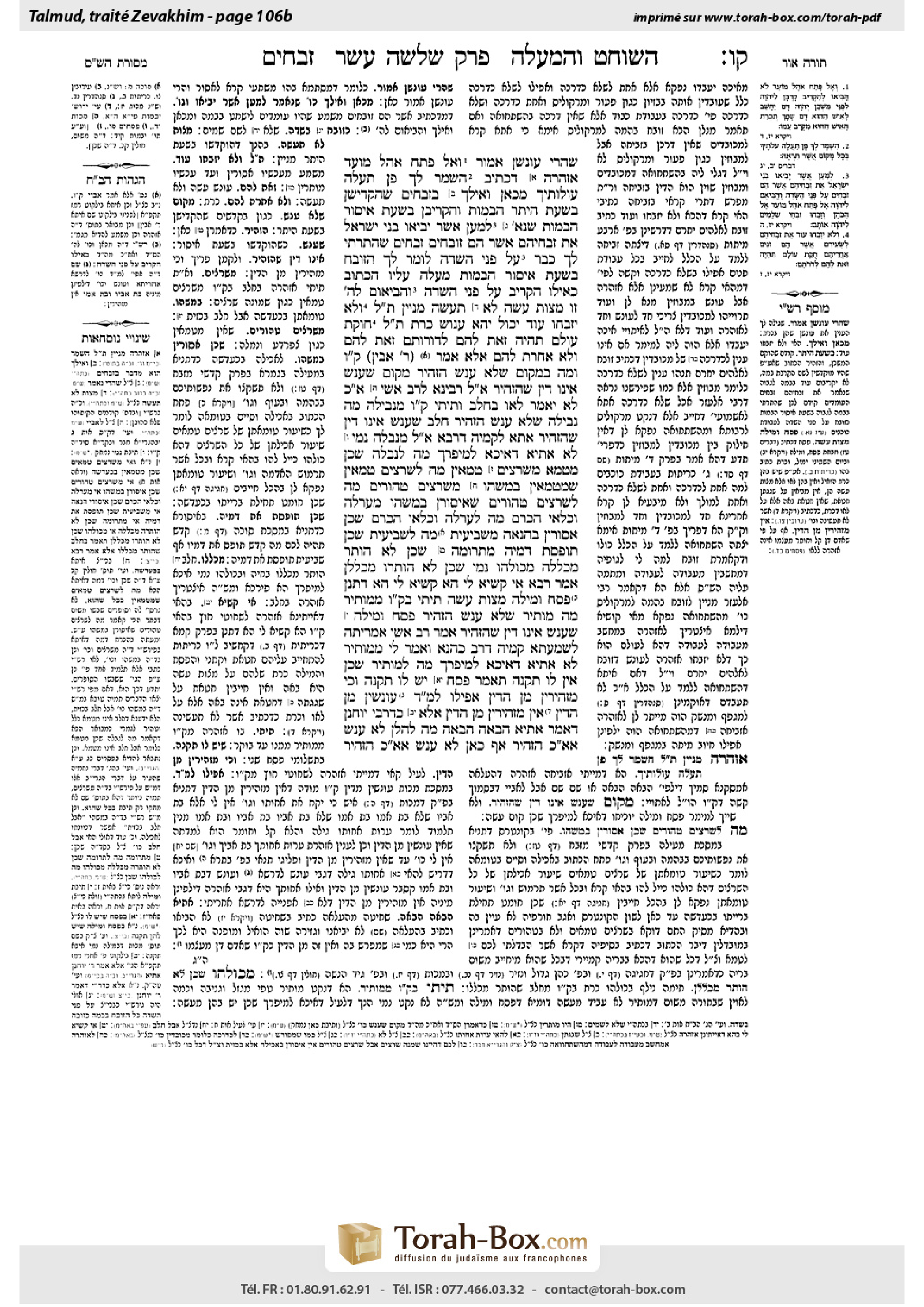
Zevachim 106b: Talmud study for Daf Yomi
Daf Yomi is the daily study of one Talmud folio. Explore 37 tractates with scans, Hebrew text, Sefaria English and AI-generated French translations where annotated.
Passage selection and English or AI-generated French translation are available where the scan has annotations. Daf Study is independent of Torah-Box and Sefaria.
Browse Zevachim · זבחים · All tractatesZevachim 106b text and translations
This page of Zevachim includes the Aramaic text, an English translation and an AI-generated French translation, alongside the scan above.
זבחים ק״ו ב · Aramaic and Hebrew text
שֶׁהֲרֵי עוֹנְשָׁן אָמוּר: ״וְאֶל פֶּתַח אֹהֶל מוֹעֵד״, אַזְהָרָה – דִּכְתִיב: ״הִשָּׁמֶר לְךָ פֶּן תַּעֲלֶה עֹלֹתֶיךָ״.
מִכָּאן וְאֵילָךְ – בִּזְבָחִים שֶׁהִקְדִּישָׁן בִּשְׁעַת הֶיתֵּר הַבָּמוֹת וְהִקְרִיבָן בִּשְׁעַת אִיסּוּר הַבָּמוֹת,
שֶׁנֶּאֱמַר: ״לְמַעַן אֲשֶׁר יָבִיאוּ בְּנֵי יִשְׂרָאֵל אֶת זִבְחֵיהֶם אֲשֶׁר הֵם זֹבְחִים״ – זְבָחִים שֶׁהִתַּרְתִּי לְךָ כְּבָר. ״עַל פְּנֵי הַשָּׂדֶה״ – לוֹמַר לָךְ: הַזּוֹבֵחַ בִּשְׁעַת אִיסּוּר הַבָּמוֹת, מַעֲלֶה עָלָיו הַכָּתוּב כְּאִילּוּ הִקְרִיב עַל פְּנֵי הַשָּׂדֶה.
״וֶהֱבִיאֻם לַה׳״ – זוֹ מִצְוַת עֲשֵׂה. לֹא תַעֲשֶׂה מִנַּיִין? תַּלְמוּד לוֹמַר: ״וְלֹא יִזְבְּחוּ עוֹד״.
יָכוֹל יְהֵא עָנוּשׁ כָּרֵת? תַּלְמוּד לוֹמַר: ״חֻקַּת עוֹלָם תִּהְיֶה זֹּאת לָהֶם לְדֹרֹתָם״ – זֹאת לָהֶם וְלֹא אַחֶרֶת לָהֶם.
אֶלָּא אָמַר רַבִּי אָבִין: קַל וָחוֹמֶר; וּמָה בִּמְקוֹם שֶׁלֹּא עָנַשׁ – הִזְהִיר, מְקוֹם שֶׁעָנַשׁ – אֵינוֹ דִּין שֶׁהִזְהִיר?!
אֲמַר לֵיהּ רָבִינָא לְרַב אָשֵׁי: אִם כֵּן, לֹא יֵאָמֵר לָאו בְּחֵלֶב – וְתֵיתֵי קַל וָחוֹמֶר מִנְּבֵילָה: מָה נְבֵילָה שֶׁלֹּא עָנַשׁ – הִזְהִיר, חֵלֶב שֶׁעָנַשׁ – אֵינוֹ דִּין שֶׁהִזְהִיר?!
אֲתָא לְקַמֵּיהּ דְּרָבָא, אֲמַר לֵיהּ: מִנְּבֵלָה נָמֵי לָא אָתְיָא, דְּאִיכָּא לְמִיפְרַךְ: מָה לִנְבֵלָה שֶׁכֵּן מְטַמֵּא!
מִשְּׁרָצִים טְמֵאִין. מָה לִשְׁרָצִים טְמֵאִין – שֶׁמְּטַמְּאִין בְּמַשֶּׁהוּ!
מִשְּׁרָצִים טְהוֹרִים. מָה לִשְׁרָצִים טְהוֹרִים – שֶׁאִיסּוּרָן בְּמַשֶּׁהוּ!
מֵעׇרְלָה וְכִלְאֵי הַכֶּרֶם. מָה לְעׇרְלָה וְכִלְאֵי הַכֶּרֶם – שֶׁכֵּן אֲסוּרִין בַּהֲנָאָה!
מִשְּׁבִיעִית. מָה לִשְׁבִיעִית, שֶׁכֵּן תּוֹפֶסֶת דָּמֶיהָ!
מִתְּרוּמָה – שֶׁכֵּן לֹא הוּתַּר מִכְּלָלָהּ! מִכּוּלְּהוּ נָמֵי – שֶׁכֵּן לֹא הוּתְּרוּ מִכְּלָלָן!
אָמַר רָבָא: אִי קַשְׁיָא לִי הָא קַשְׁיָא לִי – הָא דִּתְנַן: פֶּסַח וּמִילָה מִצְוַת עֲשֵׂה,
תֵּיתֵי בְּקַל וָחוֹמֶר מִמּוֹתִיר: מָה מוֹתִיר שֶׁלֹּא עָנַשׁ – הִזְהִיר, פֶּסַח וּמִילָה שֶׁעָנַשׁ – אֵינוֹ דִּין שֶׁהִזְהִיר?!
אָמַר רַב אָשֵׁי: אַמְרִיתַהּ לִשְׁמַעְתָּא קַמֵּיהּ דְּרַב כָּהֲנָא, וְאָמַר לִי: מִמּוֹתִיר לָא אָתְיָא, דְּאִיכָּא לְמִיפְרַךְ: מָה לְמוֹתִיר – שֶׁכֵּן אֵין לוֹ תַּקָּנָה, תֹּאמַר פֶּסַח – יֵשׁ לוֹ תַּקָּנָה.
וְכִי מַזְהִירִין מִן הַדִּין?! אֲפִילּוּ לְמַאן דְּאָמַר עוֹנְשִׁין מִן הַדִּין, אֵין מַזְהִירִין מִן הַדִּין!
אֶלָּא כִּדְרַבִּי יוֹחָנָן, דְּאָמַר: אָתְיָא הֲבָאָה–הֲבָאָה;
מָה לְהַלָּן לֹא עָנַשׁ אֶלָּא אִם כֵּן הִזְהִיר, אַף כָּאן לֹא עָנַשׁ אֶלָּא אִם כֵּן הִזְהִיר.
Zevachim 106b · English translation
This is apparent, as the punishment for sacrificing them is stated in this verse: “And he did not bring it to the entrance of the Tent of Meeting, to sacrifice an offering to the Lord, before the Tabernacle of the Lord…that man shall be cut off from among his people.” The prohibition is also explicit, as it is written: “Take heed to yourself lest you offer up your burnt offerings in every place that you see” (Deuteronomy 12:13).
From that point onward, the verse is speaking about sacrificial animals that one consecrated during a period when there was permission to sacrifice offerings on private altars, i.e., before the Tabernacle was erected, and then he sacrificed them outside the Tabernacle during a period when the prohibition against sacrificing on private altars was in effect.
This is apparent, as it is stated: “In order that the children of Israel shall bring their sacrifices, which they slaughter upon the open field, that they shall bring them to the Lord, to the entrance of the Tent of Meeting” (Leviticus 17:5). The phrase “their sacrifices, which they slaughter” is interpreted as referring to offerings that I have previously permitted for you to slaughter on private altars. This verse teaches that those offerings may now be sacrificed only inside the Tabernacle. The phrase “upon the open field” tells you that in the case of one who slaughters an offering on a private altar during a period when the prohibition against sacrificing on private altars is in effect, even if he sacrifices the offering to God, the verse ascribes him blame as if he sacrificed it upon the open field in idolatrous worship.
The verse continues: “That they shall bring them to the Lord.” This is a positive mitzva to sacrifice in the Tabernacle even offerings that were consecrated before the Tabernacle was erected. From where is it derived that there is a prohibition against sacrificing them outside the Tabernacle? The verse states: “And they shall not slaughter anymore their offerings to the se’irim after whom they go astray; this shall be to them an eternal statute, throughout their generations” (Leviticus 17:7).
One might have thought that sacrificing these offerings outside the Tabernacle would be punishable by karet, as is the halakha with regard to offerings consecrated after the Tabernacle was erected. Therefore, the verse states: “This shall be to them an eternal statute, throughout their generations” (Leviticus 17:7). One can infer from this verse that this, the punishment for transgressing a positive mitzva and a prohibition, applies to them, but no other punishment applies to them. It is clear from this baraita that the verse “And they shall not slaughter anymore” is used to teach about the prohibition against sacrificing outside the Tabernacle those offerings that were consecrated while there was permission to sacrifice on private altars, and not those offerings that were consecrated while it was prohibited to sacrifice on private altars.
Rather, Rabbi Avin says: The prohibition against slaughtering an offering outside the Temple is derived through an a fortiori inference: Just as in a case in which the Torah did not prescribe punishment for a certain action, it nevertheless prohibited it, as is the case with regard to sacrificing outside the Temple an offering consecrated while there was permission to sacrifice on private altars, so too, in a case in which the Torah did prescribe punishment for a certain action, as is the case with regard to slaughtering outside the Temple an offering consecrated while it was prohibited to sacrifice on private altars, is it not logical that the Torah prohibited the action?
Ravina said to Rav Ashi: If so, that whenever the Torah states a punishment for a certain action, there is no need for it to state the prohibition, then let the Torah not state a prohibition with regard to eating forbidden fat of a kosher animal, and then derive the fact that it is prohibited through an a fortiori inference from the prohibition against eating an unslaughtered animal carcass: Just as with regard to a carcass, even though the Torah did not prescribe punishment for consuming it, it nevertheless prohibited consuming it, so too, with regard to animal fat, for which the Torah did prescribe punishment, is it not logical that the Torah prohibited its consumption?
Rav Ashi came before Rava and said to him: The prohibition against eating animal fat can also not be derived from the prohibition of a carcass, as the a fortiori inference can be refuted as follows: What is notable about a carcass? It is notable in that it renders other items ritually impure through contact with it. Forbidden fat does not share this stringency. The existence of a unique stringency undermines the possibility of using an a fortiori inference.
Rav Ashi raises the possibility of deriving the prohibition against eating forbidden fat through an a fortiori inference from various other prohibitions that, like forbidden fat, do not carry the stringency of being punishable by karet, and Rava rejects each one. Can one derive the prohibition against eating forbidden fat from the prohibition against eating carcasses of ritually impure creeping animals (see Leviticus 11:41)? One cannot, as what is notable about ritually impure creeping animals? They are notable in that they render other items ritually impure though contact with any amount of them. Forbidden fat does not share this stringency.
Can one derive it from the prohibition against eating the carcasses of ritually pure creeping animals (see Leviticus 11:41), which do not have the capacity to render other items ritually impure? One cannot, as what is notable about ritually pure creeping animals? They are notable in that with regard to their prohibition there is liability for consuming any amount of them. Forbidden fat does not share this stringency, as one is liable only if he eats an olive-bulk of it.
Can one derive it from the prohibition against eating the fruit of a tree during the first three years after its planting [orla] or from the prohibition against eating diverse kinds in a vineyard, for which one is liable only if he eats an olive-bulk of them, just like with regard to animal fat? One cannot, as what is notable about orla and diverse kinds in a vineyard? They are notable in that they are items from which deriving benefit is prohibited. Forbidden fat does not share this stringency.
Can one derive it from the prohibition against eating Sabbatical Year produce, from which benefit is permitted just like with regard to animal fat? One cannot, as what is notable about Sabbatical Year produce? It is notable in that it transfers its sanctity to the money with which it is purchased. Forbidden fat does not share this stringency.
Can one derive it from the prohibition of a non-priest partaking of the portion of the produce that is designated for the priest [teruma]? One cannot, as in the case of teruma there are no circumstances in which its general prohibition was permitted. The prohibition concerning teruma applies broadly, unlike in the case of forbidden fat, where the prohibition applies only to the fat of domesticated animals but not to the fat of undomesticated animals. Rava notes that the possibility of deriving the prohibition against eating forbidden fat from all of those prohibitions can also be refuted based on this claim, as in those cases, too, there are no circumstances in which their general prohibition was permitted.
Rava said: If there is a difficulty for me in accepting Rabbi Avin’s claim that the prohibition against slaughtering an offering outside the Temple can be derived via an a fortiori inference, this is difficult for me: That which we learned in a mishna (Karetot 2a), which enumerates the thirty-six cases for which one is liable to receive karet. The end of that mishna lists: One who neglects sacrificing the Paschal offering and one who does not undergo circumcision, which are positive mitzvot, unlike the other cases enumerated in the mishna, which are all prohibitions.
Rava explains his difficulty: If Rabbi Avin is correct, derive that there is a prohibition against neglecting the sacrifice of the Paschal offering and not undergoing circumcision via an a fortiori inference from the case of one who leaves over sacrificial meat beyond the allotted period for its consumption (see Leviticus 22:30): Just as in the case of one who leaves over sacrificial meat, where the Torah did not prescribe punishment but nevertheless prohibited this act, so too, with regard to neglecting the sacrifice of the Paschal offering and not undergoing circumcision, for which the Torah did prescribe punishment, is it not logical that the Torah actually prohibited neglecting them as well?
Rav Ashi said: I stated this very discussion before Rav Kahana, and he said to me: One cannot derive a prohibition against neglecting the sacrifice of the Paschal offering from the case of one who leaves over sacrificial meat via an a fortiori inference, as it can be refuted: What is notable about one who leaves over sacrificial meat? He is notable in that there is no remedy once the prohibition has been violated. Shall you say the same about the neglect of the Paschal offering, for which there is a remedy? One who fails to bring it on the first Pesaḥ must bring it on the second Pesaḥ.
The Gemara challenges the very premise of Rabbi Avin’s claim: But can one derive that the Torah prohibits an action via an a fortiori inference? Even the one who says that the court administers punishment based on an a fortiori inference concedes that one does not derive a prohibition from an a fortiori inference. Therefore, Rabbi Avin’s claim is refuted.
Rather, the prohibition against slaughtering an offering outside the Temple courtyard can be derived in accordance with the statement of Rabbi Yoḥanan, who says: It is derived from the prohibition against offering up outside the Temple through a verbal analogy between the reference to bringing stated with regard to slaughtering outside the Temple, and the reference to bringing stated with regard to offering up outside the Temple.
With regard to slaughtering, it is stated: “Or that slaughters it outside the camp, and he did not bring it to the entrance of the Tent of Meeting” (Leviticus 17:3–4), and with regard to offering up, it is stated: “That offers up a burnt offering or sacrifice, and he will not bring it to the entrance of the Tent of Meeting” (Leviticus 17:8–9). The verbal analogy teaches that just as there, with regard to offering up, the Torah did not prescribe punishment for an action unless it also explicitly prohibited the action, so too here, with regard to slaughtering, the Torah did not prescribe punishment unless it also prohibited it. Therefore, even though the Torah does not explicitly state the prohibition, it is evident that it is prohibited.
Zevachim 106b · Traduction française (IA)
Cela ressort du fait que la peine encourue pour les offrir est énoncée dans ce verset : « Et il ne l’a pas apportée à l’entrée de la Tente d’assignation pour offrir un sacrifice à l’Éternel devant le Tabernacle de l’Éternel… cet homme sera retranché du sein de son peuple. » L’interdiction est également explicite, comme il est écrit : « Prends garde à toi, de peur d’offrir tes holocaustes en tout lieu que tu verras » (Deutéronome 12,13).
À partir de là, le verset parle d’animaux destinés aux sacrifices, consacrés par une personne à une époque où il était permis d’offrir des sacrifices sur des autels privés, c’est-à-dire avant l’érection du Tabernacle, puis sacrifiés hors du Tabernacle à une époque où l’interdiction d’offrir des sacrifices sur des autels privés était en vigueur.
Cela ressort du verset : « Afin que les enfants d’Israël apportent à l’Éternel les sacrifices qu’ils immolent en plein champ, afin qu’ils les apportent à l’Éternel, à l’entrée de la Tente d’assignation » (Lévitique 17,5). L’expression « les sacrifices qu’ils immolent » est interprétée comme désignant les sacrifices que Je vous avais auparavant permis d’immoler sur des autels privés. Ce verset enseigne que ces sacrifices ne peuvent désormais être offerts qu’à l’intérieur du Tabernacle. L’expression « en plein champ » t’indique que celui qui immole un sacrifice sur un autel privé à une époque où l’interdiction d’offrir des sacrifices sur des autels privés est en vigueur, même s’il offre ce sacrifice à Dieu, se voit imputer la faute comme s’il l’avait offert en plein champ dans le cadre d’un culte idolâtre.
Le verset poursuit : « Afin qu’ils les apportent à l’Éternel. » Il s’agit d’une mitsva positive d’offrir dans le Tabernacle même les sacrifices qui avaient été consacrés avant l’érection du Tabernacle. D’où déduit-on qu’il est interdit de les offrir hors du Tabernacle ? Le verset dit : « Ils ne sacrifieront plus leurs sacrifices aux se’irim après lesquels ils se sont égarés ; ce sera pour eux une loi perpétuelle, à travers les générations » (Lévitique 17,7).
On aurait pu penser qu’offrir ces sacrifices hors du Tabernacle serait passible de retranchement, conformément à la halakha concernant les sacrifices consacrés après l’érection du Tabernacle. Le verset dit donc : « Ce sera pour eux une loi perpétuelle, à travers les générations » (Lévitique 17,7). On peut en déduire que cette peine, celle qui sanctionne la transgression d’une mitsva positive et d’une interdiction, s’applique à ces sacrifices, mais qu’aucune autre peine ne s’applique à eux. Cette baraïta montre clairement que le verset « Ils ne sacrifieront plus » sert à enseigner l’interdiction d’offrir hors du Tabernacle les sacrifices consacrés à une époque où il était permis d’offrir sur des autels privés, et non ceux consacrés à une époque où il était interdit d’offrir sur des autels privés.
Rabbi Avin dit plutôt : l’interdiction d’immoler un sacrifice hors du Temple se déduit par raisonnement a fortiori. De même que, dans le cas où la Torah n’a pas fixé de peine pour un acte donné, elle l’a néanmoins interdit — comme pour l’offrande hors du Temple d’un sacrifice consacré à une époque où il était permis d’offrir sur des autels privés —, de même, dans le cas où la Torah a fixé une peine pour un acte donné — comme pour l’immolation hors du Temple d’un sacrifice consacré à une époque où il était interdit d’offrir sur des autels privés —, n’est-il pas logique que la Torah ait interdit cet acte ?
Ravina dit à Rav Ashi : si tel est le cas, si chaque fois que la Torah énonce une peine pour un acte donné, il n’est pas nécessaire qu’elle énonce l’interdiction, alors que la Torah n’énonce pas d’interdiction concernant la consommation de graisse interdite d’un animal cachère ; on pourrait déduire cette interdiction par raisonnement a fortiori de l’interdiction de consommer la carcasse d’un animal qui n’a pas été abattu rituellement. De même que, pour une carcasse, bien que la Torah n’ait pas fixé de peine pour sa consommation, elle l’a néanmoins interdite, de même, pour la graisse animale, pour laquelle la Torah a fixé une peine, n’est-il pas logique que la Torah en ait interdit la consommation ?
Rav Ashi se présenta devant Rava et lui dit : l’interdiction de consommer de la graisse animale ne peut pas non plus se déduire de l’interdiction de consommer une carcasse, car le raisonnement a fortiori peut être réfuté ainsi : qu’a de particulier une carcasse ? Elle a ceci de particulier qu’elle rend rituellement impur ce qui entre en contact avec elle. La graisse interdite ne présente pas cette rigueur. L’existence d’une rigueur particulière empêche de recourir à un raisonnement a fortiori.
Rav Ashi envisage de déduire l’interdiction de consommer de la graisse interdite par raisonnement a fortiori à partir de diverses autres interdictions qui, comme celle-ci, ne sont pas passibles de retranchement, et Rava réfute chaque possibilité. Peut-on déduire l’interdiction de consommer de la graisse interdite de l’interdiction de consommer les carcasses d’animaux rampants impurs (voir Lévitique 11,41) ? Non, car qu’ont de particulier les animaux rampants impurs ? Ils ont ceci de particulier qu’ils rendent rituellement impur ce qui entre en contact avec eux, quelle qu’en soit la quantité. La graisse interdite ne présente pas cette rigueur.
Peut-on la déduire de l’interdiction de consommer les carcasses d’animaux rampants purs (voir Lévitique 11,41), qui ne peuvent pas rendre d’autres éléments rituellement impurs ? Non, car qu’ont de particulier les animaux rampants purs ? Ils ont ceci de particulier que, concernant leur interdiction, on est passible de peine dès qu’on en consomme une quantité quelconque. La graisse interdite ne présente pas cette rigueur, car on n’est passible de peine qu’à partir d’un volume équivalent à une olive.
Peut-on déduire cette interdiction de l’interdiction de consommer le fruit d’un arbre durant les trois premières années suivant sa plantation [orla], ou de l’interdiction de consommer des espèces mélangées dans une vigne, pour lesquelles on n’est passible de peine qu’à partir d’un volume équivalent à une olive, comme pour la graisse animale ? Non, car qu’ont de particulier l’orla et les espèces mélangées dans une vigne ? Elles ont ceci de particulier qu’il est interdit d’en tirer profit. La graisse interdite ne présente pas cette rigueur.
Peut-on la déduire de l’interdiction de consommer les produits de l’année sabbatique, dont il est permis de tirer profit, comme pour la graisse animale ? Non, car qu’ont de particulier les produits de l’année sabbatique ? Ils ont ceci de particulier qu’ils transmettent leur sainteté à l’argent avec lequel on les achète. La graisse interdite ne présente pas cette rigueur.
Peut-on la déduire de l’interdiction faite à un non-prêtre de consommer la part des produits réservée au prêtre [terouma] ? Non, car dans le cas de la terouma, il n’existe aucune circonstance où son interdiction générale aurait été levée. L’interdiction relative à la terouma s’applique de manière générale, contrairement à celle de la graisse interdite, qui concerne uniquement la graisse des animaux domestiques, et non celle des animaux sauvages. Rava fait remarquer qu’on peut également réfuter la possibilité de déduire l’interdiction de consommer de la graisse interdite à partir de toutes ces interdictions en s’appuyant sur cet argument : dans ces cas également, il n’existe aucune circonstance où leur interdiction générale aurait été levée.
Rava dit : si j’ai une difficulté à accepter l’affirmation de Rabbi Avin selon laquelle l’interdiction d’immoler un sacrifice hors du Temple se déduit par raisonnement a fortiori, voici ce qui me pose problème : ce que nous avons appris dans une Michna (Keritot 2a), qui énumère les trente-six cas passibles de retranchement. À la fin de cette Michna figurent celui qui néglige d’offrir le sacrifice pascal et celui qui ne se fait pas circoncire ; il s’agit de mitsvot positives, contrairement aux autres cas énumérés dans la Michna, qui relèvent tous d’interdictions.
Rava expose sa difficulté : si Rabbi Avin a raison, déduisons l’interdiction de négliger l’offrande du sacrifice pascal et de ne pas se faire circoncire par raisonnement a fortiori du cas de celui qui laisse de la viande sacrificielle au-delà du délai imparti pour sa consommation (voir Lévitique 22,30). De même que, dans le cas de celui qui laisse de la viande sacrificielle, la Torah n’a pas fixé de peine, mais a néanmoins interdit cet acte, de même, concernant le fait de négliger l’offrande du sacrifice pascal et de ne pas se faire circoncire, actes pour lesquels la Torah a fixé une peine, n’est-il pas logique que la Torah ait également interdit ces manquements ?
Rav Ashi dit : j’ai exposé cette même discussion devant Rav Kahana, qui m’a répondu : on ne peut pas déduire l’interdiction de négliger l’offrande du sacrifice pascal du cas de celui qui laisse de la viande sacrificielle par raisonnement a fortiori, car on peut réfuter ce raisonnement ainsi : qu’a de particulier celui qui laisse de la viande sacrificielle ? Il a ceci de particulier qu’il n’existe aucun moyen de remédier à la transgression une fois l’interdiction violée. Peut-on en dire autant du manquement au sacrifice pascal, alors qu’il existe un moyen d’y remédier ? Celui qui ne l’offre pas lors du premier Pessaḥ doit l’offrir lors du second Pessaḥ.
La Guemara remet en cause le principe même de l’affirmation de Rabbi Avin : peut-on déduire que la Torah interdit un acte par raisonnement a fortiori ? Même celui qui affirme que le tribunal applique une peine sur la base d’un raisonnement a fortiori reconnaît qu’on ne déduit pas une interdiction d’un raisonnement a fortiori. L’affirmation de Rabbi Avin est donc réfutée.
On déduit plutôt l’interdiction d’immoler un sacrifice hors de la cour du Temple conformément à l’enseignement de Rabbi Yoḥanan, qui dit qu’elle se déduit de l’interdiction d’offrir un sacrifice hors du Temple au moyen d’une analogie verbale entre la mention d’apporter, dans le passage relatif à l’immolation hors du Temple, et la mention d’apporter, dans le passage relatif à l’offrande hors du Temple.
Concernant l’immolation, il est dit : « Ou s’il l’immole hors du camp et ne l’apporte pas à l’entrée de la Tente d’assignation » (Lévitique 17,3-4) ; et concernant l’offrande, il est dit : « Qui offre un holocauste ou un sacrifice et ne l’apporte pas à l’entrée de la Tente d’assignation » (Lévitique 17,8-9). L’analogie verbale enseigne que, de même que dans le cas de l’offrande, la Torah n’a fixé de peine pour un acte que si elle l’avait également explicitement interdit, de même ici, dans le cas de l’immolation, la Torah n’a fixé de peine que si elle l’avait également interdite. Par conséquent, même si la Torah n’énonce pas explicitement l’interdiction, il est évident que cet acte est interdit.
Traduction française générée par IA à partir de l’édition anglaise de Sefaria. Vérifie toujours un passage avec le texte source.
Text from Sefaria: William Davidson Edition - Vocalized Aramaic (CC BY NC); William Davidson Edition - English (CC BY NC).