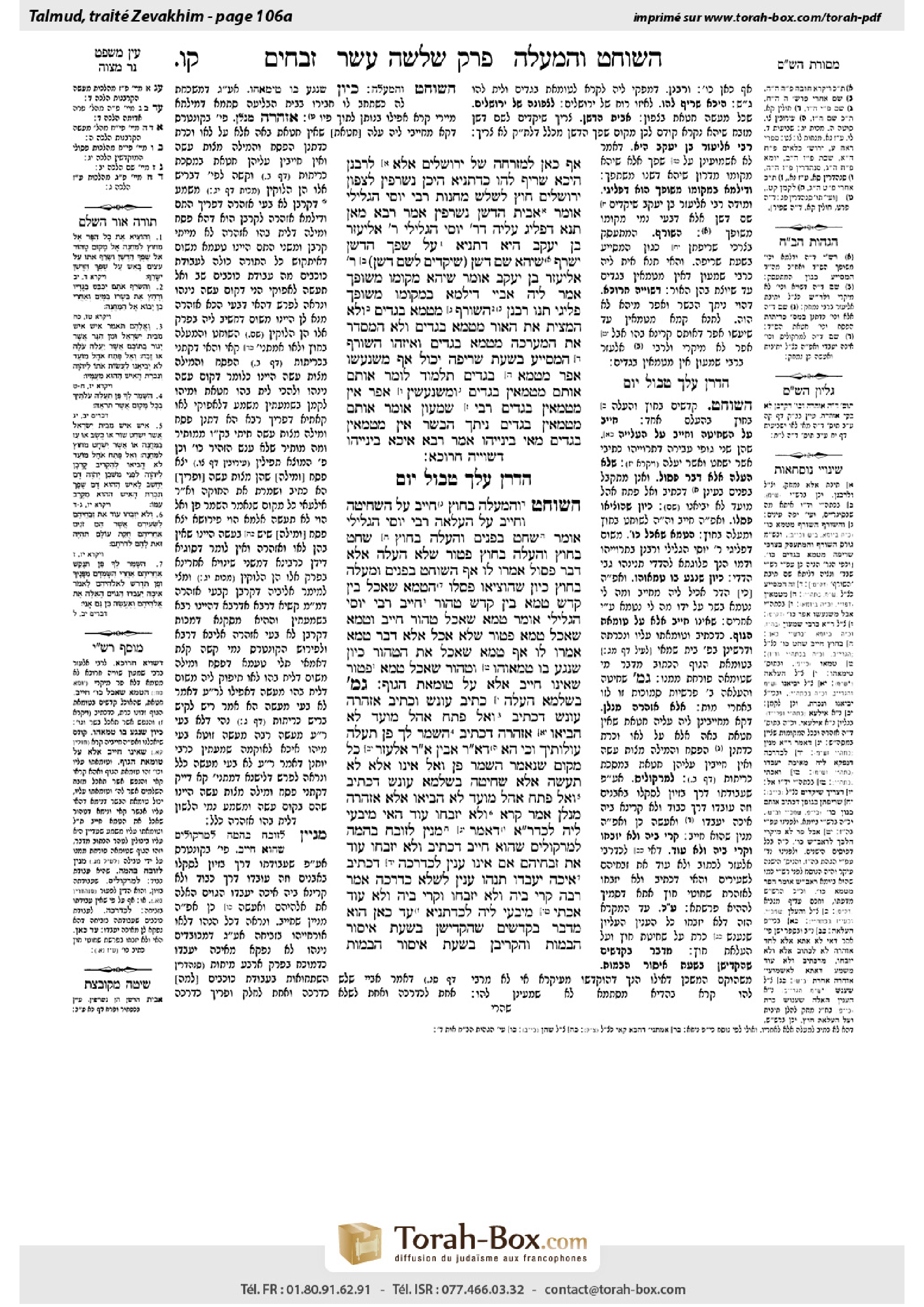
Zevachim 106a: Talmud study for Daf Yomi
Daf Yomi is the daily study of one Talmud folio. Explore 37 tractates with scans, Hebrew text, Sefaria English and AI-generated French translations where annotated.
Passage selection and English or AI-generated French translation are available where the scan has annotations. Daf Study is independent of Torah-Box and Sefaria.
Browse Zevachim · זבחים · All tractatesZevachim 106a text and translations
This page of Zevachim includes the Aramaic text, an English translation and an AI-generated French translation, alongside the scan above.
זבחים ק״ו א · Aramaic and Hebrew text
אַף כָּאן – לְמִזְרָחָהּ שֶׁל יְרוּשָׁלַיִם.
אֶלָּא לְרַבָּנַן הֵיכָא שָׂרֵיף לְהוּ? כִּדְתַנְיָא: הֵיכָן נִשְׂרָפִין? לִצְפוֹן יְרוּשָׁלַיִם, חוּץ לְשָׁלֹשׁ מַחֲנוֹת. רַבִּי יוֹסֵי הַגְּלִילִי אוֹמֵר: אַבֵּית הַדֶּשֶׁן נִשְׂרָפִין.
אָמַר רָבָא: מַאן תַּנָּא דִּפְלִיג עֲלֵיהּ דְּרַבִּי יוֹסֵי הַגְּלִילִי? רַבִּי אֱלִיעֶזֶר בֶּן יַעֲקֹב הִיא, דְּתַנְיָא: ״עַל שֶׁפֶךְ הַדֶּשֶׁן יִשָּׂרֵף״ – שֶׁיְּהֵא שָׁם דֶּשֶׁן (שֶׁיַּקְדִּים לְשָׁם דֶּשֶׁן). רַבִּי אֱלִיעֶזֶר בֶּן יַעֲקֹב אוֹמֵר: שֶׁיְּהֵא מְקוֹמוֹ מְשׁוּפָּךְ.
אֲמַר לֵיהּ אַבָּיֵי: דִּילְמָא בִּמְקוֹמוֹ מְשׁוּפָּךְ פְּלִיגִי.
תָּנוּ רַבָּנַן: הַשּׂוֹרֵף מְטַמֵּא בְּגָדִים, וְלֹא הַמַּצִּית אֶת הָאוּר מְטַמֵּא בְּגָדִים, וְלֹא הַמְסַדֵּר אֶת הַמַּעֲרָכָה מְטַמֵּא בְּגָדִים. וְאֵיזֶהוּ הַשּׂוֹרֵף? הַמְסַיֵּיעַ בִּשְׁעַת שְׂרֵיפָה.
יָכוֹל אַף מִשֶּׁנַּעֲשׂוּ אֵפֶר מְטַמֵּא בְּגָדִים? תַּלְמוּד לוֹמַר: ״אוֹתָם״ – אוֹתָם מְטַמְּאִין בְּגָדִים, וּמִשֶּׁנַּעֲשִׂין אֵפֶר אֵין מְטַמְּאִין בְּגָדִים. רַבִּי שִׁמְעוֹן אוֹמֵר: אוֹתָם מְטַמְּאִין בְּגָדִים, נִיתַּךְ הַבָּשָׂר אֵין מְטַמְּאִין בְּגָדִים.
מַאי בֵּינַיְיהוּ? אָמַר רָבָא: אִיכָּא בֵּינַיְיהוּ דְּשַׁוְּיֵיהּ חָרוֹכָא.
הֲדַרַן עֲלָךְ טְבוּל יוֹם
מַתְנִי׳ הַשּׁוֹחֵט וְהַמַּעֲלֶה בַּחוּץ – חַיָּיב עַל הַשְּׁחִיטָה, וְחַיָּיב עַל הַעֲלָאָה.
רַבִּי יוֹסֵי הַגְּלִילִי אוֹמֵר: שָׁחַט בִּפְנִים וְהֶעֱלָה בַּחוּץ. שָׁחַט בַּחוּץ וְהֶעֱלָה בַּחוּץ – פָּטוּר, שֶׁלֹּא הֶעֱלָה אֶלָּא דָּבָר פָּסוּל. אָמְרוּ לוֹ: אַף הַשּׁוֹחֵט בִּפְנִים וּמַעֲלֶה בַּחוּץ, כֵּיוָן שֶׁהוֹצִיאוֹ – פְּסָלוֹ.
הַטָּמֵא שֶׁאָכַל בֵּין קֹדֶשׁ טָמֵא בֵּין קֹדֶשׁ טָהוֹר – חַיָּיב. רַבִּי יוֹסֵי הַגְּלִילִי אוֹמֵר: טָמֵא שֶׁאָכַל טָהוֹר – חַיָּיב, וְטָמֵא שֶׁאָכַל טָמֵא – פָּטוּר, שֶׁלֹּא אָכַל אֶלָּא דָּבָר טָמֵא. אָמְרוּ לוֹ: אַף טָמֵא שֶׁאָכַל אֶת הַטָּהוֹר, כֵּיוָן שֶׁנָּגַע בּוֹ – טִמְּאוֹהוּ.
וְטָהוֹר שֶׁאָכַל טָמֵא – פָּטוּר, שֶׁאֵינוֹ חַיָּיב אֶלָּא עַל טוּמְאַת הַגּוּף.
גְּמָ׳ בִּשְׁלָמָא הֶעֱלָה – כְּתִיב עוֹנֶשׁ וּכְתִיב אַזְהָרָה. עוֹנֶשׁ – דִּכְתִיב: ״וְאֶל פֶּתַח אֹהֶל מוֹעֵד לֹא הֱבִיאוֹ״. אַזְהָרָה – דִּכְתִיב: ״הִשָּׁמֶר לְךָ פֶּן תַּעֲלֶה עוֹלוֹתֶיךָ״; וְכִי הָא דְּאָמַר רַבִּי אָבִין אָמַר רַבִּי אֶלְעָזָר: כׇּל מָקוֹם שֶׁנֶּאֱמַר ״הִשָּׁמֶר״, ״פֶּן״ וְ״אַל״ – אֵינוֹ אֶלָּא לֹא תַעֲשֶׂה.
אֶלָּא שְׁחִיטָה – בִּשְׁלָמָא עוֹנֶשׁ, דִּכְתִיב: ״וְאֶל פֶּתַח אֹהֶל מוֹעֵד לֹא הֱבִיאוֹ״; אֶלָּא אַזְהָרָה מְנָלַן? אָמַר קְרָא: ״וְלֹא יִזְבְּחוּ עוֹד״.
הַאי מִיבְּעֵי לֵיהּ לְכִדְרַבִּי אֶלְעָזָר! דְּאָמַר: מִנַּיִן לַזּוֹבֵחַ בְּהֵמָה לְמַרְקוּלִיס שֶׁהוּא חַיָּיב? דִּכְתִיב: ״וְלֹא יִזְבְּחוּ עוֹד אֶת זִבְחֵיהֶם״ – אִם אֵינוֹ עִנְיָן לִכְדַרְכָּהּ, דִּכְתִיב: ״אֵיכָה יַעַבְדוּ״; תְּנֵהוּ עִנְיָן לְשֶׁלֹּא כְּדַרְכָּהּ.
אָמַר רַבָּה: קְרִי בֵּיהּ ״וְלֹא יִזְבְּחוּ״, וּקְרִי בֵּיהּ ״וְלֹא עוֹד״.
אַכַּתִּי מִיבְּעֵי לֵיהּ לְכִדְתַנְיָא: עַד כָּאן הוּא מְדַבֵּר בְּקָדָשִׁים שֶׁהִקְדִּישָׁן בִּשְׁעַת אִיסּוּר הַבָּמוֹת וְהִקְרִיבָן בִּשְׁעַת אִיסּוּר הַבָּמוֹת –
Zevachim 106a · English translation
so too here, the bull and goat of Yom Kippur are burned east of Jerusalem.
But according to the Rabbis, then, where outside Jerusalem do they burn them? The Gemara responds: As it is taught in a baraita: Where are the bulls and goats burned? They are burned north of Jerusalem, outside of the three camps. Rabbi Yosei HaGelili says: They are burned on the place of the ashes, where the ashes from the altar were poured.
Rava said: Who is the tanna who disagrees with Rabbi Yosei HaGelili? It is Rabbi Eliezer ben Yaakov, as it is taught in a baraita: The verse states with regard to bulls that are burned: “Where the ashes are poured out [shefekh hadeshen] shall it be burned” (Leviticus 4:12). This teaches that ashes must be there already when the bulls are burned. Rabbi Eliezer ben Yaakov says: This verse teaches that its place should slope [meshupakh] downward so that ashes from the burning will slide downhill.
Abaye said to Rava: Perhaps they disagree only about whether the place must slope, but Rabbi Eliezer ben Yaakov agrees that it must be the place where the ashes from the altar were deposited.
§ The Sages taught in a baraita: The verse states with regard to the bull and goat of Yom Kippur: “And he who burns them shall wash his garments” (Leviticus 16:28). This teaches that only the one who burns them renders his garments impure, but the one who kindles the fire does not render his garments impure, and the one who sets up the arrangement of wood does not render his garments impure. And who is considered the one who burns? One who assists at the actual time of burning.
One might have thought that this priest renders his garments impure even after the bull and goat become ash. Therefore, the verse states: “And he who burns them” (Leviticus 16:28), teaching that they, the whole bull and goat, render garments impure, but they do not render garments impure once they become ash. Rabbi Shimon says: The word “them” teaches that they render garments impure, but once the flesh is incinerated they do not render garments impure.
The Gemara asks: What is the difference between the opinion of the first tanna and the opinion of Rabbi Shimon? Rava said: The difference between them is when he turned it into a charred mass, and the form of the animal has become distorted, but has not actually become ash. The first tanna holds that at this stage the offering still transmits impurity, whereas Rabbi Shimon holds that it does not.
MISHNA: One who slaughters an offering outside the Temple courtyard and one who offers it up outside the Temple courtyard is liable for the slaughter and liable for the offering up, as each act involves an independent prohibition. If done intentionally, he is liable to receive excision from the World-to-Come [karet] for each act, and if done unwittingly, he is liable to bring a sin offering for each act.
Rabbi Yosei HaGelili says: If he slaughtered an offering inside the courtyard and then offered it up outside the courtyard, he is liable. But if he slaughtered it outside, thereby rendering it unfit, and then he offered it up outside, he is exempt for the offering up, as he offered up only an item that is unfit, and one is liable only for offering up an item that is fit to be offered up inside the Temple. The Rabbis said to him: According to your reasoning, even in a case where he slaughters it inside and offers it up outside, he should be exempt, since the moment that he took it outside the courtyard, he thereby rendered it unfit. Yet, in such a case, he is certainly liable for offering it up. So too, one who slaughters an offering outside and then offers it up outside is liable.
One who is ritually impure who ate sacrificial food, whether it was ritually impure sacrificial food or ritually pure sacrificial food, is liable to receive karet if he did so intentionally and to bring a sliding-scale offering if he did so unwittingly. Rabbi Yosei HaGelili says: An impure person who ate pure sacrificial food is liable. But an impure person who ate impure sacrificial food is exempt, as he merely ate an impure item, and the prohibition against eating sacrificial food while one is impure applies only to pure sacrificial food. The Rabbis said to him: According to your logic, this halakha would apply even in a case of an impure person who ate what had been pure sacrificial food, because once he touched it, he thereby rendered it ritually impure. Yet, in such a case, he is certainly liable for eating it. So too, an impure person who ate impure sacrificial food is liable.
And a pure person who ate impure sacrificial food is exempt, as one is liable for eating sacrificial food in impurity only due to the impurity of one’s body, but not due to the impurity of the food.
GEMARA: The mishna teaches that if one both slaughters and offers up an offering outside the Temple courtyard, he is liable for each act, as they are independent prohibitions. The Gemara asks: Granted that one is liable for the offering up, as the punishment for this act is written in the Torah and the prohibition concerning this act is also written in the Torah. The punishment is as it is written: “Any man…that offers up a burnt offering or sacrifice, and will not bring it to the entrance of the Tent of Meeting, to sacrifice it to the Lord, and that man shall be cut off from his people” (Leviticus 17:8–9). The prohibition is as it is written: “Take heed to yourself lest you offer up your burnt offerings in every place that you see” (Deuteronomy 12:13). And this is in accordance with that which Rabbi Avin says that Rabbi Elazar says: Wherever it is stated in the Torah: Observe, or: Lest, or: Do not, it is nothing other than a prohibition. Accordingly, the verse in Deuteronomy is understood as issuing a prohibition.
But for the slaughtering, why is one liable? Granted that the punishment is stated in the Torah, as it is written: “Any man…that slaughters it outside the camp, and he did not bring it to the entrance of the Tent of Meeting, to sacrifice an offering to the Lord, before the Tabernacle of the Lord…that man shall be cut off from among his people” (Leviticus 17:3–4). But from where do we derive its prohibition? One is liable only in a case where the Torah specifies both the prohibition and the punishment. The Gemara answers: The verse states in the continuation of that passage: “And they shall not slaughter anymore their offerings to the se’irim after whom they go astray” (Leviticus 17:7).
The Gemara questions the use of this verse as a source: But this verse is necessary for the purpose of expounding in accordance with the statement of Rabbi Elazar, as he says: From where is it derived with regard to one who slaughters an animal as an offering to Mercury, a pagan deity, that he is liable even though this is not the established manner in which that deity is worshipped? As it is written: “And they shall not slaughter anymore their offerings to the se’irim.” If the verse is not needed to teach the matter of worshipping a deity in accordance with its established manner, as it is already taught that one is liable for this, as it is written: “Take heed to yourself…lest you inquire after their gods, saying: How do these nations serve their gods, so too will I do likewise” (Deuteronomy 12:30), then apply it to the matter of worshipping a deity in a way that is not in accordance with its established manner.
Rabba said: Both halakhot can be derived from the same verse. Read into the verse as though it stops after the phrase: “And they shall not slaughter” (Leviticus 17:7), and relates to the prohibition against slaughtering outside the Temple courtyard, which was mentioned in the previous verses. And also read into the verse as relating to the verse’s continuation: And not anymore their offerings to the se’irim, which serves as the source for the prohibition against sacrificing offerings to false deities.
The Gemara challenges: But the verse is still necessary for the purpose of expounding that which is taught in a baraita: The verse states: “Any man…that slaughters it outside the camp, and he did not bring it to the entrance of the Tent of Meeting, to sacrifice an offering to the Lord” (Leviticus 17:3–4). Until this point, the verse is speaking about sacrificial animals that one consecrated during a period when the prohibition against sacrificing on private altars was in effect, i.e., after the Tabernacle was erected, and then he also sacrificed them during a period when the prohibition against sacrificing on private altars was in effect.
Zevachim 106a · Traduction française (IA)
De même ici, le taureau et le bouc de Yom Kippour sont brûlés à l’est de Jérusalem.
Mais selon les Sages, où les brûle-t-on alors, à l’extérieur de Jérusalem ? La Guemara répond : comme il est enseigné dans une baraïta : Où brûle-t-on les taureaux et les boucs ? On les brûle au nord de Jérusalem, à l’extérieur des trois camps. Rabbi Yosei HaGelili dit : On les brûle à l’emplacement des cendres, là où l’on déversait les cendres de l’autel.
Rava dit : Quel est le tanna qui est en désaccord avec Rabbi Yosei HaGelili ? C’est Rabbi Eliezer ben Yaakov, comme il est enseigné dans une baraïta : À propos des taureaux que l’on brûle, le verset dit : « Là où l’on déverse les cendres [shefekh hadeshen], on le brûlera » (Lévitique 4, 12). Cela enseigne que des cendres doivent déjà se trouver là lorsque l’on brûle les taureaux. Rabbi Eliezer ben Yaakov dit : Ce verset enseigne que l’emplacement doit être en pente [meshupakh], afin que les cendres issues de la combustion glissent vers le bas.
Abaye dit à Rava : Peut-être ne sont-ils en désaccord que sur la question de savoir si l’emplacement doit être en pente, mais Rabbi Eliezer ben Yaakov convient qu’il doit s’agir de l’endroit où les cendres de l’autel étaient déposées.
§ Les Sages ont enseigné dans une baraïta : À propos du taureau et du bouc de Yom Kippour, le verset dit : « Celui qui les brûle lavera ses vêtements » (Lévitique 16, 28). Cela enseigne que seul celui qui les brûle rend ses vêtements impurs ; celui qui allume le feu ne rend pas ses vêtements impurs, pas plus que celui qui dispose le bois. Et qui est considéré comme celui qui les brûle ? Celui qui participe à la combustion proprement dite.
On aurait pu penser que ce prêtre rend ses vêtements impurs même après que le taureau et le bouc sont devenus des cendres. C’est pourquoi le verset dit : « Celui qui les brûle » (Lévitique 16, 28), ce qui enseigne que ce sont eux, le taureau et le bouc dans leur intégralité, qui rendent les vêtements impurs, mais qu’ils ne les rendent plus impurs une fois réduits en cendres. Rabbi Shimon dit : Le mot « les » enseigne qu’ils rendent les vêtements impurs, mais qu’ils ne les rendent plus impurs une fois la chair incinérée.
La Guemara demande : Quelle est la différence entre l’opinion du premier tanna et celle de Rabbi Shimon ? Rava dit : Leur désaccord porte sur le cas où l’animal a été réduit à une masse carbonisée et où sa forme est défigurée, sans toutefois être devenu entièrement cendre. Le premier tanna estime qu’à ce stade, l’offrande transmet encore l’impureté, tandis que Rabbi Shimon estime qu’elle ne la transmet pas.
MICHNA : Celui qui égorge une offrande à l’extérieur de la cour du Temple et celui qui la fait monter sur l’autel à l’extérieur de la cour du Temple sont passibles de sanction pour l’égorgement et pour l’offrande sur l’autel, car chacun de ces actes constitue une interdiction distincte. S’il agit intentionnellement, il encourt le retranchement [karet] pour chaque acte ; s’il agit par inadvertance, il doit apporter un sacrifice expiatoire pour chaque acte.
Rabbi Yosei HaGelili dit : S’il a égorgé une offrande à l’intérieur de la cour, puis l’a fait monter sur l’autel à l’extérieur de la cour, il est passible de sanction. Mais s’il l’a égorgée à l’extérieur, la rendant ainsi impropre, puis l’a fait monter sur l’autel à l’extérieur, il est exempté pour l’offrande sur l’autel, car il n’a fait monter qu’un objet impropre, et l’on n’est passible de sanction que pour avoir fait monter un objet qui peut être offert à l’intérieur du Temple. Les Sages lui dirent : Selon ton raisonnement, même dans le cas où il l’égorge à l’intérieur et la fait monter sur l’autel à l’extérieur, il devrait être exempté, puisque, dès qu’il l’a sortie de la cour, il l’a rendue impropre. Pourtant, dans un tel cas, il est certainement passible de sanction pour l’avoir fait monter sur l’autel. De même, celui qui égorge une offrande à l’extérieur puis la fait monter sur l’autel à l’extérieur est passible de sanction.
Une personne rituellement impure qui a consommé des aliments consacrés, qu’ils aient été rituellement impurs ou rituellement purs, encourt le retranchement [karet] si elle l’a fait intentionnellement et doit apporter une offrande à échelle variable si elle l’a fait par inadvertance. Rabbi Yosei HaGelili dit : Une personne impure qui a consommé des aliments consacrés purs est passible de sanction. Mais une personne impure qui a consommé des aliments consacrés impurs est exemptée, car elle n’a fait que consommer un objet impur, et l’interdiction de consommer des aliments consacrés lorsqu’on est impur ne s’applique qu’aux aliments consacrés purs. Les Sages lui dirent : Selon ton raisonnement, cette halakha s’appliquerait même au cas d’une personne impure ayant consommé des aliments qui étaient purs et consacrés, car, en les touchant, elle les a rendus rituellement impurs. Pourtant, dans un tel cas, elle est certainement passible de sanction pour les avoir consommés. De même, une personne impure qui a consommé des aliments consacrés impurs est passible de sanction.
Et une personne rituellement pure qui a consommé des aliments consacrés impurs est exemptée, car on n’est passible de sanction pour avoir consommé des aliments consacrés en état d’impureté qu’en raison de l’impureté du corps, et non de celle des aliments.
GUEMARA : La Michna enseigne que si quelqu’un égorge une offrande et la fait monter sur l’autel à l’extérieur de la cour du Temple, il est passible de sanction pour chacun de ces actes, car ils constituent des interdictions distinctes. La Guemara demande : Il est compréhensible qu’on soit passible de sanction pour l’offrande sur l’autel, puisque la Torah écrite énonce la peine encourue pour cet acte et l’interdit également. La peine est énoncée ainsi : « Tout homme… qui offre un holocauste ou un sacrifice et ne l’apporte pas à l’entrée de la Tente d’assignation pour le sacrifier à l’Éternel, cet homme sera retranché de son peuple » (Lévitique 17, 8-9). L’interdiction est énoncée ainsi : « Prends garde à toi, de peur d’offrir tes holocaustes en tout lieu que tu verras » (Deutéronome 12, 13). Cela correspond à ce que Rabbi Avin dit au nom de Rabbi Elazar : Chaque fois que la Torah dit « garde-toi », « de peur que » ou « ne… pas », il s’agit nécessairement d’une interdiction. Par conséquent, le verset du Deutéronome est compris comme énonçant une interdiction.
Mais pour l’égorgement, pourquoi est-on passible de sanction ? Il est compréhensible que la peine soit énoncée dans la Torah écrite, comme il est écrit : « Tout homme… qui l’égorge à l’extérieur du camp et ne l’apporte pas à l’entrée de la Tente d’assignation pour offrir un sacrifice à l’Éternel devant le Tabernacle de l’Éternel… cet homme sera retranché du milieu de son peuple » (Lévitique 17, 3-4). Mais d’où déduit-on l’interdiction ? On n’est passible de sanction que lorsque la Torah écrite énonce à la fois l’interdiction et la peine. La Guemara répond : Dans la suite de ce passage, le verset dit : « Ils ne sacrifieront plus leurs sacrifices aux se’irim, après lesquels ils se prostituent » (Lévitique 17, 7).
La Guemara conteste l’utilisation de ce verset comme source : Mais ce verset est nécessaire pour l’exégèse conforme à l’enseignement de Rabbi Elazar. En effet, il dit : D’où déduit-on que celui qui égorge un animal en sacrifice à Mercure, une divinité païenne, est passible de sanction, même si ce n’est pas la manière habituelle de rendre un culte à cette divinité ? C’est ce qui est écrit : « Ils ne sacrifieront plus leurs sacrifices aux se’irim. » Si le verset n’est pas nécessaire pour enseigner qu’on est passible de sanction lorsqu’on rend un culte à une divinité de la manière habituelle, puisque cela est déjà enseigné, comme il est écrit : « Prends garde à toi… de peur que tu ne recherches leurs dieux, en disant : Comment ces nations servent-elles leurs dieux ? Je ferai de même » (Deutéronome 12, 30), alors appliquons-le au cas où l’on rend un culte à une divinité d’une manière qui n’est pas habituelle.
Rabba dit : On peut déduire les deux halakhot du même verset. Interprète le verset comme s’il s’arrêtait après les mots : « Et ils ne sacrifieront pas » (Lévitique 17, 7) ; il se rapporte alors à l’interdiction d’égorger à l’extérieur de la cour du Temple, mentionnée dans les versets précédents. Interprète également la suite du verset — « plus leurs sacrifices aux se’irim » — comme la source de l’interdiction d’offrir des sacrifices aux fausses divinités.
La Guemara objecte : Mais le verset reste nécessaire pour l’exégèse de ce qui est enseigné dans une baraïta : Le verset dit : « Tout homme… qui l’égorge à l’extérieur du camp et ne l’apporte pas à l’entrée de la Tente d’assignation pour offrir un sacrifice à l’Éternel » (Lévitique 17, 3-4). Jusqu’ici, le verset parle d’animaux consacrés par quelqu’un pendant une période où l’interdiction d’offrir des sacrifices sur des autels privés était en vigueur, c’est-à-dire après l’érection du Tabernacle, et que cette personne a ensuite également sacrifiés pendant une période où cette interdiction était en vigueur.
Traduction française générée par IA à partir de l’édition anglaise de Sefaria. Vérifie toujours un passage avec le texte source.
Text from Sefaria: William Davidson Edition - Vocalized Aramaic (CC BY NC); William Davidson Edition - English (CC BY NC).