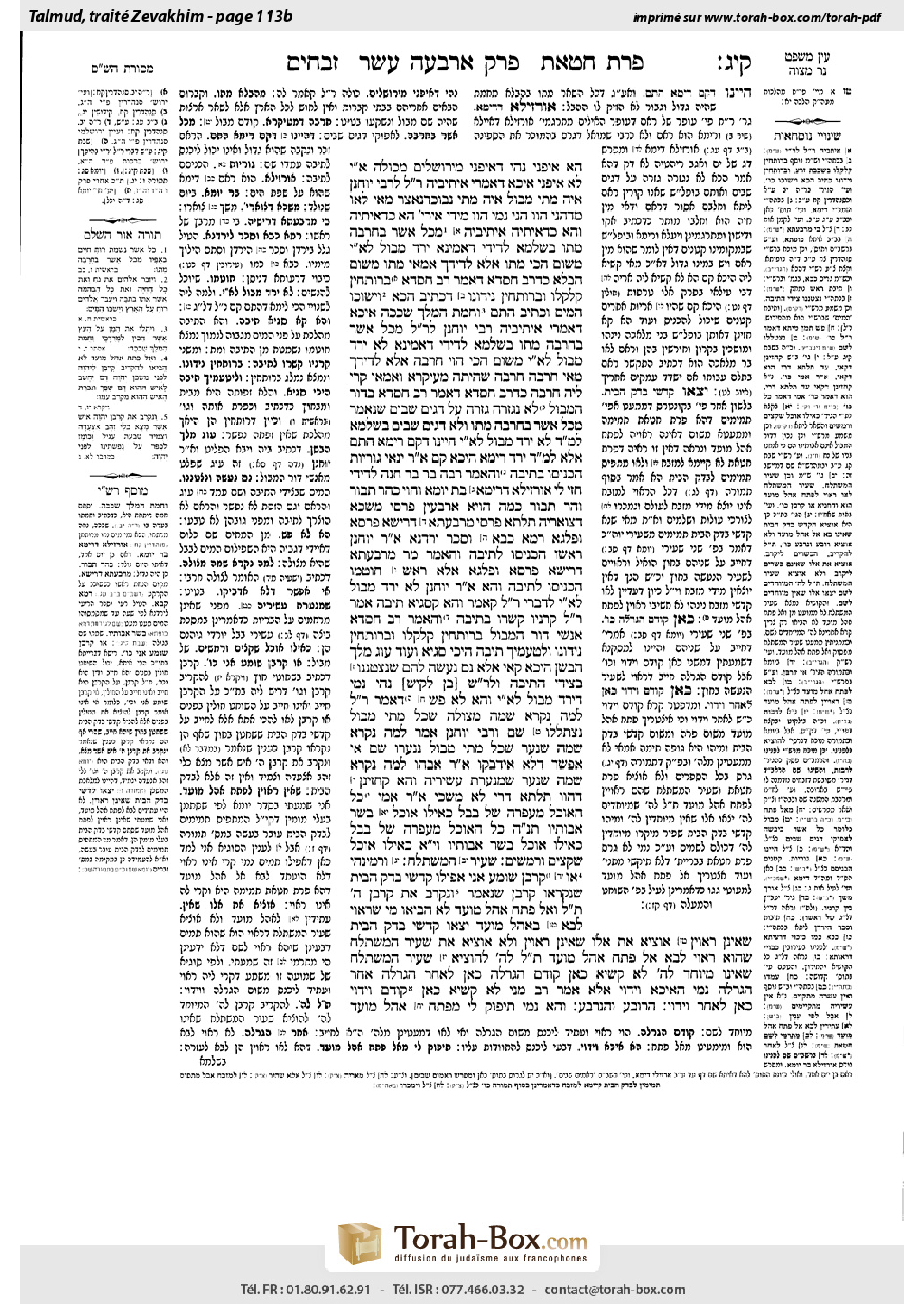
Zevachim 113b: Talmud study for Daf Yomi
Daf Yomi is the daily study of one Talmud folio. Explore 37 tractates with scans, Hebrew text, Sefaria English and AI-generated French translations where annotated.
Passage selection and English or AI-generated French translation are available where the scan has annotations. Daf Study is independent of Torah-Box and Sefaria.
Browse Zevachim · זבחים · All tractatesZevachim 113b text and translations
This page of Zevachim includes the Aramaic text, an English translation and an AI-generated French translation, alongside the scan above.
זבחים קי״ג ב · Aramaic and Hebrew text
הָא אִיפְּנוֹ! נְהִי דְּאִיפַּנּוֹ מִירוּשָׁלַיִם, מִכּוּלַּהּ אֶרֶץ יִשְׂרָאֵל לָא אִיפַּנּוֹ.
אִיכָּא דְּאָמְרִי, אֵיתִיבֵיהּ רֵישׁ לָקִישׁ לְרַבִּי יוֹחָנָן: אַיֵּה מֵתֵי מַבּוּל? אַיֵּה מֵתֵי נְבוּכַדְנֶאצַּר? מַאי, לָאו מִדְּהָנֵי הֲווֹ – הָנֵי נָמֵי הֲווֹ? מִידֵּי אִירְיָא?! הָא כִּדְאִיתֵיהּ וְהָא כִּדְאִיתֵיהּ.
אֵיתִיבֵיהּ: ״מִכֹּל אֲשֶׁר בֶּחָרָבָה מֵתוּ״ – בִּשְׁלָמָא לְדִידִי, דְּאָמֵינָא יָרַד מַבּוּל לְאֶרֶץ יִשְׂרָאֵל – מִשּׁוּם הָכִי מֵתוּ. אֶלָּא לְדִידָךְ, אַמַּאי מֵתוּ? מִשּׁוּם הַבְלָא.
כִּדְרַב חִסְדָּא, דְּאָמַר רַב חִסְדָּא: בְּרוֹתְחִין קִלְקְלוּ, וּבְרוֹתְחִין נִידּוֹנוּ; דִּכְתִיב הָכָא: ״וַיָּשֹׁכּוּ הַמָּיִם״, וּכְתִיב הָתָם: ״וַחֲמַת הַמֶּלֶךְ שָׁכָכָה״.
אִיכָּא דְּאָמְרִי, אֵיתִיבֵיהּ רַבִּי יוֹחָנָן לְרֵישׁ לָקִישׁ: ״מִכֹּל אֲשֶׁר בֶּחָרָבָה מֵתוּ״ – בִּשְׁלָמָא לְדִידִי, דְּאָמֵינָא לֹא יָרַד מַבּוּל לְאֶרֶץ יִשְׂרָאֵל – מִשּׁוּם הָכִי הֲוַי חָרָבָה. אֶלָּא לְדִידָךְ, מַאי חָרָבָה? חָרָבָה שֶׁהָיְתָה מֵעִיקָּרָא.
וְאַמַּאי קָרֵי לֵיהּ חָרָבָה? כִּדְרַב חִסְדָּא. דְּאָמַר רַב חִסְדָּא: בְּדוֹר הַמַּבּוּל לֹא נִגְזְרָה גְּזֵרָה עַל דָּגִים שֶׁבַּיָּם, שֶׁנֶּאֱמַר: ״מִכֹּל אֲשֶׁר בֶּחָרָבָה מֵתוּ״ – וְלֹא דָּגִים שֶׁבַּיָּם.
בִּשְׁלָמָא לְמַאן דְּאָמַר לֹא יָרַד מַבּוּל לְאֶרֶץ יִשְׂרָאֵל – הַיְינוּ דְּקָם רֵימָא הָתָם. אֶלָּא לְמַאן דְּאָמַר יָרַד, רֵימָא הֵיכָא קָם? אָמַר רַבִּי יַנַּאי: גּוּרִיּוֹת הִכְנִיסוּ בַּתֵּיבָה.
וְהָאָמַר רַבָּה בַּר בַּר חָנָה: לְדִידִי חֲזֵי לִי אוּרְזִילָא דְּרֵימָא (בַּת) [בַּר] יוֹמֵאּ, וְהָוֵי כְּהַר תָּבוֹר. וְהַר תָּבוֹר כַּמָּה הָוֵיא – אַרְבְּעִין פַּרְסֵי; מְשָׁכָא דְּצַוְּארֵיהּ – תְּלָתָא פַּרְסֵי, מַרְבַּעְתָּא דְּרֵישָׁא – פַּרְסָא וּפַלְגָא, רְמָא כַּבָּא וּסְכַר יַרְדְּנָא.
אָמַר רַבִּי יוֹחָנָן: רֹאשׁוֹ הִכְנִיסוּ לַתֵּיבָה. וְהָאָמַר מָר: מַרְבַּעְתָּא דְּרֵישָׁא פַּרְסָא וּפַלְגָא! אֶלָּא רֹאשׁ חוֹטְמוֹ הִכְנִיסוּ לַתֵּיבָה.
וְהָא אָמַר רַבִּי יוֹחָנָן: לֹא יָרַד מַבּוּל לְאֶרֶץ יִשְׂרָאֵל! לְדִבְרֵי רֵישׁ לָקִישׁ קָאָמַר.
וְהָא קָסָגְיָא תֵּיבָה! אָמַר רֵישׁ לָקִישׁ: קַרְנָיו קָשְׁרוּ בַּתֵּיבָה. וְהָאָמַר רַב חִסְדָּא: אַנְשֵׁי דּוֹר הַמַּבּוּל בְּרוֹתְחִין קִלְקְלוּ וּבְרוֹתְחִין נִידּוֹנוּ!
וּלְטַעְמָיךְ, תֵּיבָה הֵיכִי סָגְיָא? וְעוֹד, עוֹג מֶלֶךְ הַבָּשָׁן הֵיכָא קָאֵי? אֶלָּא נֵס נַעֲשָׂה לָהֶם, שֶׁנִּצְטַנְּנוּ בְּצִידֵּי הַתֵּיבָה.
וּלְרַבִּי שִׁמְעוֹן [בֶּן לָקִישׁ] – נְהִי נָמֵי דְּיָרַד מַבּוּל לְאֶרֶץ יִשְׂרָאֵל; וְהָא לָא פָּשׁ! דְּאָמַר רֵישׁ לָקִישׁ: לָמָּה נִקְרָא שְׁמָהּ ״מְצוּלָה״? שֶׁכׇּל מֵתֵי מַבּוּל נִצְטַלְּלוּ שָׁם. וְרַבִּי יוֹחָנָן אָמַר: לָמָּה נִקְרָא שְׁמָהּ ״שִׁנְעָר״? שֶׁכׇּל מֵתֵי מַבּוּל נִנְעֲרוּ שָׁם. אִי אֶפְשָׁר דְּלָא אִידְּבַקוּ.
אָמַר רַבִּי אֲבָהוּ: לָמָּה נִקְרָא שְׁמָהּ ״שִׁנְעָר״? שֶׁמְּנַעֶרֶת עֲשִׁירֶיהָ. וְהָא קָחָזֵינַן דְּהָווּ! תְּלָתָא דָּרֵי לָא מָשְׁכִי.
אָמַר רַבִּי אַמֵּי: כָּל הָאוֹכֵל מֵעֲפָרָהּ שֶׁל בָּבֶל – כְּאִילּוּ אוֹכֵל בְּשַׂר אֲבוֹתָיו. תַּנְיָא נָמֵי הָכִי: כָּל הָאוֹכֵל מֵעֲפָרָהּ שֶׁל בָּבֶל – כְּאִילּוּ אוֹכֵל בְּשַׂר אֲבוֹתָיו. וְיֵשׁ אוֹמְרִים: כְּאִילּוּ אוֹכֵל שְׁקָצִים וּרְמָשִׂים.
שָׂעִיר הַמִּשְׁתַּלֵּחַ.
וּרְמִינְהִי: אוֹ ״קׇרְבָּן״ – שׁוֹמֵעַ אֲנִי אֲפִילּוּ קׇדְשֵׁי בֶּדֶק הַבַּיִת שֶׁנִּקְרְאוּ קׇרְבָּן, שֶׁנֶּאֱמַר: ״וַנַּקְרֵב אֶת קׇרְבַּן ה׳״?
תַּלְמוּד לוֹמַר: ״וְאֶל פֶּתַח אֹהֶל מוֹעֵד לֹא הֱבִיאוֹ״ – מִי שֶׁרָאוּי לָבֹא בְּאֹהֶל מוֹעֵד; יָצְאוּ קׇדְשֵׁי בֶּדֶק הַבַּיִת – שֶׁאֵינָן רְאוּיִן.
אוֹצִיא אֶת אֵלּוּ – שֶׁאֵינָן רְאוּיִן; וְלֹא אוֹצִיא אֶת שָׂעִיר הַמִּשְׁתַּלֵּחַ – שֶׁהוּא רָאוּי לָבֹא אֶל פֶּתַח אֹהֶל מוֹעֵד! תַּלְמוּד לוֹמַר: ״לַה׳״ – לְהוֹצִיא שָׂעִיר הַמִּשְׁתַּלֵּחַ, שֶׁאֵינוֹ מְיוּחָד לַה׳.
לָא קַשְׁיָא; כָּאן קוֹדֶם הַגְרָלָה, כָּאן לְאַחַר הַגְרָלָה. אַחַר הַגְרָלָה נָמֵי, הָאִיכָּא וִידּוּי!
אֶלָּא אָמַר רַב מַנִּי: לָא קַשְׁיָא; כָּאן קוֹדֶם וִידּוּי, כָּאן לְאַחַר וִידּוּי.
הָרוֹבֵעַ וְהַנִּרְבָּע.
וְהָא נָמֵי תִּיפּוֹק לִי מִ״פֶּתַח אֹהֶל מוֹעֵד״!
Zevachim 113b · English translation
as they were already removed. One can respond: This baraita deals exclusively with Jerusalem. Granted that the bones of those who perished in the flood and at the hands of Nebuchadnezzar were removed from Jerusalem, but they were not removed from all of Eretz Yisrael. Therefore, outside Jerusalem, the red heifer may be slaughtered only in a place that has been inspected.
There are those who say the discussion should be inverted, and Reish Lakish raised an objection to Rabbi Yoḥanan, who holds that the flood did not affect Eretz Yisrael, from that baraita, as Rabbi Yehoshua said: Where are the dead of the flood, and where are all of the dead killed by Nebuchadnezzar? Reish Lakish said: What, is it not possible to infer from this question that since those slaughtered by Nebuchadnezzar were in Eretz Yisrael, those who perished in the flood were also there? Rabbi Yoḥanan responds: Are the cases comparable? This is as it is and that is as it is, i.e., the dead of Nebuchadnezzar were indeed in Eretz Yisrael, but the dead of the flood were not, as there was no flood there.
Reish Lakish raised an objection to Rabbi Yoḥanan: With regard to the flood, it is stated: “All in whose nostrils was the breath of the spirit of life, whatsoever was on the dry land, died” (Genesis 7:22). Granted, according to my opinion, that I say the flood descended upon Eretz Yisrael, due to that reason all living creatures on Earth died, even those in Eretz Yisrael. But according to your opinion that the flood did not descend on Eretz Yisrael, why did they die there? Rabbi Yoḥanan responds: They died due to the heat that accompanied the floodwaters, and that spread to Eretz Yisrael as well. Those corpses were then buried in known locations.
The Gemara notes that this is in accordance with the statement of Rav Ḥisda, as Rav Ḥisda says: The generation of the flood sinned with boiling heat, i.e., forbidden sexual intercourse, and they were punished with the boiling heat of the flood waters. As it is written here, with regard to the flood: “And God remembered Noah and every living creature and all the cattle that were with him in the ark; and God made a wind to pass over the earth and the waters calmed [vayashoku hamayim]” (Genesis 8:1); and it is written there, with regard to the execution of Haman: “So they hanged Haman on the gallows that he had prepared for Mordecai. Then the king’s boiling anger was assuaged [shakhakha]” (Esther 7:10). This latter verse indicates that a matter is assuaged from heat; similarly, the flood waters were hot.
There are those who say that this discussion should be inverted, and in fact Rabbi Yoḥanan raised an objection to Reish Lakish from that verse: It is stated that “whatsoever was on the dry land, died” (Genesis 7:22). Granted, according to my opinion, that I say that the flood did not descend upon Eretz Yisrael, due to that reason, there was an area of dry land even during the flood, and all living creatures there died from the heat. But according to your opinion that the flood did descend upon Eretz Yisrael, what is the meaning of “dry land”? There was no dry land anywhere. Reish Lakish responds: The verse is referring to land that had been dry initially, before the flood.
And why does the Torah call it “dry land” during the flood? There was no dry land during the flood. It is in accordance with the opinion of Rav Ḥisda, as Rav Ḥisda says: During the generation of the flood no decree was decreed upon the fish in the sea, as it is stated: “Whatsoever was on the dry land, died” (Genesis 7:22), i.e., only those creatures that had been on dry land, but not the fish in the sea.
The Gemara asks: Granted, according to the one who says the flood did not descend upon Eretz Yisrael, i.e., Rabbi Yoḥanan, this is the explanation of the fact that the reima remained there, in Eretz Yisrael, and survived the flood. But according to the one who says the flood descended upon Eretz Yisrael, i.e., Reish Lakish, how did the reima remain? Given its large size, it clearly could not have fit into Noah’s ark. Rabbi Yannai says: They brought reima cubs into the ark, and they survived the flood.
The Gemara asks: But doesn’t Rabba bar bar Ḥana say: I have seen a day-old offspring of the reima, and it was as large as Mount Tabor. And how large is Mount Tabor? It is forty parasangs. And the length of the cub’s neck was three parasangs, and the place where its head rests, i.e., its neck, was a parasang and a half. It cast feces, and thereby dammed up the Jordan river. Even the cub would have been too large for the ark.
Rabbi Yoḥanan says: They brought only the head of the cub into the ark, while its body remained outside. The Gemara asks: But doesn’t the Master, i.e., Rabba bar bar Ḥana, say that the size of the place where its head rests was a parasang and a half? Consequently, even its head alone would not fit into the ark. Rather, they brought the head, i.e., edge, of its nose into the ark, so that it might breathe.
The Gemara wonders why Rabbi Yoḥanan was compelled to give this answer: But doesn’t Rabbi Yoḥanan say that the flood did not descend upon Eretz Yisrael? According to his opinion, perhaps the reima survived by remaining there during the flood. The Gemara answers that Rabbi Yoḥanan said his answer in accordance with the statement of Reish Lakish.
The Gemara challenges: But the ark was moving upon the water. How was it was possible to keep the nose of the reima in the ark? Reish Lakish says: They tied its horns to the ark, so that the reima would move with it. The Gemara asks: But doesn’t Rav Ḥisda say that the people of the generation of the flood sinned with boiling heat and were punished with boiling heat? How could the reima have survived the boiling water?
The Gemara replies: And according to your reasoning, that it was impossible to survive the boiling water, how did the ark itself move? It was covered with pitch, which melts in boiling water. Moreover, how did Og, king of the Bashan (see Numbers 21:33–35), who according to tradition was of the generation of the flood, stand, i.e., survive the boiling water? Rather, it must be that a miracle was performed for them, namely that the water on the sides of the ark cooled, allowing the ark, the reima, and Og to survive.
The Gemara challenges: But even according to the opinion of Rabbi Shimon ben Lakish, that the flood descended upon Eretz Yisrael and the corpses of those who perished in the flood might impart impurity there, though the flood did indeed descend upon Eretz Yisrael, no trace of the dead remains there. As Reish Lakish says: Why is Babylonia called Metzula (see Isaiah 44:27)? It is because all the dead of the flood, throughout the world, sank [nitztalelu] there. And Rabbi Yoḥanan says: Why is Babylonia called Shinar? It is because all the dead of the flood were deposited [ninaru] there. Evidently, even Reish Lakish says that all who died in the flood, including those from Eretz Yisrael, sank in Babylonia. The Gemara responds: It is impossible that the corpses of some of those in Eretz Yisrael who perished in the flood were not stuck in the mud and remained there.
Having mentioned some explanations for the names of Babylonia, the Gemara adds: Rabbi Abbahu says: Why is it called Shinar? Because it shakes [shemena’eret] its wealthy people, i.e., they do not remain wealthy. The Gemara asks: But we see that there are wealthy people in Babylonia who remain wealthy. The Gemara responds: Their wealth does not extend for three generations.
With regard to the statement that the corpses of those who perished in the flood came to Babylonia, Rabbi Ami says: Concerning anyone who eats the dust of Babylonia, it is as if he eats the flesh of his ancestors, since there is a great deal of dust from the dead there. This is also taught in a baraita: Concerning anyone who eats the dust of Babylonia, it is as if he eats the flesh of his ancestors. And some say: It is as if he eats repugnant creatures and crawling things, which also died in the flood and were absorbed by the ground of Babylonia.
§ The mishna teaches that if one sacrificed the scapegoat of Yom Kippur outside the Temple he is exempt from the prohibition against sacrificing outside, since the Torah states: “And to the entrance of the Tent of Meeting he did not bring it” (Leviticus 17:3–4), and the scapegoat is not fit to be brought to the entrance of the Tent of Meeting.
And the Gemara raises a contradiction from a baraita: The verse states: “To present it as an offering to the Lord” (Leviticus 17:4), and it is derived from the word “offering” that one who slaughters non-sacred animals inside the Temple is not liable. The baraita asks: Or perhaps from the word “offering” I would derive that the prohibition against slaughtering outside the Temple applies even to items consecrated for Temple maintenance, as they too are called offerings, as it is stated with regard to the spoils of the war against Midian: “And we have brought the Lord’s offering, what every man has gotten, of jewels of gold, armlets, and bracelets, signet rings, earrings, and girdles, to make atonement for our souls before the Lord” (Numbers 31:50). These were certainly not items consecrated for the altar.
Therefore, the verse states: “And to the entrance of the Tent of Meeting he did not bring it” (Leviticus 17:4), which teaches that this halakha applies only to that which is fit to come to the entrance of the Tent of Meeting, i.e., is fit to be sacrificed. Excluded are items consecrated for Temple maintenance, which are not fit for sacrifice.
The baraita continues: Perhaps I shall exclude these, i.e., items consecrated for Temple maintenance, which are not fit to be sacrificed upon the altar, from the prohibition against slaughtering outside the Temple, but I shall not exclude the scapegoat, which is fit to come to the entrance of the Tent of Meeting. Therefore, the verse states: “To present it as an offering to the Lord,” which serves to exclude from this prohibition the scapegoat, which is not designated as a sacrifice to the Lord, but is rather sent to Azazel. According to the baraita, the scapegoat is fit to be brought to the entrance of the Tent of Meeting.
The Gemara answers: This is not difficult. Here, the baraita that states that the scapegoat is fit to be brought to the entrance of the Tent of Meeting is referring to before the lottery, wherein the two goats of the Day of Atonement are brought into the Temple courtyard, and the High Priest draws lots to determine which is to be sacrificed to the Lord, and which is for Azazel. There, the mishna that states that the scapegoat is not fit to be brought to the entrance of the Tent of Meeting is referring to after the lottery, at which point it is no longer fit for the Temple. The Gemara challenges: After the lottery it is also fit to be brought inside, as there is still an obligation for the High Priest to recite confession upon it in the Temple courtyard.
Rather, Rav Mani said: This is not difficult, as here, the baraita that states that the scapegoat may be brought to the entrance of the Tent of Meeting is referring to before the confession, when it is still fit to enter the Temple. There, the mishna that states that it is not fit to be brought to the entrance of the Tent of Meeting is referring to after the confession, at which point it is no longer fit to be brought inside.
§ The mishna teaches that with regard to an animal that actively copulated with a person, or an animal that was the object of bestiality, or another disqualified offering such as an animal that was designated for idol worship, or one that was worshipped: If one sacrificed it outside the Temple courtyard, he is exempt. This is because with regard to the prohibition against slaughtering outside, the Torah states: “He did not bring it, to present it as an offering to the Lord before the Tabernacle of the Lord” (Leviticus 17:4), which teaches that there is no liability for slaughtering outside the Temple courtyard an animal that is not fit to be sacrificed.
The Gemara asks: And with regard to this too, derive from the first part of that verse: “To the entrance of the Tent of Meeting,” that, as in the case of the red heifer and the scapegoat, if an animal is not fit to be brought to the entrance of the Tent of Meeting, one is not liable for slaughtering it outside.
Zevachim 113b · Traduction française (IA)
puisqu’ils avaient déjà été retirés. On peut répondre : Cette baraïta traite exclusivement de Jérusalem. Certes, les ossements de ceux qui périrent lors du Déluge et de ceux qui furent tués par Nabuchodonosor avaient été retirés de Jérusalem, mais pas de tout le pays d’Israël. Par conséquent, en dehors de Jérusalem, la vache rousse ne peut être abattue que dans un lieu qui a été inspecté.
Certains disent qu’il faut inverser la discussion : Reish Lakish soulève une objection contre Rabbi Yoḥanan, qui soutient que le Déluge n’a pas touché le pays d’Israël, à partir de cette baraïta. Rabbi Yehoshua a dit : « Où sont les morts du Déluge, et où sont tous ceux qui furent tués par Nabuchodonosor ? » Reish Lakish dit : Ne peut-on pas déduire de cette question que, puisque ceux qui furent tués par Nabuchodonosor se trouvaient dans le pays d’Israël, ceux qui périrent lors du Déluge s’y trouvaient également ? Rabbi Yoḥanan répond : Les deux cas sont-ils comparables ? Chacun est différent : les morts de Nabuchodonosor se trouvaient bien dans le pays d’Israël, mais ceux du Déluge ne s’y trouvaient pas, car le Déluge n’y eut pas lieu.
Reish Lakish soulève une objection contre Rabbi Yoḥanan : À propos du Déluge, il est dit : « Tous ceux qui avaient dans leurs narines le souffle de l’esprit de vie, tout ce qui se trouvait sur la terre ferme, mourut » (Genèse 7:22). Selon mon opinion, puisque je soutiens que le Déluge s’abattit sur le pays d’Israël, on comprend pourquoi toutes les créatures vivantes moururent sur la Terre, y compris celles qui se trouvaient dans le pays d’Israël. Mais selon ton opinion, que le Déluge ne s’abattit pas sur le pays d’Israël, pourquoi les créatures qui s’y trouvaient moururent-elles ? Rabbi Yoḥanan répond : Elles moururent à cause de la chaleur qui accompagnait les eaux du Déluge et qui se répandit également dans le pays d’Israël. Ces cadavres furent ensuite enterrés en des lieux connus.
La Guemara note que cela concorde avec l’enseignement de Rav Ḥisda, car Rav Ḥisda dit : La génération du Déluge pécha par une chaleur ardente, c’est-à-dire par des relations sexuelles interdites, et fut punie par la chaleur ardente des eaux du Déluge. En effet, il est écrit ici, au sujet du Déluge : « Dieu se souvint de Noé, de tous les animaux et de tout le bétail qui étaient avec lui dans l’arche ; Dieu fit passer un vent sur la terre, et les eaux s’apaisèrent [vayashoku hamayim] » (Genèse 8:1). Et il est écrit là, au sujet de l’exécution de Haman : « Ils pendirent Haman au gibet qu’il avait préparé pour Mardochée. Alors la colère ardente du roi s’apaisa [shakhakha] » (Esther 7:10). Ce dernier verset indique qu’une chose s’apaise après avoir été brûlante ; de même, les eaux du Déluge étaient chaudes.
Certains disent qu’il faut inverser cette discussion et que, de fait, Rabbi Yoḥanan a soulevé une objection contre Reish Lakish à partir de ce verset : il est dit que « tout ce qui se trouvait sur la terre ferme mourut » (Genèse 7:22). Selon mon opinion, puisque je soutiens que le Déluge ne s’abattit pas sur le pays d’Israël, on comprend pourquoi une zone de terre ferme subsista pendant le Déluge et pourquoi toutes les créatures vivantes qui s’y trouvaient moururent de chaleur. Mais selon ton opinion, que le Déluge s’abattit sur le pays d’Israël, que signifie l’expression « terre ferme » ? Il n’y avait de terre ferme nulle part. Reish Lakish répond : Le verset parle d’une terre qui était sèche au départ, avant le Déluge.
Et pourquoi la Torah la qualifie-t-elle de « terre ferme » pendant le Déluge ? Il n’y avait pas de terre ferme pendant le Déluge. Cela concorde avec l’opinion de Rav Ḥisda, car Rav Ḥisda dit : À l’époque de la génération du Déluge, aucun décret ne fut prononcé contre les poissons de la mer, comme il est dit : « Tout ce qui se trouvait sur la terre ferme mourut » (Genèse 7:22), c’est-à-dire seulement les créatures qui se trouvaient sur la terre ferme, mais pas les poissons de la mer.
La Guemara demande : Selon celui qui dit que le Déluge ne s’abattit pas sur le pays d’Israël, c’est-à-dire Rabbi Yoḥanan, on comprend que le reima resta là, dans le pays d’Israël, et survécut au Déluge. Mais selon celui qui dit que le Déluge s’abattit sur le pays d’Israël, c’est-à-dire Reish Lakish, comment le reima a-t-il pu y rester ? Étant donné sa taille imposante, il ne pouvait manifestement pas tenir dans l’arche de Noé. Rabbi Yannai dit : Ils firent entrer dans l’arche des petits du reima, qui survécurent au Déluge.
La Guemara demande : Mais Rabba bar bar Ḥana ne dit-il pas : « J’ai vu un petit du reima âgé d’un jour, et il était aussi grand que le mont Tabor. » Quelle est la taille du mont Tabor ? Quarante parasanges. Le cou du petit mesurait trois parasanges, et la partie où reposait sa tête, c’est-à-dire son cou, mesurait une parasange et demie. Il déféqua et barra ainsi le cours du Jourdain. Même le petit aurait été trop grand pour l’arche.
Rabbi Yoḥanan dit : Ils ne firent entrer dans l’arche que la tête du petit, tandis que son corps resta dehors. La Guemara demande : Mais le Maître, c’est-à-dire Rabba bar bar Ḥana, ne dit-il pas que la partie où reposait sa tête mesurait une parasange et demie ? Par conséquent, même sa tête seule n’aurait pas tenu dans l’arche. Ils firent donc entrer dans l’arche le bout de son nez, afin qu’il puisse respirer.
La Guemara s’étonne que Rabbi Yoḥanan ait dû donner cette réponse : Mais Rabbi Yoḥanan ne dit-il pas que le Déluge ne s’abattit pas sur le pays d’Israël ? Selon son opinion, le reima a peut-être survécu en restant là pendant le Déluge. La Guemara répond que Rabbi Yoḥanan a donné sa réponse conformément à l’opinion de Reish Lakish.
La Guemara objecte : Mais l’arche se déplaçait sur l’eau. Comment pouvait-on maintenir le nez du reima dans l’arche ? Reish Lakish dit : Ils attachèrent ses cornes à l’arche, afin que le reima se déplace avec elle. La Guemara demande : Mais Rav Ḥisda ne dit-il pas que les gens de la génération du Déluge péchèrent par une chaleur ardente et furent punis par une chaleur ardente ? Comment le reima aurait-il pu survivre à l’eau bouillante ?
La Guemara répond : Et selon ton raisonnement, s’il était impossible de survivre à l’eau bouillante, comment l’arche elle-même a-t-elle pu se déplacer ? Elle était enduite de poix, qui fond dans l’eau bouillante. De plus, comment Og, roi du Bashan (voir Nombres 21:33–35), qui, selon la tradition, appartenait à la génération du Déluge, a-t-il pu tenir, c’est-à-dire survivre à l’eau bouillante ? Il faut donc conclure qu’un miracle fut accompli pour eux : l’eau autour de l’arche se refroidit, permettant à l’arche, au reima et à Og de survivre.
La Guemara objecte : Mais même selon l’opinion de Rabbi Shimon ben Lakish, selon laquelle le Déluge s’abattit sur le pays d’Israël et les cadavres de ceux qui y périrent pouvaient y transmettre l’impureté, il ne reste aucune trace des morts dans ce pays, bien que le Déluge s’y soit effectivement abattu. Car Reish Lakish dit : Pourquoi la Babylonie est-elle appelée Metzula (voir Isaïe 44:27) ? Parce que tous les morts du Déluge, dans le monde entier, y sombrèrent [nitztalelu]. Et Rabbi Yoḥanan dit : Pourquoi la Babylonie est-elle appelée Shinar ? Parce que tous les morts du Déluge y furent déposés [ninaru]. Il ressort de là que même Reish Lakish dit que tous ceux qui moururent lors du Déluge, y compris ceux du pays d’Israël, sombrèrent en Babylonie. La Guemara répond : Il est impossible que certains cadavres de ceux qui se trouvaient dans le pays d’Israël et périrent lors du Déluge ne soient pas restés pris dans la boue.
Après avoir mentionné quelques explications des noms de la Babylonie, la Guemara ajoute : Rabbi Abbahu dit : Pourquoi est-elle appelée Shinar ? Parce qu’elle fait vaciller [shemena’eret] ses riches habitants, c’est-à-dire qu’ils ne restent pas riches. La Guemara demande : Mais nous voyons qu’il y a en Babylonie des riches qui le restent. La Guemara répond : Leur richesse ne se transmet pas pendant trois générations.
À propos de l’affirmation selon laquelle les cadavres de ceux qui périrent lors du Déluge arrivèrent en Babylonie, Rabbi Ami dit : Quiconque mange la poussière de Babylonie, c’est comme s’il mangeait la chair de ses ancêtres, car cette poussière provient en grande partie des morts. Cela est également enseigné dans une baraïta : Quiconque mange la poussière de Babylonie, c’est comme s’il mangeait la chair de ses ancêtres. Certains disent : C’est comme s’il mangeait des créatures répugnantes et des bêtes rampantes, qui périrent elles aussi lors du Déluge et furent absorbées par le sol de Babylonie.
§ La Michna enseigne que si quelqu’un sacrifie le bouc émissaire de Yom Kippour hors du Temple, il est exempté de l’interdiction de sacrifier à l’extérieur, puisque la Torah dit : « Il ne l’a pas amené à l’entrée de la Tente d’assignation » (Lévitique 17:3–4), et que le bouc émissaire ne peut pas être amené à l’entrée de la Tente d’assignation.
La Guemara soulève une contradiction à partir d’une baraïta : le verset dit : « Pour le présenter comme offrande à l’Éternel » (Lévitique 17:4), et le mot « offrande » permet de déduire que celui qui abat des animaux profanes dans le Temple n’est pas passible. La baraïta demande : Peut-être déduirai-je du mot « offrande » que l’interdiction d’abattre hors du Temple s’applique même aux biens consacrés à l’entretien du Temple, puisqu’on les appelle eux aussi des offrandes, comme il est dit au sujet du butin de la guerre contre Madian : « Nous avons apporté comme offrande à l’Éternel ce que chacun a obtenu : des objets d’or, des bracelets, des brassards, des bagues, des boucles d’oreilles et des ceintures, afin de faire expiation pour nos âmes devant l’Éternel » (Nombres 31:50). Il est certain qu’il ne s’agissait pas de biens consacrés à l’autel.
Le verset dit donc : « Il ne l’a pas amené à l’entrée de la Tente d’assignation » (Lévitique 17:4), ce qui enseigne que cette halakha ne s’applique qu’à ce qui peut être amené à l’entrée de la Tente d’assignation, c’est-à-dire à ce qui peut être sacrifié. Sont exclus les biens consacrés à l’entretien du Temple, qui ne peuvent pas être sacrifiés.
La baraïta poursuit : Peut-être exclurai-je de l’interdiction d’abattre hors du Temple ces biens, c’est-à-dire les biens consacrés à l’entretien du Temple, qui ne peuvent pas être sacrifiés sur l’autel, mais non le bouc émissaire, qui peut être amené à l’entrée de la Tente d’assignation. Le verset dit donc : « Pour le présenter comme offrande à l’Éternel », ce qui sert à exclure de cette interdiction le bouc émissaire, qui n’est pas destiné à être offert à l’Éternel, mais est envoyé à Azazel. Selon la baraïta, le bouc émissaire peut être amené à l’entrée de la Tente d’assignation.
La Guemara répond : Il n’y a pas de difficulté. Ici, la baraïta qui affirme que le bouc émissaire peut être amené à l’entrée de la Tente d’assignation parle d’avant le tirage au sort, lorsque les deux boucs de Yom Kippour sont amenés dans le parvis du Temple et que le Grand Prêtre tire au sort pour déterminer lequel sera sacrifié à l’Éternel et lequel sera envoyé à Azazel. Là, la Michna qui affirme que le bouc émissaire ne peut pas être amené à l’entrée de la Tente d’assignation parle d’après le tirage au sort, moment où il n’est plus apte à être amené au Temple. La Guemara objecte : Même après le tirage au sort, il est encore apte à être amené à l’intérieur, car le Grand Prêtre est toujours tenu de prononcer la confession sur lui dans le parvis du Temple.
Rav Mani dit plutôt : Il n’y a pas de difficulté. Ici, la baraïta qui affirme que le bouc émissaire peut être amené à l’entrée de la Tente d’assignation parle d’avant la confession, lorsqu’il peut encore entrer dans le Temple. Là, la Michna qui affirme qu’il ne peut pas être amené à l’entrée de la Tente d’assignation parle d’après la confession, moment où il n’est plus apte à être amené à l’intérieur.
§ La Michna enseigne qu’au sujet d’un animal qui s’est accouplé avec une personne, d’un animal qui a été l’objet d’un acte de bestialité ou d’une autre offrande disqualifiée, comme un animal destiné au culte des idoles ou un animal qui a été adoré : si quelqu’un le sacrifie hors du parvis du Temple, il est exempté. En effet, au sujet de l’interdiction d’abattre à l’extérieur, la Torah dit : « Il ne l’a pas amené pour le présenter comme offrande à l’Éternel devant le Tabernacle de l’Éternel » (Lévitique 17:4), ce qui enseigne qu’on n’est pas passible pour avoir abattu hors du parvis du Temple un animal qui n’est pas apte à être sacrifié.
La Guemara demande : Et, à propos de cela également, ne faut-il pas déduire du début de ce verset : « À l’entrée de la Tente d’assignation », que, comme dans le cas de la vache rousse et du bouc émissaire, si un animal n’est pas apte à être amené à l’entrée de la Tente d’assignation, on n’est pas passible pour l’avoir abattu à l’extérieur ?
Traduction française générée par IA à partir de l’édition anglaise de Sefaria. Vérifie toujours un passage avec le texte source.
Text from Sefaria: William Davidson Edition - Vocalized Aramaic (CC BY NC); William Davidson Edition - English (CC BY NC).